




Knee Injection Singapore
Written by Dr Gerard Ee. Reviewed by Dr Dinesh Sirisena and Dr Edwin Tan. Last medically reviewed 7 November 2026
Knee injections at The Clifford Clinic
- Done under day surgery at The Clifford Surgery, an MOH-approved day surgery centre at 50 Raffles Place, and MediSave and hospital insurance claimable
- Injections offered are PRP (RegenPRP), hyaluronic acid gel, Conjuran polynucleotide, steroid, collagen bio scaffold and PRP with hyaluronic acid
- Done by sports physician Dr Dinesh Sirisena, orthopaedic surgeon Dr Edwin Tan and Dr Gerard Ee
- A PRP knee injection is one injection, repeated 6 to 12 months later if the knee needs it
Knee pain is one of the most common joint problems in Singapore. Years of walking between MRT stations, climbing HDB stairs, standing at work and old sports injuries slowly load the knee joint. Over time the smooth cartilage softens and thins, the lining of the joint becomes inflamed and the bone underneath reacts. Simple things like walking to the coffee shop or going down stairs start to hurt.
A knee injection puts treatment straight into the joint. At The Clifford Clinic it is done at The Clifford Surgery, our day surgery centre, takes one visit and you walk out afterwards. This page explains each type of knee injection offered in Singapore, what each one costs, how long relief lasts, and how the doctors at The Clifford Clinic choose the right one for your knee.
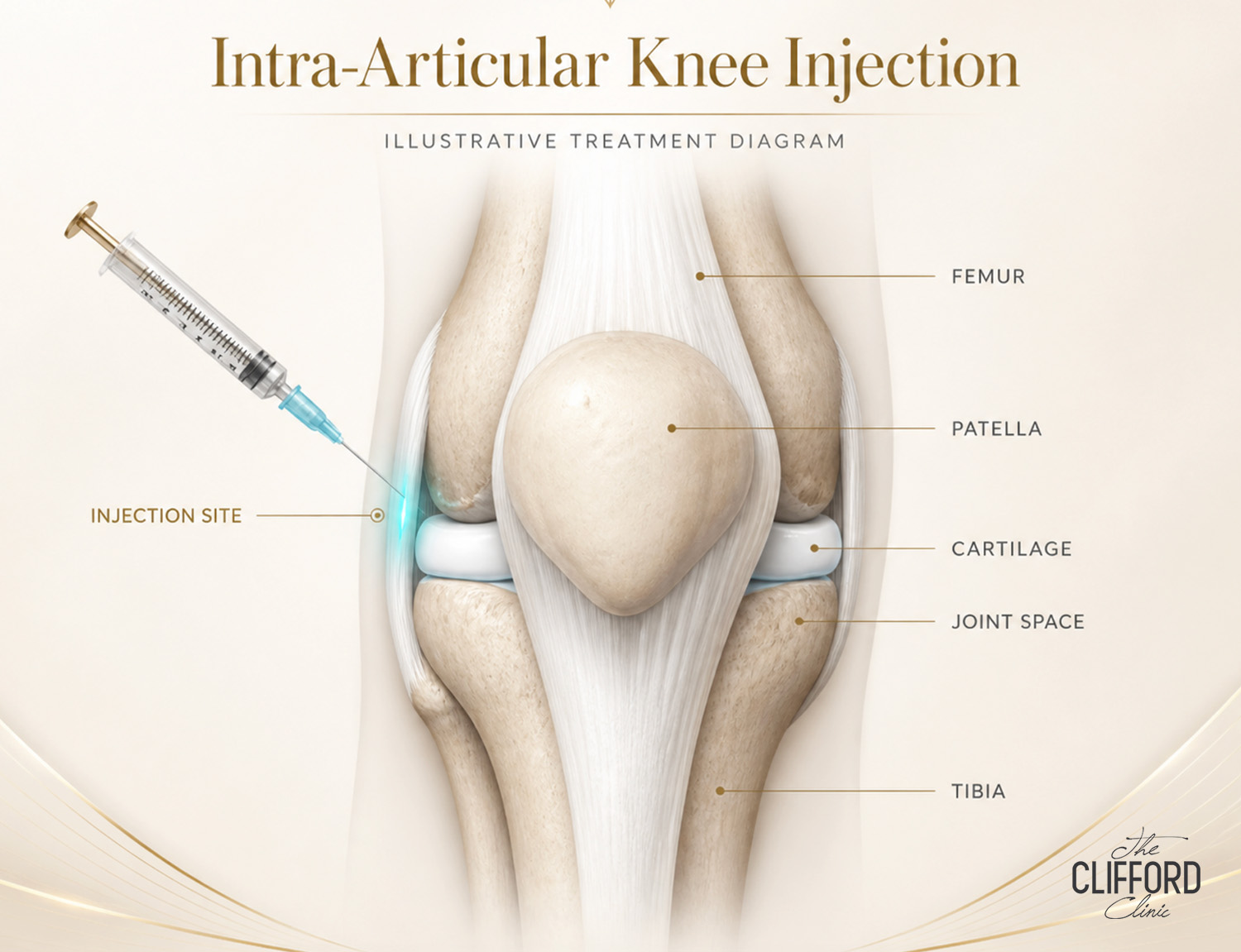
Knee joint injection in a day surgery centre
In Singapore, most knee injections are given in a GP or outpatient clinic consultation room. At The Clifford Clinic, every knee joint injection is done at The Clifford Surgery, an MOH-approved day surgery centre at 50 Raffles Place. For you, that makes three practical differences.
MediSave and hospital insurance claimable. Knee joint injections at The Clifford Surgery are done under day surgery and are MediSave and hospital insurance claimable. At many outpatient clinics, knee gel injections are paid in cash. The clinic can advise on your eligibility at consultation.
A sterile day surgery setting. Your injection is given in a day surgery centre under strict sterile technique, the same standard used for minor surgery. This matters most for biologic injections such as PRP, which are prepared from your own blood on the day of treatment.
Specialist knee doctors. Your knee is assessed by a sports physician, an orthopaedic surgeon and a doctor with published knee research. If an injection is not the right answer for your knee, surgical options can be discussed with the same team.
Knee joint injections are carried out by Dr Dinesh Sirisena (sports and exercise medicine), Dr Edwin Tan (orthopaedic surgeon) and Dr Gerard Ee. Learn more about The Clifford Surgery day surgery centre.
Types of knee injection compared
| Knee injection | Best for | How soon it works | How long relief lasts | How often |
|---|---|---|---|---|
| PRP (RegenPRP) | Mild to moderate knee osteoarthritis, cartilage wear | Builds over a few weeks | 6 to 12 months | One injection, repeated 6 to 12 months later |
| Hyaluronic acid gel | Mild to moderate osteoarthritis, a dry and creaky knee | Builds over several weeks | Several months | Single shot or short course, depending on the brand |
| Conjuran polynucleotide | Osteoarthritis and cartilage wear | Builds over weeks | Months | Short course, then reviewed |
| Steroid (cortisone) | A hot, swollen flare | 1 to 3 days | A few weeks | Sparingly |
| Collagen bio scaffold (GUNA) | Pain from the tissues around the joint | Builds over weeks | Months | Short course |
| PRP with hyaluronic acid | Moderate osteoarthritis | Builds over weeks | Months | Planned at consultation |
PRP knee injection with RegenPRP
Platelet rich plasma is one of the most studied knee injections for osteoarthritis. A small amount of your own blood is drawn and spun in a centrifuge. This separates the platelets, which carry growth factors, from the red blood cells. The concentrated platelets are then injected into the knee.
There is no single PRP. What matters is how many platelets end up in the injection, whether white blood cells are left in or taken out, and how much red blood cell contamination remains. For knee osteoarthritis, many doctors now prefer leukocyte poor PRP, which has most of the white blood cells removed, prepared in a closed sterile system. It carries a high dose of growth factors with less risk of a painful flare after the injection.
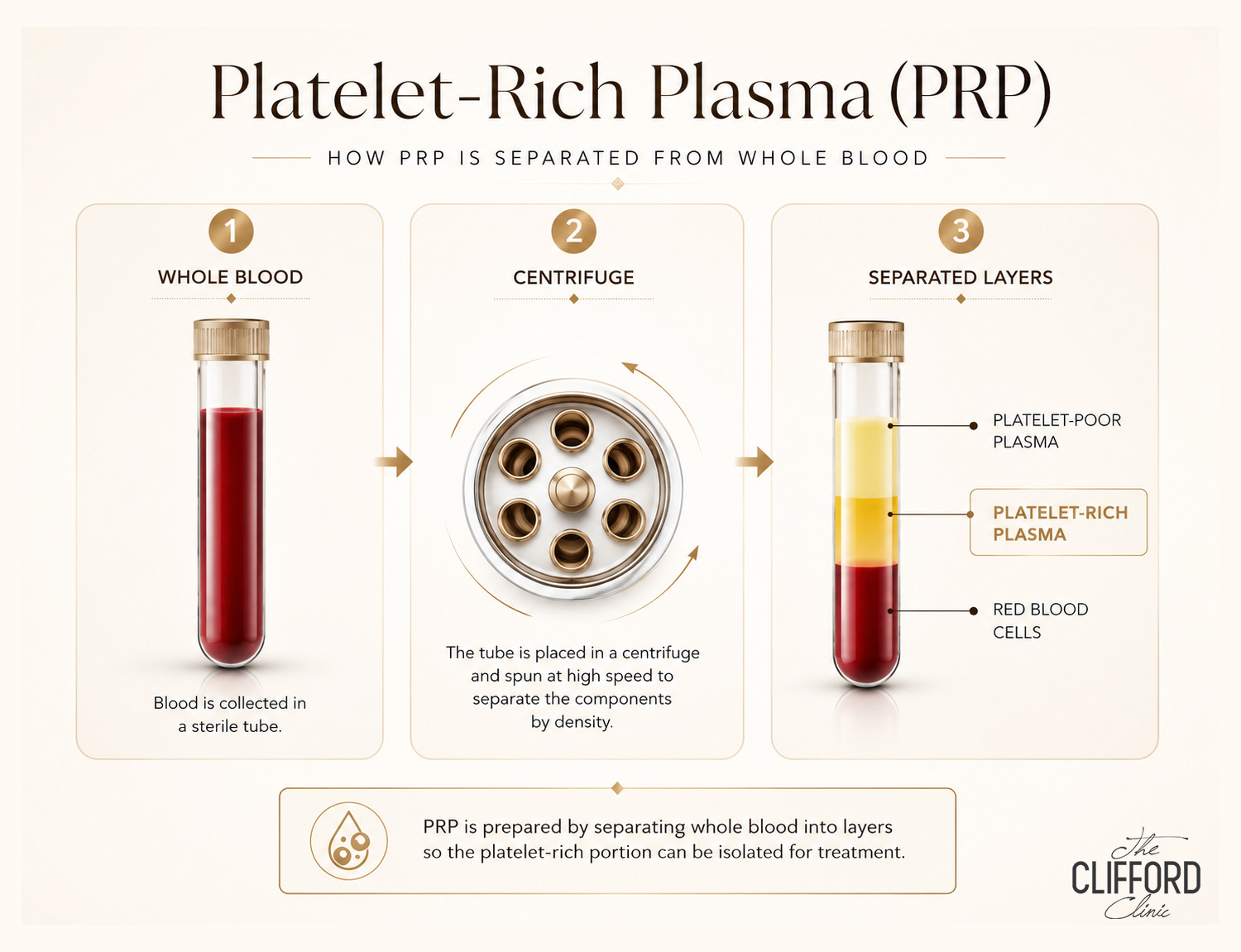
The Clifford Clinic uses RegenPRP. It is a closed, kit based system built to give a consistent, leukocyte poor PRP with very little red cell contamination. The advantages are
- the same platelet concentration every time
- very little variation between operators
- closed processing that lowers the risk of contamination
- a predictable volume and make up in every injection
PRP injected into the knee is believed to calm inflammation in the joint lining, shift cartilage cells towards repair rather than breakdown, and change pain signalling in the joint. Many clinical trials and combined analyses of trials show that in mild to moderate knee osteoarthritis, PRP gives better pain relief and function than hyaluronic acid alone at six to twelve months.
At The Clifford Clinic a PRP knee injection is one injection. It is repeated 6 to 12 months later if the knee needs it, alongside a strengthening and balance programme. RegenPRP suits patients with
- early to moderate knee osteoarthritis
- cartilage damage in one area with the rest of the joint space preserved
- good leg alignment or only a mild bow leg or knock knee
- realistic expectations about pain relief and keeping the joint working
Full details are on the PRP knee injection page. The evidence is explained in PRP injections for knee osteoarthritis.
Hyaluronic acid knee gel injection
Hyaluronic acid is what makes the fluid inside the knee thick and slippery. In osteoarthritis the hyaluronic acid strands become shorter and thinner, so the joint fluid thins and stops cushioning the knee.
A hyaluronic acid knee injection, often called a knee gel injection or viscosupplementation, is designed to
- make the joint fluid thicker and more elastic
- improve lubrication with slow and fast movement
- reduce rubbing on the cartilage that is left
- settle the cells of the joint lining
Some gels are long, linear chains and some are cross linked so they stay in the joint longer. Relief builds over several weeks and can last for months, especially in mild to moderate osteoarthritis with the joint space still preserved. See the hyaluronic acid knee injection page.
Conjuran polynucleotide knee injection
Conjuran is a polynucleotide injection made from purified salmon DNA fragments. It is injected into the knee for osteoarthritis and cartilage wear, to improve comfort and function. It is usually given as a short course and then reviewed on how the knee responds. See the Conjuran knee injection page.
Steroid knee injection
A steroid, or cortisone, injection is a strong anti inflammatory. Inside the knee it switches off the chemical signals that drive swelling and pain and calms the joint lining. It is used when
- the knee is very swollen and warm
- a clear flare of inflammation sits on top of osteoarthritis
- fast relief is needed to travel or to restart physiotherapy
Relief usually starts within one to three days and often lasts a few weeks. Frequent, repeated steroid injections can speed up cartilage loss and weaken the tissues around the knee, so the doctors use them carefully, especially in younger and active patients. Read more in steroid injections for knee pain.
Collagen bio scaffold knee injection
GUNA bio scaffold is an injection based on collagen and other building blocks of the tissue around the joint, rather than platelets or cells. It is designed to support the ligaments, capsule and tendons around the knee. It is often chosen for
- early to moderate osteoarthritis
- patients who want a biologic option without a blood draw
- pain coming from the soft tissues around the knee as well as inside the joint
PRP with hyaluronic acid combination injection
A combination injection pairs the two. Hyaluronic acid improves lubrication and load spread, and PRP brings growth factors that settle the joint. In carefully chosen patients with moderate osteoarthritis, a combination can give stronger or longer relief than either alone, especially with weight management and physiotherapy.
Bone marrow aspirate concentrate
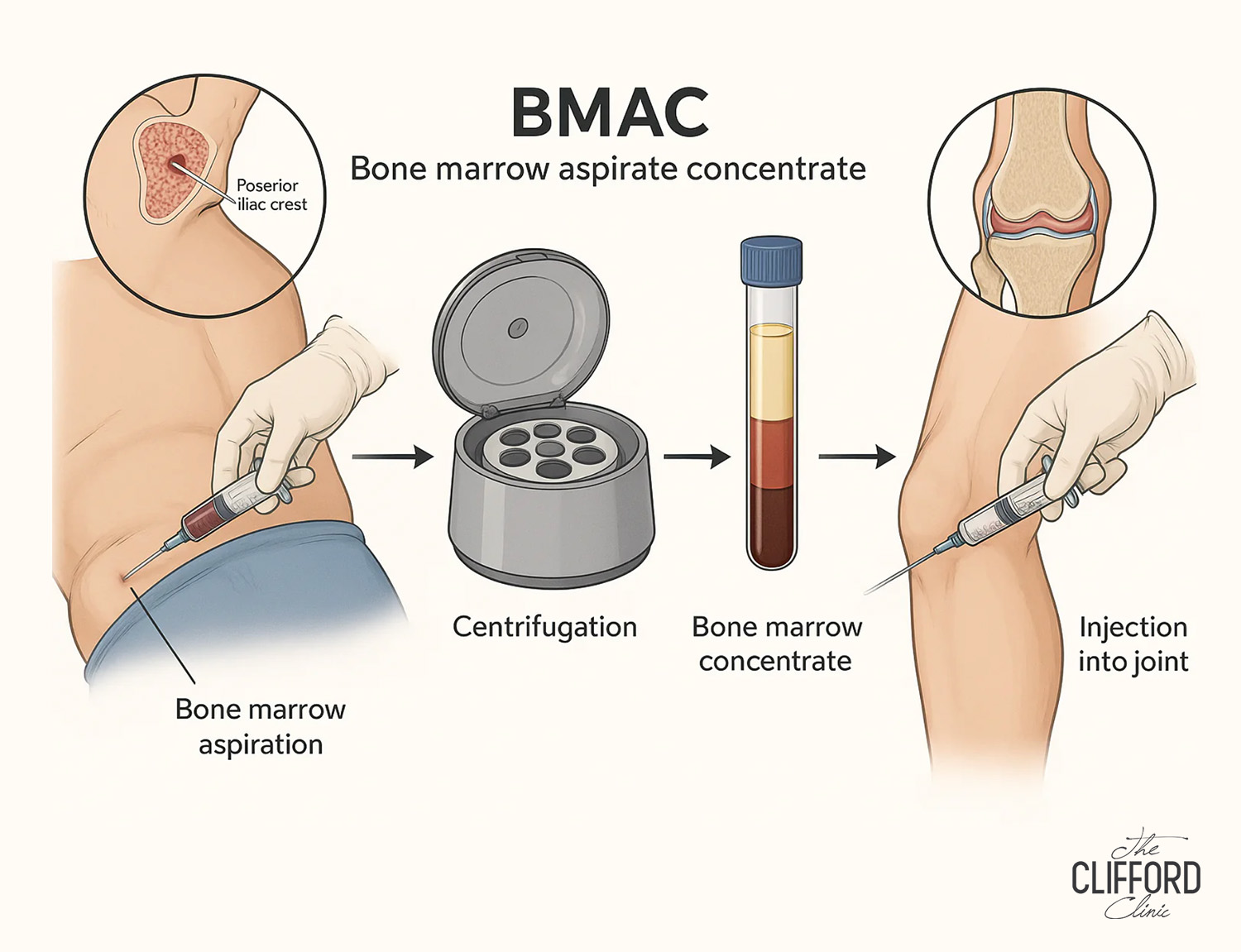
Bone marrow aspirate concentrate is a more advanced biologic option. Bone marrow is drawn from the pelvic bone and concentrated before it is injected into the knee or into damaged bone. Because it needs a minor harvest and stricter sterility, it is done as a day surgery procedure. It is usually kept for patients who have stopped improving with simpler injections but are not ready for knee replacement.
Knee injection cost in Singapore
A realistic private practice range in Singapore is
| Knee injection | Typical cost per knee in Singapore |
|---|---|
| Steroid injection | about $600 |
| Hyaluronic acid gel | about $1,500 to $1,800 |
| PRP and RegenPRP | about $900 to $2,200 |
| PRP with hyaluronic acid | about $1,500 to $2,800 |
| Collagen bio scaffold (GUNA) | about $1,500 to $2,000 |
| Bone marrow aspirate concentrate and similar cell based treatments | about $4,000 to $9,000 |
Fees depend on the product, the number of injections, the level of sterility and what is included. RegenPRP prepared in a closed sterile system sits towards the higher end of the PRP range. At The Clifford Clinic your fee is quoted at your consultation.
Is a knee injection MediSave or insurance claimable
Yes. Knee joint injections at The Clifford Surgery are done under day surgery and are MediSave and hospital insurance claimable. The Clifford Surgery is an MOH-approved day surgery centre, and the injection is done there under sterile day surgery conditions. The team confirms your eligibility and gives you a written estimate before treatment.
Which knee injection is best for knee osteoarthritis
There is no single best knee injection. The right choice depends on how much cartilage is left on your X ray, the alignment of your leg, your age and activity level, and what you want to get back to. As a guide
- for a hot, swollen flare, a steroid injection gives the fastest relief
- for early to moderate osteoarthritis where you want relief that lasts, PRP is usually the first choice
- for a dry, stiff, creaky knee, hyaluronic acid gel is an option
- for pain from the tissues around the knee, a collagen bio scaffold can be added
- for severe bone on bone arthritis with a marked bow leg, a knee replacement may serve you better
The knee injections compared guide goes through each one side by side.
Why knee research and surgical training matter for a knee injection
A knee injection is not a quick jab into a random space. The result depends on how well the doctor understands the three dimensional shape and mechanics of the joint
- the inner, outer and kneecap compartments
- the pouch above the kneecap and the recesses at the front of the joint
- how the joint line moves as the knee bends and straightens
- where cartilage loss is worst on a standing X ray
- the alignment of the whole leg and how bowed or knocked the knee is
A surgeon who has spent years doing knee replacement and keyhole knee surgery, and who has published research on knee alignment and the joint line, carries a much more accurate map of the joint. That map guides the angle and depth of the needle and the decision to drain fluid before injecting. A knee injection does not need ultrasound. The knee is a large joint and the doctors place the needle by its landmarks.
Dr Gerard Ee’s knee research
In the journal The Knee, Dr Gerard Ee co authored “Computer Navigation is a Useful Intra Operative Tool for Joint Line Measurement in Total Knee Arthroplasty”. The study looked at how accurately surgeons can measure and restore the joint line when they use computer navigation in knee replacement surgery. The joint line is where the thigh bone meets the shin bone. If it is moved too far up or down during surgery it changes ligament tension, kneecap tracking and how the knee feels in daily life.
This kind of research makes a surgeon think in millimetres and degrees. When the same doctor later looks at a standing X ray before an injection, he is not just seeing wear. He is looking at joint line height, leg alignment, inner versus outer loading and kneecap position. That shows which part of the knee is causing the pain and whether hyaluronic acid, PRP or a collagen bio scaffold is likely to help.
In Knee Surgery, Sports Traumatology, Arthroscopy, Dr Ee also co authored “Minimally Invasive Unicondylar Knee Arthroplasty in a Patellectomized Patient”. A knee without a kneecap behaves very differently from a normal knee. Managing such cases builds a deep understanding of how bone, cartilage and soft tissue share load. That experience applies directly to everyday problems such as
- early inner knee osteoarthritis in a slightly bow legged patient
- wear related meniscus tears with patchy cartilage softening
- mixed kneecap and main joint wear in a middle aged runner
Knee injection doctors at The Clifford Clinic
Dr Dinesh Sirisena · Consultant in Sports and Exercise Medicine · Bart’s and The London 2004 · Sports medicine doctor at the London 2012 Olympic and Paralympic Games · former consultant in Sports Medicine at Khoo Teck Puat Hospital
Dr Edwin Tan · Consultant Orthopaedic Surgeon · MBBS (NUS) · MRCS (Edin) · MMed (Ortho) · FRCS (Edin) (Ortho) · Sports and reconstructive surgery with a special interest in the knee and upper limb

Dr Gerard Ee · Founder and Managing Director of The Clifford Clinic · MBBS (St George’s) · MRCS (Edin) · Published knee research in The Knee and Knee Surgery, Sports Traumatology, Arthroscopy
Choosing a knee injection clinic in Singapore
Clinics with good reviews for knee injections tend to share the same traits.
They are led by knee focused doctors. Orthopaedic and sports medicine doctors who treat knee problems every day, often with research experience.
They read the X ray with the whole leg in mind. Standing X rays, and MRI when needed, are read together with leg alignment, walking pattern and examination findings.
They keep high sterility standards. Biologic injections such as PRP, collagen bio scaffold and bone marrow concentrate are done in a controlled setting with strict sterile technique.
They give a full plan. Injections are combined with strengthening, balance training, weight advice and activity changes, not used as a stand alone fix.
They are honest about limits. Patients are told clearly what an injection can and cannot do, and when a partial or full knee replacement is the better path.
Why patients choose The Clifford Clinic for knee injections
Patients often want a team that offers both high level non surgical treatment and, if needed, surgery. At The Clifford Clinic a sports physician, an orthopaedic surgeon and a doctor with published knee research work under one roof at The Clifford Surgery. The same understanding of knee mechanics guides when to use a steroid, when to prefer hyaluronic acid, when to give RegenPRP, when to add a collagen bio scaffold and when to move to surgery.
Many patients report that after a tailored programme including PRP, they walk further, manage stairs more confidently and rely less on pain medication. If your knee pain comes from osteoarthritis, see knee osteoarthritis treatment without surgery. To prepare for your visit, read what to expect before, during and after a knee injection.
Knee injection FAQ
Which clinic is best for knee injections in Singapore?
The best clinic is one led by knee focused doctors who understand both surgery and non surgical treatment, and who offer PRP, hyaluronic acid, Conjuran, steroid and collagen bio scaffold injections in a sterile setting. At The Clifford Clinic knee injections are done by sports physician Dr Dinesh Sirisena, orthopaedic surgeon Dr Edwin Tan and Dr Gerard Ee, who has published knee research.
Which orthopaedic surgeon in Singapore offers PRP knee injections?
At The Clifford Clinic, PRP knee injections are done by orthopaedic surgeon Dr Edwin Tan, sports physician Dr Dinesh Sirisena and Dr Gerard Ee, using the RegenPRP system at The Clifford Surgery in Raffles Place.
What is the best PRP knee injection for mild knee osteoarthritis?
For mild knee osteoarthritis the doctors use leukocyte poor RegenPRP. It is one injection, repeated 6 to 12 months later if the knee needs it, combined with a strengthening programme.
How much does a knee injection cost in Singapore?
In Singapore private practice a steroid knee injection costs about $600, hyaluronic acid gel about $1,500 to $1,800 and PRP about $900 to $2,200 per knee. At The Clifford Clinic the fee is quoted at consultation and knee joint injections are MediSave and hospital insurance claimable.
How much do knee gel injections cost in Singapore?
Hyaluronic acid knee gel injections usually cost about $1,500 to $1,800 per knee in Singapore. The fee reflects the brand of gel and the sterile procedure.
How much does PRP cost for the knee?
PRP knee injections usually cost between $900 and $2,200 per knee in Singapore, depending on the system used. RegenPRP sits towards the higher end of that range.
Is a knee injection MediSave or insurance claimable?
Yes. Knee joint injections at The Clifford Surgery are done under day surgery and are MediSave and hospital insurance claimable. The team confirms your eligibility before treatment.
Is it better to have a knee injection at a day surgery centre or a GP clinic?
Both can give a knee injection. A day surgery centre adds a sterile procedure setting, specialist knee doctors and, at The Clifford Surgery, MediSave and hospital insurance claims for knee joint injections. This matters most for biologic injections such as PRP and for knees that may later need a surgical opinion.
How long does a knee injection last?
A steroid injection works fast but usually lasts a few weeks. Hyaluronic acid and PRP start more slowly and can give relief for several months. A RegenPRP knee injection is usually repeated 6 to 12 months apart. Lasting results depend on strengthening, weight management and sensible loading.
Does a knee injection hurt?
Numbing cream is applied to the skin first, and the injection itself takes only a few minutes. Most patients feel pressure in the knee rather than sharp pain, and the knee can feel full or sore for a day or two afterwards.
Is PRP really effective for knee osteoarthritis?
Many good quality trials show that PRP improves pain and function in mild to moderate knee osteoarthritis, and in many comparisons it outperforms hyaluronic acid alone at six to twelve months. Results are best when the knee still has some joint space and the PRP is prepared with a standardised system.
Why do not all clinics offer PRP for the knee?
PRP needs a dedicated centrifuge system, single use kits, trained staff and strict handling. True PRP is more common in knee and sports clinics than in general practice. Some clinics advertise “plasma” injections that are not high concentration, leukocyte controlled PRP, so ask which system is used.
Should I choose a knee injection or surgery?
Early to moderate osteoarthritis with acceptable leg alignment usually does well with injections such as PRP, hyaluronic acid or a collagen bio scaffold. Severe joint space loss, a marked bow leg or knock knee and very limited walking are usually better served by partial or total knee replacement. Dr Edwin Tan can advise on both.
Book a knee injection consultation
The Clifford Surgery, 50 Raffles Place, #01-01 Singapore Land Tower, Singapore 048623
Call (65) 6532 2400 · WhatsApp (65) 8318 6332
Monday to Friday 10am to 8pm · Saturday 10am to 5pm
References
- Belk JW, Kraeutler MJ, Houck DA, et al. Platelet-rich plasma versus hyaluronic acid for knee osteoarthritis. A systematic review and meta-analysis of randomized controlled trials. Am J Sports Med 2021, 49(1), 249-260. doi.org/10.1177/0363546520909397
- Li YF, Xing HH, Wei CK, et al. Platelet-rich plasma is more effective than hyaluronic acid injections for osteoarthritis of the knee. A meta-analysis based on randomized, double-blinded, controlled clinical trials. Arthroscopy 2025, 41(12), 5304-5318. doi.org/10.1016/j.arthro.2025.06.033
- Jüni P, Hari R, Rutjes AW, et al. Intra-articular corticosteroid for knee osteoarthritis. Cochrane Database Syst Rev 2015, issue 10, CD005328. doi.org/10.1002/14651858.CD005328.pub3
- McAlindon TE, LaValley MP, Harvey WF, et al. Effect of intra-articular triamcinolone vs saline on knee cartilage volume and pain in patients with knee osteoarthritis. JAMA 2017, 317(19), 1967-1975. doi.org/10.1001/jama.2017.5283
- Elphingstone J, Bowler M, Conte P, et al. The promising potential of polynucleotide injections for knee osteoarthritis. A systematic review of literature and meta-analysis of randomized control trials. J Exp Orthop 2025, 12(3), e70428. doi.org/10.1002/jeo2.70428
- Riglet L, Delgado T, Lopez RF, et al. Efficacy and safety of a combination of platelet-rich plasma with non-crosslinked hyaluronic acid versus a crosslinked hyaluronic acid, in single-injection for knee osteoarthritis. BMC Musculoskelet Disord 2026, 27(1). doi.org/10.1186/s12891-026-09625-z

Author Bio
Dr Gerard Ee

Dr Gerard Ee is the Founder and Managing Director of The Clifford Clinic in Singapore. He earned his medical degree from St George's University of London and built his surgical experience across the Singapore General Hospital, National University Hospital, and Mount Sinai Hospital in New York. He holds Membership of the Royal College of Surgeons (Edinburgh) and a Postgraduate Diploma in Dermatology (Cardiff), and is fully accredited in aesthetic procedures including botulinum toxin, fillers, lasers, and light therapies. A strong advocate of minimally invasive, natural-looking results, Dr Ee has published in several medical and scientific journals and presented his research in cities including Taipei, Las Vegas, and London.
See all posts by Dr Gerard Ee »