

PRP for Knee Osteoarthritis, Does It Work and How Long Does It Last
Written by Dr Gerard Ee. Last medically reviewed 12 November 2026
Key points
- PRP (platelet-rich plasma) is made from your own blood and injected into the knee joint.
- Research reviews find PRP eases pain and stiffness from mild to moderate knee osteoarthritis, and gives more relief at 12 months than a knee gel injection.
- Results vary from person to person.
- Benefits build over several weeks and are usually measured up to about a year.
- At The Clifford Surgery, PRP is prepared with RegenPRP and given as one injection, repeated 6 to 12 months later if the knee needs it.
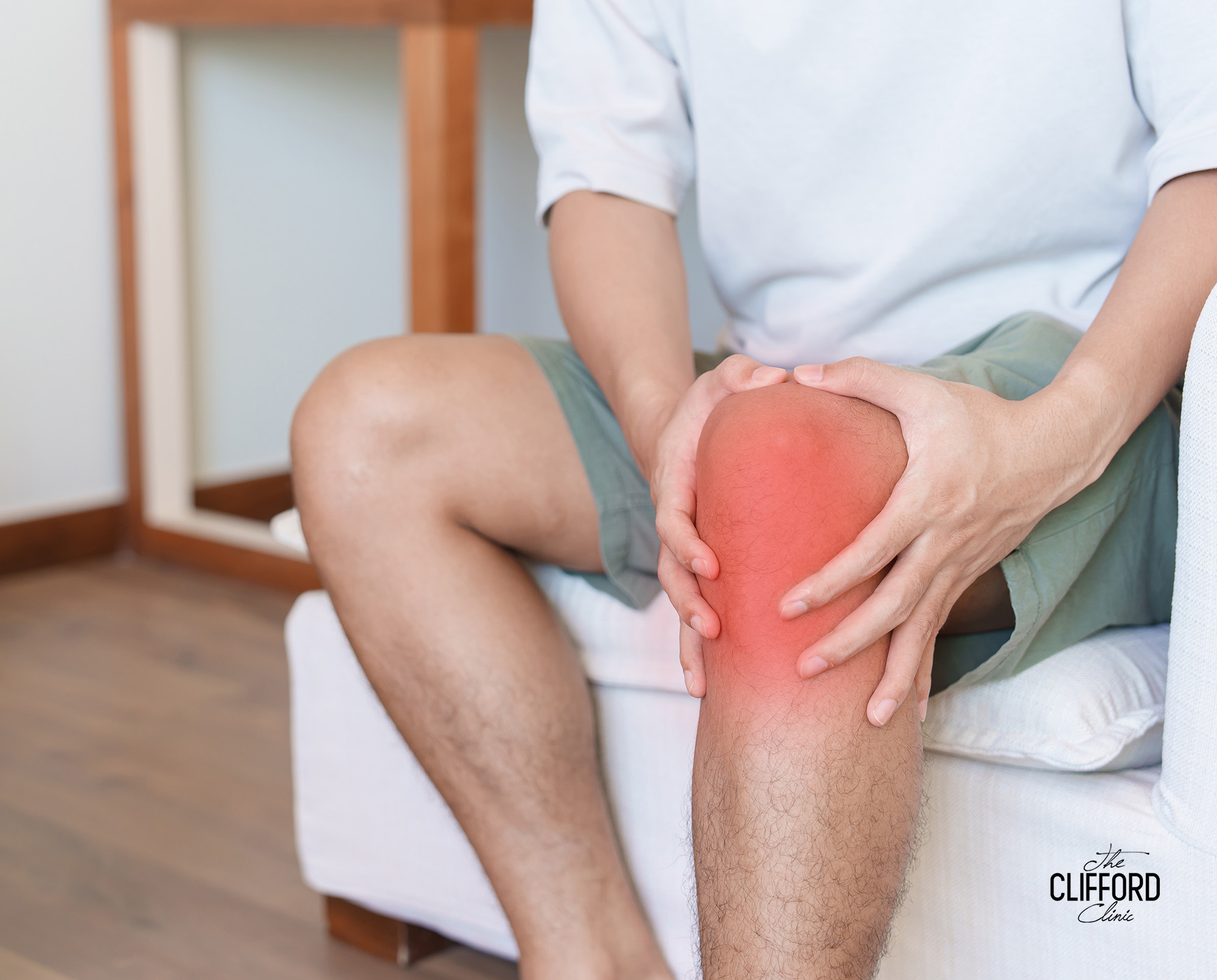
Sharp pain on the stairs, an ache after a long walk, stiffness when you stand up after sitting. For many adults in Singapore these are the first signs of knee osteoarthritis, the slow wearing of the smooth cartilage that cushions the knee. Most people with mild to moderate knee osteoarthritis do not need surgery. PRP is one of the injections used to ease the pain while you keep the knee strong and moving.
This article explains what PRP does in an arthritic knee, what the research really shows, how long it lasts, and who tends to benefit, with clinical perspective from Dr Gerard Ee, founder of The Clifford Clinic and Surgery.
The clinic’s RegenPRP protocol is set out on PRP knee injection in Singapore, and every other option in the knee injection Singapore guide.
What is PRP for knee osteoarthritis?
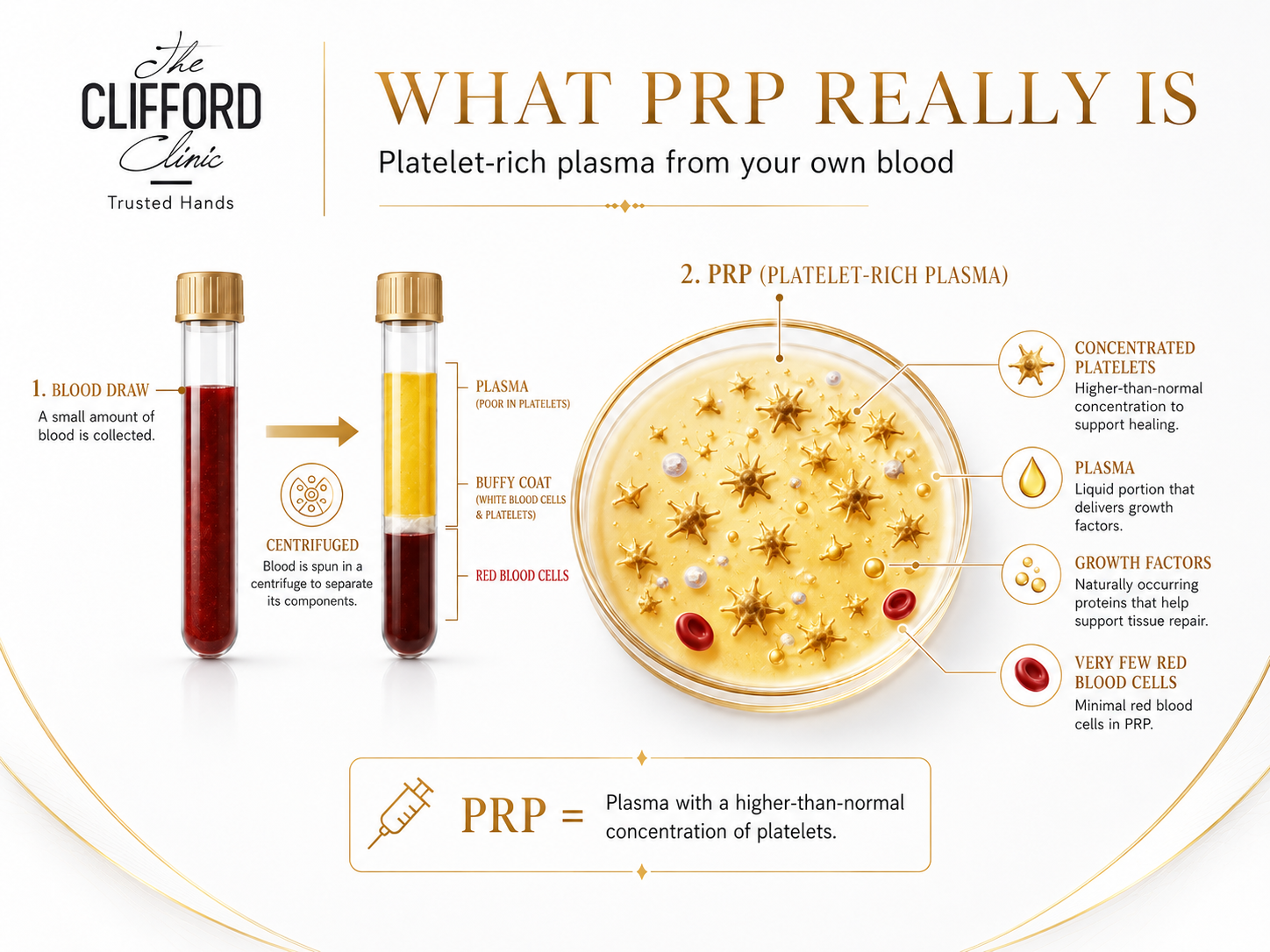
PRP stands for platelet-rich plasma. A small amount of your blood is drawn, just like a routine blood test, and spun in a machine called a centrifuge. This separates the platelets, the tiny blood cells that help wounds heal, into a small volume of plasma. That platelet-rich plasma is then injected into the knee joint.
Because PRP comes from your own blood, the risk of allergy or rejection is very low. Platelets carry growth factors, natural signalling proteins that help calm inflammation and support repair.
How does PRP work in an arthritic knee?
PRP does not grow a new knee and it cannot reverse arthritis. Its aim is to make the inside of the joint a calmer, healthier place.
Osteoarthritis is more than wear and tear. The lining of the joint is often mildly inflamed, and that inflammation adds to the pain and to the stress on the remaining cartilage. The growth factors in PRP are thought to
- settle that low-grade inflammation
- make the joint fluid and lining less hostile to the cartilage that is left
- reduce pain enough for you to move and strengthen the knee
Scientists are still working out exactly how PRP does this. What matters most to patients is the result, and that is what the research below looks at.
Does PRP work for knee osteoarthritis? What the research shows
The honest answer is that PRP helps many people with mild to moderate knee osteoarthritis, but not everyone.
The evidence for PRP
- The largest reviews pool dozens of randomised trials. They find PRP improves pain and knee function more than a hyaluronic acid knee gel injection.
- A recent review included only double-blind trials, where neither patient nor doctor knew which injection was given. PRP still came out ahead of knee gel at 12 months, by a margin patients can feel.
Why results vary
- PRP is not one product. Kits differ in how many platelets they collect and whether white blood cells are left in.
- Patients differ too. People with earlier arthritis and good muscle strength tend to respond best. “Bone-on-bone” arthritis responds much less.
In short, PRP is a reasonable option to try for a suitable knee, not a guaranteed cure.
PRP vs hyaluronic acid knee gel injection
Both are injected into the knee joint, but they work in different ways.
- Hyaluronic acid knee gel adds lubrication and cushioning to the joint fluid. Recent large reviews find its benefit over a dummy injection is small.
- PRP works on the biology of the joint, calming inflammation rather than adding cushion. Relief comes on more slowly but tends to last longer.
In head-to-head trials, PRP usually gives more relief than knee gel by 6 to 12 months. A few trials found the two about equal. Some patients have both together.
To compare all the options, including steroid and Conjuran, see types of knee injections compared. For knee gel itself, see hyaluronic acid knee injection.
How long does PRP last in the knee?
Relief from PRP builds gradually over 4 to 6 weeks, then usually lasts for several months. Most trials measure results up to 12 months, and the benefit over knee gel is clearest at 6 to 12 months. That is why a repeat injection is considered after 6 to 12 months if the knee starts to ache again.
How long it lasts depends on the stage of your arthritis, your weight, how active you are and how well you keep up with strengthening exercises.
How many PRP injections does the knee need?
Research studies have used anywhere from one to five injections. Some trials found that two or three injections gave more relief than one.
At The Clifford Surgery, PRP is given as one injection, repeated 6 to 12 months later if the knee needs it. Your doctor reviews how the knee is doing at follow-up and adjusts the plan to suit you.
PRP knee injection success rate, who is a good candidate?
There is no single success rate for PRP, because results depend so much on who is treated. People who tend to do best
- have mild to moderate knee osteoarthritis, confirmed by examination and X-ray
- have pain with stairs, walking, squatting or sport
- want to avoid or delay knee replacement surgery
- have tried physiotherapy, strengthening or weight loss with only partial relief
PRP is less suitable for
- end-stage “bone-on-bone” arthritis
- an active joint infection or certain blood disorders
- knee pain from another cause, such as a mechanical meniscus tear or pain referred from the hip or back
An accurate diagnosis always comes first. A steroid injection may suit a sudden flare better, see cortisone injection for knee pain. A polynucleotide injection is another option, see Conjuran knee injection.
What happens during a PRP knee injection?
- Consultation. A knee examination and review of your X-ray or scan to confirm osteoarthritis is the cause of your pain, and how advanced it is.
- Blood draw. A small sample of blood is taken from your arm.
- RegenPRP preparation. The blood is spun in the RegenPRP kit, which collects the platelets and leaves most white blood cells behind (leukocyte-poor PRP).
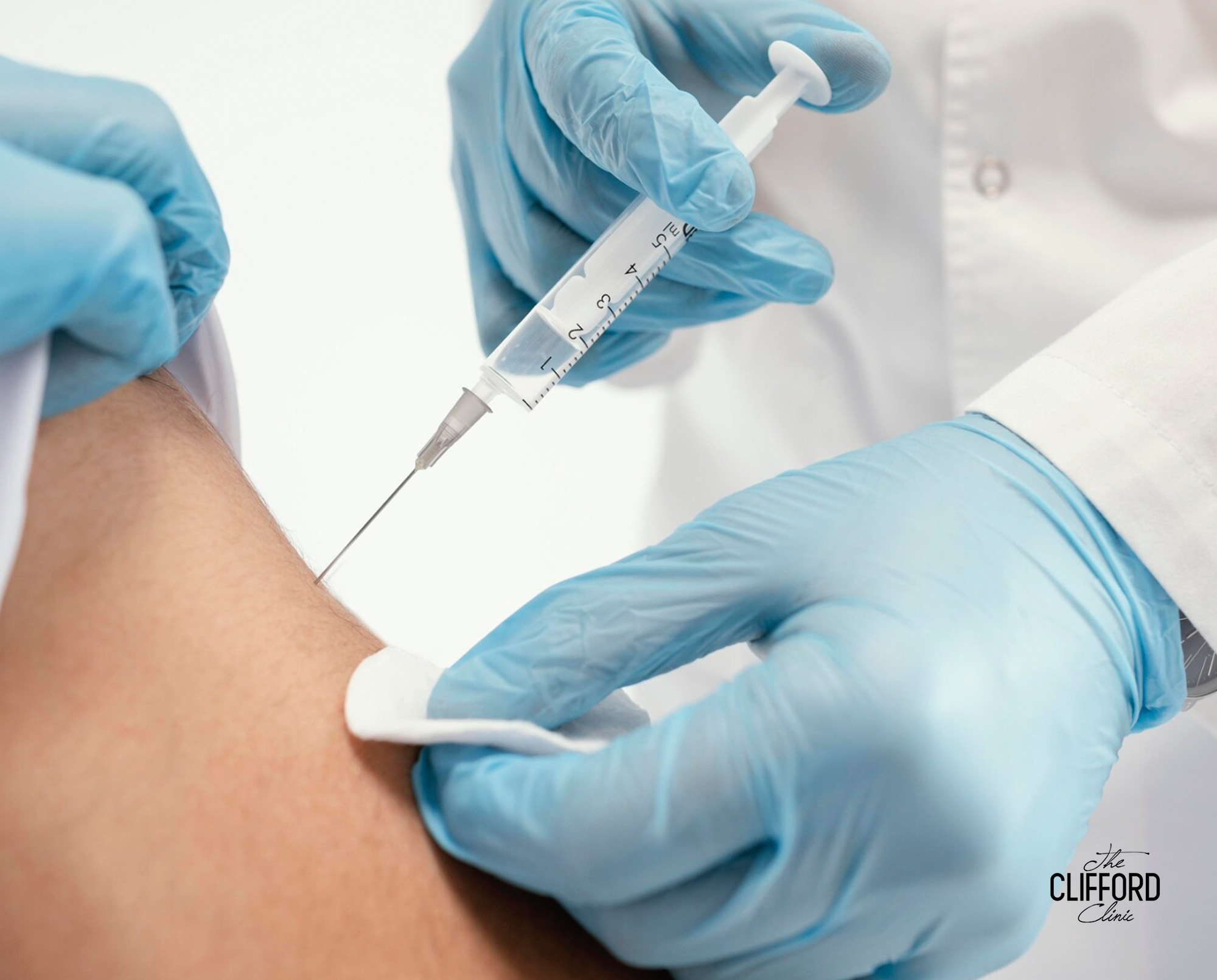
- Numbing and injection. Numbing cream is applied, the skin is cleaned and the PRP is injected into the knee joint.
- Review. A follow-up visit checks how the knee is responding, using everyday goals such as walking distance and stairs.
The procedure is done under day surgery at The Clifford Surgery, an MOH-approved day surgery centre at Raffles Place.
What to expect after a PRP knee injection
Mild soreness, stiffness or a full feeling in the knee for one to three days is normal. Most people return to light daily activities straight away. Avoid running, jumping and heavy leg exercise for the first week or two.
Improvement is gradual, not instant. PRP is not a switch that turns pain off overnight. Pair it with a structured strengthening programme, because long-term comfort depends on the muscles that support the knee.
PRP as part of the bigger picture
PRP works best as one part of a full plan. That plan usually includes
- managing weight to reduce the load through the knee
- strengthening the thigh and hip muscles
- adjusting activity so you stay active without repeatedly aggravating the joint
For many people with mild to moderate knee osteoarthritis, this combination keeps the knee comfortable and active for years and can delay the need for a knee replacement.
Frequently asked questions about PRP for knee osteoarthritis
Does PRP really work for knee arthritis?
For many people with mild to moderate knee osteoarthritis, yes. Large research reviews find PRP eases pain and improves function more than a knee gel injection at 12 months. Results vary from person to person.
How long does a PRP knee injection last?
Relief builds over 4 to 6 weeks and usually lasts several months. Most studies follow patients for up to a year, and a repeat injection is considered after 6 to 12 months if the knee needs it.
How many PRP injections will I need for my knee?
At The Clifford Surgery, PRP is given as one injection, repeated 6 to 12 months later if the knee needs it. Your doctor confirms the plan at consultation.
Is PRP better than a hyaluronic acid injection for the knee?
In most head-to-head trials PRP gives more relief than hyaluronic acid knee gel by 6 to 12 months, though a few found them about equal.
Is a PRP knee injection painful?
Numbing cream is used. Most people feel a brief pressure or sting during the injection and some soreness for a day or two afterwards.
Can PRP help me avoid knee replacement surgery?
For some people with mild to moderate osteoarthritis, PRP eases pain enough to delay surgery. It cannot reverse advanced arthritis, and results vary.
PRP knee injection at The Clifford Surgery
Knee joint injections at The Clifford Surgery are done under day surgery and are MediSave and hospital insurance claimable. The clinic can advise on your eligibility at consultation.
Knee injections are carried out by Dr Dinesh Sirisena (sports and exercise medicine), Dr Edwin Tan (orthopaedic surgeon) and Dr Gerard Ee. Read more about the treatment on PRP knee injection in Singapore.
The Clifford Clinic, 50 Raffles Place, #01-01 Singapore Land Tower, Singapore 048623 (Exit B, Raffles Place MRT). Phone (65) 6532 2400, WhatsApp (65) 8318 6332.
Related reading
- Knee injection Singapore guide
- PRP with hyaluronic acid knee injection
- Will a knee injection help my knee pain? (Dr Gerard Ee)
About Dr Gerard Ee

Dr Gerard Ee is a physician at The Clifford Clinic whose main specialty is dermatology and aesthetic medicine, and who is also trained in orthopaedic surgery, with a substantial peer-reviewed research record in orthopaedics. His published work spans knee surgery — including studies on total knee arthroplasty and joint line restoration in journals such as The Knee and the Journal of Bone and Joint Surgery (British) — as well as shoulder, spine and bone-healing research in titles including Knee Surgery, Sports Traumatology, Arthroscopy, Clinical Orthopaedics and Related Research and the Journal of Orthopaedic Surgery and Research. This research-informed background underpins the evidence-based, individualised approach to knee care at The Clifford Clinic.
Medical Disclaimer
This article is for general education only and is not a substitute for personalised medical advice. Suitability for PRP or any knee injection can only be determined after an in-person assessment by a qualified doctor. Outcomes vary between individuals.
References
- Belk JW, Kraeutler MJ, Houck DA, et al. Platelet-rich plasma versus hyaluronic acid for knee osteoarthritis, a systematic review and meta-analysis of randomized controlled trials. Am J Sports Med. 2021;49(1):249-260. PMID 32302218
- Li YF, Xing HH, Wei CK, et al. Platelet-rich plasma is more effective than hyaluronic acid injections for osteoarthritis of the knee, a meta-analysis based on randomized, double-blinded trials. Arthroscopy. 2025;41(12):5304-5318. PMID 40681006
- Filardo G, Di Matteo B, Di Martino A, et al. Platelet-rich plasma intra-articular knee injections show no superiority versus viscosupplementation, a randomized controlled trial. Am J Sports Med. 2015;43(7):1575-1582. PMID 25952818
- Di Martino A, Boffa A, Andriolo L, et al. Leukocyte-rich versus leukocyte-poor platelet-rich plasma for the treatment of knee osteoarthritis, a double-blind randomized trial. Am J Sports Med. 2022;50(3):609-617. PMID 35103547
- Zhuang W, Li T, Li Y, et al. The varying clinical effectiveness of single, three and five intraarticular injections of platelet-rich plasma in knee osteoarthritis. J Orthop Surg Res. 2024;19(1):284. PMID 38720362
- Pereira TV, Jüni P, Saadat P, et al. Viscosupplementation for knee osteoarthritis, systematic review and meta-analysis. BMJ. 2022;378:e069722. PMID 36333100

Author Bio
Dr Gerard Ee

Dr Gerard Ee is the Founder and Managing Director of The Clifford Clinic in Singapore. He earned his medical degree from St George's University of London and built his surgical experience across the Singapore General Hospital, National University Hospital, and Mount Sinai Hospital in New York. He holds Membership of the Royal College of Surgeons (Edinburgh) and a Postgraduate Diploma in Dermatology (Cardiff), and is fully accredited in aesthetic procedures including botulinum toxin, fillers, lasers, and light therapies. A strong advocate of minimally invasive, natural-looking results, Dr Ee has published in several medical and scientific journals and presented his research in cities including Taipei, Las Vegas, and London.
See all posts by Dr Gerard Ee »