

Using CDA and Baby Bonus for Teenage Acne and Children Acne Treatment in Singapore
Written by The Clifford Surgery medical team. Last medically reviewed and updated: [15th October 2026]
If your child has acne, the Child Development Account (CDA), the savings account under the Baby Bonus scheme, can pay for the acne consultation and prescribed acne medication at The Clifford Surgery. The Clifford Surgery at 50 Raffles Place is a Baby Bonus Approved Institution. A brother’s or sister’s CDA can also be used, so a teenager whose own CDA has closed can still be treated through a younger sibling’s account.
This guide covers CDA coverage, age limits, sibling use and payment, and how teenage acne and children’s acne are treated.
On this page
- Can I use CDA or Baby Bonus to pay for my child’s acne treatment?
- Is The Clifford Surgery a CDA-approved clinic?
- What does CDA cover for teenage acne and children acne?
- Until what age can CDA be used for acne treatment?
- Can I use a younger sibling’s CDA for my teenager’s acne?
- How do I pay for acne treatment with the Baby Bonus (CDA) card?
- What is the difference between the CDA and the Baby Bonus Cash Gift?
- Children acne by age, from neonatal acne to preadolescent acne
- Teenage acne types, causes and when to see a doctor
- How teenage acne is assessed and treated at The Clifford Surgery
- Teenage acne treatment cost in Singapore
- Worked examples of CDA payment for children acne and teenage acne
- Common reasons a CDA card payment is declined
- CDA and Baby Bonus acne treatment FAQs
- Summary of CDA acne treatment at The Clifford Surgery
- Related reading at The Clifford Clinic
- About The Clifford Surgery
- Selected references
Can I use CDA or Baby Bonus to pay for my child’s acne treatment?
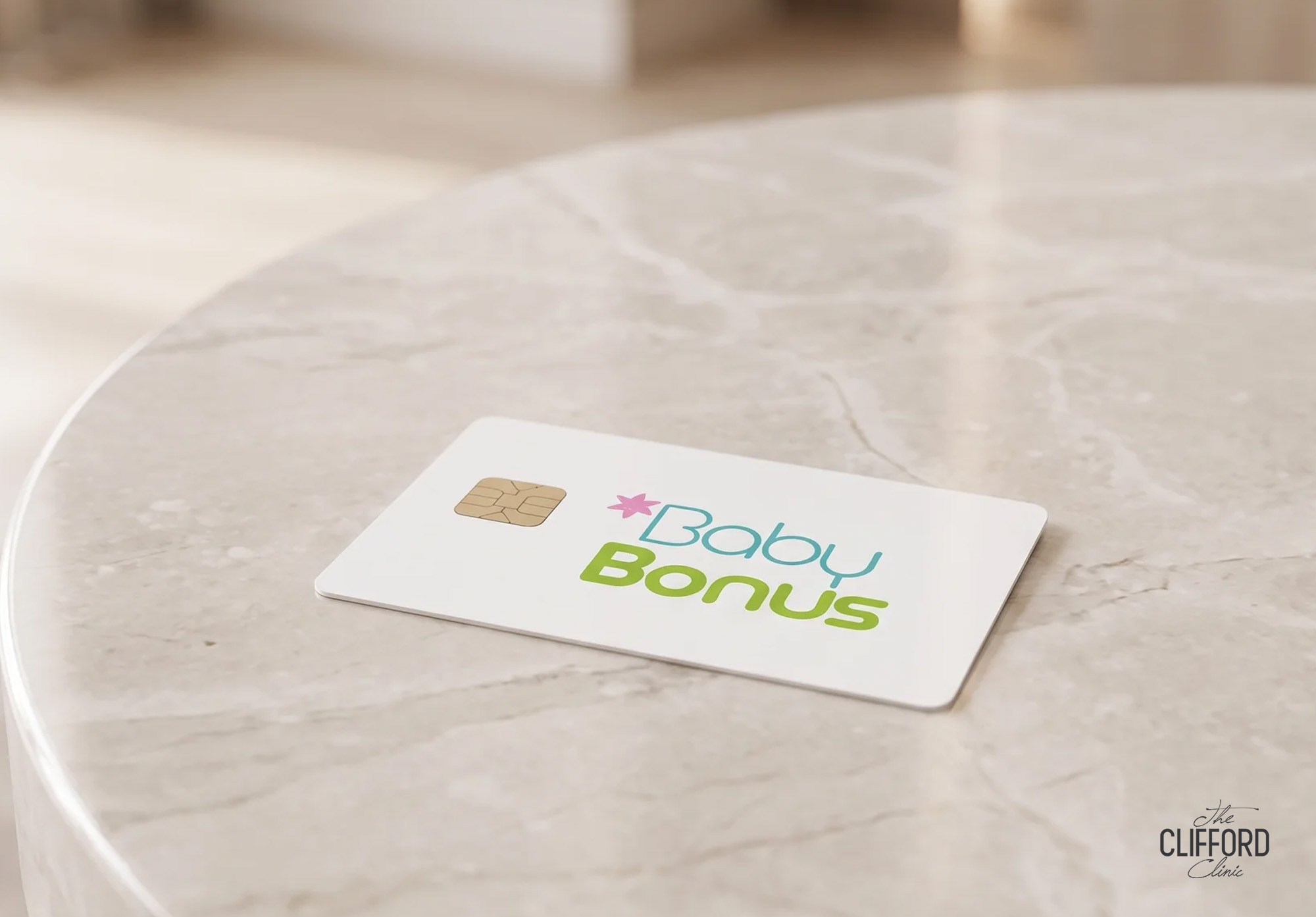
CDA funds can pay for medical services and prescribed medication at any Baby Bonus Approved Institution. At The Clifford Surgery, this covers the acne consultation with any doctor at the clinic and the acne medication the doctor prescribes. The CDA trustee, the parent who registered the child’s birth or applied for Baby Bonus, must be present to authorise the CDA payment. Skincare and beauty products bought without a prescription are not approved CDA expenses.
Key facts on CDA acne treatment
- The Clifford Surgery, 50 Raffles Place, Singapore Land Tower #01-01, is a Baby Bonus Approved Institution.
- CDA funds pay for the acne consultation and prescribed acne medication.
- CDA funds can pay for the CDA holder and for the holder’s siblings, including step-siblings and adopted siblings.
- The CDA trustee must be present to authorise a CDA payment.
- Under the current rules, the CDA stays open until 31 December of the year the child turns 12.
- Under the SG Child Support Package, the CDA of a child born on or after 1 January 2015 stays open until the end of the year the child turns 16.
- Unused CDA funds transfer automatically to the child’s Post-Secondary Education Account (PSEA), up to the PSEA cap, when the CDA closes. Any excess above the cap is refunded to the child’s PayNow-linked bank account.
- CDA funds cannot be withdrawn as cash.
Is The Clifford Surgery a CDA-approved clinic?
The Clifford Surgery is a CDA-approved clinic, registered with the Ministry of Social and Family Development (MSF) as an Approved Institution under the Baby Bonus scheme. Only Approved Institutions can accept CDA payment, and only for the uses MSF approves. The Clifford Surgery is listed in the Healthcare Institution category, which allows the Baby Bonus (CDA) card to be used for acne consultations and prescribed medication.
The listing can be confirmed on the official MSF list at go.gov.sg/listofais in three steps.
- Under Step 1, select Search by institution.
- Under Step 2, enter The Clifford Surgery, then click Search.
- The result reads THE CLIFFORD SURGERY, Healthcare Institution, 50 Raffles Place, Singapore Land Tower #01-01, Singapore 048623.
Approved Institution status permits a clinic to accept CDA payment and does not constitute a government endorsement of any treatment.
What does CDA cover for teenage acne and children acne?
Child Development Account (CDA): Eligible Acne Treatments at The Clifford Surgery
| Item at The Clifford Surgery | Paid by CDA |
|---|---|
| Acne consultation with any doctor at The Clifford Surgery | Yes |
| Acne review consultations | Yes |
| Prescribed acne medication, including topical creams and gels, oral antibiotics and isotretinoin | Yes |
| Skincare and beauty products without a prescription | No |
| Cash withdrawal | No |
What CDA can be used for at a clinic is set by the MSF List of Approved CDA Uses. It covers “fees for medical services and treatment endorsed by a medical practitioner employed by the AI”, where AI stands for Approved Institution. At pharmacies, the list excludes beauty products, toiletries and health tonics.
Until what age can CDA be used for acne treatment?
Under the Baby Bonus rules, the CDA closes on 31 December of the year the child turns 12. The SG Child Support Package, announced at the 2026 National Day Rally, extends this to the end of the year the child turns 16 for children born on or after 1 January 2015, adding four years of CDA use across the early teenage years.
Child Development Account (CDA): Closing Date by Birth Year
| Child Born In | CDA Open Until |
|---|---|
| 2013 or Earlier | Closed under the age 12 rule |
| 2014 | 31 December 2026 |
| 2015 | 31 December 2031 (age 16) |
| 2016 | 31 December 2032 (age 16) |
| 2017 and Later | 31 December of the year the child turns 16 |
A teenager turning 13 to 16 in 2026 was born between 2010 and 2013, so that teenager’s own CDA has already closed. A younger sibling’s open CDA can still pay for the teenager’s acne consultation and prescribed medication.
When the CDA closes, unused funds transfer automatically to the child’s PSEA, up to the PSEA cap, and any excess above the cap is refunded to the child’s PayNow-linked bank account. Children turning 17 from 2026 onwards also receive a one-off $10,000 PSEA top-up under the SG Child Support Package, paid in June 2027 for those turning 17 in 2026.
Can I use a younger sibling’s CDA for my teenager’s acne?
CDA funds can pay for approved expenses of the CDA holder and of the holder’s siblings, and The Clifford Surgery accepts sibling CDA payment. A sibling is a natural, step- or adopted brother or sister. For example, in a family with a 15-year-old who has teenage acne and a younger child whose CDA is still open, the teenager’s acne consultation and prescribed medication can be paid from the younger child’s CDA.
The child whose CDA will be used is named at booking. For a sibling’s CDA NETS payment above $500, the clinic must verify and record the sibling relationship, for example through a written declaration by the CDA trustee.
How do I pay for acne treatment with the Baby Bonus (CDA) card?
- State at booking that payment will be by CDA, and which child’s CDA will be used.
- Bring the Baby Bonus card (CDA card) linked to that CDA, and confirm the card PIN beforehand. The card is issued to the CDA trustee.
- Bring the child’s birth certificate and the CDA trustee’s identification.
- The CDA trustee must be present, and payment is made by CDA NETS.
- For a sibling’s CDA payment above $500, the CDA trustee declares the sibling relationship in writing at the clinic.
- The consultation and prescribed medication are charged to the CDA, and any other item is paid separately.
The CDA balance can be checked before the visit on Family View in the Baby Bonus Parent Portal Services (Singpass login), under View Statement > CDA Details.
What is the difference between the CDA and the Baby Bonus Cash Gift?
The Baby Bonus scheme has two parts. The Baby Bonus Cash Gift is paid into the parent’s bank account in instalments until the child is six and a half years old, and it can be spent on anything, including acne treatment. The CDA is a co-savings account in which the Government matches each dollar the parents save, up to a cap. CDA funds can be spent only at Approved Institutions such as The Clifford Surgery and cannot be withdrawn as cash. A “Baby Bonus claim” at a clinic therefore refers to a CDA payment.
Baby Bonus Cash Gift vs Child Development Account (CDA)
| Feature | Baby Bonus Cash Gift | CDA |
|---|---|---|
| Paid To | Parent’s bank account | The child’s CDA |
| Where It Can Be Spent | Anywhere | Baby Bonus Approved Institutions only |
| Acne Consultation and Prescribed Medication | Yes | Yes, at The Clifford Surgery |
| Cash Withdrawal | Yes | No |
| Use for a Sibling | Parent’s choice | Yes, for approved expenses |
From April 2027, the SG Child Support Package replaces the Baby Bonus Scheme. Children enrolled in the Baby Bonus Scheme move to the Package automatically, Baby Bonus Cash Gift payouts continue until 31 March 2027, and the CDA remains in use.
Children acne by age, from neonatal acne to preadolescent acne
Acne in children is classified by the age at which it first appears.
Types of Acne in Children by Age of Onset
| Type of Children’s Acne | Age at Onset |
|---|---|
| Neonatal Acne | Birth to 6 weeks |
| Infantile Acne | 6 weeks to 1 year |
| Mid-Childhood Acne | 1 year to under 7 years |
| Preadolescent Acne | 7 to 12 years, or until a girl’s first period |
| Adolescent (Teenage) Acne | 12 to 19 years, or after a girl’s first period |
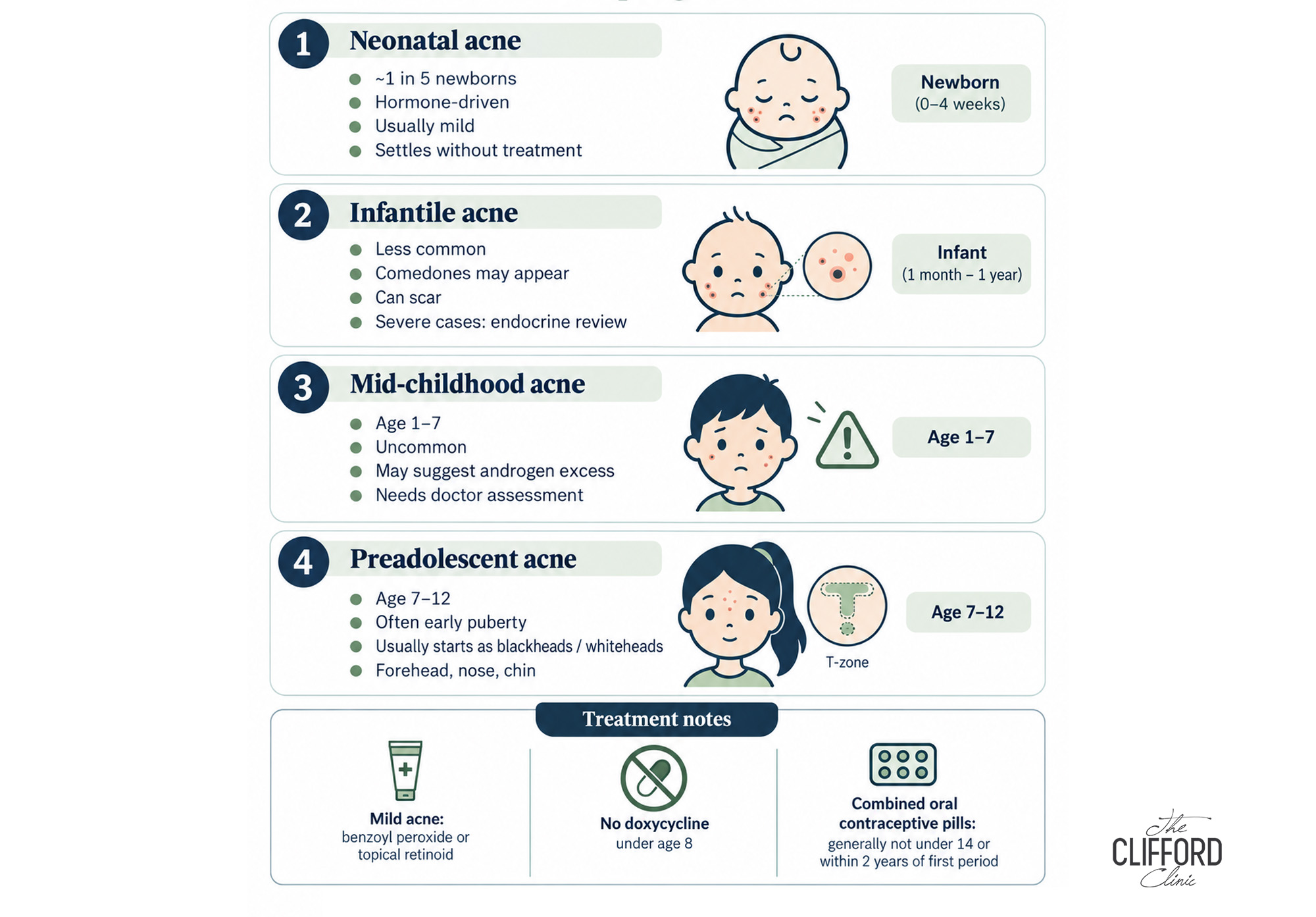
Neonatal acne affects about 1 in 5 newborns. Hormones passed from the mother stimulate the newborn’s oil glands, and the small red bumps on the cheeks and nose that result are usually mild and settle without treatment.
Infantile acne is less common, includes blackheads and whiteheads, and can leave scars. Severe infantile acne, or acne with other signs of a hormone problem such as accelerated growth, is referred to a paediatric endocrinologist.
Mid-childhood acne, between 1 and 7 years of age, is uncommon because the body produces very little androgen, the hormone group that drives oil production, at this age. Acne in this age group is therefore a recognised sign of possible androgen excess, and a child with acne at this age should be assessed by a doctor.
Preadolescent acne, from 7 to 12 years, is often the first sign of puberty, as androgens from the adrenal glands rise and increase oil production before other pubertal changes appear. It usually starts as blackheads and whiteheads on the forehead, nose and chin.
The choice of medicine for children’s acne depends on the child’s age.
- Benzoyl peroxide or a topical retinoid is the first-line treatment for mild acne.
- Tetracycline antibiotics such as doxycycline are not used under 8 years of age, because they bind to calcium in developing teeth and can stain them permanently.
- Combined oral contraceptive pills are generally not used under 14 years of age or within two years of a girl’s first period.
Acne affects up to 87% of teenagers. At puberty, rising androgen levels enlarge the oil glands and increase oil (sebum) production. Dead skin cells and sebum then block the pores, and the acne bacterium Cutibacterium acnes (C. acnes) multiplies inside the blocked pore and triggers inflammation. Teenage pimples usually start on the forehead, nose and chin, where oil glands are densest, and can spread to the cheeks, jawline, chest and back.
Types of Teenage Acne and Their Appearance
| Type of Teenage Acne | Appearance |
|---|---|
| Comedonal Acne | Blackheads (open comedones) and whiteheads (closed comedones) |
| Papular and Pustular Acne | Red, tender bumps (papules) and pus-filled pimples (pustules) |
| Nodular and Cystic Acne | Deep, painful lumps under the skin, with the highest risk of scarring |
A doctor’s assessment is advised in five situations.
- Acne starts between 1 and 7 years of age.
- Acne leaves dark marks, red marks or scars.
- Deep, painful nodules or cysts develop.
- Acne has not improved after two to three months of over-the-counter products.
- Acne is affecting the child’s confidence, sleep or schoolwork.
Treating inflammatory acne early can lower the risk of permanent acne scars.
How teenage acne is assessed and treated at The Clifford Surgery
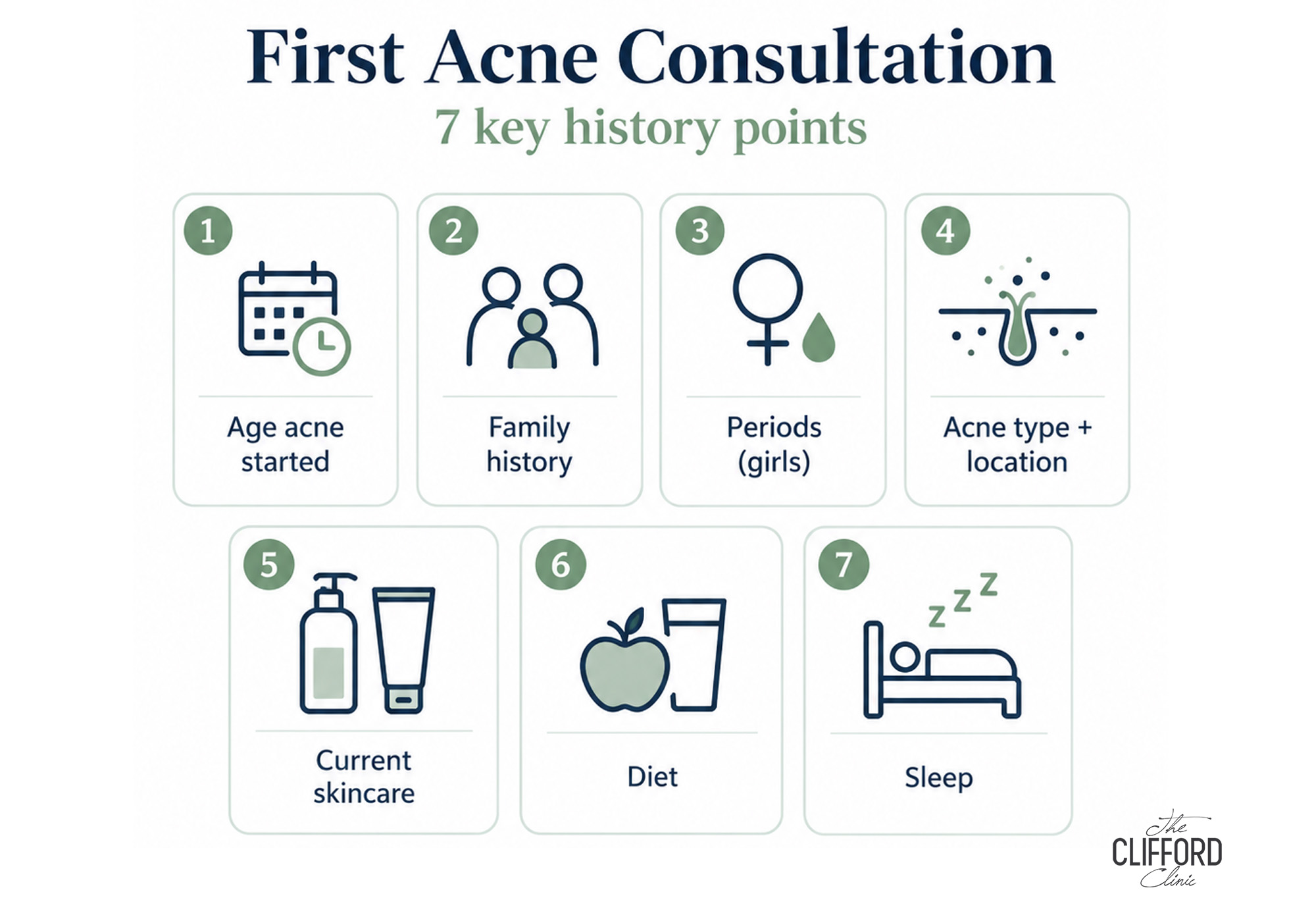
At the first consultation, the doctor takes a history covering seven points.
- Age at which the acne first started
- Family history of acne
- Regularity of periods, in girls
- Type and location of the acne
- Skincare and acne products in current use
- Diet
- Sleep
Younger children and most teenagers are usually treated with medication alone. The suitability of an in-clinic procedure depends on skin type, acne severity and associated concerns such as rough skin texture.
Prescribed acne medication covered by CDA
- Topical treatments include benzoyl peroxide, which kills acnes, topical retinoids such as adapalene, which clear blocked pores, and topical antibiotics, which are combined with benzoyl peroxide to limit antibiotic resistance.
- Oral antibiotics such as doxycycline are used for moderate inflammatory acne, usually for about three months and alongside a topical treatment.
- Isotretinoin, an oral vitamin A derivative that shrinks the oil glands, is used for severe, scarring or treatment-resistant acne, with blood test monitoring during the course.
In-clinic acne treatments paid separately
Four in-clinic acne treatments are available, namely Gold PTT (gold photothermal therapy), Platinum PTT, AGNES RF and AviClear. Gold PTT delivers gold nanoparticles into the oil glands and heats them with laser light. AGNES RF passes radiofrequency energy through an insulated microneedle into individual oil glands, and AviClear is a 1726 nm laser that targets the oil glands directly. The choice depends on the type of acne, skin type and severity, and is made with the doctor at the consultation.
Acne review schedule
Every patient is reviewed 1 week after starting treatment. Patients having laser treatment are then seen every 2 weeks, and patients having HydraFacial are seen monthly.
Teenage acne treatment cost in Singapore
Teenage Acne Treatment Prices and CDA Payment
| Treatment | Price (GST Included) | Paid by CDA |
|---|---|---|
| Acne Consultation | $100 | Yes |
| Isotretinoin | About $500 a month, depending on dose | Yes (prescribed medication) |
| Gold PTT | $700 a session, or $3,500 for 5 | No, paid separately |
| Platinum PTT | $700 a session | No, paid separately |
| AGNES RF | $800 to $1,500 | No, paid separately |
| AviClear | $1,800 a session | No, paid separately |
Full acne treatment pricing is listed on Acne Treatment Price in Singapore.
Worked examples of CDA payment for children acne and teenage acne
A 10-year-old with early children acne
Blackheads and whiteheads have appeared on the forehead and nose, the typical first sign of preadolescent acne. A child turning 10 in 2026 was born in 2016, so the CDA stays open until 31 December 2032. The consultation and prescribed cream are paid from the child’s own CDA.
A 15-year-old with teenage acne, using a younger sibling’s CDA
The teenager’s own CDA closed at the end of the year the teenager turned 12. The 8-year-old sister’s CDA remains open. The CDA trustee brings the sister’s Baby Bonus card, the birth certificate and the trustee’s own identification, declares the sibling relationship in writing if the bill is above $500, and pays for the teenager’s acne consultation and prescribed medication from the sister’s CDA.
A 13-year-old born in 2015, treated in 2028
Under the SG Child Support Package, a child born in 2015 keeps the CDA open until 31 December 2031. At 13, in 2028, the teenager’s acne consultation and prescribed medication are paid from the teenager’s own CDA.
A 14-year-old with a closed CDA and no younger sibling
A teenager turning 14 in 2026 was born in 2012, so the CDA closed at the end of 2024, and there is no younger sibling with an open CDA. The consultation and medication are paid by other means.
Common reasons a CDA card payment is declined
- The clinic is not an Approved Institution. The MSF list at gov.sg/listofaisconfirms a clinic’s status before booking.
- The CDA trustee is not present at payment.
- The child’s birth certificate or the CDA trustee’s identification is not presented.
- For a sibling’s payment above $500, the sibling relationship has not been declared.
- The card PIN is wrong or unknown. A forgotten PIN is reset through the CDA bank before the visit.
- The CDA balance is insufficient to cover the bill.
- The CDA has closed at the end of the year the child turned 12, or 16 for children born on or after 1 January 2015.
- The item is not an approved CDA use, for example, skincare or beauty products bought without a prescription.
CDA and Baby Bonus acne treatment FAQs
Can I use CDA for my teenager’s acne treatment?
CDA can pay for a teenager’s acne treatment if the teenager’s own CDA is still open or if a younger sibling’s open CDA is used. At The Clifford Surgery, CDA covers the acne consultation and prescribed acne medication.
Can I use my younger child’s CDA for my older child’s acne?
A younger child’s CDA can pay for an older sibling’s acne consultation and prescribed medication, as CDA funds can be used for the CDA holder’s siblings, including step-siblings and adopted siblings. The Clifford Surgery accepts sibling CDA payment. For a sibling payment above $500, the CDA trustee declares the relationship in writing.
Is The Clifford Surgery a CDA-approved clinic?
The Clifford Surgery at 50 Raffles Place, Singapore Land Tower #01-01, is a CDA-approved clinic, listed as THE CLIFFORD SURGERY in the MSF search of Baby Bonus Approved Institutions.
Can Baby Bonus be used for children acne treatment?
Baby Bonus can be used for children acne treatment through the CDA, which pays for the acne consultation and prescribed medication at The Clifford Surgery. The Baby Bonus Cash Gift is paid to the parents and can be spent as they choose, including on acne treatment.
Does a parent need to be present to pay with CDA?
The CDA trustee, the parent who registered the child’s birth or applied for Baby Bonus, must be present for a CDA payment, with the Baby Bonus card, the child’s birth certificate and the trustee’s identification.
Can CDA pay for acne skincare products?
CDA cannot pay for acne skincare products unless a doctor at the Approved Institution prescribes them.
Until what age can CDA be used for acne treatment?
The CDA can be used until 31 December of the year the child turns 12, or until the end of the year the child turns 16 for children born on or after 1 January 2015.
What happens to unused CDA money?
Unused CDA money transfers automatically to the child’s PSEA when the CDA closes, up to the PSEA cap, and can then be used for approved post-secondary education expenses.
When should a child with acne see a doctor?
A child with acne should see a doctor if the acne starts between 1 and 7 years of age, leaves marks or scars, forms deep painful nodules or cysts, or has not improved with over-the-counter products.
Summary of CDA acne treatment at The Clifford Surgery
The Clifford Surgery is a CDA-approved clinic. CDA pays for the acne consultation and prescribed acne medication for children’s acne and teenage acne, from the child’s own CDA or a sibling’s. Payment requires the CDA trustee in attendance with the Baby Bonus card, the child’s birth certificate and the trustee’s identification. The CDA balance and the date the account closes are best checked before booking.
Related reading at The Clifford Clinic
- Understanding Teenage Acne: Causes, Treatments & Long-Term Solutions
- The Ultimate Age-by-Age Guide to Tackling Teen Acne
- Teen Acne: Just a Phase or Something That Needs Attention?
- Gold PTT for Pregnant Women and Teenagers
- Accutane (Isotretinoin) in Singapore, What Patients Should Know
- Acne Treatment Price in Singapore
- Using CDA & Baby Bonus for Circumcision Singapore
About The Clifford Surgery
The Clifford Surgery is a Baby Bonus Approved Institution at 50 Raffles Place, Singapore Land Tower #01-01, Singapore 048623. Acne consultations for children and teenagers are available with any doctor at The Clifford Surgery.
The Clifford Surgery offers the treatments named on this page. No manufacturer funded this article.
Selected references
- Palmieri SA. Acne vulgaris in children and adolescents: what’s the cause and how to combat it. J Pediatr Pharmacol Ther. 2025;30(3):401–406. doi:10.5863/JPPT-25-01205. PMID 40534933.
- Eichenfield LF, Krakowski AC, Piggott C, et al. Evidence-based recommendations for the diagnosis and treatment of pediatric acne. Pediatrics. 2013;131(Suppl 3):S163–S186. doi:10.1542/peds.2013-0490B.
- Reynolds RV, Yeung H, Cheng CE, et al. Guidelines of care for the management of acne vulgaris. J Am Acad Dermatol. 2024;90(5):1006.e1–1006.e30. doi:10.1016/j.jaad.2023.12.017.
- Ministry of Social and Family Development. List of Approved CDA Uses.
- Ministry of Social and Family Development. Baby Bonus list of Approved Institutions.
- Ministry of Social and Family Development. Terms and Conditions for Baby Bonus Scheme (28 June 2024).
- Ministry of Social and Family Development. About Baby Bonus Approved Institutions.
- gov.sg (MSF). How do I ensure proper deductions from the CDA?
- gov.sg (LifeSG). Where can I use the Child Development Account (CDA) funds?
- Child Development Account (CDA).
- SG Child Support Package.
- Central Provident Fund Board. Baby Bonus benefits and support for new parents.