
HBOT Evidence Grading. Approved, Supported, Emerging and Wellness Uses in Singapore
Medically reviewed by The Clifford Clinic clinical team
Reviewer: Dr Gerard Ee, MBBS
Practising at The Clifford Clinic, Raffles Place, Singapore
Last reviewed: June 2026
How we review: Articles in this hyperbaric oxygen library are written for The Clifford Clinic and reviewed by medical professionals. Reviewers check medical accuracy and ensure claims align with current MOH, UHMS and peer-reviewed guidance.
Hyperbaric oxygen therapy has been marketed for increasingly many conditions that it can be confusing. HBOT is a legitimate medical treatment with a defined set of strongly supported uses, a wider group of conditions where evidence supports its use in selected cases, an active research frontier in emerging areas, and a still wider group of wellness applications where claims have outpaced the evidence.
This guide lays out an evidence-grading framework for HBOT and how to apply it to any provider’s claims. For broader context, read alongside our complete guide to hyperbaric oxygen therapy and our does HBOT work guide.
Why Evidence Grading Matters
Without a grading, a provider can imply the same level of confidence for decompression sickness as for general fatigue, which is misleading.
A four-tier evidence grading, namely established, supported, emerging and wellness, captures most of what matters. Not every use of HBOT carries the same weight of evidence, and patients should know which is which.
Tier 1. Established Medical Uses
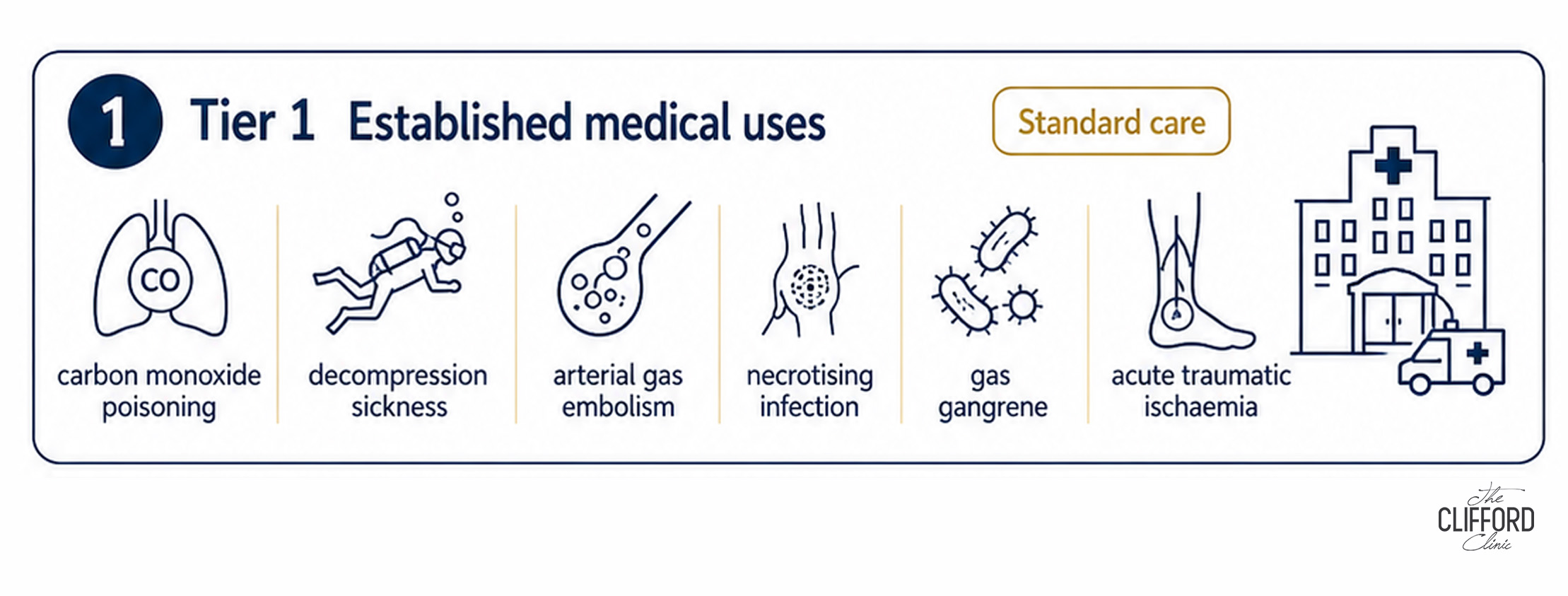
Established medical uses are the conditions for which HBOT is standard care, supported by decades of evidence and recognised by international hyperbaric medicine bodies such as the Undersea and Hyperbaric Medical Society. They are the foundation of clinical hyperbaric medicine and are typically delivered in hospital-based hyperbaric units, often as emergencies.
These include severe carbon monoxide poisoning, decompression sickness, arterial gas embolism, severe necrotising soft tissue infections, gas gangrene, and acute traumatic ischaemia. They are explained in detail in our guide on HBOT for carbon monoxide poisoning and decompression sickness.
Tier 2. Supported in Selected Cases
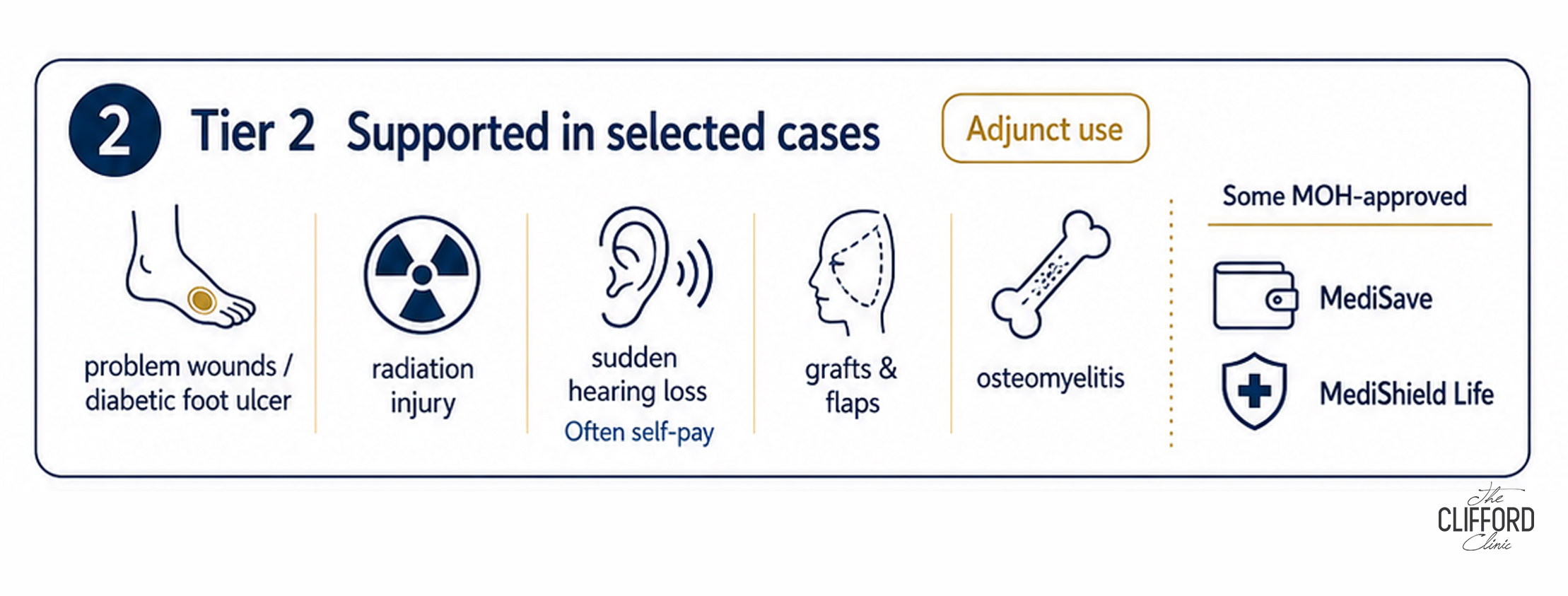
Supported uses are conditions where HBOT has good clinical evidence in carefully selected patients, typically as an adjunct to other treatment. They are recognised by hyperbaric medicine bodies such as the UHMS. Some, including selected non-healing wounds, delayed radiation injury and osteoradionecrosis, compromised skin grafts and myocutaneous flaps, and chronic refractory osteomyelitis, are also on MOH’s approved-indication list. In eligible cases two separate Singapore healthcare schemes may apply: MediSave (CPF medical savings) covers up to S$100 per treatment session, while MediShield Life (national health insurance) provides a separate claim limit of up to S$780 per treatment session. The two schemes operate independently and each has its own rules. Others, such as sudden sensorineural hearing loss, have good clinical evidence but are not on MOH’s financing list and are paid out of pocket.
These include selected diabetic foot ulcers and other problem wounds (see our HBOT for diabetic foot ulcers guide), delayed radiation tissue injury (see our HBOT for radiation injury guide), sudden sensorineural hearing loss within the treatment window (see our HBOT for sudden hearing loss guide), compromised skin grafts and flaps, and refractory osteomyelitis.
Tier 3. Emerging and Investigational
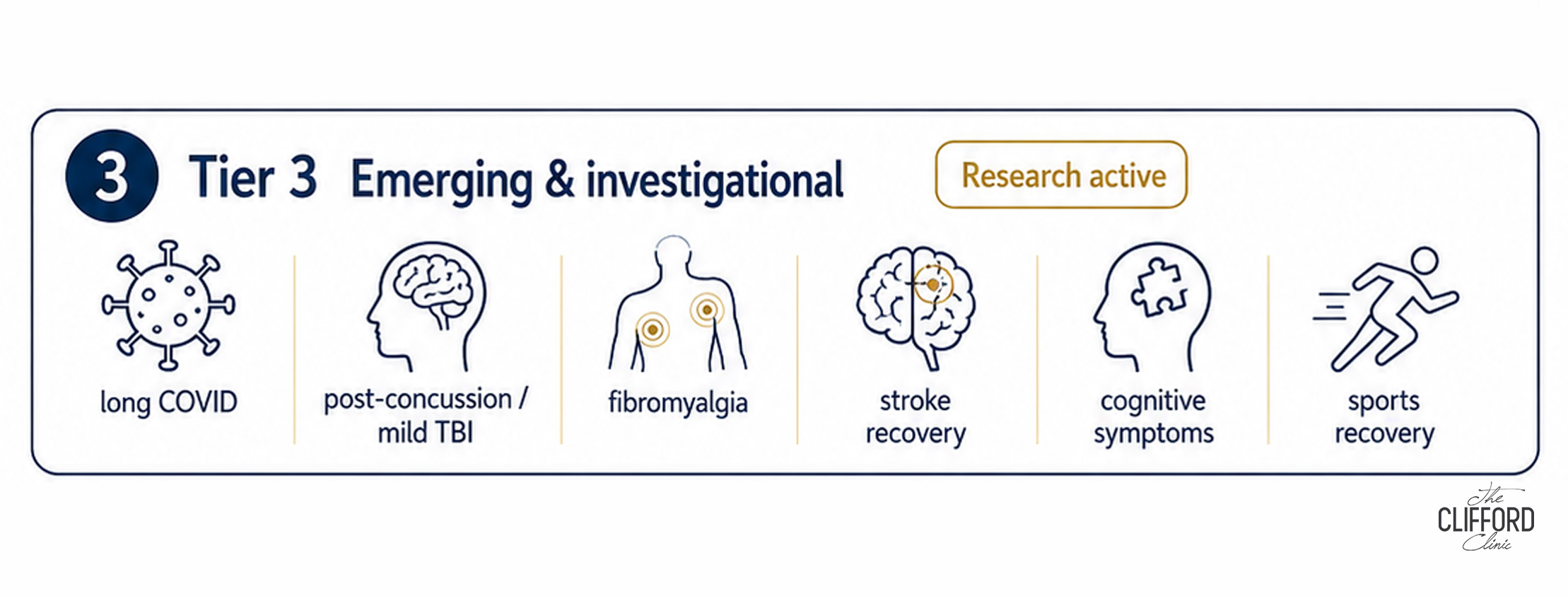
Here research is active and signals are interesting, but the evidence is not yet at the level of the established or supported tiers. Patients exploring HBOT in these areas should do so with realistic expectations and in coordination with their primary care or specialist team.
These include selected long COVID populations with fatigue and cognitive symptoms, certain post-concussion and mild traumatic brain injury cases, fibromyalgia, ischaemic stroke recovery, certain cognitive impairment populations, and specific elective recovery contexts. See our guides on HBOT for fatigue, sleep and brain fog and HBOT for sports recovery.
Tier 4. Wellness and Anecdotal
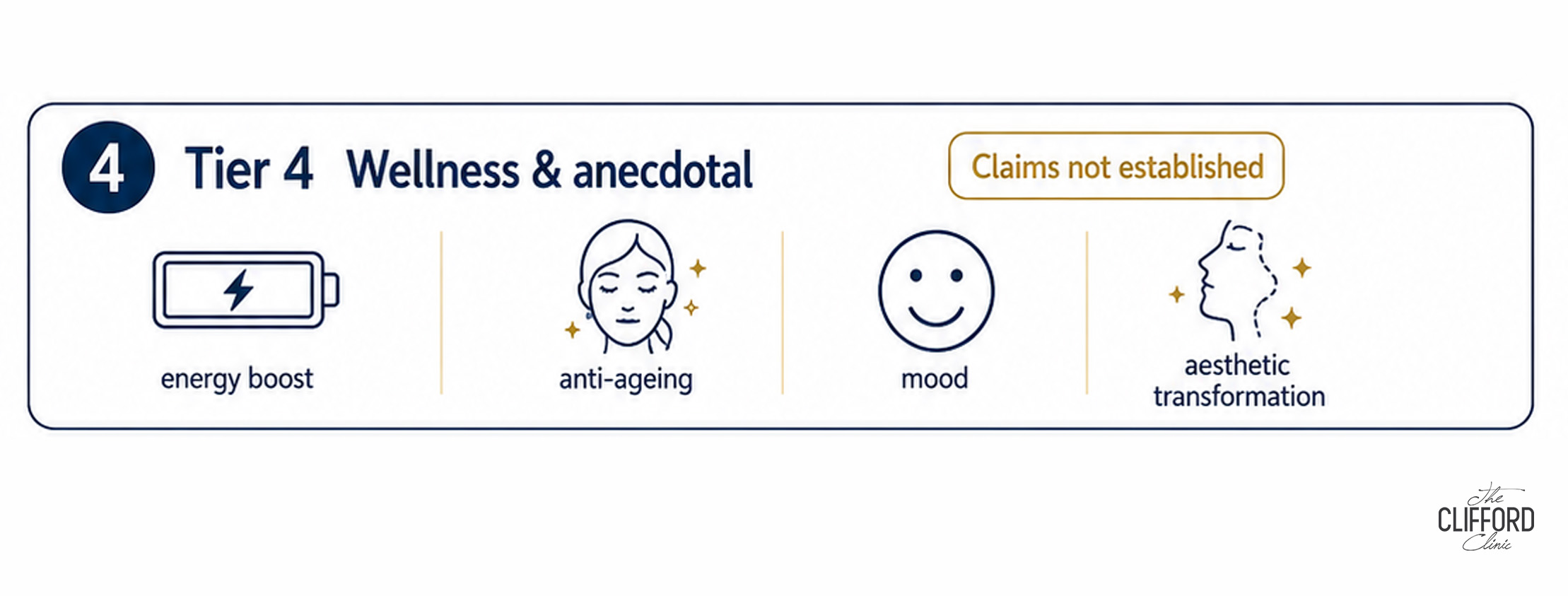
Here patients seek HBOT for goals like general energy, mood, anti-ageing or aesthetic transformation, and the evidence does not yet support the claims being made.
These include generic ‘energy boost’, immediate anti-ageing claims, broad mood improvement without a defined diagnosis, and aesthetic transformation from HBOT alone. For an honest read on the longevity-skin angle, see our guide on HBOT for skin rejuvenation and anti-ageing.
A Full Evidence Grading Table
The table below condenses the picture across the most-asked uses of HBOT in Singapore.
HBOT Uses and Evidence Tiers
| Use or Claim | Evidence Tier | How We Talk About It |
|---|---|---|
| Decompression Sickness | Established | Standard hospital emergency care. |
| Severe Carbon Monoxide Poisoning | Established | Standard hospital emergency care. |
| Gas Gangrene / Necrotising Soft Tissue Infection | Established | Adjunct to surgery and antibiotics. |
| Arterial Gas Embolism | Established | Standard hospital emergency care. |
| Selected Diabetic Foot Ulcer, Wagner 3+ | Supported | MOH-approved non-healing wounds. Adjunct to standard care. |
| Delayed Radiation Tissue Injury | Supported | MOH-approved indication. Recognised adjunct in selected cases. |
| Sudden Sensorineural Hearing Loss, Early | Supported | Adjunct to steroids in early window. Not on MOH financing list. |
| Compromised Graft or Flap | Supported | MOH-approved indication. Adjunct to reconstructive surgery. |
| Refractory Osteomyelitis | Supported | MOH-approved indication. Adjunct in resistant cases. |
| Sports Soft Tissue Injury Recovery | Emerging | Adjunctive role. Trial evidence in selected injuries. |
| Post-Elective-Surgical Recovery | Emerging | Reasonable off-label adjunct. Less robust evidence. |
| Long COVID with Fatigue / Cognitive Symptoms | Emerging | Early supportive studies. Not established. |
| Post-Concussion / Mild TBI Cognition | Emerging | Active research. Selected populations. |
| Fibromyalgia | Emerging | Some supportive trials. Further evidence needed. |
| Cellular Ageing Markers, Telomere Length, etc. | Emerging | Single notable study. Promising but not established. |
| Improved Deep Sleep During a Course | Emerging | Most consistent patient-reported observation. |
| General Fatigue Without a Defined Diagnosis | Wellness | Diagnose the cause first. HBOT is not a generic fix. |
| “Instant Energy” After a Single Session | Wellness | Not supported. Marketing rather than evidence. |
| Anti-Ageing as a Standalone Aesthetic Claim | Wellness | Not supported. Established aesthetic tools drive visible change. |
| Replacement for Sleep, Training or Medical Care | Wellness | HBOT is an adjunct. It does not replace fundamentals. |
Singapore Context
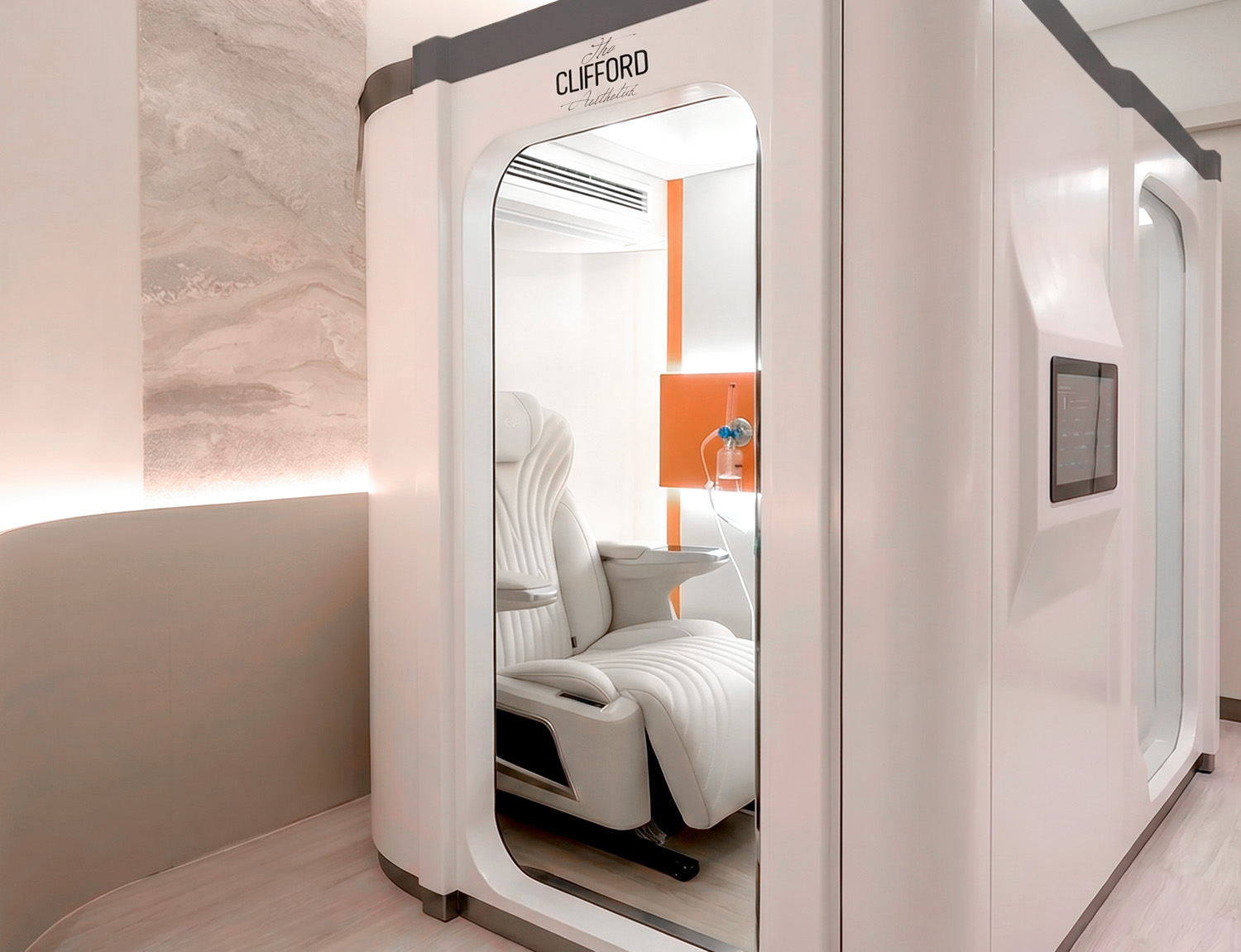
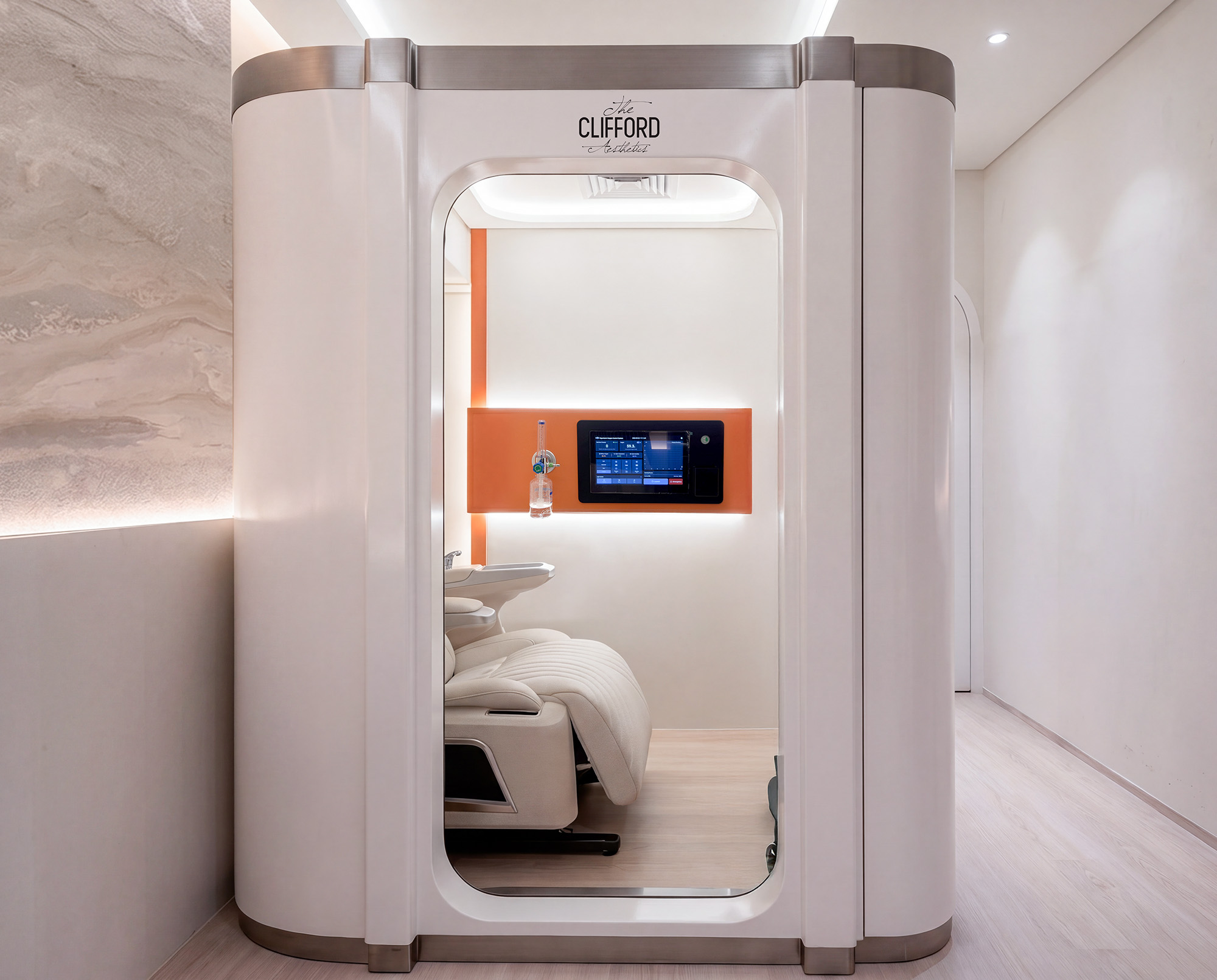
Singapore has three broadly distinct HBOT settings, each suited to a different point on this spectrum. Hospital-based hyperbaric services, including Singapore General Hospital’s Hyperbaric and Diving Medicine Centre, manage the established emergency indications and most of the medically indicated supported cases. Doctor-led clinic-based HBOT, such as that provided by The Clifford Clinic with a hard-shell chamber at a therapeutic 2.0 ATA, handles selected supported cases, post-surgical recovery and emerging uses. Soft-shell mild HBOT, often marketed for wellness, does not deliver the doses that the supporting research describes and should not be considered a clinical equivalent.
For more on the chamber differences that determine what HBOT can actually deliver, see our guide on hard-shell versus soft-shell hyperbaric oxygen chambers.
How to read HBOT marketing critically
Apply this evidence grading to any HBOT page you read. If a clinic markets emerging or wellness uses with the same confidence as established medical indications, that is a credibility problem. If a clinic openly distinguishes between what is established, what is supported, what is emerging and what is still wellness, that is the kind of provider patients can trust.
How to Read HBOT Marketing Critically
Take any HBOT page or brochure and try to assign each claim to a tier. If everything reads as if it were established medicine, the page is overpromising. Willingness to use words like ‘may support’, ‘is being studied for’ and ‘evidence is still developing’ is a signal of an evidence-disciplined clinic.
Words like ‘reverses ageing’, ‘guaranteed recovery’, ‘instant results’, ‘best HBOT clinic’ and ‘cures fatigue’ should prompt scepticism. These are marketing claims, not clinical statements, and are discouraged by Singapore healthcare advertising guidance.
The Clifford Clinic Perspective
Every HBOT conversation at the consultation includes an explicit version of this, namely where the patient’s goal sits on the spectrum from established medical indication to wellness claim, what HBOT can realistically offer for that goal, and what other interventions might serve the patient better. Patients deserve that clarity before they pay for a course of anything.
For established and supported indications, the team is comfortable being direct about HBOT’s role. For emerging uses, such as selected long COVID, post-concussion cases, fibromyalgia and longevity care, the team is candid about the early-stage nature of the evidence and the role of objective markers in tracking response. For wellness claims that are not supported by the evidence, the team will say so and decline to oversell, even at the cost of a booking.
Across four years and more than 200 patients, the clinical team’s experience is that patients respect this discipline far more than vague promises. The clinic’s HBOT is delivered through a hard-shell chamber at a therapeutic 2.0 ATA, with doctor-led screening and at a Raffles Place location that makes a structured course practical.
Treating these four tiers as distinct is the clearest way to tell a trustworthy HBOT provider from a marketing one.
Frequently Asked Questions
Which HBOT uses are MOH-recognised in Singapore?
MOH publishes 13 approved clinical indications for MediSave and MediShield Life coverage of HBOT. These are air or gas embolism, carbon monoxide poisoning, chronic refractory osteomyelitis, compromised skin grafts and myocutaneous flaps, crush injury, compartment syndrome and other acute ischaemias, decompression illness, exceptional blood loss, gas gangrene, intracranial abscess, necrotising soft tissue infections, non-healing wounds, osteoradionecrosis and delayed radiation injuries, and thermal burns. Confirm current specifics with MOH and your treating doctor.
Is wellness HBOT a waste of money?
Not necessarily. Patients may still find value, particularly in observations like improved deep sleep. Wellness HBOT should be described as wellness, not as established medicine.
Where can I get hospital-based HBOT in Singapore?
Singapore General Hospital’s Hyperbaric and Diving Medicine Centre is the established local hospital-based hyperbaric service.
Why does the same indication sit in different tiers across guides?
Evidence quality changes over time as research accumulates. A use can move from emerging to supported as trials replicate. Good guides date their content and update accordingly.
Are emerging uses worth doing?
They can be, with realistic expectations and the right setting. Patients exploring emerging uses should ideally do so in coordination with their primary or specialist team, and with attention to objective markers where possible.
Can HBOT marketing be regulated?
Singapore healthcare advertising guidance discourages overclaiming, before-and-after promises and time-bound transformation marketing. Consumers can also report concerning material to MOH.
What is the difference between supported and emerging?
Supported uses have a substantive evidence base and are recognised by hyperbaric medicine bodies. Emerging uses are active research areas where signals are interesting but the evidence is not yet at the recognised-indication level.
Will my goal qualify for MediSave or MediShield Life?
Only if it meets MOH’s clinical criteria for a recognised indication. Wellness, emerging and most off-label uses are paid out of pocket.
Key Research References
- Undersea and Hyperbaric Medical Society. Hyperbaric Oxygen Therapy Indications, 13th Edition.
- Ministry of Health Singapore. MediSave-claimable outpatient treatments and MediShield Life claim limits.
- Singapore General Hospital. Hyperbaric and Diving Medicine Centre. Clinical services.
- Kirby JP et al. Essentials of Hyperbaric Oxygen Therapy. 2019 Review. Missouri Medicine.
- Tibbles PM, Edelsberg JS. Hyperbaric-Oxygen Therapy. New England Journal of Medicine.
- Mayo Clinic. Hyperbaric oxygen therapy. Overview, indications and risks.
- Heyboer M et al. Hyperbaric Oxygen Therapy. Side Effects Defined and Quantified. Advances in Wound Care.
- Hachmo Y et al. Hyperbaric oxygen therapy increases telomere length and decreases immunosenescence in isolated blood cells. Ageing.
To plan HBOT for an indication that fits your case and the evidence behind it, book a consultation at The Clifford Clinic.

Author Bio
Dr Gerard Ee

Dr Gerard Ee is the Medical Director of The Clifford Clinic in Singapore. He earned his medical degree from St George's University of London and built his surgical experience across the Singapore General Hospital, National University Hospital, and Mount Sinai Hospital in New York. He holds Membership of the Royal College of Surgeons (Edinburgh) and a Postgraduate Diploma in Dermatology (Cardiff), and is fully accredited in aesthetic procedures including botulinum toxin, fillers, lasers, and light therapies. A strong advocate of minimally invasive, natural-looking results, Dr Ee has published in several medical and scientific journals and presented his research in cities including Taipei, Las Vegas, and London.
See all posts by Dr Gerard Ee »