



HBOT for Diabetic Foot Ulcers and Chronic Wounds: The Singapore Clinical Guide
| Medically reviewed by The Clifford Clinic clinical team
Reviewer: Dr Gerard Ee, MBBS Practising at The Clifford Clinic, Raffles Place, Singapore Last reviewed: June 2026 How we review: Articles in this hyperbaric oxygen library are written for The Clifford Clinic and reviewed by medical professionals. Reviewers check medical accuracy and ensure claims align with current MOH, UHMS and peer-reviewed guidance. |
Hyperbaric oxygen therapy (HBOT) is among the most established interventions in wound medicine, and the diabetic foot ulcer is, more than any other condition, what built that evidence base. For diabetic patients in Singapore, slow-healing wounds risk infection, ulceration and, in serious cases, amputation. In selected cases, international hyperbaric medicine bodies recognise HBOT as a meaningful adjunct to standard wound care.
This guide explains why diabetic foot ulcers behave differently from ordinary wounds, how HBOT helps, what the evidence supports, and where it fits in the Singapore wound-care pathway. For broader context, start with our complete guide to hyperbaric oxygen therapy and our dedicated guide on hyperbaric oxygen for wounds.
Why Diabetic Foot Ulcers Do Not Heal
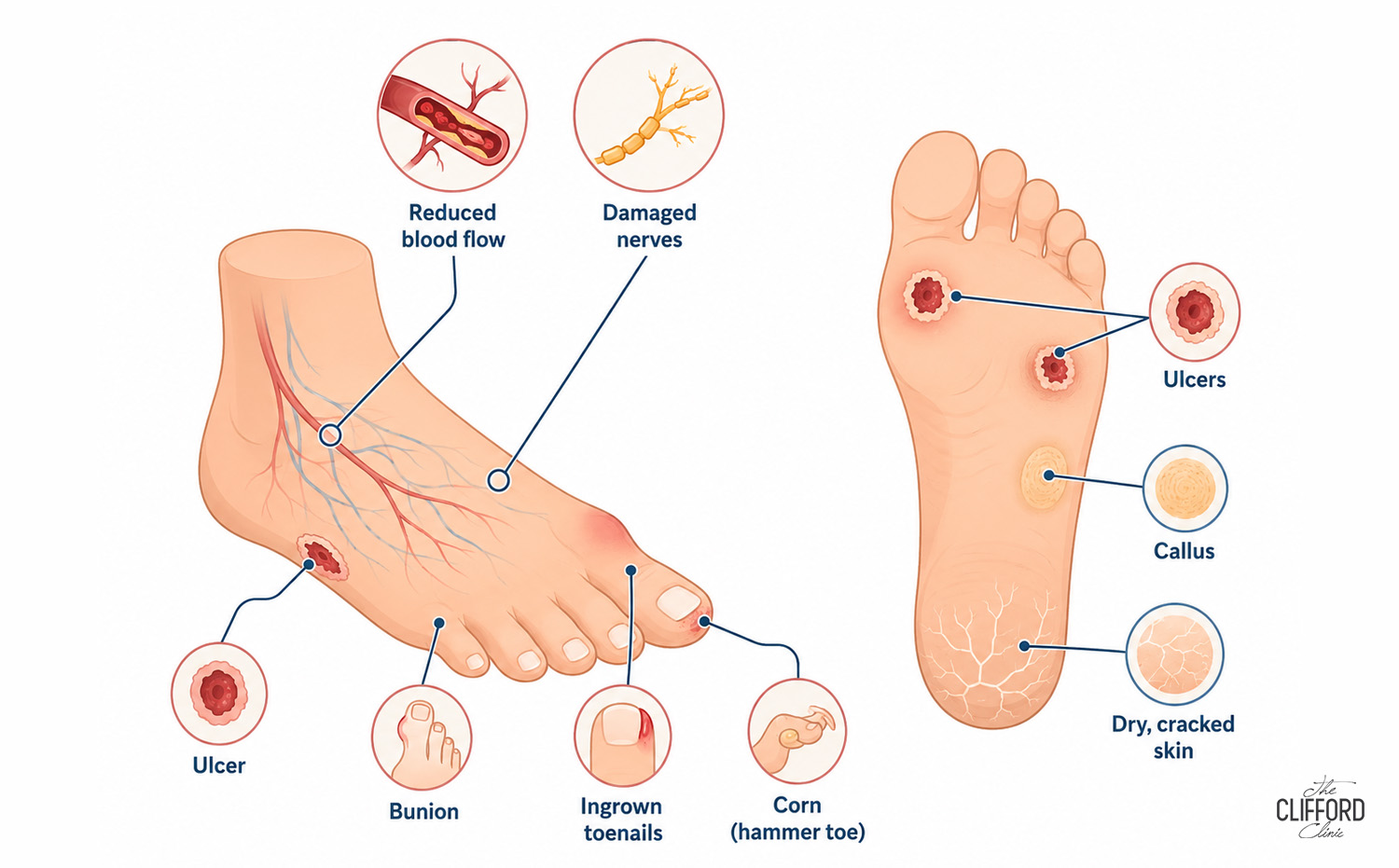
A diabetic foot ulcer is not a simple cut that takes a long time to close. Diabetes creates three overlapping problems. Peripheral neuropathy means the patient cannot feel pressure damage as it accumulates. Peripheral arterial disease means the tissue is poorly perfused with oxygen and nutrients. The wound environment then favours infection over repair. The wound is hypoxic at exactly the moment it most needs oxygen to heal.
Even with debridement, offloading, infection control and tight glycaemic management, some ulcers continue to enlarge or fail to close. In these wounds, where tissue is salvageable but oxygen supply is the limiting factor, HBOT has its strongest evidence base.
How HBOT Helps a Chronic Wound
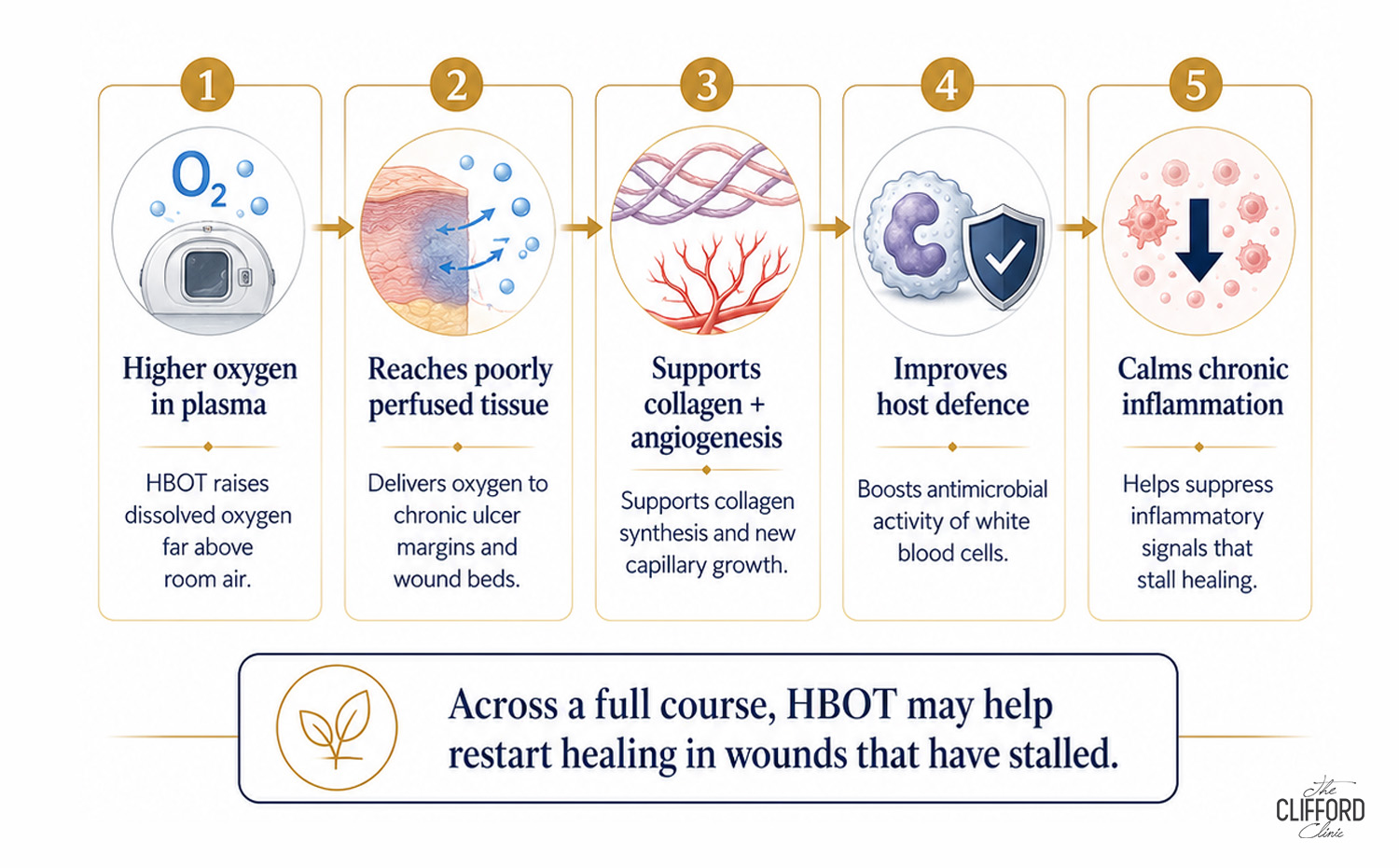
HBOT raises the partial pressure of oxygen in plasma far above what breathing room air can achieve. That dissolved oxygen reaches tissue that red blood cells cannot, including the poorly perfused margins of a chronic ulcer. The mechanism is explained in our guide on how hyperbaric oxygen therapy works. At therapeutic pressures, the body delivers oxygen to wound beds that room air cannot reach.
Oxygen at these levels supports collagen synthesis and angiogenesis (the growth of new small blood vessels), strengthens the antimicrobial activity of white blood cells, and helps suppress chronic inflammatory signals that stall wound healing. Across a full course, this can restart healing in wounds that have stalled.
What the Evidence Says
Diabetic foot ulcer has the most consistent evidence base of any HBOT indication. The Undersea and Hyperbaric Medical Society (UHMS) lists selected diabetic foot ulcers among its recognised indications, and a 2017 review in Advances in Wound Care by Heyboer et al. described HBOT as among the better-supported uses with a favourable safety profile when properly screened.
The evidence is strongest in selected cases, typically Wagner grade 3 or higher ulcers, in patients whose wounds have failed to progress despite at least 30 days of standard wound care, where vascular assessment shows the tissue is salvageable. The evidence is weaker, and HBOT is not generally recommended for superficial ulcers that respond to standard care, or for limbs where vascular reconstruction is the appropriate first step.
When HBOT Is Considered
Typically, a diabetic patient develops a foot ulcer, undergoes standard wound care including debridement, offloading, dressings, infection control and glycaemic optimisation. If, over weeks, the wound is not closing on the expected trajectory, the clinical team will reassess. If vascular imaging shows reasonable perfusion and the wound is not responding to optimised care, HBOT may be added as an adjunct.
The decision is rarely made by the hyperbaric team alone. It usually involves the patient’s primary diabetes physician, a vascular surgeon, a podiatrist or wound nurse, and the hyperbaric clinician. A treatment course is then planned, typically running across several weeks of regular sessions.
Other Chronic Wounds That May Be Considered
Diabetic foot ulcers attract most of the attention, but they are not the only chronic wound where HBOT has an established or supported role. Compromised skin grafts and flaps after reconstructive surgery, delayed soft tissue or bone injury after radiation therapy, refractory osteomyelitis, and certain crush injuries are all recognised indications in major hyperbaric medicine guidelines, including the UHMS indications list.
These are still selected cases rather than blanket use. A wound that is healing normally does not need HBOT. The judgement is whether the wound’s biology is being held back by an oxygen-supply problem that hyperbaric pressure can address. For more on the radiation-related angle, see our guide on HBOT for radiation injury.
HBOT for Wounds: Evidence and Use Cases
| Use or Claim | Evidence Tier | How We Talk About It |
|---|---|---|
| Diabetic Foot Ulcer, Selected Wagner 3+ | Supported | Adjunct to standard wound care after failure to progress. |
| Compromised Graft / Flap After Surgery | Supported | Considered when tissue viability is at risk. |
| Refractory Osteomyelitis | Supported | Adjunct in selected resistant cases. |
| Delayed Radiation Tissue Injury | Supported | Recognised indication for late radiation damage. |
| Superficial Uncomplicated Wounds | Wellness | Not an HBOT indication; standard wound care alone. |
HBOT Is an Adjunct, Not a Substitute

HBOT does not replace surgical debridement, infection control, glycaemic management, offloading, or vascular intervention where vascular intervention is needed. A wound with significant infection or ischaemia is treated for the infection and the ischaemia first. HBOT supports those treatments rather than replacing them.
When HBOT is added on top of good wound care in the right case, the results can be meaningful. When it is added in place of good wound care, the results are usually disappointing, which says nothing about HBOT and everything about clinical judgement.
The Singapore Picture
Singapore has well-developed wound-care services across both public and private healthcare. Singapore General Hospital’s Hyperbaric and Diving Medicine Centre lists problem wound management and HBOT among its core clinical services, and works alongside vascular, podiatric, endocrine and infectious-disease teams to manage complex diabetic foot disease. For patients with a recognised wound-care indication, hospital-based hyperbaric units are often the most appropriate setting, particularly where MediSave or MediShield Life support may apply.
Private clinics also offer HBOT, including The Clifford Clinic. Whether a private setting is appropriate depends on the wound, the patient and the wider care plan. For details on financing, see our guide to HBOT MediSave and MediShield coverage in Singapore.
| MediSave and MediShield Life note
Diabetic foot ulcers fall under MOH’s approved indication of non-healing wounds. Two separate Singapore healthcare schemes may apply to qualifying cases. MediSave (CPF medical savings) can be used for up to S$100 per treatment session. MediShield Life (national health insurance) is a separate scheme with a claim limit of up to S$780 per treatment session. The two operate independently, and both require MOH’s clinical criteria to be met. Confirm with MOH, CPF Board and your provider’s billing team before treatment. |
The Clifford Clinic Perspective

The Clifford Clinic’s clinical team treats wounds with HBOT as part of a wider practice that includes plastic surgery and a Day Surgery unit, so the cases we see are usually surgical or post-surgical rather than purely chronic. That includes wounds that need help recovering after an operation, swelling and tissue compromise after reconstructive procedures, and, at the more demanding end, reattachment cases, including paediatric patients with finger reattachments, where the survival of repaired nerves, blood vessels and soft tissue depends on the tissue being kept well oxygenated while circulation is still fragile.
On classical diabetic foot ulcer, the team is honest about the appropriate setting. A patient with a non-healing diabetic foot ulcer that meets the recognised criteria is often best served by a hospital-based multidisciplinary wound and hyperbaric service, such as Singapore General Hospital’s Hyperbaric and Diving Medicine Centre, where vascular, podiatric and endocrine input sits alongside HBOT and where MediSave and MediShield Life support is more straightforward. When that is the right pathway, the team will say so.
Where The Clifford Clinic adds value is in surgical and post-surgical wound contexts that fit a doctor-led private clinic. The clinic offers a hard-shell chamber at a therapeutic 2.0 ATA (atmospheres absolute), medical supervision, and Raffles Place accessibility for working patients. Over four years and more than 200 patients, the consistent observation is that wounds in patients on a properly delivered HBOT course close and recover faster than the same patient or referring surgeon would otherwise expect.
HBOT for a chronic diabetic foot ulcer, a delayed radiation injury, a compromised graft or a post-surgical soft tissue problem are different decisions, and each one deserves the right clinical environment, the right multidisciplinary team, and an honest conversation about what HBOT can and cannot add.
Frequently Asked Questions
Does HBOT cure diabetic foot ulcers?
No. HBOT is an adjunct that supports wound healing in selected cases. It does not replace debridement, infection control, glycaemic management, offloading or vascular treatment where those are needed.
How many sessions are usually needed for a diabetic foot ulcer?
Protocols vary, but a typical course runs across several weeks of regular sessions. Your hyperbaric clinician will set the protocol based on the wound, the response and your wider care plan.
Is HBOT painful?
No. The most common sensation is mild ear pressure during pressurisation, managed with simple equalisation techniques.
Will MediSave cover HBOT for my diabetic foot ulcer?
It may, if your case meets MOH’s clinical criteria and your provider is recognised for the indication. Confirm with your treating doctor and the provider’s billing team.
Can HBOT save a limb that has been recommended for amputation?
Not on its own, and not in every case. In selected patients with salvageable tissue, HBOT alongside aggressive wound care and vascular treatment may reduce major amputation risk. The decision is multidisciplinary.
Is private clinic HBOT as good as hospital HBOT for diabetic foot ulcer?
For straightforward, clinically indicated diabetic foot ulcer cases, hospital-based hyperbaric services usually offer better integration with vascular, podiatric and endocrine teams. Private clinics fit better with surgical and post-surgical wound contexts.
Are there side effects?
Most side effects are mild and managed routinely. The most common is ear pressure. Less common issues are screened for in advance by a doctor.
What if my wound does not respond to HBOT?
Not every wound responds, which is one reason properly screened cases matter. Lack of response will prompt a review of the wound, the wider treatment plan and whether HBOT should continue.
Key Research References
- Undersea and Hyperbaric Medical Society. Hyperbaric Oxygen Therapy Indications, 13th Edition.
- Heyboer M et al. Hyperbaric Oxygen Therapy: Side Effects Defined and Quantified. Advances in Wound Care, 2017.
- Bhutani S, Vishwanath G. Hyperbaric oxygen and wound healing. Indian Journal of Plastic Surgery, 2012.
- Tibbles PM, Edelsberg JS. Hyperbaric-Oxygen Therapy. New England Journal of Medicine, 1996.
- Kirby JP et al. Essentials of Hyperbaric Oxygen Therapy: 2019 Review. Missouri Medicine.
- Singapore General Hospital. Hyperbaric and Diving Medicine Centre — services and conditions treated.
- Mayo Clinic. Hyperbaric oxygen therapy: overview and indications.
To discuss whether HBOT may be appropriate for your wound, book a consultation at The Clifford Clinic.

Author Bio
Dr Gerard Ee

Dr Gerard Ee is the Medical Director of The Clifford Clinic in Singapore. He earned his medical degree from St George's University of London and built his surgical experience across the Singapore General Hospital, National University Hospital, and Mount Sinai Hospital in New York. He holds Membership of the Royal College of Surgeons (Edinburgh) and a Postgraduate Diploma in Dermatology (Cardiff), and is fully accredited in aesthetic procedures including botulinum toxin, fillers, lasers, and light therapies. A strong advocate of minimally invasive, natural-looking results, Dr Ee has published in several medical and scientific journals and presented his research in cities including Taipei, Las Vegas, and London.
See all posts by Dr Gerard Ee »