


Breastfeeding, Pregnancy and Mammograms After Breast Implants
Many women breastfeed successfully after breast augmentation, pregnancy does not typically damage an implant, and mammograms remain both possible and important. Each of those statements carries a caveat that deserves a full explanation rather than a reassuring headline, and the caveats differ from one another. This guide treats the three topics separately, as part of our full resource on breast augmentation with implants in Singapore.
Breastfeeding After Breast Implants
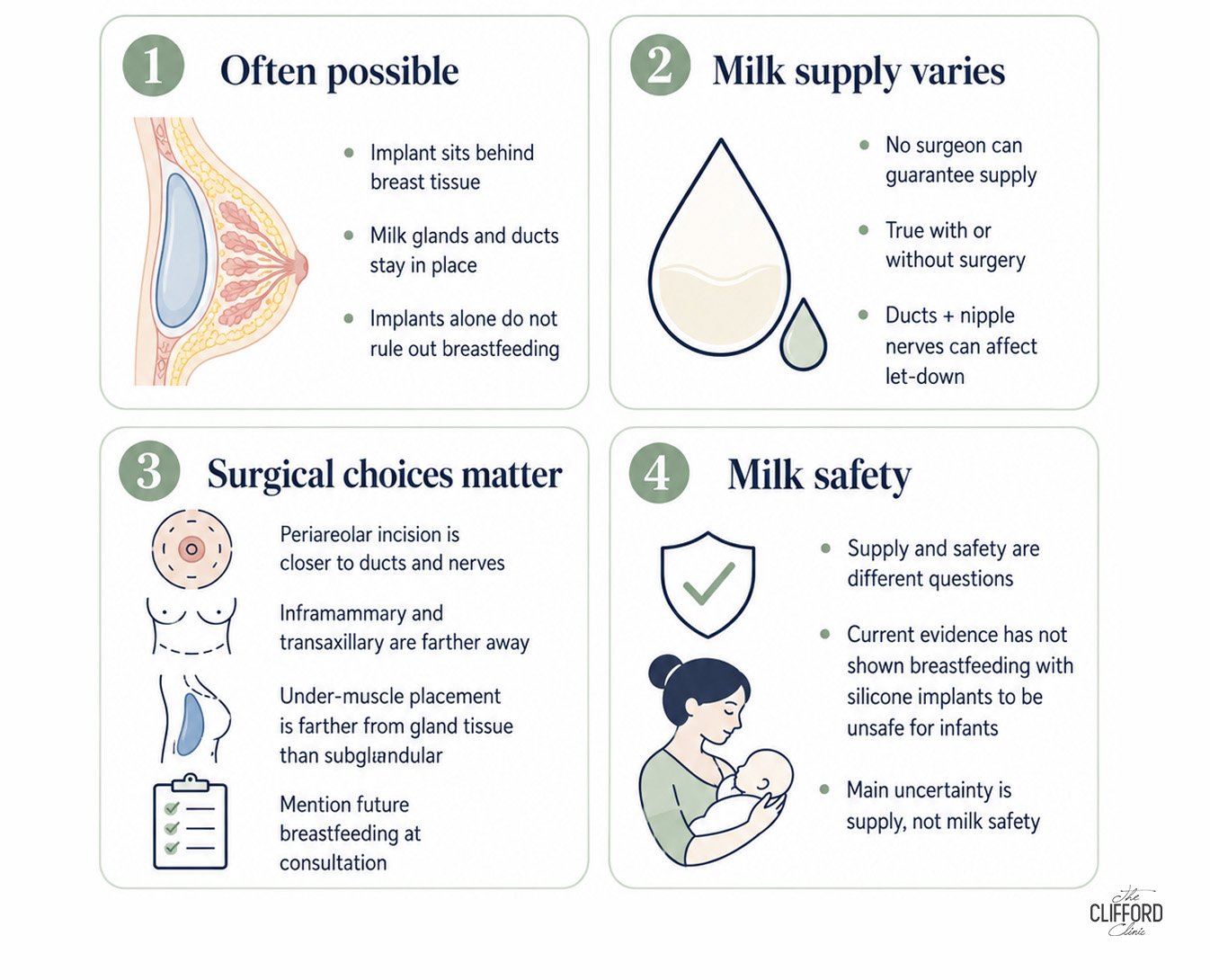
Breastfeeding is possible for many women with implants. The implant is placed behind the gland, or behind the chest muscle, rather than within the milk-producing tissue itself, so the glandular tissue that makes milk and the ducts that carry it are left in place. Having implants is not in itself regarded as a reason to avoid breastfeeding.
No surgeon can guarantee milk supply, and the reason is not specific to surgery. Milk supply varies widely among all women, including those who have never had an operation, so full supply cannot be promised to any individual with or without implants. What surgery adds is a set of variables. Incisions and dissection close to the ducts and nerves can affect lactation in some patients, and the nerve supply to the nipple governs the let-down reflex, the hormonal signal that releases milk once feeding begins.
Surgical choices influence those variables in ways that can be anticipated before the operation. A periareolar incision, placed at the border of the areola, passes closer to the ducts and to the nerves supplying the nipple than an inframammary incision in the fold beneath the breast or a transaxillary incision in the armpit. Placement beneath the muscle holds the implant further from glandular tissue than subglandular placement does. Where future breastfeeding matters to a patient, raising it at consultation is worthwhile, because it is a legitimate factor in the choice of incision and placement, as covered in placement, incisions and scars. What no technique can do is guarantee an outcome in either direction.
The safety of the milk is a separate question from the sufficiency of the supply, and the two should not be blurred into a single claim. Current evidence has not shown breastfeeding with silicone implants to be unsafe for infants, and professional guidance supports breastfeeding with implants in place. Uncertainty that remains concerns how much milk is produced, not whether that milk is safe.
Pregnancy With Breast Implants
Pregnancy and breastfeeding do not typically harm the implant itself. No special implant precautions apply during pregnancy beyond ordinary obstetric care, and the device is not affected by the hormonal and glandular changes taking place around it.
What pregnancy changes is the tissue surrounding the implant. The breasts enlarge during pregnancy and lactation and then involute afterwards, the skin envelope stretches to accommodate that enlargement, and volume redistributes as the glandular tissue recedes. An augmented breast passes through the same cycle, so the post-pregnancy appearance can differ from the pre-pregnancy result, most commonly through some deflation of the upper breast, some droop of the tissue over the implant, or both together. Some patients later consider a lift or an implant revision for that reason, as discussed in implants vs fat transfer vs breast lift.
There is no medical requirement to complete a family before augmentation, but the sequence is worth discussing at consultation. Patients planning a pregnancy in the near term sometimes defer surgery so that the result is not reshaped within a year or two of achieving it, whereas others proceed on the understanding that a revision may become appealing later. Dr Naidu advises the following. “If a patient is actively planning a pregnancy in the near future, I generally advise her to consider postponing surgery. This is not because pregnancy is unsafe with implants, but because the aesthetic result may change relatively soon after the operation and she may later require a lift, implant exchange or another revision. If pregnancy plans are uncertain or several years away, augmentation can still be reasonable as long as the patient understands that future breast changes cannot be predicted.” On breastfeeding, he notes that many women with implants breastfeed successfully, and that where appropriate, an inframammary-fold incision with placement beneath the muscle may reduce direct disruption of tissue around the nipple and milk ducts compared with some other approaches, although no technique can guarantee that breastfeeding will be unaffected. “Augmentation should be planned for the patient’s current anatomy, while recognising that pregnancy, weight change and ageing may alter the result. Future revision is possible, but it is not automatically necessary after every pregnancy.”
Mammograms and Breast Screening With Implants
Mammography remains possible with implants in place, and age-appropriate breast cancer screening should continue exactly as recommended for women who do not have them. Implants are not a reason to defer or skip screening.
The mammography facility should be told about the implants before the appointment, and the United States Food and Drug Administration advises this specifically. Technologists then use implant displacement views, also known as Eklund views, in which the implant is gently pushed back towards the chest wall so that more of the overlying breast tissue can be brought into the image, and the radiographer positions and compresses the breast accordingly.
Implants are radiopaque, which means x-rays do not pass through them, so they can obscure some of the tissue behind them on standard views. Displacement views compensate for this substantially, and additional imaging with ultrasound or magnetic resonance imaging can be used where a view remains inadequate. Rupture caused by the compression of mammography is rare. Subglandular implants tend to interfere with views more than submuscular ones do, because tissue positioned in front of the implant is harder to displace clear of it, which is one more downstream consequence of the placement decision.
Implant surveillance runs on a separate track from cancer screening, and one does not substitute for the other. Mammography screens the breast tissue for cancer, whereas surveillance for silent rupture of silicone implants uses ultrasound or magnetic resonance imaging on its own schedule, described in breast implant safety and monitoring. Attending one appointment therefore leaves the other still outstanding.
Timing Surgery Around Family Plans
No single sequence is correct for every patient, but three common sequences carry trade-offs worth weighing.
- Surgery well before children delivers the result for the longest period. The breast over the implant may later be changed by pregnancy, and some patients eventually choose a revision or a lift as a result. Breastfeeding remains possible for many, particularly where the incision and placement choices above were made with it in mind.
- Surgery between pregnancies is generally sensible only where a genuine interval separates them. Operating on a breast that another pregnancy will reshape within a year or two spends both the cost and the recovery on a result that will not persist. Most surgeons also advise waiting until breastfeeding has finished, six months after the last feed at Clifford, so that the glands involute and breast size stabilises before any measurement is taken.
- Surgery after the family is complete gives the most durable result, because the tissue the surgeon plans around is the tissue that will persist. Patients at this stage also present with the widest set of options, namely an implant, a lift, or both combined, because deflation and droop can then be addressed in the same operation.
Whichever sequence fits, family plans are worth stating explicitly at consultation. They legitimately influence the incision route, the placement plane, the implant size, and the question of whether to operate at this point at all.
Preparing to Breastfeed With Implants
Where implants are in place and a pregnancy is ahead, a small amount of preparation improves the odds of a smooth experience. The obstetric and lactation team should be told about the implants, the incision route and the placement plane, and the implant card carries all three. Feeding support is worth establishing early, because a lactation consultant can distinguish a supply question that relates to the surgery from the ordinary difficulties every new mother encounters. Supplementing where supply falls short is a nutrition decision rather than a failure. Engorgement can feel more taut than expected with an implant beneath the tissue, although the usual engorgement management still applies. Symptoms of mastitis, meaning fever together with a hot and tender segment of the breast, warrant the same prompt medical attention as they would for any breastfeeding mother, with the implant history mentioned to whoever assesses them.
Breast Screening in Singapore With Implants
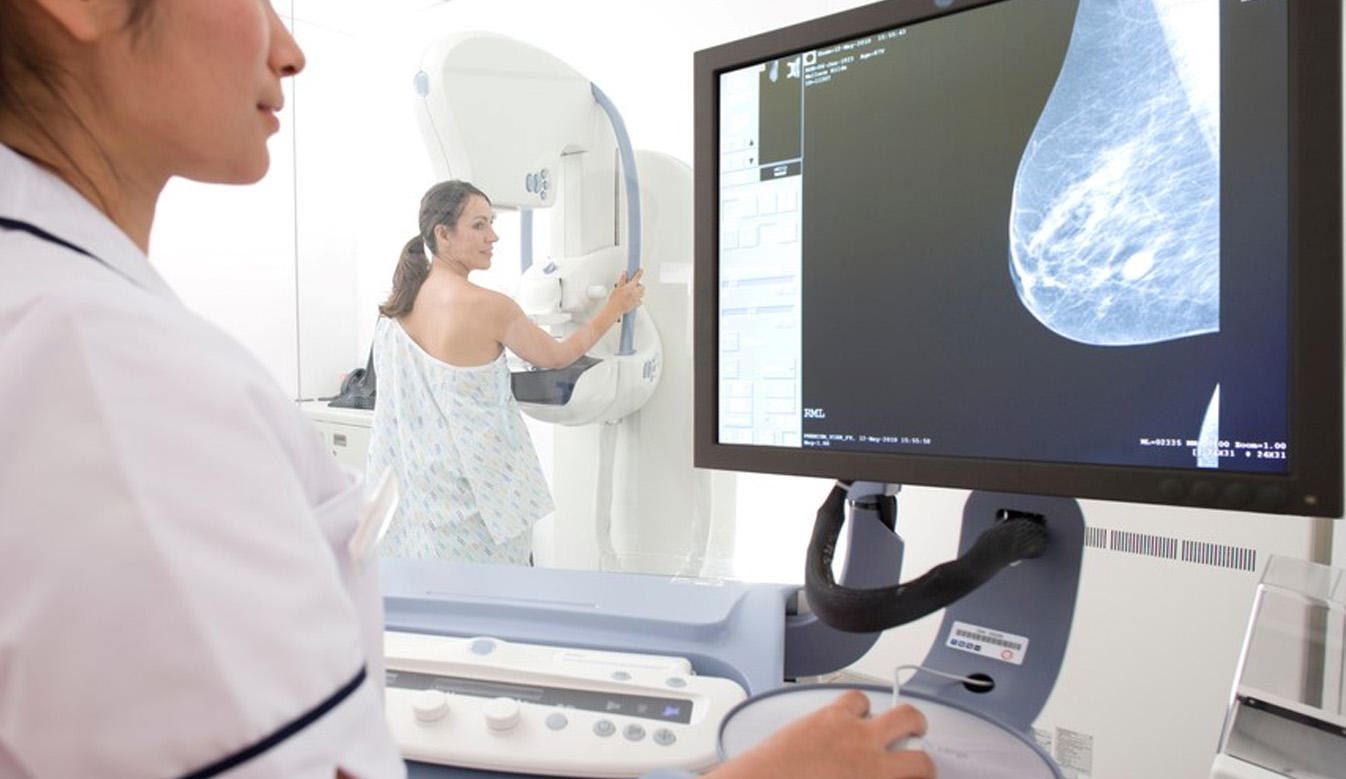
Singapore’s national guidance encourages regular mammographic screening from age 50, with informed choice from age 40. Implants do not change that recommendation, only the technique used to carry it out. Four practical steps follow from this. The implants should be mentioned at the point of booking, so that the facility can allow for implant displacement views and a slightly longer appointment. The implant card should be brought to the appointment so that the device details are recorded. Surveillance imaging for rupture should be kept as a separate track from cancer screening, since neither substitutes for the other. Where a screening recall follows, it warrants no alarm on its own, because implants make additional views more common for reasons that are purely technical.
Common Myths About Implants, Breastfeeding and Screening
- “Implants make breastfeeding unsafe for the baby.”This is not supported by the evidence. Studies have not shown elevated silicone in the breast milk of mothers with implants, and professional guidance supports breastfeeding. The genuine uncertainty concerns supply, not safety.
- “You cannot have a mammogram with implants.”This is false. Screening proceeds using displacement views and remains as important as it is for any other patient. The only additional obligation is informing the facility beforehand.
- “Pregnancy will rupture or shift my implants.”Pregnancy does not typically harm the implant. It remodels the natural tissue around it instead, which is a different problem calling for different planning.
- “Implants placed under the muscle guarantee that breastfeeding will be fine.”Placement and incision shift the probabilities rather than settling them. Nothing guarantees supply for any individual, whether or not she has been operated on.
- “Breastfeeding ruins augmentation results.”Most post-baby breast change is driven by the pregnancy cycle rather than by breastfeeding itself. Declining to breastfeed in order to protect an aesthetic result therefore misreads the evidence.
Each of these myths shares a single structure. A real fact, such as the proximity of implants to the glandular tissue or the need to adjust imaging technique, is inflated into a false absolute. The correction is never that there is no issue at all, but rather the specific and honest version of the issue.
Frequently Asked Questions
Can I breastfeed after breast augmentation?
Many women do. No surgeon can guarantee any individual’s milk supply, with or without implants, but implants are not themselves a reason to avoid breastfeeding.
Which incision is best if I want to breastfeed later?
Routes away from the areola, meaning the inframammary and transaxillary approaches, avoid the dissection closest to the ducts and the nipple nerves. Raising breastfeeding plans at consultation allows this to be factored into the planning.
Will pregnancy ruin my augmentation result?
Pregnancy changes the natural tissue over the implant, often producing some deflation or droop afterwards. The implant itself is unharmed, but the aesthetic result may shift, and some patients later choose a revision.
Do implants hide breast cancer on mammograms?
They can obscure some tissue, which is why facilities use displacement views and supplementary imaging where it is needed. Screening remains effective and remains important. Inform the facility and attend as scheduled.
Should I get a mammogram before augmentation?
Where age or risk factors indicate screening, being up to date before elective breast surgery is sensible. Clifford arranges the standard pre-operative work-up in-clinic, and where screening is due it is completed before surgery.
Is silicone found in breast milk from mothers with implants?
Studies have not shown elevated silicone levels in the breast milk of mothers with silicone implants compared with those without. Professional guidance supports breastfeeding with implants. The evidence base continues to grow, and this page is reviewed against it.
Will breastfeeding change how my implants look?
Breastfeeding itself adds little beyond what pregnancy has already done, because the enlargement and involution cycle affects the natural tissue either way. Attributing post-baby change specifically to breastfeeding is one of the more persistent myths, as the pregnancy is the main event.
How long after stopping breastfeeding can I have augmentation or revision?
Common practice is to wait several months after the last feed so that the glands involute and breast size stabilises, because measurements taken earlier risk planning around a temporary breast. Clifford advises waiting six months after the last feed.
Do I need extra scans because of implants during pregnancy?
No routine extra imaging is needed in pregnancy because of implants. Any new breast lump or concern arising in pregnancy is investigated on its own merits, as it would be for any woman, and the implants should be mentioned to whoever examines them.

Medically reviewed by Dr Gerard Ee. Surgery described on this page is performed by Dr Shenthilkumar Naidu, MBBS (NUS), FRCS (Edin), MOH-accredited Consultant Plastic Surgeon. He is a member of the Singapore Association of Plastic Surgeons and ISAPS, and a fellow of the Academy of Medicine, Singapore.
References. United States Food and Drug Administration, mammography and breast implant guidance. HSA Singapore, breast implant advisories. Peer-reviewed lactation and breast-surgery literature.
Explore the Full Breast Implant Series
For anyone considering breast augmentation, the main Breast implants at The Clifford Clinic service page is the place to book a consultation. The rest of the series follows.
Breast Augmentation With Implants in Singapore — the complete guide
· Breast Implant Cost in Singapore
· Motiva Breast Implants in Singapore
· Breast Implant Size and Profile
· Breast Implant Placement, Incisions and Scars
· Breast Augmentation Recovery Timeline
· Breast Implant Safety and Monitoring
· Breast Implants vs Fat Transfer vs Breast Lift
· Breast Implant Removal and Revision.

Author Bio
Dr Gerard Ee

Dr Gerard Ee is the Medical Director of The Clifford Clinic in Singapore. He earned his medical degree from St George's University of London and built his surgical experience across the Singapore General Hospital, National University Hospital, and Mount Sinai Hospital in New York. He holds Membership of the Royal College of Surgeons (Edinburgh) and a Postgraduate Diploma in Dermatology (Cardiff), and is fully accredited in aesthetic procedures including botulinum toxin, fillers, lasers, and light therapies. A strong advocate of minimally invasive, natural-looking results, Dr Ee has published in several medical and scientific journals and presented his research in cities including Taipei, Las Vegas, and London.
See all posts by Dr Gerard Ee »