
Chest and Shoulder Keloid Treatment in Singapore, Options for High Tension Scars
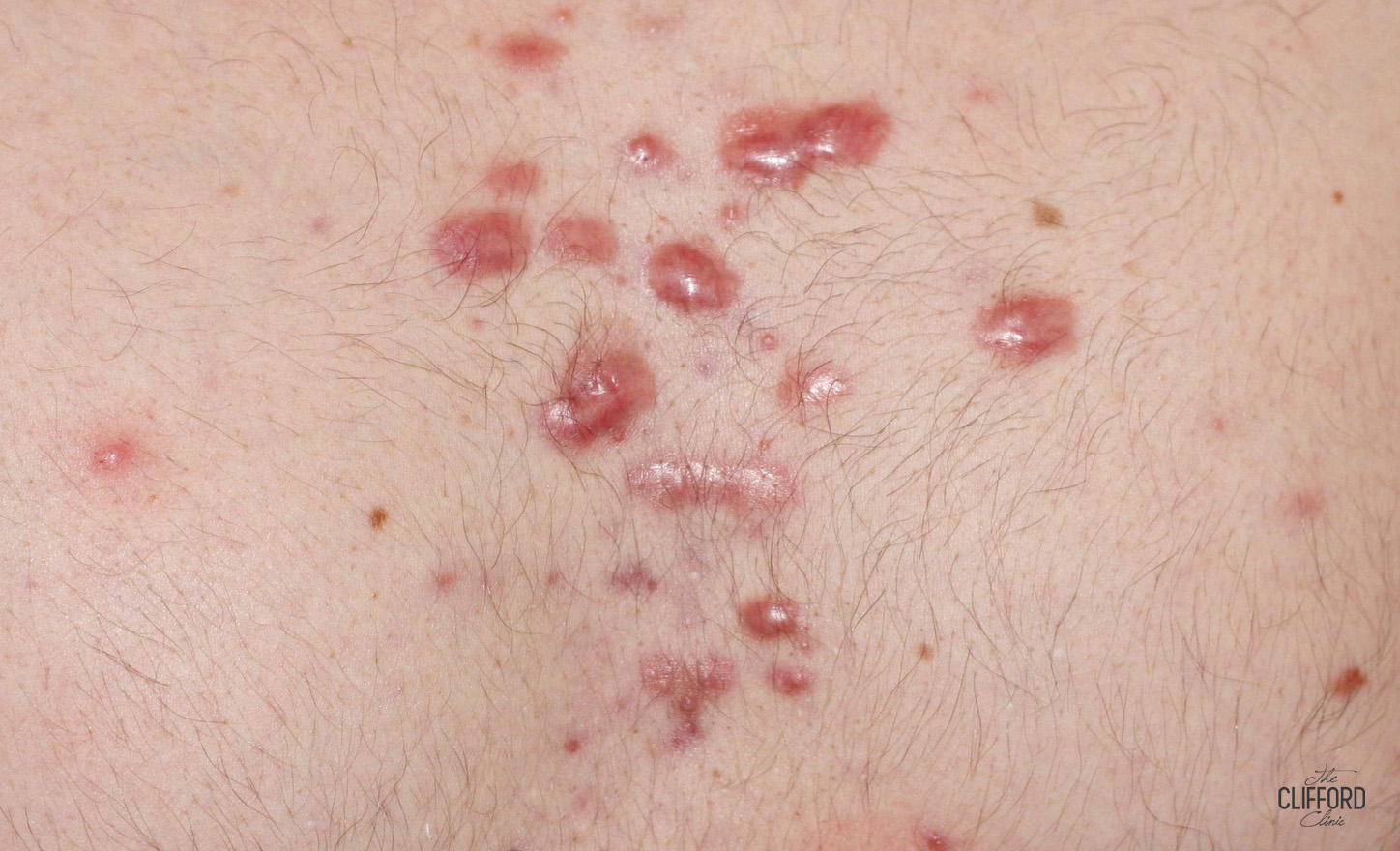
Keloids on the chest, shoulders and upper back are among the most common and the most difficult to treat. Two properties of this region account for that. The skin is held under constant mechanical tension by breathing, arm movement and posture, and the same skin is a frequent site of inflammatory acne, in which every cyst is a small dermal wound. Keloids consequently form readily here, extend along tension lines, and recur more persistently than keloids at a low-tension site such as the earlobe.
This guide sets out why keloids at these sites behave differently and how they are treated. It sits within our wider keloid scar treatment Singapore resource.
Why Chest, Shoulder and Back Keloids Are Different
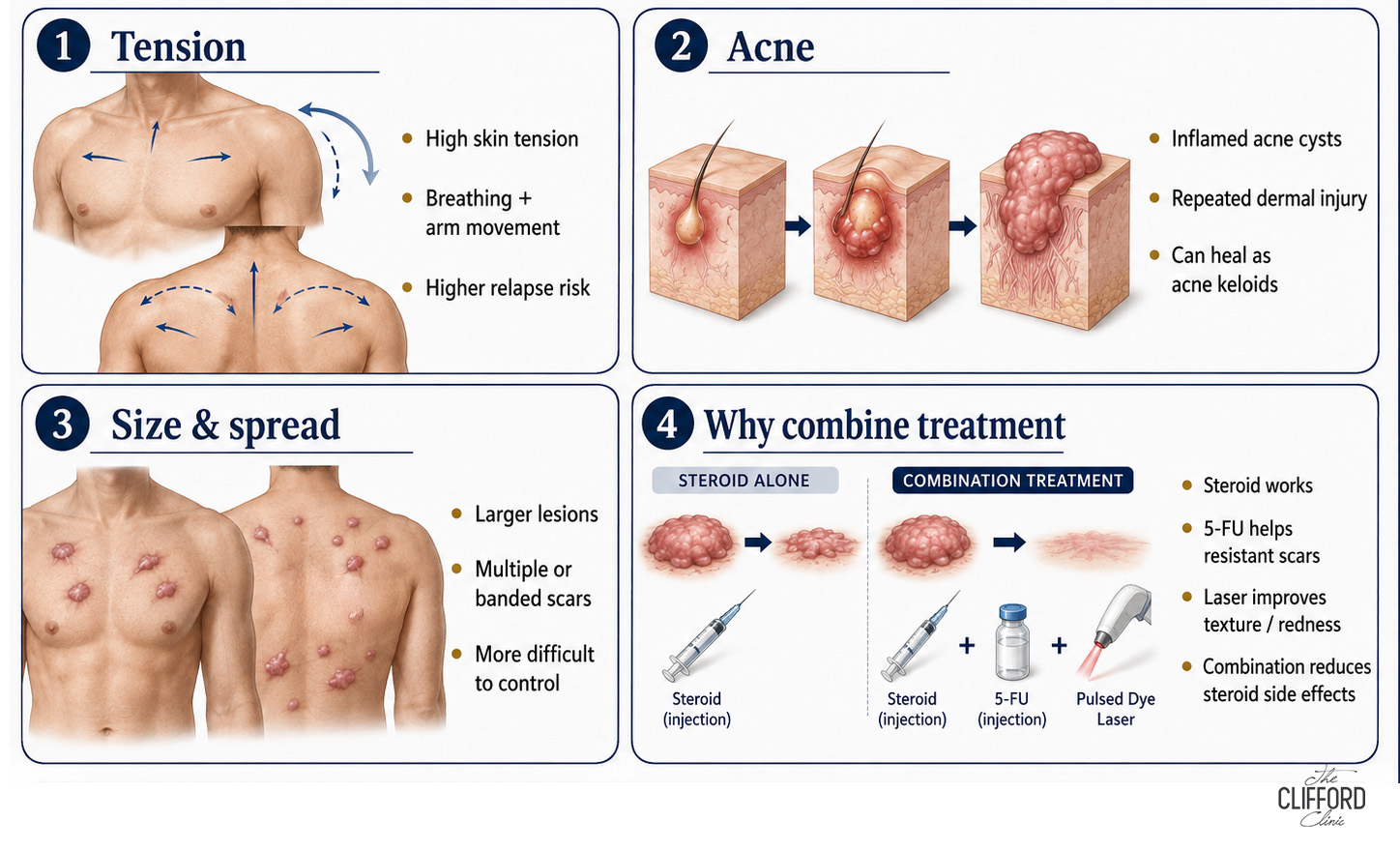
Three factors account for the difficulty of treating keloids at these sites. The first is mechanical tension. The skin over the chest, shoulders and upper back is stretched continuously by breathing, arm movement and posture, and sustained wound tension is a recognised driver of keloid formation. Anatomical site is an independent predictor of relapse, and in a series of 834 keloids treated by excision and adjuvant radiotherapy, site remained significantly associated with recurrence on multivariate analysis, alongside lesion size and the interval between surgery and irradiation [12]. The second is acne. Inflammatory acne of the chest and back is common, and every inflamed cyst is a small dermal wound that, in keloid-prone skin, can heal as an acne keloid. The third is size and distribution, because tension combined with multiple acne sites produces keloids that are larger, more numerous or banded, and lesion size is itself associated with a higher rate of relapse [12].
Much of the strongest keloid evidence comes from this region. The trial that established the comparative standing of intralesional corticosteroid, 5 fluorouracil and pulsed dye laser was conducted on keloidal and hypertrophic scars of the chest, and all three produced significant improvement. The intralesional preparations acted faster on scar induration, while the laser acted more effectively on scar texture. Adverse effects, comprising hypopigmentation, telangiectasia and skin atrophy, occurred in half of the segments given corticosteroid alone and in none of the segments given the other regimens [4]. That contrast is the practical argument for combining agents rather than escalating the steroid dose.
Treatment Options for Chest and Shoulder Keloids
Steroid Injections
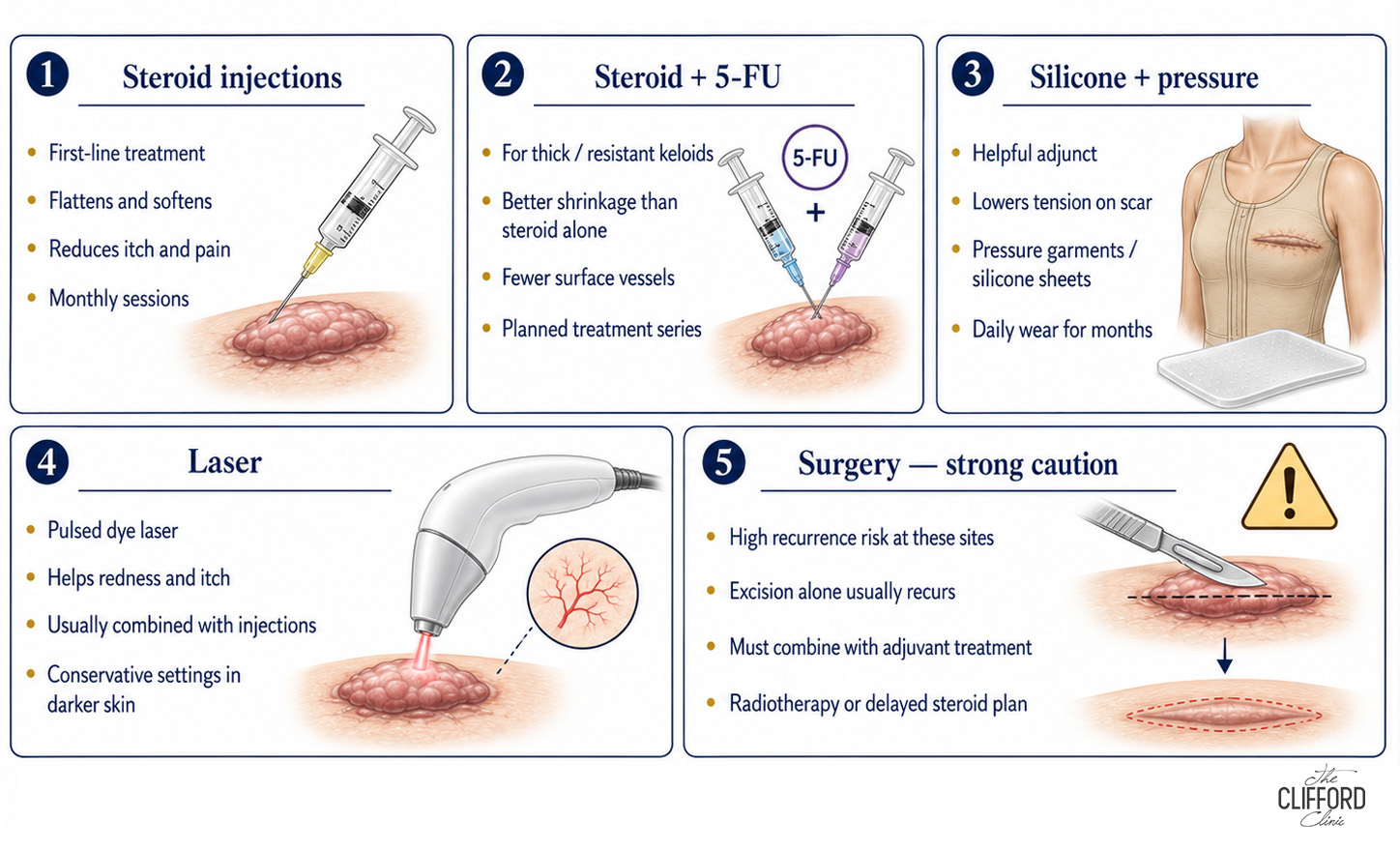
Intralesional corticosteroid injections remain first line. They soften, flatten and shrink the keloid and relieve the itch and tenderness these scars often cause, by suppressing local inflammation and reducing the activity of the cells that build the scar’s collagen. Across 42 comparative studies, corticosteroid alone produced a large and consistent improvement in scar severity, and the certainty of that evidence was rated highest for reduction in scar volume, pain and itch [2][5]. Injections are given at monthly intervals, and for larger or banded keloids at these sites they usually form the base of a longer combination plan. See our steroid injections guide.
5-FU and Steroid Injections for Persistent Keloids
For a chest or shoulder keloid that remains raised, a treatment review can include a discussion of 5-FU with triamcinolone. Clinical trials involving keloids and hypertrophic scars have reported improved scar reduction with this combination compared with triamcinolone alone13,14.
These studies support an individualised discussion rather than a guaranteed result for every scar. The research includes different scar types and treatment schedules, so its findings should not be presented as a chest- or shoulder-specific success rate13,14.
Read the dedicated guide to 5-FU treatment for keloid scars, including how combination injections are studied and what patients should understand before treatment.
Silicone and Pressure
Silicone sheeting suits the flat, coverable skin of the chest, shoulders and back particularly well, and it is a valuable adjunct both for flattening a keloid and for preventing its return. It acts by occluding and hydrating the scar surface, which reduces the signalling that keeps the scar’s collagen-forming cells overactive and lowers tension across the lesion, and pressure garments fitted over these broader areas after treatment counter the same mechanical tension that drives regrowth [2]. Both require several months of daily wear, typically twelve hours a day or more, and neither carries any risk of pigment change. See our silicone gel sheets guide.
Laser
Pulsed dye laser reduces the redness and itch of an active chest or shoulder keloid by targeting the small blood vessels that supply the scar, which lowers its blood supply and with it the inflammatory drive that keeps the lesion raised and symptomatic, and it is usually combined with injection rather than used on its own [1][4]. The Cochrane review of laser therapy for hypertrophic and keloid scars pooled 15 randomised trials in 604 patients and found that 585 nanometre pulsed dye laser improved scar severity compared with no treatment, although the certainty of that evidence was low and the trials were small [3]. Laser is therefore used here as an adjunct rather than as a primary treatment. In darker skin tones, settings must be conservative to limit pigment change, which is covered in our laser treatment guide.
Surgery, With Strong Caution
Surgery on chest and shoulder keloids carries a higher recurrence risk than at most other sites, precisely because the tension that produced the keloid continues to act on the closure. Excision alone almost always recurs [2], and anatomical site remains an independent predictor of relapse even where adjuvant treatment is given [12]. Where surgery is used at these sites it must be combined with adjuvant therapy, and the adjuvant evidence is specific rather than general. Radiotherapy given promptly after excision substantially reduces recurrence. A series of 250 resected keloids reported an overall recurrence of 5.6 per cent, falling to 1.6 per cent where the radiotherapy was delivered as five fractions rather than as the lower dose given in three or four [10]. A further series of 100 patients using the five-fraction schedule reported local control of 84.8 per cent at a median of 59 months [11]. Where corticosteroid is used as the adjuvant instead, timing matters, and injection 10 to 14 days after surgery is more effective than injection before or during it [2]. The closure is also planned to spread tension away from the wound edges, with silicone or pressure applied once the wound has healed. See our keloid recurrence guide.
Treating Acne to Prevent More Keloids
Where chest and shoulder keloids arise from acne, treating the keloids without controlling the acne leaves the cause in place, because each new inflamed lesion is a fresh dermal wound capable of forming a new keloid. An effective plan therefore runs acne treatment and keloid treatment in parallel, and acne control continues after the existing keloids have settled. The requirement is greatest in younger patients with active chest and back acne, in whom new lesions continue to appear while established keloids are still under treatment.
Everyday Habits That Help
Tension and friction sustain these keloids, so daily habits form part of the treatment plan. Tight straps, heavy backpacks and rough fabrics that rub across a healing scar are best avoided, the area is kept out of direct sun while it settles, and acne on the chest and back should not be picked or squeezed. None of these measures replaces medical treatment, but together they reduce the repeated minor injury that keeps a high-tension keloid active.
What to Expect, Recovery and Recurrence
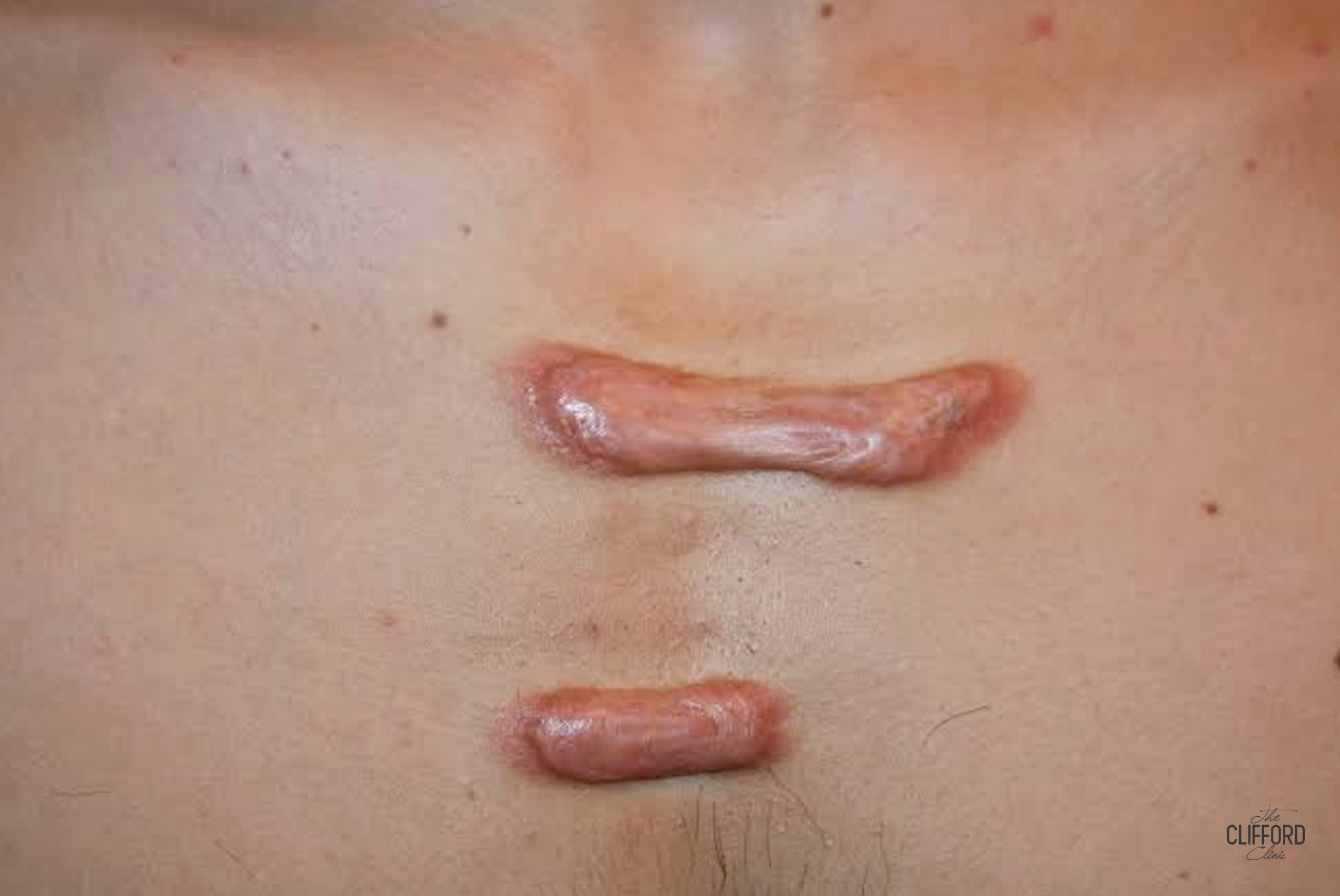
Tension and lesion size mean that chest and shoulder keloids generally require longer combination courses and closer follow-up than smaller keloids elsewhere. A typical plan comprises monthly injection sessions over four to six months, daily silicone or pressure wear throughout, acne control where relevant, and review continuing for at least twelve months, because in the largest published series relapse occurred at a median of twelve months after treatment and in every case within twenty-eight months [12]. Early signs of regrowth, such as renewed firmness or a spreading raised edge, warrant prompt review, because re-injecting a small area of recurrence is considerably easier than treating a re-established keloid.
Frequently Asked Questions
Why do I keep getting keloids on my chest and shoulders?
These areas combine continuous mechanical skin tension with frequent inflammatory acne, and both drive keloid formation in keloid-prone skin. New keloids are therefore seeded repeatedly unless the acne is brought under control. Controlling the acne and treating each keloid early are the two measures that most reduce further lesions.
What is the best treatment for a chest keloid?
Steroid injections are usually first line, commonly combined with silicone, and with 5 fluorouracil or laser added for thicker keloids. In the published comparisons, corticosteroid with 5 fluorouracil and laser ranks highest for effectiveness [6][7]. Surgery is used cautiously and only alongside adjuvant therapy, because chest keloids recur readily.
Can acne cause keloids on the chest and back?
Acne is one of the two principal causes of keloids at these sites. Inflamed acne lesions are small dermal wounds, and in keloid-prone skin they can heal as acne keloids. Treating the acne is therefore part of preventing further keloids.
Do chest and shoulder keloids come back after treatment?
They recur more readily than keloids at low-tension sites, which is why combination therapy, silicone or pressure, and long-term follow-up are important. Excision alone almost always recurs, whereas excision followed promptly by radiotherapy has reported recurrence in the region of 5 to 15 per cent [2][10][11][12].
Is silicone good for chest keloids?
Silicone is well suited to this region. The flat, coverable skin of the chest and shoulders holds a sheet reliably, which makes it a practical adjunct for flattening a keloid and for reducing the chance of recurrence, provided it is worn daily for several months.
The Clifford Clinic Approach
Over more than 16 years of treating keloid scars, The Clifford Clinic has found that keloids treated with steroid injections alone almost always come back. Our signature approach combines V Beam pulsed dye laser, botulinum toxin and steroid injections, supported by silicone. These act on different components of the keloid at the same time, the laser on its blood supply, the botulinum toxin on the tension held across it, and the steroid on the inflammation within it, and in combination they can prevent recurrence. The botulinum toxin component is supported by published work, in which three monthly intralesional sessions produced significant clinical and histological improvement sustained at six months [8], while a direct comparison with 5 fluorouracil found excellent or good flattening in about 79 per cent of keloids treated with botulinum toxin against about 49 per cent of those treated with 5 fluorouracil, with less pain, less itch and no hyperpigmentation [9]. Very few centres offer V Beam for keloids, yet in our experience it is fundamental to keeping them from returning, and it can be performed safely on darker skin tones, so patients across Singapore’s skin types can benefit. A keloid is never removed by surgery alone here, because excision without adjuvant treatment recurs. For large or persistent keloids, surgery combined with radiotherapy can be highly effective. Young keloids are treated early rather than observed, and pigment-safe, skin-tone-aware treatment is chosen from the outset. You can read more about our clinic at cliffordclinic.com and about Dr Gerard Ee at drgerardee.com.
Medically reviewed by Dr Gerard Ee. This article is educational and does not replace a consultation. To have a chest, shoulder or back keloid assessed in Singapore, contact The Clifford Clinic.
Related Guides
Keloid scar treatment in Singapore, the complete guide
Steroid injections for keloids
Laser treatment for keloid scars
Ear keloid removal in Singapore
Keloid treatment cost in Singapore
Why keloids come back after surgery
Silicone gel sheets for keloids
5-FU for keloids: steroid combinations and treatment risks
References
1.Laser Therapy of Traumatic and Surgical Scars and an Algorithm for Their Treatment. Lasers in Surgery and Medicine. 2020.
2.Management of Keloids and Hypertrophic Scars. American Family Physician. 2024.
3.Laser Therapy for Treating Hypertrophic and Keloid Scars. The Cochrane Database of Systematic Reviews. 2022.
4.Treatment Response of Keloidal and Hypertrophic Sternotomy Scars, Comparison Among Intralesional Corticosteroid, Fluorouracil, and 585-nm Flashlamp-Pumped Pulsed-Dye Laser Treatments. Archives of Dermatology. 2002.
5.Efficacy and Safety of Glucocorticoid-Based Therapies in the Management of Keloids, A Systematic Review and Meta-Analysis of Clinical Outcomes. Frontiers in Medicine. 2025.
6. Comparing Combination Triamcinolone Acetonide and 5-Fluorouracil With Monotherapy Triamcinolone Acetonide or 5-Fluorouracil in the Treatment of Hypertrophic Scars, A Systematic Review and Meta-Analysis. Plastic and Reconstructive Surgery. 2024.
7. Comparative Efficacy of Intralesional Therapies for Keloid Scars, A Network Meta-Analysis. Annals of Medicine. 2026.
8. Assessment of Intralesional Injection of Botulinum Toxin Type A in Hypertrophic Scars and Keloids, Clinical and Pathological Study. Dermatologic Therapy. 2022.
9. Botulinum Toxin Type A Versus 5-Fluorouracil in Treatment of Keloid. Archives of Dermatological Research. 2021.
10. Dose Effect in Adjuvant Radiation Therapy for the Treatment of Resected Keloids. International Journal of Radiation Oncology, Biology, Physics. 2018.
11. A Retrospective Study of Hypofractionated Radiotherapy for Keloids in 100 Cases. Scientific Reports. 2021. 12. Hypofractionated High-Energy Electron Beam Radiotherapy for Keloids. Journal of Radiation Research. 2015.
Author Bio
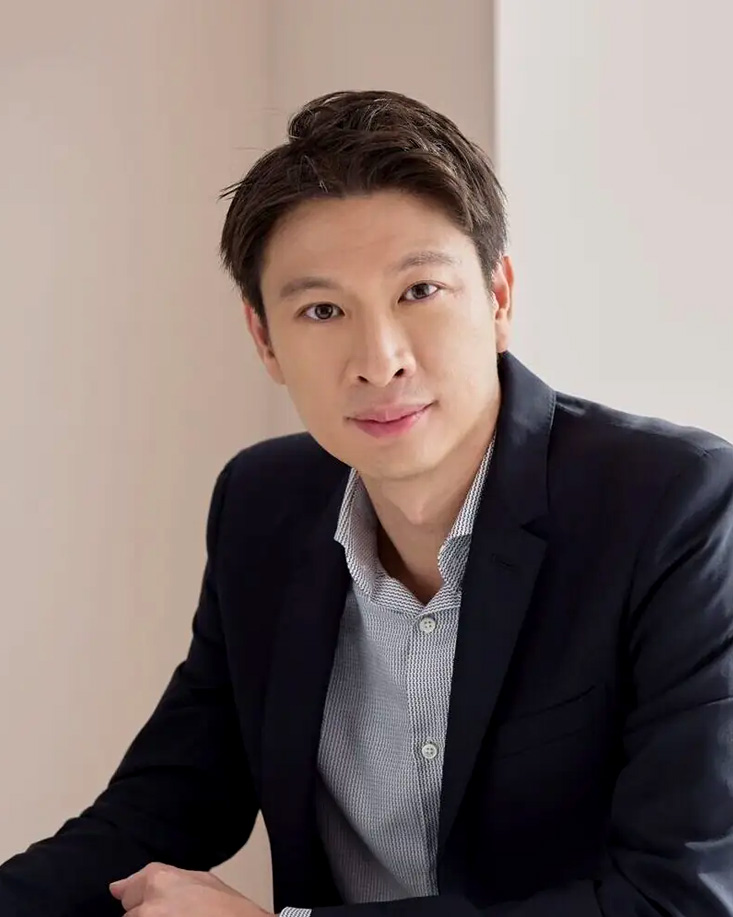
Dr Gerard Ee

Dr Gerard Ee is the Medical Director of The Clifford Clinic in Singapore. He earned his medical degree from St George's University of London and built his surgical experience across the Singapore General Hospital, National University Hospital, and Mount Sinai Hospital in New York. He holds Membership of the Royal College of Surgeons (Edinburgh) and a Postgraduate Diploma in Dermatology (Cardiff), and is fully accredited in aesthetic procedures including botulinum toxin, fillers, lasers, and light therapies. A strong advocate of minimally invasive, natural-looking results, Dr Ee has published in several medical and scientific journals and presented his research in cities including Taipei, Las Vegas, and London.
See all posts by Dr Gerard Ee »