
Laser Treatment for Keloid Scars in Singapore, Benefits, Limits and Cost
Laser treatment for keloid scars is frequently requested as it is effective in reducing a keloid’s redness, height and itch as part of a combination plan. It is however not a standalone treatment for an established keloid. This guide from The Clifford Clinic explains what laser genuinely achieves for keloids in Singapore, and it sits within our wider keloid scar treatment Singapore resource.
How Laser Works on Keloid Scars
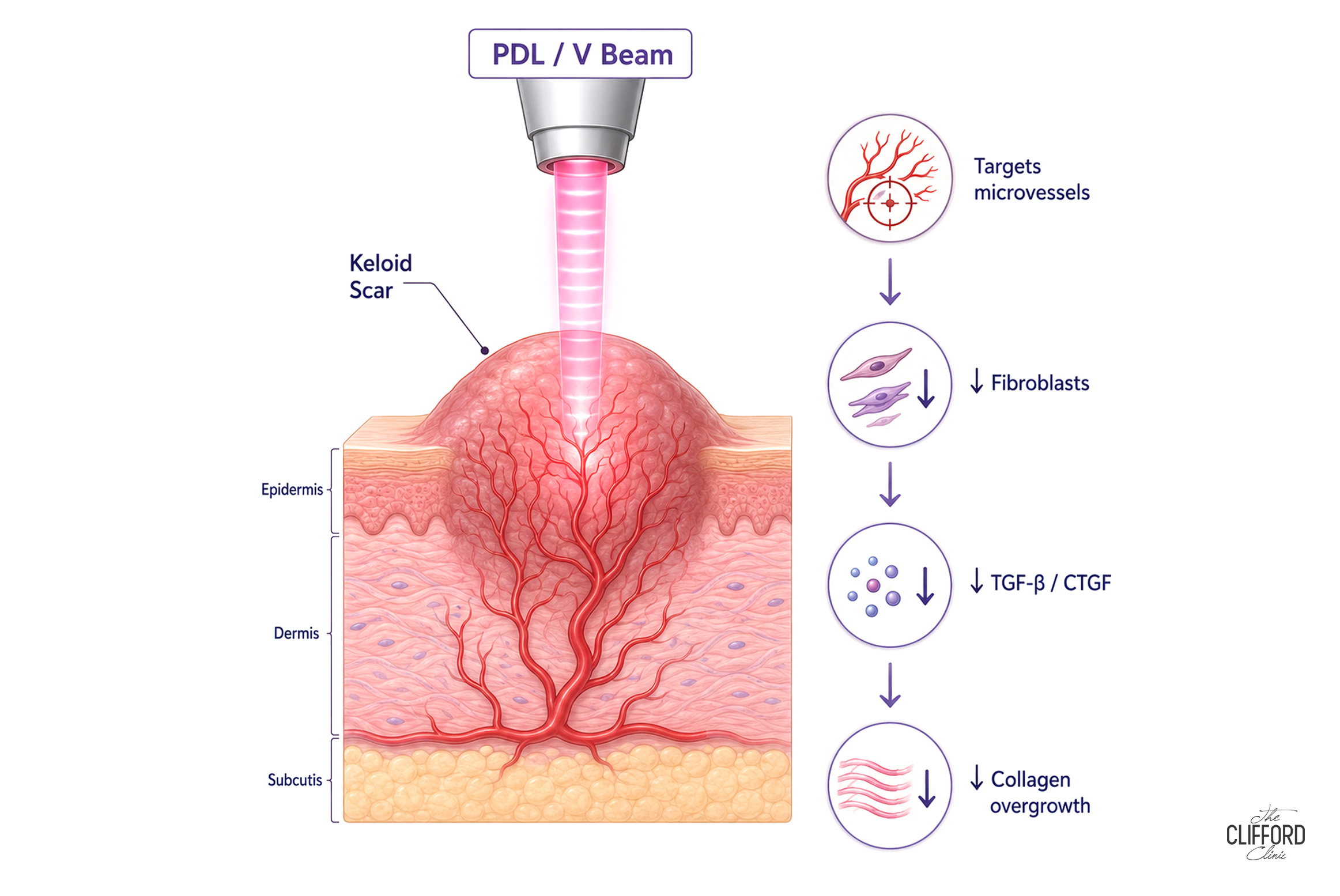
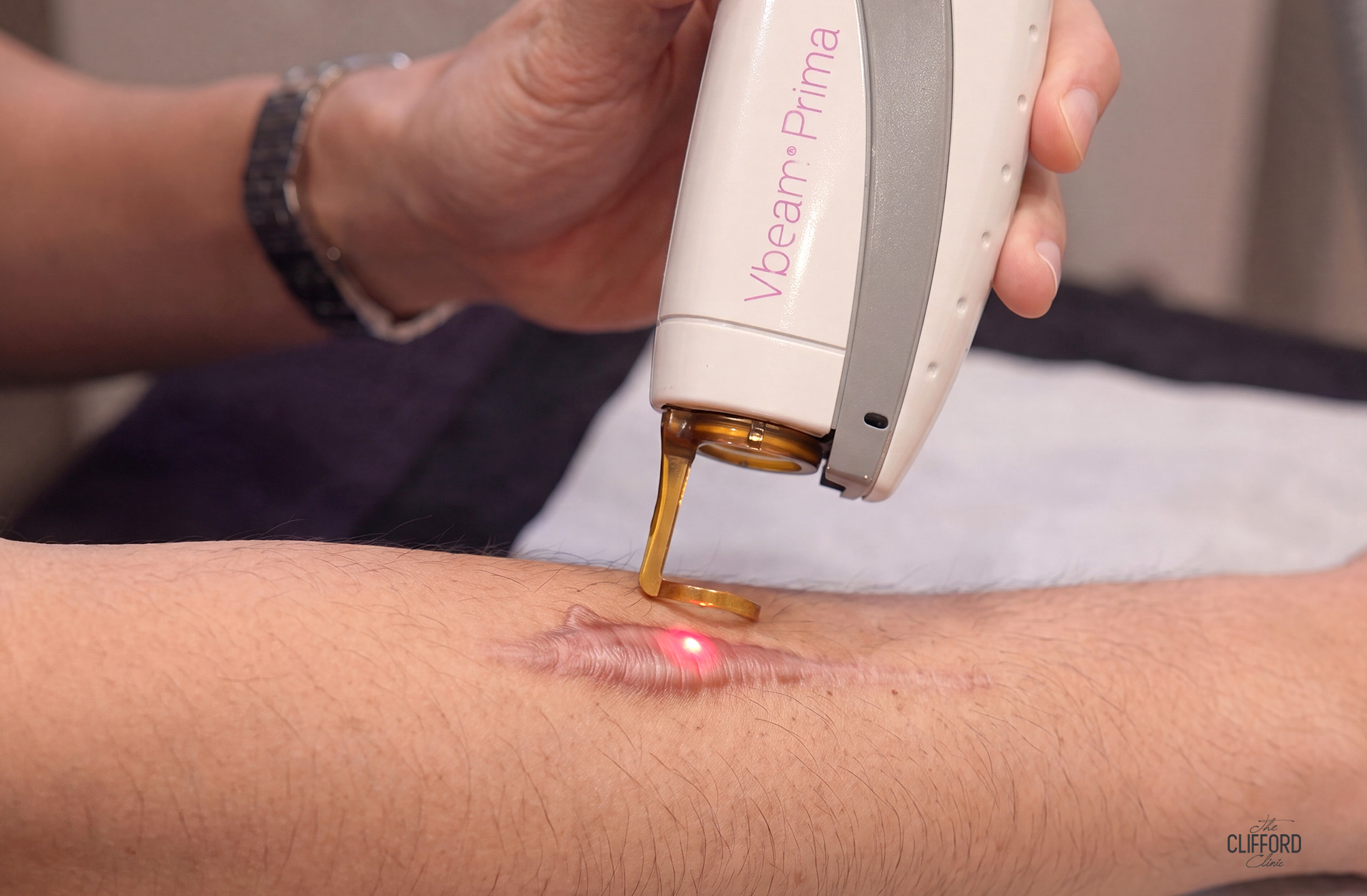
The most established laser for keloids is the pulsed dye laser (PDL), delivered by systems such as V Beam. Its light targets the abnormal microvasculature that characterises keloid tissue, a principle called selective photothermolysis [1]. Closing these vessels reduces the delivery of oxygen, inflammatory mediators and growth factors to the scar, which starves the overgrowth of its supply lines.
The effect goes beyond vascular destruction. Pulsed dye laser suppresses fibroblast proliferation, reduces expression of TGF beta and connective tissue growth factor, and increases fibroblast apoptosis, which collectively lowers the excessive collagen production behind keloid formation [1]. Best results come from large spot sizes and lower energy settings, with sessions generally scheduled several weeks apart for immature scars so the skin can recover between treatments [1].
Fractional lasers are sometimes used to create microscopic channels that help medicines such as corticosteroids penetrate a thick keloid more evenly, but immature or unstable scars require gentle settings to avoid provoking further keloid growth [1].
What Laser Realistically Achieves
Laser improves keloids more than no treatment, although the certainty of the evidence remains limited [3].
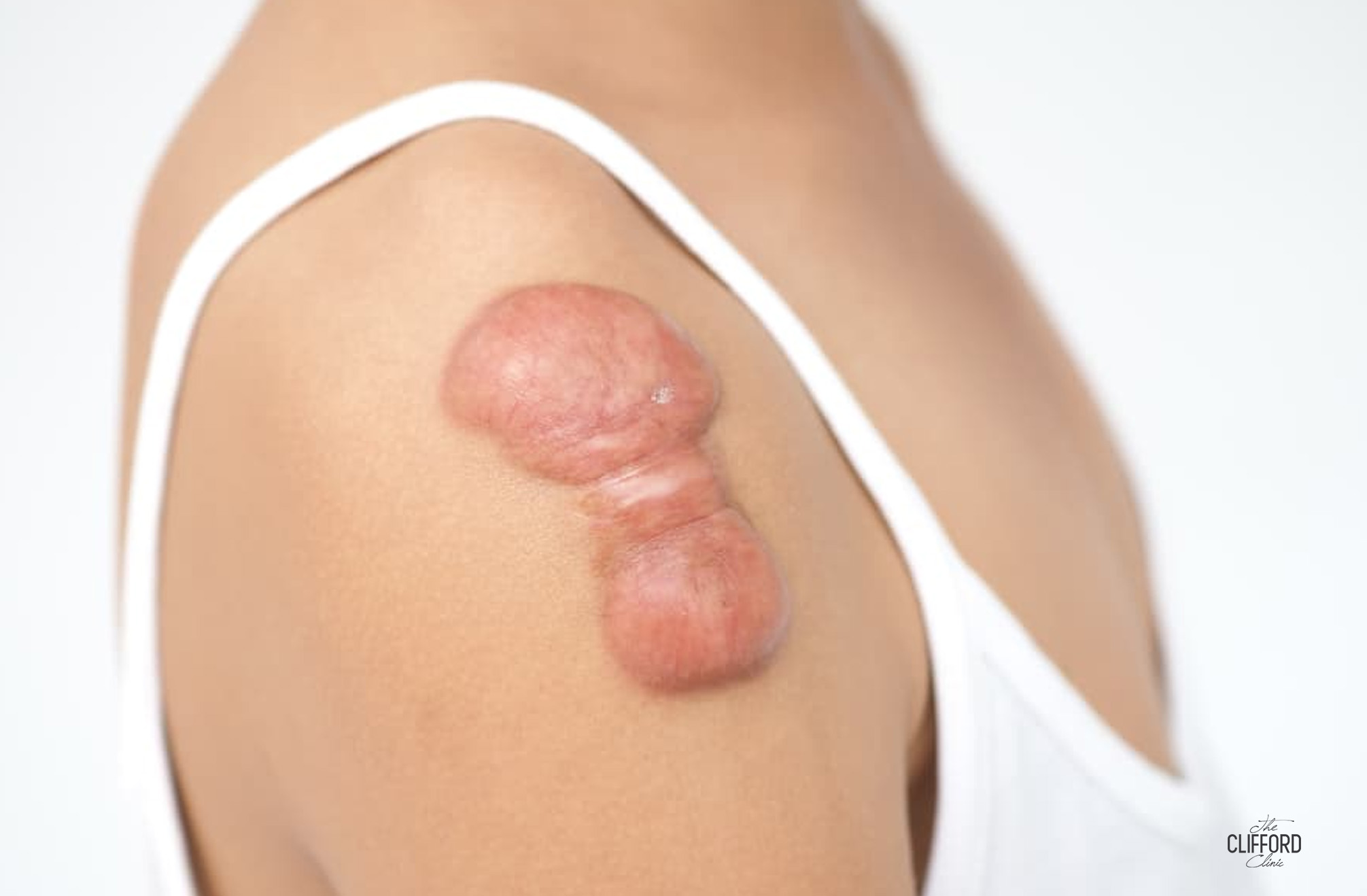
A direct comparison is instructive. In a study of chest scars comparing pulsed dye laser with intralesional corticosteroid and 5 fluorouracil, all three flattened scars, but the intralesional treatments flattened scars faster and to a greater degree, while laser still produced meaningful improvement [4]. In practical terms, laser is especially good at calming redness and itch and improving surface texture, while injections do more of the heavy lifting on bulk and height. Laser is therefore a credible component of care, not a proven silver bullet, and it works best on red, mildly raised scars [1].
Sessions, Timeline and Recovery
Laser treatment for keloids is a course. Sessions are typically spaced several weeks apart for immature scars, and some keloids need many sessions over an extended period to reach a satisfying result [1]. Each session is short.
Afterwards, expect temporary bruising that usually settles within a couple of weeks, mild swelling and transient redness. Blistering or crusting can occur but is uncommon. Modern V Beam devices spray a cooling burst onto the skin surface to protect the outer layer and reduce discomfort. There is generally little downtime, although sun protection on the treated area is important during healing, because ultraviolet exposure can darken a healing scar. Improvement is cumulative, so results should be judged after the course, not after one session.
Skin Tone and V Beam in Singapore
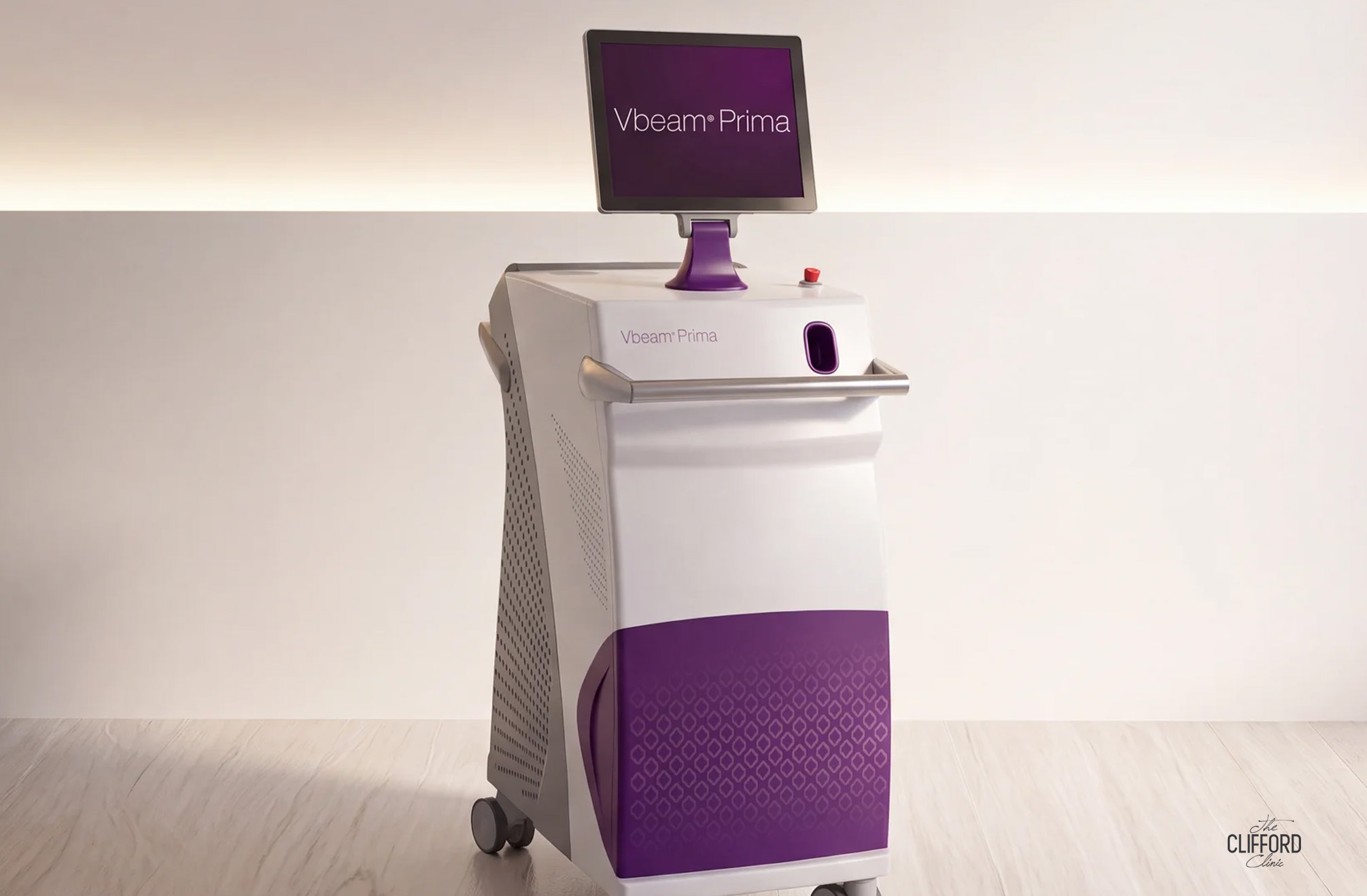
V Beam pulsed dye laser can be performed safely on darker skin tones, which matters in Singapore where most patients have medium to deep skin. In our experience, with appropriate settings and cooling, V Beam is well tolerated across skin types and is a core part of preventing keloid recurrence. Technique still matters, so treatment should be carried out by an experienced practitioner who adjusts the device to your skin. Cryotherapy, by contrast, can lighten darker skin, so it is the pigment concern that is used more selectively.
Laser Works Best in Combination
Modern keloid care rarely uses laser alone. Adding intralesional corticosteroid, with or without 5 fluorouracil, enhances results for mildly hypertrophic red scars, because the laser addresses vascularity while the injected medicine suppresses collagen overproduction [1]. The combination of 5 FU, corticosteroids and laser ranks among the most effective intralesional approaches studied [7]. Laser also pairs well with steroid injections, which soften and flatten the bulk of the keloid, and with silicone therapy to protect results.
In the overall hierarchy, laser is usually a second line or adjunctive option and a symptom control tool for red, itchy keloids. If you want to avoid surgery entirely, laser is one component of a non surgical plan.
What Does Keloid Laser Treatment Cost in Singapore?
Laser generally costs more per session than a steroid injection, and because keloids need several sessions, the total depends heavily on the number required, which in turn depends on the keloid’s size, colour and response. Combining laser with injections adds to the plan cost. We provide an individual estimate at consultation. For the factors that drive keloid pricing, read keloid treatment cost in Singapore.
Who Is a Good Candidate?
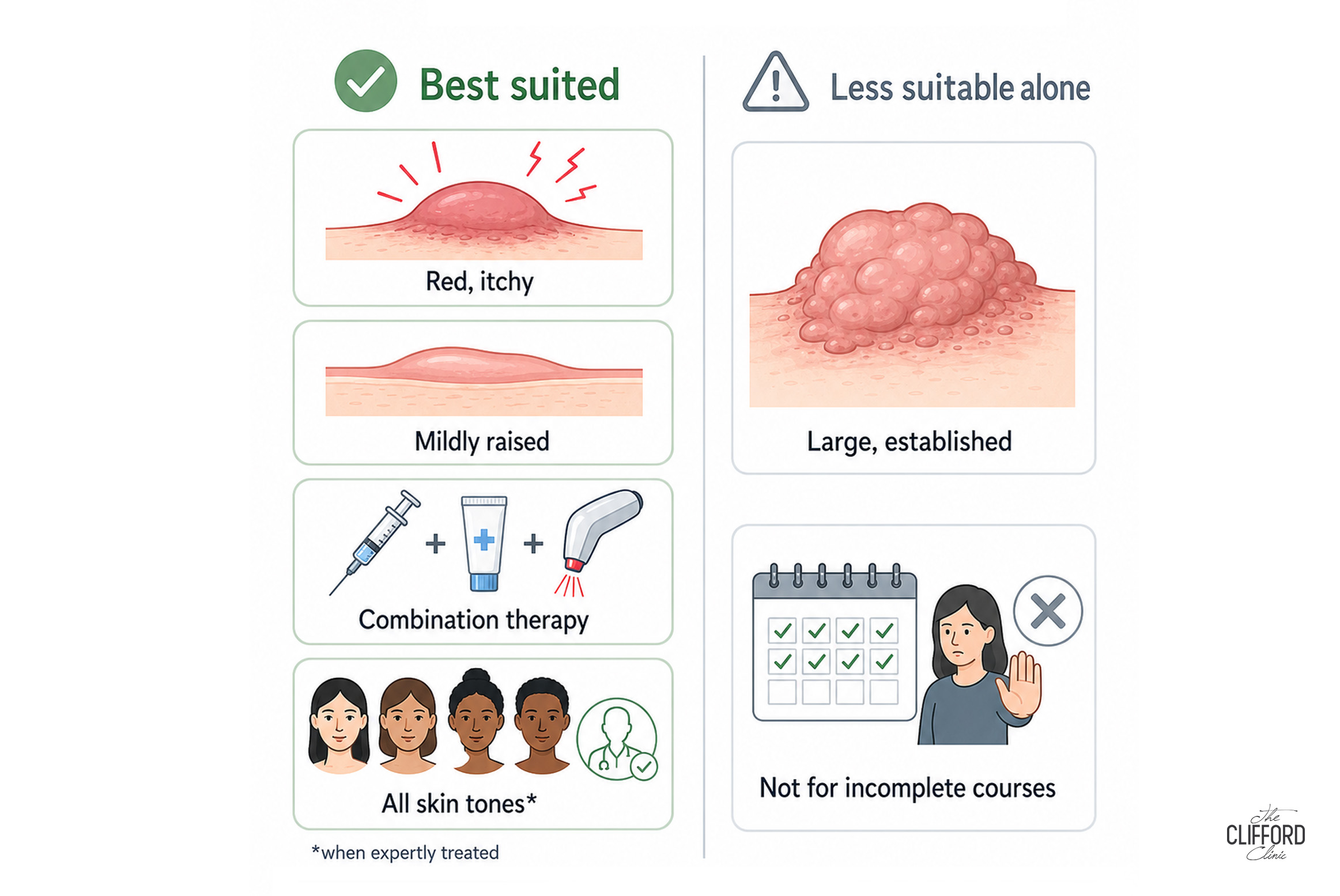
Laser tends to suit red, vascular, actively symptomatic keloids where itch and redness respond best, mildly elevated scars, patients already on combination therapy, and patients of any skin tone when treated by an experienced practitioner [1]. It is less suitable as sole therapy for large established keloids, or for patients unwilling to complete a multi-session course.
Frequently Asked Questions
Does laser treatment remove keloids permanently?
No laser reliably removes keloids permanently. Laser reduces redness, itch and height, usually within combination therapy, and recurrence remains possible [3][4].
How many laser sessions does a keloid need?
Sessions are typically spaced several weeks apart, and some keloids need many sessions over an extended course [1].
Is laser safe for keloids on dark skin?
Yes. V Beam pulsed dye laser can be performed safely on darker skin tones with appropriate settings and cooling. In our experience it is well tolerated across skin types and is central to preventing recurrence.
How much does keloid laser treatment cost in Singapore?
Laser costs more per session than injections, and totals depend on the number of sessions needed. We give an individual estimate at consultation.
Does keloid laser treatment hurt?
Most patients describe a snapping sensation, well tolerated with topical anaesthetic and device cooling. Treated skin may look bruised for a short time after pulsed dye laser.
The Clifford Clinic Approach
Over more than 16 years of treating keloid scars, The Clifford Clinic has found that steroid injections alone almost always fail, so our signature approach combines V Beam pulsed dye laser, botulinum toxin and steroid injections, supported by silicone. These act on different parts of the keloid at once and together prevent recurrence. Very few centres offer V Beam for keloids, yet in our experience it is fundamental to preventing recurrence. We never remove a keloid by surgery alone, because surgery on its own does not work for keloids and the scar comes back. For large or stubborn keloids, surgery combined with radiotherapy is effective. We treat young keloids early rather than waiting, and we choose pigment safe, skin tone aware treatment from the start. Read more about our clinic at cliffordclinic.com.
Medically reviewed content. This article is educational and does not replace a consultation. To find out whether laser suits your keloid, contact The Clifford Clinic, Singapore.
Related Guides
Keloid scar treatment in Singapore, the complete guide
Steroid injections for keloids
References
- Laser Therapy of Traumatic and Surgical Scars and an Algorithm for Their Treatment. Lasers in Surgery and Medicine. 2020.
- Management of Keloids and Hypertrophic Scars. American Family Physician. 2024.
- Laser Therapy for Treating Hypertrophic and Keloid Scars. The Cochrane Database of Systematic Reviews. 2022.
- Treatment Response of Keloidal and Hypertrophic Sternotomy Scars, Comparison Among Intralesional Corticosteroid, Fluorouracil and 585 nm Pulsed Dye Laser. Archives of Dermatology. 2002.
- Efficacy and Safety of Glucocorticoid Based Therapies in the Management of Keloids, a Systematic Review and Meta Analysis. Frontiers in Medicine. 2025.
- . Comparing Combination Triamcinolone Acetonide and 5 Fluorouracil With Monotherapy in the Treatment of Hypertrophic Scars. Plastic and Reconstructive Surgery. 2024.
Author Bio
Dr Gerard Ee

Dr Gerard Ee is the Medical Director of The Clifford Clinic in Singapore. He earned his medical degree from St George's University of London and built his surgical experience across the Singapore General Hospital, National University Hospital, and Mount Sinai Hospital in New York. He holds Membership of the Royal College of Surgeons (Edinburgh) and a Postgraduate Diploma in Dermatology (Cardiff), and is fully accredited in aesthetic procedures including botulinum toxin, fillers, lasers, and light therapies. A strong advocate of minimally invasive, natural-looking results, Dr Ee has published in several medical and scientific journals and presented his research in cities including Taipei, Las Vegas, and London.
See all posts by Dr Gerard Ee »