
Dark Eye Circles Treatment in Singapore. Treating the Cause, Not Just the Colour
Dark eye circles in Singapore are treated according to cause, which may be vascular, pigmented, structural or skin thinning. Where allergic rhinitis is the cause, allergy testing and sublingual immunotherapy address it while V Beam Eyes and Juvelook Eyes treat the visible discolouration. Nasal symptoms usually improve after 8 to 14 weeks and the full course lasts 3 to 5 years. Not every dark circle is allergy related, and some patients are advised that no procedure is appropriate.
Dark eye circles are among the most persistent concerns treated at The Clifford Clinic. Persistence reflects the number of distinct causes rather than a shortage of available treatments. Four separate mechanisms produce under-eye darkness, each responding to a different intervention, and the allergic cause is the one most frequently missed.
Allergy-related circles return after creams or laser treatment because the vascular congestion producing them is continually renewed. Dr Gerard Ee, founder and medical director of The Clifford Clinic, identifies the cause first, then treats the allergy and the circles together using allergy testing, sublingual immunotherapy, V Beam Eyes and Juvelook Eyes. In my experience treating patients who arrive after several rounds of creams and laser, I have found that the ones who relapse fastest are those whose year-round nasal symptoms were never asked about. Allergy is not the cause in every patient, and where testing is negative the treatment plan changes accordingly.
The four causes of dark eye circles
Under-eye darkness has four main causes. Each responds to a different treatment, so a treatment chosen before the cause is established frequently fails.
| Type | Clinical Appearance | Underlying Cause | Our Treatment Verdict |
|---|---|---|---|
| Vascular | Bluish, purplish or dusky discolouration | Congested vessels showing through thin skin, most often driven by allergic rhinitis | Treat the allergy first. V Beam Eyes clears the vessels, which creams and concealers cannot reach. |
| Pigmented | Brownish discolouration that remains when the skin is stretched | Melanin from genetics, rubbing, eczema or sun exposure | Treat the pigment, although the response is commonly partial and holds only once the rubbing, eczema or sun exposure driving it stops. |
| Structural Shadow | Darkness that disappears in direct light or when the skin is stretched | A tear trough groove or an eye bag casting shadow | Not a discolouration, so lasers and creams will not change it. The contour is corrected, as covered on our eye bag and tear trough pages. |
| Skin Thinning | Vessels and muscle visible through crepey thin skin | Age, chronic rubbing or genetics | Collagen stimulation with Juvelook Eyes thickens the skin so the structures beneath show through less. Vascular laser alone will not correct it. |
Many patients present with more than one cause, most often vascular darkness combined with mild pigmentation. Colour is separated from shadow at consultation by the stretch test. Where the darkness disappears when the skin is gently stretched under direct light, the finding is a shadow cast by contour rather than a discolouration of the skin. The contour responsible is usually a tear trough groove or an eye bag rather than a pigment problem. Where the darkness remains, its colour, the condition of the skin and a history of rubbing, eczema or year-round nasal symptoms determine whether the cause is vascular, pigmented or allergy-related. In my experience examining under-eye darkness, I have found that the stretch test reclassifies a substantial number of patients who arrive certain that they have a pigment problem, because the darkness visible in a bathroom mirror is often a shadow cast by a tear trough groove. The distinction is set out in the comparison of eye bags and tear troughs, and it matters because no treatment directed at colour will lighten a shadow.
Allergic rhinitis, the most commonly missed cause of dark eye circles
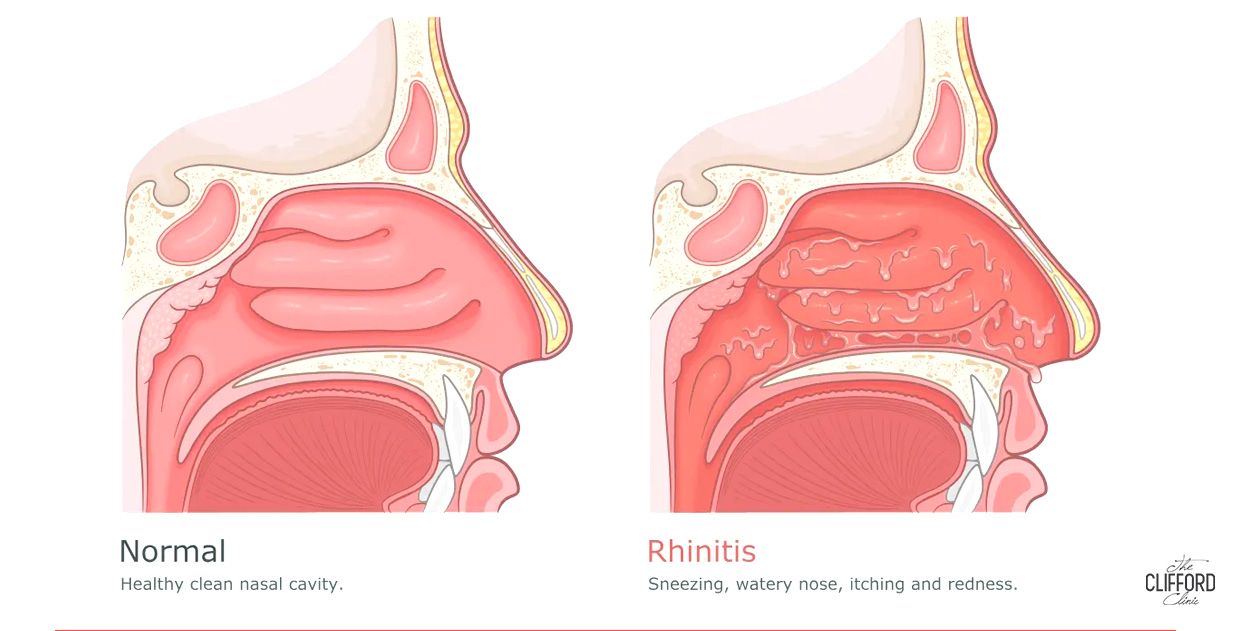
Perennial allergic rhinitis affects around 13 percent of the Singapore population. House dust mites are the dominant airborne allergen, and a warm humid climate sustains them indoors all year. Exposure is therefore continuous rather than seasonal, and symptoms such as morning sneezing, nasal blockage, a runny nose and itchy eyes or nose persist year-round.
The condition reaches the under-eye area through two separate mechanisms. First, chronic nasal and sinus inflammation obstructs venous drainage from the face, so blood pools in the vessels beneath the thin lower eyelid skin and shows through as the bluish, dusky discolouration known as allergic shiners. Second, repeated rubbing provokes post-inflammatory pigmentation and thins the skin further, which makes the congested vessels beneath it more visible.
Creams, concealers and laser treatment directed at the surface leave that congestion in place, so any improvement lasts only while the allergy is quiet. Sustained clearance therefore depends on removing the allergic trigger rather than repeating the surface treatment. Treating the rhinitis carries benefit beyond appearance, as uncontrolled allergic rhinitis is associated with asthma and chronic sinus disease. Early treatment may reduce that progression, particularly in children and adolescents. Allergic rhinitis is nonetheless only one of the four causes, and it is not established that controlling it clears the discolouration in every patient in whom it is present. Where circles have been present since childhood and run in the family, a constitutional pigmentary pattern may persist after the rhinitis is well controlled.
Treating allergy-related dark eye circles in three steps
For allergy-related dark circles, we treat the cause and the visible effects in parallel. Testing identifies the responsible allergen, sublingual immunotherapy reduces the allergic response driving the congestion, and V Beam Eyes with Juvelook Eyes treat the discolouration already present.
Step 1. Confirm the allergen with a blood test and a skin-prick test
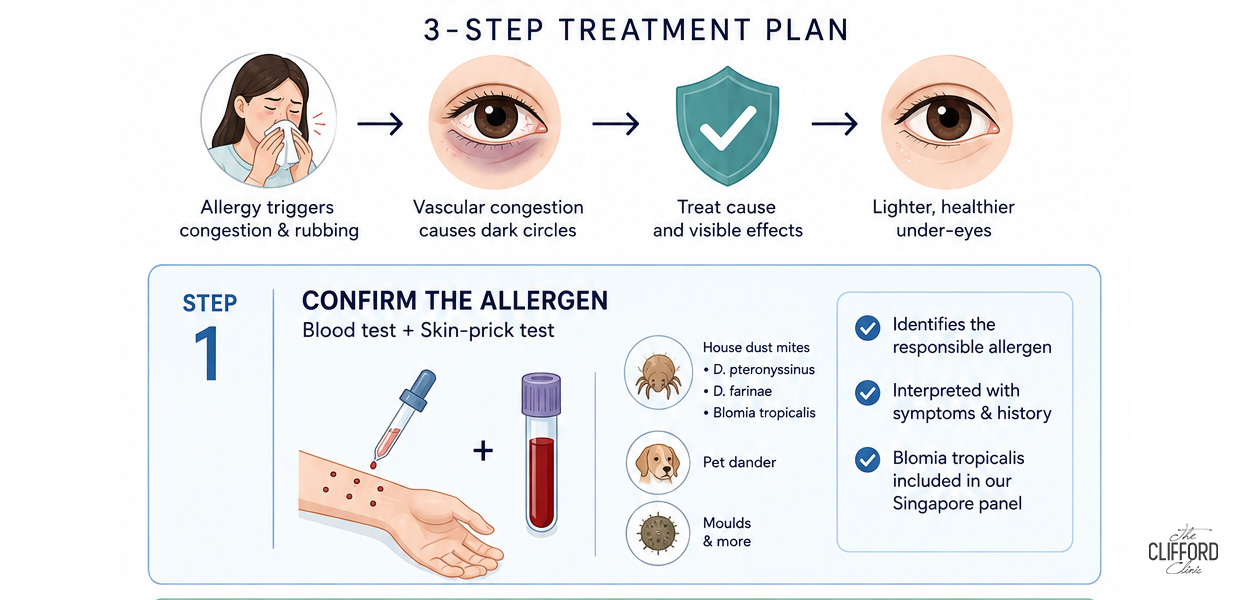
Treatment begins with objective testing because immunotherapy is effective only against the allergen it is formulated from. A skin-prick test places small drops of allergen extract on the forearm and pricks the skin beneath each drop. Where IgE antibodies to that allergen are already bound to mast cells in the skin, the contact triggers histamine release and a raised wheal appears within about 20 minutes, measured against a positive and a negative control. The result is interpreted alongside the patient’s symptoms and exposure history rather than treated as a diagnosis on its own, because sensitisation detected on testing does not always produce symptoms. The test is generally well tolerated, including by children. A blood test measures allergen-specific IgE antibodies in the circulation and is used where eczema at the test site or recent antihistamine use would suppress the skin reaction, since antihistamines block the same histamine response the skin-prick test depends on.
Our Singapore testing panels include the locally prevalent house dust mites Dermatophagoides pteronyssinus, Dermatophagoides farinae and Blomia tropicalis, a tropical species that may be missing from panels designed for temperate countries. A panel that omits Blomia tropicalis can return a negative result in a patient who is genuinely mite-allergic, and immunotherapy selected from that panel would leave the dominant local allergen untreated. Other relevant allergens, including pet dander and moulds, may also be tested. In my experience testing patients with year-round nasal symptoms, I have found that an incomplete panel is the commonest reason a mite-allergic patient has been told previously that allergy was excluded. A positive result nevertheless confirms sensitisation rather than the cause of the circles, and where the darkness does not fit the vascular pattern on examination, immunotherapy is not offered on the strength of the test alone.
Step 2. Desensitise the immune system with sublingual immunotherapy
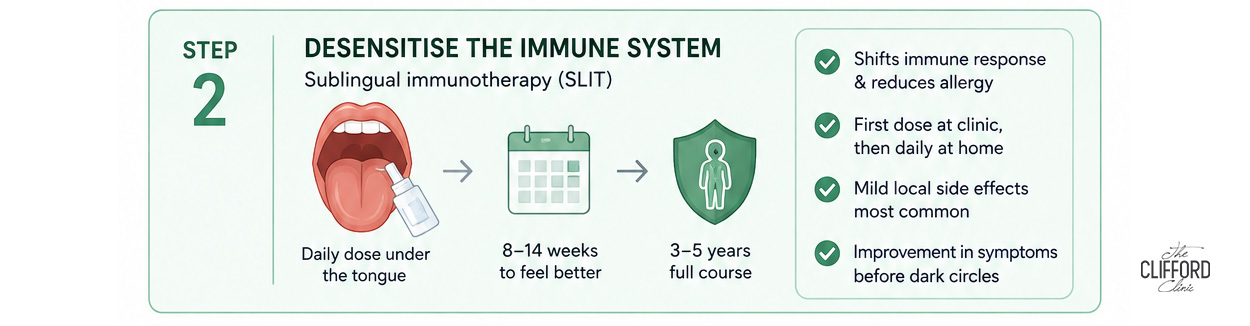
Antihistamines and nasal sprays suppress symptoms for as long as they are taken and leave the underlying sensitivity unchanged. Immunotherapy changes the underlying allergic response itself. Repeated controlled exposure to the confirmed allergen shifts the immune reaction away from IgE production and towards blocking antibodies and regulatory T cells, so the same exposure provokes progressively less inflammation.
Sublingual immunotherapy, or SLIT, delivers a small daily dose of the confirmed allergen under the tongue. The sublingual route is used because the lining under the tongue is rich in the dendritic cells that induce tolerance and carries few of the mast cells that drive severe reactions, so the daily dose can be given at home rather than by injection. The first dose is taken at the clinic under supervision, followed by daily treatment at home, usually as two sprays or one dissolvable tablet held under the tongue for about one minute. Eating, drinking and tooth brushing are avoided for 15 minutes afterwards so the dose is absorbed across the lining of the mouth rather than swallowed. Improvement usually begins after 8 to 14 weeks, and reduced sneezing, congestion and rubbing are noticed before any change in the circles, since the discolouration lightens only after the congestion producing it has settled. The full course lasts 3 to 5 years. Existing antihistamine and nasal spray treatment can continue through the early months, and the benefit of a completed course commonly persists after treatment stops.
We use allergoid-based preparations such as SLIM sublingual spray. In these products the allergen proteins are polymerised, so they bind less readily to the IgE antibodies that trigger an allergic reaction while remaining recognisable to the immune cells that build tolerance. Higher doses can therefore be given with fewer local side effects, which matters because the desensitising effect of immunotherapy is dose-dependent. The preparations also include Blomia tropicalis alongside the two Dermatophagoides species common in Singapore.
Side effects are usually mild and local, most commonly an itchy mouth during the first few weeks. Severe reactions are rare but not absent, and the first dose is therefore given under supervision at the clinic. SLIT is generally unsuitable for patients with poorly controlled asthma, in whom a systemic allergic reaction is more dangerous and harder to treat, so asthma control and other contraindications are assessed before the first dose. In my experience supervising the first dose, I have found that the patients who abandon immunotherapy early are usually those who expected the circles to lighten within the first month, so the 8 to 14 week interval before symptoms shift is set out before the course begins. Immunotherapy reduces the allergic response rather than abolishing it, and a proportion of patients gain useful control of nasal symptoms with no visible change in the circles.
Step 3. Treat the visible discolouration with V Beam Eyes and Juvelook Eyes
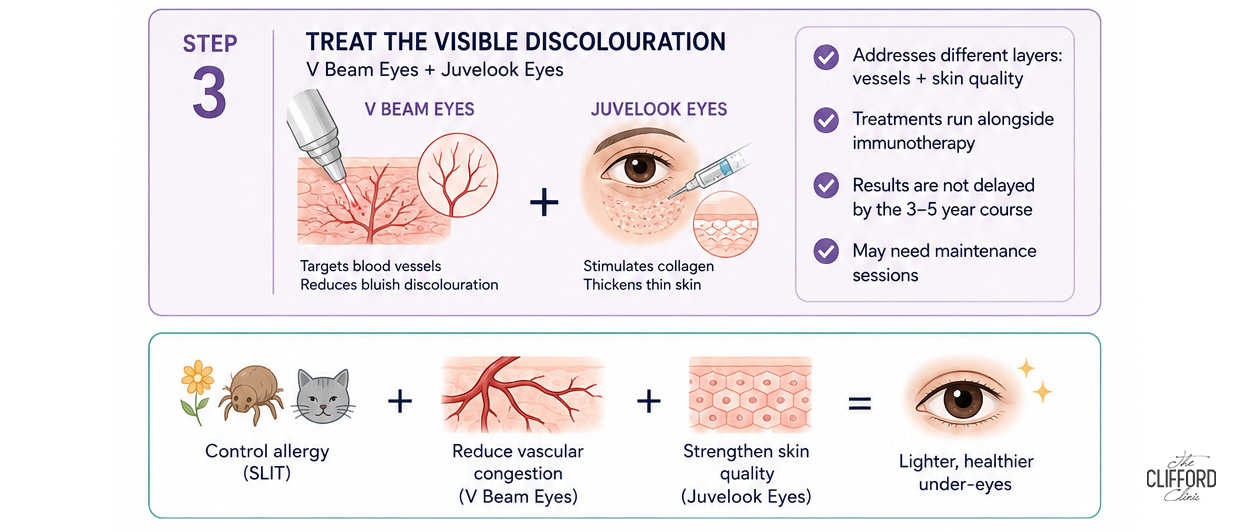
While SLIT addresses the allergy, the discolouration already present is treated directly, because immunotherapy prevents further congestion but does not clear vessels that are already dilated. V Beam Eyes is a vascular laser whose wavelength is absorbed by oxyhaemoglobin in preference to the surrounding tissue. The absorbed energy heats and seals the congested vessels, which are then cleared by the body, so the bluish component fades. Creams directed at pigment act on melanin in the surface layer and cannot reach vessels lying in the dermis. Juvelook Eyes is a collagen-stimulating injectable placed in the thin under-eye skin. Where chronic rubbing has left the skin thin and crepey, new collagen thickens the dermis so the vessels and muscle beneath show through less. The balance between the two depends on whether vascular colour or reduced skin quality predominates on examination. Neither treatment is directed at melanin. Response to pigment-directed treatment is commonly partial, so where genetic or post-inflammatory pigmentation lies beneath the vascular colour the darkness lightens rather than resolves. In my experience treating mixed vascular and pigmented circles, I have found that the vascular component clears first and that the residual brown tone determines whether the patient regards the outcome as complete.
The two treatments act at different depths, the vessels within the dermis and the overlying skin, and both run alongside immunotherapy rather than waiting for it to finish. Visible improvement in the discolouration is therefore not held back by the 3 to 5 year immunotherapy course. Treatment is not a single event, as the vascular component can recur where nasal congestion returns, and further sessions may be required.
Why this combination is preferred to antihistamines, laser alone or Rejuran
Antihistamines control symptoms while they are taken and do nothing to the discolouration already present. Laser treatment alone may improve the vessels, but the circles recur where untreated rhinitis produces renewed congestion. In our assessment, Rejuran has no meaningful role in treating dark eye circles because it does not lighten pigmentation or act as a collagen biostimulator. Where the darkness is a shadow rather than a discolouration, no device directed at colour will change it, and the tear trough or eye bag responsible is addressed as a contour problem. In my experience the patients who ask for a named laser or for Rejuran by name are most often those whose darkness is a contour shadow or a fluid problem, in whom the treatment requested is not the clinically appropriate option. Where an eye bag is casting the shadow, the answer lies with non-surgical eye bag removal rather than with any treatment directed at colour.

What dark eye circle treatment does not achieve
Treatment lightens under-eye darkness in most patients and does not eliminate it. The vascular component responds most reliably, the pigmented component responds partially, and a structural shadow does not respond at all to treatment directed at colour. Lower eyelid skin is the thinnest on the body, so the vessels beneath it can remain faintly visible even after the congestion has settled. Where the darkness is constitutional and has been present since childhood, the realistic outcome is a lighter circle rather than an even skin tone.
No published trial compares allergy testing with sublingual immunotherapy against laser treatment alone for dark eye circles, so the sequence used here rests on the mechanism linking nasal congestion to venous pooling rather than on comparative trial data. The 8 to 14 week and 3 to 5 year figures describe the response of allergic rhinitis to immunotherapy rather than the timing of visible change in the circles, which varies between patients and cannot be predicted at the first consultation. Some patients are advised that no procedure is appropriate, most commonly where the darkness is a shadow, where it follows temporary fluid retention or poor sleep, or where the visible vessels are a normal feature of thin lower eyelid skin.
The Clifford Clinic approach to dark eye circles
Treatment starts with a doctor-led examination to distinguish vascular, pigmented, structural and skin-thinning causes and to screen for allergic rhinitis. Where allergy is involved, testing and SLIT address the cause while V Beam Eyes and Juvelook Eyes treat the vascular and skin components. Testing panels include Blomia tropicalis, the tropical mite most likely to be absent from an imported panel. This avoids placing every patient into the same laser or injectable package. Where the darkness is cast by an eye bag, The Clifford Clinic and The Clifford Surgery together are the only centre among the commonly compared aesthetic clinics offering both non-surgical and surgical eye bag removal, including scarless eye bag removal and pinch blepharoplasty. Patients whose problem is a tear trough, an eye bag or temporary fluid retention are advised accordingly rather than treated for a discolouration they do not have. Where the examination identifies no cause that treatment can change, no procedure is recommended. The dark eye circles service at The Clifford Clinic is structured around establishing the cause rather than fitting the patient to an available device.
Frequently asked questions
What is the best treatment for dark eye circles in Singapore?
The appropriate treatment is determined by the cause. For vascular circles associated with allergic rhinitis, allergy testing and SLIT address the allergy while V Beam Eyes and Juvelook Eyes treat the visible circles. Pigmentation, structural shadows and skin thinning require different approaches, so treatment begins with an examination. No single treatment suits every patient, and in a proportion of patients the appropriate advice is that no procedure will help.
How do I know whether allergies cause my dark circles?
Indicators include a bluish or dusky tone, year-round sneezing or nasal blockage, itchy eyes or nose, habitual eye rubbing, onset in childhood or adolescence, and a family history of allergy, eczema or asthma. Allergy testing can confirm the cause. A positive test confirms sensitisation rather than proving that the allergy is producing the circles, so the result is read alongside the examination.
What happens during allergy testing?
A skin-prick test on the forearm produces results in about 20 minutes and is generally well tolerated, including by children. A blood test measures specific IgE antibodies. Together, the tests identify likely allergens.
How long does SLIT take to work?
Symptoms typically begin to improve after 8 to 14 weeks. The full course lasts 3 to 5 years, and the benefits of completed treatment may continue afterwards. Visible change in the circles typically lags the improvement in nasal symptoms, and in some patients the circles change little even when the rhinitis is well controlled.
Is SLIT safe?
Side effects are usually mild and local, most commonly an itchy mouth during the early weeks. Severe reactions are rare. The first dose is supervised at the clinic, and suitability, including asthma control, is assessed beforehand.
Can children have this treatment?
Allergic shiners often begin early, and skin-prick testing is generally manageable even in young children. Suitability for SLIT, laser and collagen treatment is assessed individually.
How many V Beam Eyes sessions will I need?
The number is determined by the density and depth of the vessels seen at examination and is advised after assessment. Progress is reviewed while immunotherapy continues, because reducing the allergic congestion can itself lighten the vascular component and lower the number of laser sessions required. Complete clearance is not a realistic expectation where a pigmented or structural component is also present.
What if my dark circles are caused by eye bags or tear troughs?
These are contour problems rather than discolouration and require different treatment. Options may include AGNES with Secret RF, in which AGNES melts the herniated fat from the outside in through micro-insulated needles and Secret RF ablates the deeper portion of that fat through a single direct insulated cannula carrying a radiofrequency tip, as well as fillers or surgery, depending on the diagnosis.
Book a dark eye circles assessment in Singapore

Treating the discolouration without addressing its cause is a common reason dark circles return after apparently successful treatment. During an assessment at The Clifford Clinic, a doctor will determine whether the problem is vascular, pigmented, structural or related to skin quality, screen for allergic rhinitis and recommend an appropriate treatment plan. Where no cause amenable to treatment is identified, the recommendation will be that none is undertaken.
This article provides general information and does not replace a medical consultation. Suitability and outcomes vary between individuals. Further reading is available from NUHS on Allergic Rhinitis and SingHealth on Sublingual Immunotherapy.

Author Bio
Dr Gerard Ee

Dr Gerard Ee is the Medical Director of The Clifford Clinic in Singapore. He earned his medical degree from St George's University of London and built his surgical experience across the Singapore General Hospital, National University Hospital, and Mount Sinai Hospital in New York. He holds Membership of the Royal College of Surgeons (Edinburgh) and a Postgraduate Diploma in Dermatology (Cardiff), and is fully accredited in aesthetic procedures including botulinum toxin, fillers, lasers, and light therapies. A strong advocate of minimally invasive, natural-looking results, Dr Ee has published in several medical and scientific journals and presented his research in cities including Taipei, Las Vegas, and London.
See all posts by Dr Gerard Ee »