


Public vs Private Vasectomy in Singapore: Cost, Referral, Waiting Time and Choice
Medically reviewed by Dr Nathaniel Heah, Consultant Urologist, FAMS (Urology). Clinical focus: Andrology and Men’s Health. Last reviewed: June 2026. Next review: June 2027.
Men in Singapore can have a vasectomy through either the public hospital system or a private clinic, and the right route depends on your priorities around cost, waiting time, choice of doctor and technique. Whichever route you choose, a vasectomy is not immediately effective, so another form of contraception must continue until post-vasectomy semen analysis confirms clearance. At The Clifford Surgery, vasectomy consultations and procedures are led by Dr Nathaniel Heah, FAMS (Urology), a UK fellowship-trained Consultant Urologist with subspecialty expertise in Andrology and Men’s Health, with clinical support from Dr Law Zhi Wei, MBBS (NUS), MRCSEd. This guide compares the two routes so you can decide which suits you.
Public vs Private Vasectomy: Quick Facts
| Factor | Public Route | Private Route |
|---|---|---|
| Access | Referral, for example from a polyclinic, to a specialist outpatient clinic | Direct appointment, no referral needed |
| Subsidy | Subsidies for eligible Singapore Citizens and PRs when referred | Not subsidised; package or itemised private fees |
| Doctor Choice | Usually assigned; limited choice | You choose your urologist |
| Waiting Time | Often longer; varies by institution | Usually shorter; flexible scheduling |
| MediSave | Applies, subject to TOSP and day-surgery limits | Applies, subject to the same limits |
| MediShield Life | Generally excludes contraceptive operations | Same exclusion applies |
Two Routes to a Vasectomy in Singapore
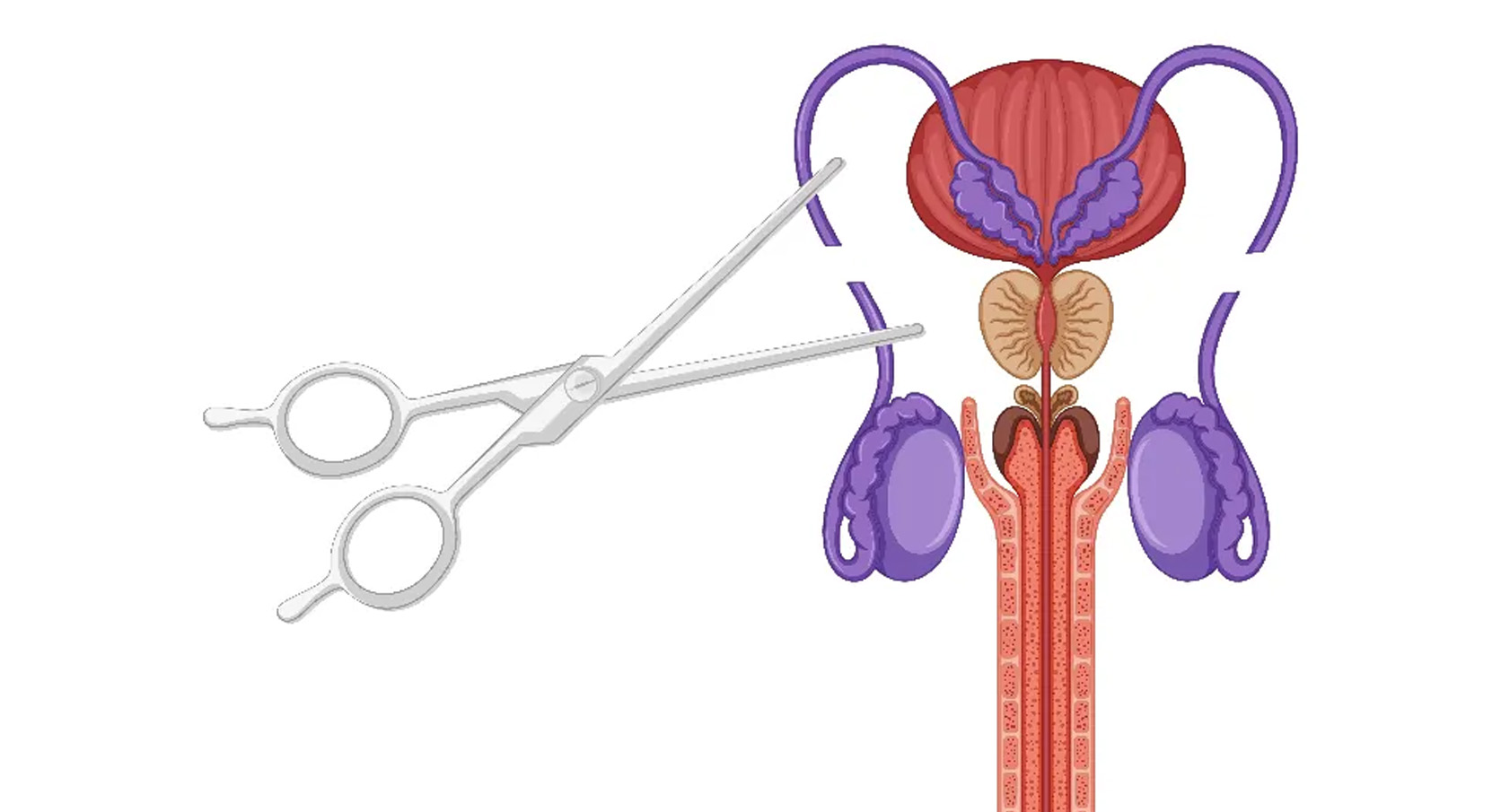
Both routes deliver the same core procedure: cutting and sealing the vas deferens so sperm can no longer enter the semen. The differences lie in how you access care, how much you pay, how long you wait, and how much choice you have over your surgeon and technique.
The Public Hospital Route
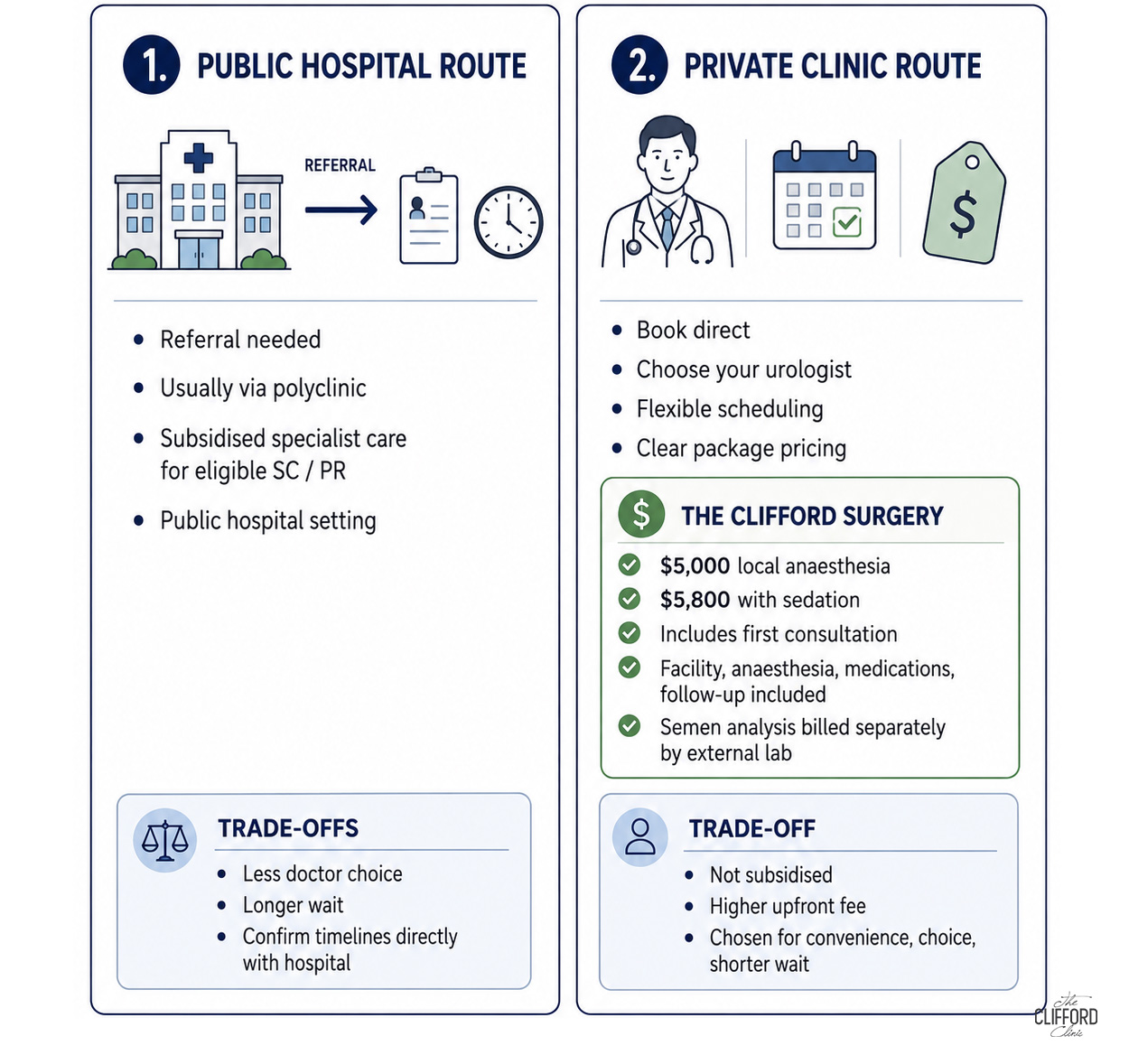
In the public system, vasectomy is typically accessed through a referral, for example from a polyclinic, to a specialist outpatient clinic at a public hospital. Eligible Singapore Citizens and Permanent Residents may receive specialist outpatient subsidies when referred from eligible sources such as polyclinics. The main advantages are subsidised fees for those who qualify and the institutional setting of a public hospital.
The trade-offs are fewer choices about which doctor performs your procedure and often a longer wait, from referral to consultation to the procedure date. Waiting times vary between institutions and over time, so it is best to confirm current timelines directly with the hospital rather than rely on general estimates.
The Private Clinic Route
In a private clinic, you can usually book directly without a referral, choose your urologist, and schedule the procedure at a time that suits you. Private clinics often quote package pricing that bundles the facility, anaesthesia, medications and follow-up into a single fee, which makes the total cost easier to understand upfront. At The Clifford Surgery, for example, the procedure fee is $5,000 for local anaesthesia or $5,800 with sedation, inclusive of the first consultation, with the external laboratory semen analysis billed separately.
The trade-off is that private care is not subsidised, so the headline fee is higher than a subsidised public fee. Many men accept this in exchange for choice of surgeon, shorter waiting time and scheduling flexibility.
Cost Comparison
A subsidised public vasectomy will usually have a lower cash cost for eligible patients than a private procedure, because of government subsidies. A private vasectomy has a higher fee but offers choice and speed. In both routes, MediSave can be applied toward the procedure, subject to the Table of Surgical Procedures (TOSP) surgical withdrawal limit, the day-surgery hospital limit, and your available balance. Because exact fees change and depend on your circumstances, confirm current figures with the specific hospital or clinic rather than assuming a fixed number.
MediSave and Insurance in Both Routes
MediSave applies whether you go public or private, within CPF and MOH limits. MediShield Life, however, generally excludes contraceptive operations and their related complications, so it usually does not cover vasectomy in either route. Private insurance and Integrated Shield Plans vary, and many exclude elective sterilisation, so it is worth checking your policy and requesting written confirmation before proceeding. A private clinic billing team can often help with insurer pre-authorisation.
Waiting Time and Scheduling
Waiting time is one of the clearest practical differences. The public route can involve a wait from referral to the specialist appointment and again to the procedure date, while private clinics typically offer earlier appointments and flexible scheduling, including around work commitments. If timing matters to you, ask each provider for their current expected timelines.
Technique and Doctor Choice
Private clinics commonly offer both the no-scalpel and conventional techniques and let you discuss options directly with the urologist who will perform your procedure. In the public system, the technique and the operating doctor are usually determined by the institution. If having a specific technique, or a consistent relationship with a chosen urologist, is important to you, the private route offers more control.
Which Route Is Right for You?
If minimising cost is your priority and you are eligible for subsidies, the public route may suit you, provided you are comfortable with a longer wait and less choice of doctor. If you value choosing your urologist, a shorter wait, flexible scheduling and clear package pricing, the private route is often preferred. Neither is universally better; the right choice depends on your budget, timeline and personal preferences.
What Both Routes Have in Common
Whichever route you choose, several things do not change. The procedure itself blocks the vas deferens and is intended to be permanent. It is performed as a day surgery, usually under local anaesthesia, and recovery is typically under a week. Both routes require post-vasectomy semen analysis to confirm success, and you must continue other contraception until your doctor confirms clearance. The clinical standard of confirming success by a semen test, rather than assuming it, applies equally in public and private settings.
The Consultation: What to Expect Either Way
A proper vasectomy consultation should cover the same essentials regardless of route. These includes your reasons and certainty, the technique options, anaesthesia, risks including bleeding, infection and the small chance of chronic scrotal pain, the recovery timeline, and the semen analysis follow-up. Informed consent and a chance to ask questions are part of good practice in any setting. In the private route you generally have this discussion directly with the urologist who will perform your procedure, which some men find reassuring.
Questions to Ask Whichever Route You Choose
Asking a few clear questions helps you compare routes and providers on equal terms:
- What is the total cost, and what is included in it?
- How much can MediSave offset for my situation, and what is the expected cash payment?
- Who will perform the procedure, and are they a urologist?
- Which technique will be used, and why is it suitable for me?
- What is the expected waiting time from now to the procedure?
- How and where is the post-vasectomy semen analysis arranged?

Can You Move Between the Two Routes?
Some men start by exploring the public route through their polyclinic and later choose a private clinic for speed or choice of surgeon, or the reverse if cost becomes the priority. There is no obligation to proceed simply because you have had a consultation, and taking your time to be certain is good practice before permanent contraception.
Do Outcomes Differ Between Public and Private?
From a clinical standpoint, the evidence indicates that vasectomy outcomes depend on the technique and how the vas is occluded, not on whether the procedure is done in a public or private setting. The AUA notes that minimally invasive vas isolation is the key determinant of complication risk, and effectiveness in either setting is confirmed the same way, by post-vasectomy semen analysis. Both routes deliver a procedure that is more than 99% effective once clearance is confirmed. The practical differences between public and private are therefore about cost, waiting time and choice, not the safety or success of the operation itself.
A lower subsidised fee does not mean a lower standard of care. A higher private fee does not buy a better clinical result. It buys choice of surgeon, shorter waiting times, and scheduling flexibility. Focus your comparison on those practical factors and on the experience of the doctor performing your procedure.
Frequently Asked Questions
Do I need a referral for a vasectomy in Singapore?
For the public route, a referral, for example from a polyclinic, is needed to access a subsidised specialist outpatient appointment. For a private clinic, you can book directly without a referral.
Is a public vasectomy cheaper than a private one?
For eligible Singapore Citizens and PRs, a subsidised public vasectomy usually has a lower cash cost. A private vasectomy has a higher fee but offers choice of doctor, shorter waiting times, and flexible scheduling.
Can I choose no-scalpel vasectomy?
Private clinics commonly offer both no-scalpel and conventional techniques and will discuss suitability with you. In the public system, the technique is usually determined by the institution.
Is recovery different between public and private vasectomy?
No. Recovery depends on the procedure and your body, not on where it is performed. In both routes, most men resume normal activities within a few days and avoid strenuous activity and sex for about a week.
Can I take time to decide in both routes?
In both routes, responsible providers give you time between the consultation and surgery rather than pressing for a same-day decision. You are never obliged to proceed after a consultation, and taking time to be certain is sensible for a procedure intended to be permanent.
Medical References
Key medical sources (subsidy, MediSave and MediShield Life details from public MOH and CPF guidance):
- Vasectomy: AUA Guideline. The Journal of Urology. 2012. Sharlip ID, Belker AM, Honig S, et al. https://doi.org/10.1016/j.juro.2012.09.080
- Vasectomy: Common Questions and Answers. American Family Physician. 2025. Arnold JJ, Villanueva D, Puntkattalee MJ. https://www.aafp.org/link_out?pmid=40961303
- ACOG Practice Bulletin No. 208: Benefits and Risks of Sterilization. Obstetrics and Gynecology. 2019. https://doi.org/10.1097/AOG.0000000000003111
Related Vasectomy Guides
Explore our other vasectomy guides for more detail on cost, technique, recovery and the decision itself:
- Vasectomy in Singapore
- Vasectomy Cost, MediSave & Insurance
- Is Vasectomy Right for Me?
- No-Scalpel vs Conventional Vasectomy
Medical Disclaimer
This article is for general educational purposes and does not replace a consultation with a qualified medical professional. Cost, subsidy and waiting-time details vary and change over time; confirm current information with the relevant hospital, clinic, MOH and CPF before proceeding.

Medically reviewed by Dr Law Zhi Wei, MBBS (NUS), MRCSEd, Partner, The Clifford Surgery | Co-authored with Dr Nathaniel Heah, FAMS (Urology), Consultant Urologist | Last reviewed: June 2026 | Next review: June 2027
Book a Private Vasectomy Consultation at The Clifford Surgery

To discuss the private vasectomy route, cost and MediSave, book a consultation with Dr Nathaniel Heah, FAMS (Urology), Consultant Urologist, or Dr Law Zhi Wei, MBBS (NUS), MRCSEd, at The Clifford Surgery, 50 Raffles Place, #01-01 Singapore Land Tower, Singapore 048623. Call (65) 6532 2400 or WhatsApp (65) 8318 6332.

Author Bio
Dr Gerard Ee

Dr Gerard Ee is the Medical Director of The Clifford Clinic in Singapore. He earned his medical degree from St George's University of London and built his surgical experience across the Singapore General Hospital, National University Hospital, and Mount Sinai Hospital in New York. He holds Membership of the Royal College of Surgeons (Edinburgh) and a Postgraduate Diploma in Dermatology (Cardiff), and is fully accredited in aesthetic procedures including botulinum toxin, fillers, lasers, and light therapies. A strong advocate of minimally invasive, natural-looking results, Dr Ee has published in several medical and scientific journals and presented his research in cities including Taipei, Las Vegas, and London.
See all posts by Dr Gerard Ee »