

Circumcision at 40, 50 and Beyond – Never Too Late
There is no upper age limit for circumcision. Men in their forties, fifties, sixties and beyond are circumcised safely every year, and age alone is never a contraindication for circumcision. Age does not change whether the procedure can be done. What changes is what needs checking first, such as diabetes, blood-thinning medication and general healing capacity. Most older men have the procedure under local anaesthesia and go home the same day, with around five to seven days of hospitalisation leave and a return to strenuous activity at about four to six weeks. A tight foreskin remains the leading medical reason at any age, accounting for around 52.5 percent of adult circumcisions in one large study. For the complete overview, see our Circumcision Singapore guide.
There is no upper age limit
This is the question men type into Google, so it deserves a direct answer rather than a hedge. Being 40, or 50, or 65, does not disqualify you.
Circumcision is a short procedure performed on the skin of the penis. It is a minor surgical procedure that can de done under local anaesthesia while you are awake. The physiological demand it places on the body is modest, which is precisely why age is not the limiting factor people assume it to be.
What genuinely matters is your health rather than your birth year. A fit 62-year-old is a more straightforward case than a poorly controlled diabetic 41-year-old.
Many men delay for years believing they have missed the window. If that is you, you have not.

Why men finally do it after 40
A foreskin that has gradually tightened over the years is the most common. Unlike the naturally non-retractile foreskin of childhood, a foreskin that becomes tight in adulthood is almost always acquired, usually through scarring or repeated inflammation, and it does not resolve on its own. It causes discomfort during erections, difficulty with hygiene, and splitting or tearing during sex.
Recurrent foreskin infections are the second. Each episode is treatable, but repeated cycles of infection, healing and reinfection wear men down, and it is often the third or fourth episode that prompts the appointment.
Hygiene is the third reason, and it becomes more pressing with age, particularly for men with reduced dexterity or other health conditions.
Then there are the men who have simply thought about it for twenty years. There is nothing wrong with that as a reason, provided the assessment confirms it is sensible.
Health checks that matter more with age
The consultation for an older man covers more ground, and this is a feature rather than an obstacle.
The doctor will review your general health and any chronic conditions, your current medications with particular attention to anything affecting bleeding, your blood sugar control if you are diabetic, any history of wound healing problems, and the state of the foreskin and surrounding skin.
Two findings warrant a closer look. Suspicious skin lesions on the penis should be assessed properly rather than simply circumcised around, since the removed tissue can be sent for laboratory examination when there is any doubt. Our page on penile lesions covers this. Second, a firm, pale, scarred ring at the foreskin tip suggests a scarring skin condition, which changes the recommendation because such foreskins respond poorly to creams and reliably need surgery.
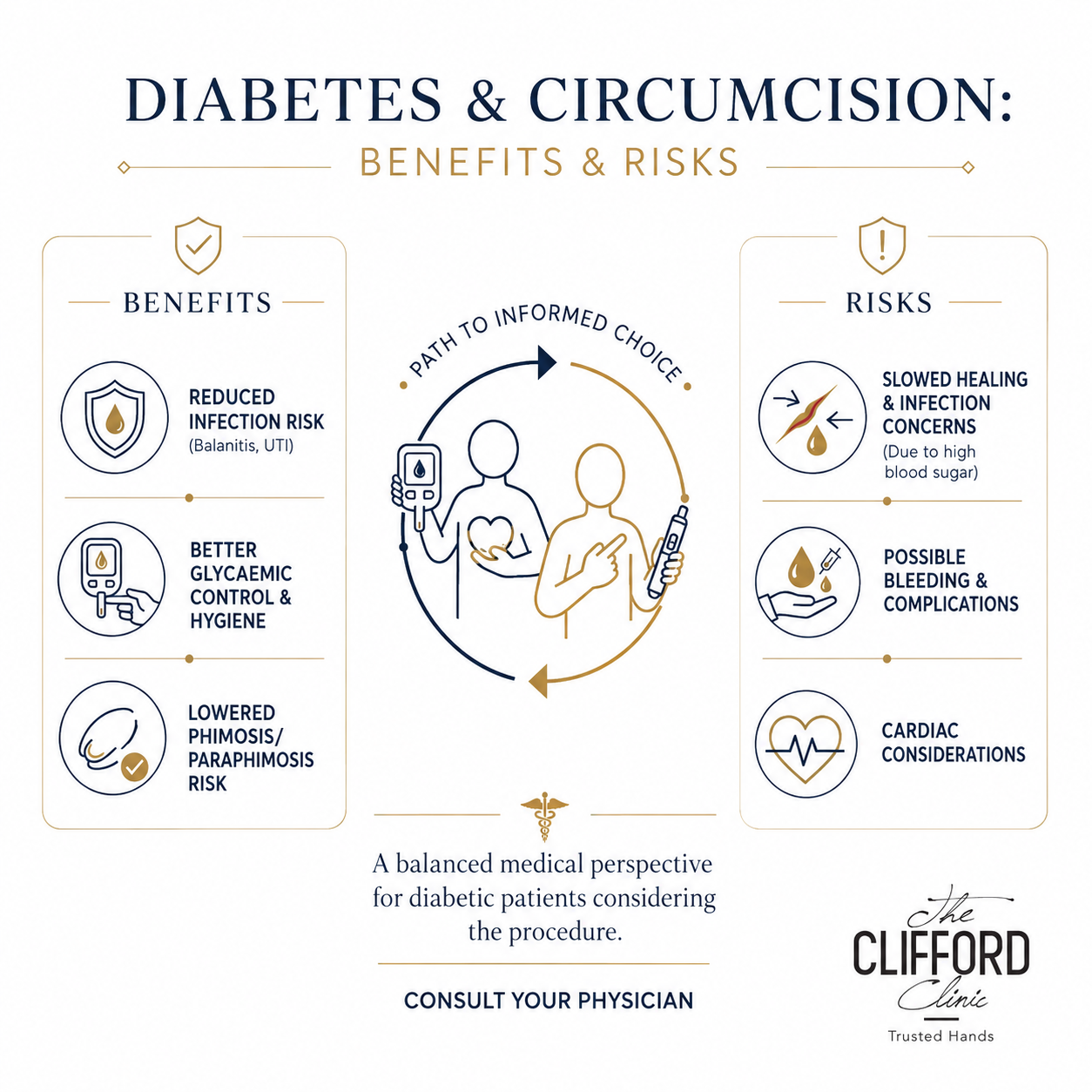
Diabetes and healing
Diabetes is common in Singapore, and it interacts with this procedure in both directions.
Poorly controlled diabetes raises the risk of recurrent balanitis, which in turn causes the scarring that leads to a tight foreskin. So diabetes is frequently the reason an older man ends up needing circumcision in the first place.
It also affects healing. Elevated blood sugar impairs wound healing and raises infection risk, so control before and after surgery genuinely changes the outcome. This does not mean diabetic men should avoid circumcision. Often the opposite, since removing the foreskin ends the cycle of recurrent balanitis. It means the procedure should be planned with your blood sugar control in view, and that aftercare instructions should be followed closely. Our guide to circumcision and diabetes covers this fully.
Blood thinners and bleeding risk
More men are on blood thinning medication after 40, and this is the single most important thing to disclose at your consultation.
Aspirin, clopidogrel, warfarin and the direct oral anticoagulants all affect bleeding, and circumcision involves cutting well-vascularised tissue. This is manageable but it must be planned rather than discovered. Depending on the medication, the reason you take it and your overall risk, the plan may involve timing adjustments made in consultation with the doctor who prescribed it, a particular choice of technique, or simply heightened attention to bleeding control.
What you should never do is stop a blood thinner on your own before surgery. That decision belongs to the doctor who prescribed it, because the reason you are taking it has not gone away.

Anaesthesia choices for older men
Local anaesthesia is the usual choice, and it suits older men particularly well.
Numbing cream is applied, then a ring block and a dorsal penile nerve block numb the area completely. You stay fully awake, which avoids the additional physiological demands of general anaesthesia. Once the block is working, the procedure should not hurt, and most men report pressure or movement rather than pain.
Light sedation can be added if you would rather feel relaxed and detached, with an anaesthetist available where needed. General anaesthesia is rarely necessary for a straightforward adult case, and avoiding it is generally an advantage as age and comorbidity increase. Our pain and anaesthesia guide explains the options in full.
What recovery looks like at this age
Recovery in an older man follows the same pattern as in a younger one, with a reasonable expectation that it may be modestly slower if healing is affected by diabetes or circulation.
Rest on the first day and take painkillers on schedule. Soreness and swelling settle steadily over the first week. Most men return to desk-based work within a few days, and we typically provide around five to seven days of hospitalisation leave. Erections in the first week can be uncomfortable, which is normal and settles.
Light exercise usually resumes after about a week. Strenuous exercise, swimming and cycling wait about four weeks, and sexual activity about four to six weeks. Conventional circumcision takes about six to eight weeks for complete healing, once the swelling has settled and the final appearance is set.
Contact the clinic promptly for persistent bleeding, a smelly discharge or pus, fever, or pain that painkillers do not control. Our recovery guide sets out the day by day timeline.
Does it change anything in the bedroom
A 2025 meta-analysis of more than 14,000 men examined sexual satisfaction, erectile function and pain during sex after circumcision. It found that circumcision does not reduce sexual satisfaction, and was associated with small improvements on average, including lower odds of pain during sex, with the authors noting variation between the included studies.
There is also a practical point that the statistics understate. If your foreskin is tight, splitting during sex, or repeatedly inflamed, then sex is already uncomfortable. Removing the cause commonly improves matters rather than worsening them.
Some increased sensitivity of the newly exposed head is normal in the early weeks and settles. Our page on circumcision and sexual health covers this in more depth.
A note from the clinic
“A lot of men in their forties and fifties open the consultation by apologising for being too old. They are not. What we need to know is whether you are diabetic, what medication you are on, and how the skin looks. Get those three right and age is close to irrelevant. Most men tell us afterwards that the only regret was the years they spent putting it off.”
Frequently asked questions
Is 40 too old for circumcision?
No. There is no upper age limit. Men in their forties, fifties and beyond are circumcised safely, and suitability is assessed on health rather than age.
Is 50 or 60 too old?
No. The same applies. What matters is your general health, your medications and the condition of the skin, not the number of years.
Why do older men need circumcision?
Most commonly a foreskin that has tightened over time, recurrent foreskin infections, and hygiene difficulty. Personal preference is also a valid reason.
Will I need general anaesthesia?
Usually not. Local anaesthesia is the standard choice for adults, with light sedation available if you would prefer to feel more relaxed.
I am diabetic, can I still have it done?
Usually yes, and it often helps by ending a cycle of recurrent balanitis. Blood sugar control before and after matters, because it affects healing and infection risk.
I take blood thinners, does that rule me out?
No, but it must be disclosed and planned. Never stop a blood thinner on your own. The prescribing doctor decides any adjustment.
Does healing take longer at my age?
It can be modestly slower where diabetes or circulation affect healing. For a healthy older man the timeline is broadly the same as for a younger one.
How much time off work will I need?
Around five to seven days of hospitalisation leave is typical, with desk-based work often resumable sooner.
Will it affect my sex life?
A 2025 meta-analysis of more than 14,000 men found no reduction in sexual satisfaction, with small improvements on average. Where a tight foreskin was causing pain, comfort usually improves.
Can I use MediSave at my age?
MediSave applies when there is a medical indication such as a tight foreskin, and it is not age restricted. Our MediSave guide explains the limits.
Book a confidential consultation
If you have been putting this off, a consultation settles it quickly. The doctor examines the area, reviews your medications and general health, tells you honestly whether surgery is the right answer, and gives you a clear cost before you decide anything.
Book a consultation at The Clifford Surgery
Related guides
- Circumcision Singapore, the complete guide
- Adult circumcision in Singapore
- Phimosis and tight foreskin
- Circumcision and diabetes
- Circumcision recovery and aftercare
- Pain, anaesthesia and safety
Medical review box

This article is written by Dr Law Zhi Wei of The Clifford Surgery. Dr Law is a Singapore-trained doctor with more than five years of surgical posting experience. He graduated from the National University of Singapore with an MBBS and holds Membership of the Royal College of Surgeons of Edinburgh, a Graduate Diploma in Family Medicine, and a Postgraduate Diploma in Practical Dermatology from Cardiff University. He trained in the Urology Department at Singapore General Hospital, where he performed hundreds of circumcisions, and completed rotations in urology, general surgery, and paediatric surgery at KK Women’s and Children’s Hospital, Sengkang General Hospital, and Changi General Hospital. He has personally performed more than 500 circumcisions across the conventional, laser-assisted, Shang Ring, and ZSR Stapler techniques, and he handles the consultation, the procedure, and the aftercare for each patient, supported by the dedicated Urology Department led by Dr Nathaniel Heah. The Clifford Surgery operates a sterile surgical theatre as a Ministry of Health-accredited Day Surgery Centre. It is a CPF and MediSave accredited, CDA-approved medical institution. We assist with hospital insurance claims where there is a medical indication. This content is general information and not a substitute for a personal consultation.
Dr Law Zhi Wei profile, https://cliffordclinic.com/dr-law-zhi-wei/
Clinical research and publications, https://cliffordclinic.com/clinical-research/
References
- National University Hospital, Services for Circumcision. https://www.nuh.com.sg/care-at-nuh/services/department-of-urology/services-for-circumcision
- Ministry of Health Singapore, MediSave for inpatient and day surgery care. https://www.moh.gov.sg/managing-expenses/schemes-and-subsidies/medisave/inpatient-care/
Medical evidence references
- Friedman B, Khoury J, Petersiel N, et al. Pros and Cons of Circumcision, An Evidence-Based Overview. Clinical Microbiology and Infection. 2016. https://pubmed.ncbi.nlm.nih.gov/27497811
- Hohlfeld A, Ebrahim S, Shaik MZ, Kredo T. Circumcision Devices Versus Standard Surgical Techniques in Adolescent and Adult Male Circumcisions. The Cochrane Database of Systematic Reviews. 2021. https://www.cochranelibrary.com/cdsr/doi/10.1002/14651858.CD012250.pub2/full
- Nabavizadeh B, Li KD, Hakam N, et al. Incidence of Circumcision Among Insured Adults in the United States. PLoS One. 2022. https://pubmed.ncbi.nlm.nih.gov/36251658
- Karaahmet AY, Laleh SS. The Influence of Circumcision on Male Sexual Function, a Meta-analysis of Satisfaction, Erectile Function, and Dyspareunia. Journal of Sex and Marital Therapy. 2025. https://doi.org/10.1080/0092623X.2025.2499141

Author Bio
Dr Gerard Ee

Dr Gerard Ee is the Medical Director of The Clifford Clinic in Singapore. He earned his medical degree from St George's University of London and built his surgical experience across the Singapore General Hospital, National University Hospital, and Mount Sinai Hospital in New York. He holds Membership of the Royal College of Surgeons (Edinburgh) and a Postgraduate Diploma in Dermatology (Cardiff), and is fully accredited in aesthetic procedures including botulinum toxin, fillers, lasers, and light therapies. A strong advocate of minimally invasive, natural-looking results, Dr Ee has published in several medical and scientific journals and presented his research in cities including Taipei, Las Vegas, and London.
See all posts by Dr Gerard Ee »