
Circumcision Recovery Singapore – Aftercare Timeline, Work and School MC, and What Is Normal
Healing takes about four weeks with modern techniques such as the stapler or Shang Ring, and about six to eight weeks with conventional circumcision. Adults are typically given around five to seven days of hospitalisation leave. Children usually return to school after about a week. Light exercise can often resume after about a week. The Clifford Surgery provides clear aftercare and follow-up. Take the prescribed painkillers and anti-inflammatories as directed. Contact the clinic urgently for persistent bleeding, a smelly discharge or pus, fever, or pain that painkillers do not control. For the complete overview, see our Circumcision Singapore guide.
The first 24 hours
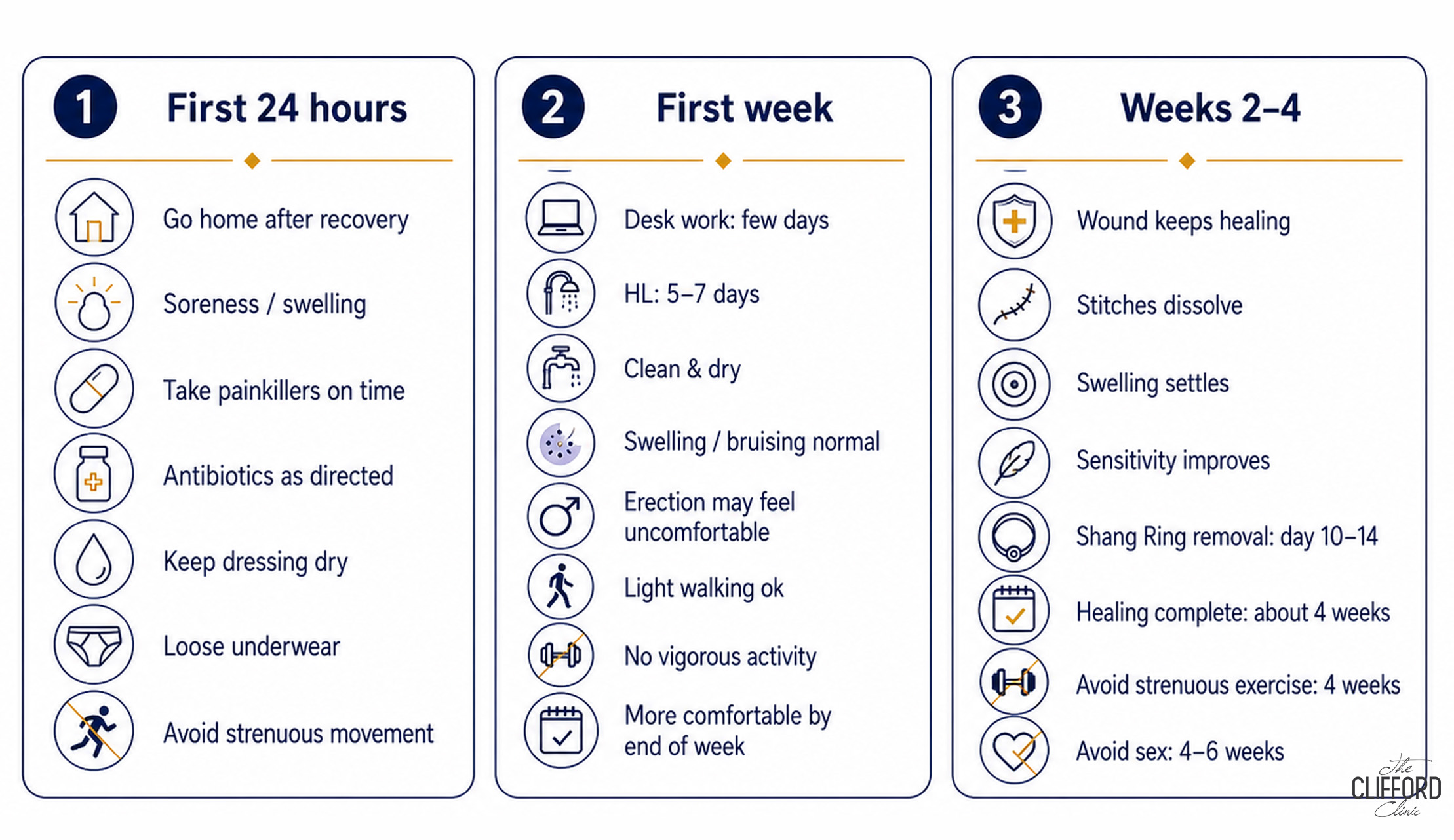
After the procedure, you will rest in recovery for a short period and then go home. Expect the area to feel sore and look a little swollen, especially after the local anaesthetic wears off several hours later. Take your prescribed painkillers on schedule rather than waiting for pain to build up, and take any prescribed antibiotics as directed. Keep the dressing dry as instructed, and avoid strenuous movement. Wear loose, breathable underwear and pants to reduce friction on the wound.
The first week
Many adults return to desk-based work within a few days, and The Clifford Surgery typically provides around five to seven days of hospitalisation leave. Keep the area clean and dry following the wound care instructions, continue any prescribed antibiotics. It is normal to notice swelling and bruising during the healing process. An erection during the first week can be uncomfortable, which is normal. Light walking is fine, but avoid vigorous activity. By the end of the first week, most people feel noticeably more comfortable.
Weeks two to four
During this phase, the wound continues to heal and any stitches, if used, dissolve. Swelling settles further, and sensitivity of the newly exposed head of the penis improves. With device methods such as the Shang Ring, a short follow-up visit is used to remove the device once initial healing has progressed, usually around 10 to 14 days. Healing with the stapler or Shang Ring is complete at about four weeks. Avoid strenuous exercise for about four weeks. Sexual activity is best avoided for about four to six weeks, after which most people resume normal activity, guided by how the wound looks and feels.
Healing times and what the evidence shows
Modern techniques such as the stapler or Shang Ring heal in about four weeks. Conventional circumcision takes about six to eight weeks for complete healing, once the swelling has settled and the final appearance is set. One comparative study reported average wound closure of about 23.7 days with the Shang Ring against 15.9 days with conventional circumcision. That measures the wound edge closing rather than the final result, because the crush line left by a device takes longer to separate. Some oedema is expected with any method and is more common with crush devices such as the Shang Ring.
Return to work and school
For adults, The Clifford Surgery usually provides around five to seven days of hospitalisation leave, with desk work often resumable sooner. For children, returning to school after about a week is common, with rough play and sports paused for about four weeks. The exact hospitalisation leave depends on the individual and the job or school activity, and the clinic can advise and provide the appropriate documentation. Planning the procedure before a quieter period or a school holiday can make the time off easier to manage.
Exercise restrictions
Exercise is reintroduced gradually. Gentle walking is fine within the first days, and light exercise can often resume after about a week. Strenuous exercise, running, gym workouts, cycling, and swimming are usually avoided for about four weeks, because exertion, friction, and immersion can disturb healing. Returning too early risks swelling, bleeding, or wound problems. Your doctor will give a clear timeline based on the method used and how you are healing.
Showering and dressing care
Keeping the area clean and dry supports healing. Showering is generally allowed soon after the procedure, following the specific wound care instructions you are given, while soaking in baths, pools, or the sea is avoided until the wound has healed. Change or care for the dressing as instructed, and pat the area dry gently rather than rubbing. Loose, breathable underwear and pants reduce friction and let air reach the wound. If you are ever unsure how to care for the wound or dressing, contact the clinic for guidance.
Top aftercare mistakes to avoid
A few common mistakes slow recovery. The first and most important is resuming strenuous activity or sexual activity too early, which can cause swelling, bleeding, or wound separation. The second is poor hygiene, since keeping the area clean and dry prevents infection. The third is wearing tight or rough clothing, which rubs the wound. Choose loose, breathable underwear and pants. A further common mistake is not taking the prescribed painkillers and anti-inflammatories, which keep you comfortable and help you rest.
Swelling, sensitivity, and bleeding
Some swelling, sensitivity, and minor spotting of blood can be normal in the early days and are part of healing. Swelling usually peaks early and then settles over one to two weeks, and sensitivity of the exposed head improves over the following weeks. A small amount of bleeding or oozing can occur, especially early on. What is not normal is heavy or persistent bleeding, which is the main warning sign to act on, along with rapidly increasing swelling, severe or worsening pain, or signs of infection.
Follow-up visits

Follow-up is included at The Clifford Surgery. A follow-up visit lets the doctor check that healing is on track, manage any concerns, and, for device methods, remove the ring or device at the right time. Attending follow-up is an important part of a safe recovery, even if everything feels fine, because it confirms the wound is healing well and gives you a chance to ask about returning to exercise and other activities. If something concerns you before the scheduled visit, you can contact the clinic sooner.
Returning to intimacy
The usual guidance is to wait until the wound has healed, often around four to six weeks, and to be guided by your doctor and by how the area looks and feels. Returning too early risks discomfort, swelling, or wound problems. Some sensitivity of the newly exposed head is normal in the early weeks and settles with time. High-quality evidence indicates that circumcision does not harm sexual function or satisfaction in the long term. If you have any concerns about comfort or healing, raise them at your follow-up visit.
Red flags and what to do
When to Contact the Clinic After Circumcision
| Sign | What to Do |
|---|---|
| Persistent Bleeding | Apply gentle pressure and seek urgent care |
| Smelly Discharge or Pus from the Wound | Contact the clinic, possible infection |
| Pain Not Controlled by Painkillers | Contact the clinic for review |
| Fever | Contact the clinic, possible infection |
| Difficulty or Inability to Pass Urine | Seek prompt medical attention |
| Dressing Fallen Off and You Are Unsure | Call the clinic for advice |
A note from the clinic
“Most worries during recovery turn out to be normal healing. We tell every patient that healing takes about four weeks with the stapler or Shang Ring and six to eight weeks with conventional circumcision. An erection in the first week can be uncomfortable, and taking the antibiotics matters. The one thing to act on quickly is bleeding, and a phone call is always better than sitting at home anxious.”
Frequently asked questions
How long does circumcision take to heal?
Healing takes about four weeks with modern techniques such as the stapler or Shang Ring. Conventional circumcision takes about six to eight weeks.
Can I shower after circumcision?
Yes, usually soon after, following your wound care instructions. Avoid soaking in baths, pools, or the sea until the wound has healed.
How many days of MC do I need?
The Clifford Surgery usually provides around five to seven days of hospitalisation leave for adults, depending on the job.
When can my child return to school?
Often, after about a week, rough play and sports should be paused for about four weeks during the healing process.
When can I return to exercise?
Light exercise can usually resume after about a week, with strenuous exercise avoided for about four weeks.
Is swelling normal?
Yes. Some swelling is normal and usually peaks early before settling over one to two weeks, and it can be a little more pronounced with crush devices such as the Shang Ring.
Is mild bleeding normal?
A small amount of spotting can be normal early on. Heavy or persistent bleeding is not normal, and it is the main symptom to act on quickly.
Do I need to take antibiotics?
If antibiotics are prescribed, take the full course as directed. Not taking them is a common aftercare mistake that can raise the risk of infection.
Will circumcision affect my sex life?
High-quality evidence indicates that circumcision does not harm sexual function or satisfaction in the long term.
When should I contact the doctor urgently?
For persistent bleeding, a smelly discharge or pus, fever, pain that painkillers do not control, or difficulty passing urine.
Book a consultation or follow-up

Whether you are planning circumcision or recovering from it, the clinic can guide your aftercare, provide hospitalisation leave documentation, and review your healing at the included follow-up. If anything concerns you during recovery, reach out rather than waiting.
Book a consultation at The Clifford Surgery
Related guides
- Circumcision Singapore, the complete guide
- Circumcision cost in Singapore
- Adult circumcision in Singapore
- Child circumcision age guide
- Phimosis and tight foreskin treatment
- Circumcision techniques compared
- MediSave, insurance and Baby Bonus for circumcision
- Circumcision pain, anaesthesia and safety
Medical review box

This article is written by Dr Law Zhi Wei of The Clifford Surgery. Dr Law is a Singapore-trained doctor with more than five years of surgical posting experience. He graduated from the National University of Singapore with an MBBS and holds Membership of the Royal College of Surgeons of Edinburgh, a Graduate Diploma in Family Medicine, and a Postgraduate Diploma in Practical Dermatology from Cardiff University. He trained in the Urology Department at Singapore General Hospital, where he performed hundreds of circumcisions, and completed rotations in urology, general surgery, and paediatric surgery at KK Women’s and Children’s Hospital, Sengkang General Hospital, and Changi General Hospital. He has personally performed more than 500 circumcisions across the conventional, laser-assisted, Shang Ring, and ZSR Stapler techniques, and he handles the consultation, the procedure, and the aftercare for each patient, supported by the dedicated Urology Department led by Dr Nathaniel Heah. Dr Law is also a published urology researcher, with peer-reviewed work in journals including the Journal of Urology, BJU International, the Asian Journal of Urology, and European Urology Supplements. The Clifford Surgery operates a sterile surgical theatre as a Ministry of Health-accredited Day Surgery Centre. It is a CPF and MediSave accredited, CDA-approved medical institution. We assist with hospital insurance claims where there is a medical indication. This content is general information and not a substitute for a personal consultation. Last updated June 2026.
Dr Law Zhi Wei profile, https://cliffordclinic.com/dr-law-zhi-wei/
Dr Nathaniel Heah profile, https://cliffordclinic.com/dr-nathaniel-heah/
Clinical research and publications, https://cliffordclinic.com/clinical-research/
References
- National University Hospital, Services for Circumcision. https://www.nuh.com.sg/care-at-nuh/services/department-of-urology/services-for-circumcision
- SingHealth, Circumcision for children. https://www.singhealth.com.sg/symptoms-treatments/circumcision-children-surgeries
Medical evidence references
- Hohlfeld A, Ebrahim S, Shaik MZ, Kredo T. Circumcision Devices Versus Standard Surgical Techniques in Adolescent and Adult Male Circumcisions. The Cochrane Database of Systematic Reviews. 2021. https://www.cochranelibrary.com/cdsr/doi/10.1002/14651858.CD012250.pub2/full
- Friedman B, Khoury J, Petersiel N, et al. Pros and Cons of Circumcision, An Evidence-Based Overview. Clinical Microbiology and Infection. 2016. https://pubmed.ncbi.nlm.nih.gov/27497811
- Zhang Q, Gao L, Liu D, et al. Comparative Analysis on the Outcomes in Circumcising Children Using Modified Chinese ShangRing and Conventional Surgical Circumcision. Pediatric Surgery International. 2022. https://pubmed.ncbi.nlm.nih.gov/36550318

Author Bio
Dr Gerard Ee

Dr Gerard Ee is the Medical Director of The Clifford Clinic in Singapore. He earned his medical degree from St George's University of London and built his surgical experience across the Singapore General Hospital, National University Hospital, and Mount Sinai Hospital in New York. He holds Membership of the Royal College of Surgeons (Edinburgh) and a Postgraduate Diploma in Dermatology (Cardiff), and is fully accredited in aesthetic procedures including botulinum toxin, fillers, lasers, and light therapies. A strong advocate of minimally invasive, natural-looking results, Dr Ee has published in several medical and scientific journals and presented his research in cities including Taipei, Las Vegas, and London.
See all posts by Dr Gerard Ee »