

Types of Breast Implants in Singapore, Silicone, Shape, Surface and Profile
Breast implants are not a single product offered in a range of sizes. They differ across several independent characteristics, namely fill material, shape, surface, gel cohesivity, diameter, projection and shell construction. The United States Food and Drug Administration (FDA) classifies implants by fill, size, shell, surface texture and shape, and each of those variables changes a different part of the result, so a sound implant decision is made variable by variable rather than by brand. This guide sits within our full resource on breast augmentation with implants in Singapore.
The construction of a breast implant
Every breast implant is a silicone elastomer shell filled with either cohesive silicone gel or sterile saline. Modern silicone gels are described as cohesive because the gel holds together as a mass rather than flowing like a liquid, so a shell failure does not release free silicone into the tissues. Manufacturers produce several cohesivity levels, and the choice between them is a trade-off. A firmer gel holds its shape more reliably, whereas a softer gel feels closer to breast tissue on palpation.
Silicone vs saline implants, how the two fills differ
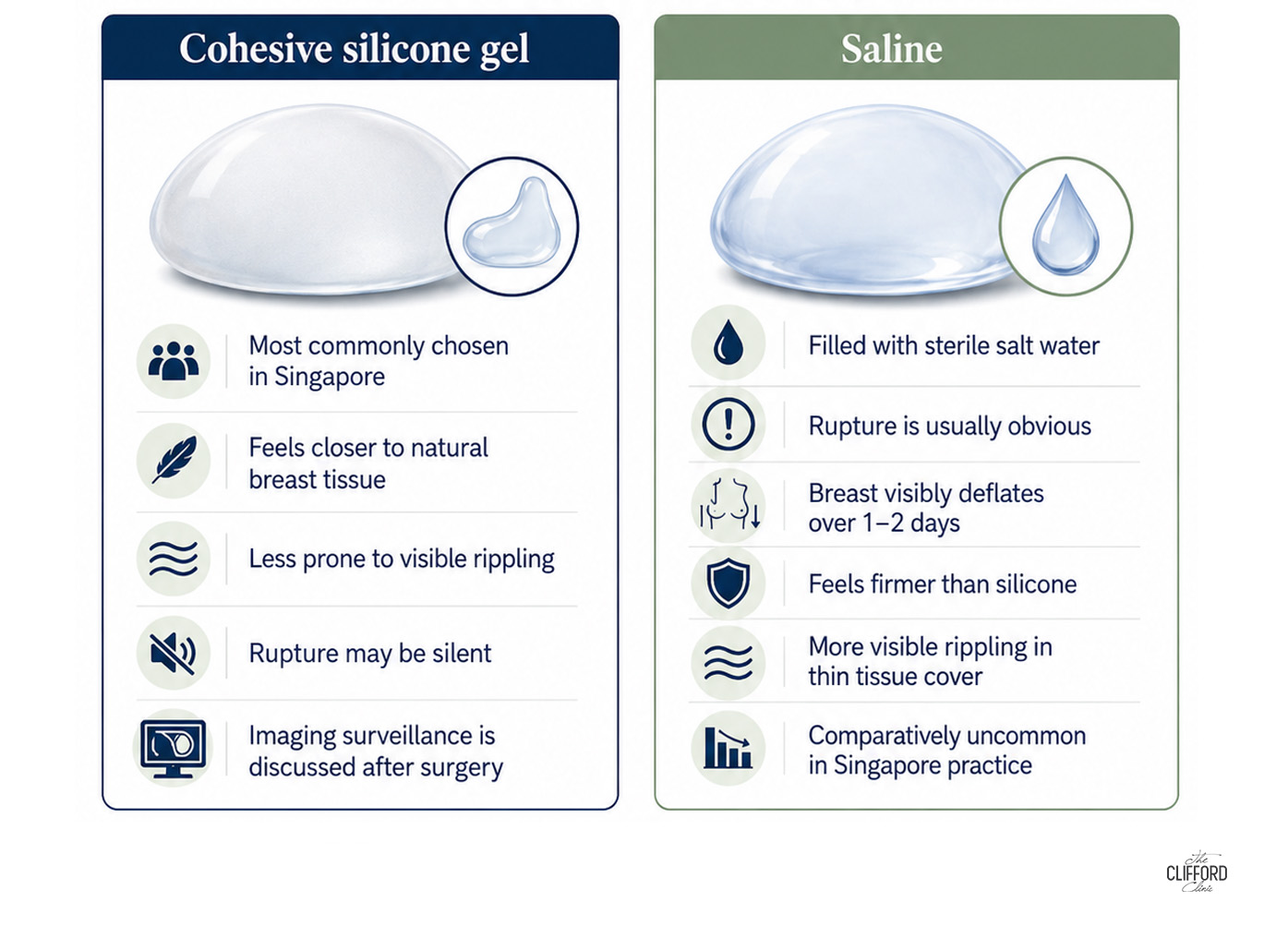
Cohesive silicone gel implants are by far the most commonly chosen in Singapore, primarily because their feel is closer to natural breast tissue and they are less prone to visible rippling. One trade-off is that silicone rupture is frequently silent, producing no pain, no change in size and no change in shape, which is why imaging surveillance is discussed after surgery rather than left to symptoms.
Saline implants are filled with sterile salt water. A rupture is obvious because the saline is absorbed and the breast visibly deflates over a day or two. The trade-off is that saline is a liquid rather than a gel, so it transmits the shell folds to the surface, and the implant feels firmer and ripples more visibly in patients with thin tissue cover. They are comparatively uncommon in Singapore practice.
Neither fill is the safer choice in general terms. Both are used within regulatory approvals, and both carry the risks common to all implants, including capsular contracture, rupture and the need for revision surgery at some point.
The meaning of the gummy bear implant label
Gummy bear is a marketing nickname rather than a specific product. It describes a highly cohesive, form-stable silicone gel that retains its shape when the implant is cut in half, in the way the confectionery does. Many modern implants use cohesive gel of varying firmness, so the useful question at consultation is not whether a clinic offers gummy bear implants, but which gel cohesivity suits the patient’s tissue thickness and aesthetic goals.
Round vs anatomical (teardrop) implants, and the rotation trade-off
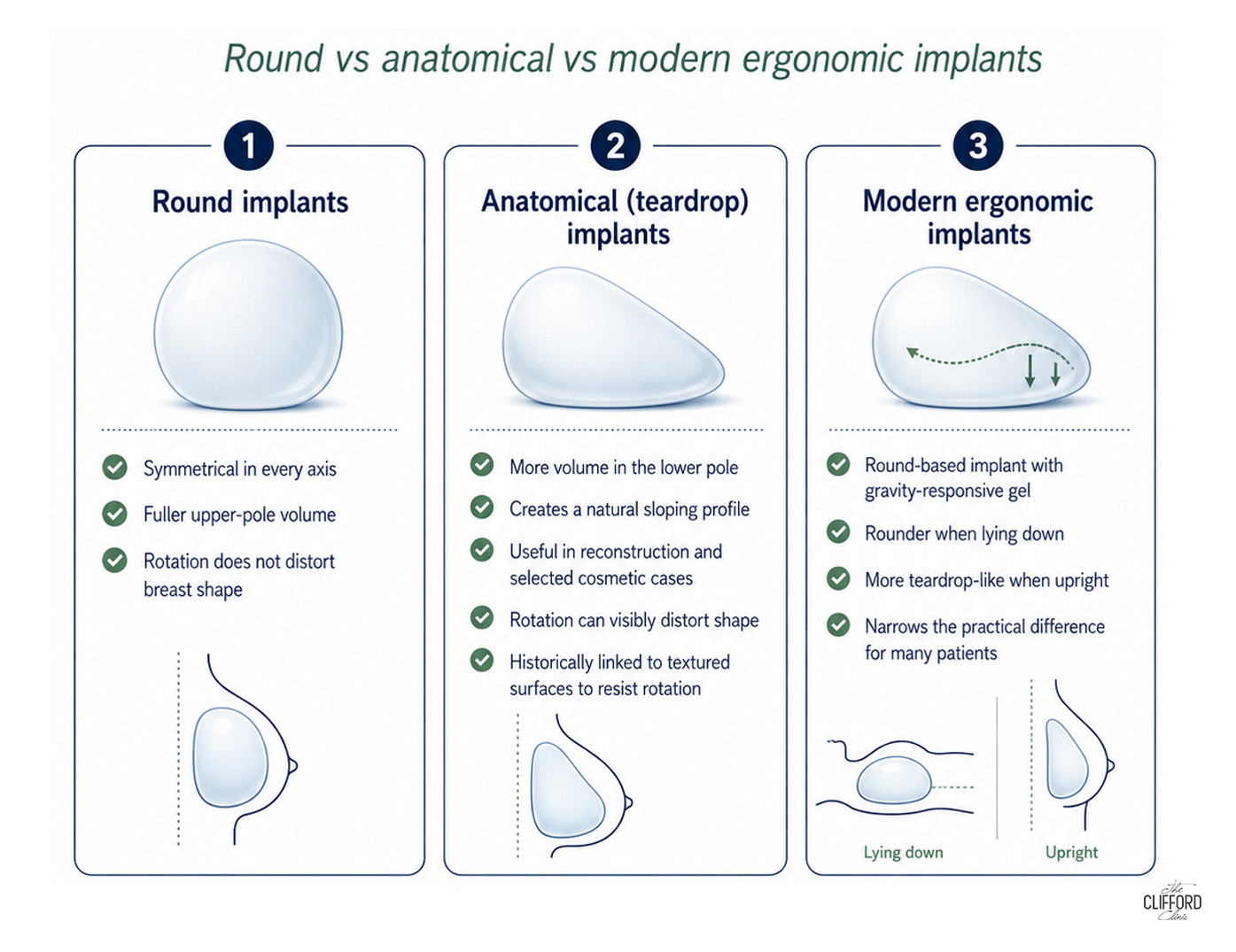
Round implants are symmetrical in every axis. They give fuller upper-pole volume, and because the profile is identical whichever way the implant sits, rotation within the pocket cannot distort the breast shape.
Anatomical, or teardrop, implants carry more volume in the lower pole to reproduce a natural slope. They are useful in reconstruction and in selected cosmetic cases, but rotation within the pocket moves that extra volume out of position and visibly changes the breast shape. To resist rotation they have historically been manufactured with textured surfaces, which is directly relevant to the surface discussion below.
Some modern round implants use gels engineered to respond to gravity, sitting rounder when the patient is supine and adopting a teardrop slope when she is upright, which narrows the practical difference between the two shapes for many patients. Dr Naidu considers that the ergonomic generation has largely settled the old debate. “Studies comparing conventional round and anatomical implants have generally not shown a consistent aesthetic advantage for anatomical implants. In several studies, even plastic surgeons had difficulty identifying which type had been used from postoperative photographs. The ergonomic generation has not made implant selection irrelevant, but it has made the old round-versus-teardrop choice much less absolute. In most primary cosmetic augmentations, I can achieve a natural slope using a modern ergonomic implant without requiring a fixed anatomical shape, and a round-based implant avoids the rotation problem, because if an anatomical implant rotates, the visible breast shape may become distorted. I reserve classic anatomical implants for uncommon cases in which they offer a clear anatomical advantage, such as a significant congenital breast-shape difference, a constricted lower breast or complex asymmetry. Ultimately, I choose the implant according to the patient’s anatomy and desired result rather than a simple label such as ‘round’ or ‘teardrop’.”
Smooth and textured implant surfaces
Surface texture determines how the surrounding tissue interacts with the implant. Textured surfaces were developed to stabilise implants, particularly anatomical ones, by encouraging tissue to grip the shell, and were once thought to reduce capsular contracture in some settings. Regulators, including Singapore’s Health Sciences Authority (HSA), have since noted a stronger association between textured implants and breast implant-associated anaplastic large cell lymphoma (BIA-ALCL), a rare cancer of the immune system that arises in the capsule around an implant. Certain heavily textured products were withdrawn from markets worldwide as a result. Smooth and newer fine-surface implants, such as the Motiva SmoothSilk surface used at The Clifford Clinic, dominate current practice. Surface choice therefore carries a risk discussion as well as a mechanical one, set out in our full guide to breast implant safety and monitoring.
Profile and projection, from low to high
For any given volume, an implant can be made wider and flatter, which is a lower profile, or narrower and more projecting, which is a higher profile. Profile therefore determines how far the breast projects forward relative to its width. Because implant diameter should respect the patient’s natural breast-base width, and that width is fixed by her anatomy, profile is the lever that adjusts volume once diameter has been set. This is a central concept explained further in how implant size and profile are selected.
Diameter and volume, and why diameter is planned first
Volume, measured in cubic centimetres, is the number patients ask about. Diameter, measured in centimetres, is the number surgeons plan around. An implant wider than the breast base has to sit partly on the chest wall beyond the breast footprint, which tends to look and feel unnatural and can create fullness at the side of the chest. An implant that is too narrow leaves the outer breast unfilled and can look isolated on the chest. Volume follows from diameter and profile rather than the other way around.
Shell construction and brand systems
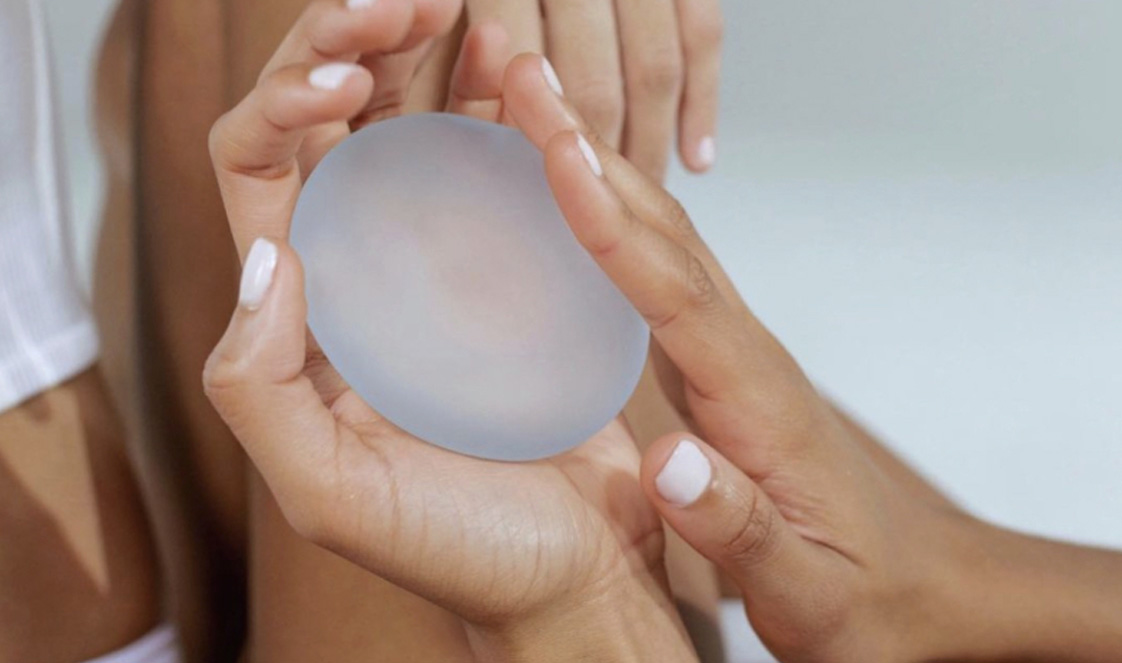
Brands differ in shell engineering, gel options, barrier layers and traceability features. Motiva implants, the system stocked at The Clifford Clinic, use a TrueMonobloc shell-gel construction, a BluSeal barrier layer that limits gel diffusion through the shell, and an optional Qid radio-frequency identification (RFID) tag that allows the implant to be identified without surgery. These are legitimate engineering differences, but no brand feature eliminates the risks common to all implants. The systems available at The Clifford Clinic are Motiva Ergonomix, referred to as Ergo 1, and Ergonomix2 (Premium JOY), referred to as Ergo 2, covered in detail in our Motiva implants guide.
How the characteristics combine into a configuration
In practice, a surgeon is not choosing between silicone and saline in isolation. The choice is a configuration of fill, shape, surface, cohesivity, diameter and profile assembled together, and the characteristics interact. A firmer, form-stable gel holds upper-pole shape but moves less with the patient, so it suits those who want defined fullness more than maximal softness. A soft gel in a patient with thin tissue ripples more visibly unless the placement plane adds coverage over it. An anatomical shape justifies its rotation risk only where the chest genuinely benefits from a shaped lower pole. Two well-qualified surgeons can therefore reasonably recommend different implants for the same patient, because they are weighting different priorities, and the consultation discussion of those priorities, namely softness, fullness, naturalness in motion and longevity of appearance, matters as much as the measurements.
A useful model is that the measurements set the diameter, the tissue coverage sets the surface and placement discussion, and the aesthetic priorities set the gel, shape and profile. Any recommendation should be explainable in those terms. A clinic that cannot explain why a specific configuration fits a particular anatomy, in terms beyond brand marketing, has not completed the assessment.
How breast implants are regulated in Singapore
Breast implants sold in Singapore are registered as medical devices with the Health Sciences Authority (HSA), which evaluates safety and quality before market entry and continues post-market surveillance afterwards, including safety communications such as its BIA-ALCL advisory. Registration has three practical consequences. Implants obtained through licensed Singapore channels are traceable, with brand, model and serial numbers documented on the patient’s implant card. Counterfeit and grey-import devices are excluded. Any future safety notice about a specific implant can be matched to the patients who received it. Confirmation of an implant’s HSA registration, and full device documentation after surgery, are reasonable requests of any clinic, and a professional clinic treats both as routine.
The engineering history behind today’s implants
Silicone implants have passed through several engineering generations since the 1960s. Early implants combined thin shells with liquid gel, so a rupture leaked readily into the surrounding tissue, which is the source of many of the historical concerns that still circulate. Modern implants use thicker multi-layer shells, barrier layers that limit gel diffusion, and cohesive gels that hold together even when the shell fails. Texturing became common in the 1990s partly to stabilise anatomical implants, then declined once the BIA-ALCL association emerged, and fine-surface and smooth implants now dominate. That history explains which questions are worth asking today, namely those about shell generation, gel cohesivity and surface classification rather than the decades-old reputations attached to brands.
Whether any one implant type is safer or more natural
No single type is safer or more natural for every patient. Every characteristic, including fill, shape, surface, cohesivity and profile, is a trade-off whose value depends on the individual’s tissue thickness, breast-base width, skin envelope and goals. Any page or clinic declaring one implant “the safest” or “the most natural” for everyone is making a marketing claim rather than a clinical one. The clinically answerable question is which combination of characteristics suits a particular anatomy, which is what the consultation exists to determine.
Matching implant characteristics to common goals
Typical patient priorities map onto configuration choices in the following ways, always subject to examination.
- “As natural as possible, especially in motion.”This points toward softer, gravity-responsive gels, moderate profiles sized within the natural base width, and a placement plane with good tissue coverage. The result moves and drapes with the patient rather than sitting statically full.
- “Visible upper-pole fullness in clothing.”This points toward a more form-stable gel or a higher-profile round implant. The accepted cost is a firmer, more sculpted appearance that moves less.
- “Maximum softness to the touch.”This prioritises lower-cohesivity gels and adequate tissue coverage. In patients with thin tissue the goal interacts strongly with placement, and it argues against choosing a larger implant than the tissue can cover.
- “Discreet, as I do not want anyone to know.”The effective levers here are a modest volume within the existing frame, a natural-slope profile, and incision planning. Implant choice alone cannot conceal a size change that is visible in clothing.
- “Correcting a size difference between sides.”This is addressed with different volumes, and sometimes different profiles, on each side, chosen from precise measurements. It is routine planning and a particular strength of implant-based augmentation.
These are starting points for the consultation rather than prescriptions. Measurements taken at examination may support, adjust or overrule any of them.
Frequently asked questions
Which implant type feels most natural?
Softness depends on gel cohesivity, implant size relative to the patient’s own tissue, and the placement plane, rather than on brand names. Patients with thin tissue usually gain more from placement and sizing decisions than from any specific implant.
Are textured implants banned in Singapore?
Certain macro-textured products were withdrawn globally, and HSA has advised on the BIA-ALCL association with textured surfaces. The current regulatory status of any specific implant should be confirmed at consultation.
Do round implants always look fake?
No. An appropriately sized round implant in the correct plane commonly looks natural. An oversized implant of any shape is what tends to look artificial.
What is the difference between cohesive gel and regular silicone?
All modern silicone implants use cohesive gel. The term distinguishes today’s form-holding gels from the liquid fills of the early generations. Within the cohesive range, firmness varies by product line, and that variation is the meaningful choice today.
Do heavier implants sag faster?
Implant weight contributes to tissue stretch over years, and larger implants are heavier. This is one reason surgeons counsel restraint on size for patients with thin tissue or lax skin, covered further in our sizing guide.
Can I choose a different implant in each breast?
Yes. Asymmetry is common, and using different volumes, and occasionally different profiles, on each side is routine planning rather than a compromise.
How do I verify what implant I received?
An implant card documenting brand, model and serial numbers should be issued after surgery, and some implants also carry readable RFID identification. The card should be kept permanently, because it matters for future imaging, warranty claims and any safety notices.
Medically reviewed by Dr Gerard Ee. Surgery performed by Dr Shenthilkumar Naidu, MBBS (NUS), FRCS (Edin), MOH-accredited Consultant Plastic Surgeon. He was the first plastic surgeon in Singapore to use Motiva breast implants (2016).
References. U.S. FDA, Breast Implants (implant characteristics and risks) · HSA Singapore, breast implant advisories · Establishment Labs, Motiva product information.
Explore the full breast implant series
Considering breast augmentation? Visit the main Breast implants at The Clifford Clinic service page to book a consultation, or continue with the rest of this series.
Breast Augmentation With Implants in Singapore — the complete guide · Breast Implant Cost in Singapore · Motiva Breast Implants in Singapore · Breast Implant Size and Profile · Breast Implant Placement, Incisions and Scars · Breast Augmentation Recovery Timeline · Breast Implant Safety and Monitoring · Breast Implants vs Fat Transfer vs Breast Lift · Breast Implant Removal and Revision · Breast Implants, Pregnancy, Breastfeeding and Mammograms.

Author Bio
Dr Gerard Ee

Dr Gerard Ee is the Medical Director of The Clifford Clinic in Singapore. He earned his medical degree from St George's University of London and built his surgical experience across the Singapore General Hospital, National University Hospital, and Mount Sinai Hospital in New York. He holds Membership of the Royal College of Surgeons (Edinburgh) and a Postgraduate Diploma in Dermatology (Cardiff), and is fully accredited in aesthetic procedures including botulinum toxin, fillers, lasers, and light therapies. A strong advocate of minimally invasive, natural-looking results, Dr Ee has published in several medical and scientific journals and presented his research in cities including Taipei, Las Vegas, and London.
See all posts by Dr Gerard Ee »