
Can Pico Laser Make Pores Look Smaller? A Practical Guide for Singapore Skin
Written by Dr Bernard Ong. Medically reviewed by Dr Gerard Ee
Pico laser can make pores less conspicuous, but it cannot close or remove them. The version used for texture is fractional: a handpiece concentrates the pulse into microscopic points that stimulate collagen repair around the follicle openings. In one controlled Asian study, three sessions were followed by about a 30 per cent reduction in measured pore volume at six months. That figure is not a promise for every face. Oil production, congestion and acne scarring may have more influence on the result than the laser itself.
Pores are normal anatomy
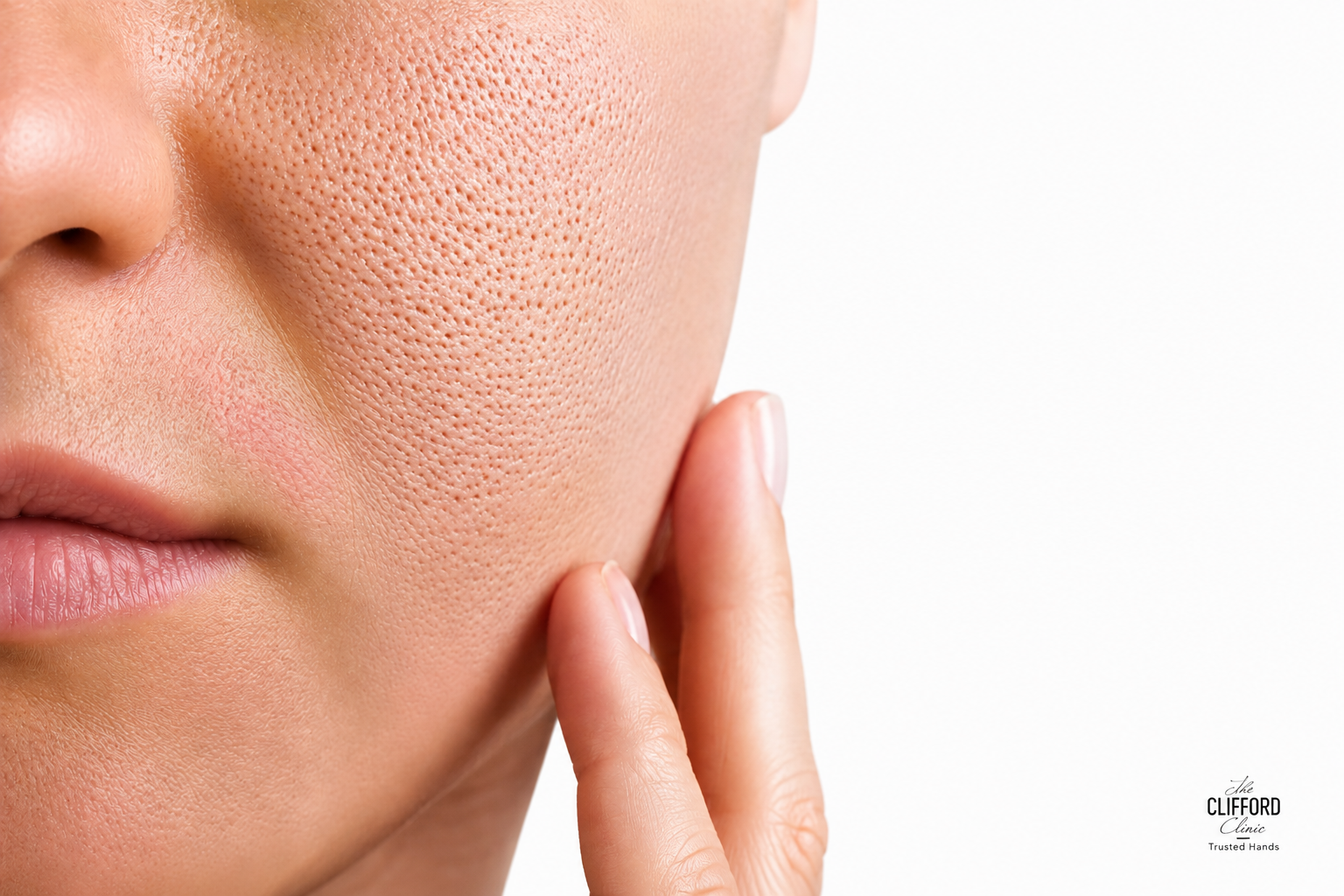
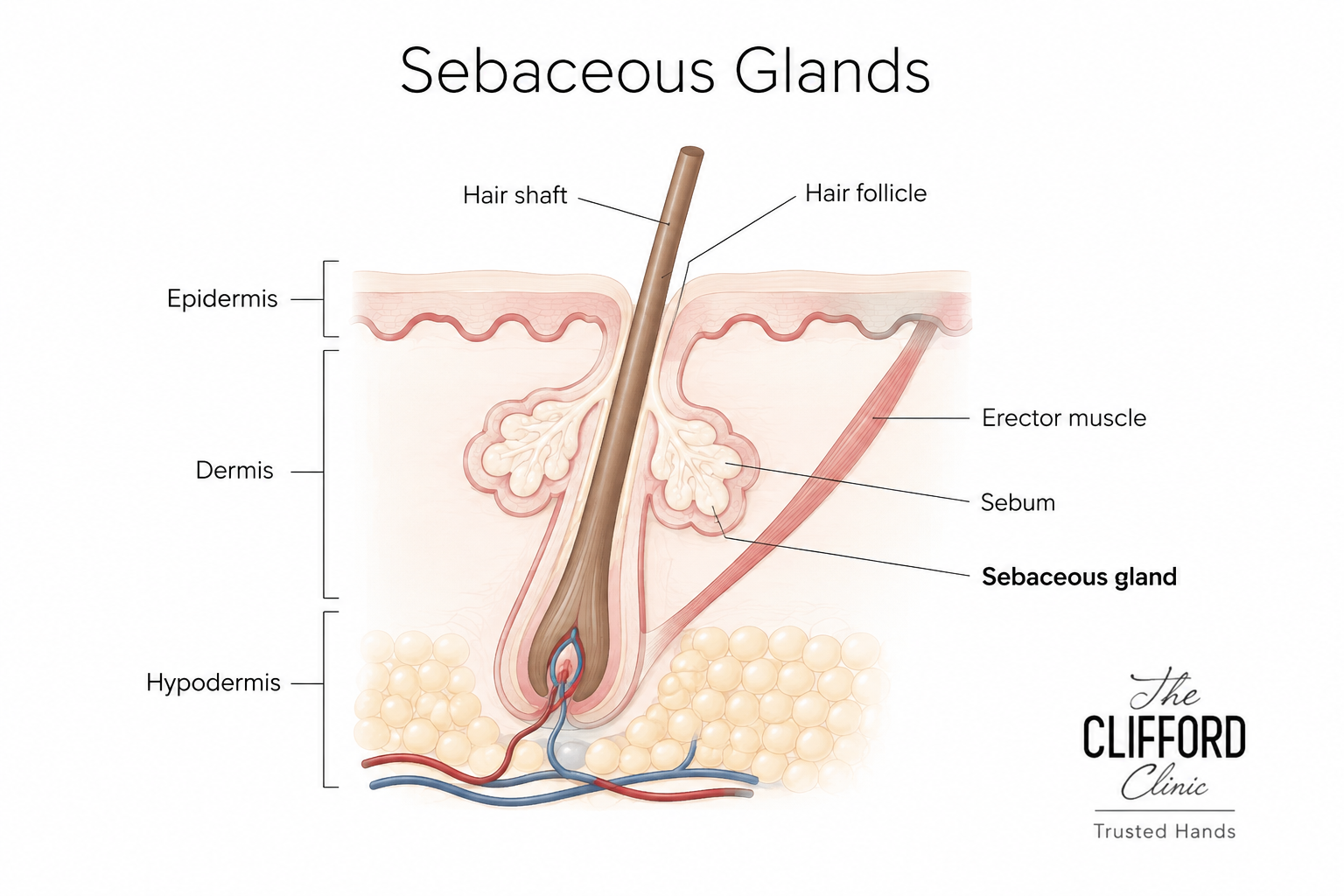
A pore is the visible opening of a hair follicle and its oil gland. It releases sebum onto the skin and cannot be permanently sealed without damaging a normal structure. What people call an “enlarged pore” is usually a pore that has become easier to see. The opening may be distended from within by oil, held open by a plug of keratin, or left less supported when collagen and elastic tissue around it decline. Treatment can reduce the shadow and the apparent diameter. It does not create poreless skin.
Why pores often look more prominent in Singapore
Heat and humidity can increase sebum output, so an oil-driven T-zone is common locally. In that situation, the pore may look large because it is continually being filled and stretched. A different pattern appears with cumulative sun exposure and ageing: the collagen framework around the opening becomes less firm, and the pore looks slack rather than congested. Active acne, blackheads and thickened surface cells can add a third component. Most patients have more than one, which is why a device-only answer is often incomplete.
What fractional Pico laser actually does
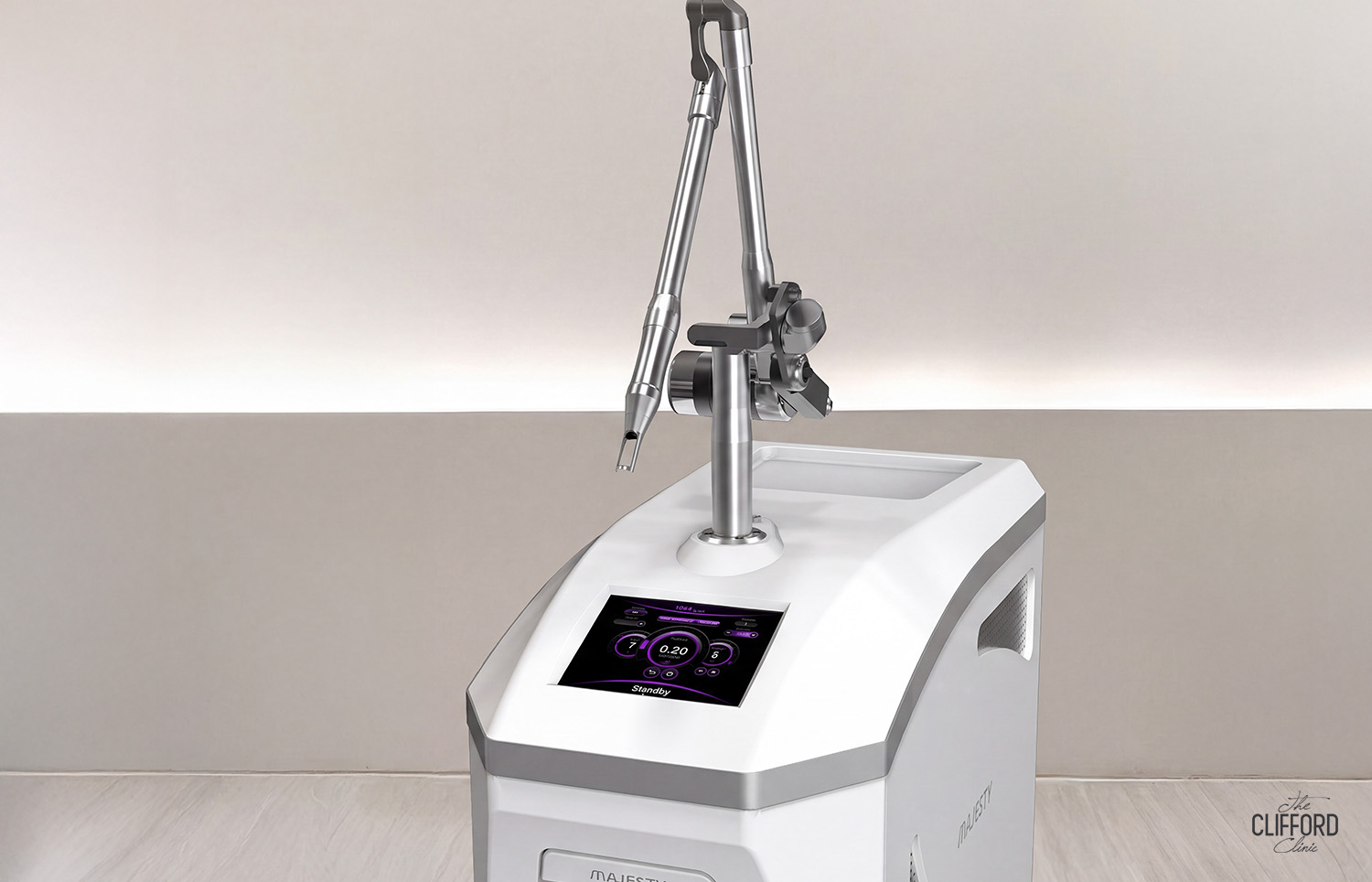
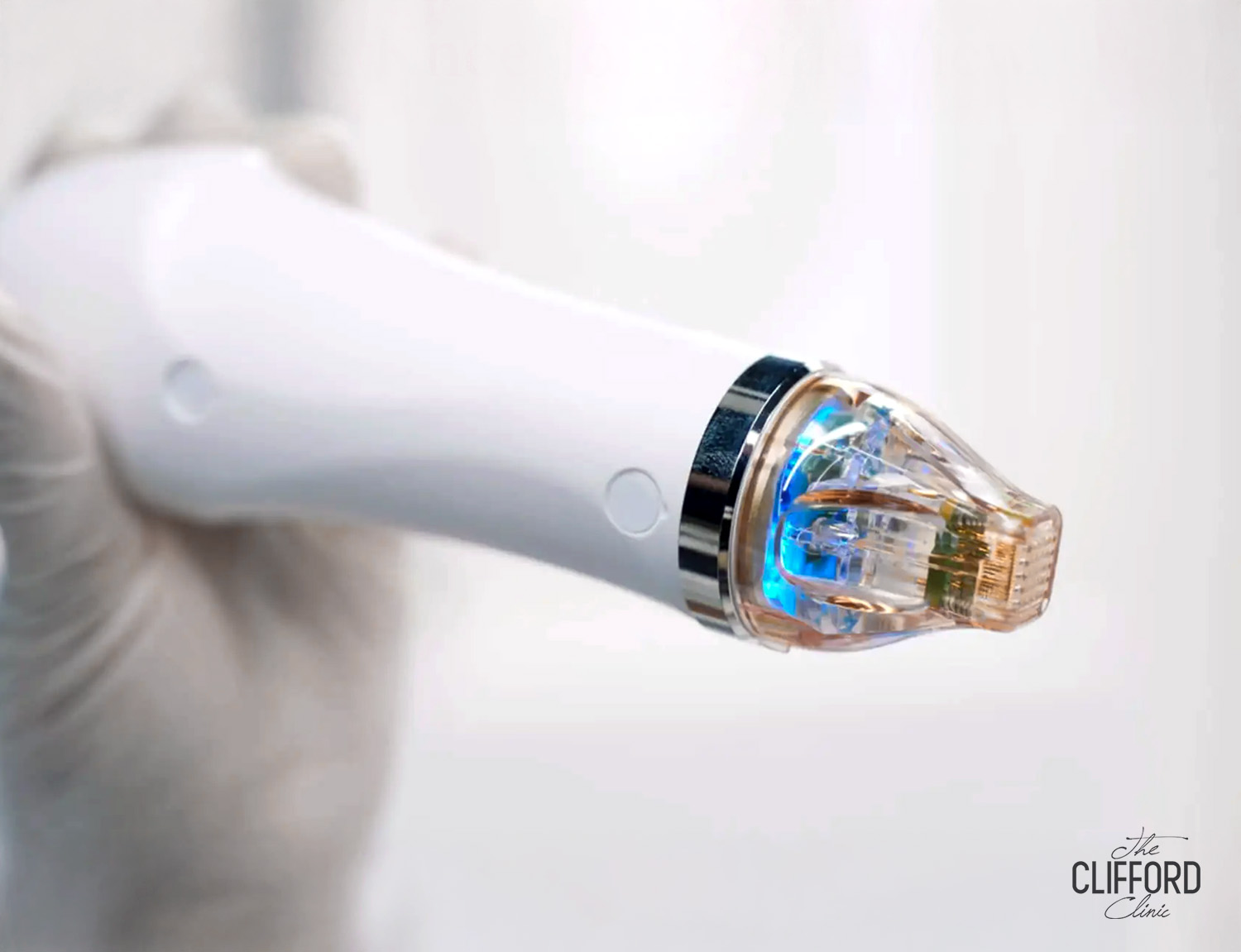
A fractional or microlens handpiece splits the beam into a grid of high-intensity points. At each point, the picosecond pulse produces laser-induced optical breakdown within the dermis with relatively little thermal spread. The skin repairs those controlled microscopic injuries by laying down new collagen. As support around the follicle opening improves, the edge casts less shadow and the surface looks smoother. The change is gradual because collagen has to be formed and remodelled; the pore is not mechanically “closed” during the appointment. This fractional application is one use of picosecond technology; our Pico laser treatment in Singapore page explains how the same platforms are used differently for pigment and other concerns.
What the measured evidence shows
In a controlled series involving Asian patients, three treatments with a 1064 nm fractional picosecond laser were associated with an average reduction of about 30 per cent in measured pore volume at six months. Improvement was still developing between the one-month and six-month assessments, and no dyspigmentation or scarring was recorded in that series. Results are most plausible when loss of collagen support or mild textural change is an important part of the problem. If heavy sebum production is the main driver, adding more laser sessions is unlikely to outperform better oil and congestion control.
Pores, scars, roughness and oiliness are different problems
The word “pores” is often used for several concerns that look similar in photographs. Separating them matters, because the treatment endpoint is different for each.
Fractional Pico Laser for Pores, Texture and Acne Scars
| Concern | What It Is | What Fractional Pico Laser Can Do |
|---|---|---|
| Enlarged Pores | Normal follicle openings made more visible by oil, congestion or loss of collagen support | May refine their appearance by rebuilding collagen around the openings |
| Shallow Acne Scars | Small permanent deficits in dermal collagen after inflammation | May soften mild surface irregularity; deeper or boxcar scars need other methods |
| General Roughness | An uneven surface related to dryness, photoageing or mild textural change | Often improves as collagen remodels and the surface becomes smoother |
| Oiliness and Blackheads | Excess sebum and material retained inside the follicle | Does not durably suppress oil glands or clear a plugged follicle on its own |
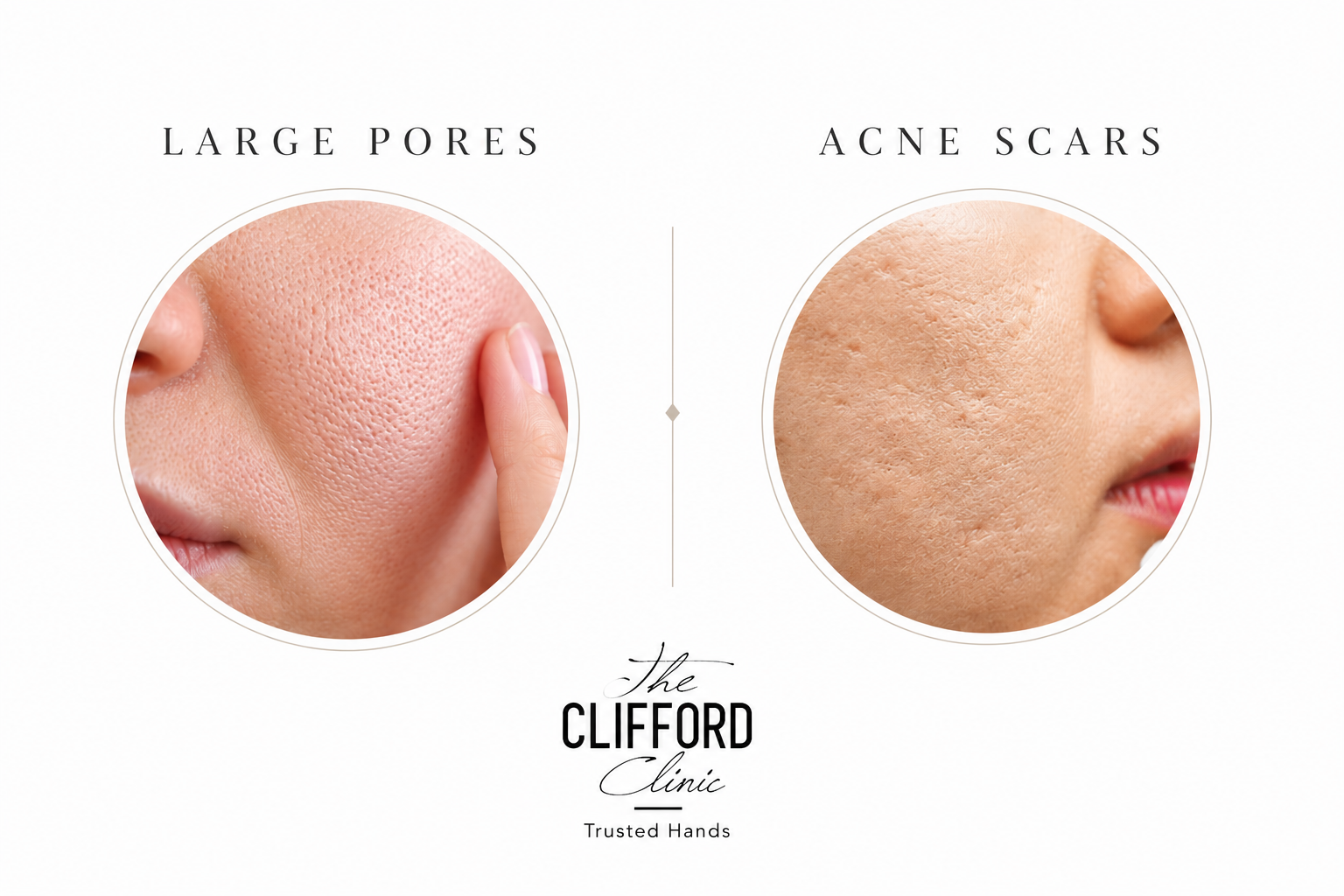
Pores are not the same as acne scars or acne marks
A shallow scar can resemble a large pore because both create a small shadow in the skin. A true scar, however, is a permanent collagen deficit left by an inflamed lesion, and deeper scars may need subcision or more intensive fractional resurfacing. Our guide to acne scars explains that distinction. Brown acne marks are different again: they are colour changes left after inflammation, not enlarged openings. It is possible to have all three concerns on the same cheek.
Why laser does not switch off oil glands
Fractional Pico treatment works mainly through collagen remodelling. It is not a durable sebaceous-gland treatment. Where the T-zone remains very oily or congested, the follicles continue to fill and the pores continue to look stretched even after the surrounding collagen has improved. Skincare that keeps follicles clear, appropriate treatment of active acne and measures that reduce excess oil are therefore not optional extras in an oil-dominant case. They address the part of the problem the laser does not.
A combined plan often makes more sense
Pore prominence is commonly mixed. Fractional picosecond treatment or radiofrequency microneedling may be used for the structural component. Topical retinoids can support cell turnover and collagen, while an acne or comedone plan addresses oil and blockage. Daily broad-spectrum photoprotection helps preserve the collagen being rebuilt, because ultraviolet exposure continues to degrade the framework around the openings. The useful question is not “Which pore treatment is best?” but “Which factor is making these pores visible?”
How many sessions are usually needed
Published protocols in Asian skin commonly use three sessions spaced two to four weeks apart. The visible result may continue to improve for several months after the last treatment as collagen matures. An individual plan may be shorter or longer depending on the starting texture and the balance between oil, congestion and collagen loss. Repeating the same procedure indefinitely is not helpful when the limiting factor is sebum rather than structure.
Downtime and aftercare
Mild redness and a dry, sandpaper-like feel can follow fractional treatment and usually settle over several days. During that period, gentle cleansing, moisturising and daily sunscreen reduce irritation and lower the chance of post-inflammatory hyperpigmentation. This is particularly relevant in Asian skin, where inflammation can leave a brown mark after the original redness has gone. Maintenance treatment may be considered later, but ongoing sun protection and a consistent routine do more to preserve the result between sessions.
What a realistic result looks like
The aim is not skin with no visible follicles. A worthwhile result is skin that looks smoother in ordinary light, with less shadow around the openings and less contrast between the pores and the surrounding surface. Makeup may sit more evenly and the T-zone may photograph better, but magnified mirrors will still show pores because they are meant to be there. Establishing that endpoint before treatment prevents a technically successful result from feeling disappointing.
Doctor’s perspective

Patients often ask how to “close” their pores. The more useful conversation is about why those pores are noticeable. When collagen support has weakened, fractional treatment addresses a real structural contributor. When the face is oily and congested, the skincare and acne plan may determine just as much of the outcome. Naming the dominant cause gives the treatment a measurable endpoint instead of an impossible promise of poreless skin.
Who may benefit—and who needs a broader plan
- May suit fractional Pico laser: pores made more visible by sun damage, loss of collagen support or mild textural change, with a preference for gradual improvement and short downtime.
- Usually needs a combined plan: prominent pores in very oily, congested or acne-prone skin.
- May need another treatment first: deep acne scars, active infection or inflammation, recently tanned skin, or an expectation that pores can be erased permanently.
The devices used for pores and texture at The Clifford Clinic
Pore refinement is primarily a collagen-remodelling task. Fractional picosecond handpieces and the non-ablative Fraxel 1550 Erbium Glass are used to create controlled treatment zones in the dermis. The 1550 nm wavelength is absorbed by tissue water rather than surface melanin, allowing it to reach the dermis while limiting direct pigment absorption. When background pigmentation or dullness is also blurring the surface, a picosecond wavelength may be added for that separate component. The plan is built around what is causing the texture rather than around a single device name.
Frequently asked questions
Can Pico laser shrink pores permanently?
It can reduce how visible pores appear by stimulating collagen around the openings, but it does not permanently close a normal follicle. Maintenance, oil control and photoprotection influence how long the refinement remains noticeable.
Does Pico laser help skin texture?
A fractional picosecond handpiece can smooth mild roughness and shallow irregularity through collagen remodelling. Recovery is usually shorter than with ablative resurfacing.
How many sessions are needed for pores?
Many published protocols use three sessions at intervals of two to four weeks. Improvement can continue for months afterwards, and the final number depends on the starting texture and the main cause of pore prominence.
Are pores the same as acne scars?
No. Pores are normal follicle openings. Acne scars are permanent collagen deficits left by inflammation. They may look similar from a distance, but deeper scars require a different treatment plan.
What causes enlarged-looking pores?
The main contributors are excess sebum, loss of collagen and elastic support, and thickened or clogged follicles. More than one is often present.
Can skincare reduce the appearance of pores?
Skincare can help by controlling oil, keeping follicles clear and supporting collagen. It complements in-clinic treatment, but it may not be enough when loss of dermal support is the dominant issue.
Refining pores with a realistic endpoint

A useful plan begins by deciding whether the concern is oil, congestion, collagen loss, scarring or a mixture. Read more about Pico laser in Singapore and pigmentation treatment in Singapore. Appointments are available at The Clifford Clinic, 50 Raffles Place, #01-01 Singapore Land Tower. Call (65) 6532 2400 or WhatsApp (65) 8318 6332.
Selected references
- Comparison of picosecond and nanosecond Nd:YAG 1064 nm lasers in the treatment of melasma. Plastic and Reconstructive Surgery, 2023. https://pubmed.ncbi.nlm.nih.gov/36729879
- Comparative study of a 1064 nm fractional picosecond laser versus intense pulsed light in facial rejuvenation. Lasers in Surgery and Medicine, 2026. https://onlinelibrary.wiley.com/doi/10.1002/lsm.70094
- DermNet: lasers in dermatology. https://dermnetnz.org/topics/lasers-in-dermatology
- Quantitative assessment of the long-term efficacy and safety of a 1064 nm picosecond laser with fractionated microlens array in the treatment of enlarged pores in Asians. Lasers in Surgery and Medicine, 2022. https://pubmed.ncbi.nlm.nih.gov/34233039
- Comparison of the 1064 nm picosecond laser with fractionated microlens array and 1565 nm non-ablative fractional laser for enlarged pores: a randomised split-face controlled trial. Lasers in Medical Science, 2024. https://pubmed.ncbi.nlm.nih.gov/38396012