
Pico Laser in Singapore for Melasma Helpful, Risky or Not Enough?
Written by Dr Bernard Ong. Medically reviewed by Dr Gerard Ee
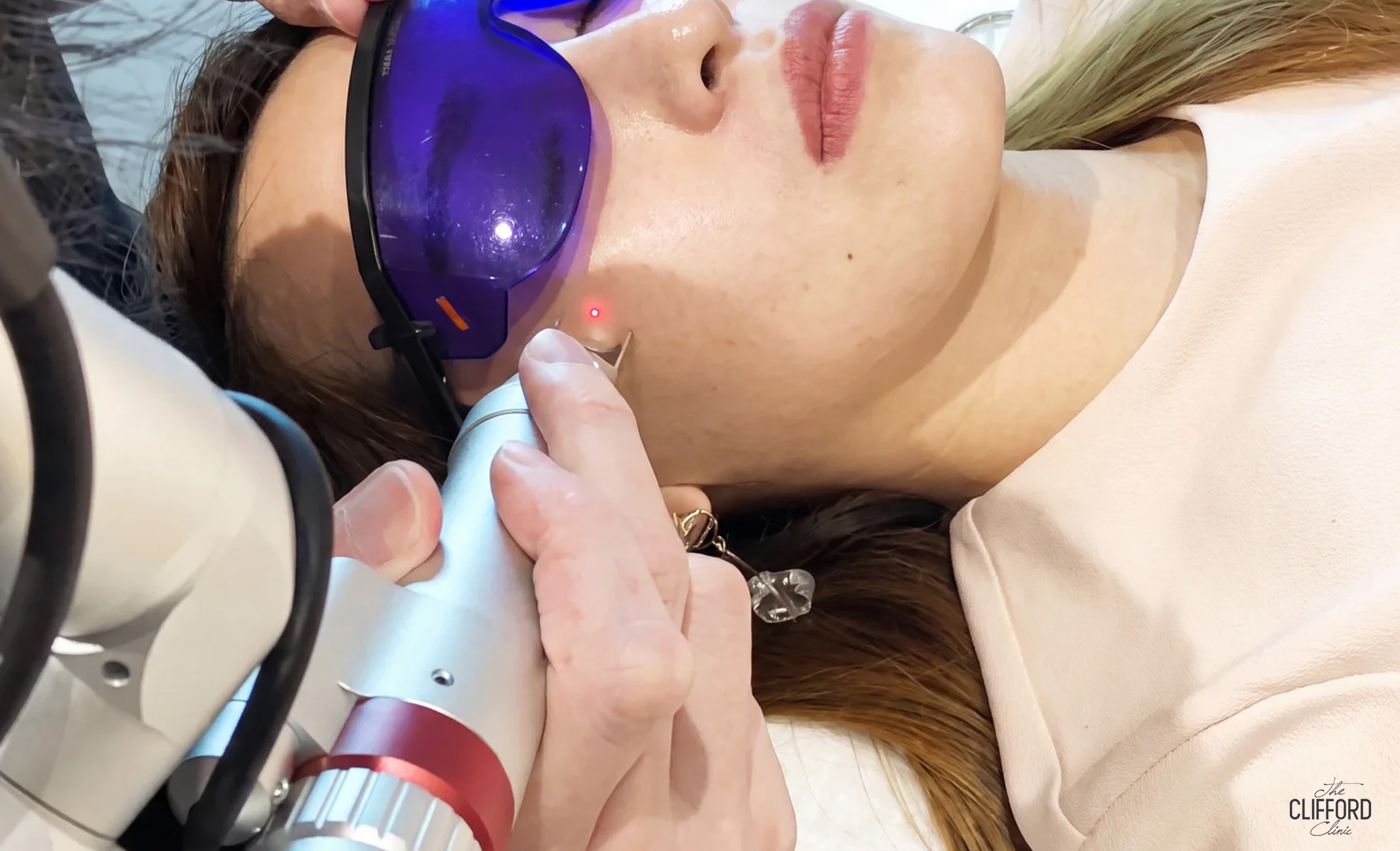
Pico laser is not a cure and not always the first step, but it can be effective in selected melasma. It is commonly used in low-energy toning settings on melasma that has been stabilised with sunscreen and topicals. But, when used aggressively or on active melasma, it can trigger rebound pigmentation.. Pico laser should be used judiciously in melasma.
Can Pico laser treat melasma?
If used correctly. Picosecond lasers deliver pigment-shattering pulses with minimal heat, which suits melasma’s fragile, reactive nature better than older high-heat approaches. Clinical studies of low-fluence picosecond toning show meaningful lightening in many patients, but also document recurrence when treatment stops and rebound when energy is excessive.
Why melasma is different from other pigmentation
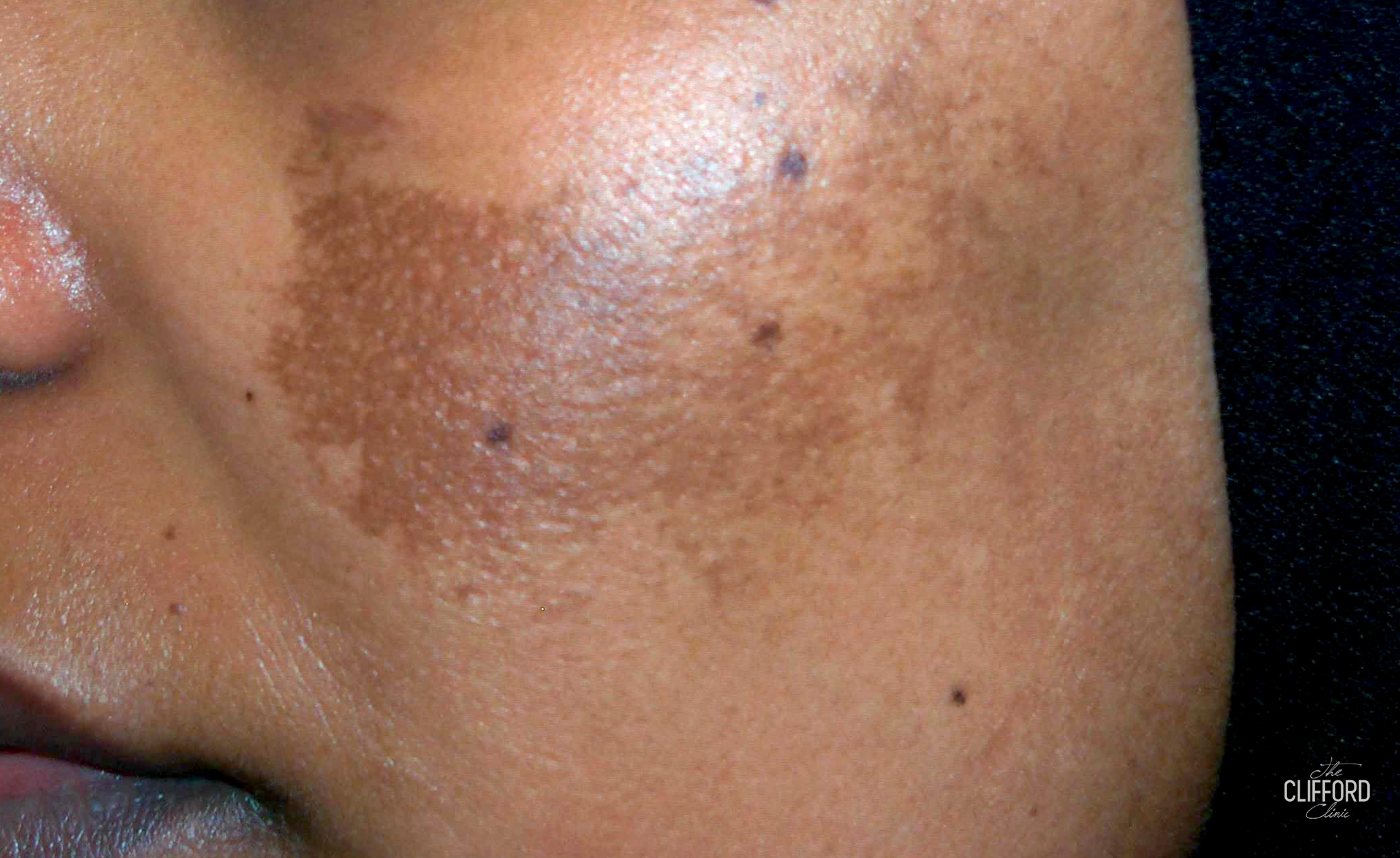
Melasma involves overactive melanocytes, increased blood vessels, a weakened basement membrane and a hair-trigger response to ultraviolet light, visible light, heat and hormones. Removing pigment does not solve underlying causes. This explains the different responses between melasma other forms of pigmentation like freckles or sun spots under the same laser. More background in our melasma treatment guide.
What Pico laser may improve, and why it may not be enough
Toning sessions can lighten established patches, even out tone and reduce the pigment load faster than topicals alone. But Patients who rely on laser alone typically watch their melasma return within months with continued UV exposure, hormonal changes, and underlying active melanocytes. While the laser was initially effective, the treatment plan was incomplete, as the underlying causes were never controlled.
When melasma should be stabilised first
Doctors generally stabilise melasma before laser with six to twelve weeks of daily tinted sunscreen and prescription topicals (oral tranexamic acid in selected cases). Stabilisation reduces melanocyte reactivity so toning works with the skin rather than provoking it. Skipping this step to fast-track visible results is the most common cause of laser-worsened melasma.
Risk of rebound pigmentation
Rebound pigmentation is melasma darkening after treatment, driven by inflammation from excessive energy, too-frequent sessions, or treating tanned or irritated skin. This is more common in deeper Asian skin tones. Conservative settings, four-week or longer spacing, strict sun protection and a doctor reviewing progress photos are essential. Treatment should pause, not intensify if patches darken progressively during a course. See our article on pigmentation looking darker after Pico laser.
Good candidate vs poor candidate
Pico Laser Suitability for Melasma
| Situation | Pico Suitability | Safer Next Step |
|---|---|---|
| Melasma Stable on Sunscreen + Topicals for 2–3 Months | Reasonable adjunct | Begin conservative toning course with review |
| Newly Noticed, Untreated Melasma | Not yet | Stabilise with tinted sunscreen and prescription topicals first |
| Melasma Darkened by a Previous Laser Course | Caution | Pause lasers, rebuild with photoprotection and topicals, then reassess |
| Pregnant or Breastfeeding with Melasma | Defer laser | Pregnancy-safe topicals and sunscreen, then treat after hormones settle |
| Mixed Melasma + Hori’s Naevus | Needs mapping | Treat each layer separately under one doctor’s plan |
| Tanned Skin, Outdoor Lifestyle, No Sunscreen Habit | Poor candidate | Fix photoprotection first or results will not hold |
Combination plans, sunscreen, topicals, laser and maintenance
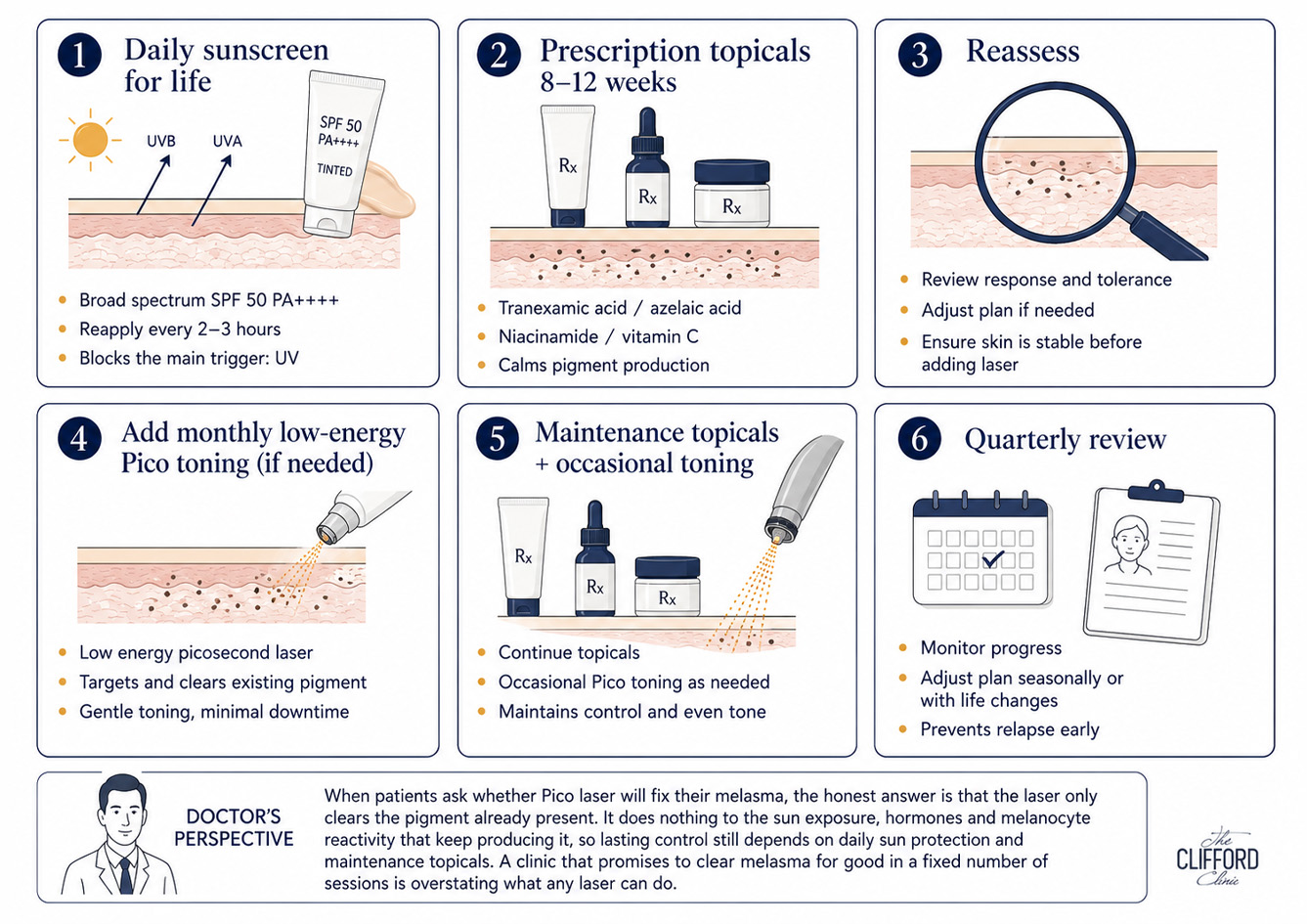
A representative sequence runs as follows. Tinted SPF 50 PA++++ sunscreen daily for life. Prescription topicals for eight to twelve weeks. Reassess. Add monthly low-energy Pico toning if needed. Then maintenance topicals with occasional toning and quarterly review. Each layer covers a weakness of the others. Sunscreen blocks triggers, topicals calm production, laser clears the backlog.
Doctor’s perspective. When patients ask whether Pico laser will fix their melasma, the honest answer is that the laser only clears the pigment already present. It does nothing to the sun exposure, hormones and melanocyte reactivity that keep producing it, so lasting control still depends on daily sun protection and maintenance topicals. A clinic that promises to clear melasma for good in a fixed number of sessions is overstating what any laser can do.
What to ask before laser for melasma
- Has my melasma been stabilised first, and how will we know?
- What settings and spacing will be used, and what is the stop rule if I darken?
- What maintenance follows the course, and what will it cost annually?
- Are my expectations, control rather than cure, aligned with yours?
What results are realistic?
With a full combination plan, many patients achieve substantial lightening over three to six months and can hold it with maintenance. Realistic success is melasma others need effort to notice, sustained year-round, not permanent erasure.
The biology that guides a cautious approach
Melasma involves overactive pigment cells set within a disturbed dermis that carries extra mast cells and an increased network of small blood vessels, with vascular growth signals feeding continued pigment production. Because heat and inflammation stimulate this same machinery, an aggressive laser can provoke rather than settle it. This biology explains why picosecond laser should be used gently, at low energy, as part of a plan built on sun protection and topical treatment. Measures that calm the vascular and inflammatory origins, such as tranexamic acid and laser wavelengths that target small blood vessels, complement the treatment plan.
How melasma is treated on our platforms
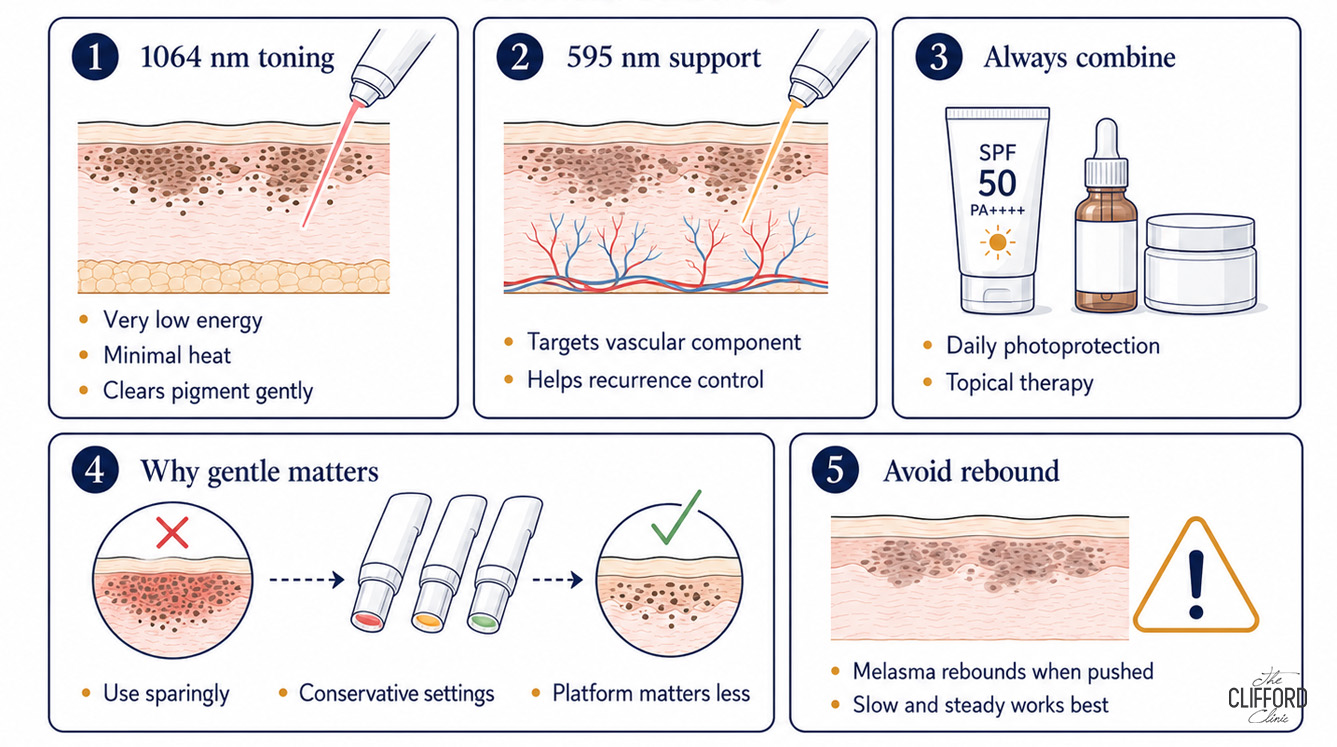
For melasma we rely on the gentler end of our range. Very low-energy 1064 nm toning removes pigment with minimal heat, and a 595 nm wavelength can be added to address the vascular component that drives recurrence. These are used sparingly and always alongside daily photoprotection and topical therapy. The deliberately conservative settings matter more here than the choice of platform, because melasma rebounds when it is pushed.
Frequently asked questions
Can Pico laser make melasma worse?
Yes, when settings are too aggressive, sessions too frequent, or skin is active, tanned or inflamed. Rebound pigmentation is the main risk, which conservative doctor-led protocols are designed to avoid.
How many Pico sessions are needed for melasma?
Toning courses commonly run monthly over several months, judged against photos, followed by maintenance. Fixed session promises are a red flag in melasma.
Why is melasma harder to treat than freckles?
Freckles are discrete lesions with a passive cause. Melasma is a field of overactive, hormonally sensitive melanocytes that re-pigments and can rebound.
Should I treat melasma with laser or creams first?
Creams and sunscreen first, in almost all cases.
Can melasma return after Pico laser?
Yes, and without maintenance it usually does. Laser clears pigment. It does not remove the underlying cause.
Is Pico laser safe for Asian skin with melasma?
At low-energy toning settings with proper spacing, it is among the safer laser options for Fitzpatrick III to V skin, though rebound risk means it should be doctor-supervised.
A melasma plan, not just a melasma laser
If your melasma has resisted or rebounded, start again from diagnosis. Learn about Pico laser in Singapore and pigmentation treatment in Singapore, or book at The Clifford Clinic, 50 Raffles Place, #01-01 Singapore Land Tower. Call (65) 6532 2400 or WhatsApp (65) 8318 6332.
Selected References
- Efficacy and safety of picosecond laser for the treatment of melasma: a systematic review and meta-analysis. Lasers in Medical Science, 2023. https://pubmed.ncbi.nlm.nih.gov/36897459.
- A systematic review of picosecond laser in dermatology: evidence and recommendations. Lasers in Surgery and Medicine, 2021. https://onlinelibrary.wiley.com/doi/10.1002/lsm.23244.
- Comparison of picosecond and nanosecond Nd:YAG 1064 nm lasers in the treatment of melasma. Plastic and Reconstructive Surgery, 2023. https://pubmed.ncbi.nlm.nih.gov/36729879.
- Characteristics of dermal vascularity in melasma and solar lentigo. Photodermatology, Photoimmunology and Photomedicine, 2024. https://onlinelibrary.wiley.com/doi/10.1111/phpp.12953.
- Comparing the efficacy and safety of a 730 nm picosecond laser with a 532 nm Q-switched Nd:YAG laser for facial pigmented disorders. European Journal of Medical Research, 2026. https://pubmed.ncbi.nlm.nih.gov/41782066.

Author Bio
Dr Gerard Ee

Dr Gerard Ee is the Medical Director of The Clifford Clinic in Singapore. He earned his medical degree from St George's University of London and built his surgical experience across the Singapore General Hospital, National University Hospital, and Mount Sinai Hospital in New York. He holds Membership of the Royal College of Surgeons (Edinburgh) and a Postgraduate Diploma in Dermatology (Cardiff), and is fully accredited in aesthetic procedures including botulinum toxin, fillers, lasers, and light therapies. A strong advocate of minimally invasive, natural-looking results, Dr Ee has published in several medical and scientific journals and presented his research in cities including Taipei, Las Vegas, and London.
See all posts by Dr Gerard Ee »