

Circumcision Before National Service – A Practical Guide for Teens and Parents
Quick answer
For a young man planning circumcision before National Service, the practical answer is to allow a clear six to eight weeks before enlistment. Initial recovery takes about a week, but strenuous physical activity is avoided for roughly four to six weeks, and basic military training is exactly the kind of sustained exertion, friction and sweating that a healing wound does not need. Older teenagers are usually treated under local anaesthesia while awake, going home the same day, with around five to seven days of medical leave. The best windows are the school holidays or the gap between finishing studies and enlisting. At The Clifford Surgery the professional fee is S$1,888 before GST, and MediSave can be applied when there is a medical indication such as a tight foreskin, including from a parent’s account in eligible cases. For the complete overview, see our Circumcision Singapore guide.
Why many choose to do it before enlisting
Recovery is easier at home than in camp. Basic training involves running, marching, field craft, heavy sweating and long stretches away from a comfortable bathroom. None of that suits a wound that needs to stay clean, dry and free from friction. Doing it beforehand means recovering in your own bed with your own shower.
Hygiene during training is the second reason, particularly for young men with a tight foreskin. Field conditions make careful cleaning difficult, and a foreskin that already traps moisture is more likely to become inflamed when washing is rushed.
Third, there is control over timing. Before enlistment you can choose the date, the doctor and the technique. Afterwards you are working around a training schedule with little flexibility.
Finally, an existing problem does not improve by being ignored. A tight foreskin that already causes discomfort will not be more convenient to deal with in the middle of training.
The timing that works
Work backwards from your enlistment date, and be generous rather than tight with the margin.
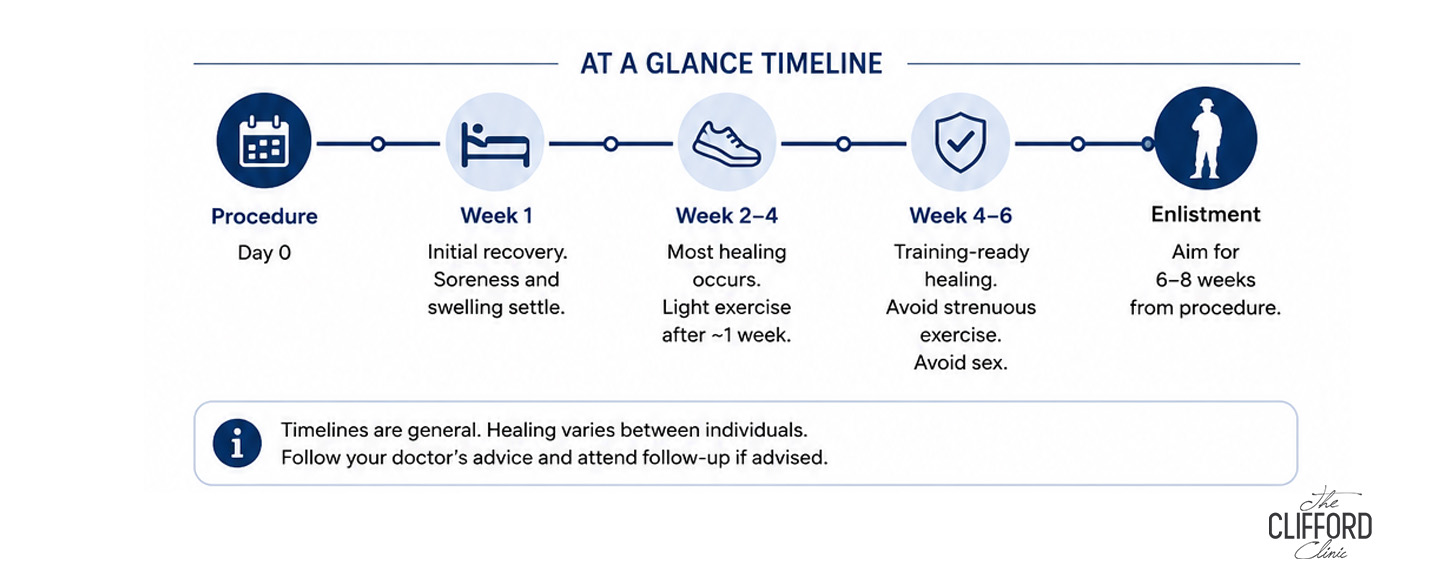
Allow about a week for the initial recovery, when soreness and swelling settle and normal daily activity resumes. Allow around four weeks before returning to strenuous exercise such as running and gym work, and about four to six weeks before the wound tolerates the sustained physical demand of training without concern.
That means six to eight weeks between the procedure and enlistment is the sensible target. Six is workable for a straightforward case that heals well. Eight gives a comfortable margin if healing is slower or if there is a minor complication that needs a review.
If you have less than four weeks before enlistment, the advice is usually to wait. Going into basic training with a wound that is only partly healed risks bleeding, infection and wound separation, and the resulting downtime is worse than the delay would have been. There will be opportunities during your service to arrange it properly.
Planning around school and examinations
Most young men in this position are finishing school, polytechnic or junior college, and the calendar is crowded.
The best windows are the November and December period after examinations, which typically leaves several clear months before a mid-year enlistment, and the mid-year school holidays for those enlisting later. Both allow a quiet first week without missing lessons, plus subsequent weeks of reduced activity without missing sport that counts.
Avoid scheduling in the fortnight before major examinations. The procedure itself is short, but discomfort in the first few days and the need to take painkillers on schedule are unnecessary distractions.
Book early for holiday periods. These are the busiest weeks of the year for circumcision in Singapore, because families and students are all working to the same calendar.
How long recovery takes
It helps to separate comfort from healing.
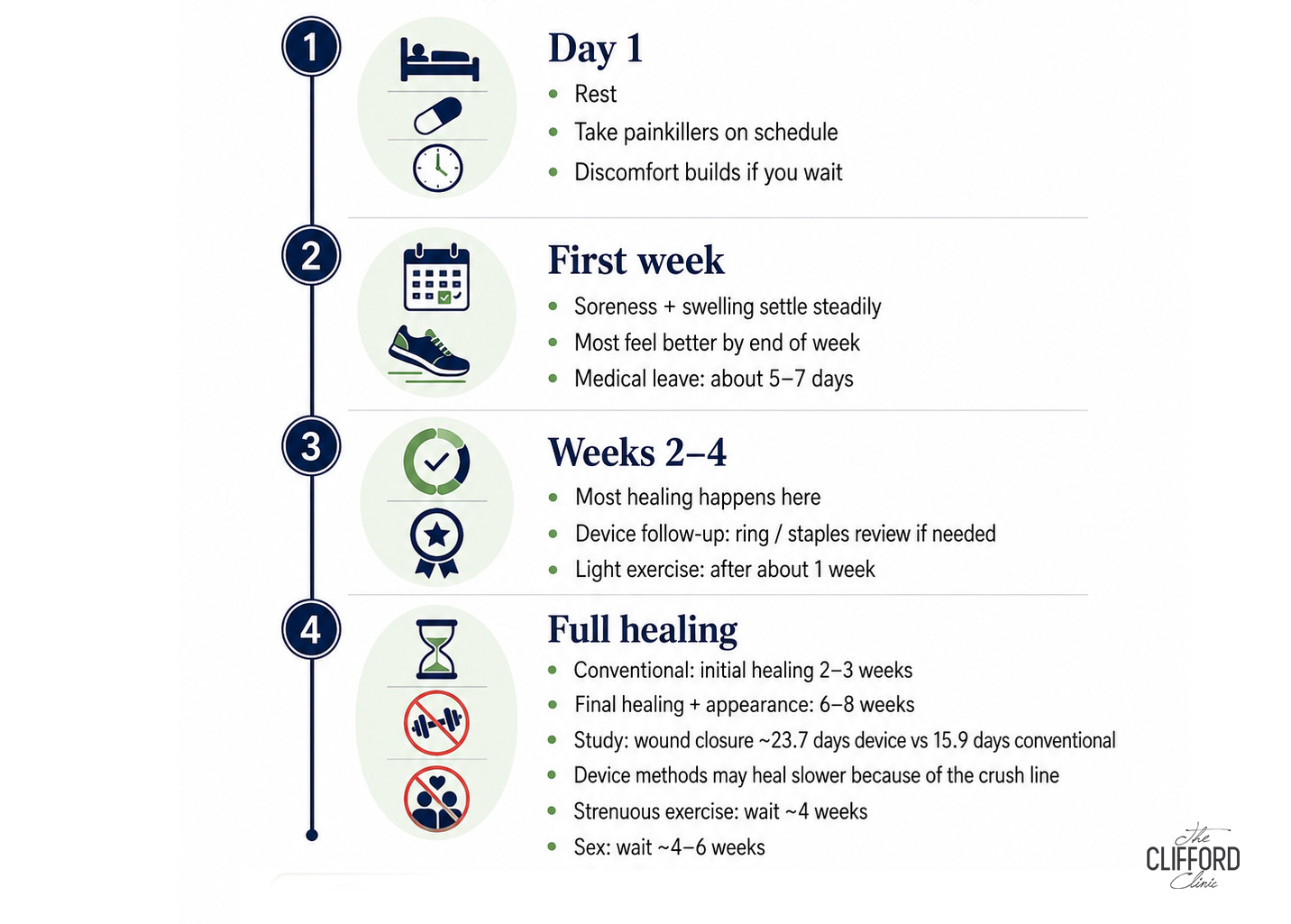
Rest for the first day, and take painkillers on schedule rather than waiting for discomfort to build. Soreness and swelling settle steadily over the first week. Most young men feel noticeably better by the end of it, and around five to seven days of medical leave is typically provided.
Most of the healing happens in weeks two to four. With device methods, a short follow up visit assesses whether the ring or staples need to be removed. Light exercise such as walking and gentle activity usually resumes after about a week.
Full healing takes longer than feeling fine does. Conventional circumcision typically heals initially over two to three weeks, with complete healing and the final appearance settling over six to eight weeks. One comparative study reported average wound closure of about 23.7 days with a device against 15.9 days with conventional surgery, because a device leaves a crush line that takes longer to separate. Strenuous exercise waits about four weeks and sexual activity about four to six weeks. Our recovery guide sets out the full timeline.
Anaesthesia for older teens
By this age, general anaesthesia is usually unnecessary.
Numbing cream is applied first, then a ring block and a dorsal penile nerve block to numb the area completely. You will be awake during the procedure. Once the block is working, the procedure should not hurt. Most describe pressure or movement rather than pain. In practice, adults and older teenagers typically report pain of around 3 to 4 out of 10 in the first few days afterwards, which is well managed with simple painkillers.
If you are anxious, light sedation by an anaesthetist can be added so you feel relaxed. Our pain and anaesthesia guide explains the options.
Which technique suits this age group
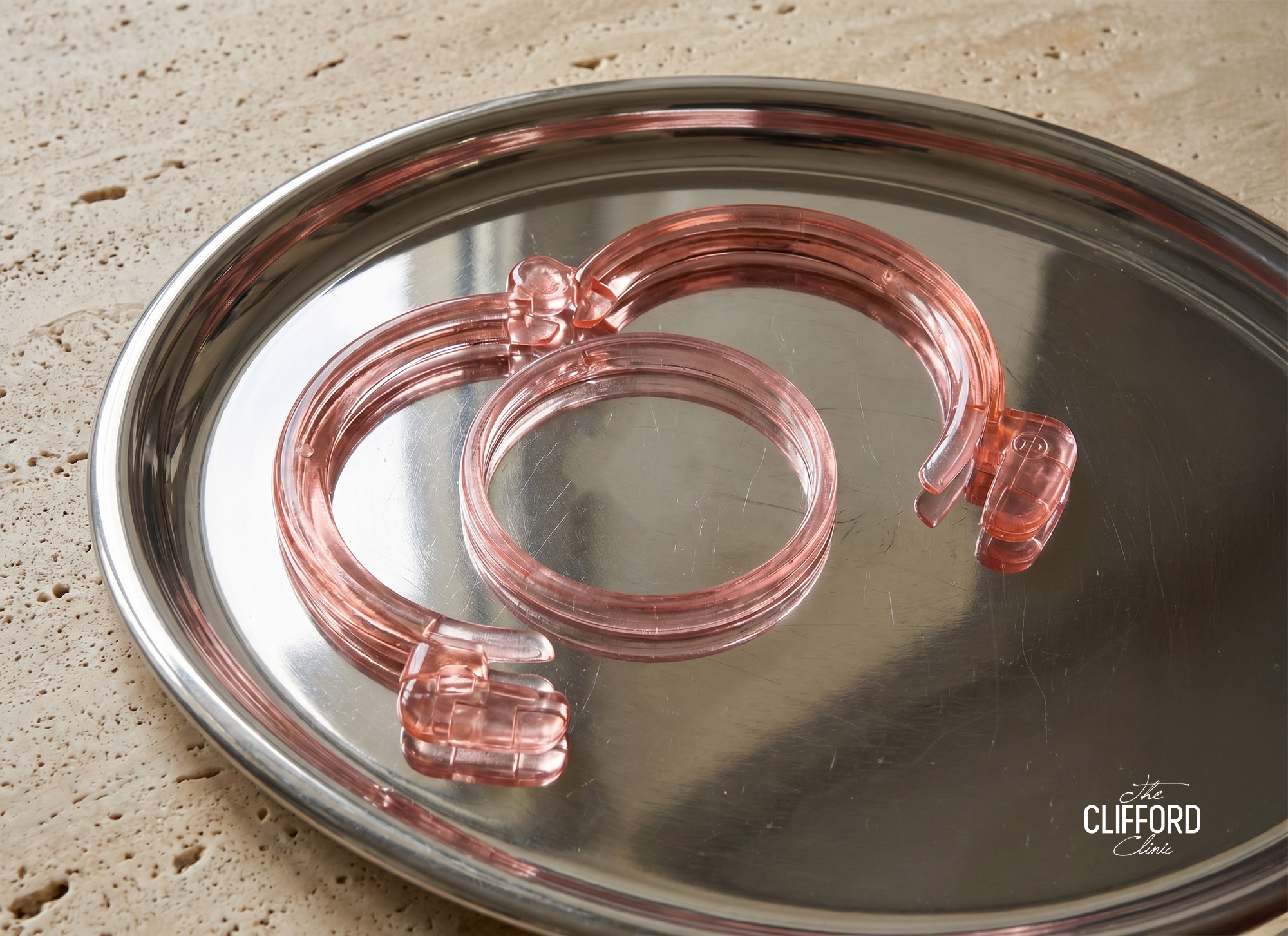
All the main methods are available, and the choice is made after assessment rather than in advance.
Device methods are popular in this age group because they are quick and avoid conventional stitching. A randomised trial of the Shang Ring recorded an average operative time of about 6.4 minutes with average blood loss of about 0.7 mL, against 2.6 mL for conventional surgery. Stapler circumcision, often called ZSR, cuts and seals in one action and typically takes around ten minutes.
Conventional surgery with dissolvable stitches remains the better choice where the anatomy is unusual or the foreskin is scarred, and it has the advantage that removed tissue can be sent for laboratory testing when a scarring skin condition is suspected.
On safety, a Cochrane review of 18 randomised trials reported no severe adverse events with either device-based or conventional techniques. Our techniques guide compares them all.
Cost, MediSave and using a parent’s account

At The Clifford Surgery the professional fee is S$1,888 before GST. The consultation is S$100 before GST and is waived if you proceed. Follow up is included, medication is charged separately, and light sedation is an optional add-on.
MediSave applies when there is a medical indication such as a tight foreskin, recurrent foreskin infection, or a previous episode of paraphimosis. A tight foreskin is the leading medical reason for circumcision in this age group and in adults generally, accounting for around 52.5 percent of adult procedures in one large study. A young man of this age is unlikely to have a substantial MediSave balance of his own, and in eligible cases a family member’s MediSave can be used, which is how most families handle it.
For those still within the age window, the Baby Bonus Child Development Account can be used at an Approved Institution and does not require a medical reason, though the account closes at the end of the year in which the child turns 12, so it is generally not available at pre-enlistment age. Our MediSave, insurance and Baby Bonus guide sets out the details.
What to tell the school
A medical certificate stating that you have undergone a day surgery procedure and require a period of medical leave is sufficient for a school, polytechnic or junior college.
If physical education or sport is involved, a note specifying the period during which strenuous activity should be avoided can be provided by our doctors after the procedure stating the period of rest required.
If you are already enlisted
If you have already enlisted and have a foreskin problem, do not simply endure it. Recurrent foreskin infections, a foreskin that will not retract, or pain during erections are all legitimate medical issues, and they get worse under training conditions rather than better.
Speak to your medical officer. Circumcision can be arranged during service, and the timing is planned around your schedule with appropriate medical leave and a period of light duties. Attempting to manage a genuinely tight or repeatedly infected foreskin through field conditions is the option most likely to end badly.
If the foreskin ever retracts and cannot be brought forward, with the head swelling, that is paraphimosis and it needs same-day medical attention. Our paraphimosis guide explains why.
A note from the clinic
“Young men in this group usually ask two things, how much time do I need and will anyone know. The honest answer on time is six to eight weeks before enlistment, not the one week you feel fine after. On the second, consultations are private and the paperwork says only what it needs to say. Most tell me afterwards it was far less of an ordeal than they had imagined.”
Frequently asked questions
How long before NS should I get circumcised?
Allow six to eight weeks. Initial recovery is about a week, but strenuous activity is avoided for roughly four to six weeks, and basic training is demanding on a healing wound.
Is one month enough time before enlistment?
It is tight. Four weeks may be workable for a straightforward case that heals well, but six to eight weeks gives sensible margin. With less than four weeks, waiting is usually the better call.
Will I need general anaesthesia?
Usually not at this age. Local anaesthesia with numbing cream is standard, with light sedation available if you are anxious.
How many days of medical leave will I get?
Around five to seven days is typical, with the exact period depending on how you are healing and what your activities involve.
Does it hurt?
Once the nerve block is working the procedure should not hurt. Afterwards, most report around 3 to 4 out of 10 in the first few days, managed with simple painkillers.
Can I use my parents’ MediSave?
In eligible cases a family member’s MediSave can be used.
Can I still do it after I enlist?
Yes. Speak to your medical officer, and it can be arranged during service with appropriate medical leave and light duties.
When can I start running again?
Light exercise usually resumes after about a week, with running, gym work and other strenuous exercise after about four weeks.
Which technique is best for me?
That is decided after assessment. Device methods such as the Shang Ring and ZSR stapler are quick and avoid stitches, while conventional surgery suits unusual or scarred anatomy.
Do my parents need to be involved?
For patients under 21, a parent or guardian is generally involved in consent. The consultation itself remains private and respectful.
Book a consultation

If you are planning circumcision before enlistment, book early so the timing works. The consultation confirms whether surgery is needed, agrees the technique, sets a date with enough margin before your enlistment, and gives you a clear cost.
Book a consultation at The Clifford Surgery
Related guides
- Circumcision Singapore, the complete guide
- Adult circumcision in Singapore
- Circumcision recovery and aftercare
- Pain, anaesthesia and safety
- Circumcision techniques compared
- MediSave, insurance and Baby Bonus
Medical review box

This article is written by Dr Law Zhi Wei of The Clifford Surgery. Dr Law is a Singapore-trained doctor with more than five years of surgical posting experience. He graduated from the National University of Singapore with an MBBS and holds Membership of the Royal College of Surgeons of Edinburgh, a Graduate Diploma in Family Medicine, and a Postgraduate Diploma in Practical Dermatology from Cardiff University. He trained in the Urology Department at Singapore General Hospital, where he performed hundreds of circumcisions, and completed rotations in urology, general surgery, and paediatric surgery at KK Women’s and Children’s Hospital, Sengkang General Hospital, and Changi General Hospital. He has personally performed more than 500 circumcisions across the conventional, laser-assisted, Shang Ring, and ZSR Stapler techniques, supported by the dedicated Urology Department led by Dr Nathaniel Heah. The Clifford Surgery operates a sterile surgical theatre as a Ministry of Health-accredited Day Surgery Centre. This content is general information and not a substitute for a personal consultation.
Dr Law Zhi Wei profile, https://cliffordclinic.com/dr-law-zhi-wei/
Clinical research and publications, https://cliffordclinic.com/clinical-research/
References
- National University Hospital, Services for Circumcision. https://www.nuh.com.sg/care-at-nuh/services/department-of-urology/services-for-circumcision
- Ministry of Health Singapore, MediSave for inpatient and day surgery care. https://www.moh.gov.sg/managing-expenses/schemes-and-subsidies/medisave/inpatient-care/
Medical evidence references
- Friedman B, Khoury J, Petersiel N, et al. Pros and Cons of Circumcision, An Evidence-Based Overview. Clinical Microbiology and Infection. 2016. https://pubmed.ncbi.nlm.nih.gov/27497811
- Zhang Q, Gao L, Liu D, et al. Comparative Analysis on the Outcomes in Circumcising Children Using Modified Chinese ShangRing and Conventional Surgical Circumcision. Pediatric Surgery International. 2022. https://pubmed.ncbi.nlm.nih.gov/36550318
- Sokal DC, Li PS, Zulu R, et al. Randomized Controlled Trial of the Shang Ring Versus Conventional Surgical Techniques for Adult Male Circumcision. JAIDS. 2014. https://pubmed.ncbi.nlm.nih.gov/24326606/
- Hohlfeld A, Ebrahim S, Shaik MZ, Kredo T. Circumcision Devices Versus Standard Surgical Techniques in Adolescent and Adult Male Circumcisions. The Cochrane Database of Systematic Reviews. 2021. https://www.cochranelibrary.com/cdsr/doi/10.1002/14651858.CD012250.pub2/full
- Nabavizadeh B, Li KD, Hakam N, et al. Incidence of Circumcision Among Insured Adults in the United States. PLoS One. 2022. https://pubmed.ncbi.nlm.nih.gov/36251658

Author Bio
Dr Gerard Ee

Dr Gerard Ee is the Medical Director of The Clifford Clinic in Singapore. He earned his medical degree from St George's University of London and built his surgical experience across the Singapore General Hospital, National University Hospital, and Mount Sinai Hospital in New York. He holds Membership of the Royal College of Surgeons (Edinburgh) and a Postgraduate Diploma in Dermatology (Cardiff), and is fully accredited in aesthetic procedures including botulinum toxin, fillers, lasers, and light therapies. A strong advocate of minimally invasive, natural-looking results, Dr Ee has published in several medical and scientific journals and presented his research in cities including Taipei, Las Vegas, and London.
See all posts by Dr Gerard Ee »