
AGNES vs AviClear, Which Acne Treatment Fits Your Skin?
Written by Dr Bernard Ong. Medically reviewed by Dr Gerard Ee. Dr Gerard Ee (MBBS, MRCS, Diploma in Practical Dermatology, Cardiff) is the Founder and Medical Director of The Clifford Clinic, with more than 14 years of experience treating acne, and among the first doctors in Singapore to use AGNES and AviClear. This article reflects the clinical approach of The Clifford Clinic, and is for general education only. It does not replace a personal consultation. Last reviewed July 2026.
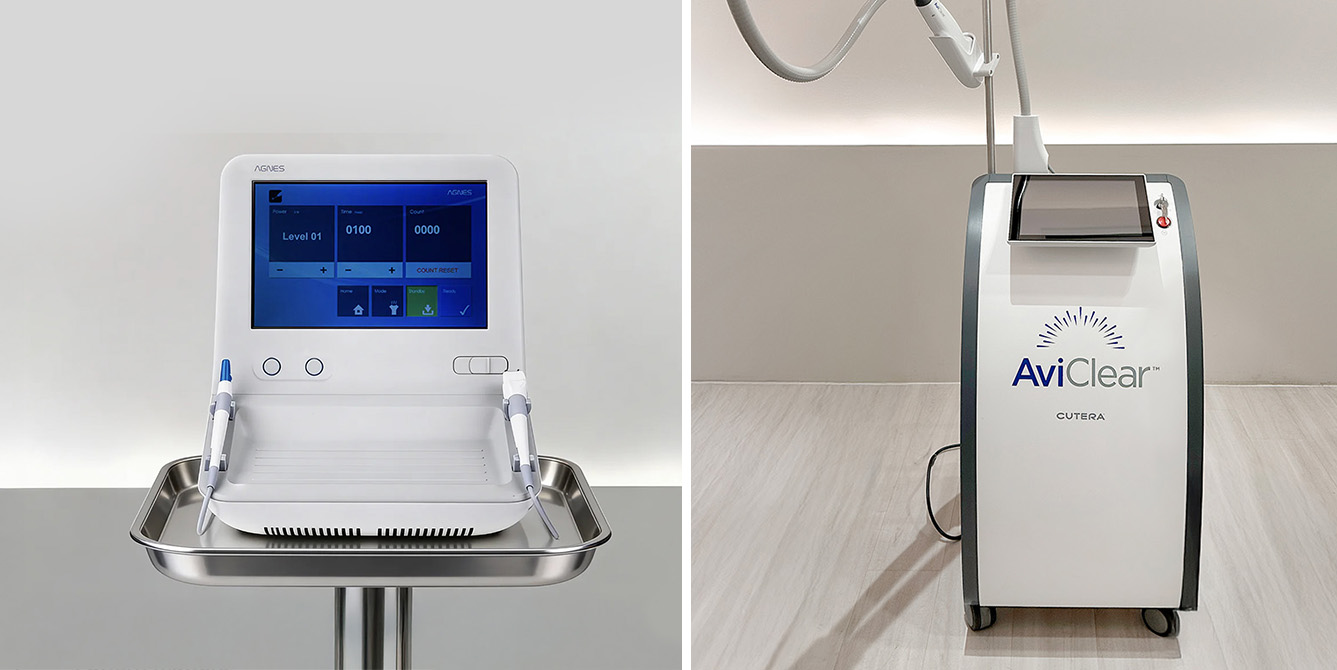
AGNES and AviClear are the two principal sebum-targeting treatments in Singapore, and patients frequently ask which of the two is better. Neither is superior in general terms. Both reduce output from the sebaceous gland, the structure in which acne originates, but AGNES acts on individually selected glands whereas AviClear acts across the whole treated field, so the appropriate choice follows from the distribution of the acne rather than from the reputation of the device. This article sets out the mechanism of each, the patterns each suits, and how the choice is made.
Which device suits which acne pattern
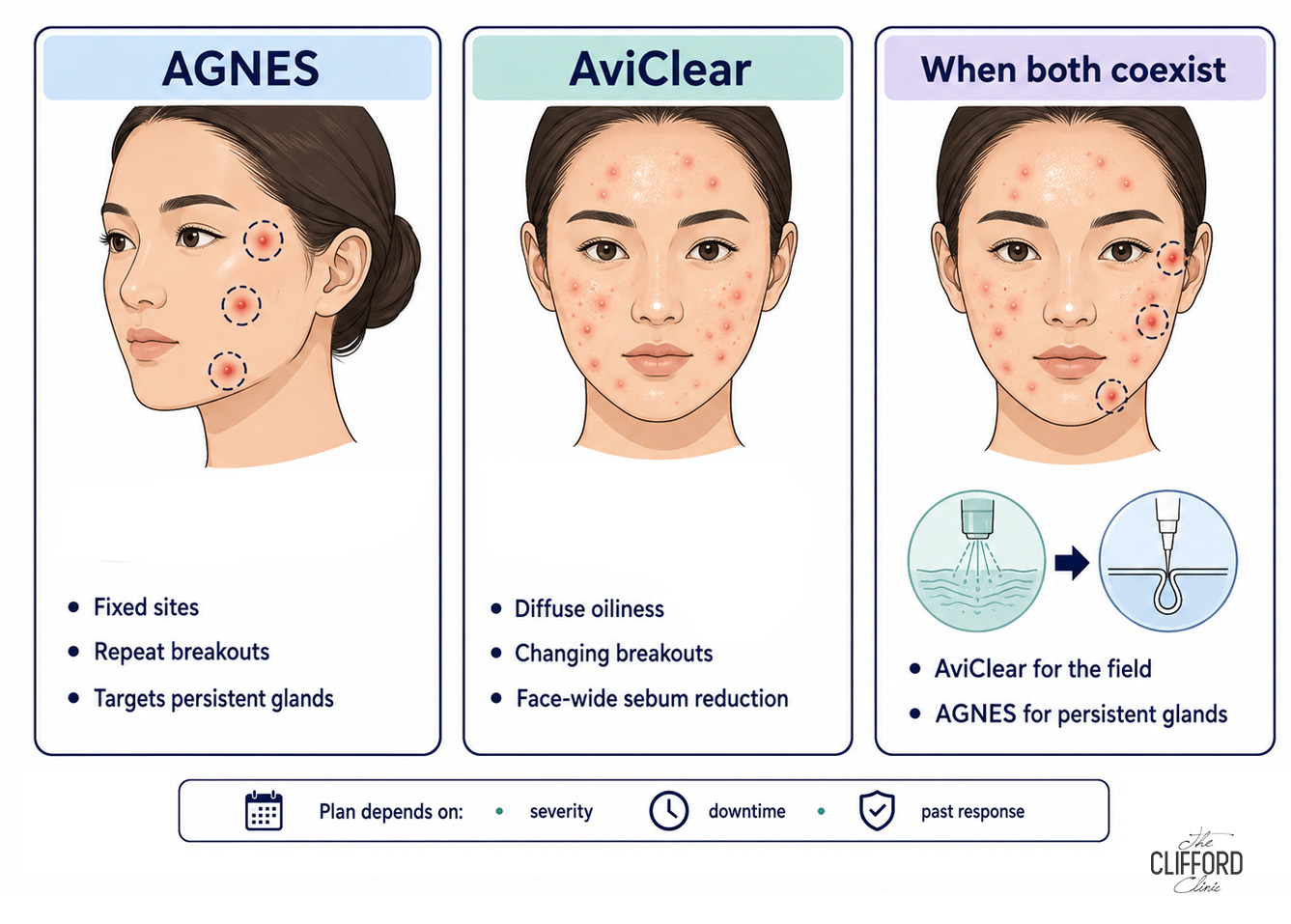
AGNES is indicated where acne returns repeatedly to the same few sites. The typical picture is a small number of glands that refill and reinflame at fixed locations and account for most of the remaining disease. AviClear is indicated where the face is diffusely oily and inflamed, breakouts appear at changing locations, and a face-wide reduction in sebum production is sought without medication. Severity, tolerance for downtime and response to previous treatment determine the remainder of the plan. Where both patterns coexist, AviClear is used to settle the field and AGNES to treat the glands that persist.
What the consultation assesses
The most informative question is where the breakouts occur. Acne that recurs at the same sites indicates specific glands that refill and reinflame, which is the pattern AGNES is designed to treat. Breakouts distributed across a diffusely oily face indicate a field problem, for which AviClear is better suited. Severity, previous treatment, tolerance for needling as against laser warmth, acceptable downtime, and whether medication is to continue are then assessed together, since it is the combination rather than any single factor that determines the device.
How AGNES works
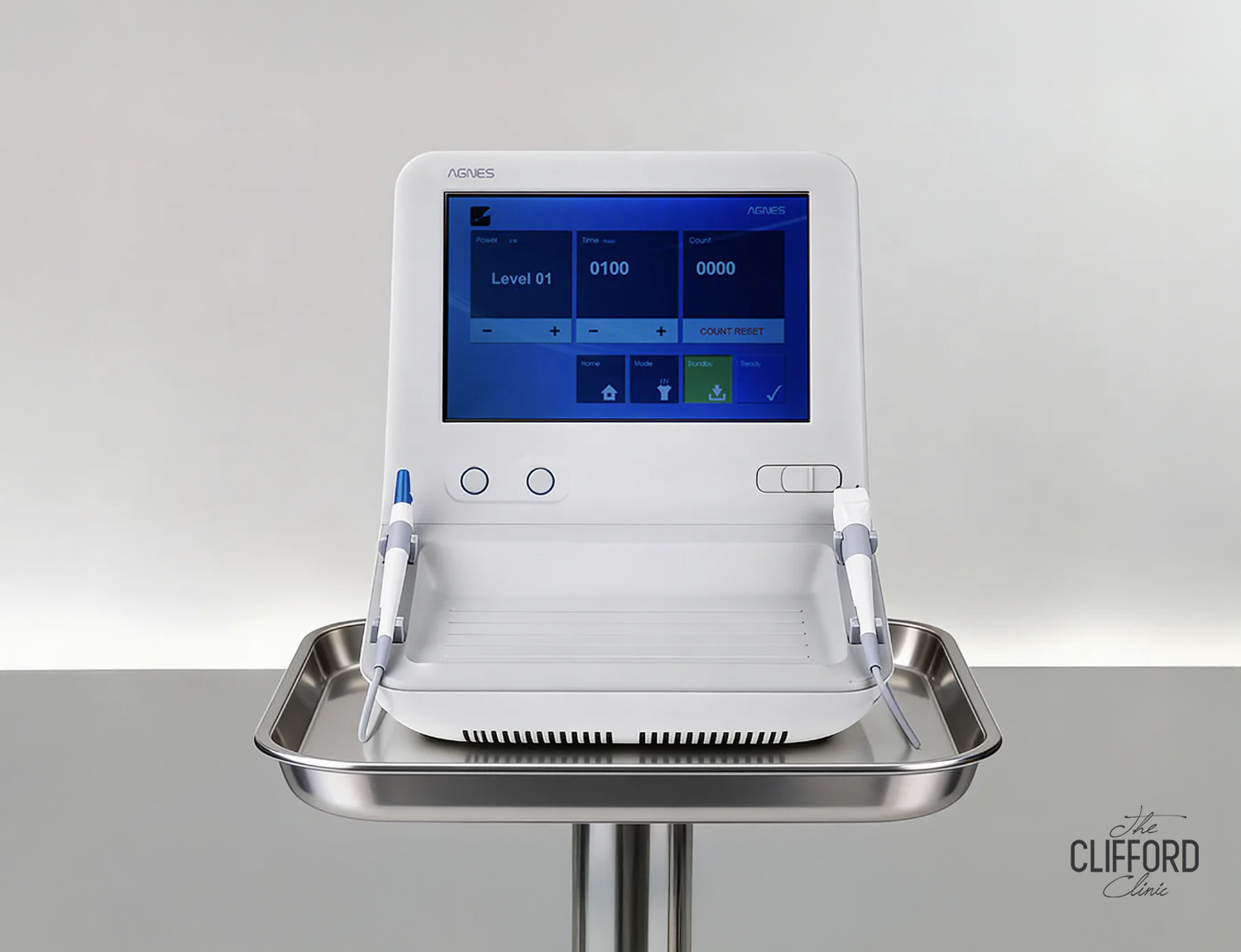
AGNES delivers radiofrequency energy through a fine insulated microneedle inserted into an individual pore. The insulation confines the heat to the needle tip, so the skin surface is spared while the sebaceous gland at the base of that follicle is coagulated. A coagulated gland no longer produces the sebum that refilled the same cyst each month. Its indication is therefore acne recurring at a small number of fixed sites rather than acne in general. Treatment is performed under local anaesthetic, and glands are treated one at a time, which makes the technique precise but slow across a large area. In the published randomised controlled trial the protocol was three sessions at four-week intervals.
How AviClear works
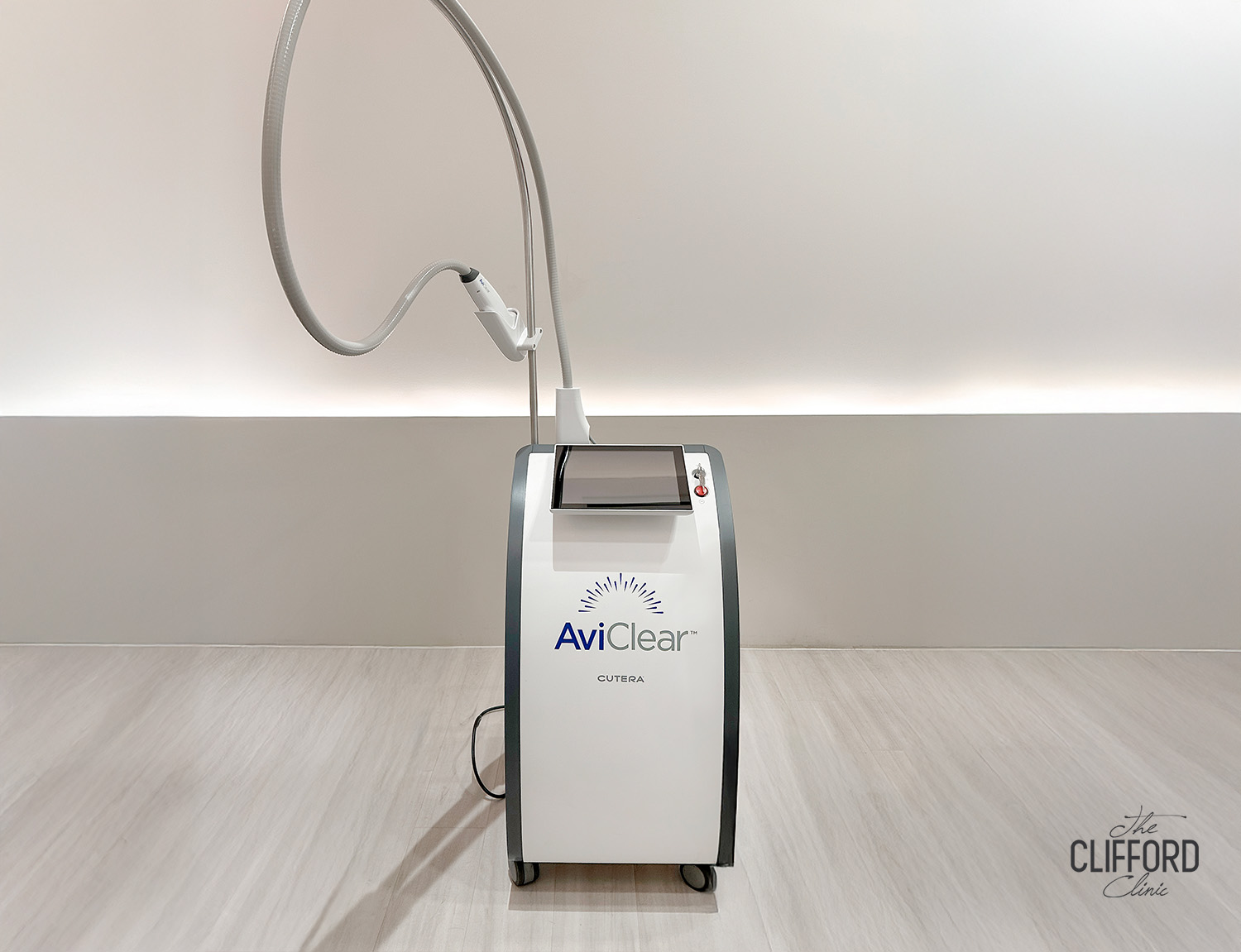
AviClear is a 1726 nm laser. That wavelength coincides with an absorption peak for lipid, so the energy is taken up by sebum rather than by the surrounding tissue, and heat accumulates in the sebaceous glands across the entire treated area while contact cooling protects the epidermis. Rather than coagulating selected glands, it reduces sebum output from the glands of the whole face. Sessions require no anaesthetic and are suitable across all skin tones, because absorption depends on lipid rather than on melanin. Relative to AGNES, precision is traded for coverage. AviClear cannot be directed at one identified gland, and it treats a diffusely oily, inflamed face far more efficiently than gland-by-gland work.
Comparing the experience of AGNES and AviClear
AGNES involves local anaesthetic, the sensation of fine needling, and one to two days of swelling around the treated sites. AviClear involves pulses of warmth beneath a cooled handpiece, no needles, and at most a few hours of mild flushing. The two are also assessed differently. AGNES is judged site by site, on whether the glands that were treated cease to recur. AviClear is judged across the face, on whether breakouts become fewer, smaller and shorter-lived and the skin less oily over the months following the course. Neither produces an immediate result, because both act by reducing gland output rather than by suppressing existing inflammation.
When the two are combined
A frequent presentation is a diffusely oily face with scattered breakouts together with two or three long-standing cysts that have recurred at the same locations for years. AviClear is used first to reduce sebum output across the field, and AGNES is then applied to the individual glands that continue to recur once the background acne has settled. Sequencing depends on which component is causing the greater burden and on the response to the first phase. Topical or oral treatment is usually continued in parallel, since both devices act over months rather than weeks.
Common errors in device selection
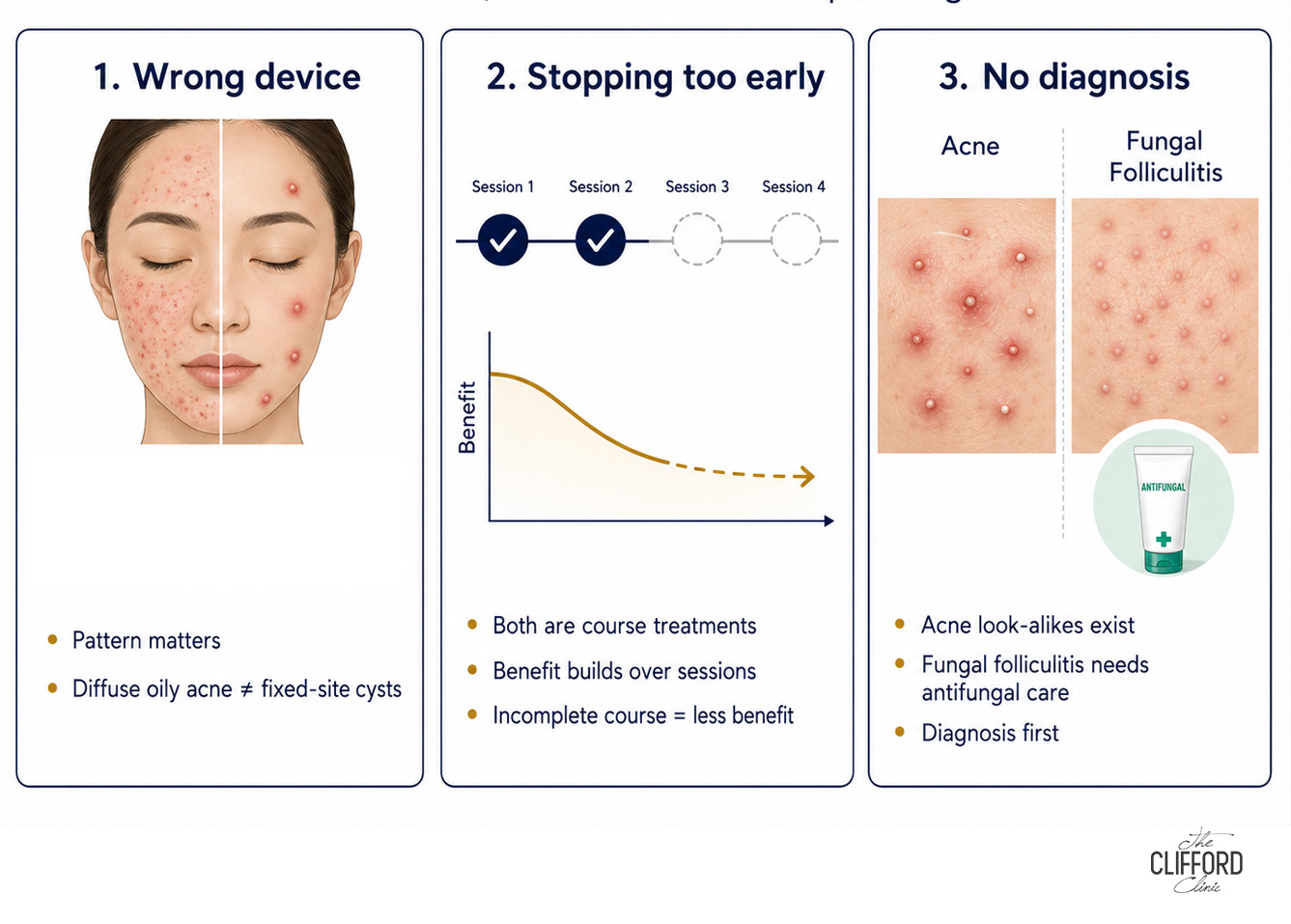
The first is selecting a device by reputation rather than by acne pattern. A device that suits diffuse oily acne in one patient is frequently the wrong choice for fixed-site cysts in another. The second is abandoning a course partway through. Both treatments are administered as courses, and the reduction in gland output accumulates across sessions, so an incomplete course forfeits most of the benefit. The third is proceeding without a diagnosis, since conditions that resemble acne, such as fungal folliculitis, respond to neither device and require antifungal rather than gland-directed treatment.
What the evidence shows
Radiofrequency delivered into the sebaceous gland through a microneedle has been tested in a prospective randomised controlled trial of 63 patients, in which three sessions at four-week intervals produced a significantly greater reduction in inflammatory lesion counts at twelve weeks than microneedling with extraction (P = 0.03). Inflammation settles and treated glands are smaller on follow-up imaging. For the 1726 nm laser, selective heating of the sebaceous gland reduces inflammatory lesion counts across the treated field in all skin types, and a two-year retrospective analysis reports that the improvement is maintained after the course has been completed. The two literatures converge on one finding. Lasting acne control follows from reducing sebaceous gland output, whether that reduction is achieved gland by gland or across the whole field.
Realistic expectations from each treatment
AGNES involves targeted sessions under local anaesthetic, brief localised swelling, and treated sites that cease to refill over the months that follow, with occasional retreatment of a gland that proves resistant. A standard AviClear course is three sessions at approximately monthly intervals. An early flare in the weeks after the first session is common, and is followed by a progressive reduction in the number and severity of breakouts and in oiliness, which is best assessed several months after the final session rather than immediately. In both cases a maintenance routine of cleansing, a topical agent such as a retinoid where it is tolerated, and daily sun protection remains necessary, because reducing gland output does not remove the other drivers of acne.
When to see a doctor
A choice between AGNES and AviClear should not be made from a description of the devices, because the deciding information is the distribution of the acne on the face, which requires examination. Assessment covers the sites of recurrence, the extent of oiliness, the response to previous treatment, and whether an alternative diagnosis needs to be excluded first. The device, or the combination of devices, follows from that assessment.
Why both approaches produce durable results
Both devices follow from the same observation, that durable acne control requires a change in the sebaceous gland itself. The delivery differs, but the endpoint, a reduction in gland output, is the same. Results from either therefore persist in a way that treatments acting only on the skin surface do not, because a gland whose output has been reduced does not resume refilling the follicle once topical treatment is stopped.
Which patients suit each device
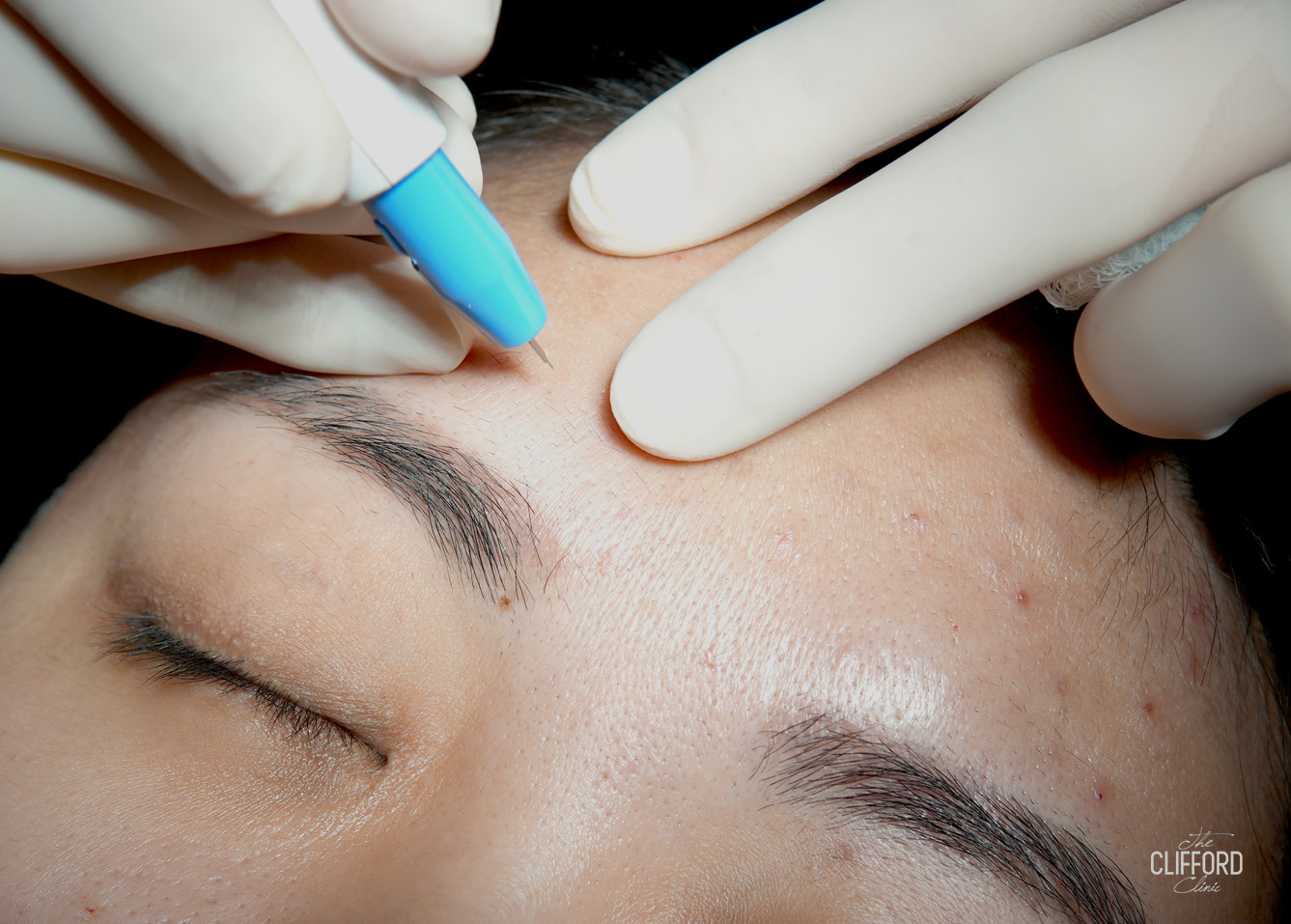
AGNES is most clearly indicated where the history is one of the same sites refilling, for example a chin cyst recurring each month, a jawline nodule that never fully resolves, or a small group of follicles that persisted through every previous medication. It also suits patients who relapsed after isotretinoin at a few fixed sites, where treating two or three glands is more proportionate than another systemic course. AviClear is most clearly indicated where oiliness is generalised, breakouts appear at varying sites, and a face-wide reduction is sought without medication, as in the persistently oily T-zone with scattered monthly flares, or the adult whose acne returns across the face whenever oral treatment is stopped.
Skin tone rarely determines the choice, since neither device targets melanin. Tolerance for downtime sometimes does. AGNES concentrates recovery into one to two days of localised swelling per session, whereas AviClear distributes a milder response across a greater number of sessions. Cost more often affects the order in which treatments are undertaken than the selection itself, and a device that is not indicated should be identified as such at the assessment.
Why cost follows the acne pattern
The two devices are priced differently because the unit of treatment differs. AGNES is charged against the work done at each site, since anaesthetic, needling and operator time are concentrated on a small number of follicles, so it is economical only where those follicles can be identified. Treating three chronic glands is proportionate. Treating an entire oily face one gland at a time is not. AviClear is charged per face-wide session, so it is economical in proportion to how diffuse the disease is. It follows that a package price quoted before the acne has been examined cannot be assessed for value.
Aftercare and how results are judged
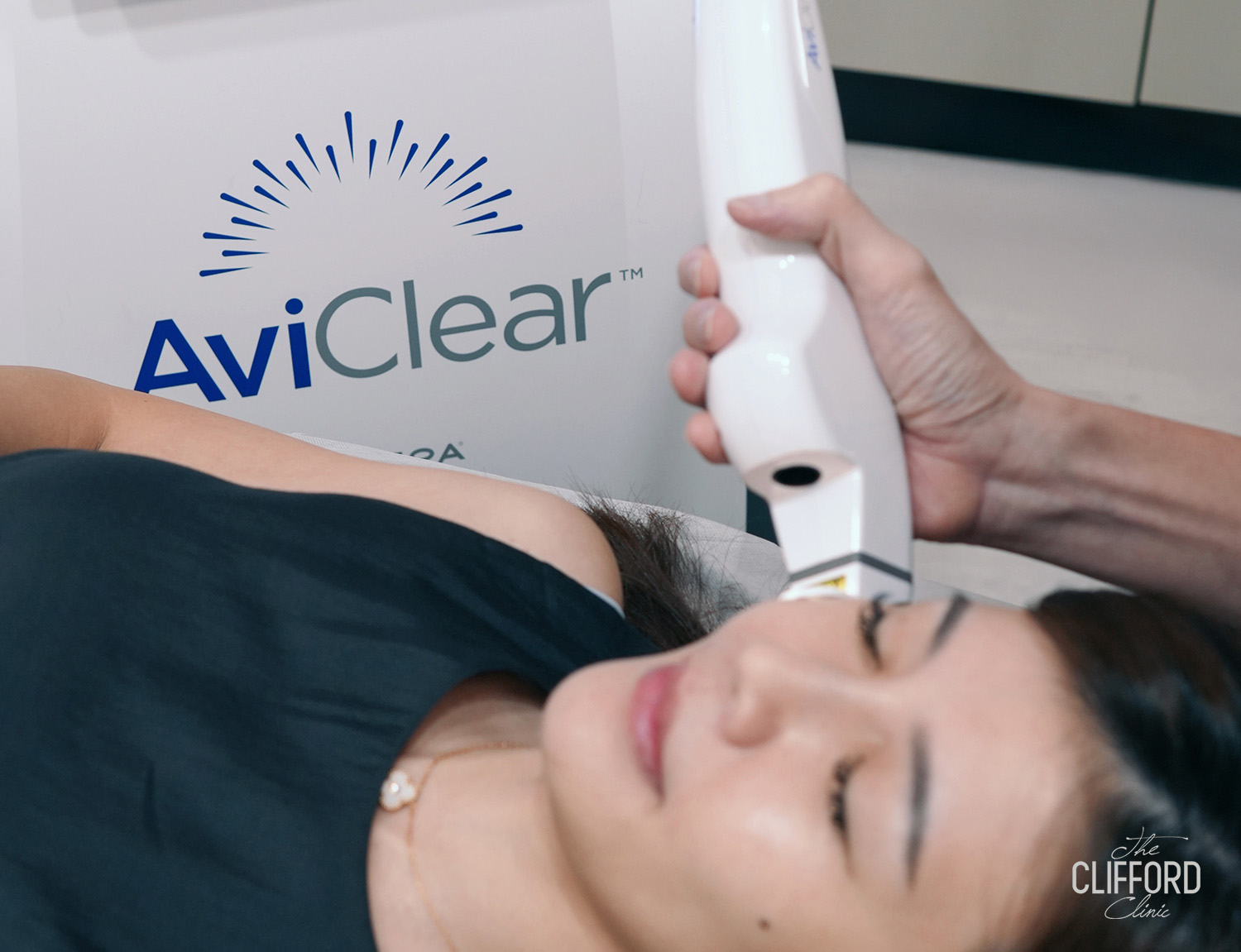
After AGNES, the treated sites may swell briefly and small crusts can form at the needle entry points. These resolve with routine care. After AviClear redness settles within hours. In both cases the assessment period is months rather than weeks. For AGNES the measure is whether the treated glands cease to recur over subsequent cycles, and for AviClear whether the face as a whole moves towards fewer, smaller and faster-resolving breakouts. Photographs recorded at baseline are more reliable than recollection, and a review part way through the course allows the plan to be adjusted where the response is slower than expected.
Frequently asked questions
Which is better, AGNES or AviClear?
Neither is universally better. AGNES is the more effective option for acne that recurs at the same sites, because it coagulates individual glands. AviClear is the more effective option for diffuse oily acne, because it reduces sebum production across the whole face. The distribution of the lesions determines which is appropriate.
Can AGNES and AviClear be combined?
AviClear is used to reduce sebum output across the face, and AGNES to treat the few glands that continue to refill. The sequence is determined by the response to the first phase rather than fixed in advance.
Which hurts more, AGNES or AviClear?
AGNES is performed under local anaesthetic, so the needling itself is not painful, and the discomfort that follows is brief swelling at the treated sites. AviClear requires no anaesthetic and is experienced as pulses of warmth beneath a cooled handpiece. Both are tolerated well by most patients, and neither requires sedation or oral analgesia.
Do AGNES and AviClear results last?
Both achieve durable control by reducing sebaceous gland output rather than by clearing lesions already present. Glands treated with AGNES should cease to recur, and improvement after AviClear commonly continues for three to six months after the final session. Neither prevents glands elsewhere from becoming active later, so acne that remains hormonally driven may still require medical treatment alongside.
Not sure which fits your acne pattern? Our doctors will map it and tell you honestly.
The Clifford Clinic, 50 Raffles Place, Singapore Land Tower. Call (65) 6532 2400 or WhatsApp (65) 8318 6332 to arrange a consultation.
Related reading
- Best Acne Treatment in Singapore, A Doctor-Led Guide
- Acne Treatment at The Clifford Clinic
- AGNES Acne Treatment
- Recurrent Acne in the Same Spot
- AviClear (Dr Gerard Ee)
- AGNES Acne Treatment (Dr Gerard Ee)
Selected References
- HealthHub Singapore. Acne. https://www.healthhub.sg/a-z/diseases-and-conditions/acne.
- American Academy of Dermatology. Guidelines of care for the management of acne vulgaris. https://www.aad.org/member/clinical-quality/guidelines/acne.
- Acne vulgaris. https://dermnetnz.org/topics/acne.
- Radiofrequency microneedling of the sebaceous gland for acne. PubMed. https://pubmed.ncbi.nlm.nih.gov/31502662/.
- A 1726 nm laser system for the treatment of acne vulgaris. PubMed. https://pubmed.ncbi.nlm.nih.gov/36197599/.
- Long-term outcomes of 1726 nm laser treatment for acne. JAAD. https://www.jaad.org/article/S0190-9622(25)02900-7/fulltext.
Medical disclaimer: This article is for general education and does not replace an in-person consultation. Treatment suitability, results and risks vary between individuals. Please speak with a qualified doctor before starting any acne treatment.

Author Bio
Dr Gerard Ee

Dr Gerard Ee is the Medical Director of The Clifford Clinic in Singapore. He earned his medical degree from St George's University of London and built his surgical experience across the Singapore General Hospital, National University Hospital, and Mount Sinai Hospital in New York. He holds Membership of the Royal College of Surgeons (Edinburgh) and a Postgraduate Diploma in Dermatology (Cardiff), and is fully accredited in aesthetic procedures including botulinum toxin, fillers, lasers, and light therapies. A strong advocate of minimally invasive, natural-looking results, Dr Ee has published in several medical and scientific journals and presented his research in cities including Taipei, Las Vegas, and London.
See all posts by Dr Gerard Ee »