
Gold PTT vs Platinum PTT for Acne, How They Differ and Who Each Suits
Written by Dr Bernard Ong. Medically reviewed by Dr Gerard Ee. Dr Gerard Ee (MBBS, MRCS, Diploma in Practical Dermatology, Cardiff) is the Founder and Medical Director of The Clifford Clinic, with more than 14 years of experience treating acne, and among the first doctors in Singapore to use AGNES and AviClear. This article reflects the clinical approach of The Clifford Clinic, and is for general education only. It does not replace a personal consultation. Last reviewed July 2026.
Photothermal therapy (PTT) is among the least aggressive treatments directed at the sebaceous gland, and The Clifford Clinic offers it in two forms, gold and platinum. Patients often ask which is better, on the assumption that one supersedes the other. The two are alternatives rather than successive generations of the same treatment. Both deliver nanoparticles into the sebaceous glands and then heat them with laser energy, and both remain available where stronger options are not, including younger teenagers and pregnant and breastfeeding mothers. They differ in which laser wavelength the particle absorbs most efficiently, and that difference governs how deeply the heat is deposited and how safely the treatment can be delivered in darker skin. This guide sets out the mechanism of each, the basis on which they differ, and how the selection is made.
The short answer on Gold PTT vs Platinum PTT
Both treatments place nanoparticles inside the pores and oil glands using the Bellasonic 40 kHz ultrasound device, then activate them with specialised lasers so that heat is generated precisely where the particles sit. Gold PTT is the established option for active acne, oily skin and enlarged pores, and it carries the larger published evidence base in acne. Platinum PTT is selected where the heat must reach deeper, or where a darker skin tone makes the longer 1064 nm wavelength the safer activator. Both are low-intensity, involve minimal downtime, and are among the few in-clinic acne treatments appropriate during pregnancy and breastfeeding.
How the consultation decides between them
The assessment establishes the acne type and severity first, then settles whether the skin needs a gentle field treatment across the whole area, or a more decisive one directed at individual glands. Photothermal therapy is indicated in mild to moderate acne dominated by congestion and oiliness. It is also selected where downtime must be minimal, or where systemic medication is unsuitable. Pregnancy and breastfeeding are the commonest reasons for setting medication aside, since retinoids and isotretinoin are contraindicated in both. Younger teenagers are the second group, since adherence across a course of treatment matters more than the intensity of any single session.
How photothermal therapy works
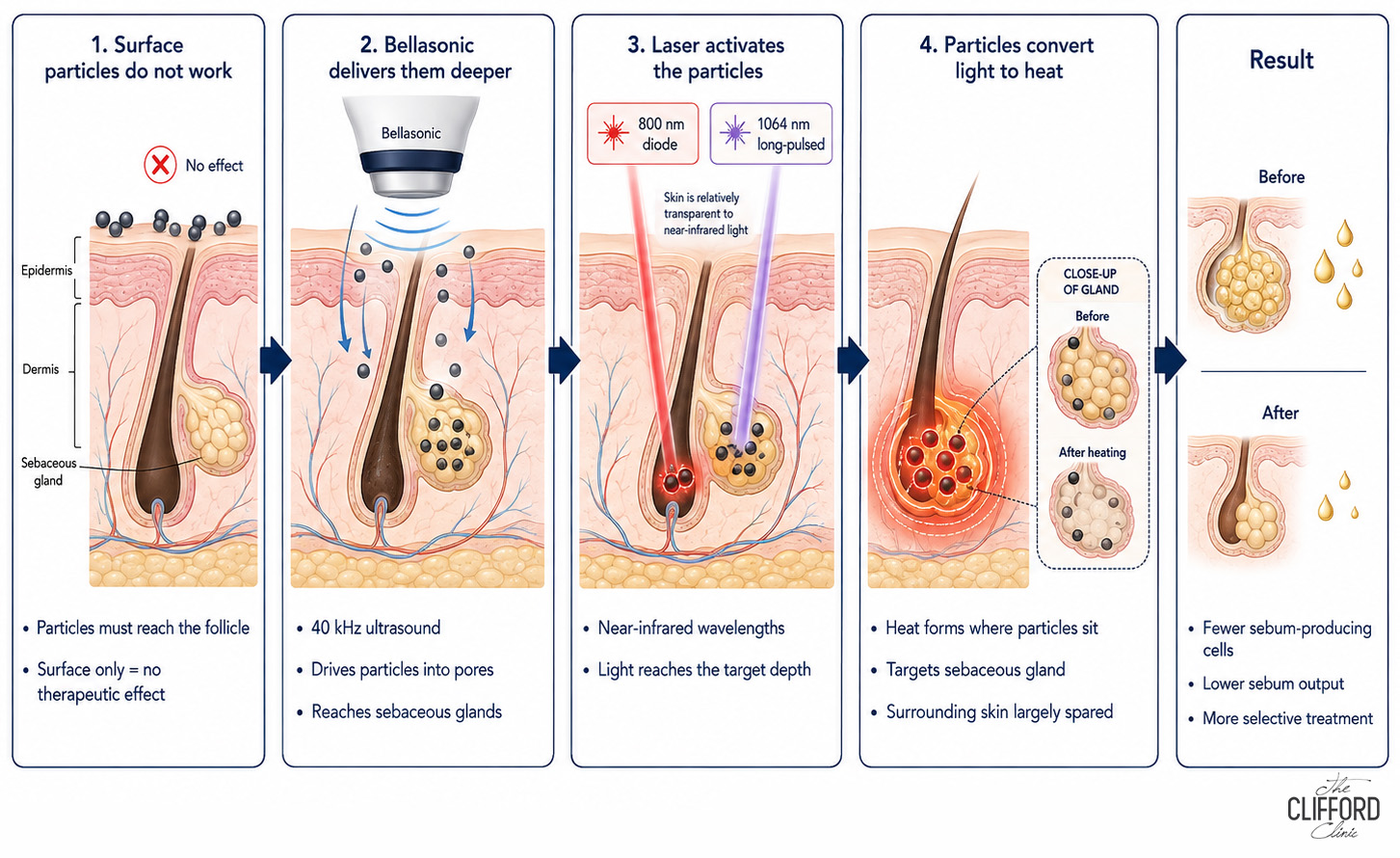
The principle is to place an absorber of light at the depth where the heat is required. Nanoparticles resting on the skin surface produce no therapeutic effect, because the sebaceous gland they are meant to heat lies deep in the follicle rather than at the surface. Delivery therefore matters as much as the particle itself.
At The Clifford Clinic the particles are driven into the pores and sebaceous glands using Bellasonic, a 40 kHz ultrasound device, and only then are they activated by laser light at wavelengths those particles absorb strongly, using the 800 nm diode and the 1064 nm long-pulsed laser. Both wavelengths sit in the near infrared, the band in which skin is most transparent, so the light reaches the particle instead of being absorbed on the way down. The particles convert light into heat exactly where they are lodged, heating the sebaceous gland enough to reduce the number of sebum-producing cells and lower its output, while the surrounding skin is largely spared because it does not absorb at the same intensity.
Where Gold PTT and Platinum PTT differ
The difference is an optical one. Gold nanoparticles absorb light in a narrow band engineered to fall in the near infrared, close to the 800 nm diode wavelength, so almost all of the delivered energy is converted to heat at the particle itself. Platinum particles absorb across a broader and flatter span of the near infrared rather than at a single sharp peak, which allows the 1064 nm long-pulsed laser to drive them as well. Gold has the longer track record in acne and remains the default choice for active breakouts, oily skin and enlarged pores. Platinum is the more useful option where the heat must reach deeper, since 1064 nm penetrates further than 800 nm, and in darker skin tones, since 1064 nm is absorbed far less by melanin in the epidermis and therefore carries a lower risk of surface burning and post-inflammatory pigmentation. It also provides a second option where a patient has plateaued on the first. Neither is an upgrade of the other. The choice is made on examination, and in particular on the skin tone and on how deep the active glands sit.
Why photothermal therapy suits teenagers and pregnancy
Most effective acne treatment depends on retinoids, antibiotics, hormonal medication or isotretinoin, and pregnancy removes almost all of them from consideration. Breastfeeding narrows the list similarly. Photothermal therapy is valuable in these patients, because it is a physical treatment acting locally on the gland with no systemic medication involved. The same logic applies to younger teenagers, where parents are often reluctant to start medication and where a comfortable, low-downtime treatment supports the consistency that adolescent acne demands. Gold and Platinum PTT are therefore used more often in these two groups than in any other.
How Gold and Platinum PTT compare with AGNES and AviClear
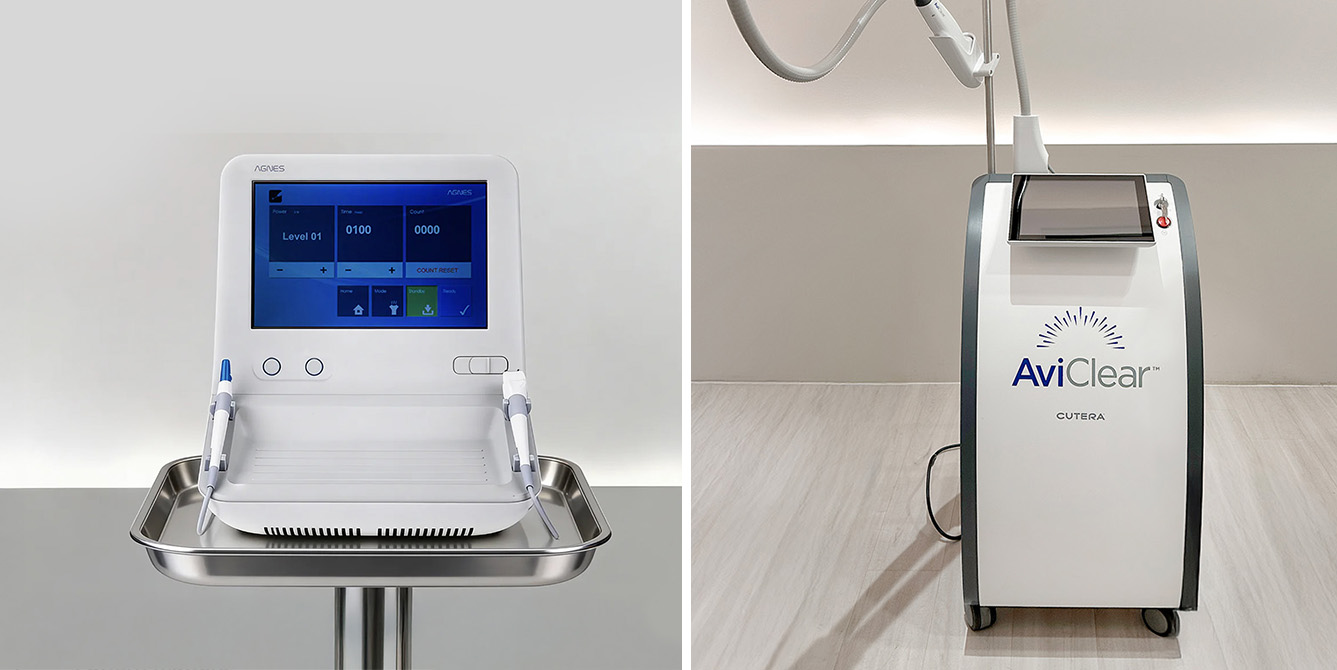
All four treatments target the sebaceous gland, and they sit on a spectrum of intensity. AGNES is the most precise and most decisive, using an insulated radiofrequency microneedle to shrink individual overactive glands, and it is the treatment of choice for acne that recurs at the same site. AviClear treats more diffuse oily congestion across a wider area with a 1726 nm laser, a wavelength preferentially absorbed by sebum itself. Gold and Platinum PTT are the gentlest of the group, best for milder active acne, congestion and oiliness, and uniquely appropriate in pregnancy, breastfeeding and younger teenagers. Selection is therefore governed by the intensity the problem requires, not by the maximum intensity available.
What a session involves
The skin is cleansed and the nanoparticle preparation applied, then Bellasonic ultrasound is used to drive the particles into the pores and glands. Excess is removed, and the lasers are passed over the treated area. Patients feel warmth rather than pain, no anaesthetic is required, and any flush settles within hours. Makeup and normal activities resume the same day. Treatment is delivered as a course, commonly three to six sessions spaced two to four weeks apart, with maintenance sessions thereafter. It is often combined with HydraFacial where congestion is heavy or with medical skincare as the maintaining foundation.
When photothermal therapy is not the right choice
Photothermal therapy is not offered as the primary treatment for severe nodulocystic or scarring acne, where more decisive treatment is warranted. It does not replace investigation of a hormonal driver where the distribution and timing of the acne point to one. It is also not a single-session treatment, since the benefit accumulates across the course. Where acne recurs stubbornly in a few fixed spots, AGNES is the more appropriate treatment.
Common mistakes
The commonest mistake is expecting a gentle treatment to resolve severe acne and concluding that gland-directed therapy is ineffective. The second is buying sessions as a facial package without a diagnosis. The third is stopping partway through a course, since the effect accumulates rather than appearing after one session. The fourth, specific to pregnancy, is assuming nothing can be done at all and enduring months of breakouts, when this is one of the few situations in which photothermal therapy is clearly indicated.
What the evidence shows
Gold microparticle photothermal therapy has been shown to reduce inflammatory acne lesions and sebum output through selective heating of the sebaceous gland where particles accumulate, with a favourable comfort and safety profile and minimal downtime. Across light and laser therapy for acne, approaches acting on the sebaceous gland produce more durable improvement than those acting only on surface bacteria, and more intensive gland-directed treatments deliver correspondingly greater reductions. The published acne evidence, however, sits almost entirely with gold. The use of platinum rests on the shared physics of nanoparticle heating rather than on trial data of its own, and gold therefore remains the default and platinum the considered alternative. This matches clinical experience at the practice, in which photothermal therapy performs well in mild to moderate disease, in congestion and oiliness, and in maintenance.
What to expect realistically
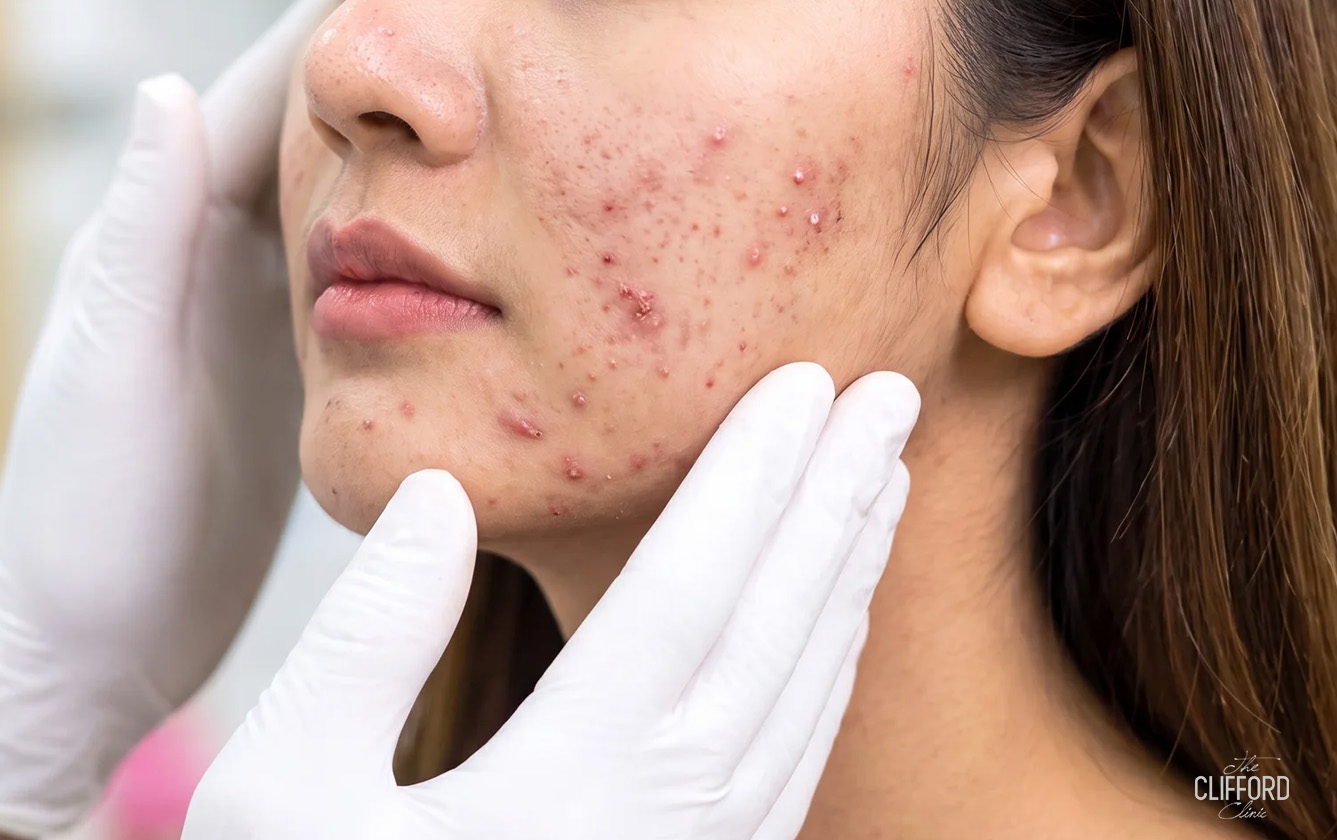
The realistic outcome is a comfortable course of sessions with no appreciable downtime, a gradual reduction in oiliness, congestion and inflamed lesions, and refinement of enlarged pores as the glands settle. Change is usually visible over several weeks rather than after a single visit, and the fullest effect appears some weeks after the course is completed. Maintenance sessions are required since the treatment reduces gland output rather than permanently abolishing it, and deeper or scarring acne needs a more intensive plan, which is set out at the first visit.
When to see a doctor
Assessment is appropriate where acne is mild to moderate and oiliness and congestion are the main complaints. It is also worthwhile for patients who are pregnant or breastfeeding and have been advised that no treatment is available, and for parents seeking treatment for a teenager not yet ready for medication.
Delivery decides the result more than the metal
Driving the particles into the pore and around the gland is the technically demanding part of the treatment, and it is the reason the practice uses the Bellasonic 40 kHz ultrasound device rather than manual application alone.
Photothermal therapy therefore varies considerably between providers. The same branded particles delivered without adequate penetration produce a superficial facial rather than a gland-directed treatment. The questions worth asking of any provider are how the particles are delivered and which lasers activate them. Those two details, rather than the metal, determine whether the treatment reaches the gland it is meant to change.
Combining photothermal therapy with the rest of the plan
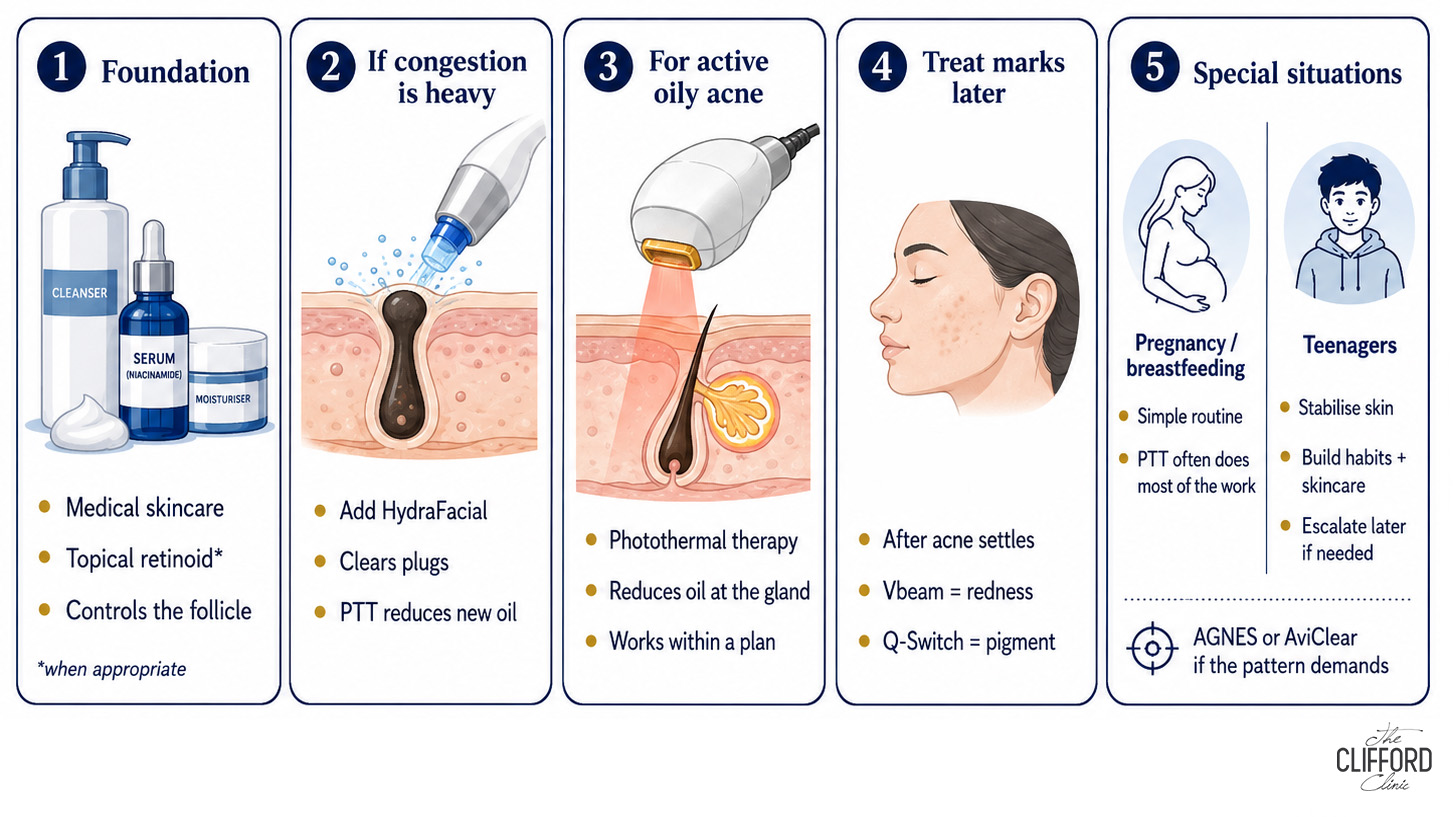
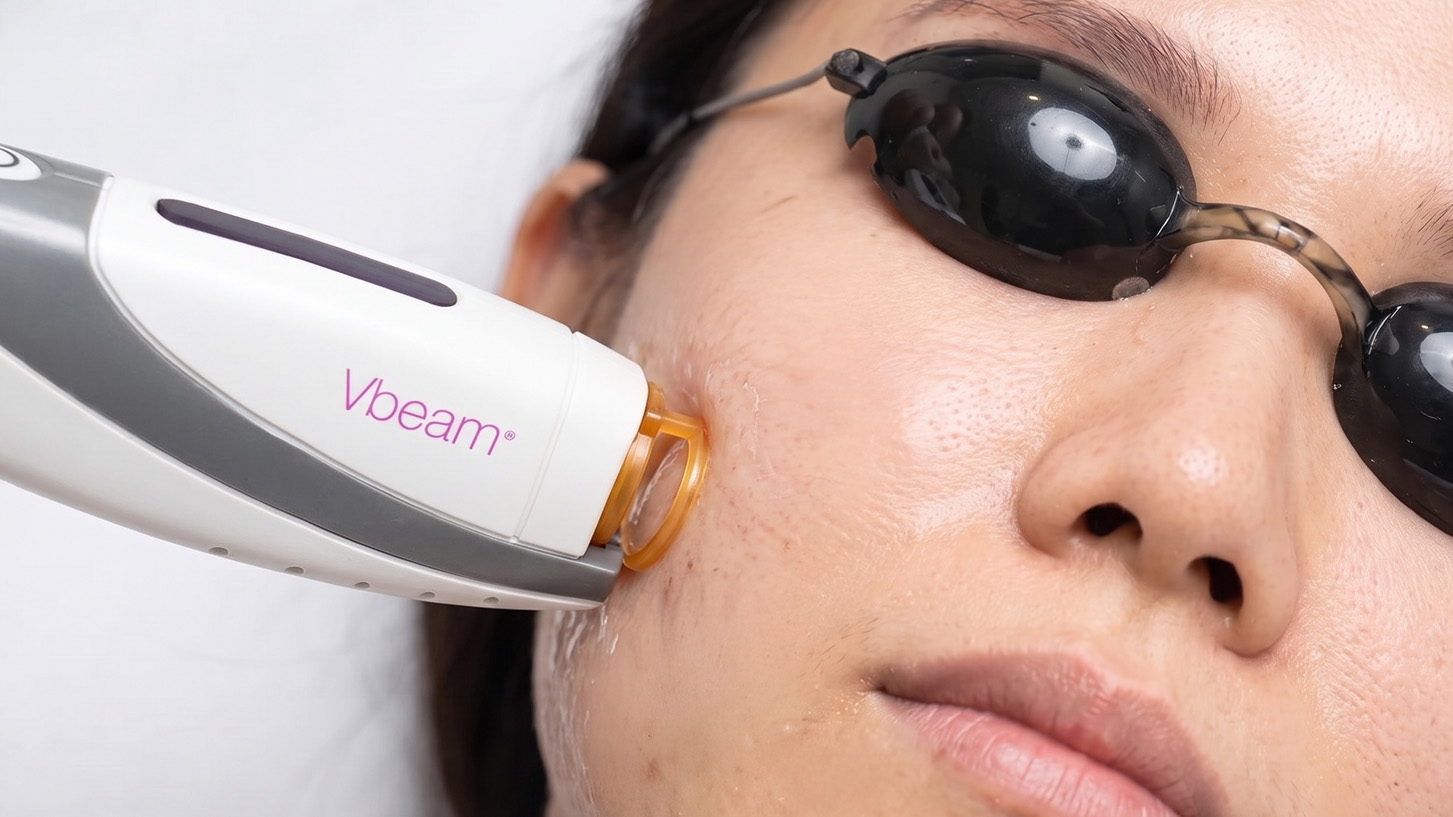
Photothermal therapy is a component of a plan rather than a standalone treatment. Medical skincare remains the foundation, since reduction of oil at the gland complements normalisation of the follicle by a topical retinoid where one is appropriate. Where congestion and blackheads are heavy, HydraFacial clears existing plugs while the photothermal work reduces new oil, and the two are frequently scheduled together. Where marks have been left behind, Vbeam and Q-Switch lasers address redness and pigment later, once active acne has settled.
In pregnancy and breastfeeding the plan is deliberately narrow, and photothermal therapy often provides most of the treatment effect alongside a simple pregnancy-appropriate routine. In teenagers it frequently stabilises the skin while habits and skincare become consistent, with the option of escalating to AGNES or AviClear later if the pattern demands it.
Frequently asked questions
What is the difference between Gold and Platinum PTT?
Both deliver nanoparticles into the oil glands using Bellasonic ultrasound and then heat them with laser energy. They differ in which wavelength the particle absorbs most strongly. Gold is matched to the 800 nm diode, whereas the broader absorption of platinum allows the more deeply penetrating 1064 nm laser to activate it, which is why platinum is often preferred where the glands sit deeper or the skin tone is darker. Neither is an upgrade of the other, and the choice is made on examination.
Is Gold PTT safe during pregnancy?
Photothermal therapy is a local physical treatment with no systemic medication involved, and it is therefore one of the few options available to pregnant and breastfeeding patients. Suitability is confirmed at consultation.
Is Gold PTT better than AviClear or AGNES?
Gold PTT is gentler rather than more effective. AGNES is the preferred option for acne recurring at the same site, AviClear for diffuse oily congestion, and photothermal therapy for milder acne, congestion and patients needing a gentle option.
How many Gold PTT sessions will I need?
A course is commonly three to six sessions spaced two to four weeks apart, followed by maintenance sessions, because the effect on the glands accumulates rather than arriving in one visit. The exact number is set at consultation according to severity and oiliness.

Pregnant, breastfeeding or treating a teenager? Ask about photothermal therapy.
The Clifford Clinic, 50 Raffles Place, Singapore Land Tower. Call (65) 6532 2400 or WhatsApp (65) 8318 6332 to arrange a consultation.
Related reading
- Best Acne Treatment in Singapore, A Doctor-Led Guide
- Acne Treatment at The Clifford Clinic
- How Our Doctors Choose Your Acne Treatment
- Gold Photothermal Treatment
- Platinum Photothermal Treatment
- AGNES Acne Treatment
Selected References
- HealthHub Singapore. Acne. https://www.healthhub.sg/a-z/diseases-and-conditions/acne.
- American Academy of Dermatology. Guidelines of care for the management of acne vulgaris. https://www.aad.org/member/clinical-quality/guidelines/acne.
- Acne vulgaris. https://dermnetnz.org/topics/acne.
- Guidelines of care for the management of acne vulgaris. JAAD. https://www.jaad.org/article/S0190-9622(23)03389-3/fulltext.
- A 1726 nm laser system for the treatment of acne vulgaris. PubMed. https://pubmed.ncbi.nlm.nih.gov/36197599/.
- Radiofrequency microneedling of the sebaceous gland for acne. PubMed. https://pubmed.ncbi.nlm.nih.gov/31502662/.
Medical disclaimer: This article is for general education and does not replace an in-person consultation. Treatment suitability, results and risks vary between individuals. Please speak with a qualified doctor before starting any acne treatment.

Author Bio
Dr Gerard Ee

Dr Gerard Ee is the Medical Director of The Clifford Clinic in Singapore. He earned his medical degree from St George's University of London and built his surgical experience across the Singapore General Hospital, National University Hospital, and Mount Sinai Hospital in New York. He holds Membership of the Royal College of Surgeons (Edinburgh) and a Postgraduate Diploma in Dermatology (Cardiff), and is fully accredited in aesthetic procedures including botulinum toxin, fillers, lasers, and light therapies. A strong advocate of minimally invasive, natural-looking results, Dr Ee has published in several medical and scientific journals and presented his research in cities including Taipei, Las Vegas, and London.
See all posts by Dr Gerard Ee »