

Acne Maintenance After Treatment, How to Keep Acne From Coming Back
Written by Dr Bernard Ong. Medically reviewed by Dr Gerard Ee Dr Gerard Ee (MBBS, MRCS, Diploma in Practical Dermatology, Cardiff) is the Founder and Medical Director of The Clifford Clinic, with more than 14 years of experience treating acne, and among the first doctors in Singapore to use AGNES and AviClear. This article reflects the clinical approach of The Clifford Clinic, and is for general education only. It does not replace a personal consultation. Last reviewed July 2026.
The most preventable disappointment in acne care occurs in the weeks after the best results are achieved. The skin clears, treatment is stopped, and within a few months the breakouts return, which patients understandably interpret as failure of the treatment. In most cases it is not. Acne is a relapsing condition whose drivers persist after the lesions resolve, so clearance marks the point at which maintenance begins rather than the point at which treatment can be abandoned. In a randomised trial of patients who had already cleared, a quarter of those given no active maintenance relapsed within 56 days, compared with 175 days in those maintained on a topical. This guide sets out what maintenance involves and how long it should continue.
Key takeaways
- Maintenance means continuing a reduced version of what worked, most often a topical retinoid on two or three nights a week alongside a simple non-comedogenic routine and daily sunscreen.
- Where acne was hormonally driven, maintenance may involve continuing hormonal therapy for as long as that driver remains active.
- Where gland-directed devices produced the result, sessions repeated every three to six months sustain the reduction in oil production.
- Maintenance usually continues for months to years rather than weeks, because the driver of the acne does not resolve simply because the lesions have.
Summary

Maintenance means continuing a reduced version of what worked, most often a topical retinoid at a lower frequency alongside a simple non-comedogenic routine and daily sunscreen. The reduced dose is sufficient because the agent is now preventing microcomedones from forming rather than clearing lesions already present, which is the less demanding task. Where the acne was hormonally driven, hormonal therapy is usually continued in its own right. Where gland-directed devices produced the result, sessions repeated every three to six months sustain the reduction in oil production. Maintenance typically continues for months to years rather than weeks, because the driver of the acne does not resolve simply because the lesions have.
The maintenance review
Once acne is controlled, the review shifts from suppressing active lesions to planning their prevention. The assessment begins with what drove the acne, since that determines what has to continue to be addressed. An oily, relapsing pattern requires ongoing attention to sebum production. A hormonal pattern in a woman requires continued management of the androgen signal. Externally driven acne, arising from occlusive cosmetics or mechanical friction, requires the causative habit to be modified rather than a medication to be continued. The regimen is also simplified at this point. Maintenance regimens should be lighter than treatment regimens, because a burdensome plan will not be sustained over a year.
Why acne recurs after clearance
Clearance does not remove the underlying tendency. The sebaceous glands continue to respond to androgen signalling, the follicles continue to shed cells capable of obstructing a pore, and the local climate keeps the skin warm and oily. Treatment shifts this balance far enough that lesions cease to form. Withdrawing it entirely allows the balance to drift back. Relapse commonly appears two to four months after stopping, an interval long enough for patients to have concluded the problem was resolved and short enough to be dispiriting when it returns.
Maintenance in practice
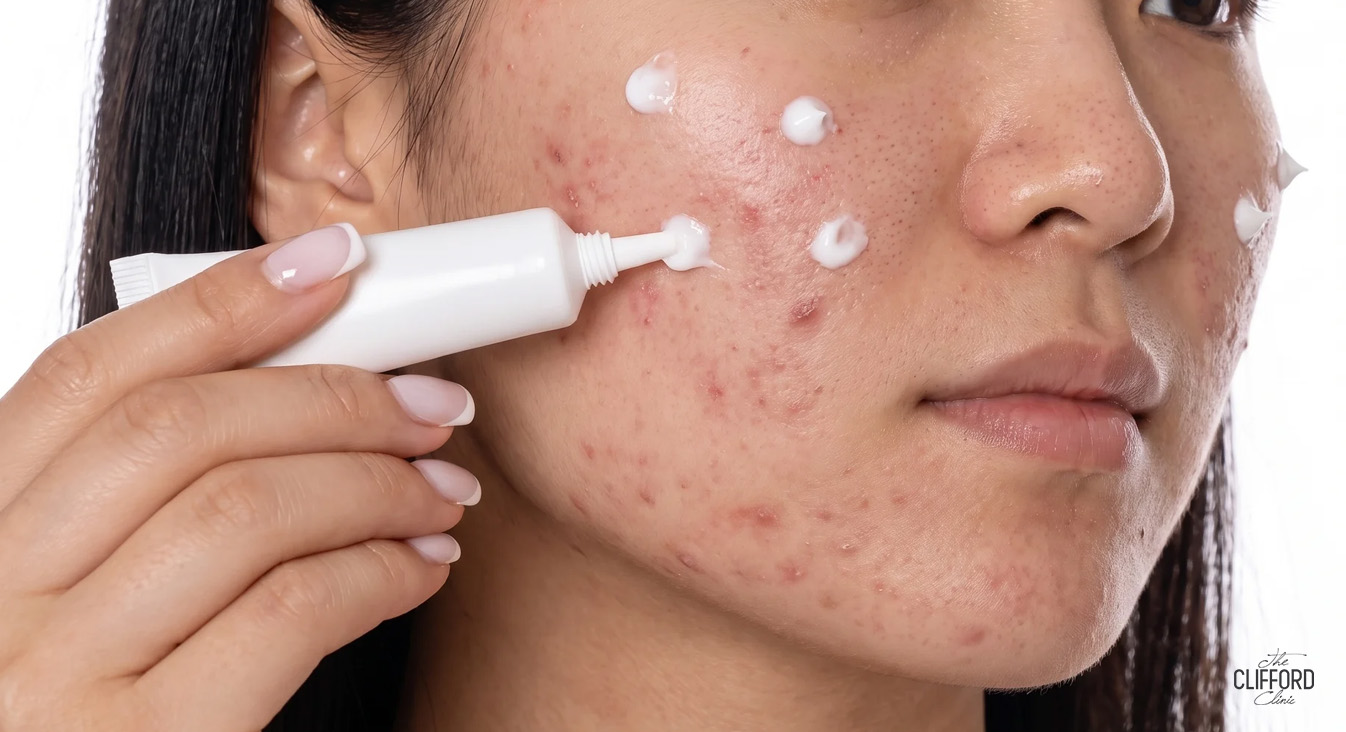
For most patients the backbone is a topical retinoid at a reduced frequency, typically two or three nights a week, which continues to normalise follicular shedding and prevents comedones from re-forming. Because the retinoid acts on the microcomedone, the precursor lesion that forms before anything is visible, it prevents new lesions rather than treating established ones, which is why a lower frequency remains effective. A gentle cleanser, a light non-comedogenic moisturiser and daily sunscreen complete the routine. Patients who used benzoyl peroxide during treatment often continue it on two or three days a week, where it also limits the antibiotic resistance that arises when acne is managed with antibiotics alone. Where hormonal therapy was the decisive element, continuing it usually constitutes the maintenance plan in itself, subject to periodic review. Where gland-directed devices produced the result, sessions repeated every three to six months sustain the reduction in oil output, and gold or platinum photothermal therapy is frequently used in this role.
The duration of maintenance
Maintenance continues considerably longer than most patients expect. Adolescent acne generally requires maintenance throughout the years in which the hormonal driver is active, tapering as the skin stabilises in the late teens or early twenties. Adult acne, particularly the hormonal pattern in women, often requires maintenance for as long as that driver persists, which may be several years. Rather than fixing an arbitrary end date, treatment is reviewed periodically and reduced gradually, with attention to early signs of return, which are substantially easier to correct than an established relapse.
Treatments not appropriate for maintenance
Maintenance should not consist of continued oral antibiotics, which are indicated for short, defined courses only. Prolonged antibiotic use selects for resistant organisms without addressing the follicular obstruction that drives the acne, which is why a topical retinoid replaces the antibiotic at this stage rather than supplementing it. Nor should maintenance mean continuing an irritating regimen that is compromising the skin barrier, since redness and stinging are indications to simplify rather than to persist. Hormonal medication should not be continued without periodic review, and no treatment should be continued through a pregnancy without reassessment of what remains appropriate.
Common maintenance errors
The most frequent error is stopping all treatment in the week the skin looks good, which removes the agent at precisely the point its role changes from clearing lesions to preventing them. A second is maintaining the wrong component, typically continuing a cosmetic facial regimen while discontinuing the retinoid responsible for the result. A third is interpreting early relapse as failure and abandoning care altogether, when the appropriate response is a brief return to a higher treatment frequency. A fourth is maintaining a routine too elaborate to sustain, which is abandoned within weeks and therefore protects nothing.
What the evidence shows about acne maintenance
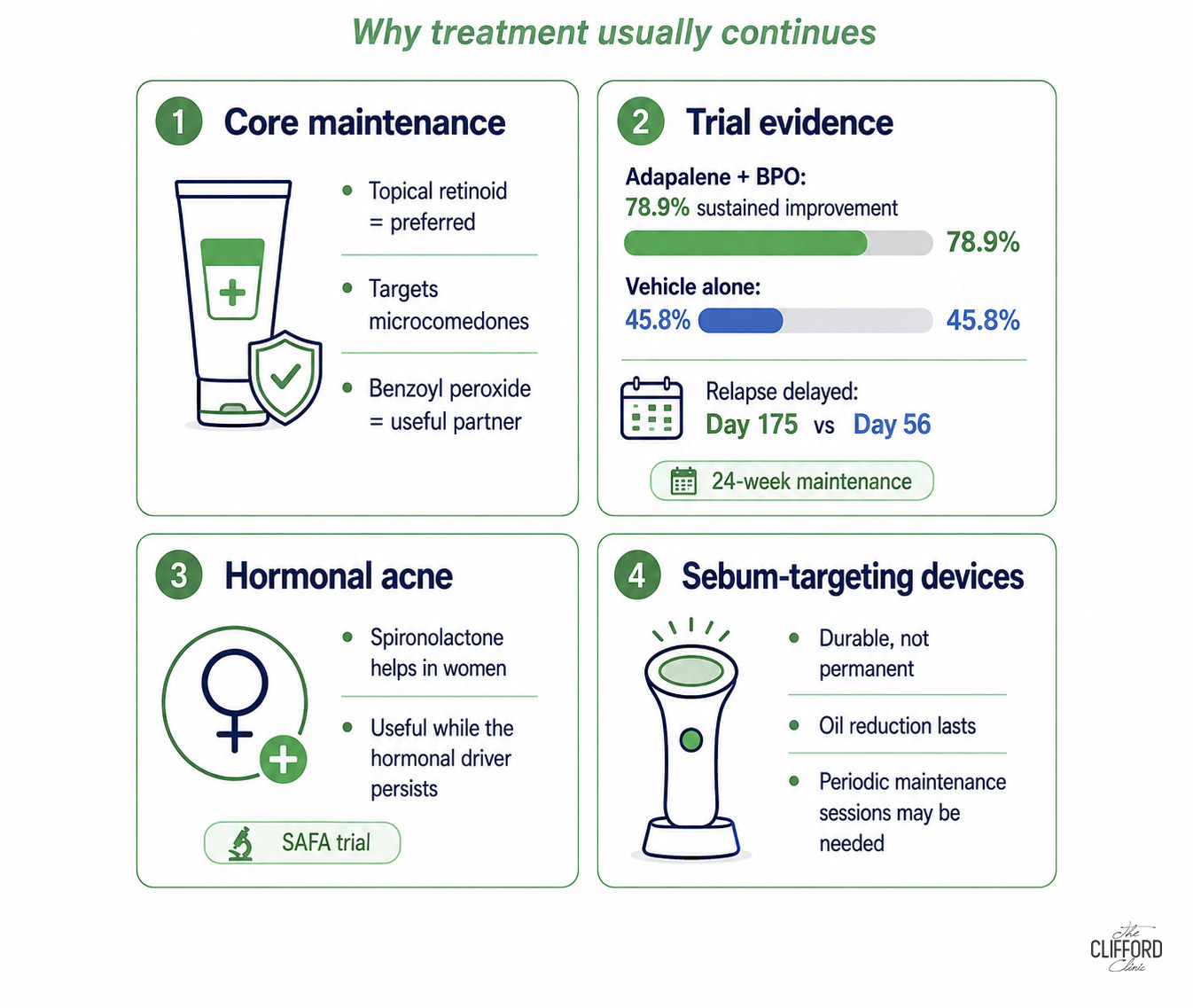
Clinical guidelines recommend maintenance therapy after acne clearance, with topical retinoids as the preferred maintenance agent because they act on the microcomedone that precedes visible lesions, and with benzoyl peroxide as a useful partner. The supporting trial evidence is specific. Among 243 patients who had already achieved at least 50 per cent improvement, 24 weeks of maintenance with a topical adapalene and benzoyl peroxide gel left 78.9 per cent with a sustained reduction in total lesions, against 45.8 per cent of those given vehicle alone (p less than 0.001). The difference in timing was equally marked. A quarter of the untreated group had relapsed by day 56, whereas the maintained group reached that point at day 175, a delay of roughly 17 weeks. For hormonally driven acne in women, the SAFA randomised trial found spironolactone superior to placebo on patient-reported acne severity at 24 weeks, supporting continuation while the driver persists. Research on sebum-targeting devices shows a durable but not permanent reduction in oil production, which is the rationale for periodic maintenance sessions rather than a single course.
Realistic expectations during maintenance
The routine during maintenance is simpler than during active treatment, and it continues for months or years rather than weeks. An occasional spot remains normal and does not indicate failure. Reviews take place periodically, at which treatment is stepped down in stages. Where acne does begin to return, early detection keeps the necessary correction small.
When to see a doctor
See a doctor if breakouts are returning after a period of clear skin, if you were discharged from treatment without a maintenance plan, or if you are unsure what you should still be using. Restarting early is straightforward, whereas waiting until the acne is fully re-established is not.
Stepping treatment down without losing control
Reducing treatment is a staged process rather than a single decision. A typical taper moves a nightly retinoid to alternate nights, then to two or three nights a week, holding at each level for six to eight weeks to establish whether the skin remains settled. Where small lesions begin to appear, the frequency returns briefly to the previous level rather than the plan being abandoned. Patients who understand this pattern manage their own maintenance effectively and require review only when the pattern changes, rather than at fixed intervals indefinitely.
The same principle applies to device maintenance. Rather than committing to an indefinite schedule, sessions are spaced progressively further apart while the skin is monitored, and brought closer together again if oiliness and congestion return. This keeps maintenance proportionate to what the skin requires, which is both clinically appropriate and considerably less expensive than a fixed programme.

Life events that warrant a maintenance review
Certain events predictably disturb settled skin, and anticipating them prevents relapse. Discontinuation of hormonal contraception, pregnancy and the postpartum period, the introduction of a new medication, a substantial change in training routine or diet, and periods of sustained stress with disrupted sleep all warrant discussion with the treating doctor in advance rather than after the event. Relocation to or from a humid climate is equally relevant, since ambient humidity changes how oily skin behaves and which formulations suit it.
In each case the required adjustment is usually small, namely a temporary increase in treatment frequency, a change of formulation, or in pregnancy a switch to agents that remain appropriate. Raising the matter early is worthwhile because a settled complexion is considerably easier to maintain than to re-establish, and a brief consultation at the right point commonly prevents months of subsequent correction.
Frequently asked questions
How do I stop acne coming back after treatment?
Continue a reduced maintenance routine, usually a topical retinoid on two or three nights a week with a simple non-comedogenic routine and daily sunscreen, and continue addressing whatever drove the acne, such as a hormonal pattern or oily skin.
How long do I need to stay on acne maintenance?
Maintenance usually continues for months to years rather than weeks, because the driver persists after the lesions stop forming. Treatment is stepped down gradually at review rather than stopped abruptly.
Can I stop my acne treatment once my skin is clear?
Stopping all treatment at clearance is the commonest cause of relapse. Treatment is reduced rather than abandoned, and a maintenance plan should be agreed with the treating doctor before the active course finishes.
Is it normal to get the occasional spot on maintenance?
An occasional lesion is normal during maintenance, which aims at control rather than at perfection, and it does not indicate failure. A pattern of returning lesions is the signal to review.

Cleared skin that may not stay clear is worth a maintenance plan. The Clifford Clinic can set one.
The Clifford Clinic, 50 Raffles Place, Singapore Land Tower. Call (65) 6532 2400 or WhatsApp (65) 8318 6332 to arrange a consultation.
Related reading
- Best Acne Treatment in Singapore: A Doctor-Led Guide
- Acne Treatment at The Clifford Clinic
- How Our Doctors Choose Your Acne Treatment
- Evidence-Based Topical Acne Ingredients
- 12 Reasons Acne Treatment Fails
- Gold Photothermal Treatment
Selected References
- HealthHub Singapore. Acne. https://www.healthhub.sg/a-z/diseases-and-conditions/acne
- American Academy of Dermatology. Guidelines of care for the management of acne vulgaris. https://www.aad.org/member/clinical-quality/guidelines/acne.
- Acne vulgaris. https://dermnetnz.org/topics/acne
- Guidelines of care for the management of acne vulgaris. JAAD. https://www.jaad.org/article/S0190-9622(23)03389-3/fulltext
- Antibiotics and antimicrobial resistance in acne. Yale J Biol Med. https://pubmed.ncbi.nlm.nih.gov/36568833/
- Spironolactone for adult female acne (SAFA trial). BMJ. https://pubmed.ncbi.nlm.nih.gov/37192767/
- Long-term outcomes of 1726 nm laser treatment for acne. JAAD. https://www.jaad.org/article/S0190-9622(25)02900-7/fulltext
Medical disclaimer: The Clifford Clinic publishes this article as general patient education only. It is not a substitute for an in-person clinical assessment, and the suitability, outcome and risk profile of any treatment differ from patient to patient. Arrange a consultation with one of our doctors before beginning treatment for acne.