

Circumcision for Boys Aged 6 to 12 – Why This Age Works Well
Quick answer
The window from 6 to 12 is a practical age for circumcision, and it is the age from which The Clifford Surgery treats boys. By 6, most boys can be treated with numbing cream and local anaesthesia while awake, which avoids general anaesthesia altogether. They can follow simple instructions, cooperate with the doctor, and manage the aftercare with a parent’s help. It is also the age at which a genuinely tight foreskin can be distinguished from the normal, naturally non-retractile foreskin of early childhood, so surgery is only recommended when it is needed. Most boys return to school after about a week, with rough play and sports paused for around four weeks. The Baby Bonus Child Development Account can pay the clinic bill without any medical reason, and it remains available until the end of the year the child turns 12. For the complete overview, see our Circumcision Singapore guide.
Why we treat boys from the age of 6
Below the age of 6, most children cannot reliably stay still and calm for a procedure performed under local anaesthesia. That means general anaesthesia, which is entirely appropriate but belongs in a paediatric hospital setting with paediatric anaesthetic support. Public hospitals do this at high volume and do it well.
From 6 upward, this changes. A boy can understand a simple explanation, tolerate the numbing process, and stay still with a parent present. That makes local anaesthesia realistic. It means no general anaesthetic, a shorter stay, and a faster return to normal.
What changes at this age
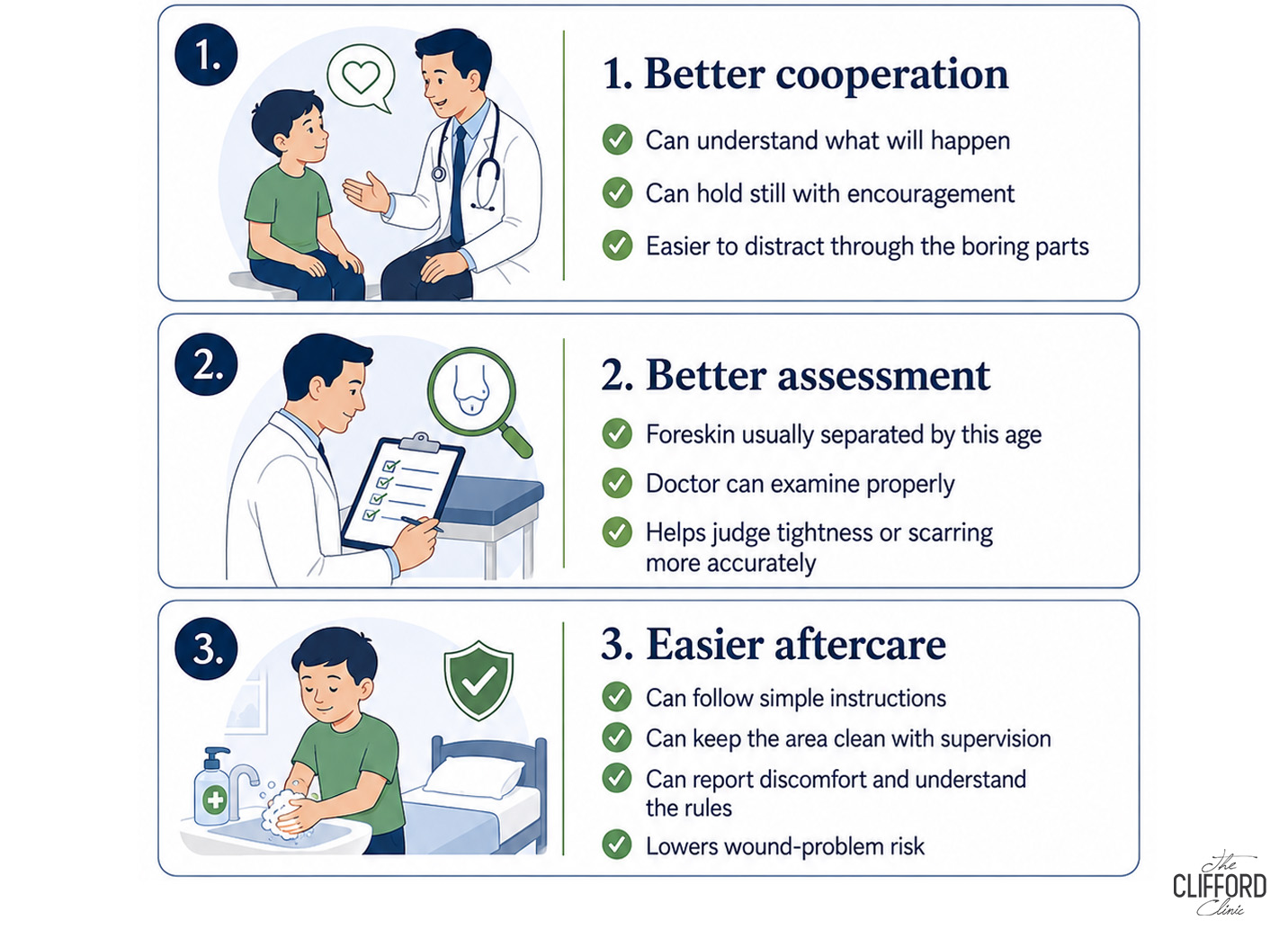
Three things make this window practical.
Firstly, a six-year-old can be told what will happen, can hold still with encouragement, and can be distracted through the parts that are boring rather than painful.
Secondly, the foreskin has usually separated from the head by this age, so the doctor can properly examine the tissue, assess whether there is genuine tightness or scarring, and make an informed recommendation instead of guessing.
Lastly, a boy of this age can be told not to run around, can keep the area clean with supervision, can report discomfort accurately, and can understand why the rules matter for a few weeks. That reduces the risk of a wound problem.
Is a tight foreskin at this age normal
In young boys, the foreskin is naturally fused to the head of the penis and cannot be retracted. This is called physiological phimosis and it is entirely normal. It separates on its own with time, and figures commonly cited indicate that around 98 to 99 percent of males can fully retract the foreskin by adolescence without any intervention.
So a foreskin that does not retract at 6 or 7 is frequently just development in progress, not a problem to be fixed. Severe cases, where there is ballooning of the foreskin during urination, pain, or significant hygiene difficulty, are uncommon, affecting fewer than 1 percent of boys.
Do not force a young boy’s foreskin back. Forceful retraction causes small tears, and those tears heal with scarring, which produces pathological tightness resulting in pathological phimosis. Clean only what is easily visible and let separation happen naturally.
When circumcision is genuinely needed
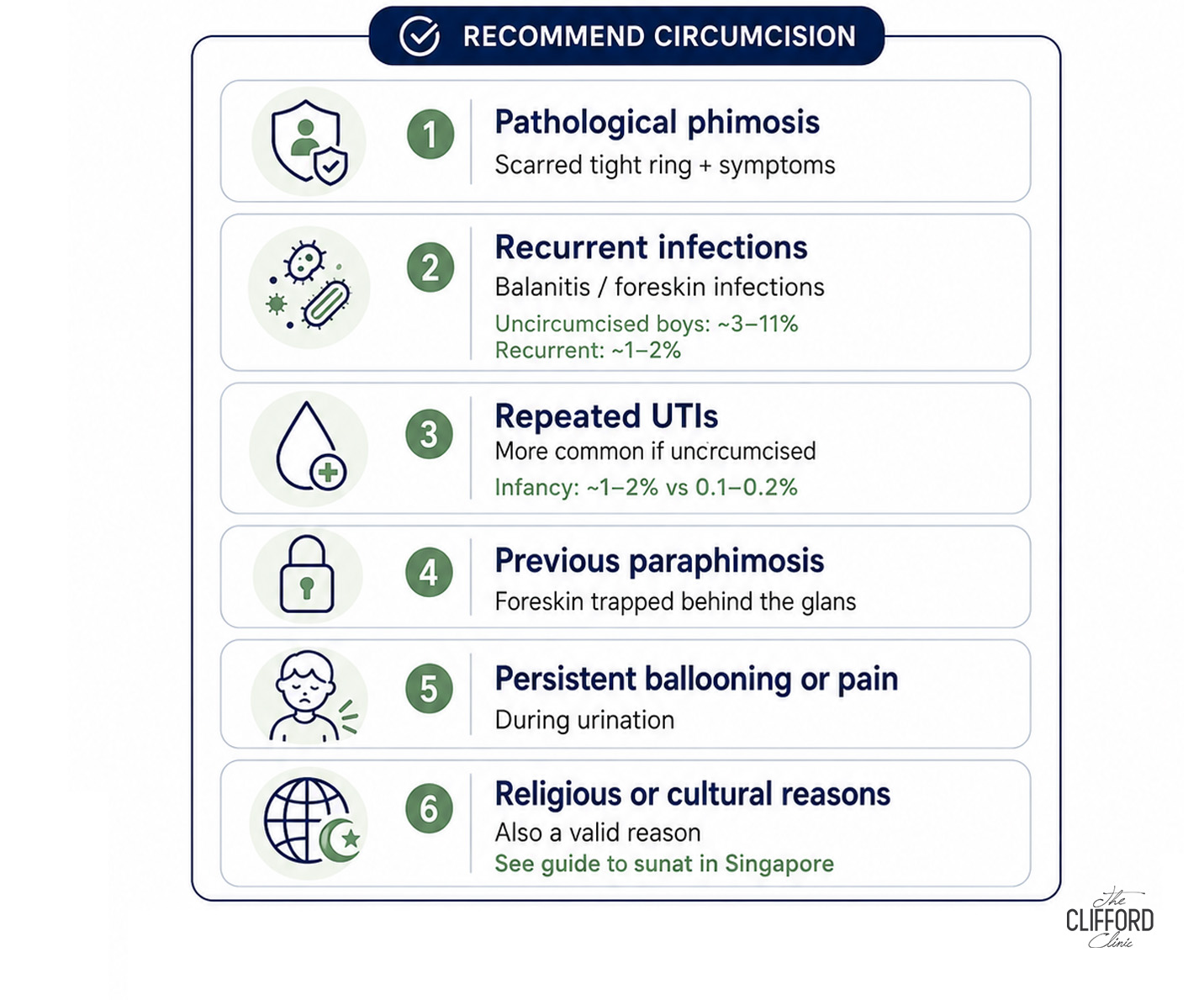
There are clear situations where it is the right recommendation, and a doctor should distinguish these from a foreskin that simply has not finished separating.
Genuine pathological tightness, with a firm scarred ring at the tip that will not retract and causes symptom. Recurrent infections of the head of the penis or foreskin, which affect roughly 3 to 11 percent of uncircumcised boys, with recurrent cases in around 1 to 2 percent. Repeated urinary tract infections, which are more common in uncircumcised boys, at roughly 1 to 2 percent in infancy against 0.1 to 0.2 percent in circumcised peers. A previous episode of paraphimosis, where the retracted foreskin became trapped behind the head. And ballooning or discomfort on passing urine that persists.
Religious and cultural reasons are also entirely valid grounds, and they do not require a medical justification. Our guide to sunat in Singapore covers that.
Where the foreskin is simply still separating and causing no trouble, the recommendation is to wait.
What the day involves
The visit is shorter than most parents expect.
You arrive, the doctor confirms the plan and answers any last questions, and numbing cream is applied to the area. The local anaesthetic is then given as a ring block and a dorsal penile nerve block. Boys are most apprehensive about this part, and the numbing cream makes it far more tolerable.
Once the area is fully numb, the procedure itself is short, commonly around ten to fifteen minutes with a device method. Your son rests in recovery briefly afterwards, receives his medication and aftercare instructions, and goes home the same day. The whole visit takes a few hours rather than a day.
Parents are involved throughout, and boys of this age generally cope considerably better than the adults accompanying them.
Anaesthesia without going to sleep
This is the main practical advantage of the 6 to 12 window.
Local anaesthesia numbs only the area being treated while your son stays awake. There is no general anaesthetic, no breathing tube, no grogginess afterwards, and none of the small risks that come with being put to sleep. Once the block is working, the procedure should not hurt, and boys typically describe pressure rather than pain.
Where a child is particularly anxious, light sedation can be added so he feels relaxed and drowsy without full general anaesthesia. That is a reasonable middle ground and worth discussing at the consultation. In practice, parents commonly report pain of around 4 to 5 out of 10 in the days afterwards, well managed with simple painkillers. Our pain and anaesthesia guide explains the options.
Which technique is used for boys
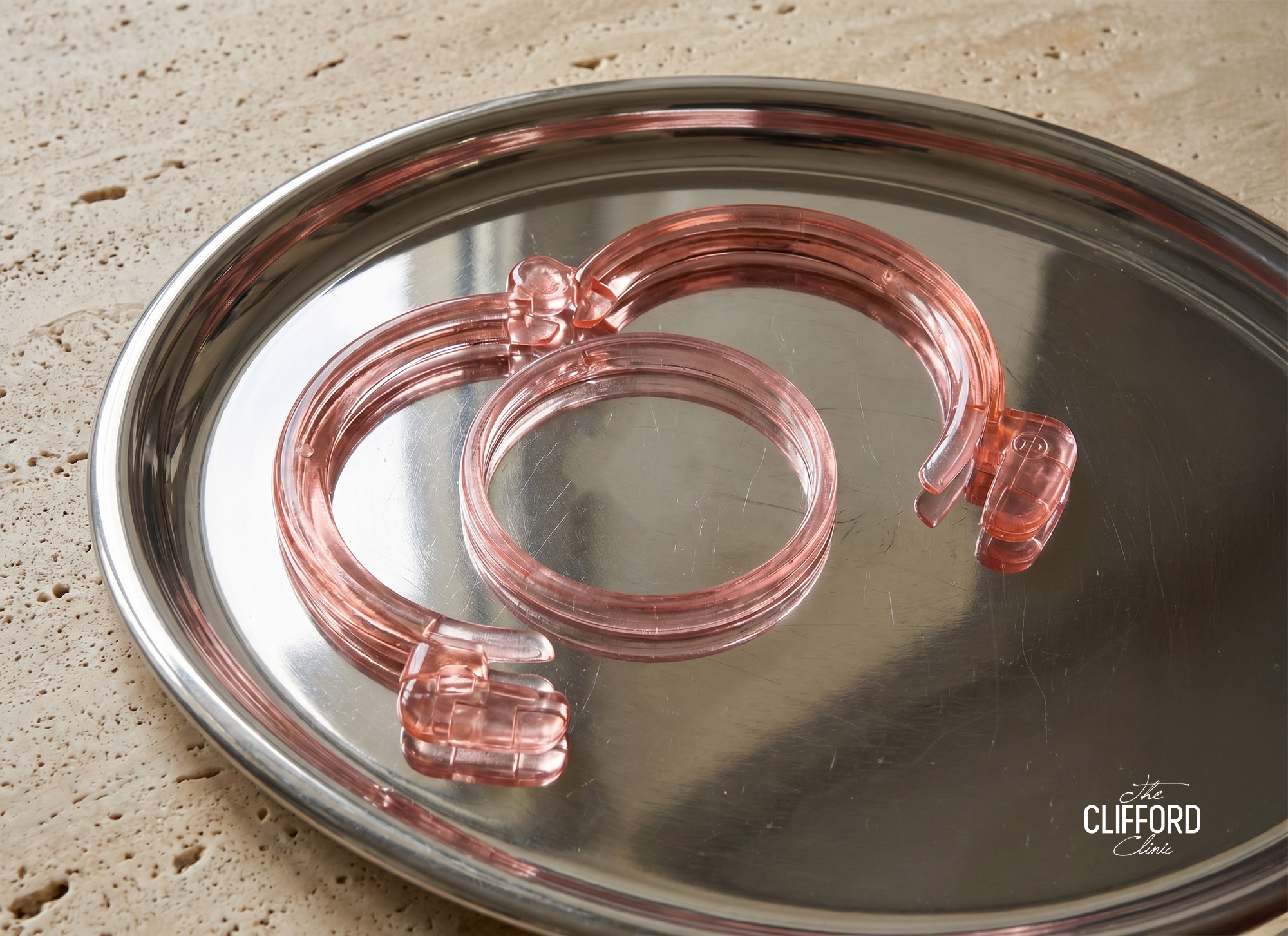
Device methods are well suited to this age group, and the choice is made after examining your son rather than in advance.
The Shang Ring is a sutureless device that clamps and removes the foreskin, with the ring removed at a short follow up visit. Stapler circumcision, often called ZSR, cuts and seals in a single action and typically takes around ten minutes. Both avoid conventional stitching and give a neat, uniform edge.
Conventional surgery with dissolvable stitches remains the better option where the anatomy is unusual or the foreskin is scarred. Laser is widely used in the public system for children.
On evidence, a randomised trial of the Shang Ring recorded average operative time of about 6.4 minutes with blood loss of about 0.7 mL against 2.6 mL for conventional surgery, and a Cochrane review of 18 randomised trials reported no severe adverse events with either devices or conventional techniques, with moderate adverse events somewhat more frequent in device groups. Our techniques guide compares them all.
Timing around school
Most families plan around the school calendar.
Boys commonly return to school after about a week. Rough play, sports, swimming and cycling pause for around four weeks while healing completes. The June and December school holidays allow the most time, and December in particular allows the quiet first week plus a further stretch before physical education resumes.
Book early for the holidays. These are the busiest weeks of the year for childhood circumcision in Singapore.
Cost and the Baby Bonus CDA
The professional fee at The Clifford Surgery is S$1,888 before GST. The consultation is S$100 before GST and is waived if you proceed. Follow up is included, medication is charged separately, and light sedation is an optional add-on.
For families the funding question usually matters more than the fee. MediSave and insurance apply only where there is a medical indication such as a tight foreskin or recurrent foreskin infection.
The Child Development Account is different. CDA funds can be used at Approved Institutions regardless of whether the procedure is medically necessary, so an elective or religious circumcision can be paid from the account. The Clifford Surgery is registered as an Approved Institution, and when checking the official list you should search for Clifford Surgery rather than Clifford Clinic. The account remains available until the end of the year in which your child turns 12. Our Baby Bonus and CDA guide explains it fully.
Aftercare parents actually need to know
Give the prescribed painkillers on schedule rather than waiting for him to complain, and finish any prescribed antibiotic course. Keep the area clean and dry following the wound care instructions, with showering generally allowed soon after and baths and pools avoided until healing is complete. Dress him in loose, breathable underwear to reduce rubbing. And enforce the activity restrictions even when he feels fine, because he will feel fine well before the wound is fully healed.
Attend the follow up visit, where healing is checked and any device is removed. Contact the clinic promptly for persistent bleeding, a smelly discharge or pus, fever, or pain that painkillers do not control. Our recovery guide has the day-by-day detail.
If your son is younger than 6
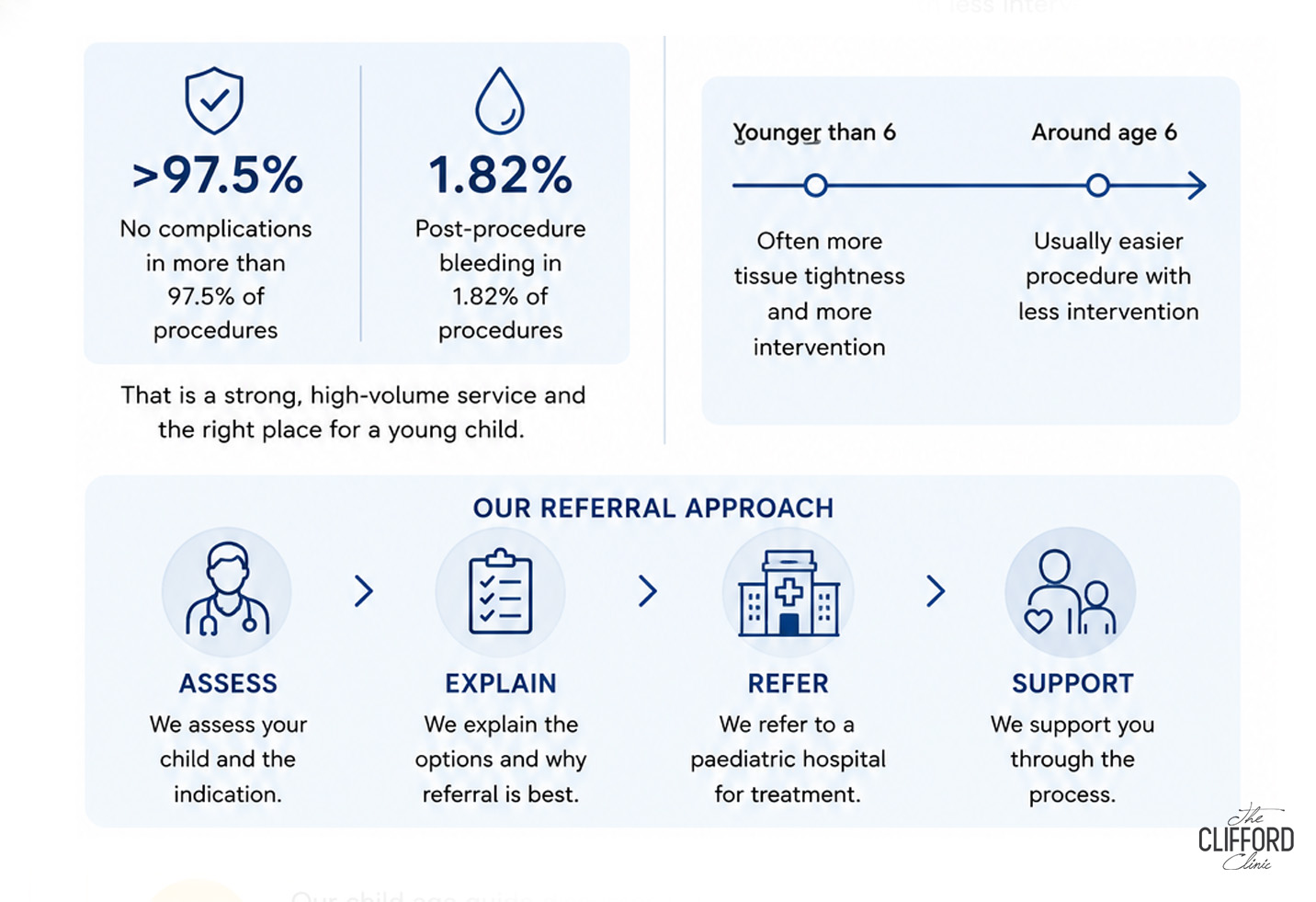
We will refer him rather than treat him.
Younger boys generally need general anaesthesia, which is best provided in a paediatric hospital with paediatric anaesthetic support. KK Women’s and Children’s Hospital performs around 1,100 to 1,200 childhood circumcisions a year, almost all using the carbon dioxide laser, and reports no complications in more than 97.5 percent of procedures, with post-procedure bleeding in 1.82 percent. That is a strong, high-volume service and the right place for a young child.
There is also rarely a clinical rush. Unless there is a specific medical problem, waiting until 6 usually means an easier procedure with less intervention. Our child age guide discusses timing in more depth.
A note from the clinic
“Parents often arrive expecting to be told their son needs surgery, and a fair number leave being told to wait, because the foreskin is simply still separating. When it is genuinely needed, the 6 to 12 window is the easiest time to do it. He stays awake, it takes minutes, and he is usually back at school within the week wondering what the fuss was about.”
Frequently asked questions
What is the best age for circumcision?
There is no single correct age. From 6 upward, the procedure can usually be done under local anaesthesia without general anaesthesia, which makes 6 to 12 a practical window.
Why do you not treat boys under 6?
Younger children generally need general anaesthesia to stay still and comfortable, which is best provided in a paediatric hospital setting. We refer them rather than treat them.
My son’s foreskin will not pull back, is that a problem?
Often not. The foreskin is naturally fused in early childhood and separates over time, with around 98 to 99 percent of males able to retract by adolescence. Never force it back.
Will my son be asleep?
Usually not. Numbing cream and local anaesthesia are the standard approach at this age. Light sedation can be added for an anxious child.
Does it hurt?
Once the nerve block is working, the procedure should not hurt. Parents commonly report around 4 to 5 out of 10 in the days afterwards, managed with simple painkillers.
How long off school?
About a week for most boys, with rough play, sports and swimming paused for around four weeks.
Can I use the Baby Bonus CDA?
Yes. CDA funds can be used at an Approved Institution even without a medical reason, and the account is available until the end of the year your child turns 12.
Can I use MediSave?
Only where there is a medical indication such as a tight foreskin or recurrent foreskin infection. A purely elective or religious circumcision does not qualify for MediSave.
Which technique will be used?
It is chosen after examination. Device methods such as the Shang Ring and ZSR stapler are common at this age because they are quick and avoid stitches.
Is it safe?
A Cochrane review of 18 randomised trials reported no severe adverse events with either devices or conventional surgery. Locally, KKH reports no complications in over 97.5 percent of its childhood procedures.
Book a consultation

If you are considering circumcision for your son, a consultation tells you whether he needs it at all, which is sometimes no. Where it is appropriate, you will leave knowing the method, the timing around school, and the cost, including how the CDA applies.
Book a consultation at The Clifford Surgery
Related guides
- Circumcision Singapore, the complete guide
- Circumcision for children, the age guide
- Muslim circumcision, sunat in Singapore
- Baby Bonus and CDA for circumcision
- Circumcision techniques compared
- Circumcision recovery and aftercare
Medical review box

This article is written by Dr Law Zhi Wei of The Clifford Surgery. Dr Law is a Singapore-trained doctor with more than five years of surgical posting experience. He graduated from the National University of Singapore with an MBBS and holds Membership of the Royal College of Surgeons of Edinburgh, a Graduate Diploma in Family Medicine, and a Postgraduate Diploma in Practical Dermatology from Cardiff University. He trained in the Urology Department at Singapore General Hospital, where he performed hundreds of circumcisions, and completed rotations in urology, general surgery, and paediatric surgery at KK Women’s and Children’s Hospital, Sengkang General Hospital, and Changi General Hospital. He has personally performed more than 500 circumcisions across the conventional, laser-assisted, Shang Ring, and ZSR Stapler techniques, supported by the dedicated Urology Department led by Dr Nathaniel Heah. The Clifford Surgery operates a sterile surgical theatre as a Ministry of Health-accredited Day Surgery Centre, and is CPF and MediSave accredited and CDA-approved. This content is general information and not a substitute for a personal consultation.
Dr Law Zhi Wei profile, https://cliffordclinic.com/dr-law-zhi-wei/
Clinical research and publications, https://cliffordclinic.com/clinical-research/
References
- SingHealth, Circumcision for children. https://www.singhealth.com.sg/symptoms-treatments/circumcision-children-surgeries
- KK Women’s and Children’s Hospital, Laser circumcision outcomes. https://www.kkh.com.sg/about-kkh/who-we-are/clinical-outcomes/laser-circumcision-outcomes
- Baby Bonus Approved Institutions list. https://go.gov.sg/listofais
Medical evidence references
- Hohlfeld A, Ebrahim S, Shaik MZ, Kredo T. Circumcision Devices Versus Standard Surgical Techniques in Adolescent and Adult Male Circumcisions. The Cochrane Database of Systematic Reviews. 2021. https://www.cochranelibrary.com/cdsr/doi/10.1002/14651858.CD012250.pub2/full
- Friedman B, Khoury J, Petersiel N, et al. Pros and Cons of Circumcision, An Evidence-Based Overview. Clinical Microbiology and Infection. 2016. https://pubmed.ncbi.nlm.nih.gov/27497811
- Sokal DC, Li PS, Zulu R, et al. Randomized Controlled Trial of the Shang Ring Versus Conventional Surgical Techniques for Adult Male Circumcision. JAIDS. 2014. https://pubmed.ncbi.nlm.nih.gov/24326606/
- Moreno G, Corbalan J, Penaloza B, Pantoja T. Topical Corticosteroids for Treating Phimosis in Boys. The Cochrane Database of Systematic Reviews. 2024. https://www.cochranelibrary.com/cdsr/doi/10.1002/14651858.CD008973.pub3/full

Author Bio
Dr Gerard Ee

Dr Gerard Ee is the Medical Director of The Clifford Clinic in Singapore. He earned his medical degree from St George's University of London and built his surgical experience across the Singapore General Hospital, National University Hospital, and Mount Sinai Hospital in New York. He holds Membership of the Royal College of Surgeons (Edinburgh) and a Postgraduate Diploma in Dermatology (Cardiff), and is fully accredited in aesthetic procedures including botulinum toxin, fillers, lasers, and light therapies. A strong advocate of minimally invasive, natural-looking results, Dr Ee has published in several medical and scientific journals and presented his research in cities including Taipei, Las Vegas, and London.
See all posts by Dr Gerard Ee »