
Acne Treatment in Singapore: How Our Doctors Choose the Right Treatment for You
If you have searched for acne treatment in Singapore, you have probably noticed that every clinic seems to recommend something different. One promises lasers, another promises facials, and a third promises a miracle cream. The reason the advice feels contradictory is simple. Acne is not one condition. It is a family of conditions, and the right treatment depends entirely on which type you have, how severe it is, and how your skin tends to heal.
At The Clifford Clinic, acne treatment is built around diagnosis first and technology second. This guide explains how our doctors decide what to recommend, so you can understand the logic before you ever sit down for a consultation.

Quick answer
There is no single best acne treatment in Singapore. The most reliable results come from matching the treatment to your acne type. Good medical skincare forms the foundation for almost every patient. From there, recurrent same-spot acne usually responds best to AGNES, more diffuse oily congestion responds well to AviClear, and younger patients or pregnant and breastfeeding mothers are often better suited to Gold or Platinum Photothermal Therapy. Marks and scars are treated separately, and only after active acne is under control.
Why there is no single best acne treatment
Two patients can both say they have acne and need completely different plans. One may have scattered blackheads and whiteheads with very little redness. Another may have deep, painful lumps along the jaw that keep returning in exactly the same place. A third may have mostly brown and red marks left behind after the pimples have healed. Treating all three the same way is the most common reason acne treatment fails.
This is why the first part of any honest acne consultation is not about machines. It is about working out what is actually happening in your skin.
Step 1: Naming your acne type
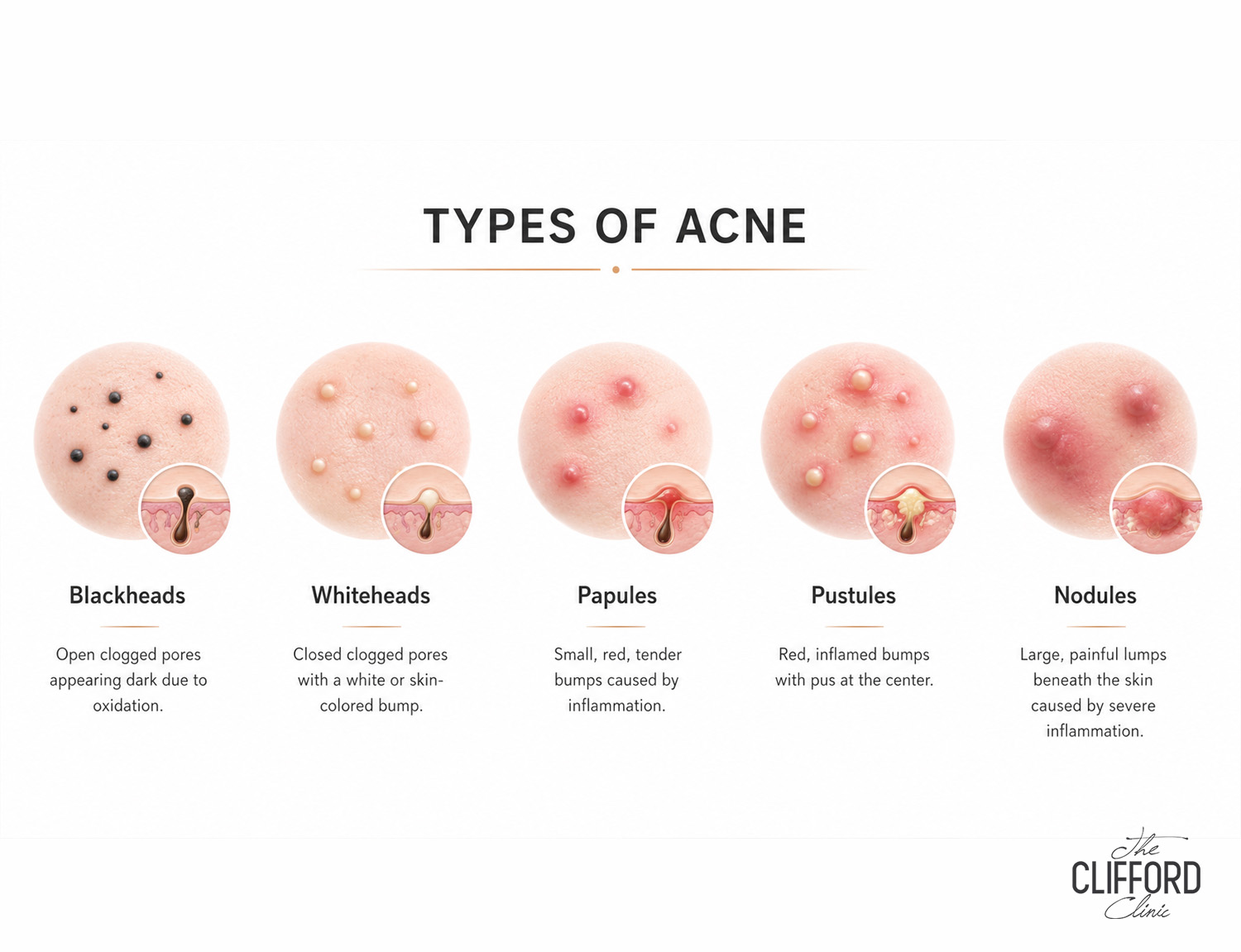
The first thing our doctors examine is the type of acne. In clinic we commonly see comedonal acne, which is blackheads and whiteheads with minimal inflammation, papular and pustular acne, which is the red and tender inflamed bumps, and nodular or cystic acne, which is the deep, painful lumps that carry the highest risk of scarring. Many adults, especially women, also have a hormonal pattern that flares along the jawline and chin.
Naming the type matters because it drives everything that follows. Comedonal acne is a pore and skincare problem. Inflammatory and cystic acne is an oil gland and inflammation problem. Hormonal acne often needs the hormonal driver addressed as well.
Step 2: Grading the severity
Once the type is clear, we grade the severity using a structured grading approach rather than guessing. Mild, moderate and severe acne are managed very differently. Grading also gives us a baseline, so that at your follow-up we can measure real improvement instead of relying on memory.
Step 3: Taking a proper history
A large part of accurate acne diagnosis comes from history taking, not just from looking at the skin. During a consultation Dr Gerard Ee will ask about your diet, in particular dairy intake, your exercise and sweat routine, the skincare products you have already tried, and your menstrual cycle and any signs of hormonal imbalance where relevant. We also ask about sun protection habits, supplements such as whey protein, and any previous acne medications.
These questions are not filler. Dairy, sugar and whey protein are common dietary triggers. A heavy gym routine with a lot of sweat and friction changes the picture. A long history of failed over the counter products tells us the acne is likely to need a medical approach rather than another cream from the pharmacy.

Dr Gerard Ee’s clinical note A lot of acne diagnosis is pattern recognition built over years. With clinical examination and careful history taking, I can usually tell within a few minutes whether the acne is mainly oil driven, hormone driven, pore driven or at high risk of scarring. That judgement is what decides the plan, not the machine a patient happens to ask for. |
The Clifford Clinic treatment ladder
Once we understand your acne, we build a plan from a wide in-house range of options. We were among the first clinics in Singapore to use AGNES and AviClear, we brought Gold PTT in from Korea, and we are one of only a small number of clinics here using Bellasonic ultrasound and the Vbeam Prima. Having the full toolkit in one place means we can match the treatment to you, rather than forcing your acne to fit the one or two machines a clinic happens to own.
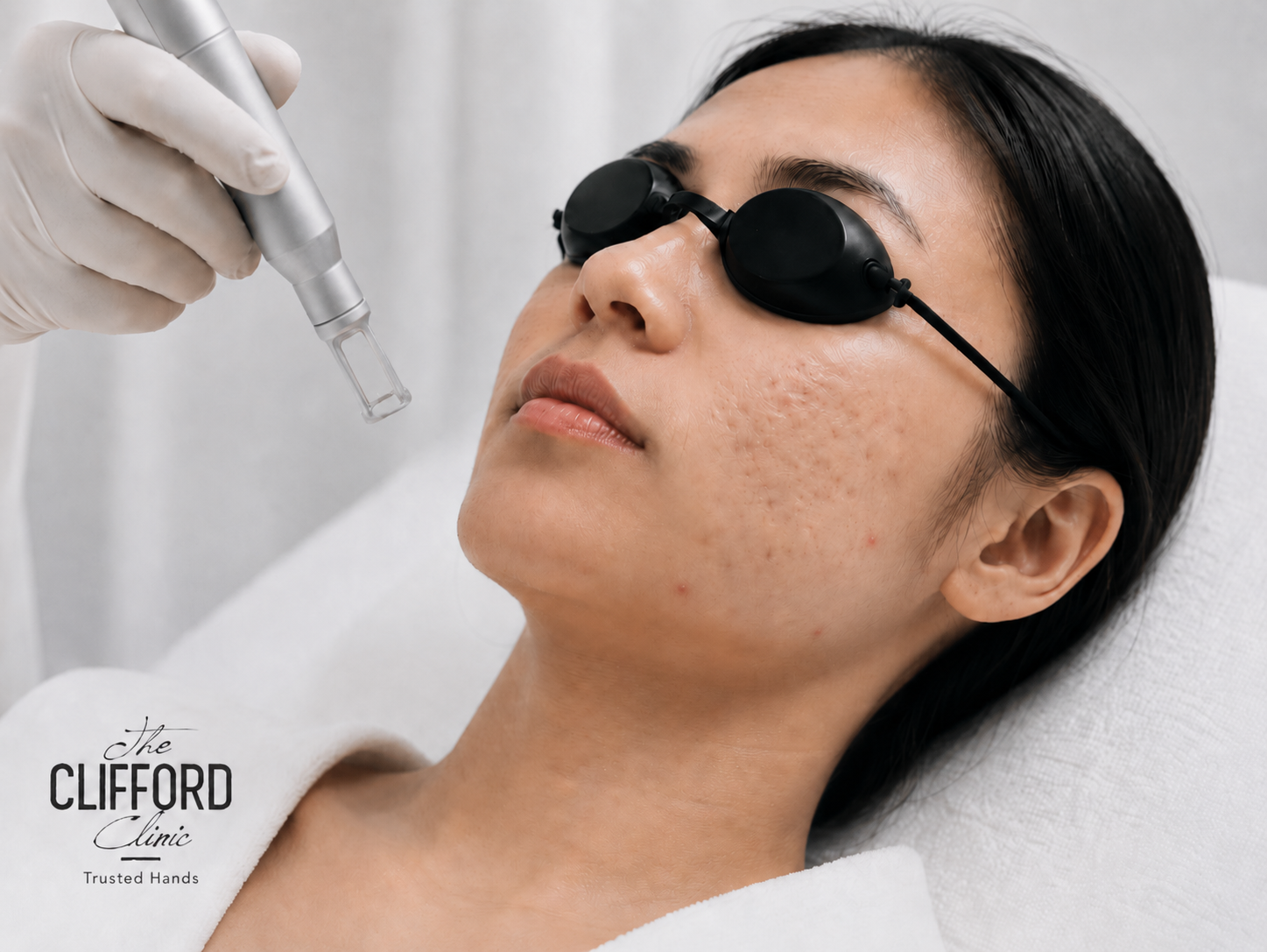
Medical skincare is the foundation and is almost always part of the plan. On top of that foundation we may add targeted treatment. AGNES uses an insulated radiofrequency microneedle to shrink individual overactive oil glands and is our treatment of choice for acne that keeps returning in the same spot. AviClear is a 1726 nm laser that gently reduces oil production across a wider area and suits milder, more diffuse congestion and oily skin, as well as maintenance. Gold and Platinum Photothermal Therapy heat nanoparticles inside the oil glands and are particularly useful for younger teenagers and for pregnant and breastfeeding mothers. HydraFacial helps when there is a lot of congestion, while Vbeam and Q-Switch lasers are used later for the redness and brown marks acne leaves behind.
Oral medication has its place. Antibiotics can be used as a short bridge in inflammatory acne, always alongside topical treatment. Isotretinoin remains a powerful option for severe or scarring acne, but in our practice it is treated as a last resort rather than a first move.
Who is at high risk of scarring
Some patients need to be treated more urgently because their risk of permanent scarring is high. Two groups stand out. The first is anyone with nodular or cystic acne, where the inflammation sits deep in the skin. The second is anyone who habitually extracts or squeezes their comedones and papules, because that physical trauma turns a temporary blemish into a lasting scar. If either applies to you, earlier medical treatment is strongly advised.
When you should see a doctor
Over the counter products help many people with mild acne. You should consider seeing a doctor when your acne keeps coming back despite your best efforts, when you have tried multiple products with no lasting result, or when the acne is deep, painful or already leaving marks. Recurrent acne that you keep expecting to settle on its own, but never does, is a clear signal that it is time for a professional assessment.
Realistic results and timelines
Acne treatment is a process, not an overnight switch. With a well matched plan, many of our patients see a meaningful reduction in active acne over a period of months, and a reduction in the region of 80 to 90 percent over about six months is a realistic target for many. Marks and scars take longer and are addressed in a separate phase. We will always set expectations honestly at your first visit rather than promising instant clearance.
Frequently asked questions
What is the best acne treatment in Singapore?
There is no single best treatment for everyone. The best treatment is the one matched to your acne type, severity and skin tone. For recurrent same-spot acne that is often AGNES, for diffuse oily congestion it is often AviClear, and for teenagers or pregnant patients it is often Gold or Platinum Photothermal Therapy. A consultation is the only way to know which applies to you.
How long does acne treatment take to work?
Topical treatments usually take several weeks to show change. Device treatments such as AviClear build up over three to six months. Many patients aim for around 80 to 90 percent reduction in active acne over roughly six months, though timelines vary.
Do I need lasers, or will skincare be enough?
Medical skincare is the foundation for almost everyone, and for mild acne it may be enough. Recurrent, inflamed or scarring acne usually needs more than creams, which is where targeted treatments come in.
Should I treat my acne scars at the same time?
Active acne is treated first. Most scar treatments are only started once the acne is controlled, with the exception of Secret RF, which can help manage active acne and scarring together in selected cases.
| Find out exactly which acne treatment suits your skin.
The Clifford Clinic, 50 Raffles Place, Singapore Land Tower. Call (65) 6532 2400 or WhatsApp (65) 8318 6332 to arrange a consultation. |
Related reading
- AGNES Acne Treatment
- AviClear Acne Treatment
- Gold Photothermal Treatment
- Acne Scar Treatment
- About Dr Gerard Ee
References
- HealthHub Singapore. Acne. https://www.healthhub.sg/a-z/diseases-and-conditions/acne
- American Academy of Dermatology. Guidelines of care for the management of acne vulgaris. https://www.aad.org/member/clinical-quality/guidelines/acne
- DermNet. Acne vulgaris. https://dermnetnz.org/topics/acne
- The Clifford Clinic. Acne Treatment Singapore. https://cliffordclinic.com/skin/acne-treatment-singapore/
Medical disclaimer: This article is for general education and does not replace an in-person consultation. Treatment suitability, results and risks vary between individuals. Please speak with a qualified doctor before starting any acne treatment.
Written and medically reviewed by Dr Gerard Ee (MBBS, MRCS, Diploma in Practical Dermatology, Cardiff), Founder and Medical Director, The Clifford Clinic. Dr Ee has more than 14 years of experience treating acne and was among the first doctors in Singapore to use AGNES and AviClear.

Author Bio
Dr Gerard Ee

Dr Gerard Ee is the Medical Director of The Clifford Clinic in Singapore. He earned his medical degree from St George's University of London and built his surgical experience across the Singapore General Hospital, National University Hospital, and Mount Sinai Hospital in New York. He holds Membership of the Royal College of Surgeons (Edinburgh) and a Postgraduate Diploma in Dermatology (Cardiff), and is fully accredited in aesthetic procedures including botulinum toxin, fillers, lasers, and light therapies. A strong advocate of minimally invasive, natural-looking results, Dr Ee has published in several medical and scientific journals and presented his research in cities including Taipei, Las Vegas, and London.
See all posts by Dr Gerard Ee »