


Types of Acne Scars: How to Identify Yours and Match the Right Treatment
Written by Dr Bernard Ong · Medically reviewed by Dr Bernard Ong · Expert opinion by Dr Bernard Ong
Dr Bernard Ong is an aesthetic doctor at The Clifford Clinic with 16 years of experience treating acne and acne scars, having personally treated over 5,000 cases of acne and over 3,000 cases of acne scars. More about Dr Bernard Ong.
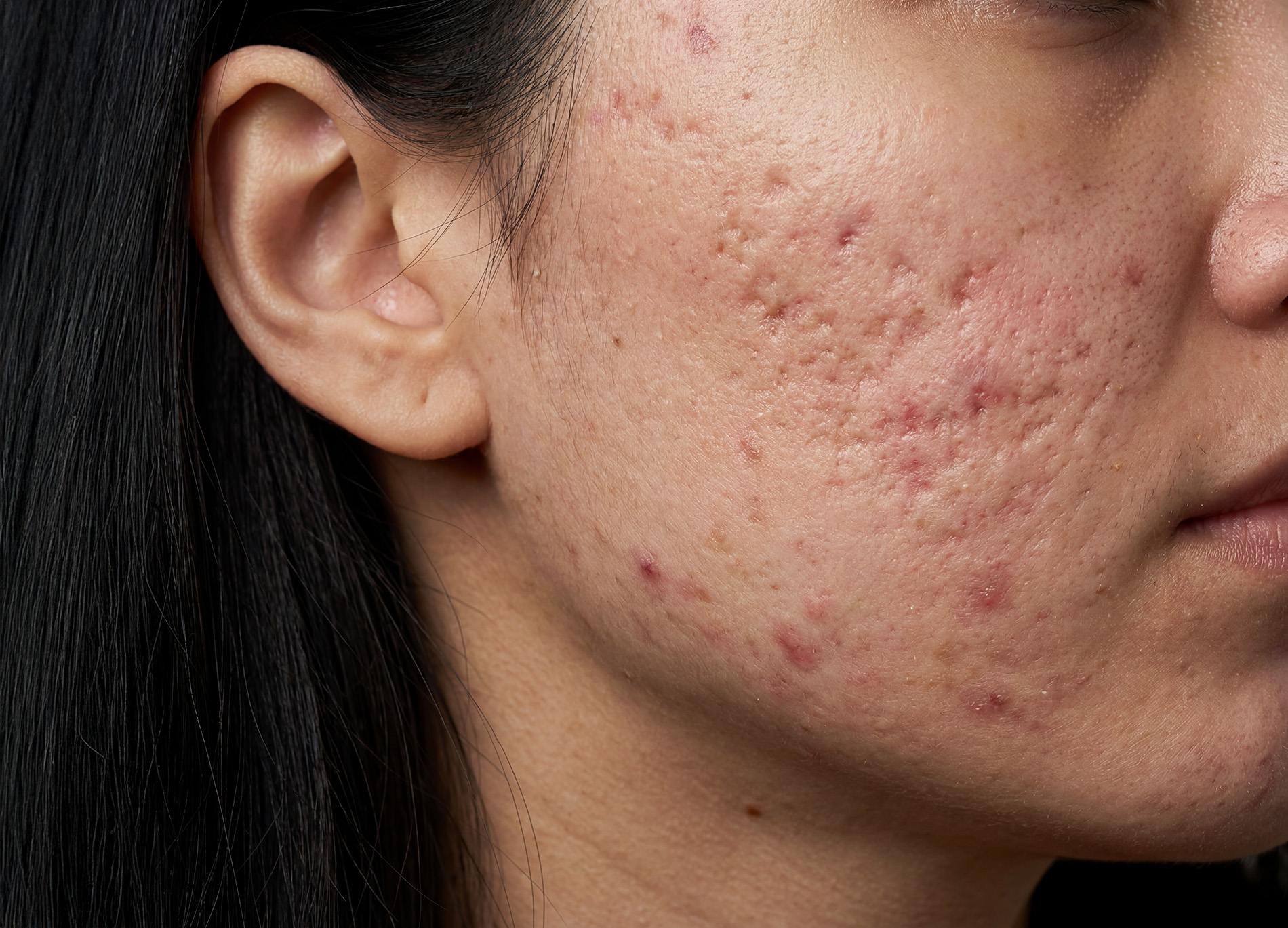
One of the biggest reasons people see little improvement from acne scar treatment is a mismatch between the scar type and the treatment used. There is no single best treatment, only the right treatment for your specific scars. In my practice, identifying the scar type accurately is the most important step determines the result.
Most patients have a mixture of scar types that each need a different tool. This guide explains how to recognise each one and how I match treatment to it. It builds on our complete acne scar treatment guide and on what causes acne scars.
Atrophic (depressed) scars, the majority
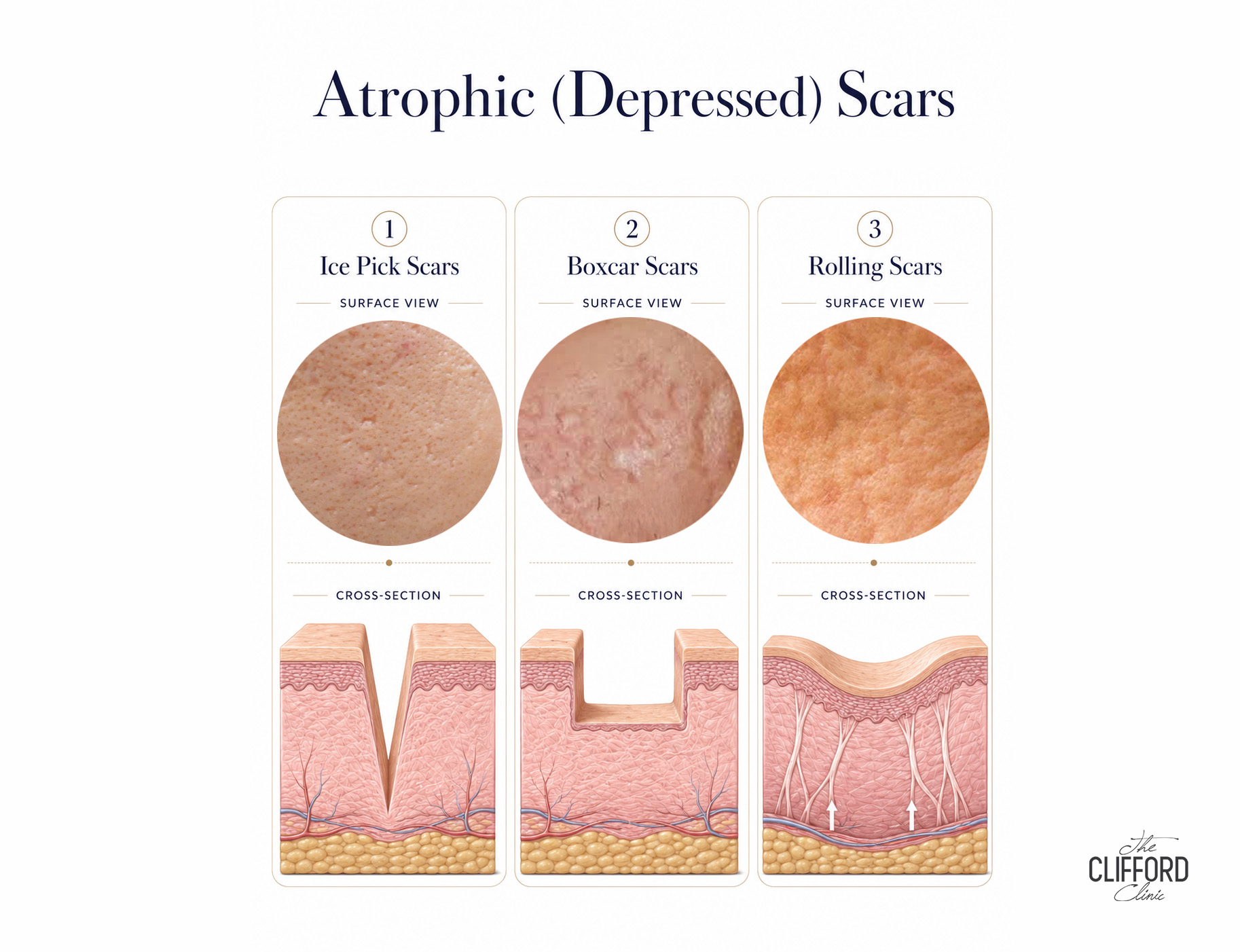
Around eight to nine in ten acne scars are atrophic. They sit below the surrounding skin. They divide into three sub-types, and telling them apart is easiest under angled light, which casts shadows that reveal their shape.
Ice pick scars
Narrow, deep, V-shaped scars that look as though the skin was punctured with a fine tool. They reach deep into the dermis which makes them the most challenging to treat. From experience, extremely deep ice pick scars do not respond well to RF microneedling or general resurfacing. They need either TCA CROSS, where a high-strength acid is applied precisely into the scar to rebuild it from the base, or a biostimulator called PDLLA that can be placed directly into the scar. Trying to resurface a deep ice pick scar with a laser alone is a common reason for disappointment.
Boxcar scars
Round or oval depressions with sharp, well-defined edges, often on the cheeks and temples. These respond well to resurfacing and energy-based remodelling (fractional CO2 laser and RF microneedling) and, in my experience, to PDLLA, which suits boxcar and ice pick scars particularly well.
Rolling scars
Broad, sloping depressions with rounded edges that give the skin a wavy look, caused by fibrous bands tethering the skin to deeper tissue. The key point is that these are tethered. Until the bands are released with subcision, resurfacing alone will not lift them. I often pair subcision with a biostimulator such as PLLA or PDLLA, especially where the skin is also loose, because that combination releases the tether and stimulates collagen to hold the lift.
Raised scars are a different problem
A smaller number of acne scars are raised, hypertrophic or keloid scars, caused by an overproduction of collagen during healing. These are more common on the jawline, chest, back and shoulders. Both Microneedle Fractional RF like Infini and Secret RF, together with fractional Co2 laser resurfacing, cannot improve keloid scars and treating them requires a different approach. This is one of the limitations I always highlight, using the wrong tool on a keloid wastes time and money.
Matching biostimulators to the scar type
Where volume and collagen support are needed, the choice of biostimulator should follow the scar type rather than being one-size-fits-all. PCL filler stimulates collagen and this is is useful when there is significant volume loss. PDLLA for ice pick and boxcar scars, PLLA or PDLLA when the scars are mostly rolling with loose skin, and ECM skinbooster for very mild scarring. PDRN is a valuable add-on across the board because it improves healing and potentiates results, and it can be done alongside microneedle RF. The reasoning behind combining subcision with these injectables is set out in our combination therapy article.
Why most patients need a combination
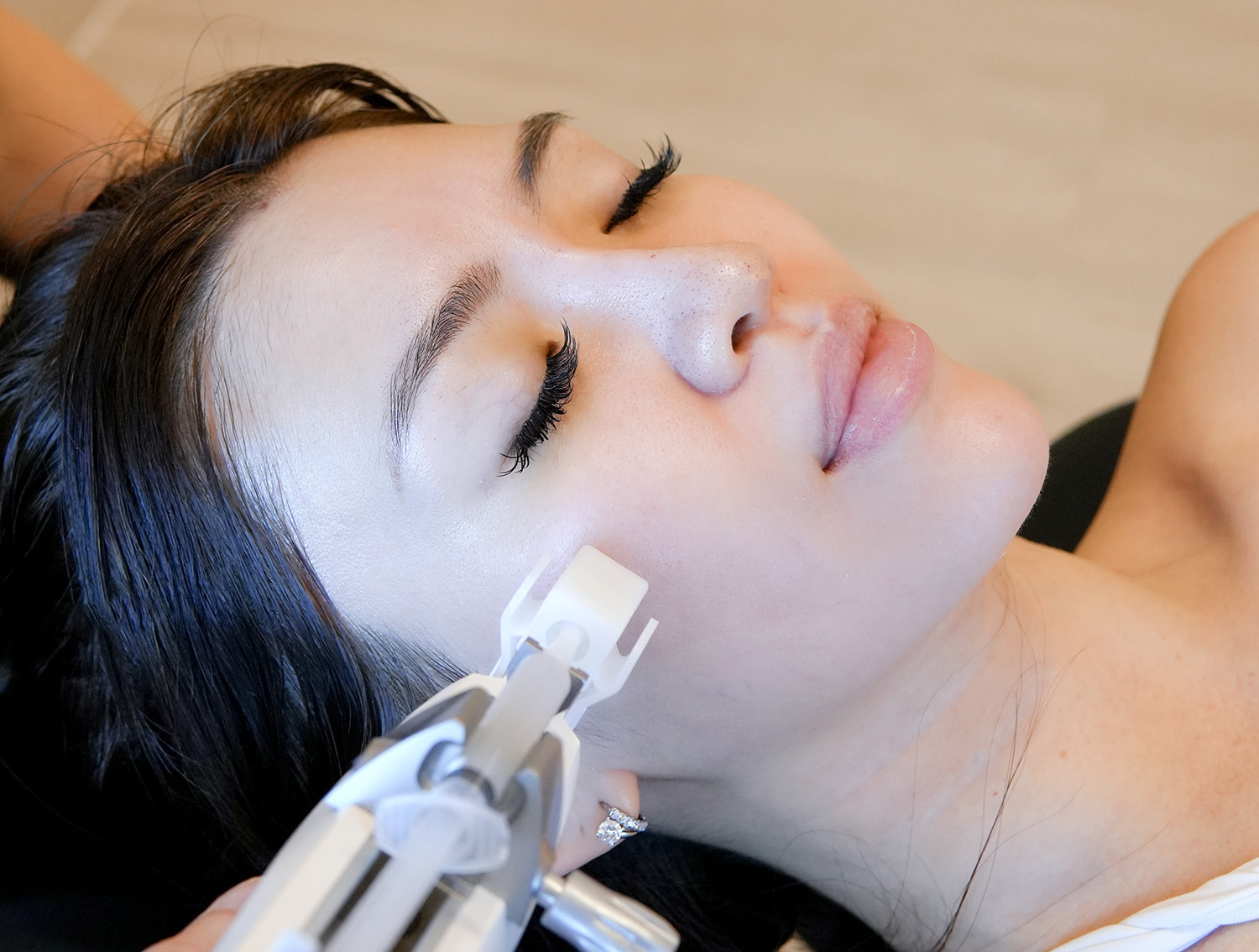
Because a single face often carries rolling scars, a few ice pick scars and some boxcar scars all at once, treating everything with one machine inevitably leaves part of the problem untouched. An acne scar plan consisting of different treatments targeting different scar types is the most effective way to achieve a smoother texture. Using subcision for the tethered scars, either TCA CROSS or PDLLA for pick scars, fractional laser resurfacing and microneedle fractional RF like Infini and Secret RF for rolling and boxcar scars.
Don’t confuse scars with marks
Before committing to scar treatment, it is worth confirming that what you are seeing is a true scar and not a flat brown or red mark, which fades differently and needs different care. Our acne scars vs hyperpigmentation guide explains the distinction, and do acne scars go away on their own covers what time will and will not fix.
How I assess your scar type in the clinic
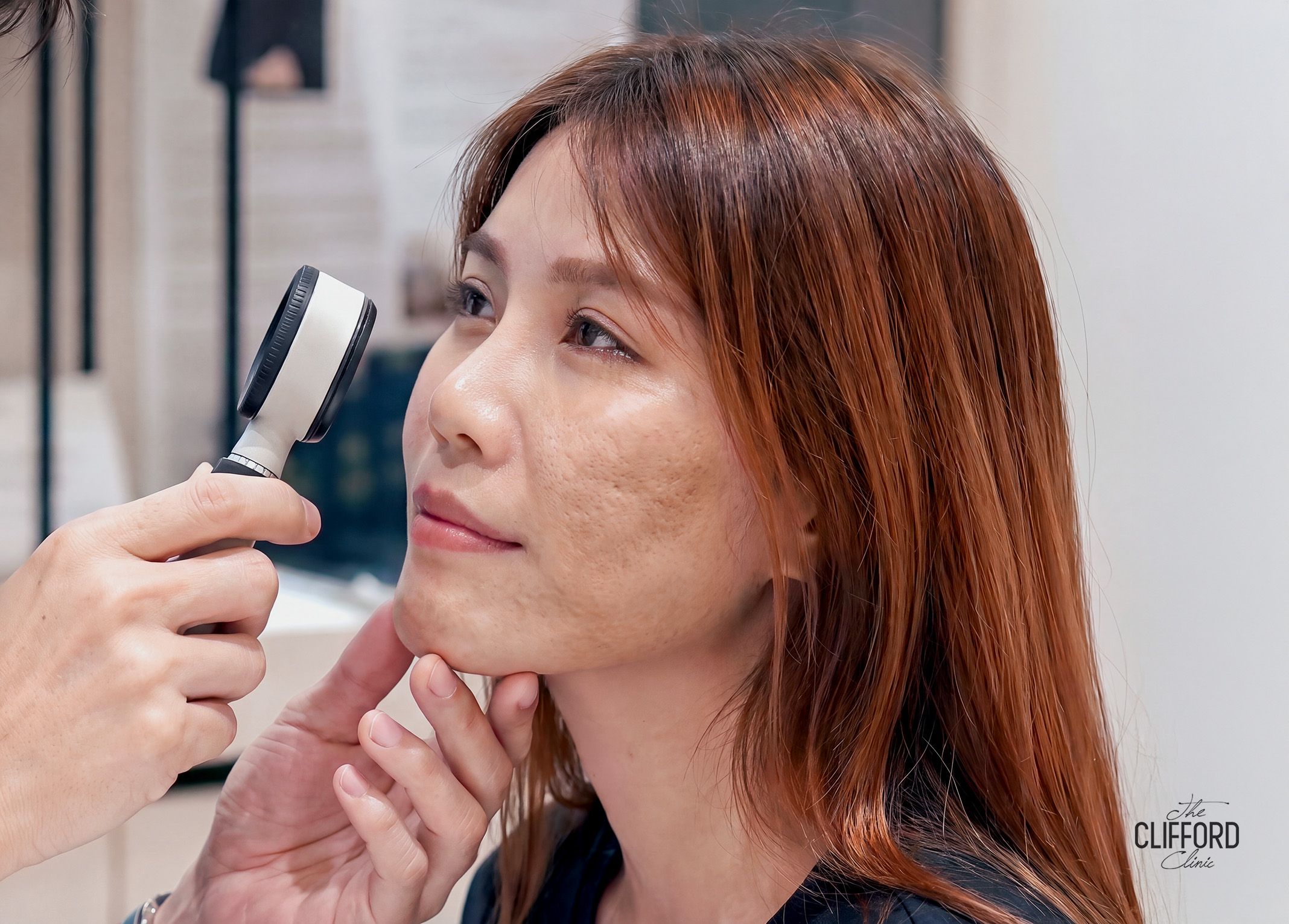
Identifying scar types accurately is a hands-on process, and it shapes everything that follows. I examine the skin under good, angled lighting, often stretching it gently, because rolling and boxcar scars become far more visible when the skin is pulled taut and shadows fall across the surface. I look at the width, depth and edge of each scar (a narrow deep pit reads as ice pick, a sharp-edged round depression as boxcar, a broad wavy area as rolling) and I note the overall pattern across the face. I also separate true scars from flat marks at this stage, because the two need completely different plans.
In practice, almost everyone has a mixture, and the proportions matter. A face that is mostly rolling scars with a few ice pick scars needs a different plan from one that is mostly boxcar scars. Mapping that mix allows me to sequence subcision, TCA CROSS, resurfacing and biostimulators in the right order rather than reaching for one machine and hoping.
When the scar type points away from RF microneedling
Identifying the scar type is not only about choosing the right tool. Sometimes it is about eliminating the wrong one. If the dominant problem is extremely deep ice pick scars, I steer away from RF microneedling and resurfacing as the main treatment and reach for TCA CROSS or PDLLA, which rebuilds the narrow deep pit from its base. If the scars are raised (hypertrophic or keloid) then microneedling and lasers are the wrong family of treatment altogether, because these scars are an excess of collagen, not a deficit. If the dominant complaint is flat discolouration rather than texture, the solution is pigment care, not collagen remodelling.
Accurate diagnosis protects patients from wasteful spending. A great deal of disappointment in acne scar treatment comes not from bad technology, but from good technology wrongly targetted. Matching the mechanism of the treatment to the mechanism of the scar is the discipline that makes the difference.
Clinical summary
Acne scars are not one condition but several, and the right treatment depends entirely on which types you have (ice pick, boxcar, rolling or raised), usually in combination. Accurate identification, ideally in person under good lighting, is the foundation of a plan that actually works. To go further, see the three main scar types, the complete treatment guide, or how subcision and fillers treat rolling scars.
Frequently Asked Questions
Which treatment is most effective for depressed acne scars?
It depends on the subtype. Rolling scars need subcision to release tethers, ice pick scars usually need TCA CROSS or PDLLA, and boxcar scars respond to resurfacing and RF microneedling. Most patients need a combination.
Can boxcar and ice pick scars be improved with biostimulators?
Yes. In my practice, PDLLA suits boxcar and ice pick scars particularly well, while PCL filler is used for volume loss and PLLA or PDLLA for rolling scars. Biostimulators are matched to the scar type rather than applied identically.
How do I know what type of acne scar I have?
Shine a light across the skin from the side. Narrow deep pits are ice pick scars, sharp-edged round depressions are boxcar scars, broad wavy depressions are rolling scars, and raised firm lumps are hypertrophic or keloid scars. A doctor confirms this in person.
Can raised acne scars be treated with microneedling?
No. RF microneedling and resurfacing cannot improve keloid or hypertrophic scars. These need a different approach. Using the wrong tool on a raised scar is ineffective.
Written, medically reviewed and expert opinion by Dr Bernard Ong, The Clifford Clinic. This article is for general education and reflects Dr Ong’s clinical experience treating acne scars in Singapore. It is not medical advice. Treatment suitability, results, downtime and cost vary between individuals. Please arrange a consultation for advice specific to your skin.