
Pico Laser vs Ruby Laser for Freckles and Sun Spots in Singapore
Written by Dr Bernard Ong. Medically reviewed by Dr Gerard Ee
Ruby laser and Pico laser are often presented as competing technologies, but the comparison needs one clarification. Ruby describes a wavelength, 694 nm, whereas Pico describes pulse duration. A picosecond device can itself deliver a 694 nm ruby wavelength, while a traditional Q-switched ruby laser usually delivers that wavelength in nanosecond pulses. In everyday clinic discussions, Pico versus ruby normally means a multiwavelength picosecond platform versus a conventional nanosecond 694 nm ruby laser. Both can clear freckles and solar lentigines. Skin tone, the diagnosis, the available wavelength and the treatment endpoint decide which is more suitable.
Wavelength and pulse duration answer different questions
Wavelength determines which target absorbs the light and, together with spot size and tissue scattering, how deeply useful energy reaches. A 532 nm wavelength is strongly absorbed by superficial melanin. The 694 nm ruby wavelength is also strongly melanin-selective, with more penetration than 532 nm but less forgiveness in heavily pigmented epidermis. Longer wavelengths such as 755, 785 and 1064 nm are absorbed less strongly by melanin and can be useful for deeper targets. Pulse duration determines how quickly that energy is delivered. Nanosecond and picosecond systems both produce photothermal and photoacoustic effects. Picosecond pulses tend to confine the energy more tightly and reduce, rather than eliminate, thermal spread.
How a traditional 694 nm ruby laser works
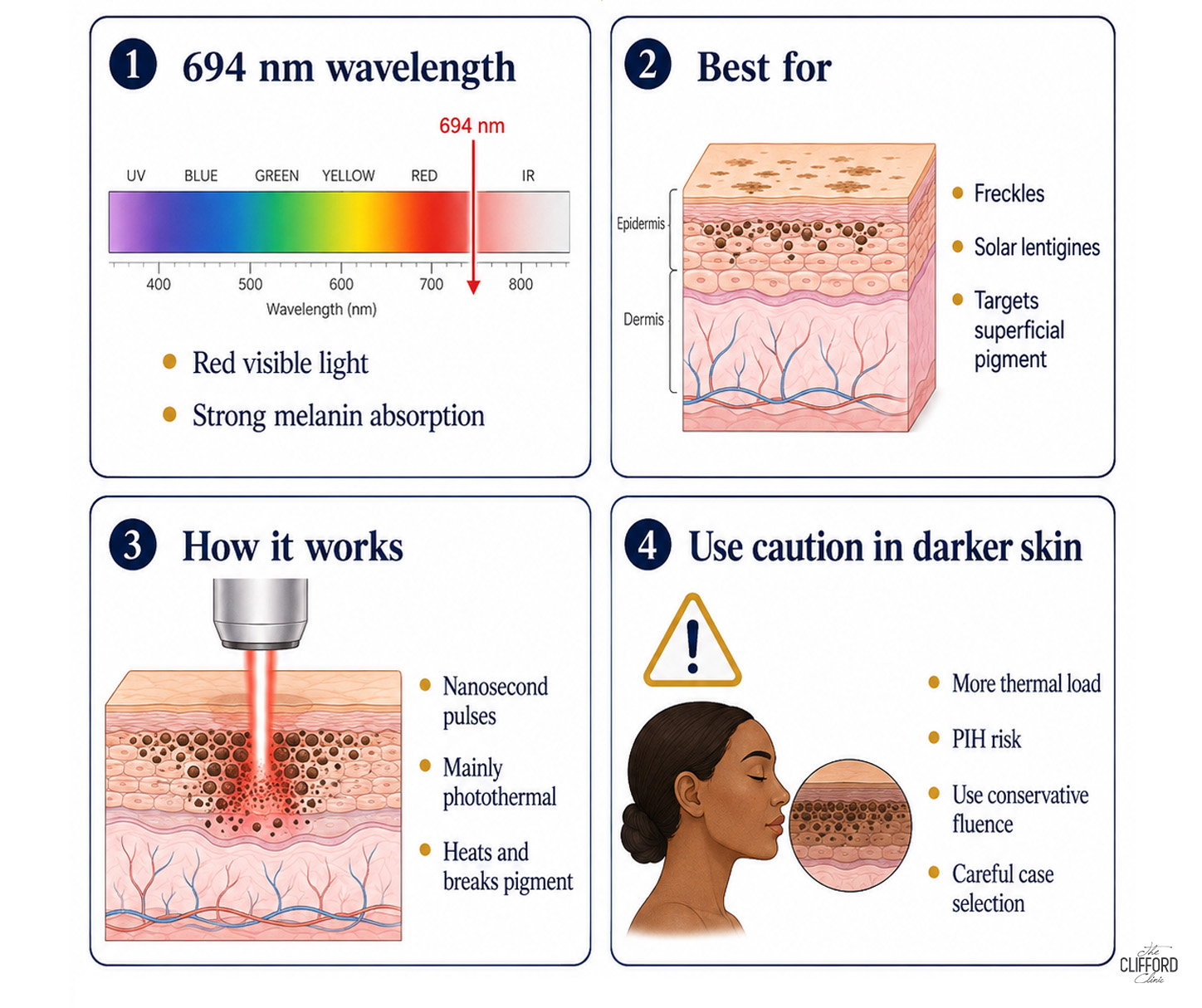
The ruby laser’s strong affinity for melanin makes it highly effective for well-defined freckles and solar lentigines. In a conventional Q-switched system, the nanosecond pulse heats and fragments pigment before the body clears the treated material. This selectivity is both its strength and its limitation. In lighter skin, a discrete brown spot can respond very well. In darker or recently tanned skin, the epidermis contains more competing melanin, so the same wavelength has a narrower margin before blistering, post-inflammatory hyperpigmentation or unwanted lightening occurs. Ruby lasers also have a history of use for selected dermal melanocytic lesions, although these cases require multiple sessions and careful counselling.
How Pico laser works
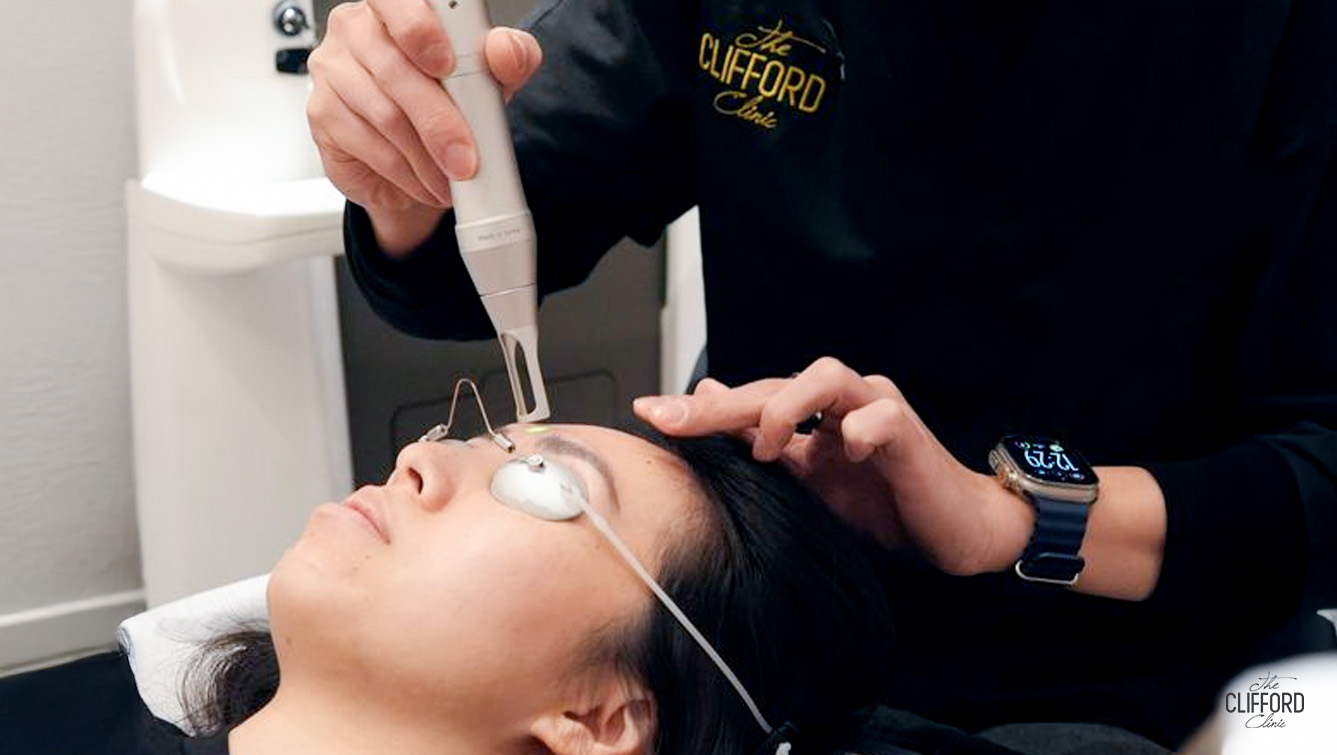
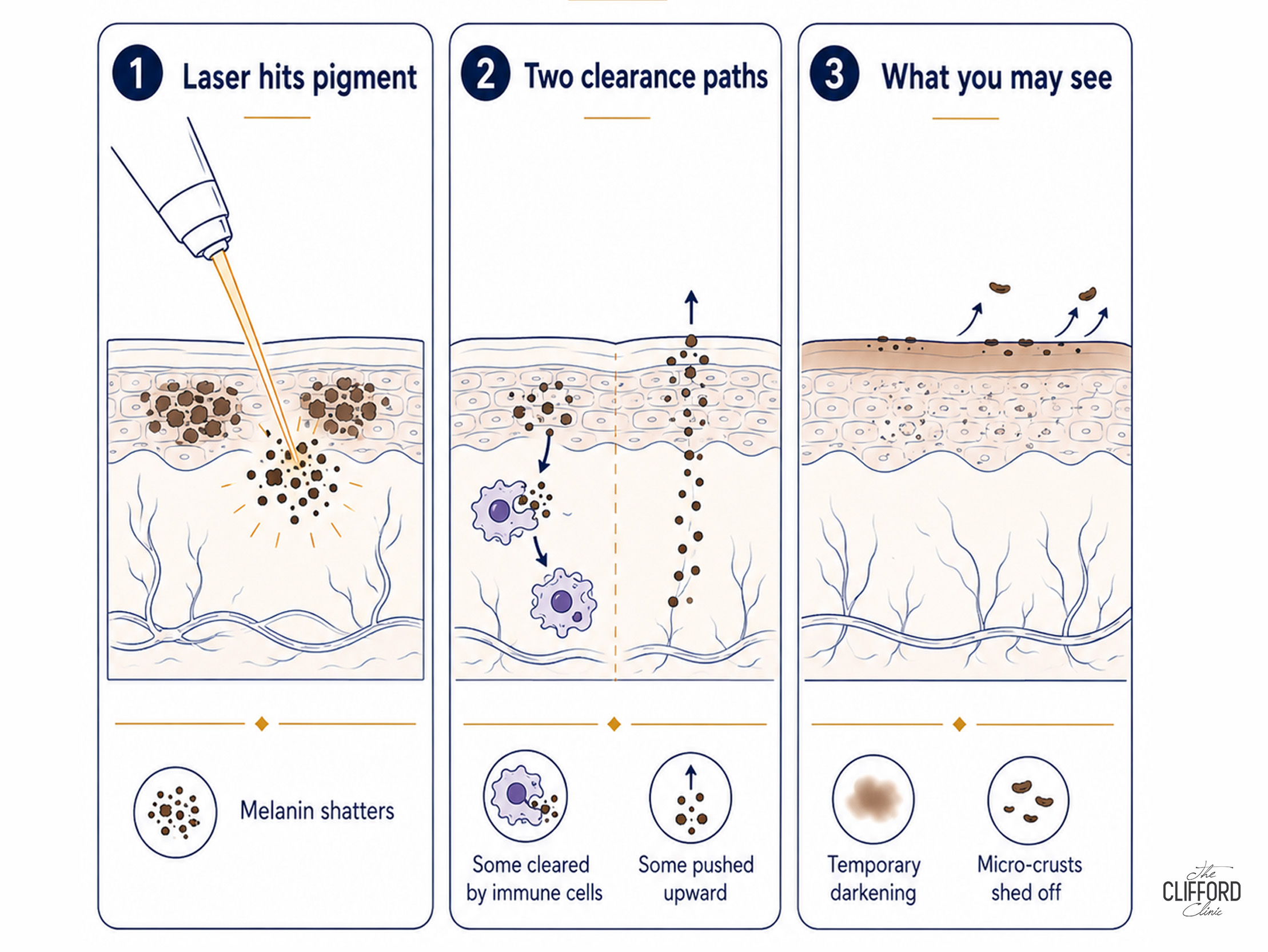
Picosecond platforms deliver pulses in trillionths of a second and may offer several wavelengths on one system. That flexibility allows the doctor to choose a superficial wavelength for a freckle, a longer wavelength for dermal pigment or a fractional handpiece for texture. The shorter pulse can fragment pigment with less heat diffusion than a comparable nanosecond exposure, which may be helpful in Asian skin. It is still possible to cause burns, PIH or hypopigmentation, particularly when a strongly absorbed wavelength is used aggressively. Evidence for picosecond treatment is encouraging, but results from one device or wavelength should not be treated as proof that every Pico laser is superior to every ruby laser.
Which pigment concerns may respond
Traditional Ruby Laser and Picosecond Laser Compared for Pigmentation
| Pigment Concern | Traditional 694 nm Ruby Laser | Picosecond Laser |
|---|---|---|
| Freckles | Strong melanin absorption; precise for discrete lesions | Effective with the available superficial wavelength; protocol-dependent |
| Solar Lentigines | Effective for well-defined epidermal spots | Effective; multiwavelength platforms offer more flexibility |
| Post-Inflammatory Hyperpigmentation | Usually not first-line because treatment can worsen PIH | Selected persistent cases only, using conservative settings |
| Hori’s Naevus and Dermal Pigment | Published historical role; multiple sessions and PIH risk | Longer wavelengths or 694 nm options may be selected by platform |
| Melasma | Not a routine first-line treatment | Low-fluence adjunct in selected stable cases; not curative |
| Mixed-Depth Pigment | One 694 nm wavelength limits flexibility | Multiwavelength systems may be more adaptable |
Asian skin and post-inflammatory hyperpigmentation
Asian patients commonly fall within Fitzpatrick skin types III to V, but skin type alone does not predict every reaction. Recent tanning, a history of PIH, the density of epidermal pigment, lesion type, fluence, spot size, pulse duration, cooling and the chosen endpoint all alter risk. The 694 nm ruby wavelength is strongly absorbed by melanin, so conservative case selection is especially important. Picosecond treatment may offer a wider thermal margin, particularly with longer wavelengths, but it is not automatically safe. A low-risk plan starts with the correct diagnosis and a test spot when uncertainty remains.
Downtime varies more by protocol than by device name
Targeted treatment of freckles or solar lentigines commonly makes each spot turn darker within a day. Fine crusting may then lift over about five to ten days, followed by gradual fading. This can occur with both a ruby laser and a spot-treated picosecond laser. Low-fluence Pico toning may cause only short-lived redness, while fractional Pico treatment can produce swelling and a rough texture for several days. Ruby laser settings that create a stronger visible endpoint may involve more crusting. The aftercare is similar: do not pick the treated spots, avoid unnecessary irritation and use consistent photoprotection. Our Pico laser aftercare guide explains the recovery process in more detail.
Side effects to discuss before treatment
Both lasers can cause temporary redness, swelling and darkening of the treated lesion. The complication of greatest concern in melanin-rich skin is PIH, which may appear after the initial crusting has settled and can last longer than the original downtime. Hypopigmentation, blistering and textural change are less common but possible. Risk rises with recent sun exposure, aggressive energy, overlapping pulses and premature retreatment. The label Pico should not be used as a guarantee of zero heat or zero downtime, just as ruby should not be dismissed as unsafe in every Asian patient.
Diagnosis and pigment depth come before wavelength
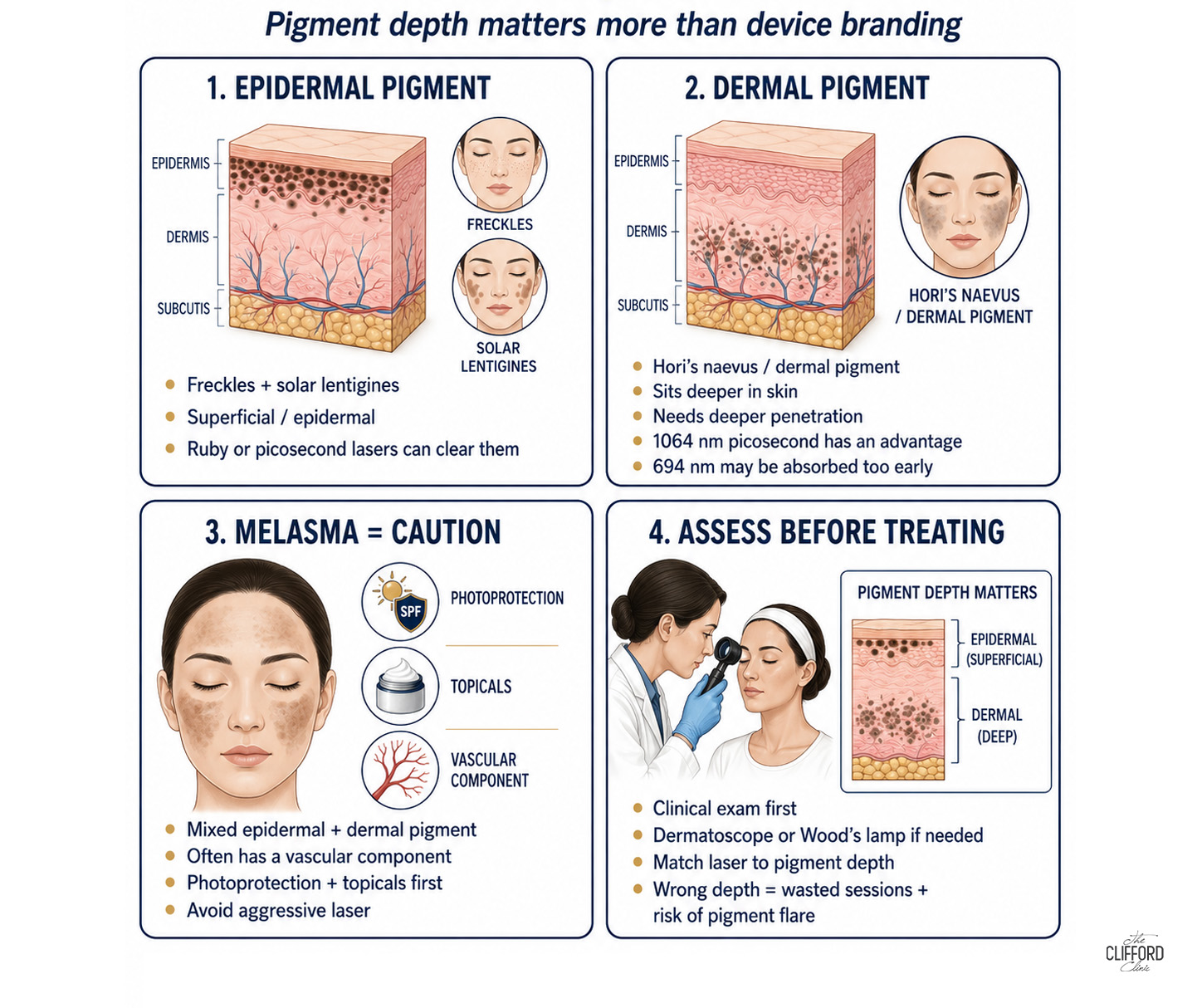
Freckles and most solar lentigines are epidermal lesions, so several pigment lasers can reach them. Hori’s naevus is dermal and usually requires a longer treatment course with a wavelength and fluence chosen for deeper pigment. Traditional Q-switched ruby, alexandrite and 1064 nm Nd:YAG systems all have published roles in dermal melanocytosis, and modern picosecond platforms add further options. Melasma is different: it is a chronic, mixed process that can worsen after aggressive laser. Clinical examination, dermoscopy and sometimes Wood’s lamp assessment can contribute to the diagnosis, although no single bedside test defines pigment depth perfectly in every skin tone. Any lesion that is changing or atypical should be assessed before cosmetic treatment.
Why freckles and sun spots can return
Laser removes pigment that is visible at the time of treatment. It does not remove a person’s tendency to produce freckles or reverse all cumulative sun damage. Freckles may darken again after ultraviolet exposure, and new solar lentigines can develop on previously untreated skin. Daily broad-spectrum sunscreen, shade and sensible reapplication are therefore part of the treatment rather than an optional extra. Topical pigment inhibitors may be useful for selected patients, but they do not replace lesion diagnosis or sun protection.
How doctors choose between ruby and Pico laser
For a small number of sharply defined freckles in lighter skin, a 694 nm ruby laser can be an efficient and precise choice. A multiwavelength picosecond platform may be preferred when skin is more pigment-prone, when lesions sit at different depths or when the plan also includes fractional treatment for texture. Cost, expected number of sessions and the doctor’s experience with a particular platform also deserve consideration. The comparison is therefore not simply old technology versus new technology. It is a choice between specific wavelengths, pulse structures and treatment endpoints for a specific patient.
Can ruby and Pico laser be combined?
They can, although most patients do not need both merely to clear a straightforward freckle. Combination or sequential treatment may be useful when different lesions require different wavelengths, or when a resistant spot remains after a broader picosecond plan. Treatments should be spaced so that the skin response can be judged before more energy is delivered to the same area. Using two lasers is only an advantage when each has a defined role.
Who may be suitable
- Ruby laser may suit:lighter skin with a small number of discrete, benign freckles or solar lentigines, and selected dermal melanocytic lesions under experienced care.
- Pico laser may suit:pigment-prone Asian skin, mixed-depth pigmentation, selected persistent PIH after inflammation has settled, dermal pigment, or plans that need several wavelengths or a fractional handpiece.
- Treatment may need to be postponed or modified when:melasma is unstable, the skin is recently tanned, inflamed or infected, or the brown lesion is undiagnosed or changing.
When a brown spot needs medical review
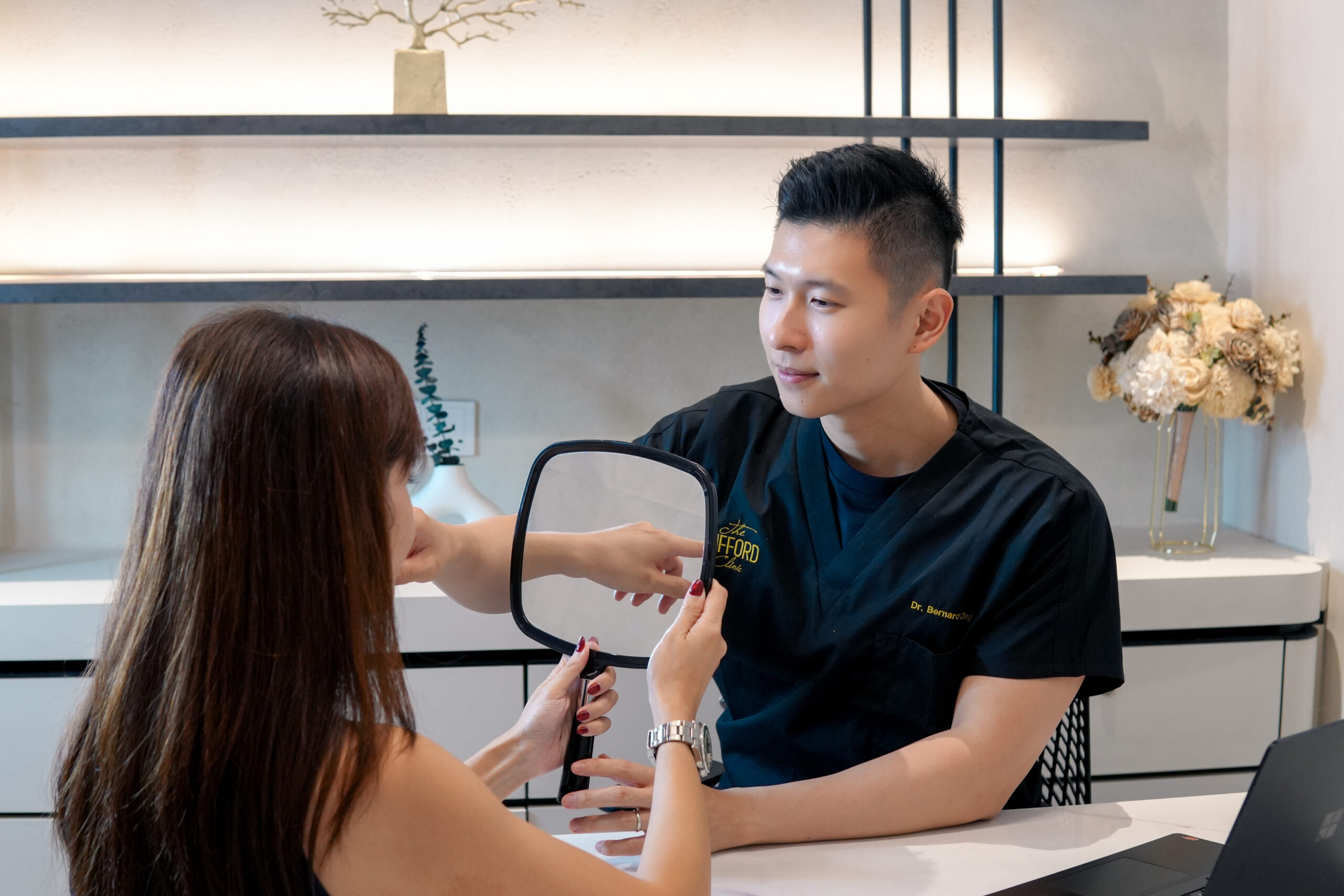
Do not assume every brown spot is a freckle. A lesion that is new in adult life, growing, irregular, asymmetrical, showing several colours, bleeding, itching persistently or looking unlike the surrounding spots should be examined before laser. Cosmetic treatment can remove visible pigment and make later assessment more difficult without treating an underlying malignancy. Most freckles and solar lentigines are benign, but the diagnosis should be established first. Once that has been done, the discussion can return to wavelength, skin type and expected downtime.
Doctor’s perspective. Pico is a pulse duration, while ruby is a wavelength. That is the detail most simplified comparisons miss. A 694 nm ruby laser remains an effective pigment tool, and a picosecond platform is not automatically better simply because it is newer. In Asian skin, the broader wavelength choice and tighter energy confinement of modern Pico systems can be useful, but conservative settings and an accurate diagnosis remain more important than the label on the machine.
Pigment wavelengths used at The Clifford Clinic
Our picosecond platforms include 532 nm and 1064 nm options for superficial and deeper pigment, together with additional device-specific wavelengths such as 785 nm on selected systems. This range allows the wavelength to be matched to the lesion rather than using one beam for every type of brown mark. A traditional ruby laser is not required to reproduce every indication associated with 694 nm, although a ruby wavelength may still be an appropriate option in other practices or on compatible platforms. Device choice follows the diagnosis and the doctor’s familiarity with the system.
Frequently asked questions
Is ruby laser better than Pico laser for freckles?
Not always. The 694 nm ruby wavelength is strongly absorbed by melanin and can be excellent for discrete freckles, especially in lighter skin. A picosecond platform may offer a lower thermal burden or a wider choice of wavelengths in pigment-prone Asian skin. The device and settings used matter as much as the category name.
Is Pico laser better for sun spots?
Both can clear solar lentigines. Pico laser may be favoured when skin tone, mixed lesion depth or prior PIH makes a more flexible protocol useful. Ruby laser remains a reasonable option for well-defined benign lesions in appropriately selected patients.
Is ruby laser safe for Asian skin?
Yes, with appropriate case selection and conservative technique. Its strong melanin absorption also means a narrower margin in darker or recently tanned skin, so PIH and hypopigmentation must be discussed. A test spot may be sensible when the response is uncertain.
Which laser has more downtime?
Neither has one fixed downtime. Spot treatment with either device often causes darkening and fine crusting for about five to ten days. Low-fluence Pico toning may have much less visible recovery, while stronger ruby or fractional Pico protocols may have more.
Can both treat melasma?
Neither laser cures melasma. Aggressive spot treatment can worsen it. Low-fluence picosecond or Q-switched protocols are sometimes used as adjuncts after melasma has been stabilised, but sunscreen and topical treatment remain the foundation.
How many sessions are needed?
Some discrete freckles and solar lentigines improve after one session, although one to three treatments is common. Dermal pigmentation and dense or recurrent lesions usually require more. The interval and total number should be estimated after the diagnosis and skin response are known.
Choose a wavelength, not a marketing label
The best treatment is the one that fits the diagnosis, skin tone and acceptable recovery, not the one with the newest name. Learn about Pico laser in Singapore and pigmentation treatment in Singapore, or book at The Clifford Clinic, 50 Raffles Place, #01-01 Singapore Land Tower. Call (65) 6532 2400 or WhatsApp (65) 8318 6332.
Selected References
- Comparing the efficacy and safety of a 730 nm picosecond laser with a 532 nm Q-switched Nd:YAG laser for facial pigmented disorders. European Journal of Medical Research, 2026. https://pubmed.ncbi.nlm.nih.gov/41782066/.
- Disorders of hyperpigmentation, part I: pathogenesis and clinical features of common pigmentary disorders. Journal of the American Academy of Dermatology, 2023. https://pubmed.ncbi.nlm.nih.gov/35151757/.
- DermNet: lasers in dermatology. https://dermnetnz.org/topics/lasers-in-dermatology.
- 730 nm, 532 nm and 694 nm laser in the treatment of freckles and solar lentigines: a randomized clinical trial. Lasers in Medical Science, 2025. https://pubmed.ncbi.nlm.nih.gov/40616673/.
- Treatment of acquired bilateral nevus of Ota-like macules (Hori’s nevus) using a combination of scanned carbon dioxide laser followed by Q-switched ruby laser. Journal of the American Academy of Dermatology, 2003. https://pubmed.ncbi.nlm.nih.gov/12664023/.

Author Bio
Dr Gerard Ee

Dr Gerard Ee is the Medical Director of The Clifford Clinic in Singapore. He earned his medical degree from St George's University of London and built his surgical experience across the Singapore General Hospital, National University Hospital, and Mount Sinai Hospital in New York. He holds Membership of the Royal College of Surgeons (Edinburgh) and a Postgraduate Diploma in Dermatology (Cardiff), and is fully accredited in aesthetic procedures including botulinum toxin, fillers, lasers, and light therapies. A strong advocate of minimally invasive, natural-looking results, Dr Ee has published in several medical and scientific journals and presented his research in cities including Taipei, Las Vegas, and London.
See all posts by Dr Gerard Ee »