



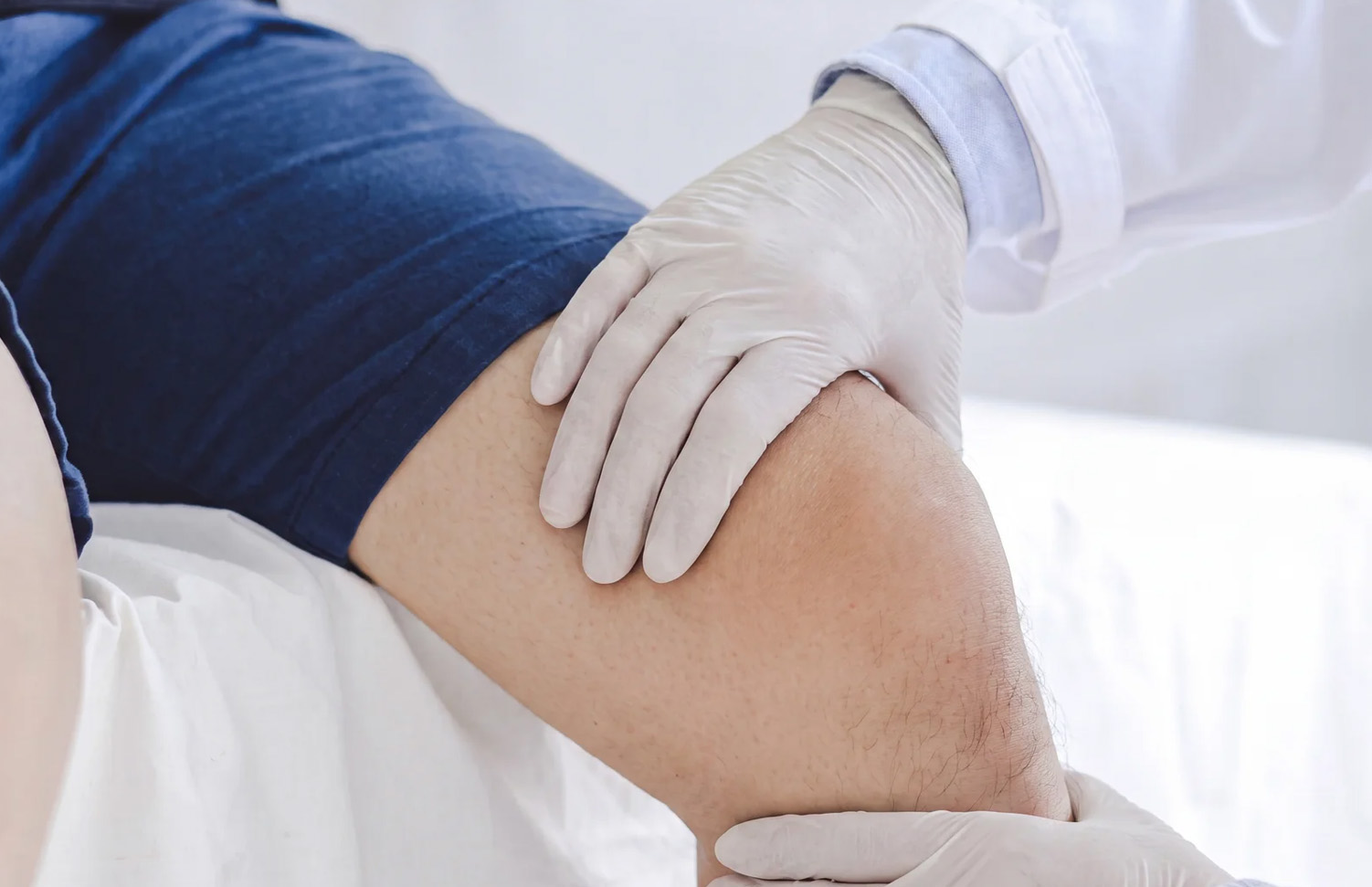
Early Knee Osteoarthritis Treatment, Why Injection Timing Matters
Most patients present for assessment of knee osteoarthritis only once the pain has become difficult to ignore. By then, the knee has often passed the stage at which cartilage, muscle strength and joint alignment respond most readily to treatment. One of the most important and most overlooked principles in knee care is that early knee osteoarthritis treatment tends to deliver the best results, and that the timing of intervention can matter as much as the choice of treatment.
This article covers the early signs of knee osteoarthritis, the treatment window, and how injection timing fits in, with clinical perspective from Dr Gerard Ee at The Clifford Clinic in Singapore.
What Is Early Knee Osteoarthritis?
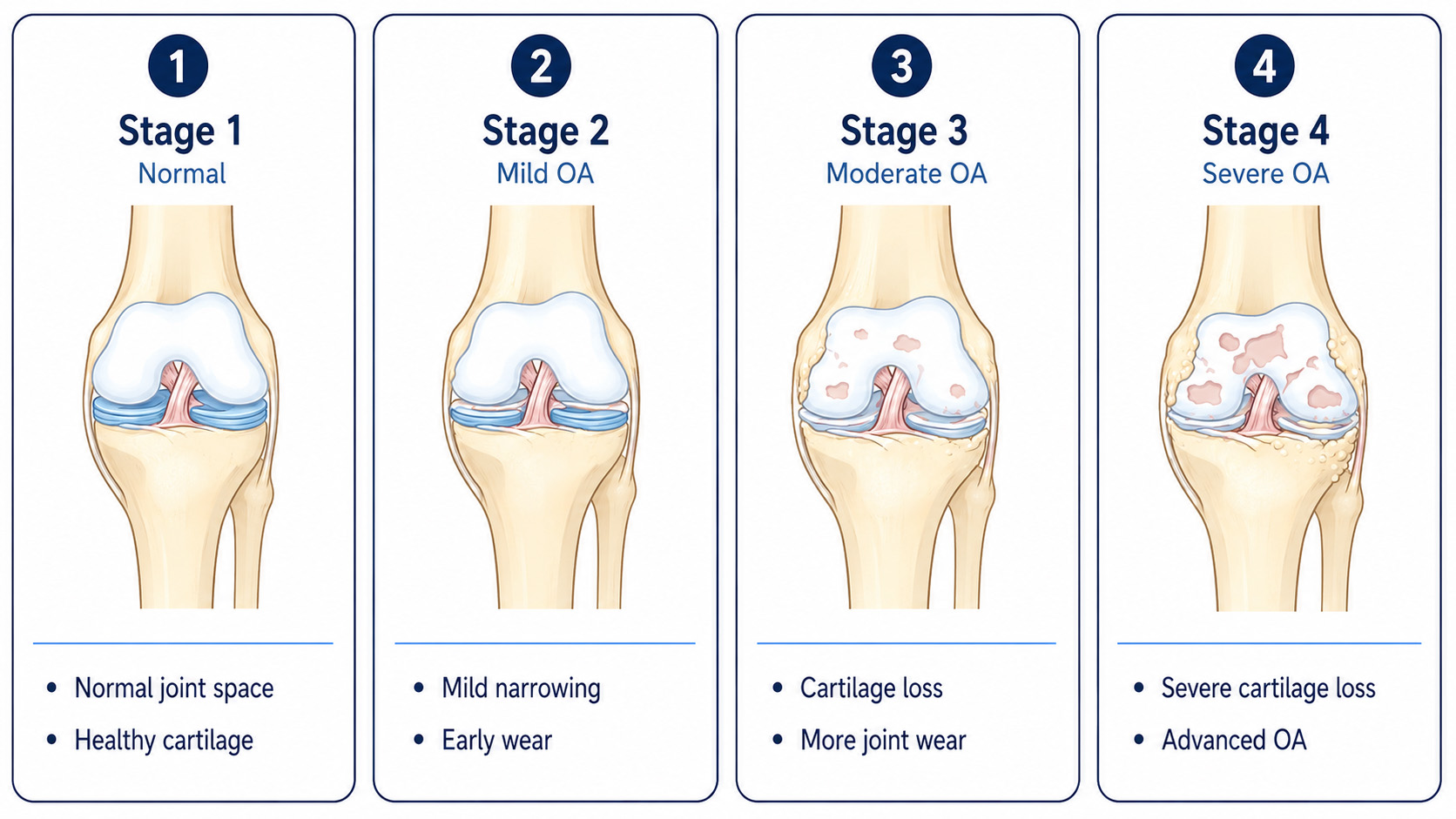
Osteoarthritis is a gradual process rather than a sudden event. It develops over years, as the smooth cartilage covering the ends of the thigh bone and shin bone thins under repeated loading and the synovial lining of the joint becomes intermittently inflamed. Cartilage has no blood supply of its own and is nourished by joint fluid driven through it during movement, which is why it repairs slowly once it is damaged.
In early osteoarthritis, the changes are present but limited. Most of the cartilage remains, the joint still functions well, and symptoms tend to be intermittent rather than constant. On the Kellgren-Lawrence scale, which grades osteoarthritis from zero to four on a weight-bearing X-ray, early disease corresponds to grades one and two, where joint space narrowing is slight and small bony spurs may have formed. This is a different clinical problem from end-stage arthritis, in which cartilage loss is advanced and the joint surface is structurally compromised.
Early Signs of Knee Osteoarthritis Worth Noticing
Early knee osteoarthritis usually produces mild and inconsistent symptoms. These are easily dismissed as normal ageing or ordinary tiredness, but the following patterns are worth noting.
- Stiffness after rest, when the knee feels tight on first standing after sitting or on waking, then eases within minutes of movement.
- Activity-related ache, meaning pain that appears on stairs, squatting, kneeling or long walks, and settles with rest.
- Occasional swelling after demanding activity, which reflects intermittent inflammation of the joint lining.
- A sensation of grinding, clicking or creakiness in the joint.
- A knee that tires more quickly than it used to, or that the patient has begun to favour.
None of these signs is dramatic. Their mildness is precisely why they are so often ignored, and why the early treatment window is so frequently missed.
Who Is More Likely to Develop Early Knee Osteoarthritis?
Knee osteoarthritis is not purely a condition of old age. Several factors can bring it forward by years, and recognising them indicates when closer attention to the knee is warranted.
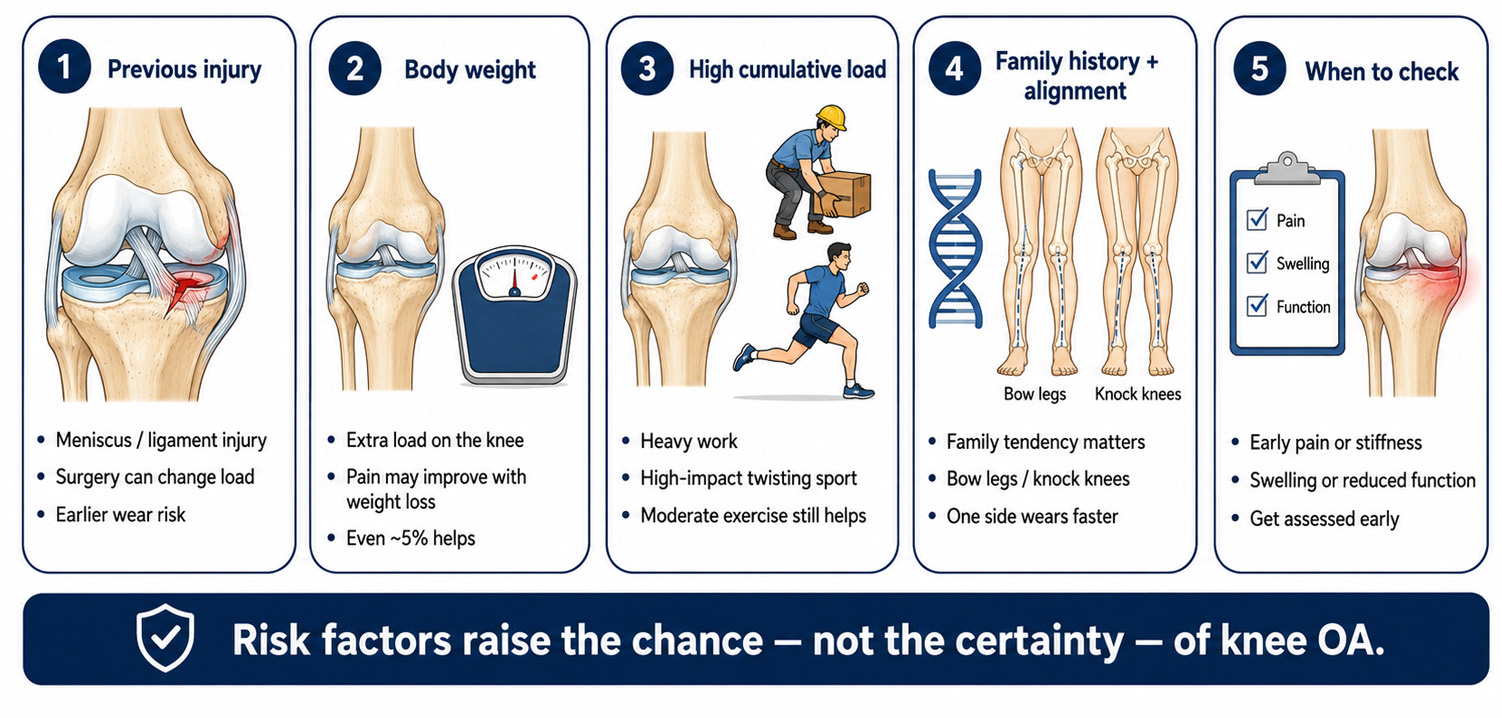
Previous knee injury. A past meniscus tear, ligament injury or knee surgery alters how load is distributed across the joint surface, and is one of the more significant contributors to earlier-onset osteoarthritis. Removal or loss of meniscal tissue matters most, because the meniscus spreads load across the joint surface. Once it is damaged, the same force is carried over a smaller area of cartilage, which raises peak stress with every step.
Body weight. Level walking already transmits roughly three to four times body weight through the knee, so each additional kilogram is multiplied several times over at the joint surface. A weight reduction of around five per cent is enough to produce a measurable fall in pain scores.
High cumulative load. Years of demanding physical work, or high-volume impact and twisting sport, can contribute to earlier cartilage wear in some people. The association is with cumulative exposure rather than with exercise itself, and moderate regular activity protects the joint rather than damaging it.
Family history and individual factors. A family tendency towards osteoarthritis and joint alignment together influence how early symptoms appear. Bow-legged or knock-kneed alignment concentrates load on one side of the joint, so that one compartment wears ahead of the other.
One or more of these factors raises the probability of osteoarthritis without making it inevitable. Early knee symptoms in this group warrant assessment rather than dismissal, and an early review is a reasonable precaution.
Why Timing Matters, the Early Treatment Window
Osteoarthritis is progressive, but its rate of progression is not fixed. It is influenced by load, muscle strength, body weight, activity pattern and the degree of inflammation within the joint.
Acting early means treating a knee that still has cartilage worth protecting and a joint that still functions well. At this stage, the foundational treatments, namely strengthening, weight management and activity adjustment, have the most favourable conditions in which to work. Quadriceps strengthening reduces the load passing through the joint surface by improving how the knee absorbs and controls force, and in well-conducted trials its effect on pain is comparable to that of oral anti-inflammatory medication. A strengthening programme should be given about three months before its effect is judged. Where an injection is appropriate, it is added to a joint that still has the cartilage and muscle to benefit from a calmer, better-supported environment.
Acting late means treating a joint with less remaining cartilage and weaker surrounding muscle. Treatment still has a role, but what it can achieve is limited by what remains of the joint surface. Where most of the cartilage has already been lost, there is no longer a surface for a biological injection to act on, and the realistic aim shifts from protecting the joint to managing symptoms until joint replacement is considered.
How Knee Injections Fit Into Early Treatment
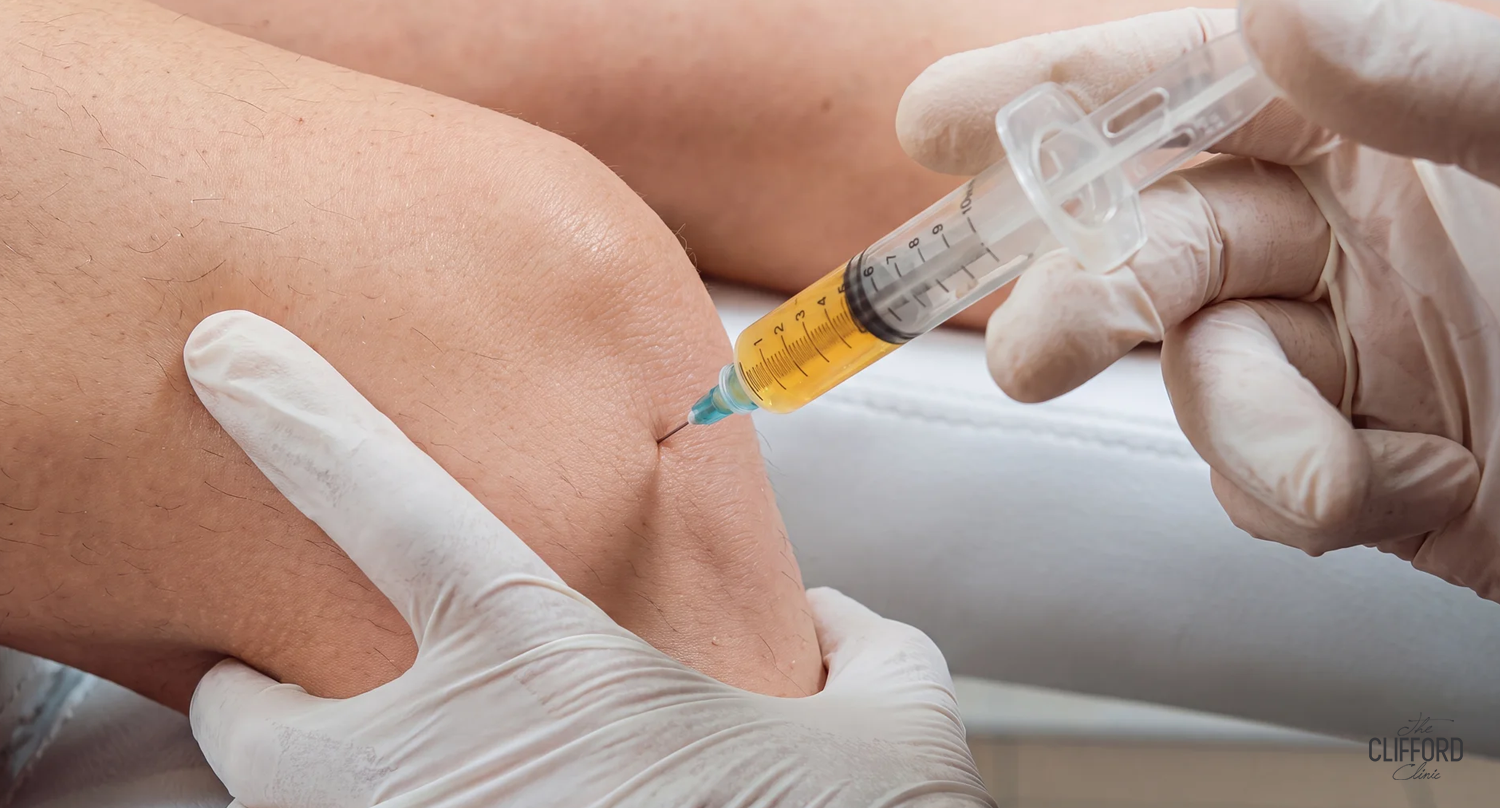
In early osteoarthritis, the foundation is always the same, namely strengthening, weight management and appropriate activity. Injections are not a first-line intervention and do not substitute for that work.
Where they are appropriate, injections have a defined place in early treatment. Platelet-rich plasma (PRP) is prepared by concentrating the patient’s own platelets and injecting them into the joint, where the growth factors they release are intended to dampen inflammation and support the cartilage that remains. It is therefore best suited to earlier-stage wear, because it acts on cartilage that is still present and cannot replace cartilage that has already gone. Benefit usually appears over four to six weeks and lasts six to twelve months, and a course of three injections one to four weeks apart is common. Hyaluronic acid supplements the joint’s own lubricating fluid, which thins and loses its cushioning capacity as osteoarthritis progresses. It is given either as a single injection or as a course of three to five weekly injections depending on the preparation’s molecular weight, with benefit commonly lasting up to six months. Conjuran is a polynucleotide preparation derived from purified salmon DNA, given to improve the fluid environment within the joint and to reduce symptoms in early to moderate cartilage wear. A course is typically three injections one to two weeks apart. Steroid injections have a role in settling an acute flare, acting within one to three days with benefit that lasts four to twelve weeks. Their use is deliberately limited, usually to three or four injections per knee in a year, because repeated steroid exposure has been associated with cartilage loss.
An injection in early disease is used to support a joint that still has cartilage and muscle to work with, and to reduce pain enough that the patient can build the strength that protects the knee in the long term.
The Cost of Waiting for Knee Osteoarthritis Treatment
Patients who delay assessment commonly present with wasting of the thigh muscle, several years of reduced activity, and a joint that has progressed further than it needed to. Thigh muscle is lost quickly once a knee is painful, and that loss itself increases the load the joint surface has to absorb. Treatment can still help, but it is working against muscle loss and joint damage that need not have accumulated.
Early assessment does not commit the patient to more treatment. In most cases it produces a clear diagnosis, reassurance, and a measured plan that may amount to no more than targeted strengthening and periodic review. Early assessment preserves the range of options available, whereas delay progressively removes them.
Expert Opinion, The Clifford Clinic’s View on Acting Early
At The Clifford Clinic, Dr Gerard Ee and the team apply one principle to every knee. Accurate diagnosis comes first. Early knee symptoms are easily mislabelled, because knee pain may arise from the joint surface, the meniscus, the surrounding tendons, or be referred from the hip or the lower back. Establishing that distinction in the first year rather than the fifth allows treatment to be both appropriate and proportionate.
The clinic’s approach is personalised and stepwise. In early osteoarthritis, that often means leading with the foundational work and monitoring, and considering an injection, namely PRP, hyaluronic acid or Conjuran, only where the clinical picture genuinely calls for it. Acting early is valuable because the knee still has cartilage and muscle worth protecting, not because it permits more treatment.
This reflects the clinic’s broader objective of keeping patients active and deferring or avoiding knee replacement where possible.
Frequently Asked Questions
What are the first signs of knee osteoarthritis?
Common early signs include stiffness after rest, activity-related aching with stairs or long walks, occasional swelling, and a sensation of grinding or creaking in the knee. Because they are mild and intermittent, they are commonly attributed to age or tiredness rather than to a joint problem.
Why does early treatment work better?
A knee in early osteoarthritis still has cartilage worth protecting and continues to function well. More of the joint remains responsive to treatment, so foundational measures and, where appropriate, injections can achieve more than they can in advanced disease. The difference is structural, since a biological injection acts on cartilage that is still present and cannot restore cartilage that has already been lost.
Should I get a knee injection as soon as I am diagnosed?
An injection is not usually the first step. In early osteoarthritis, strengthening, weight management and activity adjustment usually come first. Injections are considered after assessment, where pain limits the strengthening work or where symptoms persist despite it.
Can early treatment slow knee osteoarthritis?
Osteoarthritis progresses, but its rate is influenced by load, muscle strength and the level of inflammation in the joint. Early intervention exerts more influence over the rate of progression, although no treatment currently halts it entirely.
I only have occasional knee pain, is it too early to see a doctor?
It is not too early. Occasional, activity-related knee pain is precisely the presentation that warrants assessment. An early review may simply confirm a sensible monitoring and strengthening plan, and it preserves the range of options available.
Related Reading
Other guides in The Clifford Clinic knee injection series.
- Knee Injections Compared, PRP, Hyaluronic Acid, Conjuran and Steroids
- Treating Mild to Moderate Knee Osteoarthritis Without Surgery
- PRP vs Hyaluronic Acid for Knee Osteoarthritis, Which Is Right for You?
- Steroid (Cortisone) Injections for Knee Pain, Benefits, Risks and Timing
- Conjuran Knee Injections, What to Expect
- Hyaluronic Acid Knee Injections (Viscosupplementation), A Patient’s Guide
- PRP Injections for Knee Osteoarthritis, How They Work and Who Benefits
Clinic treatment pages.
Speak to The Clifford Clinic About Your Knee Pain

If you have noticed early signs of knee osteoarthritis, an early assessment establishes the diagnosis while the joint still has the most to gain from treatment.
Knee assessments and injections at The Clifford Clinic are carried out by an experienced medical team that includes sports physicians and orthopaedic surgeons, supported by an MOH-approved day surgery facility for procedures that require it. Knee joint injections may also be claimable through MediSave and insurance. The clinic can advise on your eligibility and coverage at consultation.
The Clifford Clinic 50 Raffles Place, #01-01 Singapore Land Tower, Singapore 048623 (Exit B, Raffles Place MRT) Phone (65) 6532 2400 | WhatsApp (65) 8318 6332.
About Dr Gerard Ee

Dr Gerard Ee is a physician at The Clifford Clinic whose main specialty is dermatology and aesthetic medicine, and who is also trained in orthopaedic surgery, with a substantial peer-reviewed research record in orthopaedics. His published work spans knee research, including studies on total knee arthroplasty and joint line restoration in The Knee and the Journal of Bone and Joint Surgery (British), and a report on meniscal pathology in The Open Orthopaedics Journal, alongside shoulder, spine and bone-healing research in journals such as Knee Surgery, Sports Traumatology, Arthroscopy and Clinical Orthopaedics and Related Research. This research-informed background underpins the careful, individualised approach to knee care at The Clifford Clinic.
Medical Disclaimer
This article is for general education only and is not a substitute for personalised medical advice. The right treatment for knee osteoarthritis can only be determined after an in-person assessment by a qualified doctor. Outcomes vary between individuals.

Author Bio
Dr Gerard Ee

Dr Gerard Ee is the Medical Director of The Clifford Clinic in Singapore. He earned his medical degree from St George's University of London and built his surgical experience across the Singapore General Hospital, National University Hospital, and Mount Sinai Hospital in New York. He holds Membership of the Royal College of Surgeons (Edinburgh) and a Postgraduate Diploma in Dermatology (Cardiff), and is fully accredited in aesthetic procedures including botulinum toxin, fillers, lasers, and light therapies. A strong advocate of minimally invasive, natural-looking results, Dr Ee has published in several medical and scientific journals and presented his research in cities including Taipei, Las Vegas, and London.
See all posts by Dr Gerard Ee »