



Diabetes, Tight Foreskin and Circumcision – What Diabetic Men Should Know
Quick answer
Diabetes is one of the most common reasons a man develops a tight foreskin in adulthood. Elevated blood sugar promotes repeated infection of the head of the penis and foreskin. Each episode of inflammation leaves a little more scarring, which gradually tightens the foreskin opening. Once that scarring is established, creams frequently fail. Circumcision becomes the definitive treatment because it removes the tight, scarred tissue and ends the cycle. Diabetes is not a reason to avoid circumcision. It is a reason to plan it properly, with attention to blood sugar control before and after. Control affects both healing and infection risk. A tight foreskin is a recognised medical indication. MediSave and insurance can apply. For the complete overview, see our Circumcision Singapore guide.
Why diabetes causes foreskin problems
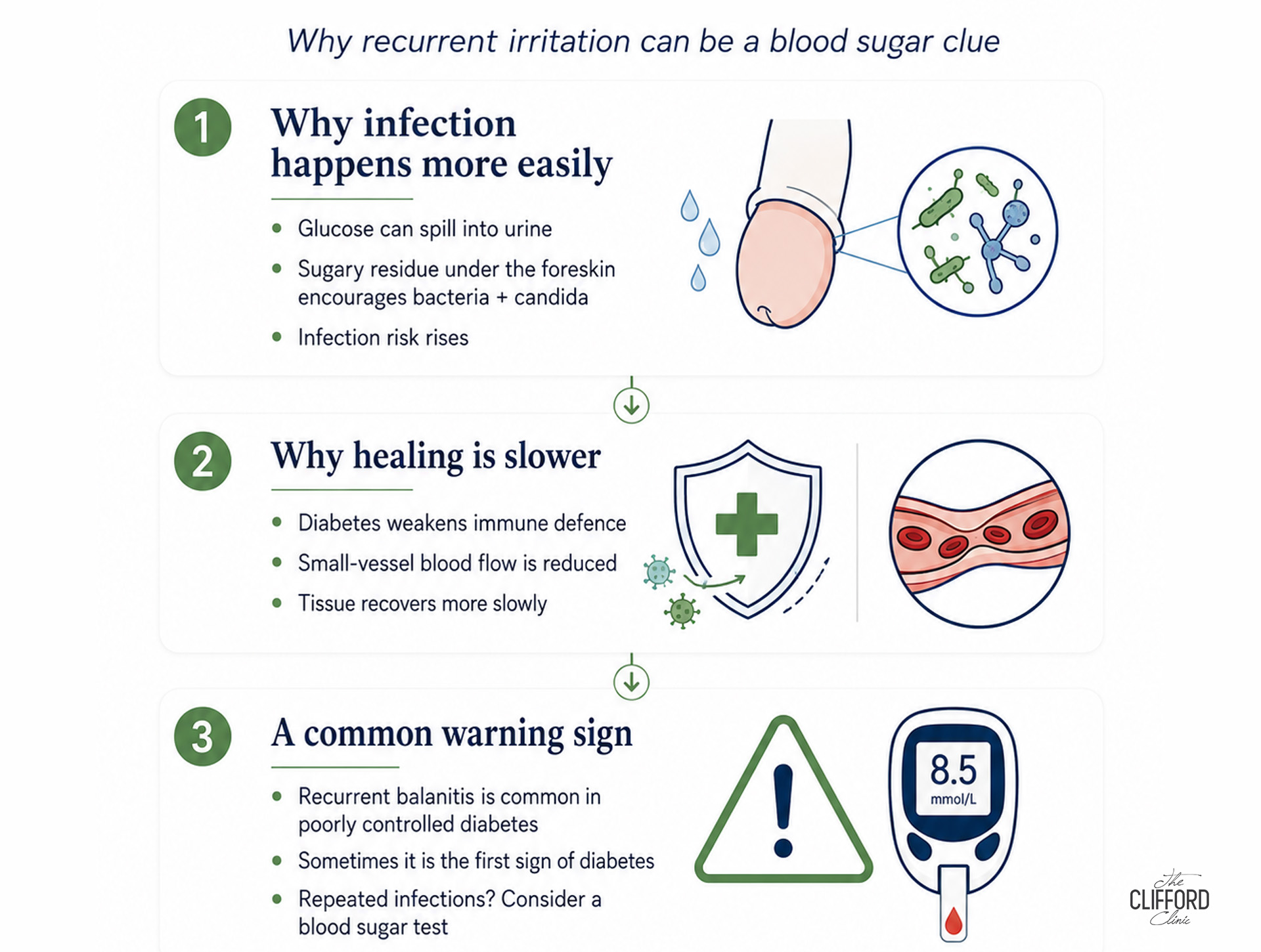
Elevated glucose appears in the urine, and small residues of sugary urine under the foreskin create an environment where bacteria and yeast, particularly candida, thrive. Diabetes also impairs the immune response and reduces small vessel blood flow. The tissue is both more likely to become infected and slower to recover once it does.
Men with poorly controlled diabetes get inflammation of the head of the penis, called balanitis, more often and more severely than other men. It is one of the commonest presentations of foreskin trouble in Singapore.
This can be the first sign. A number of men are diagnosed with diabetes after presenting with recurrent balanitis, having had no idea their blood sugar was raised. If you have had repeated foreskin infections and have never been tested, that test is worth doing.
The infection and scarring cycle
An episode of inflammation occurs. It is treated and settles, but healing leaves a small amount of fibrous scar tissue at the foreskin tip. The tip is now marginally less elastic, which makes retraction and cleaning slightly harder. Harder cleaning means more residue, which increases the risk of the next infection. The next infection results in more scarring.
Over months and years, the foreskin opening narrows into a firm ring that will not retract. At that point the problem is no longer an infection to be treated but an anatomical change to be corrected. This is what doctors mean by pathological phimosis, and it does not reverse on its own.
The practical lesson is timing. Men who come early, before repeated infections and forceful retraction have caused significant scarring, have more options available to them. Men who come after years of the cycle usually need surgery.
Recurrent balanitis and what it means
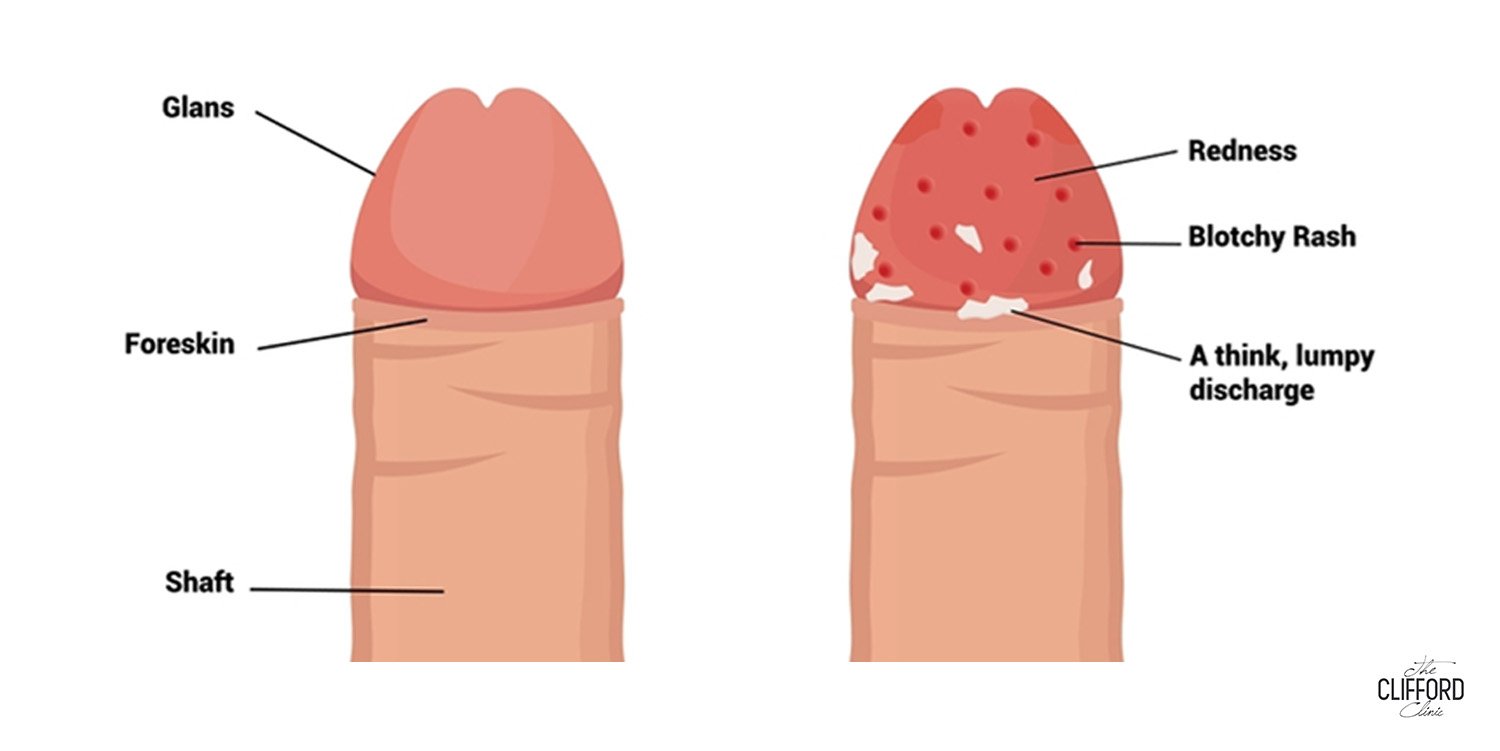
Balanitis is inflammation of the head of the penis, and balanoposthitis involves the foreskin as well. It presents as redness, soreness, itch, swelling, an unpleasant discharge, and sometimes discomfort passing urine.
A single episode is not alarming and is usually treated with attention to hygiene, a topical antifungal or antibacterial cream, and management of any underlying cause. What matters is the pattern rather than the episode.
If you are having repeated episodes, three questions need answering. Is the blood sugar controlled? Is there now scarring or tightening that makes recurrence inevitable? And is the treatment being aimed at the cause or only the symptom? Treating episode after episode without addressing a tightened foreskin is a cycle that repeats indefinitely. Our guide to balanitis and recurrent foreskin infections covers the condition in detail.
When circumcision is the right treatment
Circumcision should be considered for the following:
- When the foreskin has become genuinely tight and will not retract, and this is causing symptoms.
- When infections keep returning despite reasonable hygiene and adequate treatment of each episode.
- When there is visible scarring at the foreskin tip, particularly the firm, pale ring that suggests a scarring skin condition.
- When there has been an episode of paraphimosis, where a retracted foreskin becomes trapped behind the head.
- When hygiene is genuinely difficult to maintain, which for some men with reduced dexterity or vision is a practical reality rather than a matter of effort.
Circumcision works in the above cases because it removes the scarred tissue entirely. There is no tight ring left to trap moisture, no scarred segment to reinfect, and hygiene becomes markedly simpler. Recurrence of phimosis after circumcision is uncommon.
Why creams often fail in diabetic men
Topical steroid cream is the standard first-line treatment for a tight foreskin.The evidence supports it. A Cochrane review found that topical corticosteroids applied to the tight foreskin for four to eight weeks, with gentle retraction, improve the chance of complete or partial resolution compared with no treatment, with side effects rare and similar to placebo.
But the results depend heavily on the skin’s appearance. A 2026 multicentre study of 235 boys using a twice-daily steroid for eight weeks reported around 68 percent success overall, and the factor that predicted failure was altered foreskin skin. Success was around 72 percent when the skin looked healthy, and fell to roughly 29 percent when it appeared scarred or abnormal.
That is exactly the problem in long-standing diabetic phimosis, where the skin is scarred rather than merely tight. Cream in that setting has a low chance of working. The doctor will tell you when your foreskin looks like one that will not respond.
Planning surgery safely with diabetes
Diabetes changes the pre-surgery preparation, and there are four practical elements.
Firstly, Blood sugar control is assessed. It is the single biggest modifiable factor in how well you heal. Where control is poor, it is often worth improving it before an elective procedure rather than proceeding regardless.
Secondly, active infections are treated before the circumcision is performed. A course of antibiotics to settle the acute episode usually precedes surgery.
Medications are reviewed. Many diabetic men also take blood thinners or have cardiovascular disease. Anything affecting bleeding must be disclosed and planned in consultation with the prescribing doctor. Never stop a blood thinner on your own.
Technique is matched to the tissue. Where the foreskin is thickened or scarred, the surgeon selects the method that handles that anatomy best. Conventional surgery has the advantage that the removed tissue can be sent for laboratory testing where a scarring skin condition is suspected. Our techniques guide compares the options.
Healing and aftercare for diabetic men
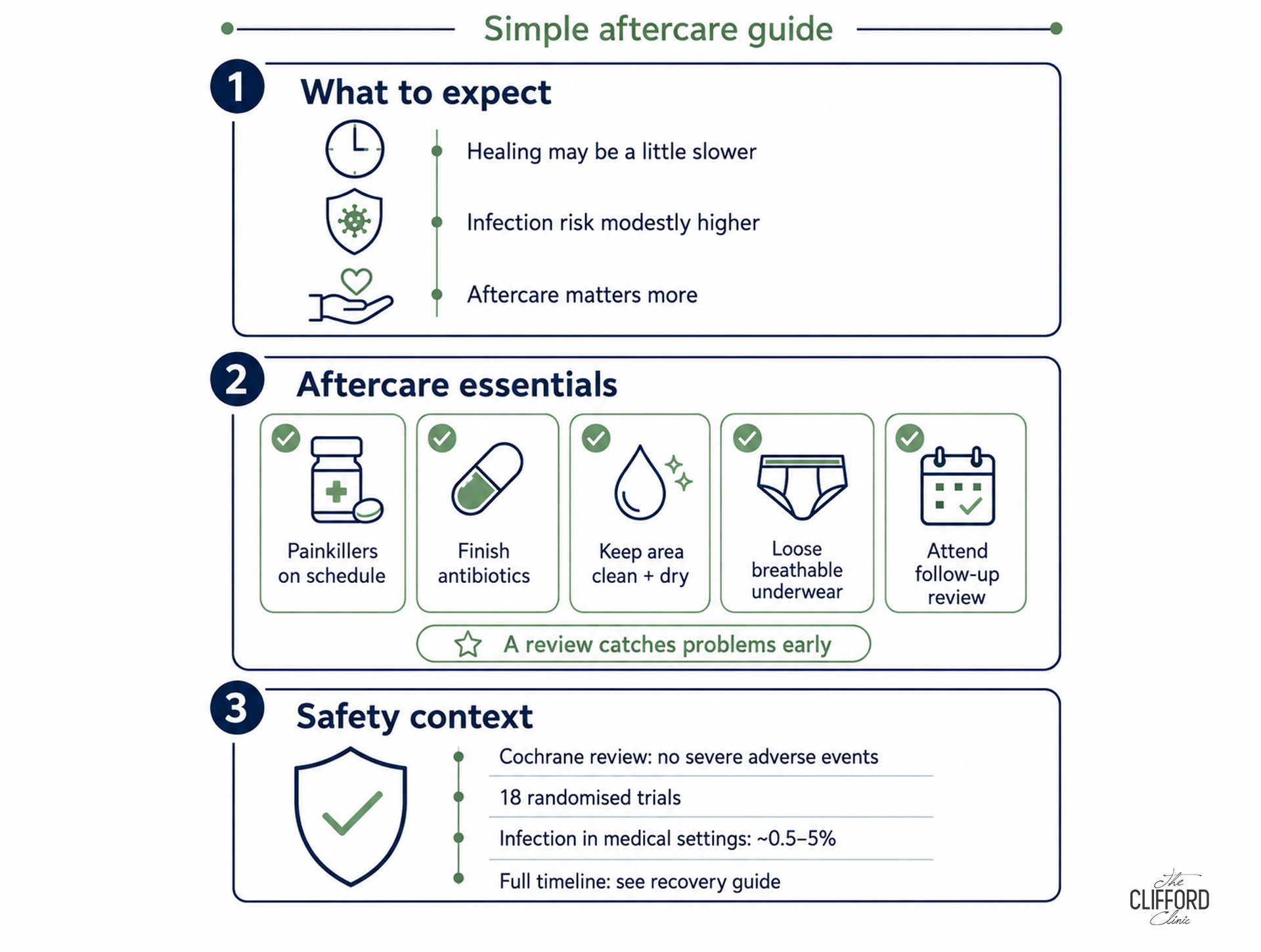
Healing is generally straightforward. It can be somewhat slower than in a non-diabetic man, and infection risk is modestly higher.
The aftercare is the same in structure but matters more in practice. Take prescribed painkillers on schedule. Complete the prescribed antibiotic course. Keep the area clean and dry exactly as instructed. Wear loose, breathable underwear. Attend the follow up appointment even if everything feels fine. A review catches a problem early.
For context on the general safety of the procedure, a Cochrane review of 18 randomised trials reported no severe adverse events with either device-based or conventional techniques. Infection rates in proper medical settings generally range from about 0.5 to 5 percent. Our recovery guide sets out the full timeline.
Blood sugar control before and after
If there is one thing within your control that changes your outcome, this is it.
Good glycaemic control supports wound healing and lowers infection risk, both before the procedure and through the healing weeks that follow. Practically that means continuing your usual diabetes medication as prescribed, keeping to your monitoring routine, and telling the clinic if your control has been poor recently rather than hoping it will not matter.
It also means continuing to manage your diabetes after the wound has healed. Circumcision removes the tight foreskin and ends that particular cycle. It does not treat the diabetes.
Warning signs to act on
Contact the clinic promptly if you notice persistent or heavy bleeding, a smelly discharge or pus from the wound, fever, pain that painkillers do not control, rapidly increasing swelling, or difficulty passing urine.
Separately, if the foreskin ever retracts and then cannot be brought forward, and the head begins to swell, that is paraphimosis and it needs urgent attention the same day rather than a routine appointment. Our guide to paraphimosis explains why.
A note from the clinic
“Diabetic men often arrive apologetic, expecting to be told they are too high risk. That is rarely the conversation. More often the foreskin is the thing making their diabetes harder to live with, and removing it stops the infections that keep bringing them back. What I do want is honest information about blood sugar control and medication, because that is what lets me plan it properly.”
Frequently asked questions
Can diabetes cause a tight foreskin?
Yes. Poorly controlled diabetes raises the risk of recurrent inflammation of the head of the penis, and repeated episodes cause scarring that tightens the foreskin over time.
Can I have a circumcision if I am diabetic?
Usually yes. Diabetes is a reason to plan the procedure carefully with attention to blood sugar control, not a reason to avoid it.
Will circumcision stop my recurrent foreskin infections?
It commonly does, because it removes the tight, scarred tissue that traps moisture and harbours infection, and it makes hygiene considerably simpler.
Will my wound heal more slowly?
It can be somewhat slower where blood sugar control is poor, since elevated glucose impairs healing and raises infection risk. Good control before and after helps.
Should I try steroid cream first?
It depends on how the skin looks. Cream succeeds around 72 percent of the time when the foreskin looks healthy but only around 29 percent when it appears scarred. Long-standing diabetic phimosis is usually in the second group.
Do I need to stop my diabetes medication before surgery?
Do not stop any medication on your own. Bring a full list to the consultation and the plan will be made with your prescribing doctor where needed.
I am on blood thinners as well, is that a problem?
It must be disclosed and planned, but it is manageable. The decision on any adjustment belongs to the doctor who prescribed the blood thinner.
Can I claim MediSave?
A tight foreskin and recurrent foreskin infections are recognised medical indications, so MediSave can generally be applied within the set limits. Confirm the current limits at your consultation.
Could my foreskin infections mean I have undiagnosed diabetes?
They can be the first sign. If you have had repeated episodes and have never been tested, a blood sugar test is worth doing.
How soon can I go back to work?
Around five to seven days of medical leave is typical, with desk-based work often resumable sooner, guided by how you are healing.
Book an assessment

If repeated foreskin infections or a tightening foreskin are affecting you, an assessment settles what is going on. The doctor examines the area, considers your diabetes control and medications, and gives you a recommendation on whether cream or surgery is the sensible next step.
Book a consultation at The Clifford Surgery
Related guides
- Circumcision Singapore, the complete guide
- Phimosis and tight foreskin
- Balanitis and recurrent foreskin infections
- Circumcision at 40, 50 and beyond
- Adult circumcision in Singapore
- MediSave, insurance and Baby Bonus
Medical review box

This article is written by Dr Law Zhi Wei of The Clifford Surgery. Dr Law is a Singapore-trained doctor with more than five years of surgical posting experience. He graduated from the National University of Singapore with an MBBS and holds Membership of the Royal College of Surgeons of Edinburgh, a Graduate Diploma in Family Medicine, and a Postgraduate Diploma in Practical Dermatology from Cardiff University. He trained in the Urology Department at Singapore General Hospital, where he performed hundreds of circumcisions, and completed rotations in urology, general surgery, and paediatric surgery at KK Women’s and Children’s Hospital, Sengkang General Hospital, and Changi General Hospital. He has personally performed more than 500 circumcisions across the conventional, laser-assisted, Shang Ring, and ZSR Stapler techniques, supported by the dedicated Urology Department led by Dr Nathaniel Heah. The Clifford Surgery operates a sterile surgical theatre as a Ministry of Health-accredited Day Surgery Centre. This content is general information and not a substitute for a personal consultation.
Dr Law Zhi Wei profile, https://cliffordclinic.com/dr-law-zhi-wei/
Clinical research and publications, https://cliffordclinic.com/clinical-research/
References
- National University Hospital, Services for Circumcision. https://www.nuh.com.sg/care-at-nuh/services/department-of-urology/services-for-circumcision
- European Association of Urology, Guidelines on Paediatric Urology, phimosis section. https://uroweb.org/guidelines/paediatric-urology
Medical evidence references
- Moreno G, Corbalan J, Penaloza B, Pantoja T. Topical Corticosteroids for Treating Phimosis in Boys. The Cochrane Database of Systematic Reviews. 2024. https://www.cochranelibrary.com/cdsr/doi/10.1002/14651858.CD008973.pub3/full
- Campos JM, et al. Topical Steroids Are Effective Even in Severe Phimosis, Evidence From a Multicenter Cohort. Journal of Pediatric Surgery. 2026. https://www.jpedsurg.org/article/S0022-3468(26)00176-4/abstract
- Hohlfeld A, Ebrahim S, Shaik MZ, Kredo T. Circumcision Devices Versus Standard Surgical Techniques in Adolescent and Adult Male Circumcisions. The Cochrane Database of Systematic Reviews. 2021. https://www.cochranelibrary.com/cdsr/doi/10.1002/14651858.CD012250.pub2/full
- Friedman B, Khoury J, Petersiel N, et al. Pros and Cons of Circumcision, An Evidence-Based Overview. Clinical Microbiology and Infection. 2016. https://pubmed.ncbi.nlm.nih.gov/27497811
- Nabavizadeh B, Li KD, Hakam N, et al. Incidence of Circumcision Among Insured Adults in the United States. PLoS One. 2022. https://pubmed.ncbi.nlm.nih.gov/36251658

Author Bio
Dr Gerard Ee

Dr Gerard Ee is the Medical Director of The Clifford Clinic in Singapore. He earned his medical degree from St George's University of London and built his surgical experience across the Singapore General Hospital, National University Hospital, and Mount Sinai Hospital in New York. He holds Membership of the Royal College of Surgeons (Edinburgh) and a Postgraduate Diploma in Dermatology (Cardiff), and is fully accredited in aesthetic procedures including botulinum toxin, fillers, lasers, and light therapies. A strong advocate of minimally invasive, natural-looking results, Dr Ee has published in several medical and scientific journals and presented his research in cities including Taipei, Las Vegas, and London.
See all posts by Dr Gerard Ee »