


Breast Implant Removal, Replacement and Revision in Singapore
Breast implants are not lifetime devices, and a proportion of patients will eventually consider further surgery, whether their operation was last year or twenty years ago. That surgery may exchange the implants, adjust their position, treat capsular contracture, or remove the implants altogether. None of this means the original surgery failed. Implants are manufactured devices with a finite service life, the breast tissue around them continues to age and change shape, and a patient’s own preferences shift across two decades of adult life. This guide explains why revision arises, how the underlying problem is diagnosed before any operation is planned, and what each surgical option involves, as part of our full resource on breast augmentation with implants in Singapore.
Why breast implants are removed or replaced
- The implant shell fails. With saline implants the failure is obvious, because the salt-water filling is absorbed by the body within days and the breast visibly deflates. With silicone implants the gel holds its shape even when the shell has split, so rupture is frequently silent and is detected on imaging rather than by symptoms.
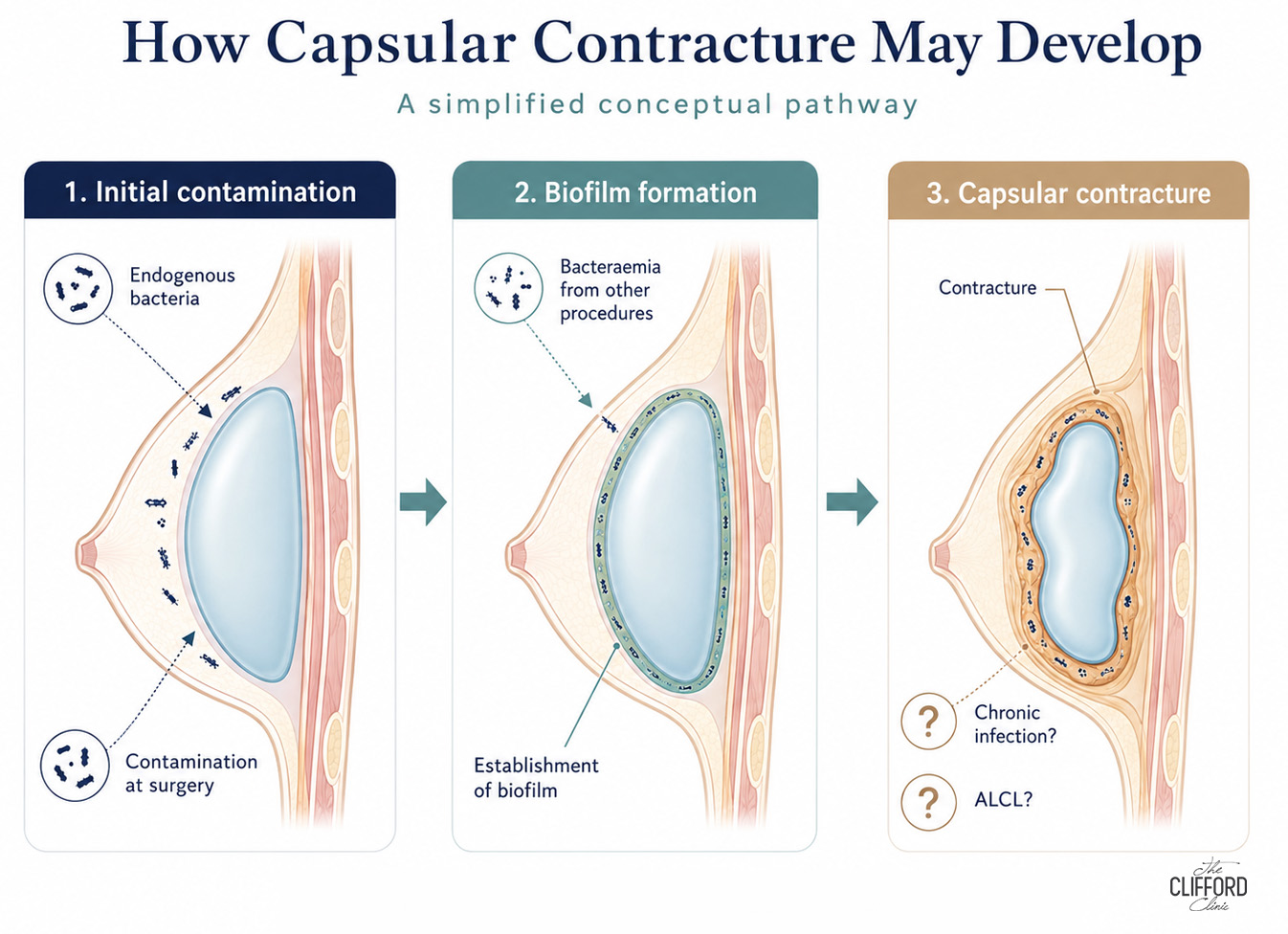
- Capsular contracture.The body forms a scar capsule around every implant. Where that capsule thickens and tightens, it squeezes the implant into a firmer and rounder shape, which patients notice as hardness, visible distortion or discomfort.
- The implant sits outside its intended position, having settled too low (“bottoming out”), too far apart, too close together, or, in the case of shaped implants, rotated within the pocket so the contoured surface no longer faces forwards.
- Rippling or visibility.The folds in the implant shell become visible or palpable through the skin. This occurs where the overlying tissue is thin, most often in slim patients and in implants placed above the muscle, and it can develop years later as breast tissue thins with age or weight loss.
- Size or style change.Preferences change with age, body composition and life stage, and a size chosen in a patient’s twenties is not necessarily the size she wants in her forties.
- Symptoms or concern.Some patients attribute systemic symptoms such as fatigue or joint pain to their implants, and others request removal after reading safety coverage in the media. Both are legitimate reasons to seek assessment.
- Age of implants.Implant age is not by itself a reason to operate, and there is no automatic ten-year replacement rule, but the cumulative chance of the problems above rises the longer an implant has been in place. Dr Naidu is direct about the ten-year myth. “There is no fixed replacement date that applies to every patient. If a patient’s implants are 12 years old but remain soft, comfortable and aesthetically satisfactory, I would not recommend surgery purely because of their age. I would first review the implant records, examine the breasts and make sure the patient has undergone the appropriate surveillance. Silicone rupture can be silent, which is why imaging matters even when everything looks normal. The important question is not ‘how old are they?’ but whether the implants are intact, whether the surrounding tissues are healthy, and whether the patient is still happy with the result. If the examination and imaging are reassuring, it is reasonable to continue monitoring rather than expose the patient to an unnecessary operation.”
How implant problems are assessed before surgery
Assessment begins with the history and clinical examination, together with the implant’s identity, meaning its brand, model and serial number as recorded on the implant card, which patients should bring to the consultation. For Motiva implants fitted with the Qid microtransponder, a handheld reader can retrieve the implant’s identification directly from the device even when the paperwork has been lost. Imaging follows as indicated. Ultrasound or MRI is used where rupture is suspected, and MRI is the most accurate test for silicone rupture because it distinguishes silicone from surrounding tissue on signal characteristics rather than on shape alone. Any lump, swelling or fluid collection is investigated with standard breast imaging. A late seroma, meaning fluid appearing around an implant a year or more after surgery, is investigated specifically because of the BIA-ALCL association covered in our safety guide. Only once the diagnosis is established does the surgical conversation make sense, because the operation is selected to treat a known problem rather than to explore an unknown one.
The surgical options for implant revision
Implant exchange. The existing implants are removed and replaced, either with the same size, a different size, or a different implant style, and the procedure is frequently combined with adjustment of the pocket that holds the implant. This is the most common revision operation.
Capsulectomy and capsule surgery. The scar capsule is removed in part (partial capsulectomy) or in full (total capsulectomy), or it is simply opened to release the tightening (capsulotomy). Symptomatic contracture is commonly treated by capsulectomy combined with implant exchange. Total capsulectomy is not automatically required in every case, and the extent of capsule surgery should match the clinical problem, because removing a healthy capsule means dissecting against the chest wall and adds bleeding and injury risk without a corresponding benefit. En bloc removal, in which the implant and the capsule are taken out as a single unsealed unit, is a specific technique with specific indications, most clearly where a capsule-associated cancer is confirmed or suspected. It is not a routine upgrade to request by default.
Removal without replacement (explant). The implants are removed and, where indicated, the capsule with them. The appearance afterwards depends on how much natural breast tissue remains, on the quality and elasticity of the skin, and on the size of the implant being removed, because a large implant in place for many years stretches the skin envelope further than a small recent one. Some patients are satisfied with removal alone, others combine it with a lift, and others use fat grafting to restore a degree of volume. An honest preview of the likely appearance is a core part of the explant consultation.
Pocket correction. Malposition is treated by repairing and reshaping the pocket that holds the implant, which includes internal suture techniques that reinforce the pocket boundary, and sometimes by changing the plane the implant sits in. Converting a subglandular implant to a dual-plane position, for example, recruits the chest muscle to cover the upper edge of the implant and so reduces visible rippling, as discussed in placement, incisions and scars.
Combined procedures. Revision is frequently paired with mastopexy, a breast lift, where the skin envelope has stretched and the breast has developed droop that exchanging the implant alone would not correct. How these operations differ is set out in our comparison of implants vs fat transfer vs lift.
Signs of an implant problem worth a review
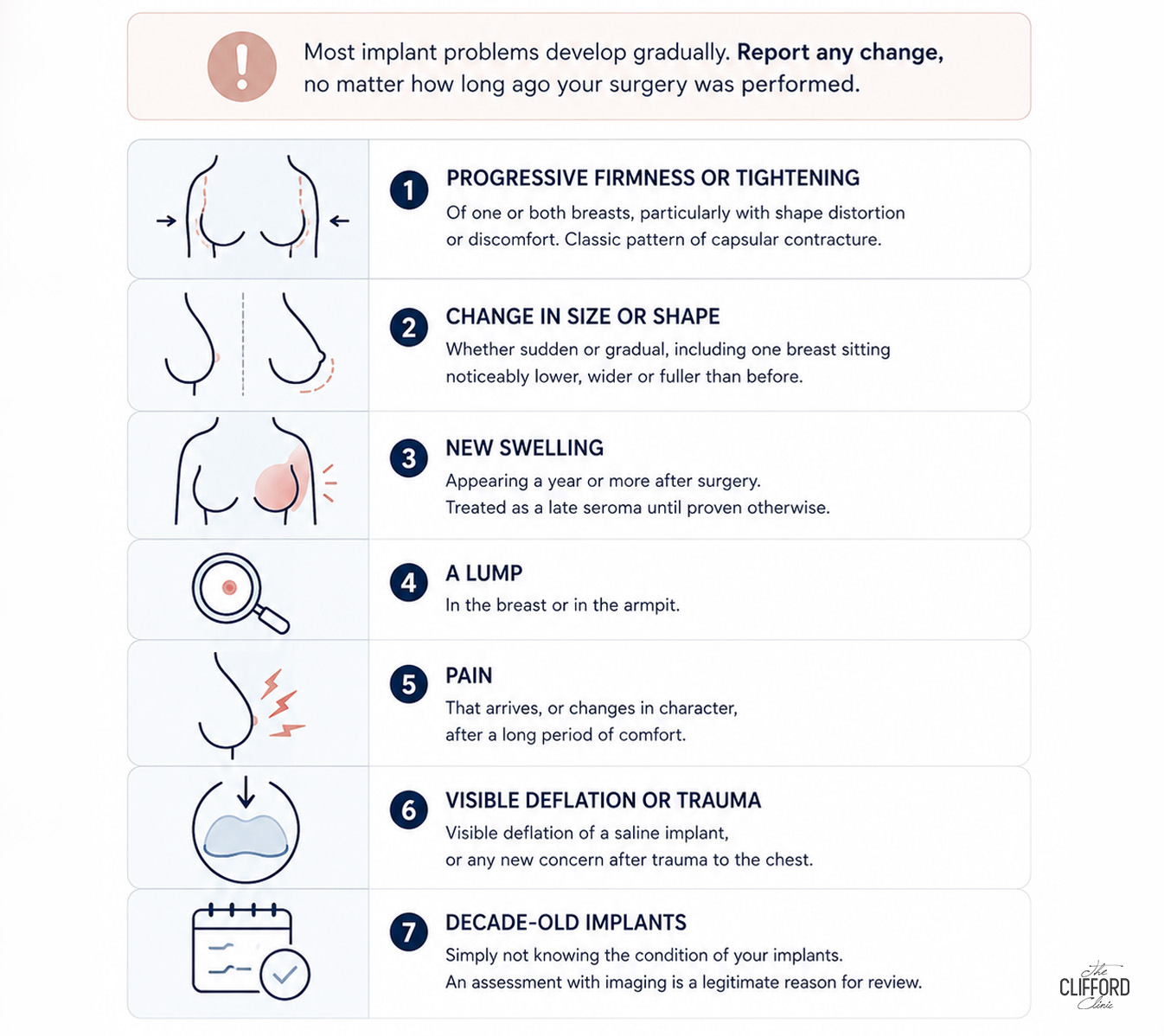
Most implant problems announce themselves gradually rather than suddenly, which is why a change that develops over months is still worth reporting. A review is warranted, regardless of how long ago the surgery was performed or which clinic performed it, where any of the following is noticed.
- Progressive firmness or tighteningof one or both breasts, particularly where it is accompanied by distortion of the shape or by discomfort, which is the classic pattern of capsular contracture.
- A change in size or shape, whether sudden or gradual, including one breast sitting noticeably lower, wider or fuller than it did before.
- New swelling appearing a year or more after surgery, which is treated as a late seroma until proven otherwise and investigated accordingly.
- A lumpin the breast or in the armpit.
- Pain that arrives, or changes in character, after a long period of comfort.
- Visible deflation of a saline implant, or any new concern following trauma to the chest.
- Simply not knowing the condition of decade-old implants. An assessment with imaging is a legitimate reason for review in its own right.
None of these symptoms amounts to a diagnosis on its own. Each is a reason to look. The earlier a problem is characterised, the wider the range of surgical options that remain available, because an early contracture can often be managed with capsulotomy and exchange where a long-standing one may require full capsulectomy.
How revision surgery differs from first-time augmentation
Revision operates on changed terrain. A capsule already exists, the tissue may have thinned or stretched, and the previous pocket dictates the starting geometry of the new one. In practical terms this produces longer and more variable operating times, a greater reliance on pre-operative imaging, and more decisions taken during the operation itself, occasionally including staged surgery where an infected or severely contracted pocket must be allowed to settle before a new implant is inserted. It also means that surgeon selection matters more than it did the first time, so ask specifically about revision experience rather than about augmentation experience in general. Clifford assesses external revision cases individually and acceptance follows the consultation. Every available record matters here, including the implant card, the operation notes and any prior imaging, because knowing which device is already in place changes the plan.
What to expect from breast implant revision surgery
Revision is generally more individual than first-time augmentation. Scar tissue, thinned coverage and previous pocket work make the planning case-specific, and operating times and costs vary accordingly (cost guide). At Clifford, revision is quoted individually after assessment. Where rupture or capsular contracture qualifies under the Motiva warranty, which the clinic registers on the patient’s behalf at the time of the original surgery, manufacturer support may reduce the cost of the replacement implants. Recovery resembles that of primary augmentation, adjusted for the work actually done. Where the surgery followed a rupture or a contracture, imaging and follow-up recommence on the new implants, since the surveillance clock restarts with the device rather than with the patient.

A framework for deciding on explant without replacement
Choosing to remove implants without replacing them is increasingly common and entirely legitimate, and it deserves the same rigour as the original decision to augment. Four questions structure it well. The first is why now. A diagnosed problem such as rupture or contracture, attributed systemic symptoms, changed aesthetic preferences, or simply wanting the implants out are all valid reasons, but each predicts a different pattern of satisfaction. Patients who remove implants for a diagnosed problem are the most reliably pleased, whereas patients hoping that explant will resolve systemic symptoms deserve honest counselling that improvement is possible but cannot be promised. The second is what will remain. Tissue that has spent years stretched over an implant behaves differently once the implant is gone, and while some breasts recoil impressively, others are left deflated or lax. Age, implant size, the duration of the implant and skin quality drive that difference, and the surgeon should be able to show comparable outcomes. The third concerns the capsule, where the principle set out above applies, namely that capsule surgery is matched to the pathology rather than performed maximally by default. The fourth is whether a second step is likely, since a lift or fat grafting can be performed at the same time or staged, and knowing the appetite for further surgery before the explant shapes how the first operation is planned. Explant undertaken with this clarity is among the most satisfying operations in revision practice, whereas explant undertaken as a rushed reaction tends to trade one set of regrets for another.
Preparing for a breast implant revision consultation
Revision consultations are only as good as the information they run on. Five items are worth assembling in advance. The first is the implant card, which records the brand, model and serial numbers. The second is the operation notes from the original surgery where these can be obtained, and the original clinic should release them on request. The third is any prior imaging with the accompanying reports, including any ultrasound or MRI of the implants. The fourth is a timeline of the problem, covering when it started and how it has changed, with photographs if the appearance has shifted. The fifth is a plain statement of the goal, whether that is to keep the existing implants after repair, to exchange them, to downsize, or to remove them entirely. Where records cannot be obtained, because clinics close and files are lost, say so early. Imaging can characterise the implant, devices fitted with an identification microtransponder can be read directly, and the surgical plan can accommodate unknowns, but the surgeon has to know which facts are unknown. Expect the consultation to include examination and usually fresh imaging before any firm surgical recommendation is made, because a revision plan offered without either is a plan built on guesswork.
Frequently asked questions
Does every implant need replacement at ten years?
No. Replacement is undertaken for a reason, whether that is rupture, contracture, malposition, symptoms or a change of preference, and not on an anniversary. Implants are not lifetime devices, however, so follow-up continues for as long as they remain in place.
What happens if a ruptured implant is left alone?
Saline deflation is largely a cosmetic issue, because the salt-water filling is harmlessly absorbed. Silicone rupture is different, and removal or exchange is generally advised after proper assessment even where the gel remains contained within the capsule, since a contained rupture can progress to an extracapsular one that is harder to clear. This is a decision to make with a surgeon on the basis of real imaging rather than one to postpone indefinitely.
Will my breasts look deflated after explant without replacement?
The result depends on the natural breast tissue, the elasticity of the skin, and the size and duration of the implant. Some patients are satisfied without further surgery, whereas others choose a lift or fat grafting. Ask to discuss realistic outcomes, including photographs of comparable cases. Clifford operates a strict photo-consent policy, under which no patient photographs are shown or displayed, publicly or privately, without the patient’s explicit consent, so any comparable-case photographs shown to you are shared with permission.
Is total capsulectomy always necessary?
No. Capsule surgery should match the problem. Diseased or symptomatic capsules are removed, whereas routine total capsulectomy of a healthy capsule adds surgical risk without established benefit. Discuss the reasoning that applies to your own case.
Can Clifford revise implants placed at another clinic?
Cases from other clinics are considered individually. The consultation should be supported by the implant card, the operation notes and any prior imaging.
How long is recovery after revision surgery?
Recovery is broadly similar to that of primary augmentation, with a staged return to normal activity over four to six weeks, adjusted for the work actually done. A simple exchange can be gentler than the original surgery, whereas capsulectomy combined with pocket repair can be more involved.
Will insurance or the implant warranty cover my revision?
Cosmetic revision is generally self-funded, but manufacturer warranties matter here. Qualifying rupture or capsular contracture may entitle a patient to replacement implants and, under some programmes, to a financial contribution. Registration and documentation from the original surgery are what unlock this, which is a further argument for implant traceability. Clifford registers Motiva warranties on the patient’s behalf at the time of surgery and assists with the documentation if a claim is ever needed.
Can I go smaller at revision?
Yes. Downsizing is a common and legitimate revision goal, and it is sometimes combined with a lift where the skin envelope has stretched around the larger implant.
Is it safe to leave old but symptom-free implants alone?
Age alone is not an indication for surgery, but it is an indication for surveillance, meaning examination and imaging in line with current guidance, continued for as long as the implants are in place. Leaving implants alone should mean monitoring them, never forgetting them.

Medically reviewed by Dr Gerard Ee. Surgery described on this page is performed by Dr Shenthilkumar Naidu, MBBS (NUS), FRCS (Edin), MOH-accredited Consultant Plastic Surgeon, who has performed more than 500 breast augmentation procedures over more than two decades of plastic-surgery practice.
Selected references. U.S. FDA, Breast Implants (not lifetime devices). ACR Appropriateness Criteria, Breast Implant Evaluation, Journal of the American College of Radiology (2023). Motiva warranty programme information.
Explore the full breast implant series
Considering breast augmentation? Visit the main Breast implants at The Clifford Clinic service page to book a consultation, or continue with the rest of this series.
Breast Augmentation With Implants in Singapore — the complete guide
· Breast Implant Cost in Singapore
· Motiva Breast Implants in Singapore
· Breast Implant Size and Profile
· Breast Implant Placement, Incisions and Scars
· Breast Augmentation Recovery Timeline
· Breast Implant Safety and Monitoring
· Breast Implants vs Fat Transfer vs Breast Lift
· Breast Implants, Pregnancy, Breastfeeding and Mammograms.

Author Bio
Dr Gerard Ee

Dr Gerard Ee is the Medical Director of The Clifford Clinic in Singapore. He earned his medical degree from St George's University of London and built his surgical experience across the Singapore General Hospital, National University Hospital, and Mount Sinai Hospital in New York. He holds Membership of the Royal College of Surgeons (Edinburgh) and a Postgraduate Diploma in Dermatology (Cardiff), and is fully accredited in aesthetic procedures including botulinum toxin, fillers, lasers, and light therapies. A strong advocate of minimally invasive, natural-looking results, Dr Ee has published in several medical and scientific journals and presented his research in cities including Taipei, Las Vegas, and London.
See all posts by Dr Gerard Ee »