
Botox for Gastrocnemius and Calf Muscle Tightness
Quick answer. Botulinum toxin type A injected into the gastrocnemius may relax a persistently tight, overactive calf. This can ease tightness and recurrent cramps and reduce the resulting load on the Achilles tendon and forefoot. Direct evidence outside spasticity is very limited, so treatment is reserved for carefully selected cases that have not improved with standard care.
Medically reviewed by Dr Gerard Ee of The Clifford Clinic, Singapore. Last updated July 2026.
A persistently tight calf can cause more than local discomfort. The gastrocnemius works during every step, and when it cannot relax, it restricts upward movement at the ankle. The Achilles tendon, heel and forefoot then take more of the load. Tight calves are associated with recurring cramps and strains, Achilles problems and plantar heel pain. Botulinum toxin may be considered when stretching, footwear changes and physiotherapy have not reduced the overactivity.
What gastrocnemius tightness is
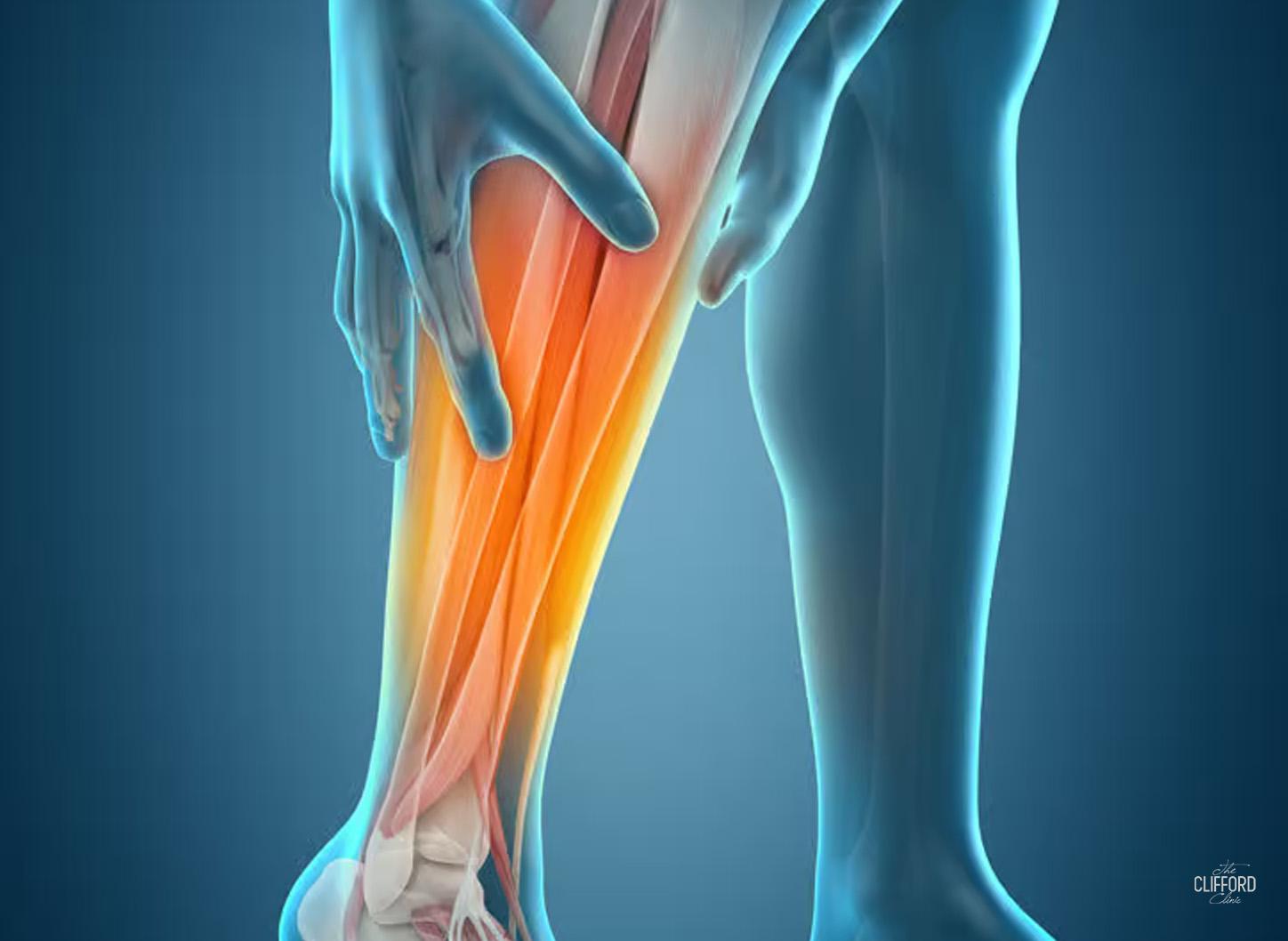
The calf consists mainly of the gastrocnemius and the deeper soleus, which join to form the Achilles tendon. The gastrocnemius crosses both the knee and ankle and is particularly prone to tightness. Possible causes include running and jumping, habitual heel elevation from high heels or stiff shoes, previous injury and neurological spasticity after stroke or in cerebral palsy. In each case, the muscle remains partly contracted, limits upward ankle movement and may cause cramping or overload in the structures below.
Why calf tightness causes pain and problems
Walking and running require the ankle to move upwards. If a tight gastrocnemius blocks that movement, the body compensates elsewhere: the foot may pronate further, the Achilles tendon carries more load and pressure shifts towards the plantar fascia and forefoot. This helps explain the link between calf tightness, Achilles disorders, plantar fasciitis and forefoot pain. The muscle itself may also ache, cramp or strain when suddenly loaded.
Why conventional treatments sometimes fall short
Treatment begins with calf stretching, loading programmes, heel drop exercises, footwear or orthotic changes, manual therapy and load management. Most patients improve. A muscle with persistently high resting tone, however, may resist stretching and tighten again during normal walking. In spasticity, the increased tone is neurological and will not respond to stretching alone. Reducing muscle overactivity may then improve ankle movement and allow rehabilitation to progress.
How Botox works for gastrocnemius tightness
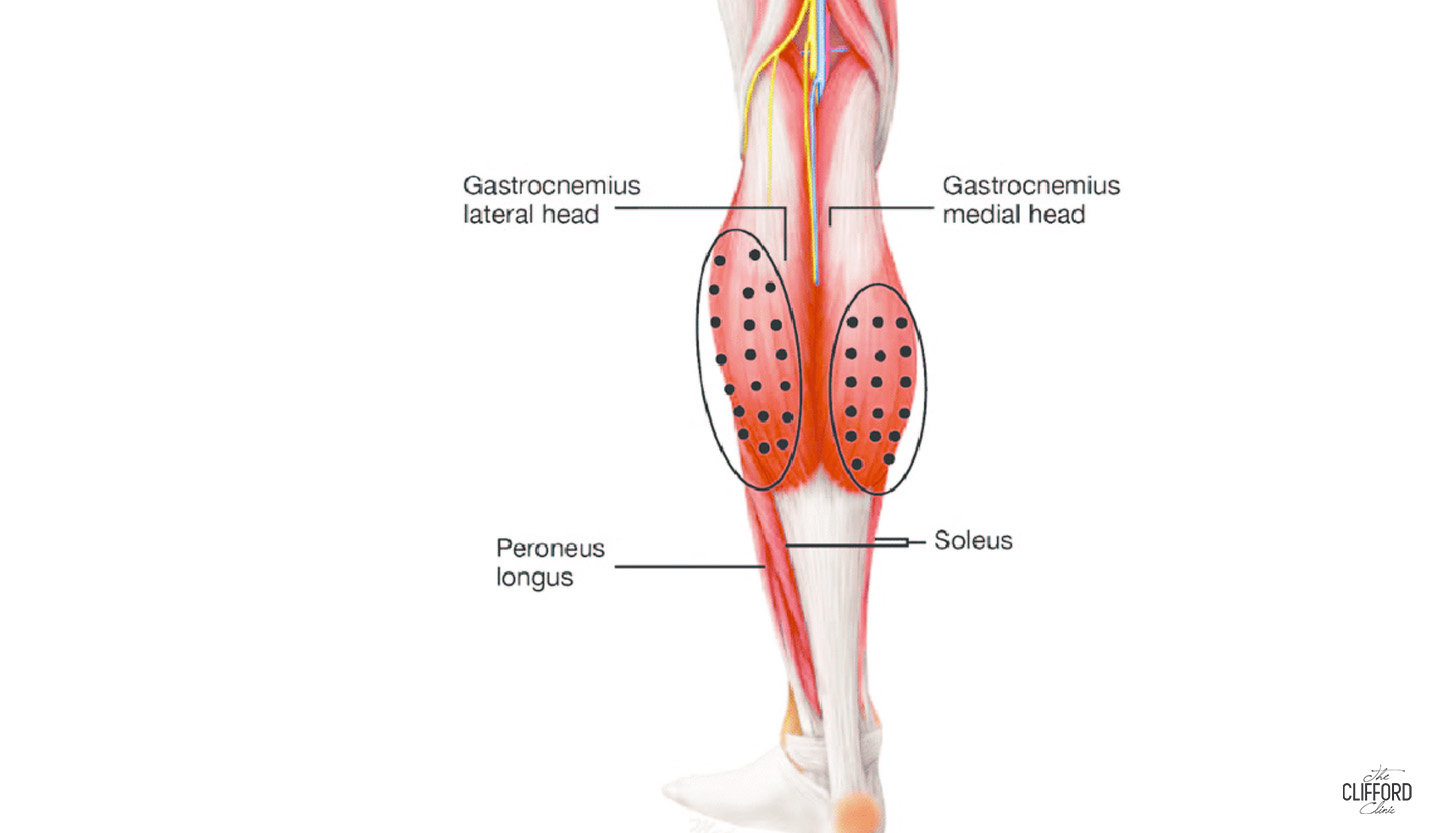
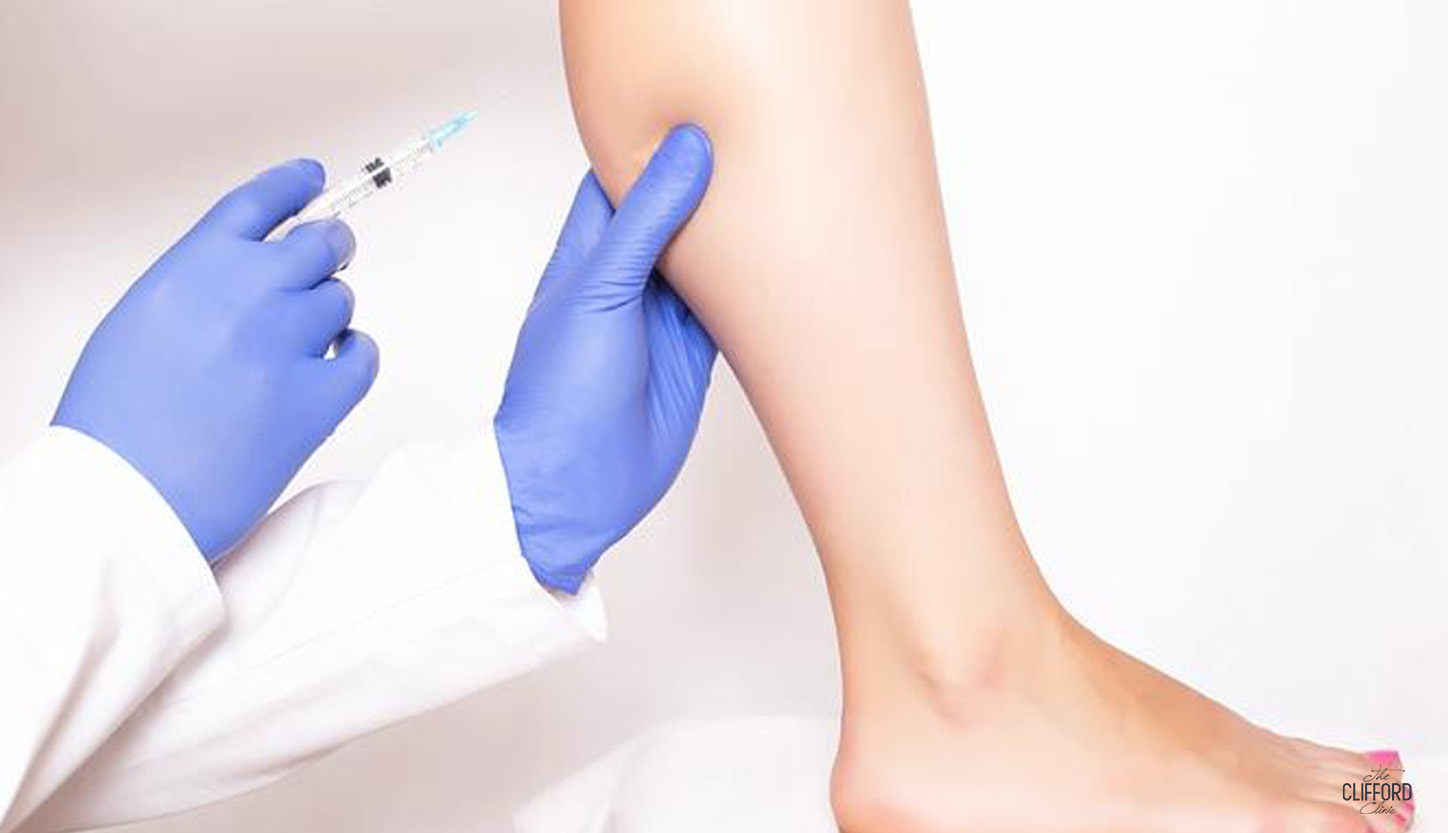
Botulinum toxin blocks the release of acetylcholine, the chemical signal that makes a muscle contract. After injection into the gastrocnemius, resting tone falls over one to two weeks. Ankle movement may improve, while the pull on the Achilles tendon and forefoot lessens. Cramps and trigger point pain may also settle. Stretching and loading exercises continue while the muscle is easier to lengthen. Ultrasound is normally used to guide injections into the medial and lateral heads of the gastrocnemius and avoid nearby nerves and blood vessels.
What the evidence shows
Direct evidence for botulinum toxin in isolated calf tightness outside spasticity is very limited. In neurological spasticity, calf injection is established and reduces muscle tone while improving ankle movement and gait. No comparable high quality trials exist for non neurological tightness. Treatment in this group therefore relies on the muscle’s behaviour, its known relationship with conditions such as plantar fasciitis and clinical judgement. It should be reserved for resistant cases and combined with stretching and loading rather than used alone.
Most patients get good relief. For the persistent, recurrent cases who might otherwise be sent for a calf release, botulinum toxin combined with physiotherapy, orthoses and either platelet rich plasma or Tenex, along with a night boot, can be the answer.
Dr Dinesh Sirisena, Consultant in Sports and Exercise Medicine, The Clifford Clinic
When calf tightness is severe and keeps coming back, surgery to release the muscle is one option. Botulinum toxin gives us a less invasive step to try first, and many patients do not then need an operation.
Dr Gerard Ee, Medical Director, The Clifford Clinic
The relationship between calf tightness and foot pain
The calf and foot work as one chain. When gastrocnemius tightness restricts upward ankle movement, the foot may compensate by pronating and loading the forefoot earlier in each step. Over time, this can contribute to Achilles problems, plantar fasciitis, forefoot pain and recurrent ankle symptoms. Treating the calf may therefore be part of a wider plan for heel or Achilles pain, rather than an isolated procedure.
Distinguishing the gastrocnemius from the soleus
The gastrocnemius crosses both the knee and ankle, whereas the deeper soleus crosses only the ankle. Comparing ankle movement with the knee straight and then bent helps identify which muscle is limiting movement. This distinction guides both injection placement and the choice of stretches. Ultrasound is then used to confirm the target.
Who may benefit, and who should avoid treatment
Calf Botox Treatment: Who May Benefit
| May Benefit | Should Avoid or Delay |
|---|---|
| Chronic calf tightness or limited ankle movement resistant to stretching | Pregnancy or breastfeeding |
| Calf tightness and pain related to spasticity | Neuromuscular disease such as myasthenia gravis |
| Recurrent calf cramps or strains, or Achilles and forefoot overload from a tight calf | Infection at the injection site |
| Willing to use the relaxation window for stretching and loading work | In-season athletes needing full calf power |
Risks and side effects
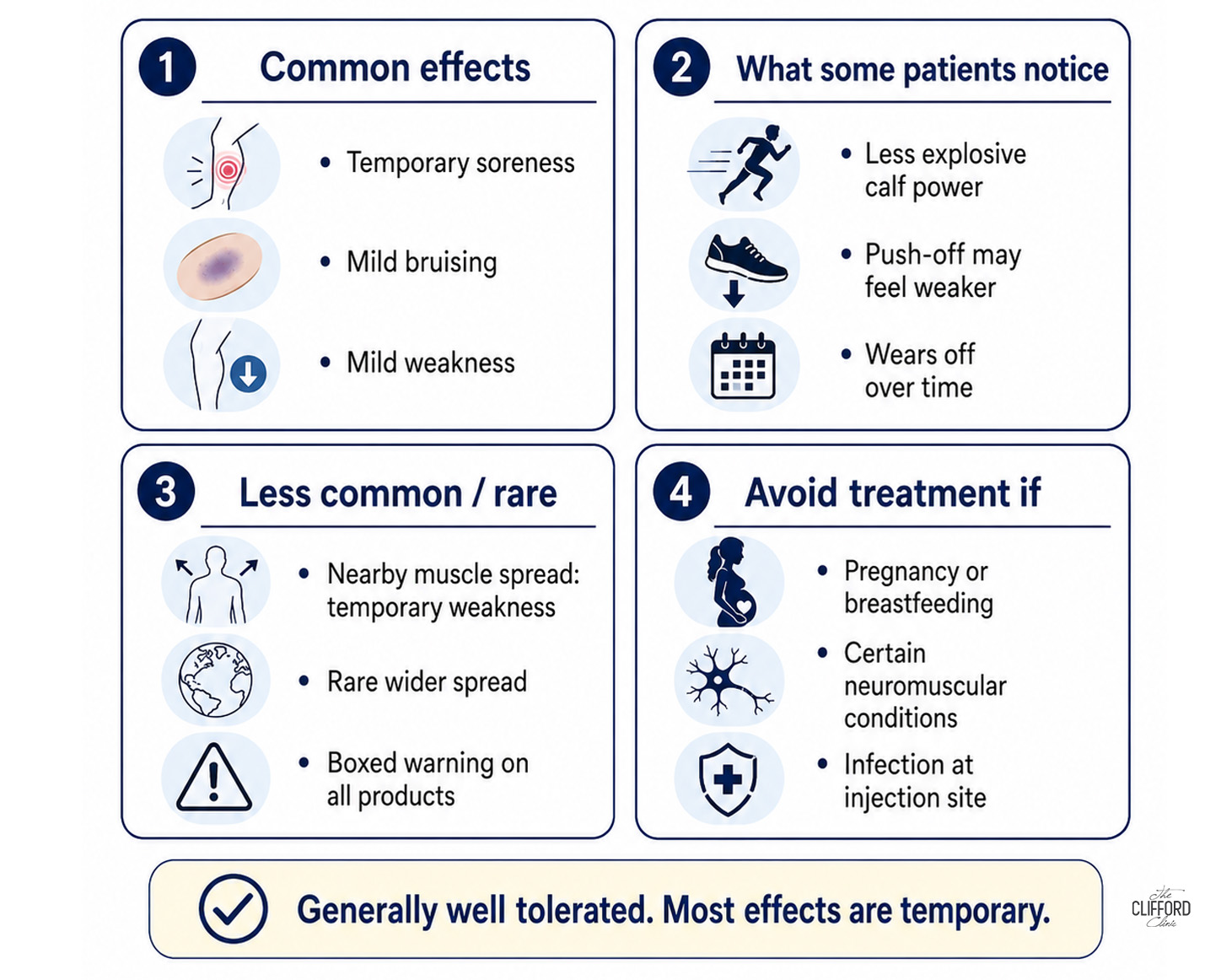
Botulinum toxin is generally well tolerated in the calf. Temporary soreness, bruising and mild weakness in the treated muscle are the most common effects. Because the gastrocnemius contributes to push off, some patients notice a temporary reduction in explosive calf power. Spread to a neighbouring muscle is uncommon and causes weakness that resolves as the treatment wears off. All botulinum toxin products carry a boxed warning about the rare possibility of wider spread. Treatment is avoided during pregnancy and breastfeeding, in certain neuromuscular conditions and where the injection site is infected.
Clinical targeting of the gastrocnemius
Dr Dinesh Sirisena uses the gastrocnemius as an adjunctive target in calf driven heel pain. Reducing calf tone can offload the Achilles tendon and plantar fascia while other treatments address the painful tissue. Network meta analyses rank botulinum toxin among the more effective injectable treatments for short term relief in chronic plantar fasciitis, and it may be combined with shockwave therapy. Its main limitation is duration: platelet rich plasma, prolotherapy or shockwave may provide a more sustained benefit.
For calf driven heel pain, I inject around 50 units into the gastrocnemius to reduce tone and offload the Achilles and plantar fascia. I consider it once stretching, orthoses, shockwave, or a steroid have been tried, or earlier where there is profound calf tightness or contracture and a strongly positive Silfverskiold test.
Dr Dinesh Sirisena, Consultant in Sports and Exercise Medicine, The Clifford Clinic
Speak to our doctors

Botulinum toxin for muscle and joint pain is a considered, individualised treatment. To determine whether it is appropriate, arrange an assessment with the team at The Clifford Clinic or read more about the work of Dr Gerard Ee. The clinicians will review the history, perform an examination and explain the available options before any treatment is planned.
Frequently Asked Questions
Can botulinum toxin relax a chronically tight calf?
It may help by reducing excessive gastrocnemius tone, improving upward ankle movement and easing the load on the Achilles tendon and forefoot. Direct evidence outside spasticity is very limited, so treatment is considered only when persistent tightness has not improved with stretching and loading, and rehabilitation must continue afterwards.
What is the strength of the evidence for this use?
Treatment is well established for calf spasticity, which is an approved use. There are no specific high quality trials for calf tightness without a neurological cause. Decisions in these cases rely on the muscle’s behaviour, its association with conditions such as plantar fasciitis and clinical judgement.
How is the gastrocnemius distinguished from the soleus?
The clinician compares ankle movement with the knee straight and then bent. Gastrocnemius tightness restricts movement mainly when the knee is straight. Soleus tightness remains when the knee is bent. This guides the injection target and the stretching programme.
Does it help associated Achilles or plantar fascia problems?
The benefit is usually indirect. A tight gastrocnemius increases the load on the Achilles tendon and plantar fascia. Relaxing the muscle and restoring ankle movement may reduce that load. When plantar fasciitis is the main problem, the dedicated article explains the available direct treatments.
Does it reduce calf strength?
A mild, temporary reduction in calf power is expected because the gastrocnemius contributes to push off. Strength returns as the treatment wears off. Rehabilitation during this period aims to restore ankle movement and rebuild strength.
Related Conditions
Explore other articles in our series on botulinum toxin for musculoskeletal pain.
- Botox for Muscle Pain (main guide), the overview of botulinum toxin for musculoskeletal pain
- Botox for Lower Back Pain, chronic low back pain and lumbar muscle spasm
- Botox for Quadratus Lumborum Pain, stubborn one sided lower back spasm
- Botox for Tight Hip Flexors, anterior hip pain in runners and cyclists
- Botox for Iliopsoas Syndrome, psoas spasm and snapping hip
- Botox for Plantar Fasciitis, chronic heel pain that resists other measures
- Botox for Trapezius and Shoulder Myofascial Pain, trapezius tightness and shoulder trigger points
Compare Treatments and Procedures
Compare the available treatments and what each procedure involves.
- Botox vs Steroid Injection, how the two injections differ and when each is chosen
- Botox vs PRP, muscle relaxation compared with tissue healing
- Botox vs Dry Needling, two trigger point options compared
- Ultrasound Guided Injections, why guidance matters for deep muscles
- Recovery and Physiotherapy after Botox, what to expect and how to get the most from treatment
More from The Clifford Clinic
Read about related treatments and services available at The Clifford Clinic.
- Platelet Rich Plasma Injections for Musculoskeletal Injury Recovery
- Botox for the Trapezius Muscle
- Botox Treatment for Cervical Torticollis
- Bioscaffold Therapy for Musculoskeletal Regeneration
- Hyaluronic Acid Injection for Knees
About the Authors

Dr Dinesh Sirisena is a Consultant in Sports and Exercise Medicine at The Clifford Clinic. He completed his sports and exercise medicine training in the United Kingdom and has cared for elite football, rugby, athletics and hockey teams, including at the London 2012 Olympic and Paralympic Games. He specialises in ultrasound guided injections and other non surgical treatments for muscle, tendon and joint pain, has led a musculoskeletal service as its medical director, and is an assistant professor at the NUS Yong Loo Lin and NTU Lee Kong Chian schools of medicine.

Dr Gerard Ee is the Medical Director of The Clifford Clinic. He trained at St George’s University of London and is a Member of the Royal College of Surgeons of Edinburgh, and built his orthopaedic experience at National University Hospital and Singapore General Hospital with a focus on the knee, joint and spine. He has published widely in peer reviewed orthopaedic and spine journals. You can also read more about his work at drgerardee.com.
Dr Dinesh Sirisena is a Consultant in Sports and Exercise Medicine at The Clifford Clinic. He trained in sports and exercise medicine in the United Kingdom and has worked with elite football, rugby, athletics and hockey teams, including at the London 2012 Olympic and Paralympic Games. He specialises in ultrasound guided injections and other non surgical treatments for muscle, tendon and joint pain. He has also led a musculoskeletal service as medical director and is an assistant professor at the NUS Yong Loo Lin and NTU Lee Kong Chian schools of medicine.
Selected orthopaedic and spine publications by Dr Gerard Ee
- Ee G, Srivastava A, Peng CWB, Tan SB, Tow BPB. Management of the neglected and healed bilateral cervical facet dislocation. European Spine Journal. 2014.
- Ee WWG, Lau WLJ, Yeo W, Yap VB, Yue WM. Does minimally invasive surgery have a lower risk of surgical site infections compared with open spinal surgery. Clinical Orthopaedics and Related Research. 2014.
- Ee G, Jiang L, Guo CM, Yeo W, Tan SB, Tow B, Chen J, Yue WM. Comparison of clinical outcomes and radiographic measurements in four treatment modalities for osteoporotic compression fractures. Journal of Spinal Disorders and Techniques. 2015.
- Ee G, Pang SY, Kumar N, Malhotra R. A silent acute abdomen in a patient with spinal cord injury. BMJ Case Reports. 2013.
References
- Myofascial pain syndrome, an update on clinical characteristics, etiopathogenesis, diagnosis and treatment. Muscle and Nerve. 2025.
- Clinical efficacy of botulinum toxin in the treatment of plantar fasciitis, a systematic review and meta analysis of randomized controlled trials. Archives of Physical Medicine and Rehabilitation. 2022.
- Neurobiological mechanisms of botulinum neurotoxin induced analgesia for neuropathic pain. Pharmacology and Therapeutics. 2024.
- Approved uses and prescribing information for botulinum toxin type A. United States Food and Drug Administration. 2024.
- Network meta analysis of injectable therapies for plantar fasciitis. Scientific Reports. 2026.
- Network meta analysis of injectable treatments for plantar fasciitis. International Journal of Surgery. 2025.
- Gastrocnemius injection case series for plantar fasciitis. Cureus. 2025.
- Meta analysis of conservative treatments for plantar fasciitis. Clinical Rehabilitation. 2022.
- Network meta analysis of treatments for plantar fasciitis. Pain Physician. 2021.
Medical disclaimer. This article is for general education and does not replace a consultation with a qualified doctor. Botulinum toxin for musculoskeletal pain is an individualised treatment that is off label for most of these conditions. Suitability, dosing and outcomes vary between people. Please seek an in person assessment at The Clifford Clinic before making any treatment decision.

Author Bio
Dr Gerard Ee

Dr Gerard Ee is the Medical Director of The Clifford Clinic in Singapore. He earned his medical degree from St George's University of London and built his surgical experience across the Singapore General Hospital, National University Hospital, and Mount Sinai Hospital in New York. He holds Membership of the Royal College of Surgeons (Edinburgh) and a Postgraduate Diploma in Dermatology (Cardiff), and is fully accredited in aesthetic procedures including botulinum toxin, fillers, lasers, and light therapies. A strong advocate of minimally invasive, natural-looking results, Dr Ee has published in several medical and scientific journals and presented his research in cities including Taipei, Las Vegas, and London.
See all posts by Dr Gerard Ee »