


Acne Scar Treatment in Singapore: Your Complete, Doctor-Led Guide
Acne may clear in your teens or twenties, but the scars it leaves behind can last for decades. A true acne scar is a structural change in the deeper layer of the skin, not a surface stain. it needs clinical treatment to improve. Encouragingly, in my many years of treating acne scars in Singapore, the right combination of treatments can help most patients achieve noticeably smoother skin. This guide explains your options, how to match a treatment to your scar type, what results and cost to expect, and how I approach these cases in practice.
First, are they really scars?
Many people who think they have acne scars actually have post-acne marks, flat red or brown discolouration that often fades on its own over months. A true scar is a change in texture: a depression, a raised lump, or an uneven surface. Telling them apart matters,because the two need completely different treatments, and I see patients spend money on the wrong one every week. A simple home test helps: Gently stretch the skin, or shine a light across it from the side. If the discolouration flattens and the surface is smooth, it is a mark, but if you can see a dip that casts a shadow, it is a scar. Our overview of acne and acne scar treatment and the detailed acne scars vs hyperpigmentation guide explain this distinction further.
Why acne scars form
Acne scarring begins when an inflamed pore (particularly a cystic or nodular lesion) damages the deeper layers of the skin. As the body repairs the damage it lays down collagen; too little and the surface sinks into a depressed (atrophic) scar; too much and a raised scar forms. Because the change sits deep in the dermis, topical products cannot reach it. This is also why I am insistent on one point with every patient: we have to settle the active acne first. New breakouts create new scars, and resurfacing acne-prone skin can trigger a flare-up. For a fuller explanation see what causes acne scars. 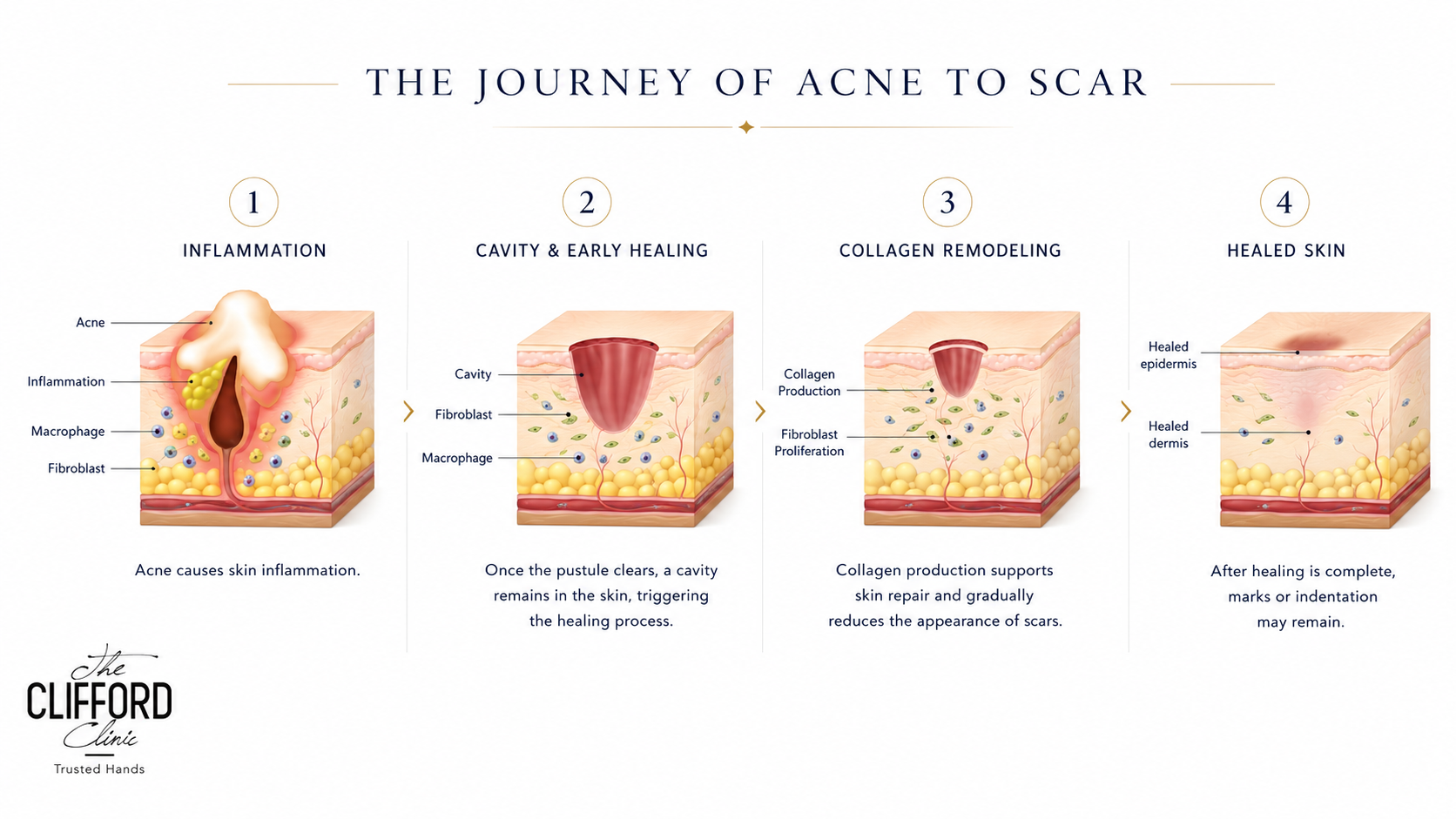
The main types of acne scars
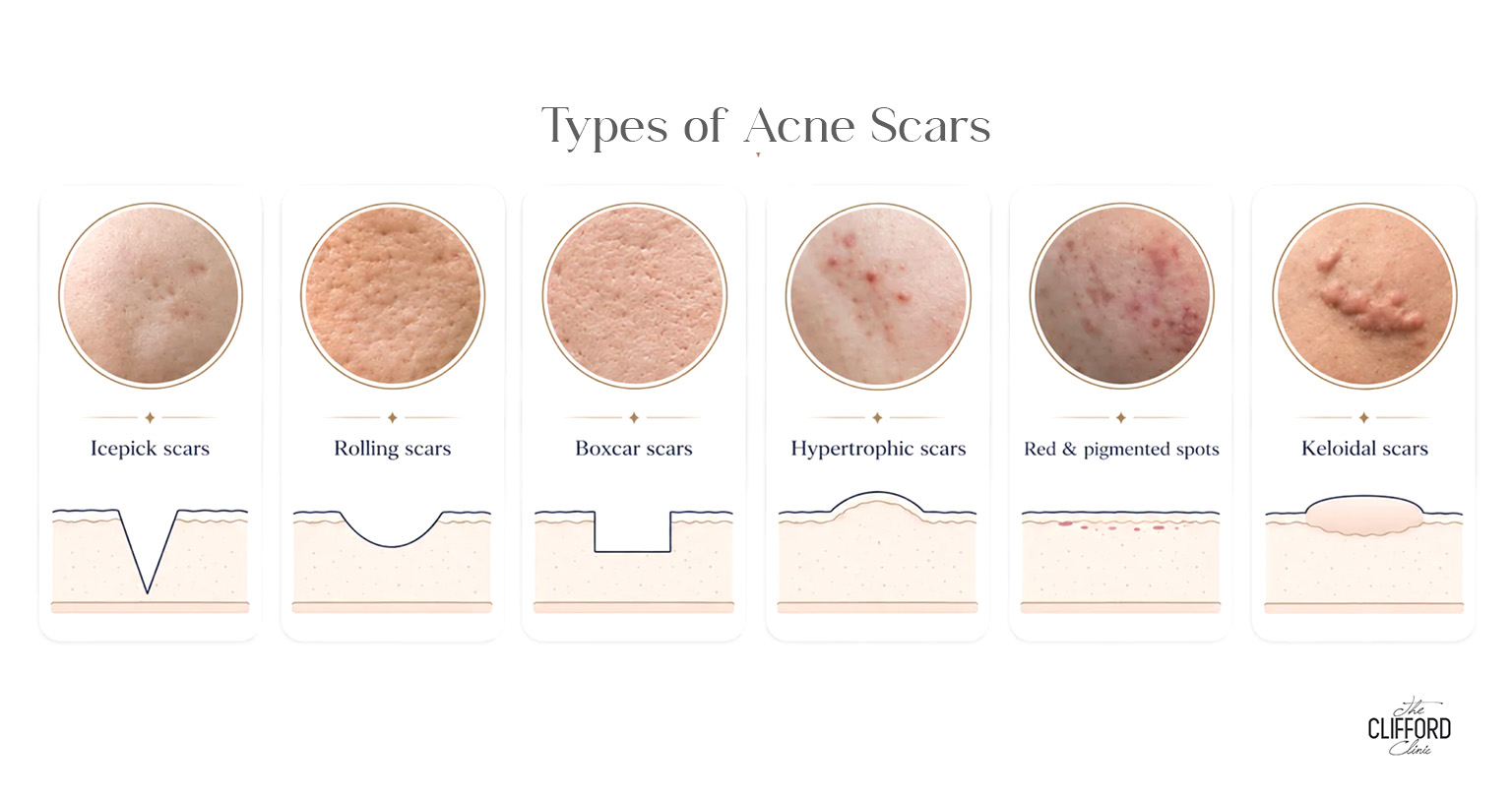
Around eight to nine in ten acne scars are atrophic, and they come in three shapes that usually appear together:
- Ice pick scars: narrow, deep, pitted scars like a fine puncture, and the hardest to treat.
- Boxcar scars: round or oval depressions with sharp edges, common on the cheeks and temples.
- Rolling scars: broad, sloping depressions caused by fibrous bands that tether the skin down.
A smaller number are raised hypertrophic or keloid scars. Most patients have a mixture, which is precisely why no single machine is the answer.Matching the tool to the scar type is the whole skill. Our types of acne scars guide and the breakdown of the three main scar types go deeper.
How acne scars are treated
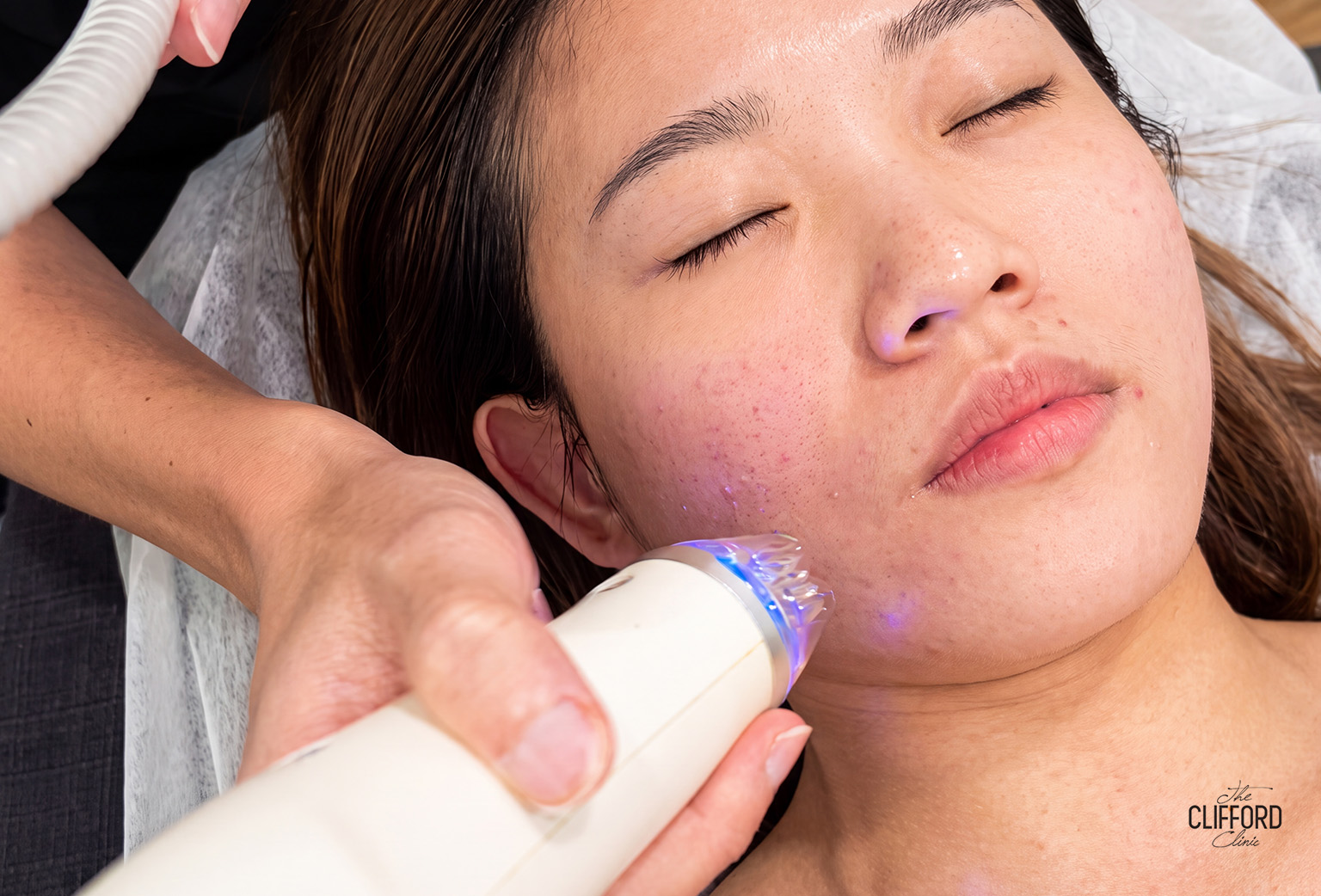
There is no single best treatment; the right approach depends on your scar types, your skin tone and how much downtime you can take. Fractional CO2 laser resurfaces the skin and rebuilds collagen – well-suited toboxcar scars and improving overall texture (see laser treatment for acne scars). Radiofrequency (RF) microneedling delivers heat into the dermis through fine needles; Infini uses insulated needles for deep, controlled energy, while Secret RF is non-insulated and, importantly, well-tolerated for acne-prone skin because it calms the oil gland (the full comparison is in Infini vs Secret RF). Subcision releases the tethers under rolling scars; TCA CROSS rebuilds deep ice pick scars; and biostimulators restore lost volume. Where the surface and pigment are the main concern rather than depth, gentler devices such as Sylfirm X have their place too, which I discuss in is Sylfirm X good for acne scars. A picosecond laser with a microlens array (Pico MLA) is another surface-and-pigment tool in the rotation: it refines enlarged pores and evens out pigment with minimal downtime, though it is not a treatment for tethered rolling scars.
Why combination treatment wins
Because most patients have several scar types at different depths, the strongest results come from combining modalities rather than repeating one. In my practice a typical programme rotates treatments: for example one session of Infini, one of Secret RF and two of fractional CO2 over about six months. Subcision is often paired with a biostimulator such as Sculptra, which I place with a cannula. That placement itself produces a subcision effect while stimulating collagen. PDRN (a polynucleotide-based injectable), also known as Rejuran, is an excellent add-on, because it speeds healing and enhances the result. The logic behind layering is set out in our piece on combination therapy for atrophic scars.
What results are realistic
Acne scars can be significantly improved but are rarely erased completely, and the change is gradual. In my experience, a rotation between modalities without injectables typically delivers around twenty to thirty per cent improvement over a six-month period, with more possible when biostimulators and PDRN are added. Most of the visible change appears over three to six months as new collagen matures, which is why I space sessions four to six weeks apart, giving the skin time to build collagen between treatments.
How much does acne scar treatment cost in Singapore?
Cost depends on the treatments used, the number of sessions and the severity of scarring. As a guide, an individual fractional CO2 session can start from S$390, while a typical six-month custom scar package in my practice (combining Infini, Secret RF, fractional CO2 and Pico MLA) is around S$4,000. Chasing the lowest price is one mistake; assuming the most expensive machine repeated gives the best result is another. Neither is true. Spending more is not the most cost-effective route to better skin; the right combination, properly spaced, is. Our dedicated guide to acne scar removal cost in Singapore covers this in detail.
A note on darker skin
For medium to deep skin tones (Fitzpatrick types IV to VI), the priority is avoiding post-inflammatory hyperpigmentation. I favour insulated Infini in these patients because it spares the epidermis while working at depth, and where I use fractional CO2 I dial the energy down. A tendency to keloids is not, in itself, a barrier to treatment. Our acne scar treatment for dark skin guide expands on this.
How I choose, in practice
I first ask whether the acne is stable; if it is not, I reach for Secret RF, sometimes with AGNES RF, to bring it under control. Then I identify each scar type and match it: subcision for tethered rolling scars, TCA CROSS or Juvelook for deep ice pick scars, biostimulators where volume is lost, and resurfacing for surface texture. I keep skincare in the plan too, because calming the oil gland and supporting collagen is part of the result. The consistent outcomes come from accurate diagnosis, treating the root cause, and giving the process time.
Choosing a clinic
Look for a doctor who assesses your specific scar types in person and owns a range of technologies rather than a single device, and is candid about limitations. RF microneedling cannot improve keloid scars and is not very effective for temple scars; significant cheek volume loss needs biostimulators alongside microneedling. You can read more about The Clifford Clinic and Dr Gerard Ee, or the candid six things your doctor isn’t telling you.
Clinical summary
Acne scar treatment that works starts with an accurate in-person assessment. Scar type, skin tone, acne control and goals all shape the plan, and no single machine addresses all of them. To go deeper, explore what causes acne scars, the types of acne scars, or what the best treatment is for you.
Frequently Asked Questions
Which acne scar treatment is most effective?
In my practice, the strongest results come from combining modalities (RF microneedling (Infini or Secret RF), subcision, fractional CO2 and biostimulators) matched to your specific scar types, rather than repeating one device.
How much does acne scar treatment cost in Singapore?
It varies with the treatments and number of sessions. An individual fractional CO2 session can start from as low as S$390, while a six-month custom scar package combining Infini, Secret RF, fractional CO2 and Pico MLA is around S$4,000 in Dr Ee’s practice. Spending more on a single expensive treatment is not the most cost-effective route to better results.
Can acne scars be completely removed?
Rarely to perfection. Acne scars can be significantly improved, but gradual change over months is the realistic goal, not total erasure.
How long does acne scar treatment take to work?
Collagen remodelling is slow. Most patients need several sessions spaced four to six weeks apart, with much of the visible improvement appearing over three to six months.
Device specifications & sources
- U.S. FDA 510(k) Summary K213612 (SYLFIRM X, ViOL Co., Ltd.): Output power Max 16 W at 50 Ω; 2 MHz; bi-polar RF.
- U.S. FDA 510(k) Summary K170325 (Secret RF, Ilooda Co., Ltd.): Max power Max 25 W at 500 Ω; 2 MHz; needle depth 0.5-3.5 mm.
- U.S. FDA 510(k) K121481 (INFINI, Lutronic Inc.): insulated RF microneedling system, 49-pin handpiece, maximum RF generator output approximately 50 W.
Written by Dr Bernard Ong – Medically reviewed by Dr Bernard Ong – Expert opinion by Dr Bernard Ong
Written, medically reviewed and expert opinion by Dr Bernard Ong, Aesthetic Doctor, The Clifford Clinic. This article is for general education and reflects Dr Ong’s clinical experience treating acne scars in Singapore; it is not medical advice. Treatment suitability, results, downtime and cost vary between individuals. Please arrange a consultation for advice specific to your skin.
Dr Bernard Ong is an aesthetic doctor in The Clifford Clinic. The Clifford Clinic has more than 16 years of experience of treating acne scars with established protocols fine tuned over the years to deliver results in a safe and effective manner.