
Pico Laser vs Yellow Laser in Singapore: Brown Pigment, Redness and Acne Marks
Written by Dr Bernard Ong. Medically reviewed by Dr Gerard Ee
Patients often compare Pico laser with yellow laser as though one is a stronger version of the other. They are not. Standard Pico wavelengths such as 532 nm and 1064 nm are selected mainly for melanin, so they are used for brown concerns including freckles, sun spots and post-inflammatory hyperpigmentation. A yellow vascular laser, such as a 595 nm pulsed dye laser, is chosen for haemoglobin and therefore treats redness, flushing, visible vessels and red post-acne marks. A face can carry both types of mark at the same time. In that situation, the treatments may be combined, but each device still has a separate job.
Why the colour of the mark changes the treatment
Laser light is absorbed by particular targets, known as chromophores. Melanin is the main target in brown pigment. Haemoglobin is the target in blood vessels, while water is targeted by resurfacing lasers. The absorption curves overlap, so no wavelength is completely exclusive, but the dominant target still determines the clinical effect. Increasing the energy of a pigment laser does not turn it into a reliable vascular treatment. It mainly increases the chance of irritation. The same principle applies in reverse. Diagnosis comes before the device setting.
How Pico laser treats brown pigment
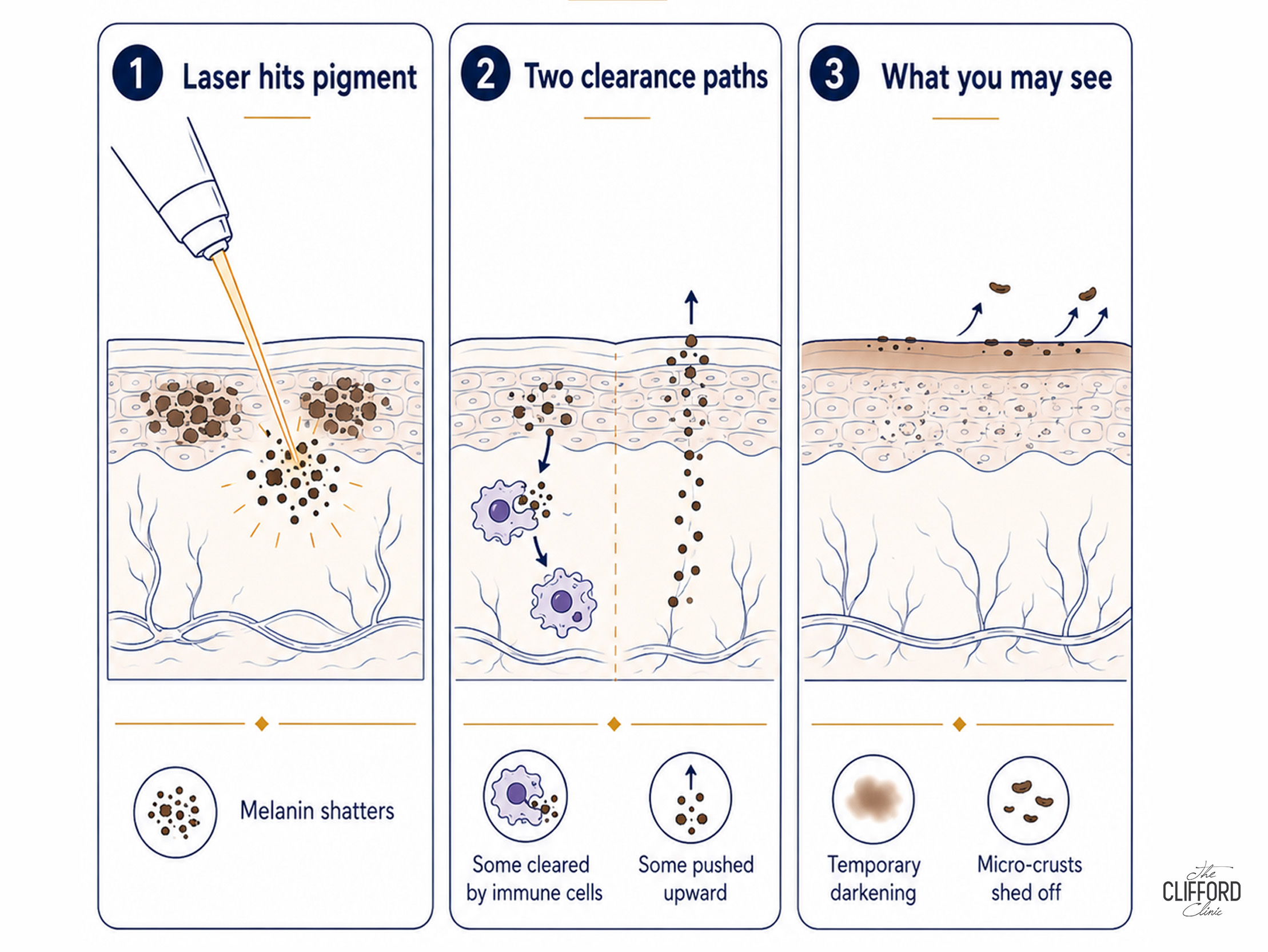
Picosecond lasers release energy in very short pulses. When an appropriate wavelength is absorbed by melanin, the pigment is disrupted through a mixture of photoacoustic and thermal effects, with less time for heat to spread than with many longer-pulse systems. The fragments are then cleared gradually over the following weeks. Pico laser is not heat-free and it can still cause post-inflammatory hyperpigmentation if the wavelength, fluence or treatment endpoint is poorly chosen. Used conservatively, however, it is a useful option for Asian skin because it can treat selected epidermal or dermal pigment with relatively limited injury to the surrounding tissue. Fractional handpieces have a different role: they create microscopic optical effects in the dermis and may improve texture as well as colour.
How yellow laser treats redness
Yellow laser is a broad consumer term rather than one single machine. In this comparison it refers to a vascular laser in the yellow light range, particularly the 595 nm pulsed dye laser used by systems such as Vbeam. Oxyhaemoglobin absorbs this wavelength, so the energy is concentrated within small blood vessels. Depending on the pulse duration and fluence, the vessel is heated and gradually resorbed. This is why yellow laser is used for persistent facial redness, rosacea, telangiectasia, some vascular birthmarks and post-inflammatory erythema after acne. It is not the first choice for a flat brown mark caused mainly by melanin.
Brown acne marks and red acne marks are different
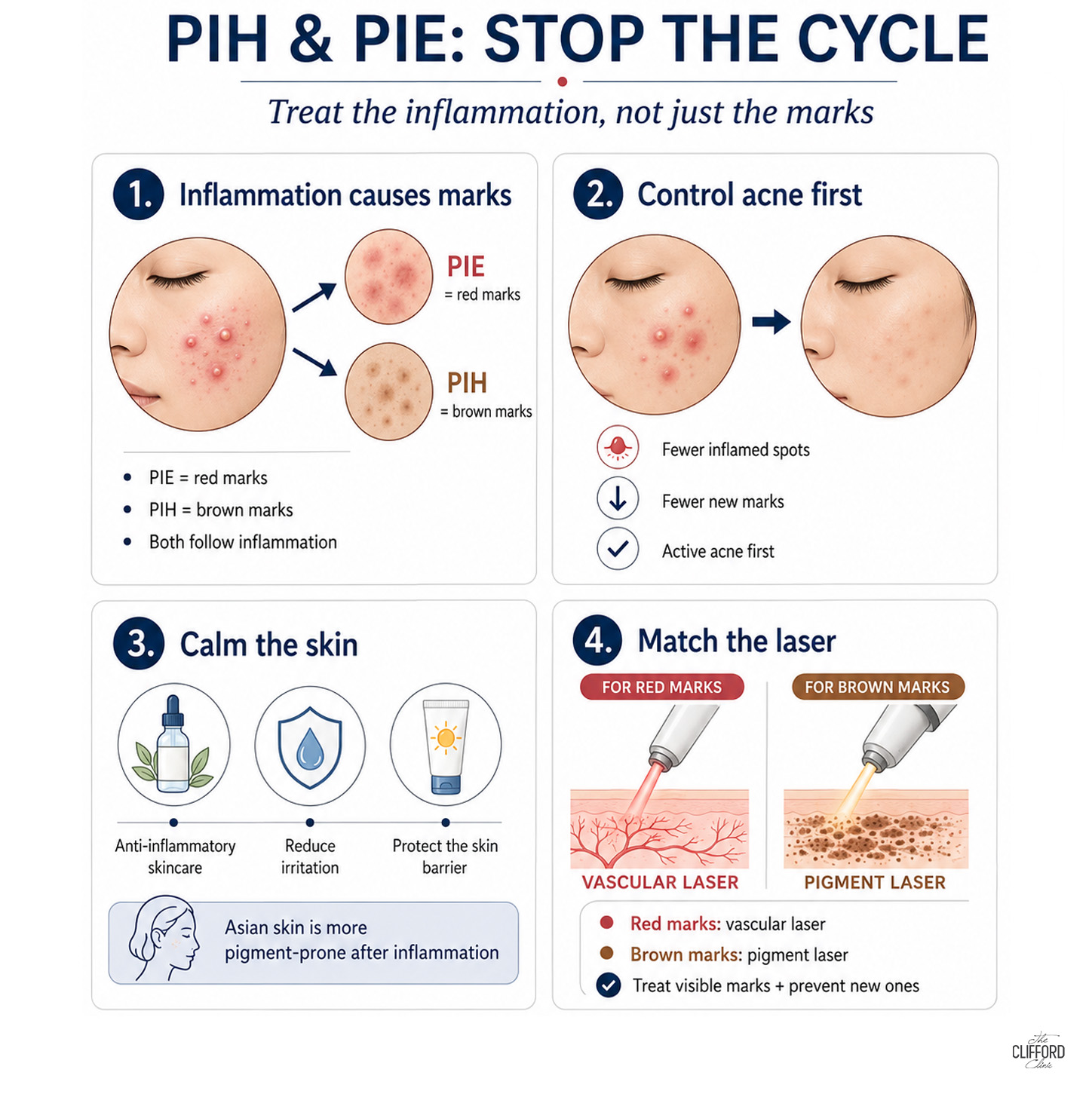
After an inflamed pimple settles, the remaining mark may be brown, red or a mixture of both. Brown post-inflammatory hyperpigmentation, or PIH, reflects excess melanin. Red post-inflammatory erythema, or PIE, reflects persistent superficial vessels and inflammation. Both are flat, which separates them from an indented or raised acne scar. Colour alone is not always enough, especially in deeper skin tones, so examination is useful. Redness often pales briefly when pressed. Deposited pigment usually does not.
Brown Acne Marks and Red Acne Marks Compared
| Feature | Brown Acne Marks, PIH | Red Acne Marks, PIE |
|---|---|---|
| Cause | Excess melanin after inflammation | Persistent superficial vessels after inflammation |
| Chromophore | Melanin | Flat, pink, red or purple-red |
| Matching Laser | Pico laser | Often pales temporarily when pressed |
| Typical Skin Tone | More common in darker skin | Haemoglobin; a vascular wavelength |
| Natural Course | Fades over three to twelve months | Usually fades gradually; persistent redness can last for months |
This distinction has a practical consequence. A pigment laser may do little for a purely vascular red mark, while a vascular laser will not reliably clear melanin-based PIH. Some patients have overlapping colour, particularly when a fresh red mark begins to develop brown pigmentation. Our guide to brown acne marks versus red acne marks explains the difference in more detail.
Melasma does not fit neatly into a brown-versus-red rule
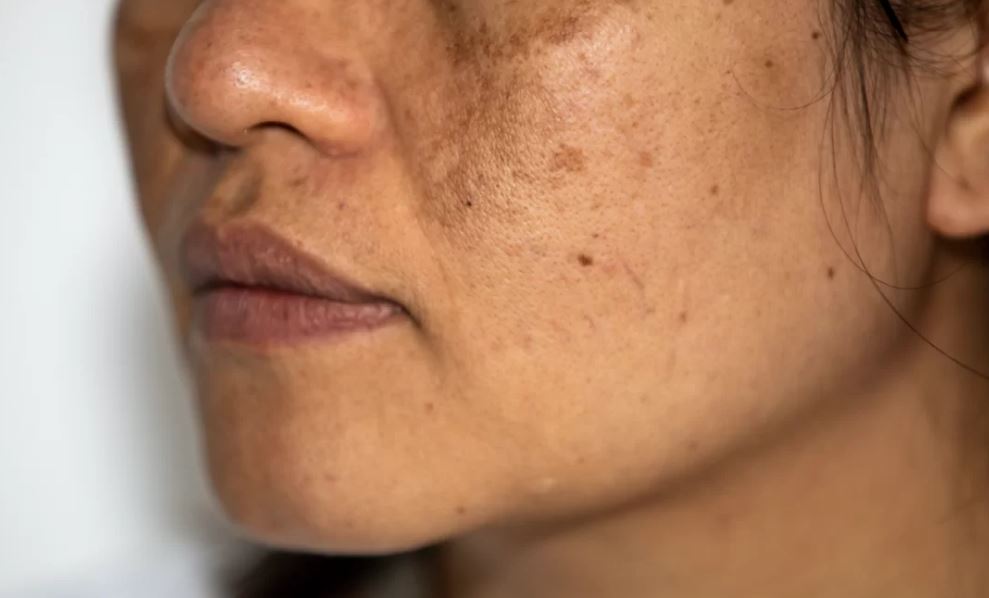
Melasma is primarily a pigment disorder, but many lesions also show increased dermal vascularity and inflammatory signalling. That does not mean every patient needs a vascular laser. Treatment still begins with daily photoprotection, a stable skincare routine and appropriate topical therapy. A low-fluence picosecond protocol may be considered for selected, stabilised cases, while a 595 nm vascular treatment may have a role when visible or dermoscopically apparent vessels are part of the picture. Both must be used cautiously because excessive heat or inflammation can produce rebound darkening. Oral tranexamic acid is sometimes prescribed for resistant melasma, but it requires medical screening and is unsuitable for some patients because of thromboembolic risk. Our melasma treatment guide covers the wider treatment plan.
Downtime depends on the treatment mode
A single downtime figure is misleading because both lasers can be used in different ways. Non-purpuric 595 nm treatment usually causes redness and mild swelling for several hours to a few days. Higher vascular settings may produce purple bruising that lasts roughly one to two weeks. Pico toning can cause little more than short-lived redness, whereas targeted treatment of freckles or sun spots commonly makes each spot darken and form a fine crust for about five to seven days. Fractional picosecond treatment may also produce swelling or a sandpaper-like texture for several days. Cooling, conservative settings and strict sun protection reduce discomfort and the risk of post-treatment pigment. Our Pico laser aftercare guide explains the pigment side of recovery.
What improves the result besides laser
Laser can clear an existing mark, but it does not remove the reason new marks are forming. For PIH, topical options such as retinoids, azelaic acid, vitamin C, niacinamide or a supervised hydroquinone course may be used according to skin tolerance and diagnosis. For PIE, the priority is often to reduce irritation and allow the vascular inflammation to settle. A simple barrier-supporting routine is usually more useful than layering multiple acids or scrubs. Broad-spectrum sunscreen is relevant to both, especially in Singapore, because ultraviolet exposure darkens PIH and can prolong visible inflammation. The surrounding plan should be individualised rather than built around a long list of active ingredients.
Control active acne while treating the marks
New inflammatory lesions continually create new red and brown marks. For that reason, acne treatment should run alongside any laser plan rather than being postponed until every mark has cleared. Topical retinoids, benzoyl peroxide, azelaic acid, oral medication or device-based acne treatments may be considered according to severity. The aim is to slow the production of new marks while older ones fade. This is particularly important in Asian skin, where even a small inflammatory lesion may leave pigmentation that persists for months.
Which laser is better for acne marks?
Neither device is better for every acne mark. Pico laser is the more logical choice when the residual colour is predominantly brown and melanin-based. Yellow laser is selected when the mark is predominantly red and vascular. When both are present, treatment can be sequenced according to which component is more prominent, how reactive the skin is and whether acne remains active. In some patients, time and topical care are enough. Laser is not automatically required simply because a mark is visible.
Can Pico and yellow laser be combined?
Yes, but combination treatment should solve two identified problems rather than add procedures for their own sake. A doctor may use a vascular laser for PIE and a picosecond wavelength for PIH in separate sessions. Same-day treatment is possible in selected cases when the areas and endpoints do not overlap, although spacing the procedures often makes the skin response easier to assess. The interval is not fixed for every patient. Recent tanning, barrier irritation, active dermatitis and a history of rebound pigmentation generally favour a slower plan.
How doctors decide which laser to use
Assessment starts with the appearance and distribution of the marks. Blanching with pressure suggests a vascular component, and dermoscopy can make fine vessels and pigment patterns easier to see. Skin tone, recent sun exposure, active acne, rosacea, melasma, current skincare and previous reactions to treatment then influence the settings. A changing or unusual lesion is examined before any cosmetic laser is considered. The final choice may be Pico, yellow laser, both, or neither. Matching the treatment to the diagnosis is more important than choosing the newest platform.
Who may be suitable
- Pico laser may suit:flat brown acne marks, freckles, sun spots, selected PIH and diagnosed dermal pigmentation. Melasma requires a separate, conservative assessment.
- Yellow laser may suit:red acne marks, facial flushing, rosacea-associated redness, visible capillaries and other diagnosed vascular concerns.
- Treatment may need to be postponed or modified when the skin is recently tanned, inflamed, infected or significantly irritated, when melasma is unstable, when acne is actively flaring in the area, or when a pigmented lesion has not been diagnosed.
Doctor’s perspective. The most common mismatch is not a weak setting. It is treating a red mark as though it were brown, or a brown mark as though it were red. Once the colour and underlying target are identified, the treatment plan becomes much simpler. Patients with mixed marks may need two devices, but they do not necessarily need both at every visit.
Lasers used at The Clifford Clinic
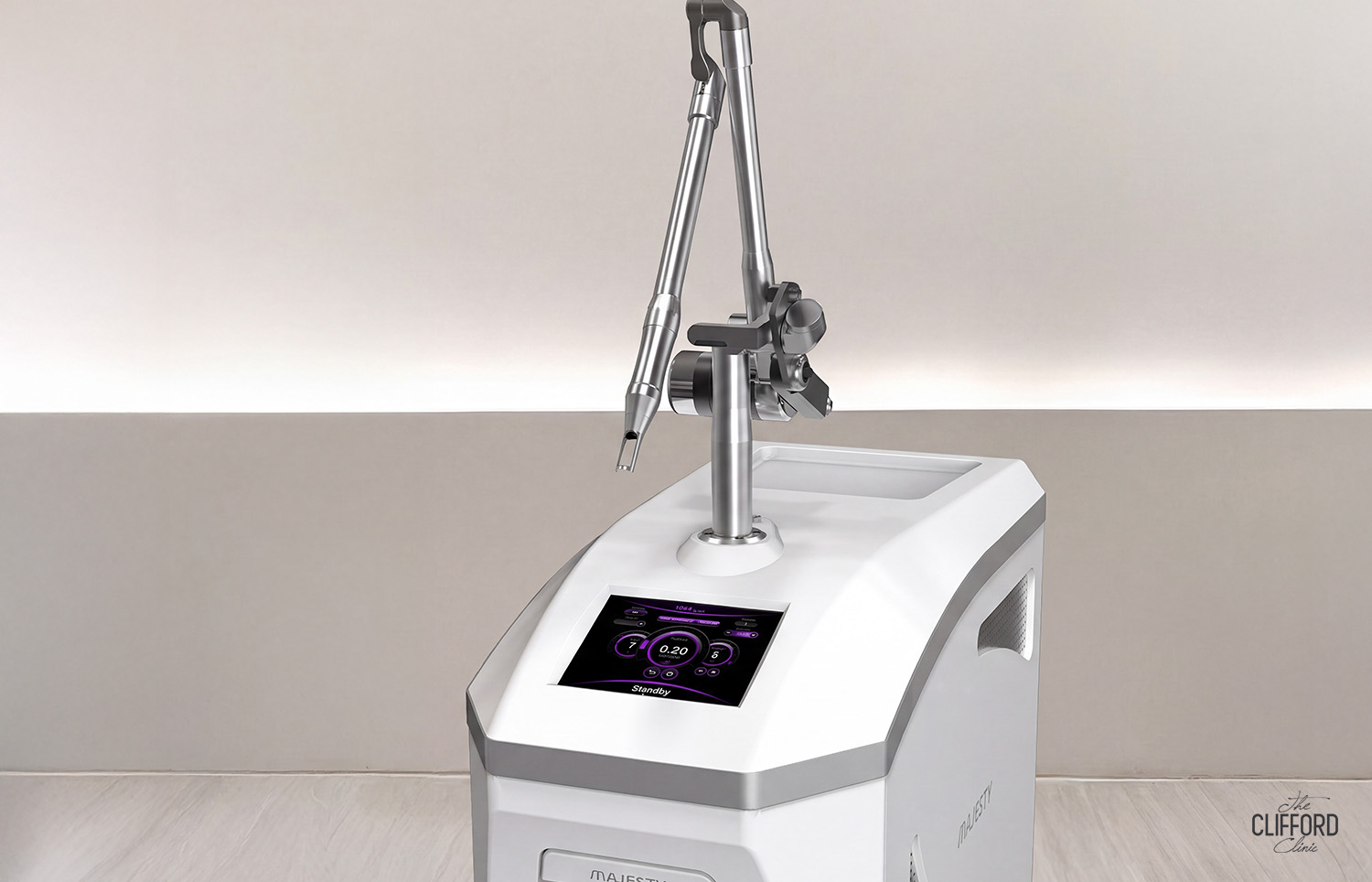
For melanin-based pigmentation, our picosecond platforms provide wavelengths such as 532 nm for selected superficial lesions and 1064 nm for deeper pigment or low-fluence treatment. For vascular redness and red acne marks, Vbeam Prima uses a 595 nm pulsed dye wavelength, with 1064 nm available for selected deeper vessels. These systems are complementary. The choice of wavelength, pulse duration, spot size and endpoint is adjusted to the individual lesion rather than applied as a fixed clinic protocol.
Lasers used at The Clifford Clinic
For melanin-based pigmentation, our picosecond platforms provide wavelengths such as 532 nm for selected superficial lesions and 1064 nm for deeper pigment or low-fluence treatment. For vascular redness and red acne marks, Vbeam Prima uses a 595 nm pulsed dye wavelength, with 1064 nm available for selected deeper vessels. These systems are complementary. The choice of wavelength, pulse duration, spot size and endpoint is adjusted to the individual lesion rather than applied as a fixed clinic protocol.
Frequently asked questions
Is Pico laser or yellow laser better for acne marks?
Look at the colour and cause of the mark. Brown PIH is treated as pigment and may respond to Pico laser or topical therapy. Red PIE is vascular and is more likely to respond to a yellow vascular laser. Mixed red-brown marks may need a staged plan.
Does yellow laser treat pigmentation?
Yellow vascular laser is designed mainly for haemoglobin, not melanin. It may influence some mixed red-brown lesions, but it is not a dependable substitute for a pigment-specific treatment when the concern is a flat brown spot.
Does Pico laser treat redness?
Standard Pico wavelengths used for pigmentation have a limited direct effect on vascular redness. They may improve colour indirectly when brown pigment is also present, but persistent red marks and visible vessels are usually better matched to a vascular laser.
What is better for red acne marks?
A 595 nm pulsed dye laser is a well-established option for persistent post-acne erythema because it targets the superficial vessels responsible for the red colour. Mild marks may also fade with time, acne control and gentle skincare.
Can yellow laser and Pico laser be used together?
Yes. They can be used in the same overall plan because they target different components. Whether they are performed on the same day or in separate sessions depends on skin tone, treatment area, settings and how the skin responded previously.
Which is safer for Asian skin?
Safety depends more on diagnosis, settings and operator technique than on the device name. Pico laser can offer a lower thermal burden for pigment work, but it can still trigger PIH. A 595 nm vascular laser can also be used in Asian skin, although conservative settings and careful cooling are important.
Choose the laser only after identifying the mark

Brown pigment, vascular redness and true acne scars need different treatments. An examination can establish which of these is present before a course is planned. Learn about Pico laser in Singapore and pigmentation treatment in Singapore, or book an assessment at The Clifford Clinic, 50 Raffles Place, #01-01 Singapore Land Tower. Call (65) 6532 2400 or WhatsApp (65) 8318 6332.
Selected References
- Disorders of hyperpigmentation, part I: pathogenesis and clinical features of common pigmentary disorders. Journal of the American Academy of Dermatology, 2023. https://pubmed.ncbi.nlm.nih.gov/35151757/.
- Characteristics of dermal vascularity in melasma and solar lentigo. Photodermatology, Photoimmunology and Photomedicine, 2024. https://onlinelibrary.wiley.com/doi/10.1111/phpp.12953.
- American Academy of Dermatology: acne scars. https://www.aad.org/public/diseases/acne/derm-treat/scars.
- DermNet: lasers in dermatology. https://dermnetnz.org/topics/lasers-in-dermatology.
- Acne erythema improvement by long-pulsed 595 nm pulsed dye laser treatment: a pilot study. Journal of the European Academy of Dermatology and Venereology, 2008. https://pubmed.ncbi.nlm.nih.gov/18273723/.

Author Bio
Dr Gerard Ee

Dr Gerard Ee is the Medical Director of The Clifford Clinic in Singapore. He earned his medical degree from St George's University of London and built his surgical experience across the Singapore General Hospital, National University Hospital, and Mount Sinai Hospital in New York. He holds Membership of the Royal College of Surgeons (Edinburgh) and a Postgraduate Diploma in Dermatology (Cardiff), and is fully accredited in aesthetic procedures including botulinum toxin, fillers, lasers, and light therapies. A strong advocate of minimally invasive, natural-looking results, Dr Ee has published in several medical and scientific journals and presented his research in cities including Taipei, Las Vegas, and London.
See all posts by Dr Gerard Ee »