
Sun Spot Removal Singapore: How Lasers Treat Solar Lentigines
Written by Dr Bernard Ong. Medically reviewed by Dr Gerard Ee
Sun spots, known medically as solar lentigines, are flat brown spots caused by years of cumulative sun exposure. They respond well to pigment lasers such as Pico laser and Q-switched laser, and discrete spots often clear over a short course in Singapore. Sun protection limits new spots. Because a small number of changing brown spots can be something more serious, any spot that grows, changes colour or looks different should be examined by a doctor first.
What are sun spots?
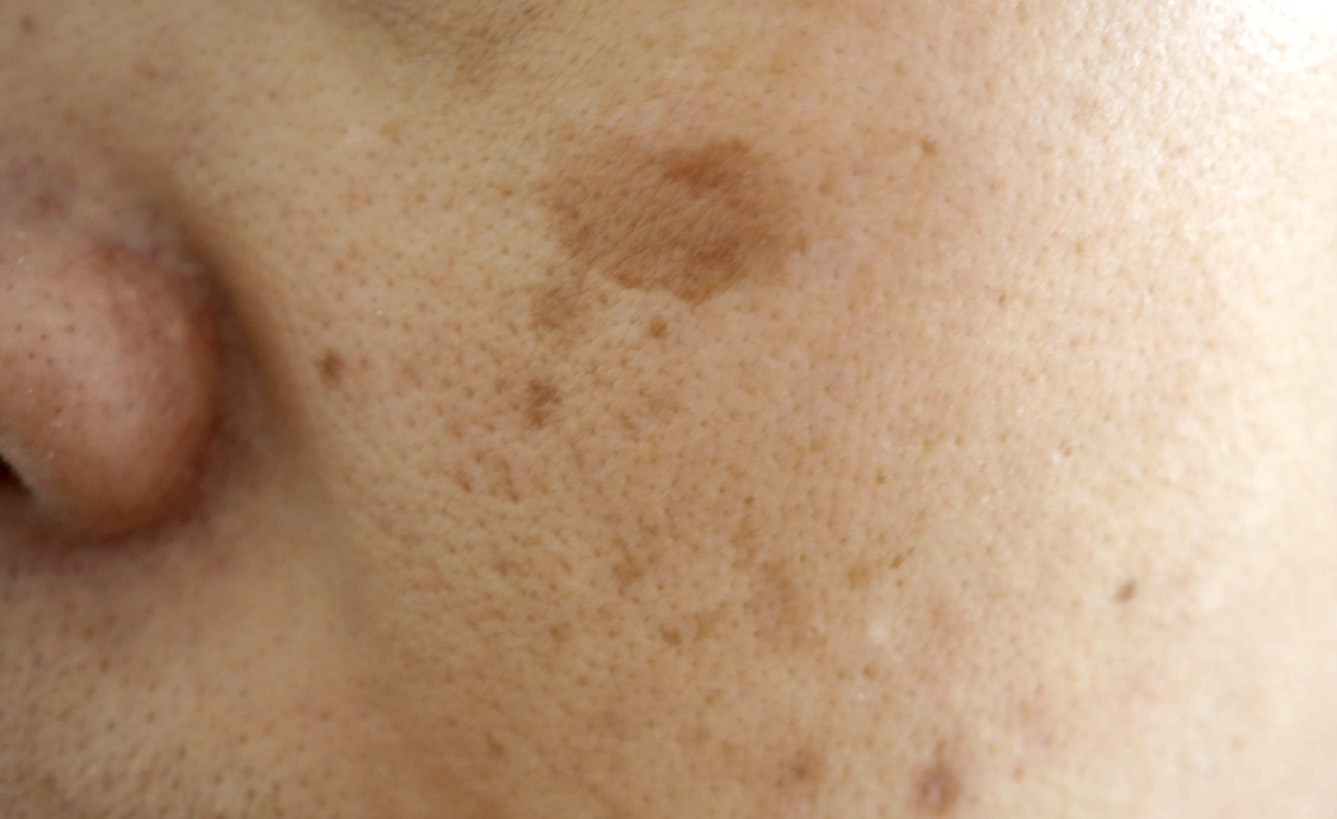
Solar lentigines are well defined tan to dark brown macules that appear on sun exposed skin, usually from the fourth decade of life. They reflect chronic ultraviolet exposure and are a visible marker of photoageing. The pigment sits in the basal layer of a mildly thickened epidermis, with a modest increase in melanocyte activity. Damaged dermal cells beneath the spot also release signals that keep melanin production elevated, which is one reason sun spots persist rather than fade.
Sun spots vs freckles vs melasma
Sun Spots, Freckles and Melasma Compared
| Feature | Sun Spots, Solar Lentigines | Freckles | Melasma |
|---|---|---|---|
| Onset | Adulthood, cumulative sun | Childhood | Adulthood, hormone linked |
| Border | Distinct, well demarcated | Small and scattered | Soft, blended, symmetrical |
| Behaviour | Persistent, accumulate over years | Fade a little without sun | Fluctuate with sun, heat and hormones |
| Best First Step | Pigment laser | Pigment laser | Sunscreen and topicals first, cautious laser |
Why sun spots appear on cheeks, temples and hands
These are the areas that receive the most cumulative ultraviolet light over a lifetime, including through car windows during daily driving. In Singapore year round sun means the exposure never pauses, so solar lentigines are common on the cheeks, temples, forehead and backs of the hands.
Can Pico laser remove sun spots?
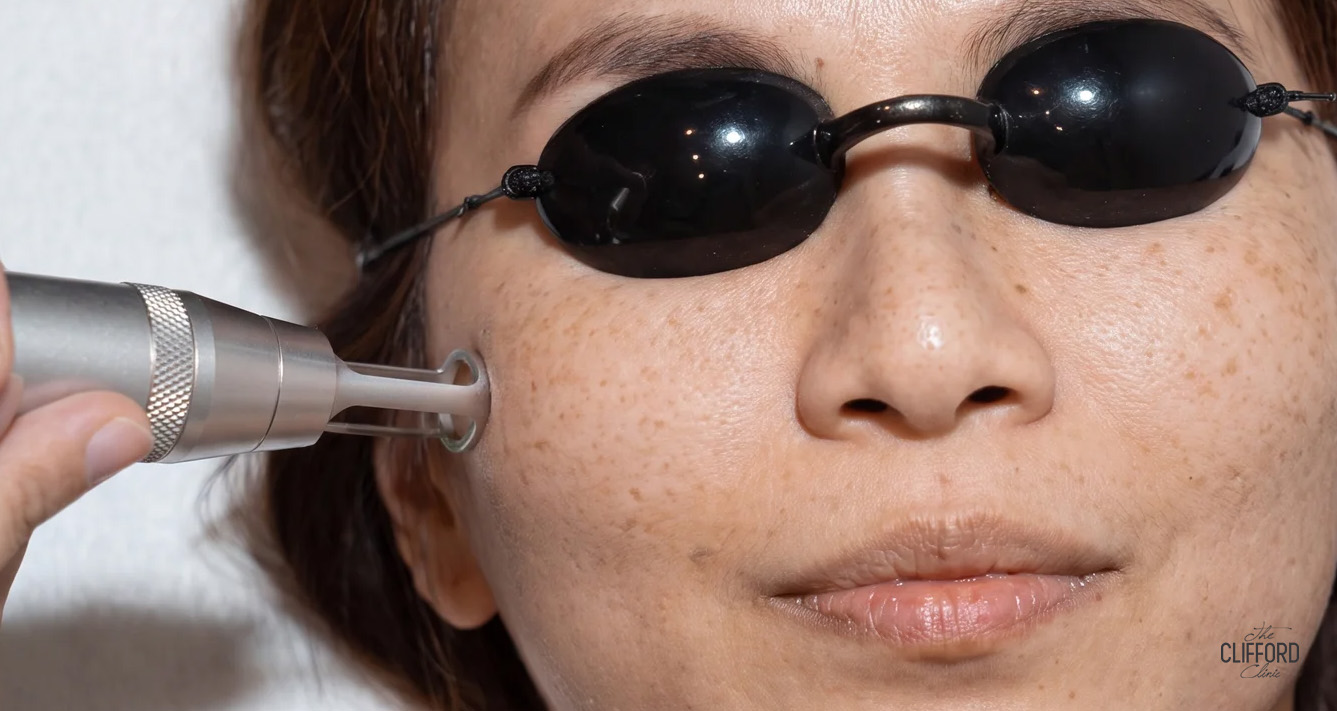
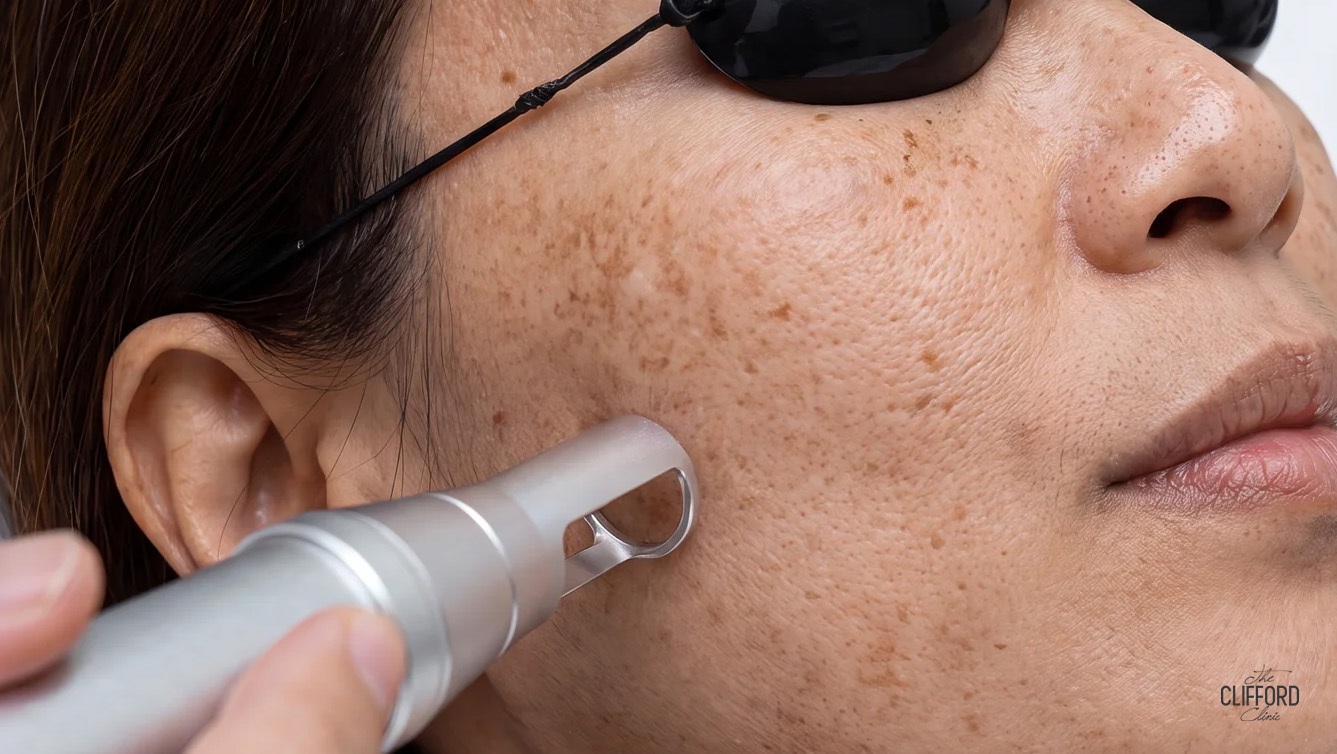
Pico laser fragments the pigment in a sun spot with very short pulses and minimal heat, and the fragments are then cleared by the body. Treated spots typically darken for several days, sometimes with a fine crust, then flake and fade. Superficial, well defined spots often respond within a small number of sessions.
Q-switched laser for sun spots
The Q-switched laser is a long established and effective option for solar lentigines, often at a lower price per session. It delivers more heat than a picosecond system, so conservative settings are used for darker skin tones to reduce the risk of post inflammatory pigmentation. For a fuller comparison see our article on Pico laser versus Q-switched laser.
What happens after spot laser
Expect mild redness for a few hours and localised darkening of the treated spot for several days. A fine crust may form and should be allowed to flake away naturally. Applying sunscreen each morning is essential during healing, because ultraviolet exposure on recovering skin is the main cause of temporary post inflammatory darkening. See our Pico laser aftercare guide.
Why spots can crust or darken first
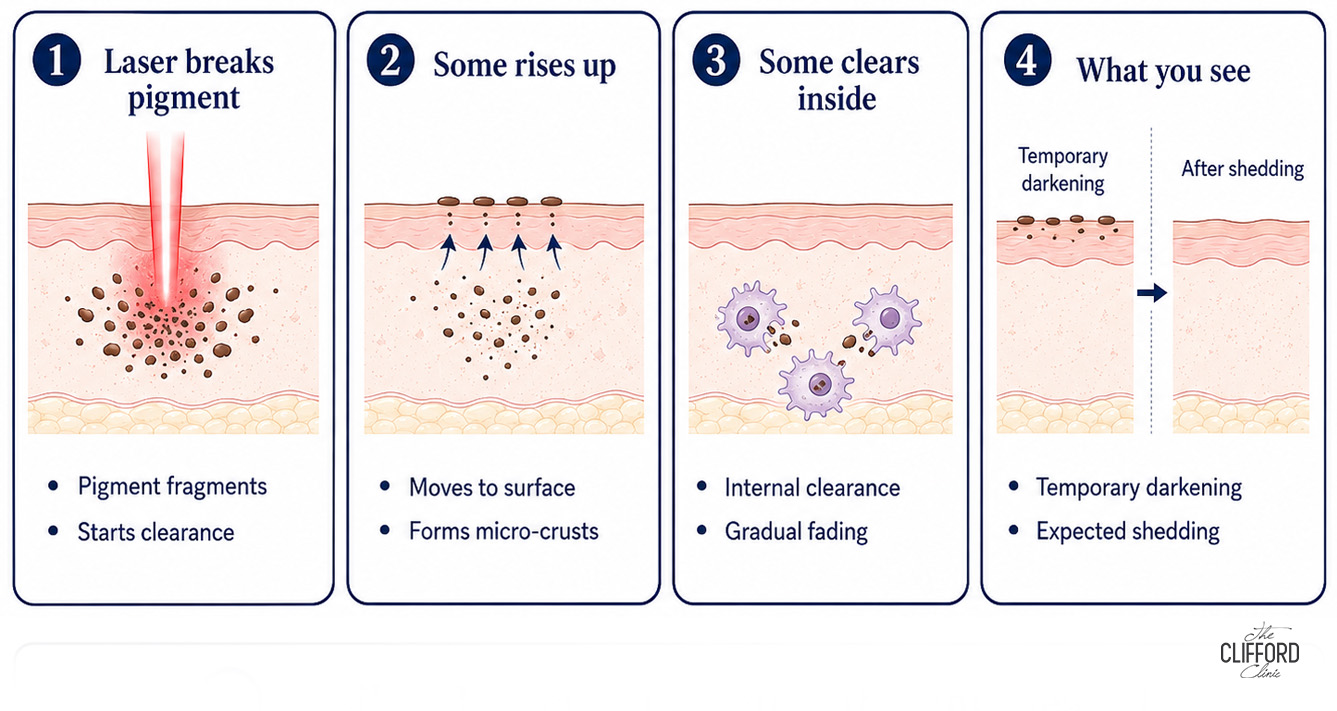
This is expected clearance, not a complication. The laser breaks the pigment into fragments, some of which rise to the surface and are shed as micro crusts while the rest are cleared internally. The visible darkening is the pigment being cleared.
Recurrence and sun protection
A cleared sun spot does not usually recur in the same place, but new spots form in sun exposed skin over time. Broad spectrum SPF 50 daily, hats and shade slow the appearance of new lentigines and protect your results.
When a brown spot needs medical review
Most sun spots are harmless, but a minority of pigmented lesions are not. See a doctor before any cosmetic treatment if a spot is new and enlarging in adulthood, has an irregular or notched border, shows more than one colour, is changing, or looks clearly different from your other spots. Learn more on our skin cancer page.
Suitable and not suitable
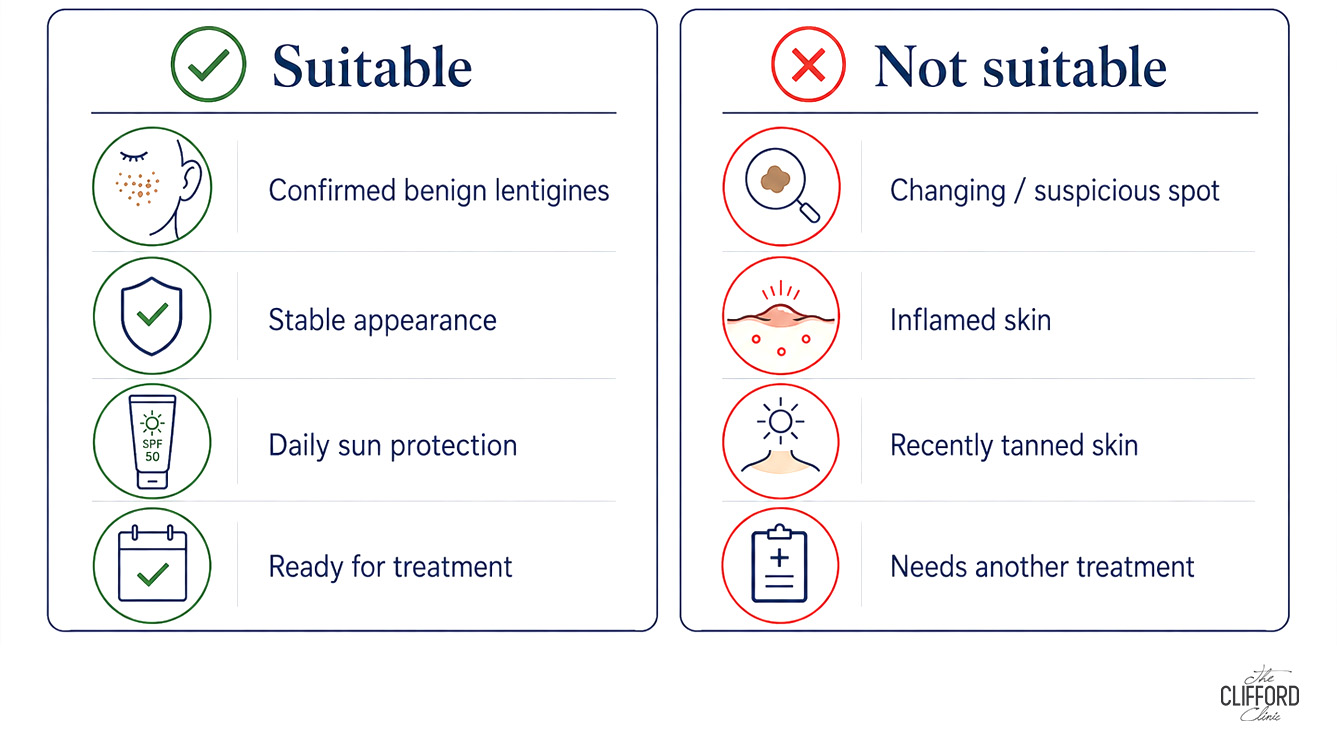
- Suitable:confirmed benign solar lentigines, stable in appearance, in a patient ready to use daily sun protection.
- Not suitable:any changing or suspicious spot before medical assessment, inflamed or tanned skin, or a lesion better managed by another method.
Doctor’s perspective. The most important step in sun spot treatment is the least glamorous one, confirming the spot is benign before we treat it. Lasering an unexamined changing lesion can delay a diagnosis that matters. Once a spot is confirmed as a simple solar lentigo, clearance is usually straightforward.
What a sun spot looks like under the skin
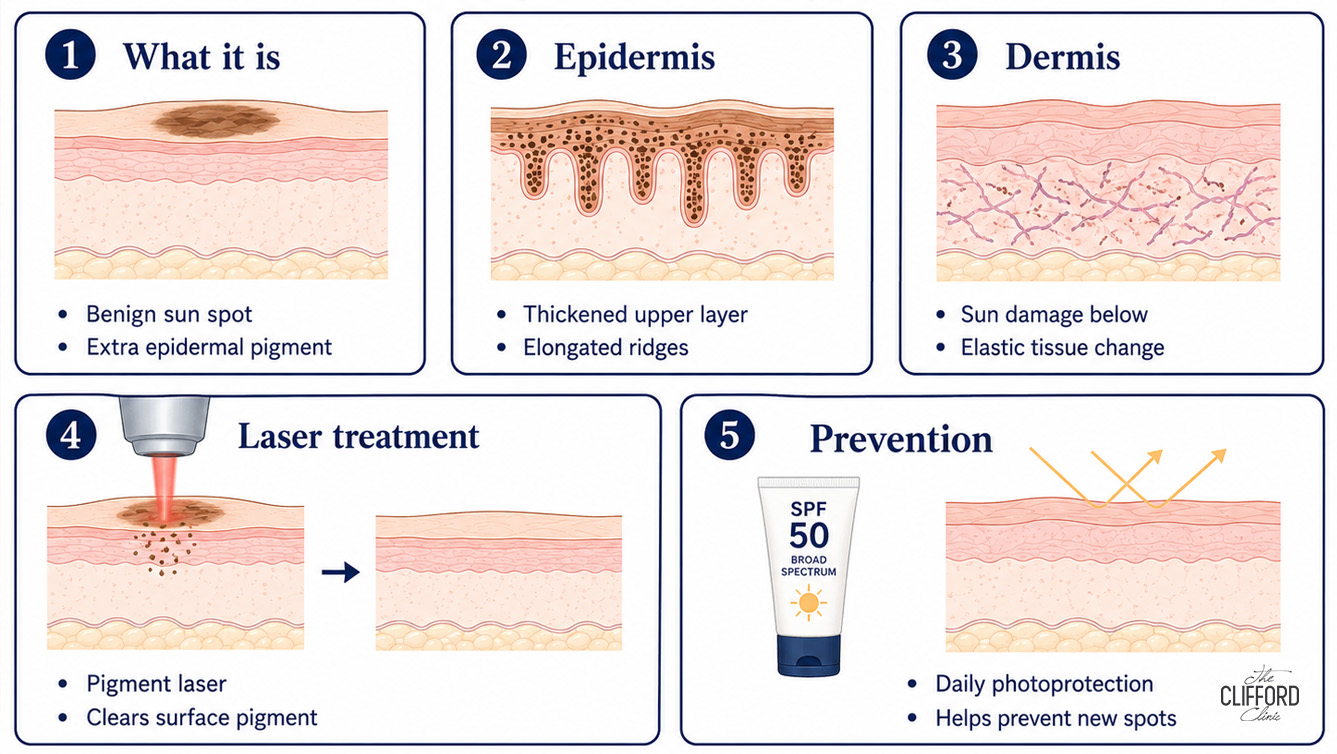
A sun spot, known medically as a solar lentigo, is more than a patch of extra colour. Under the skin the upper layer is thickened, the ridges at the base of the epidermis are elongated, and the dermis shows a build up of sun damaged elastic tissue. Solar lentigines respond well to pigment lasers that clear the epidermal pigment, while ongoing photoprotection addresses the dermal drive that would otherwise form new spots.
How sun spots are matched to a wavelength
Sun spots are superficial pigments, a 532 nm picosecond beam is effective when treated to a light whitening rather than an aggressive frost endpoint. Where sun damage is diffuse across the cheeks as opposed to isolated spots, the non-ablative Fraxel 1927 is a more effective tool in achieving even tone. In darker skin the energy is kept conservative, since these spots sit in skin already primed to pigment.
Frequently asked questions
What is the best treatment for sun spots in Singapore?
Pigment lasers such as Pico laser or Q-switched laser are the mainstay for confirmed solar lentigines, chosen by a doctor to suit your skin tone and the depth of pigment.
Can Pico laser remove sun spots?
Yes. It fragments the pigment with short, low heat pulses and the body clears it over the following weeks, often within a small number of sessions.
Are sun spots permanent?
Untreated they tend to persist and slowly accumulate. Laser can clear individual spots, and sun protection limits new ones.
Why do sun spots get darker after laser?
Temporary darkening is a normal stage of clearance as fragmented pigment rises and sheds. It settles over one to two weeks.
How many sessions are needed for sun spot removal?
Discrete spots often need only a small number of sessions. Widespread or deeper pigmentation may need more. Your doctor estimates after examining the area.
Are sun spots the same as age spots?
Yes. Age spots and liver spots are common names for solar lentigines. The term describes the same sun related pigmentation.
Have your spots checked and cleared

Diagnosis first, treatment second. Learn about pigmentation treatment in Singapore, or book at The Clifford Clinic, 50 Raffles Place, #01-01 Singapore Land Tower. Call (65) 6532 2400 or WhatsApp (65) 8318 6332.
Selected References
- Algorithmic approach to the treatment of solar lentigines with picosecond lasers. Lasers in Surgery and Medicine, 2023. https://onlinelibrary.wiley.com/doi/10.1002/lsm.23701.
- Characteristics of dermal vascularity in melasma and solar lentigo. Photodermatology, Photoimmunology and Photomedicine, 2024. https://onlinelibrary.wiley.com/doi/10.1111/phpp.12953.
- Disorders of hyperpigmentation, part I: pathogenesis and clinical features of common pigmentary disorders. Journal of the American Academy of Dermatology, 2023. https://pubmed.ncbi.nlm.nih.gov/35151757.
- American Academy of Dermatology: hyperpigmentation. https://www.aad.org/public/diseases/a-z/hyperpigmentation-treatment

Author Bio
Dr Gerard Ee

Dr Gerard Ee is the Medical Director of The Clifford Clinic in Singapore. He earned his medical degree from St George's University of London and built his surgical experience across the Singapore General Hospital, National University Hospital, and Mount Sinai Hospital in New York. He holds Membership of the Royal College of Surgeons (Edinburgh) and a Postgraduate Diploma in Dermatology (Cardiff), and is fully accredited in aesthetic procedures including botulinum toxin, fillers, lasers, and light therapies. A strong advocate of minimally invasive, natural-looking results, Dr Ee has published in several medical and scientific journals and presented his research in cities including Taipei, Las Vegas, and London.
See all posts by Dr Gerard Ee »