

Rejuran for Dark Eye Circles in Singapore: What It Can and Cannot Improve
Rejuran is one of the most commonly requested injectable treatments for the under-eye area in Singapore and Korea. It is used mainly to improve hydration, elasticity, fine lines and the quality of thin or crepey lower-eyelid skin. In selected patients, better-supported skin may make underlying vessels less visible and help the under-eye area look brighter and smoother. Rejuran does not treat every cause of dark eye circles, so the first step is still to identify whether the dominant problem is pigment, visible vessels, structural shadowing, allergy or a mixture.
Why Rejuran Is Widely Used for the Under-Eye Area
Rejuran is most relevant when thin, dry or crepey skin contributes to the under-eye concern. By supporting hydration, elasticity and fine lines, it may make translucent lower-eyelid skin look healthier and less tired. Its effect on dark circles is indirect: it improves the skin through which vessels and shadows are seen, rather than directly targeting haemoglobin or melanin.
Dark Eye Circles: Presentation and Treatment Direction
| Presentation | Aligned Treatment Message |
|---|---|
| Vascular-Looking Circles | Vbeam targets haemoglobin. Rejuran may be added where thin or crepey skin makes the vessels more visible. |
| Pigmented Circles | Q-switched or picosecond laser and topical pigment treatment address melanin. Rejuran is not the pigment-directed step. |
| Structural Hollows or Selected Mild Bags | Filler can restore a tear trough and may camouflage selected mild bags by smoothing the lid-cheek transition. Rejuran does not provide the same structural correction. |
| True Eye Bags | AGNES plus Secret RF or surgery may be considered according to anatomy. Rejuran does not reduce protruding fat. |
| Allergic Shiners | Treat rhinitis, conjunctivitis, dermatitis and rubbing. Rejuran may support skin quality but does not correct the allergic driver. |
The Four Types of Dark Eye Circles (and Why Rejuran Alone Cannot Fix Them All)
There are 4 subtypes of Dark Eye circles.
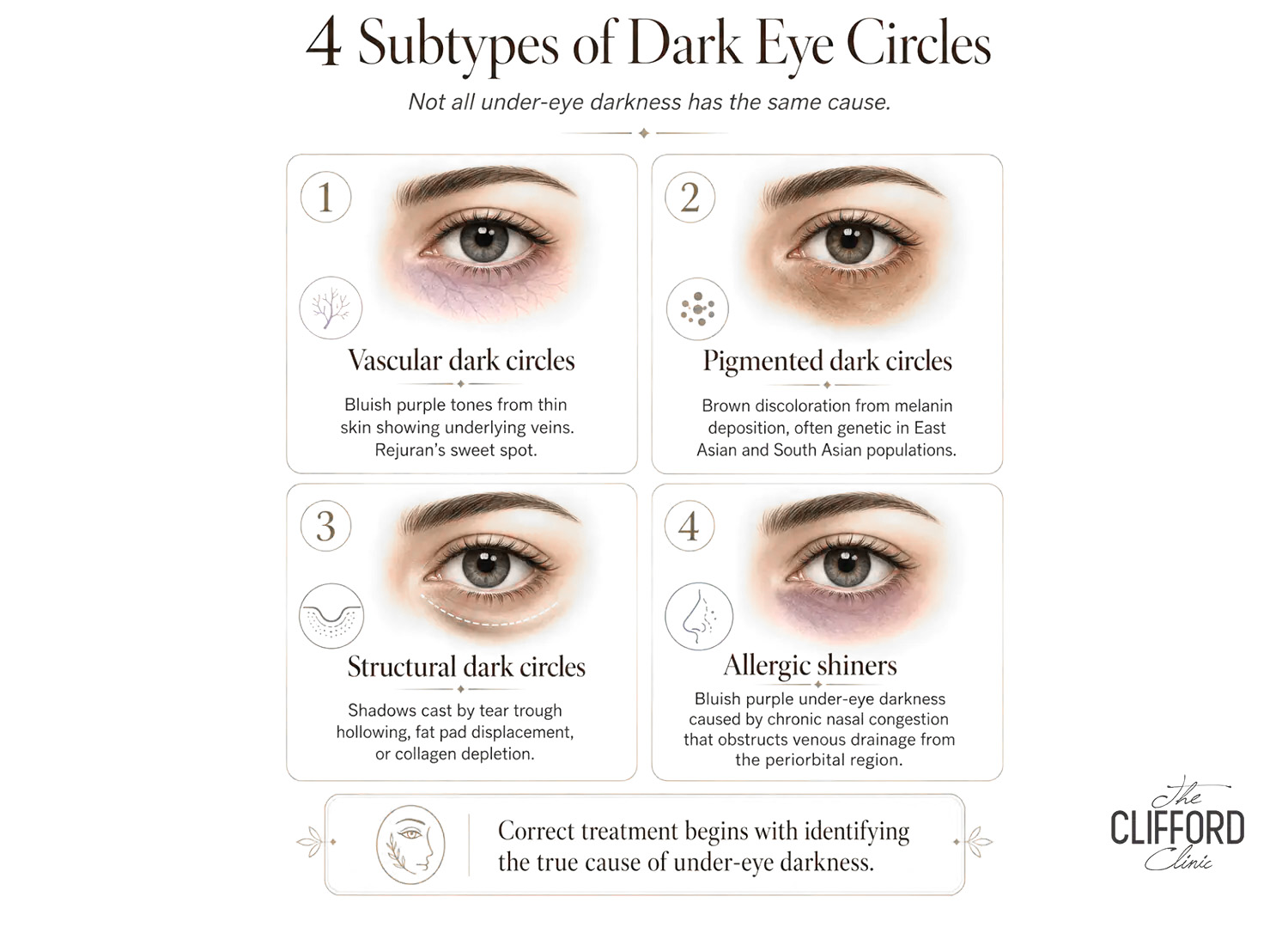
- Vascular dark circles — bluish-purple tones from thin skin showing underlying veins. Rejuran’s sweet spot.
- Pigmented dark circles — brown discoloration from melanin deposition, often genetic in East Asian and South Asian populations.
- Structural dark circles — shadows cast by tear trough hollowing, fat pad displacement, or collagen depletion.
- Allergic shiners — bluish-purple under-eye darkness caused by chronic nasal congestion that obstructs venous drainage from the periorbital region.
Rejuran handles vascular and mild textural concerns brilliantly. It does not, however, fill hollows, bleach melanin, or fix venous drainage problems caused by allergies. This is why there is a large range of treatment options and why either a combination or alternative options may be more suitable for you.
Juvelook for Dark Eye Circles
Where a genuine tear-trough hollow is present, hyaluronic acid filler remains the direct volumising treatment. Juvelook may be considered for skin quality and selected shallow contour concerns, sometimes in combination with filler, depending on the anatomy. It should not be described as a universal substitute for filler in a significant hollow.
Why Koreans pair Juvelook with Rejuran: Rejuran improves skin quality from within; Juvelook restores structural support. Used together, they address both the surface and the foundation of the under-eye region.
RE20 (Re2O) ECM Skin Booster: Korea’s 5th-Generation ECM Skin Booster

RE20 is an emerging extracellular-matrix injectable used for skin-quality concerns. Its published randomised facial study assessed the cheeks rather than the lower eyelid. Under-eye use should therefore be presented as an application based on broader facial evidence, manufacturer information and the treating doctor’s clinical experience, rather than as proven correction of dark eye circles.
Why Korean dermatologists love RE20 for under-eyes:
- It delivers the exact building blocks of skin (collagen, elastin, GAGs) rather than relying on the skin to produce them from scratch.
- It improves texture, elasticity, and loose skin, especially in common complaints in mature under-eye zones.
- It works synergistically with PDRN-based products like Rejuran.
RE20’s goal is improvement in texture, elasticity, crepey skin, pores, and overall vitality, rather than hydration alone. This makes it a particularly elegant fit for patients whose under-eyes look thin and weathered rather than hollow.
Cellredem (CellREDM) ECM Skin Booster for Dark Eye circles
CellREDM is another emerging extracellular-matrix injectable used for skin-quality concerns. At the evidence-search date, no indexed brand-specific clinical trial was identified. This does not establish that the product is ineffective; it means that recommendations currently rely on manufacturer information and clinical experience rather than published under-eye trial evidence.
The Korean Combination Philosophy: Why One Product Is Rarely Enough
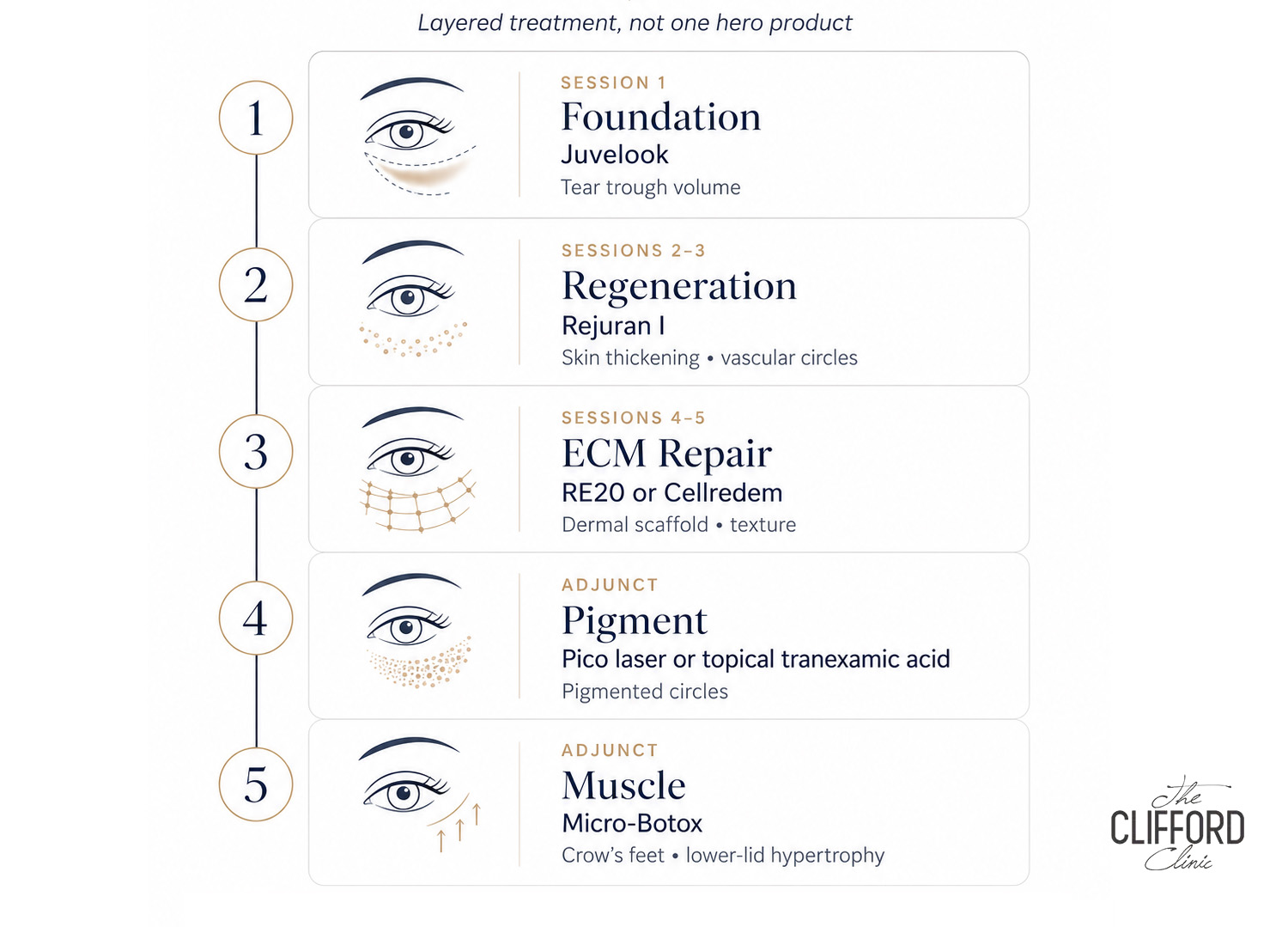
What separates Korean dermatology from much of the global aesthetic industry is the concept of treatment stacking, using multiple modalities in a coordinated protocol rather than relying on a single hero product. A typical Gangnam under-eye protocol may look like this:
- Session 1 (Foundation): Juvelook to restore structural volume in the tear trough.
- Sessions 2–3 (Regeneration): Rejuran I to thicken skin and improve vascular dark circles.
- Sessions 4–5 (ECM Repair): RE20 or Cellredem to rebuild dermal scaffolding and improve texture.
- Adjunct (Pigment): Pico laser or topical tranexamic acid for pigmented circles.
- Adjunct (Muscle): Micro-Botox for crow’s feet and lower-lid hypertrophy.
The Most Overlooked Cause: Allergic Shiners and the SLIT Solution
Where allergic rhinitis, conjunctivitis or dermatitis contributes to congestion and rubbing, treating the allergy is medically appropriate and may reduce an ongoing driver of under-eye darkness. Sublingual immunotherapy may be considered for suitable allergic-rhinitis patients. It should not be presented as proven to erase established under-eye pigmentation or as a direct replacement for every injectable or laser treatment.
Why Allergic Rhinitis Causes Dark Eye Circles
When you inhale allergens like dust mites, pollen, and pet dander, the mast cells in your nasal mucosa release histamine, leukotrienes, and Th2 cytokines like IL-4, IL-5, and IL-13. This triggers nasal turbinate swelling and mucosal oedema, which compresses the venous drainage pathways from the orbits. The result is that periorbital veins widen and fill with pooled, deoxygenated blood, creating dark, shadowy discolouration visible through thin skin.
Studies also show that allergic patients exhibit significantly higher periorbital vascular density and elevated VEGF-C expression, perpetuating the congestion even between flare-ups. Especially in Singapore, where house dust mite sensitisation rates exceed 80% in some populations, allergic shiners may be the single most under-diagnosed cause of stubborn dark circles.
How Sublingual Immunotherapy (SLIT) Fixes Allergic Rhinitis
Sublingual Immunotherapy (SLIT) is currently the only disease-modifying treatment for allergic rhinitis. Patients place escalating doses of allergen extract, which is often dust mite or grass pollen, under the tongue daily for about 3 years, gradually retraining the immune system to tolerate the allergen.
The mechanism is elegant:
- An immune shift from Th2-dominant (allergic) to Th1-dominant (tolerant) responses.
- Induction of IL-10-expressing CD4+CD25+Foxp3+ regulatory T cells that suppress allergic inflammation.
- A documented two-fold increase in allergen-specific IgG4 antibodies that act as blocking antibodies, intercepting allergens before mast cell activation.
As nasal inflammation subsides, venous drainage from the periorbital region normalises, and allergic shiners gradually fade.
SLIT is endorsed by the World Allergy Organization as a safe and effective alternative to subcutaneous immunotherapy, with the major advantages of home administration, no needles, and a far lower risk of severe systemic reactions. For patients in tropical and subtropical climates where dust mite exposure is constant, SLIT may be the single most cost-effective long-term investment in under-eye appearance.
The Smart Treatment Roadmap for Dark Eye Circles
Pulling it all together, the optimal Dr Gerard Ee inspired protocol in 2026 looks something like this:
- Diagnose first. Identify which subtype (vascular, pigmented, structural, allergic) is dominant or which combination.
- Screen for allergic rhinitis. A simple skin prick test or specific IgE blood panel rules out allergic shiners. If positive, start SLIT.
- Layer injectables strategically:
- Rejuran I for vascular dark circles, thin skin, and texture.
- Juvelook for tear trough hollowing and structural support.
- RE20 or Cellredem for ECM rebuilding and ceramic-skin texture.
- Add adjunctive therapies pico laser for pigment, micro-Botox for muscle-driven shadows, daily SPF 50+, and retinoids.
- Maintain consistently. Have patients treat under-eye care as ongoing maintenance, not a one-time fix.
Frequently Asked Questions (FAQ)
Q: Is Rejuran for dark eye circles really the best Korean treatment? Rejuran I is the most popular Korean treatment for vascular dark circles and thin under-eye skin, but it is rarely used alone. Korean dermatologists typically combine it with Juvelook, RE20, or Cellredem depending on the patient’s specific concerns.
Q: What is the difference between Rejuran, Juvelook, RE20, and Cellredem? Rejuran uses salmon-derived PDRN for regeneration. Juvelook combines PDLLA with HA for structural volume and collagen. RE20 and Cellredem use human-derived acellular dermal matrix (ECM) for skin rebuilding. Each targets different aspects of under-eye ageing.
Q: How do I know which treatment I need? A proper diagnosis matters more than the product. If your dark circles are bluish and from thin skin, Rejuran. If your under-eyes are hollow, Juvelook. If your skin texture is rough or crepey, RE20 or Cellredem. If symptoms worsen with allergies, get tested for allergic rhinitis and consider SLIT.
Q: Are RE20 and Cellredem available outside Korea? RE20 and Cellredem are primarily available in South Korea and also in Singapore.
Q: How many sessions do I need for Korean under-eye treatments? Most protocols require 3–4 sessions spaced 3–4 weeks apart, followed by maintenance every 6–12 months. Stacked protocols may require more sessions distributed across different products.
Q: Is RE20 safe? RE20 uses tissue to build ECM deep within the skin. The cellular material is removed, leaving only the ECM scaffold. The product has gone through many round of testing and purification before it is released to the public.
Q: Can SLIT really replace injectables for dark eye circles? For allergic shiners, yes SLIT addresses the root cause. For non-allergic dark circles, SLIT will not help. Many patients benefit from combining SLIT (for allergies) with injectables (for ageing-related changes).
Q: How much do these treatments cost in Singapore? Prices vary by clinic, but ranges typically include Rejuran I at approximately SGD$800 per session, Juvelook eyes at SGD$1000 for both eyes, and RE20 or Cellredem at $1500-$1800 for the full face including the eyes.
Q: Is there any downtime with these treatments? Mild swelling, redness, and small injection bumps lasting 4-6 hours are common. Cellredem typically has the least downtime due to its ultra-fine particle technology. Rejuran may produce more visible bumps initially.
Q: Can I do all of these treatments together? Yes, but they should be sequenced strategically by an experienced injector. Dr Gerard Ee, Medical director of The clinic as well as most clinics in Korea schedule different products 2–4 weeks apart rather than stacking them in a single session.
Final Thoughts: Rejuran for Dark Eye Circles Is Just the Beginning
Rejuran remains a widely used under-eye treatment because many patients value improvements in hydration, fine lines and skin quality. It is most useful when thin, dry or crepey lower-eyelid skin contributes to the tired appearance. It is not a universal treatment for pigment, a major hollow or a true eye bag. The best result comes from matching Rejuran – or an alternative treatment – to the part of the under-eye problem it can realistically improve.
If you are serious about treating your dark eye circles, do not just ask your clinician for Rejuran. Ask them what Koreans are actually doing. What experts like Dr Gerard Ee are recommending, and which combination is right for your specific under-eye pathology.