
Post-Inflammatory Hyperpigmentation Treatment Singapore
Written by Dr Bernard Ong. Medically reviewed by Dr Gerard Ee
Post-inflammatory hyperpigmentation, or PIH, is the flat brown mark left behind after acne, eczema, injury or a procedure inflames the skin. It is a pigment problem, not a scar, and it is especially common in Asian skin. PIH fades over months to years without treatment, depending on how deeply the pigment sits, and faster with sunscreen, topical treatments and, where needed, Pico laser. The first step is controlling the inflammation that caused it, because untreated acne or eczema continues to generate new marks.
What is post-inflammatory hyperpigmentation?
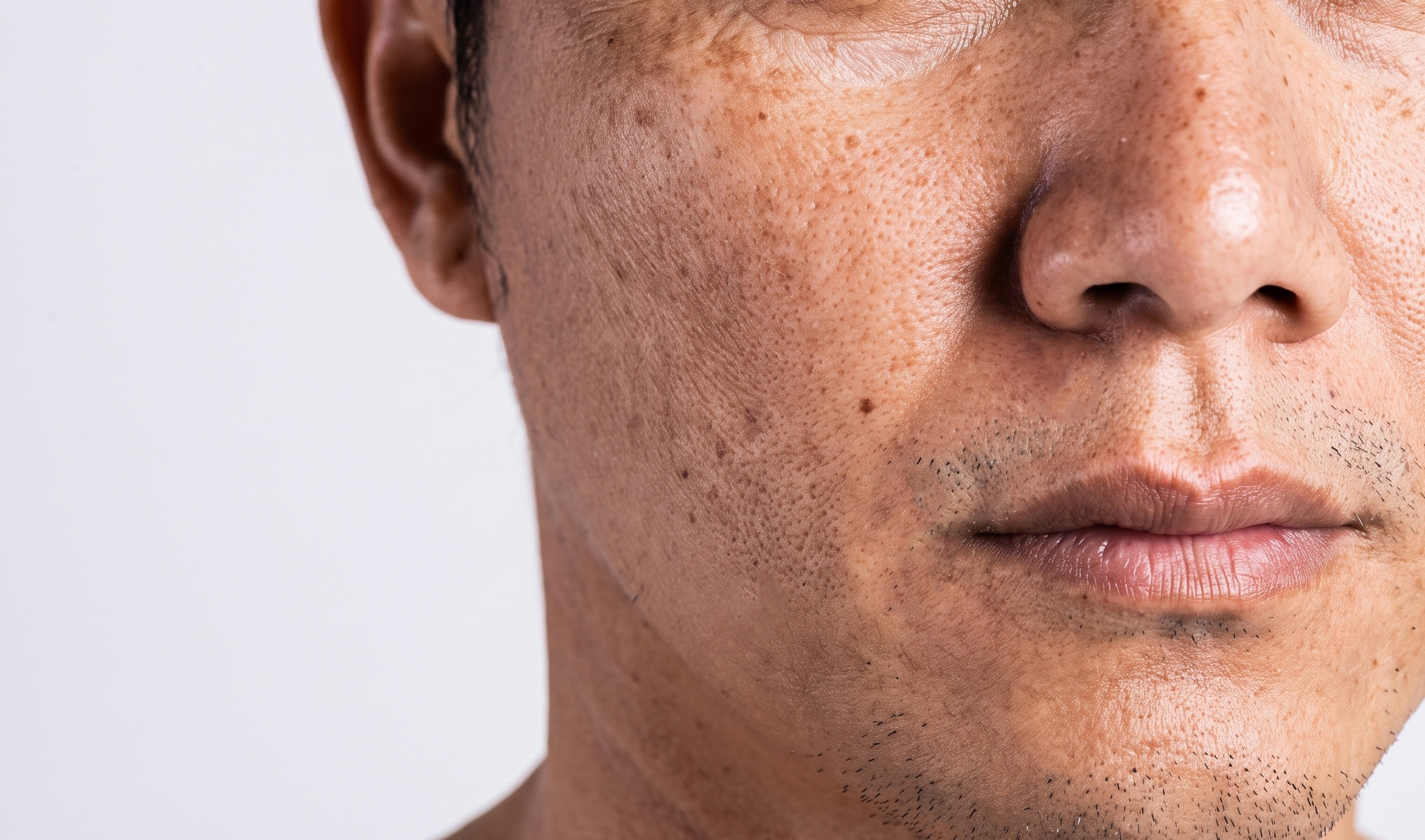
PIH is excess melanin produced in response to skin inflammation. When skin is inflamed, melanocytes are stimulated to make more pigment, which is deposited in the epidermis and sometimes the dermis. That depth determines both the colour and the time to clearance. Pigment held in the epidermis looks light to dark brown and usually clears within months, while pigment that has dropped into the dermis looks greyish or blue-brown and can persist for years. The result is a flat brown or tan mark exactly where the inflammation occurred. Unlike a scar, PIH involves no change in skin texture, only colour, which is why resurfacing treatments designed for acne scars do little to shift it.
Why PIH is common in Asian skin
Asian skin (Fitzpatrick types III to V) carries more reactive melanocytes, which respond briskly to any inflammation. In Singapore, the combination of acne-prone conditions, humidity and intense year-round sun means PIH is one of the most frequent pigment complaints. Ultraviolet exposure restimulates the melanocytes that produced the mark, deepening it and delaying resolution, which is why daily photoprotection is central to treatment.
Acne and PIH
Acne is the leading cause of facial PIH. Each inflamed lesion can leave a brown mark that persists for months, and deeply inflamed lesions such as nodules leave darker marks than blackheads and whiteheads do. Picking or squeezing worsens the inflammation and the resulting mark, because it drives inflammation deeper into the skin, where pigment is far harder to clear. Controlling active acne through a proper acne treatment plan is the foundation, because pigment treatment cannot outpace skin that is still producing new inflamed lesions.
Eczema, irritation and PIH
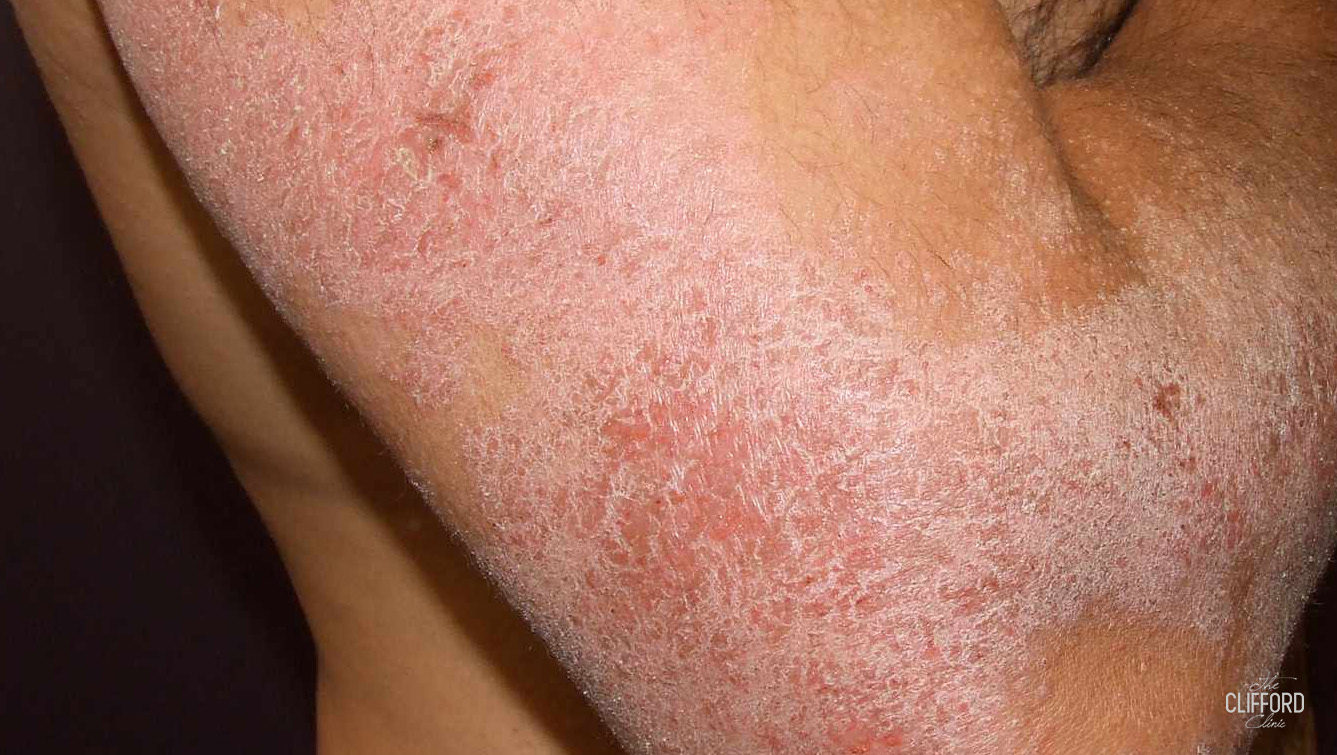
Eczema, allergic reactions, harsh scrubbing and over-exfoliation all inflame the skin and can trigger PIH. Marks that follow eczema return with each subsequent flare and in the same distribution, so control of the eczema takes priority over any pigment treatment. Aggressive skincare intended to fade dark marks sometimes causes more of them, because the irritation itself drives pigment. Faster results are observed with a restrained routine, slow, sequential introduction of active ingredients, and cessation of product causing stinging or lasting redness, compared to an aggressive regimen keeping skin inflammation.
PIH after procedures
Energy-based treatments, chemical peels and other procedures can occasionally cause PIH, particularly in darker skin or when settings are too strong. The mechanism is the same one that follows acne, namely heat and inflammation stimulating the melanocytes, so a treatment aimed at pigment can transiently produce more of it. This is why doctors use conservative settings, space sessions three to four weeks apart and insist on strict sun protection afterwards in Asian skin. Our Pico laser aftercare guide covers how to reduce this risk.
Treatment options at a glance
PIH Treatment Options Compared
| Approach | What It Does | Best Suited To |
|---|---|---|
| Sun Protection | Prevents darkening and allows fading | Everyone with PIH |
| Topical Agents | Suppress melanin and speed cell turnover | Most epidermal PIH |
| Chemical Peels | Accelerate exfoliation of pigmented cells | Superficial PIH, in a series |
| Pico Laser | Fragments residual pigment with minimal heat | Stubborn or deeper PIH after acne control |
| Tranexamic Acid | Reduces melanin production and inflammation | Selected persistent cases, doctor-supervised |
Can Pico laser treat PIH?
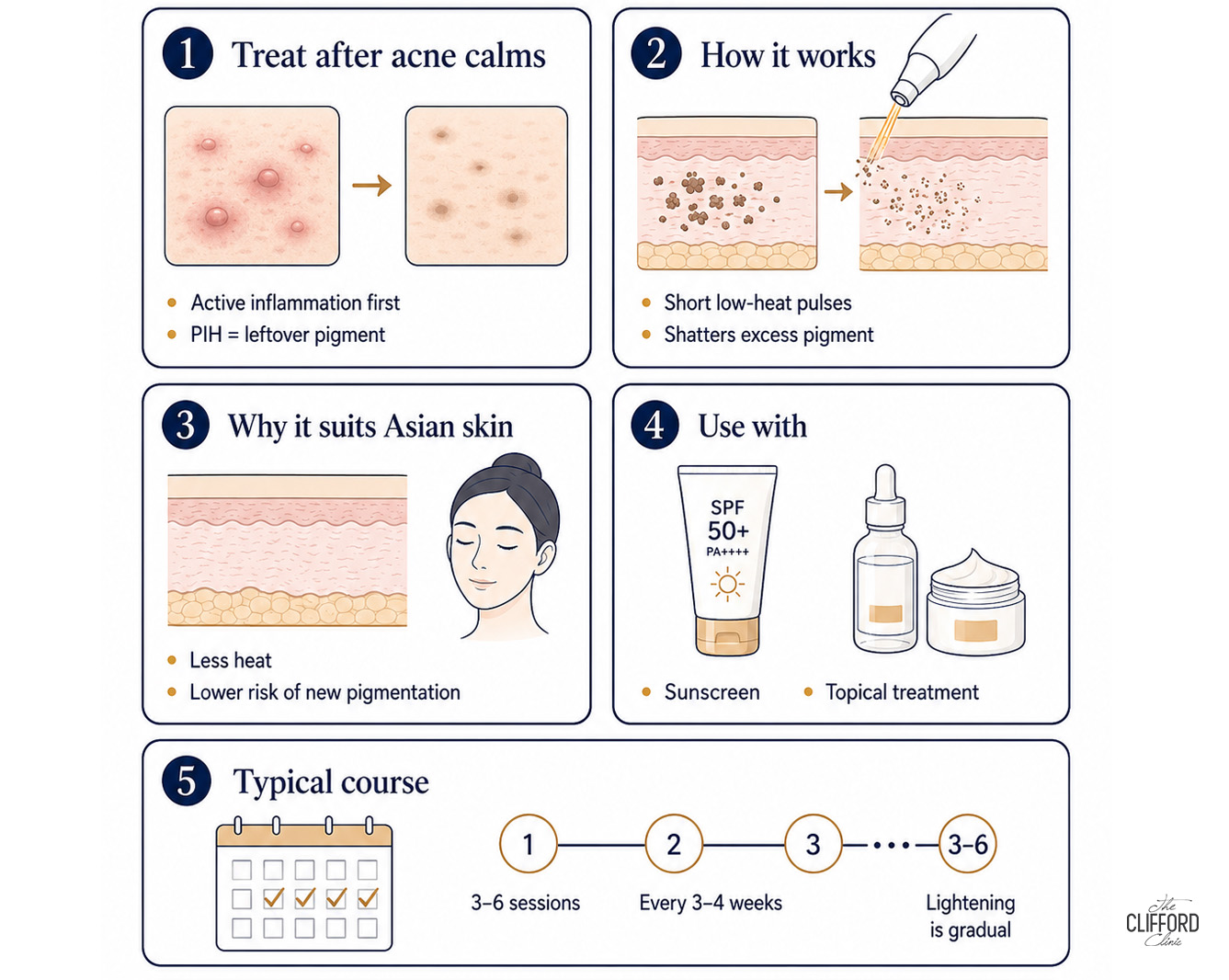
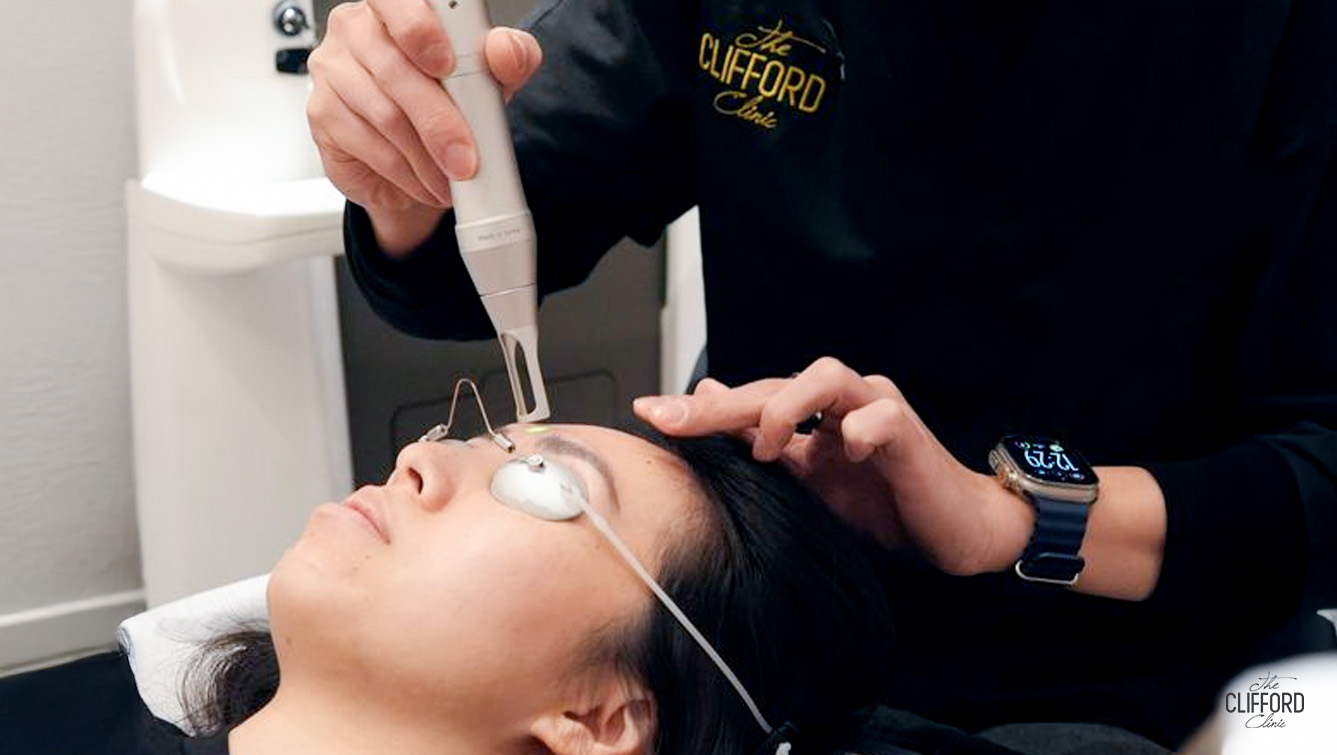
Pico laser has a defined role in PIH once active inflammation is controlled. Pico laser fragments excess pigment with short, low-heat pulses, which suits Asian skin and lowers the risk of causing further pigmentation. Each pulse lasts trillionths of a second, so the pigment is shattered mechanically rather than by heat, and it is heat that provokes fresh pigment in darker skin. It is usually combined with sunscreen and topical treatment. Most patients require a course of three to six sessions spaced three to four weeks apart, and lightening is gradual rather than immediate.
Topical skincare for PIH
Prescription and cosmeceutical ingredients that help PIH include retinoids to speed turnover, vitamin C and niacinamide, azelaic acid, and pigment inhibitors such as hydroquinone, which is prescribed in short, supervised courses rather than used continuously. Niacinamide also reduces the transfer of pigment into skin cells and supports the skin barrier. Tranexamic acid, topical or oral, may be added by a doctor for persistent cases, because it reduces both melanin production and the inflammatory signals that drive it. Topical treatment acts gradually, and eight to twelve weeks of consistent daily use is a fair trial before judging whether a regimen is working.
Why active inflammation must be controlled first
Treating PIH while the underlying acne or eczema remains active, produces little durable benefit. Every fresh lesion leaves a fresh mark. Once the inflammation is controlled, the remaining pigment is a finite problem that can be treated to completion, whereas continuing inflammation replenishes it faster than any treatment can clear it. Pigment-directed treatment therefore begins only after new inflamed lesions have stopped appearing, which for acne usually means several weeks of effective medical therapy first.
How long PIH takes to fade
Superficial PIH often improves over three to twelve months with daily sun protection and topicals. Deeper or older marks can take years to resolve and are where laser contributes most. Progress is not linear, and a mark that has faded can darken again after a single weekend of unprotected sun exposure, which is why daily photoprotection matters more than the strength of any individual treatment.
Suitable and not suitable
- Suitable: flat brown marks after controlled acne or inflammation, in a patient using daily sun protection.
- Not suitable: active untreated acne or eczema in the area, textured acne scars that need resurfacing rather than pigment treatment, or an undiagnosed lesion.
Doctor’s perspective. PIH is a disorder of pigment rather than of structure, and pigment can be cleared. It clears slowly, however, and recurs with every new inflammatory episode. The patients who clear their marks fastest are those who control the inflammation first and protect their skin from the sun every day, not those who begin with the most powerful device.
The wavelengths that suit post-inflammatory marks
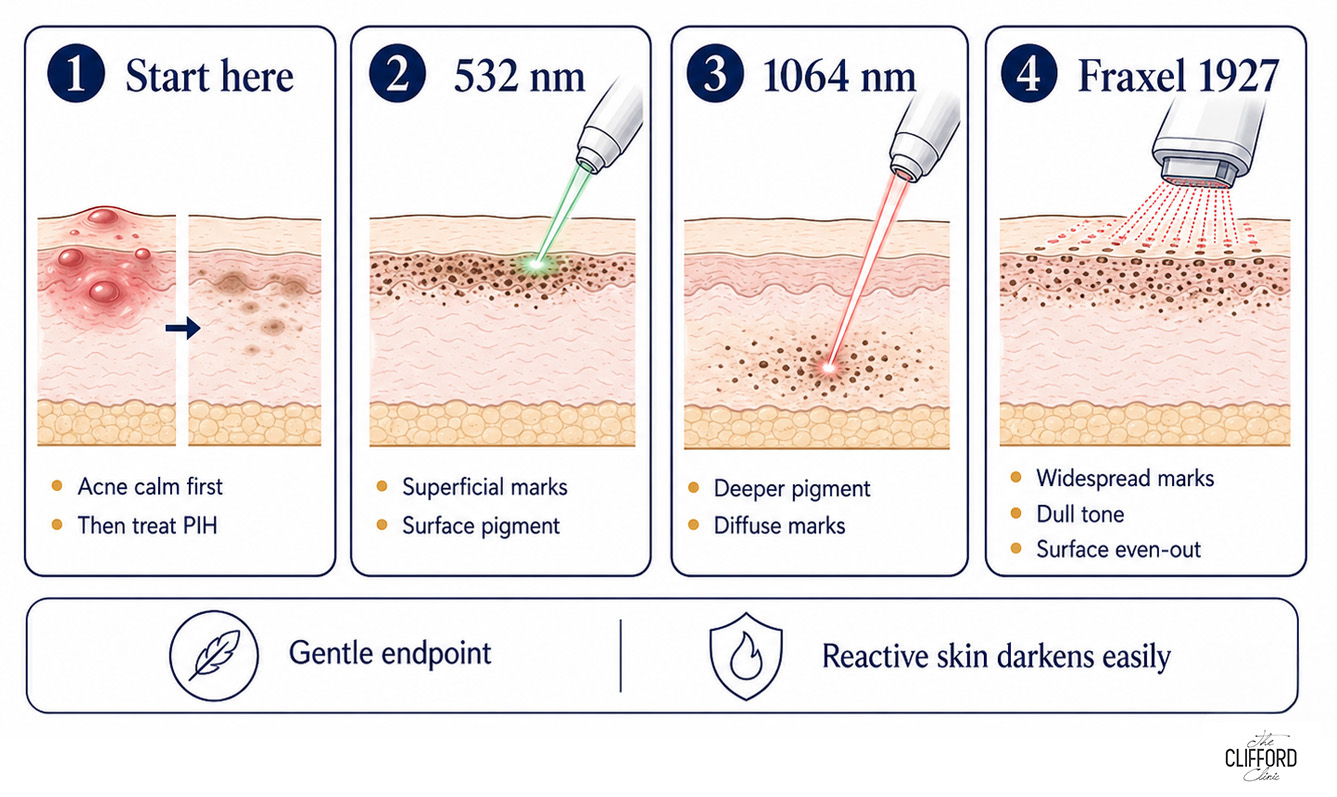
Once the inflammation behind the marks is controlled, the pigment is matched to a wavelength by depth. Superficial marks respond to 532 nm, while deeper or more diffuse pigment suits 1064 nm, both delivered at a gentle endpoint because reactive skin darkens easily. Where the marks are widespread and mixed with dull tone, the non-ablative Fraxel 1927 can even out the surface. Restraint in the settings matters as much as the wavelength in skin already prone to pigment.
Frequently asked questions
What causes PIH?
PIH is caused by inflammation of the skin, most often from acne, but also eczema, irritation, injury or procedures, which stimulates excess melanin.
How long does PIH take to fade?
Superficial marks often improve over three to twelve months with sun protection and topicals. Deeper marks can take years and usually need laser.
Can Pico laser remove PIH?
Yes, once active inflammation is controlled. It fragments residual pigment with low-heat pulses, usually over three to six sessions, alongside sunscreen and topicals.
Is PIH the same as acne scars?
No. PIH is a flat brown mark, a pigment problem. Acne scars are texture changes in collagen. They need different treatments and often occur together.
Why does Asian skin get PIH easily?
Asian skin has more reactive melanocytes that respond strongly to inflammation, and intense sun exposure in Singapore deepens and prolongs the marks.
Can skincare fade PIH?
Yes, gradually. Sunscreen, retinoids, vitamin C, niacinamide and azelaic acid help superficial PIH over two to three months of consistent use. Stubborn marks benefit from added laser.
Building a PIH treatment plan that lasts
Control the cause, protect from the sun, then treat what remains. Learn about pigmentation treatment in Singapore, or book at The Clifford Clinic, 50 Raffles Place, #01-01 Singapore Land Tower. Call (65) 6532 2400 or WhatsApp (65) 8318 6332.
References
- Disorders of hyperpigmentation, part I, pathogenesis and clinical features of common pigmentary disorders. Journal of the American Academy of Dermatology, 2023. https://pubmed.ncbi.nlm.nih.gov/35151757.
- Safety and efficacy of niosomal and conventional tranexamic acid and niacinamide versus hydroquinone creams in melasma. Scientific Reports, 2025. https://pubmed.ncbi.nlm.nih.gov/41315336.
- DermNet, postinflammatory hyperpigmentation. https://dermnetnz.org/topics/postinflammatory-hyperpigmentation.

Author Bio
Dr Gerard Ee

Dr Gerard Ee is the Medical Director of The Clifford Clinic in Singapore. He earned his medical degree from St George's University of London and built his surgical experience across the Singapore General Hospital, National University Hospital, and Mount Sinai Hospital in New York. He holds Membership of the Royal College of Surgeons (Edinburgh) and a Postgraduate Diploma in Dermatology (Cardiff), and is fully accredited in aesthetic procedures including botulinum toxin, fillers, lasers, and light therapies. A strong advocate of minimally invasive, natural-looking results, Dr Ee has published in several medical and scientific journals and presented his research in cities including Taipei, Las Vegas, and London.
See all posts by Dr Gerard Ee »