
Can Pico Laser Treat Acne Scars? When Fractional Laser or CO2 May Be Better
Written by Dr Bernard Ong. Medically reviewed by Dr Gerard Ee
Pico laser can improve some acne scars, particularly shallow textural change, and it treats the brown marks that often accompany scarring. Deeper indented scars respond better to fractional resurfacing such as fractional CO2 or radiofrequency microneedling, which rebuild collagen more aggressively. Most patients present with a mix of pigment marks and true scars, so a treatment plan usually combines several methods.
Acne marks are not acne scars
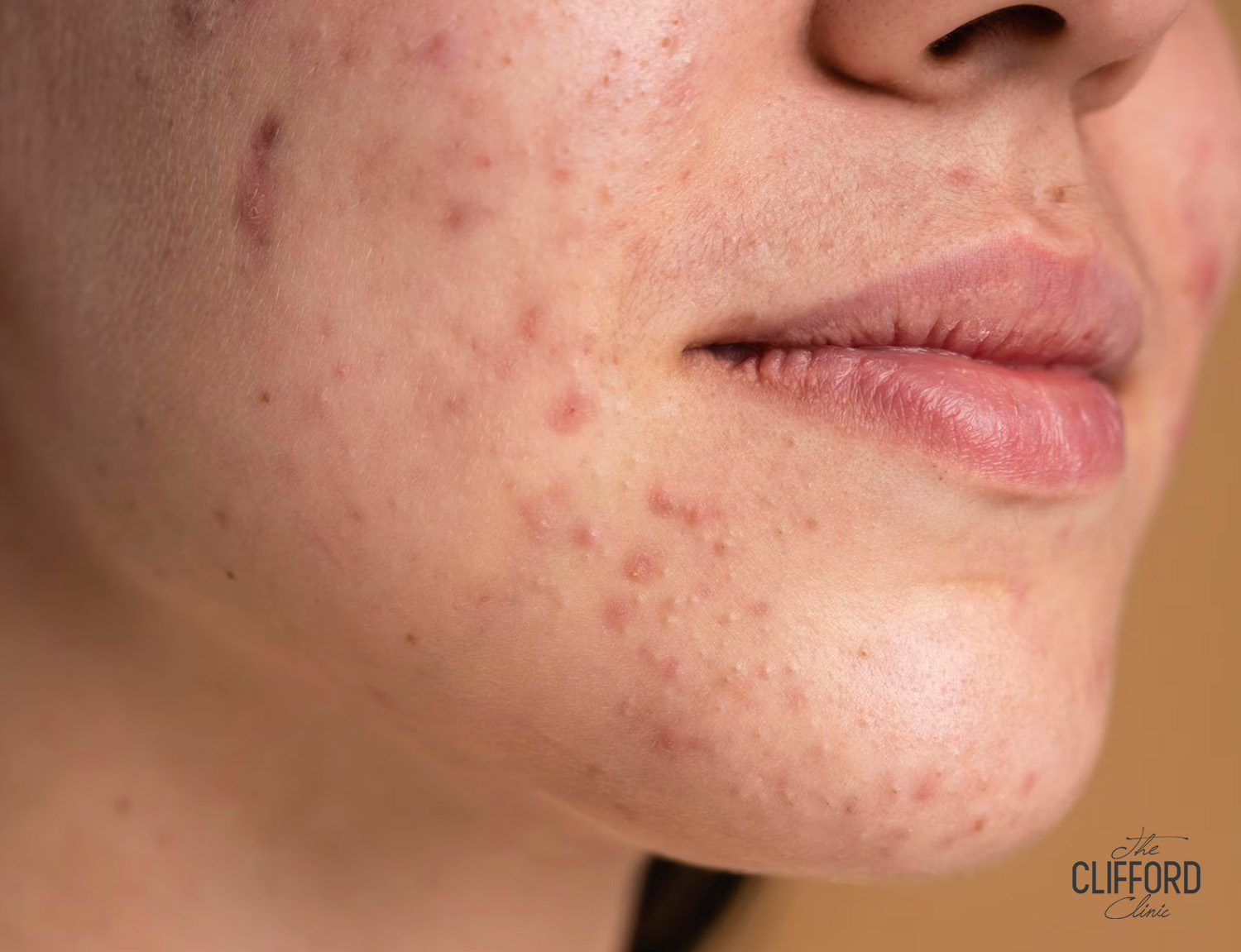
Patients often use the two terms interchangeably, but they describe different problems. Acne marks are flat colour changes with no change in skin texture. Brown marks are post-inflammatory hyperpigmentation (PIH), caused by excess melanin, whereas red marks are post-inflammatory erythema, caused by dilated blood vessels. Acne scars are textural changes, in which the skin surface is physically altered because collagen was lost or, less often, overproduced during healing. Marks and scars can usually be distinguished by touch and by angled light. Marks are flat, whereas scars cast shadows and can be felt as dips or raised areas. Pigment treatments never fill a scar, and resurfacing is not needed for a flat mark.
Types of atrophic acne scars
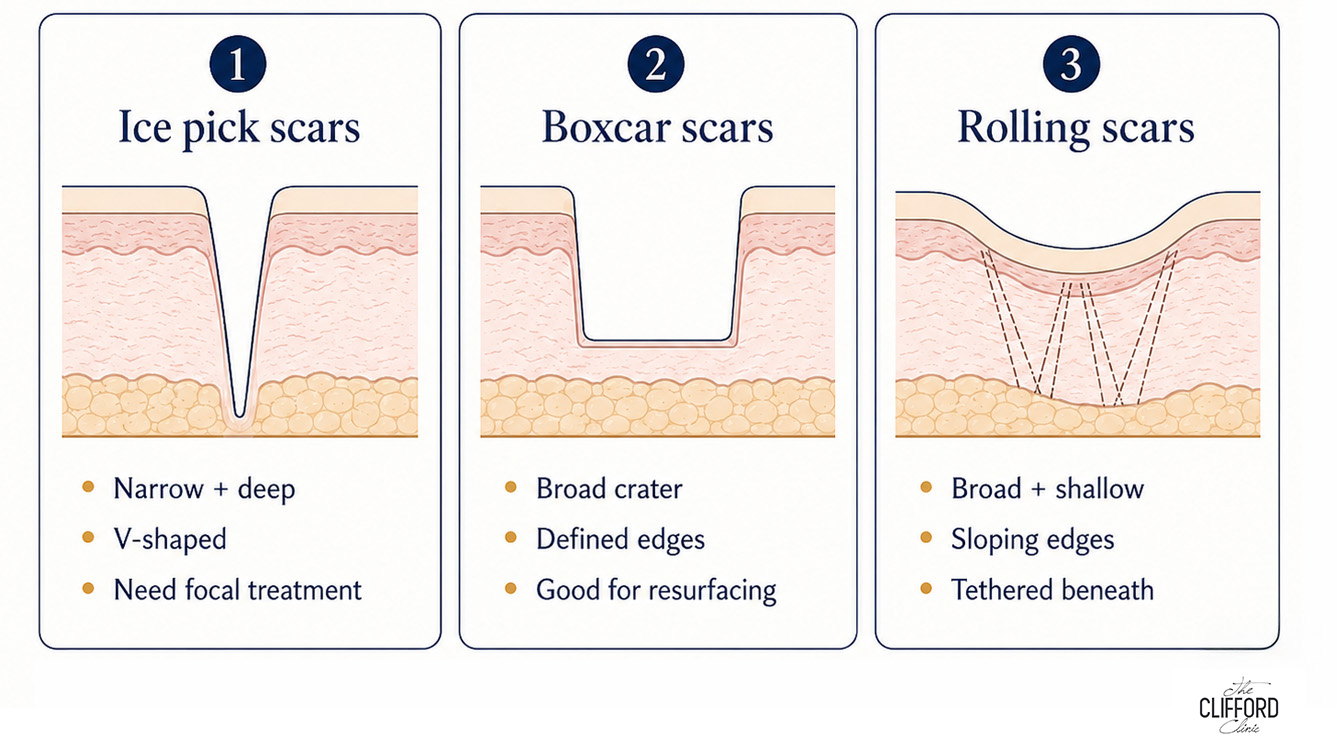
Most acne scars are atrophic, meaning the affected tissue sits below the surrounding skin, and they fall into three recognised patterns that respond differently to treatment.
- Ice pick scars are narrow, deep, V-shaped pits that extend into the dermis. Because they are both deep and narrow, they respond poorly to surface resurfacing alone and usually require focal techniques.
- Boxcar scars are broader depressions with sharp, well-defined edges, resembling small craters. They respond well to resurfacing that remodels the edges and floor.
- Rolling scars are broad, shallow depressions with sloping edges, caused by fibrous tethers that pull the skin down from beneath. They usually require release of those tethers in addition to resurfacing.
Most patients present with more than one scar type on the same face, so treatment rarely relies on a single technique.
How Pico laser addresses scars
A standard Pico laser handpiece targets pigment. It clears the brown marks that accompany scarring but does little to alter the scar texture. A fractional or focusing handpiece concentrates the picosecond energy into microscopic zones beneath the surface, creating controlled points of laser-induced optical breakdown in the dermis. These micro-injuries trigger a wound-healing response and collagen remodelling, which can gradually improve shallow textural irregularity and refine the skin surface with relatively low downtime, because the surface is largely spared. For mild, shallow scarring, and for patients who cannot accommodate significant recovery time, fractional picosecond treatment is a reasonable option.
When fractional CO2 may be better
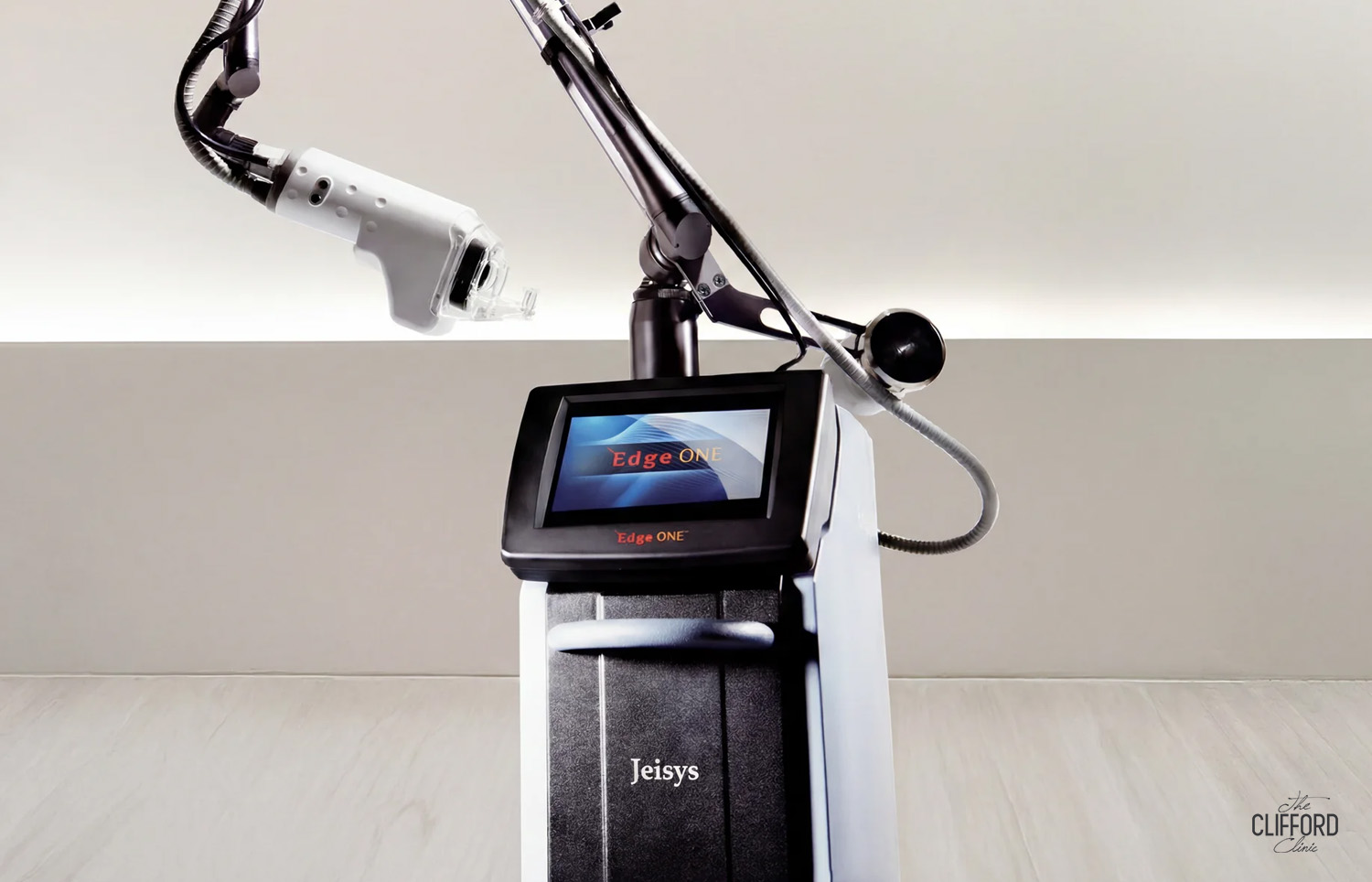
Fractional CO2 is an ablative resurfacing laser that targets water in the skin, vaporising narrow columns of tissue and stimulating a strong collagen rebuilding response as the skin heals. Because it remodels collagen more aggressively and reaches deeper than a picosecond laser, it is often more effective for moderate to severe atrophic scarring, including many boxcar scars and deeper textural change. The trade-off is more downtime, with visible redness and healing over a longer period, and in darker skin a higher risk of PIH, which is managed with conservative settings, spacing and diligent aftercare. Our fractional CO2 laser page describes this treatment.
Comparing the options
Pico Laser, Fractional Pico and Scar Treatments Compared
| Concern | Pico Laser, Standard | Fractional Pico | Fractional CO2 and RF Microneedling |
|---|---|---|---|
| Brown Marks, PIH | Effective | Effective | Not the primary purpose |
| Shallow Texture | Limited | Helpful, low downtime | Effective |
| Boxcar Scars | Limited | Modest | More effective |
| Ice Pick Scars | Limited | Limited | Focal techniques often added |
| Rolling Scars | Limited | Modest | Effective, often with subcision |
| Downtime | Low | Low to moderate | Moderate to higher |
Radiofrequency microneedling and other scar techniques
Beyond lasers, several techniques address scars by different mechanisms. Radiofrequency microneedling, such as Secret RF or Infini, delivers energy into the dermis through fine needles to stimulate collagen while sparing much of the surface, which can suit darker skin, where surface ablation carries a higher risk of pigmentation. Subcision uses a fine instrument to release the fibrous tethers beneath rolling scars, allowing the skin to lift. Focal chemical techniques such as TCA CROSS treat individual ice pick scars by stimulating collagen at the base of each pit. Our acne scar treatment page covers the full range.
Why active acne must be controlled first
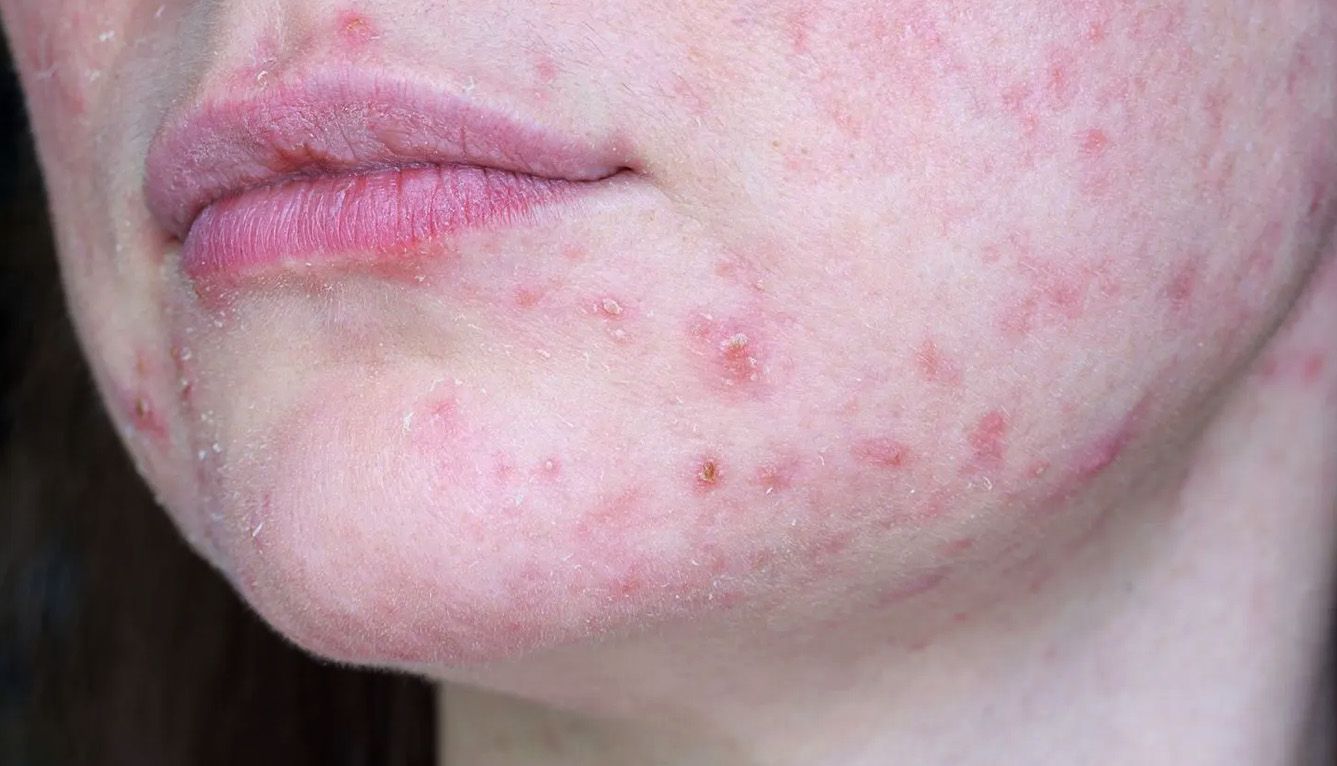
No scar treatment should begin while acne is still active. Ongoing breakouts create new scars and marks, undermining the work, and treating inflamed skin raises the risk of complications. Controlling the acne first, through an appropriate acne treatment plan, means the scars being treated are the final ones. Acne should be stable, with no new inflammatory lesions, for several months before resurfacing begins.
Combination treatment planning
Because acne scarring is usually mixed, the most effective plans combine several methods. A typical sequence is to control active acne, clear pigment marks with a pigment laser, release tethered rolling scars with subcision, treat ice pick scars with focal techniques, and finally remodel the general texture with fractional resurfacing, so that no single session over-treats the skin. This staged approach usually outperforms reliance on any single device.
Managing the pigment that accompanies scars in Asian skin
In Asian skin, acne scarring is usually accompanied by PIH, the brown marks left by the same inflammation that caused the scars. Resurfacing treatments that remodel collagen can themselves provoke further PIH, particularly at more aggressive settings and greater depths. A careful plan therefore addresses pigment and texture in a considered order, reducing the pigment load with topical pigment inhibitors and sun protection before or alongside resurfacing, and using conservative settings with adequate spacing to guard against new pigment. Treating the brown marks and the scars as related but distinct problems produces an even, smooth result rather than trading texture improvement for new discolouration.
Realistic timelines for scar improvement
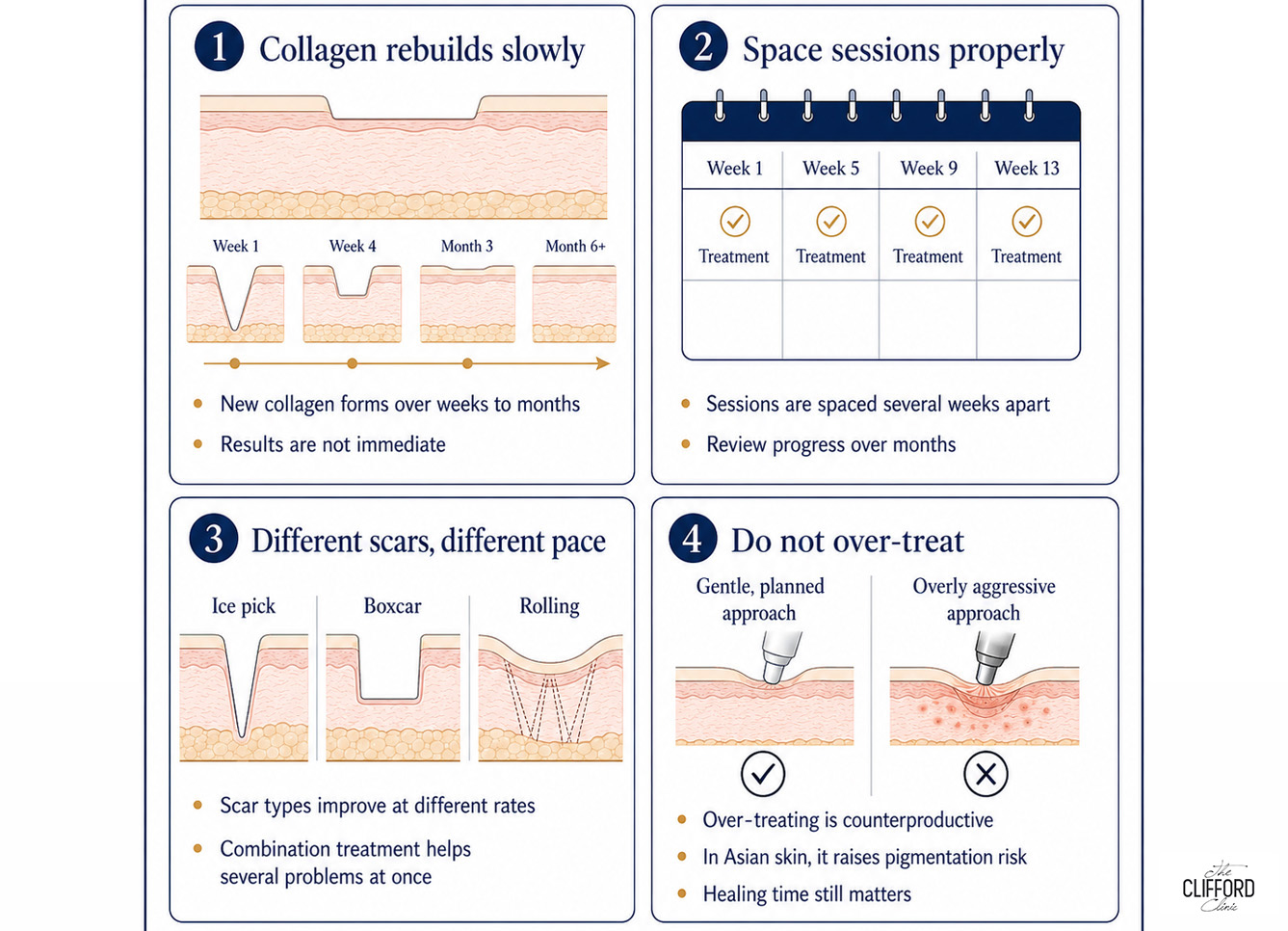
Scar treatment rewards patience because collagen remodelling is a slow biological process. After a resurfacing session, the skin continues to build new collagen for weeks to months, so the full benefit of each treatment is not visible immediately. Sessions are therefore typically spaced several weeks apart, and improvement is assessed over a course of several months rather than after any single session. Because different scar types improve at different rates, combining techniques lets several components progress in parallel, though each still needs healing time. Attempting to accelerate results by over-treating is counterproductive, and in Asian skin it raises the risk of pigmentation without improving the final outcome.
Downtime comparison
Standard and fractional Pico treatments have relatively low downtime, usually redness and mild swelling that settle quickly, though fractional treatment sits slightly higher. Fractional CO2 and deeper resurfacing involve more visible redness and a longer healing period. Whichever is used, sun protection during recovery is essential, because ultraviolet exposure on healing skin can cause PIH, particularly in Asian skin. Our Pico laser aftercare guide covers the pigment side, and your doctor will provide resurfacing-specific aftercare where relevant.
Doctor’s perspective. Effective treatment begins with separating pigment from texture, and then identifying the type of texture. Pico laser is well suited to clearing the marks and, with a fractional handpiece, to softening shallow texture with little downtime. A deep boxcar or a tethered rolling scar, however, needs its collagen rebuilt, and this is where fractional resurfacing and focal techniques are decisive. The goal is realistic improvement rather than perfection, and combining several techniques is usually how we reach it.
Who is suitable and who is not
- Pico laser and fractional Picomay suit brown acne marks, shallow textural change, and patients wanting lower downtime, usually as part of a combination plan.
- Fractional CO2, RF microneedling and focal techniquesmay suit moderate to deep atrophic scars, including boxcar, ice pick and rolling scars.
- Caution is neededwith active untreated acne, recently tanned skin, a tendency to keloid scarring, or an undiagnosed lesion.
Lasers for the pigment and the texture of scars
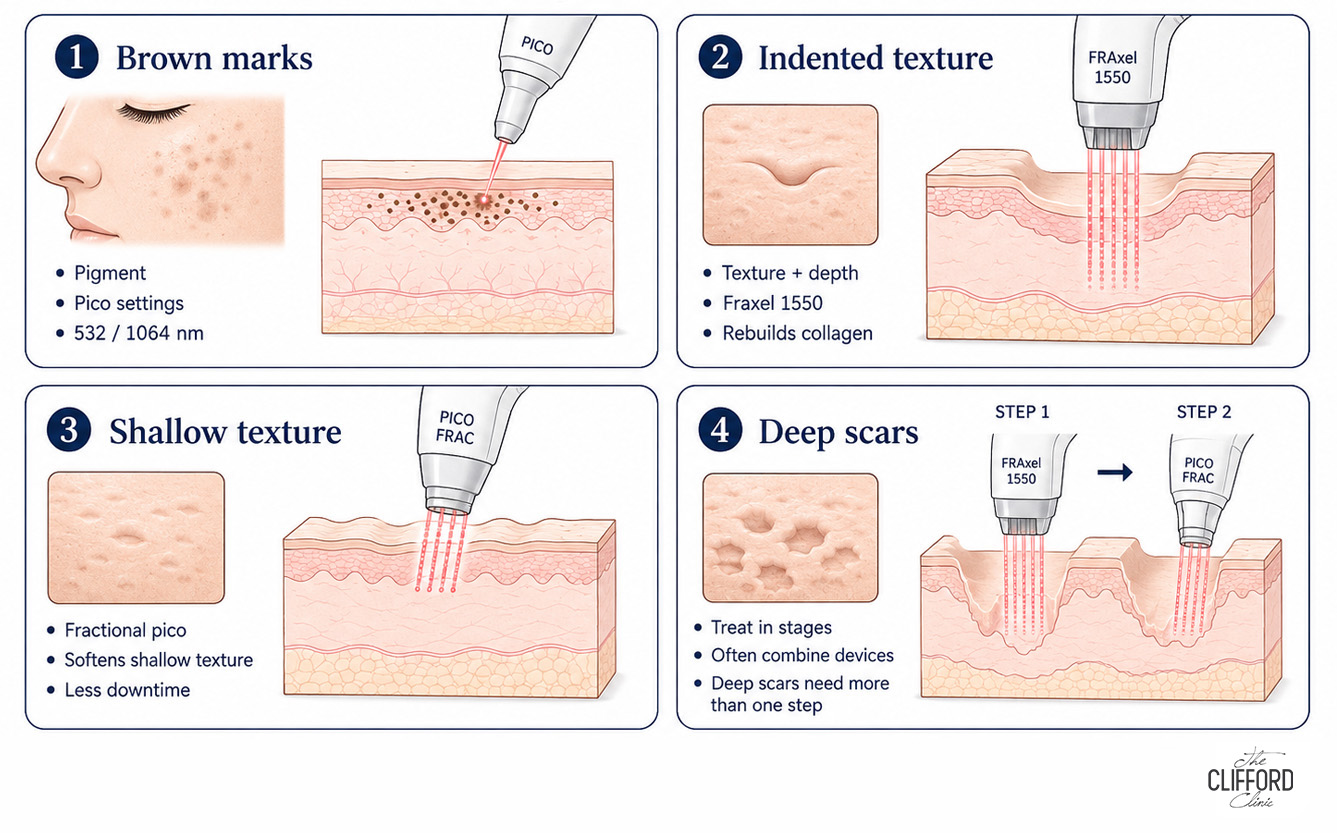
Scarring may be accompanied by brown marks that are cleared with picosecond pigment settings, while the indented texture is remodelled with fractional resurfacing such as the Fraxel 1550 Erbium Glass, which works at depth to rebuild collagen. A fractional picosecond handpiece can soften shallow texture with less downtime. Deep scars are treated in stages and often with more than one device.
Frequently asked questions
Can Pico laser remove acne scars?
It can improve shallow textural scarring, especially with a fractional handpiece, and it treats the brown marks that accompany scars. Deeper indented scars usually respond better to fractional resurfacing.
Is Pico laser better than CO2 laser for acne scars?
Not for deeper scars. Pico laser offers lower downtime and suits pigment and shallow texture, whereas fractional CO2 remodels collagen more aggressively and suits moderate to severe scarring.
What is the best treatment for indented acne scars?
It depends on the scar type. Boxcar and rolling scars often respond to fractional resurfacing, with subcision for tethered rolling scars, whereas ice pick scars usually require focal techniques. Combination plans are usually most effective.
Does Pico laser help acne marks or scars?
It helps with both, in different ways. It treats brown marks well, and with a fractional handpiece it can soften shallow scar texture. Deep scars require more aggressive resurfacing.
How many sessions are needed for acne scars?
Scar treatment requires more sessions than treating marks, with the number depending on scar type, depth and the combination of methods used.
Can acne scars be completely removed?
Meaningful improvement is realistic, but complete erasure is not a promise anyone should make. The goal is significant, lasting improvement in texture and tone through an appropriate combination of treatments.
Build a scar plan matched to your skin
Separating marks from scars, and scar type from scar type, is what makes treatment effective. Learn about Pico laser in Singapore and acne scar treatment in Singapore, or book at The Clifford Clinic, 50 Raffles Place, #01-01 Singapore Land Tower. Call (65) 6532 2400 or WhatsApp (65) 8318 6332.
Selected References
- American Academy of Dermatology: acne scars. https://www.aad.org/public/diseases/acne/derm-treat/scars.
- Comparing the efficacy and safety of a 730 nm picosecond laser with a 532 nm Q-switched Nd:YAG laser for facial pigmented disorders. European Journal of Medical Research, 2026. https://pubmed.ncbi.nlm.nih.gov/41782066.
- DermNet: lasers in dermatology. https://dermnetnz.org/topics/lasers-in-dermatology.

Author Bio
Dr Gerard Ee

Dr Gerard Ee is the Medical Director of The Clifford Clinic in Singapore. He earned his medical degree from St George's University of London and built his surgical experience across the Singapore General Hospital, National University Hospital, and Mount Sinai Hospital in New York. He holds Membership of the Royal College of Surgeons (Edinburgh) and a Postgraduate Diploma in Dermatology (Cardiff), and is fully accredited in aesthetic procedures including botulinum toxin, fillers, lasers, and light therapies. A strong advocate of minimally invasive, natural-looking results, Dr Ee has published in several medical and scientific journals and presented his research in cities including Taipei, Las Vegas, and London.
See all posts by Dr Gerard Ee »