

Hyperbaric Oxygen Chamber: Hard-Shell vs Soft-Shell Compared
While researching the benefits of hyperbaric oxygen therapy (HBOT), you may have come across two types of HBOT chambers, the hard-shell medical-grade chamber and the soft-shell mild chamber. While both chambers are sold as hyperbaric oxygen therapy, published research shows they are not interchangeable. Choosing the wrong type of chamber that is incompatible with your treatment goals can lead to a waste of time and money.
This guide compares both types of chambers directly with accompanying medical evidence. For the basics, start with our guide to what a hyperbaric chamber is.
The Two Types of Hyperbaric Oxygen Chamber
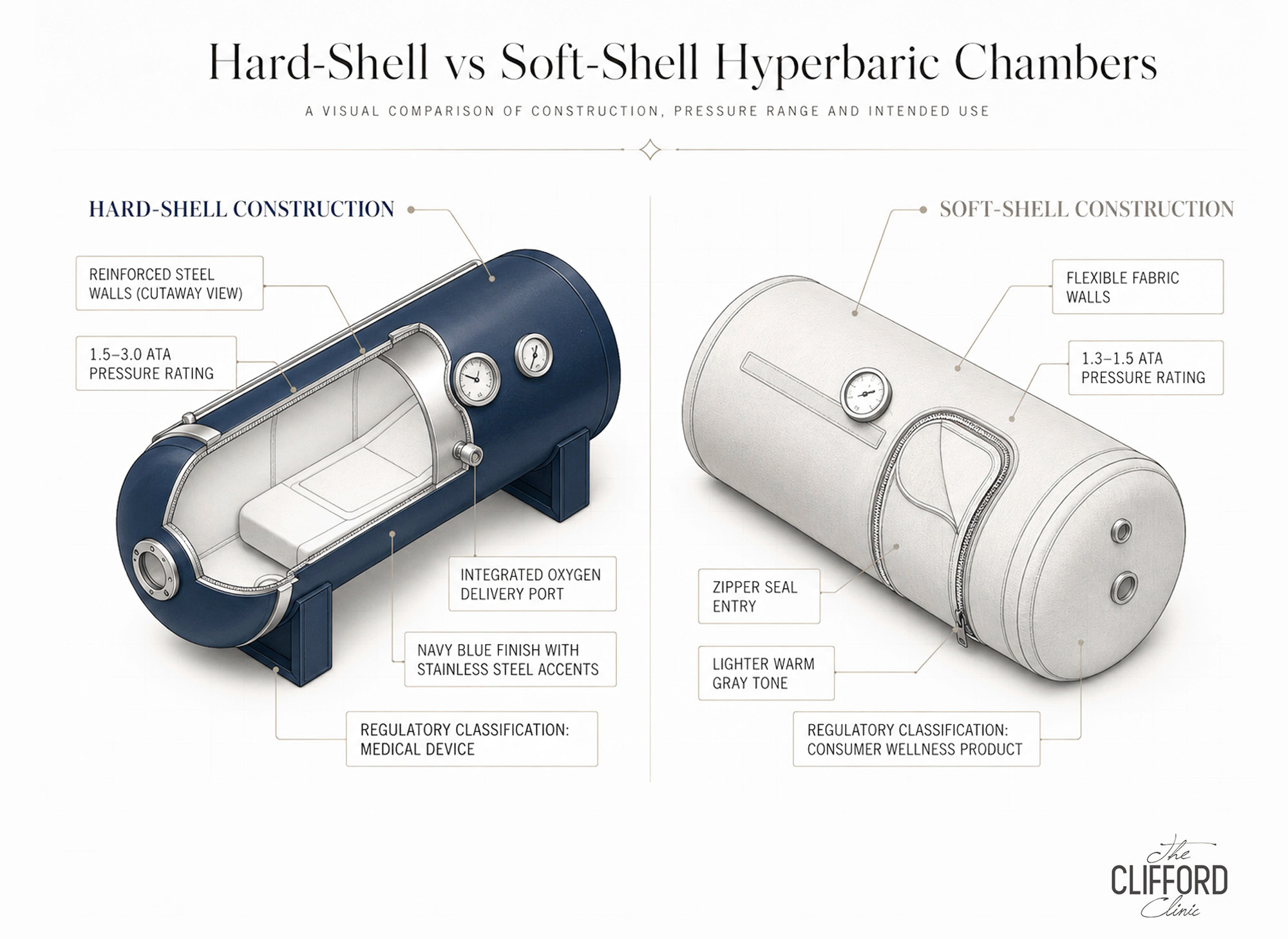
Hard-Shell Medical Chambers
Rigid, sealed chambers that are pressurised to 2.0 ATA or higher, with the patient breathing 100% medical-grade oxygen. These are the chambers used in hospitals and in clinical research.
Soft-Shell Mild Chambers
Flexible inflatable chambers that operate at around 1.3 to 1.5 ATA, often with oxygen supplied by a concentrator rather than 100% medical-grade oxygen. They are popular in wellness settings as they are affordable and accessible.
If you want to know how patient capacity affects HBOT, our guide to HBOT chamber types covers the difference between the monoplace chamber and multiplace chamber variants.
The Decisive Factor: Pressure Is the Dose
The benefit of a hyperbaric oxygen chamber comes from its ability to raise the partial pressure of oxygen in the blood. This forces more oxygen to dissolve directly into the blood plasma, bypassing the haemoglobin in the red blood cells. The amount of oxygen that dissolves into the plasma rises directly with pressure.
This data comes from the 1996 New England Journal of Medicine review by Tibbles and Edelsberg. At sea level, dissolved plasma oxygen is about 0.3 millilitres per decilitre. At 3 atmospheres, it reaches roughly 6 millilitres per decilitre when breathing 100% oxygen. This is enough to meet the needs of resting tissue without haemoglobin. At 1.5 ATA the increase is noticeable but far smaller.
The most important evidence on this point comes from the 2010 Cell Stress and Chaperones study by Godman and colleagues. The researchers compared cells treated with oxygen under hyperbaric pressure against cells given 100% oxygen at normal pressure. The hyperbaric group showed large, beneficial gene-expression changes and enhanced new blood vessel formation. The normal-pressure group showed minimal changes. This is direct laboratory evidence that pressure, not oxygen alone, determines the amount of oxygen that can dissolve directly into the blood plasma. It is also the reason why clinical protocols use hard-shell pressures.
Hyperbaric Oxygen Chamber Comparison: Hard-Shell and Soft-Shell HBOT Systems
Not all hyperbaric oxygen chambers deliver the same oxygen concentration or pressure.
This comparison explains the differences between soft-shell chambers, mild hyperbaric systems,
and medical-grade hard-shell hyperbaric oxygen chambers used in hospitals and medical clinics.
| Factor | Hard-Shell Medical HBOT Chamber | Soft-Shell Mild HBOT Chamber |
|---|---|---|
| Pressure | Typically 2.0 to 2.4 ATA | Typically 1.3 to 1.5 ATA |
| Oxygen Concentration | 100% medical oxygen | Often supported by an oxygen concentrator |
| Medical Grade | Yes | No, usually considered mild hyperbaric or wellness-use equipment |
| Typical Setting | Hospitals and medical clinics | Wellness centres, recovery studios or home-use settings |
| Evidence Base | Stronger clinical evidence for approved medical HBOT indications | More limited evidence, especially at lower pressure |
| Best For | Medical and demanding treatment goals | Light wellness, relaxation or general recovery support |
| Suitable Uses | Wound healing, radiation injury, sports recovery and post-surgical recovery support | General wellness and mild recovery use |
| Overall Recommendation | Best choice for medical-grade HBOT in Singapore | May be suitable for mild wellness use, but not equivalent to medical HBOT |
When a Soft-Shell Chamber Is Appropriate
A mild soft-shell chamber delivers a meaningful but limited physiological dose. It can be a reasonable choice for general wellness, energy and relaxation, light recovery support, and maintenance between hard-shell courses. The soft-shell chamber is also suitable for patients who cannot tolerate higher pressures.
When You Need a Hard-Shell Chamber
A hard-shell hyperbaric oxygen chamber is essential if you hope to achieve similar results to clinical research performed at clinical pressures, and for more rigorous treatment goals, such as:
- Wound healing and diabetic ulcers.
- Recovery from serious injury or surgery.
- Cognitive and longevity programmes, like the kind tested in the 2020 Ageing trial by Hadanny and colleagues.
- Any indication where research used 2.0 ATA or higher.
The 2019 Missouri Medicine review by Kirby and colleagues sets the minimum effective clinical pressure at 1.4 ATA, with most medical protocols utilising a pressure of above 2.0 ATA. If your goal is to replicate the outcomes shown in published studies, it is vital that you replicate the pressure used in the referenced study.
Common Myths About Hyperbaric Chambers
The first myth is that all chambers that are labelled as hyperbaric chambers deliver the same treatment results. The Godman study shows this is not true.
The second myth is that a higher-pressure chamber is automatically better for everyone. It is not. For a light wellness goal, a milder chamber may be appropriate.
The third and last myth is that the type of chamber used determines the outcome of the whole treatment. It does not. The chamber is the equipment. The result depends on the protocol, the pressure, the number of sessions and the medical screening behind it.
How to Choose Your Hyperbaric Oxygen Chamber
- Define your goal: wellness or medical?
- Check the pressure used in medical studies to achieve that goal. See our evidence review.
- Ask your clinic what chamber type they use and what pressure it operates at.
- Confirm that medical screening and supervision will be provided. See our safety guide.
- Compare total course cost against your goal, using our cost guide.
The Clifford Clinic Approach
The Clifford Clinic matches the chamber and protocol to each patient’s goal, as part of a wider longevity and wellness practice. Our guides to HBOT treatment and the wider hyperbaric oxygen therapy overview explain how a course is planned.
What Clinical Trials Reveal About Pressure Selection
The clearest way to settle the hard-shell versus soft-shell question is to look at the pressures researchers actually use as when scientists design a trial to test whether HBOT works, they will choose a pressure they expect to be therapeutic.
The 2003 acute stroke trial by Rusyniak and colleagues, published in Stroke, treated its HBOT group at 2.5 atmospheres, and used 1.14 atmospheres as the placebo. The salvage-treatment study for sudden hearing loss by Uzzi and colleagues was similarly conducted at 2.5 atmospheres. This indicates that cognitive and wound-healing literature is built on hard-shell chamber pressures.
Researchers use a pressure of 1.14 ATA as a deliberate placebo. A soft-shell chamber operating at 1.3 to 1.5 ATA sits much closer to the placebo range than to the 2.0 to 2.5 ATA used in positive clinical trials. This does not make mild chambers worthless for light wellness use, but it does mean that anyone expecting clinical results should look for a hard-shell chamber capable of reaching clinical pressure, as evidence does not support the idea that all chambers are equivalent.
Making the Final Decision
Once you understand the difference between hard-shell and soft-shell chambers, the decision depends on your goal. If your goal is general wellness, a mild chamber may be reasonable and cost-effective. If your goal has anything to do with what clinical research has studied, wound healing, recovery, or cognition, then the evidence points firmly to a hard-shell chamber at clinical pressure.
Next, consider the whole protocol, not just the chamber. Pressure, session length, the number of sessions and proper medical screening all matter. Our treatment guide elaborates on this point in full, but in short, the chamber is the equipment and the protocol is the medicine.
Finally, weigh the cost against your goal using our cost guide. The aim is never to buy the most expensive option, nor the cheapest, but the one whose pressure and protocol genuinely match what you are trying to achieve.
The Clifford Clinic Perspective
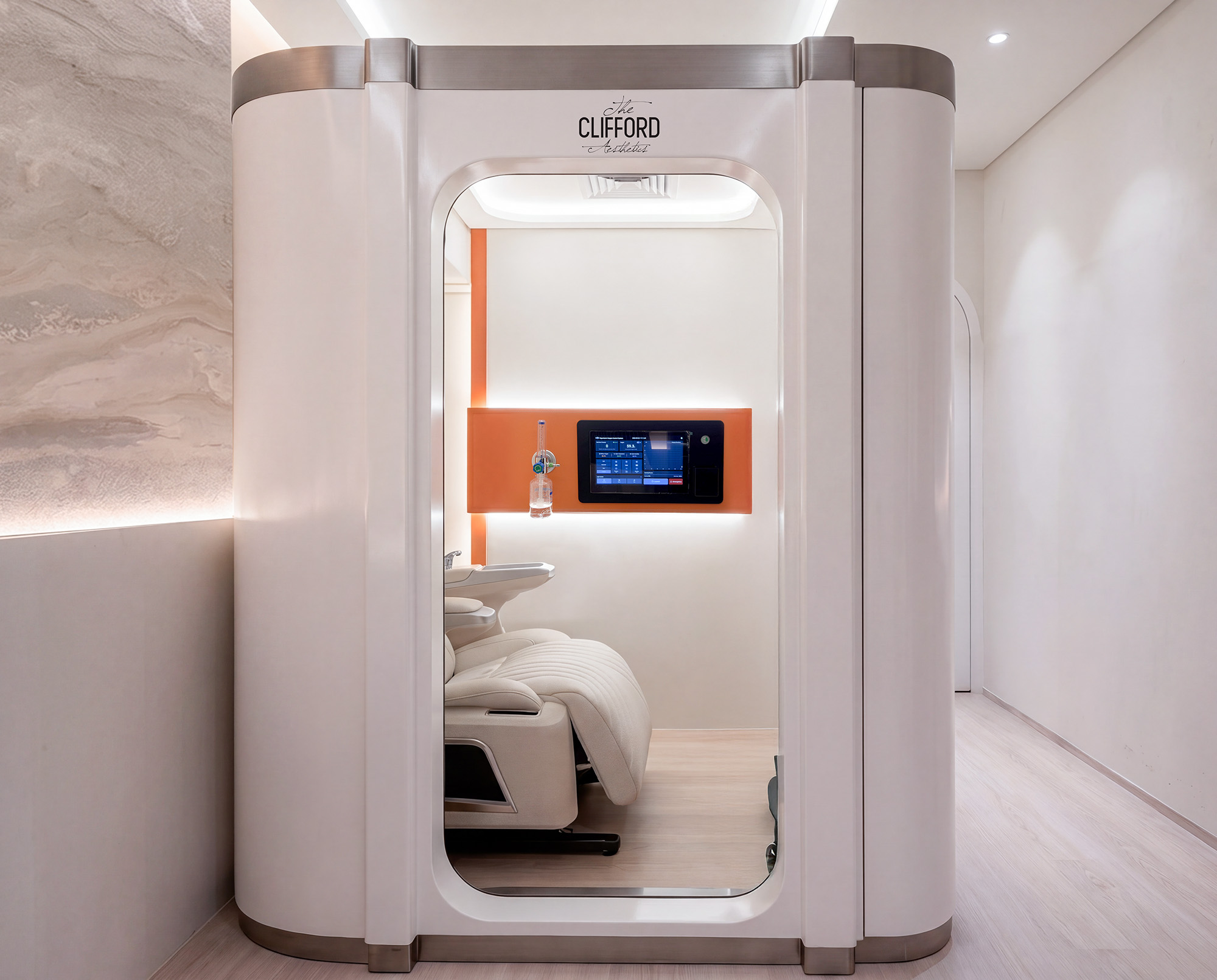
On the hard-shell versus soft-shell question, The Clifford Clinic’s clinical team’s position is that a clinically meaningful hyperbaric oxygen chamber is a hard-shell chamber capable of reaching a therapeutic 2.0 ATA. As such, that is the type of HBOT chamber that the clinic operates. We made this choice on the basis that the bulk of the research that demonstrates a real therapeutic effect uses pressures a soft-shell chamber simply cannot reach.
The team is equally direct about soft-shell mild chambers. In their assessment, these are essentially home-use devices, and even in that role, the clinical team considers their practical benefit limited. A soft-shell unit can raise pressure slightly, but it cannot deliver the dose that the studies behind hyperbaric oxygen therapy describe. In the team’s view, presenting the two as broadly equivalent is misleading to patients.
However, this does not mean the clinical team dismisses the use of soft-shell chambers entirely. If someone wants a mild-pressure environment at home and understands exactly what they are and are not getting, that is their decision to make. What the team objects to is a soft-shell session being sold as the clinical equivalent of a proper hard-shell course. A patient seeking real outcomes, such as wound healing, post-surgical recovery, and sports recovery, should not expect a mild chamber to substitute for a hard-shell one.
The clinical team’s guiding principle, drawn from four years and more than 200 patients, is that pressure is the dose, and the hyperbaric oxygen chamber is simply the vehicle that delivers it. When choosing a hyperbaric oxygen chamber, The Clifford Clinic advises patients to confirm the pressure it achieves and what medical supervision is provided during the session, and to treat soft-shell and hard-shell as two genuinely different treatments because clinically, they are.
Frequently Asked Questions
Is a hard-shell hyperbaric oxygen chamber better than a soft-shell?
For medical and clinically demanding goals, yes. Laboratory research shows the therapeutic response depends on elevated pressure, which only hard-shell chambers deliver. For light wellness use, a soft-shell chamber may be sufficient.
What pressure should a hyperbaric oxygen chamber reach?
Clinical protocols generally use 2.0 to 2.4 ATA. The minimum effective clinical pressure is widely cited as 1.4 ATA. Mild soft-shell chambers reach only 1.3 to 1.5 ATA.
Can I use a soft-shell chamber for a medical condition?
It is not advisable. Medical indications need the higher pressures that only a hard-shell chamber delivers.
How do I know which chamber a clinic uses?
Ask directly. A reputable provider will tell you the chamber type and operating pressure without hesitation.
Key Research References
- Tibbles PM, Edelsberg JS. Hyperbaric-Oxygen Therapy. New England Journal of Medicine, 1996.
- Godman CA et al. Hyperbaric oxygen induces a cytoprotective and angiogenic response in human microvascular endothelial cells. Cell Stress and Chaperones, 2010.
- Kirby JP et al. Essentials of Hyperbaric Oxygen Therapy: 2019 Review. Missouri Medicine, 2019.
- Hadanny A et al. Cognitive enhancement of healthy older adults using hyperbaric oxygen: a randomised controlled trial. Aging, 2020.
To match the right chamber to your goal, book a consultation at The Clifford Clinic.