

How HBOT for Post-Surgery Recovery Fits Within Your Plan
Medically reviewed by The Clifford Clinic clinical team
Reviewer: Dr Gerard Ee, MBBS
Practising at The Clifford Clinic, Raffles Place, Singapore
Last reviewed: June 2026
How we review: Articles in this hyperbaric oxygen library are written for The Clifford Clinic and reviewed by medical professionals. Reviewers check medical accuracy and ensure claims align with current MOH, UHMS and peer-reviewed guidance.
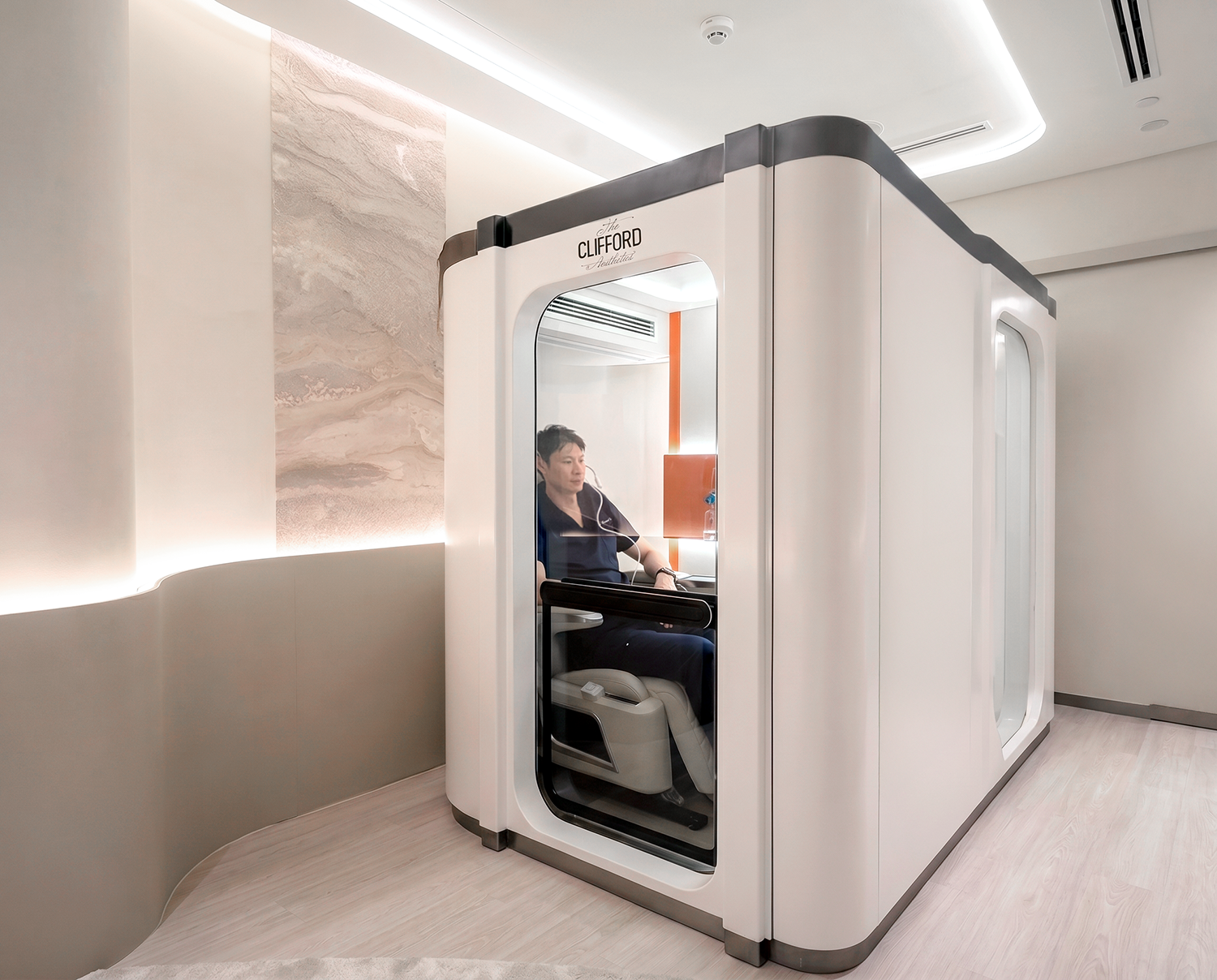
HBOT can support Reconstructive, plastic, orthopaedic and selected general surgical patients in their post-operative healing in selected cases, particularly for tissue at risk and for swelling and recovery in the early post-operative weeks. Recovery from surgery is one of the most reasonable, evidence-aware uses of HBOT outside the classical emergency and chronic wound indications.
This guide explains where HBOT fits within post-surgical care, how to achieve the most benefits, and how to integrate it with your surgical team’s plan. Read alongside our complete guide to hyperbaric oxygen therapy and our guide on HBOT for wounds.
Where HBOT Fits in Post-Op Recovery
Surgery, even when straightforward, leaves tissue acutely inflamed, swollen and metabolically stressed. Healing depends on adequate oxygen delivery to the operated tissue, an immune response that resolves rather than persists, and an absence of complications like infection or compromised perfusion. HBOT supports those processes by raising plasma oxygen reaching the operated site, modulating inflammation, and supporting tissue repair.
It does not replace good surgical technique, conventional post-operative care, infection control or rehabilitation. It is an adjunct in the cases where the additional oxygen delivery and tissue support is likely to matter.
Procedures With the Strongest Adjunctive Case
The post-operative indications with the strongest hyperbaric medicine support are compromised skin grafts and flaps after reconstructive surgery, complex tissue reattachment after trauma, and selected reconstructive procedures in previously irradiated tissue.
These are the cases where the published evidence is strongest and where HBOT meaningfully adds to standard surgical recovery.
Procedures Where HBOT Is Sometimes Used Off-Label
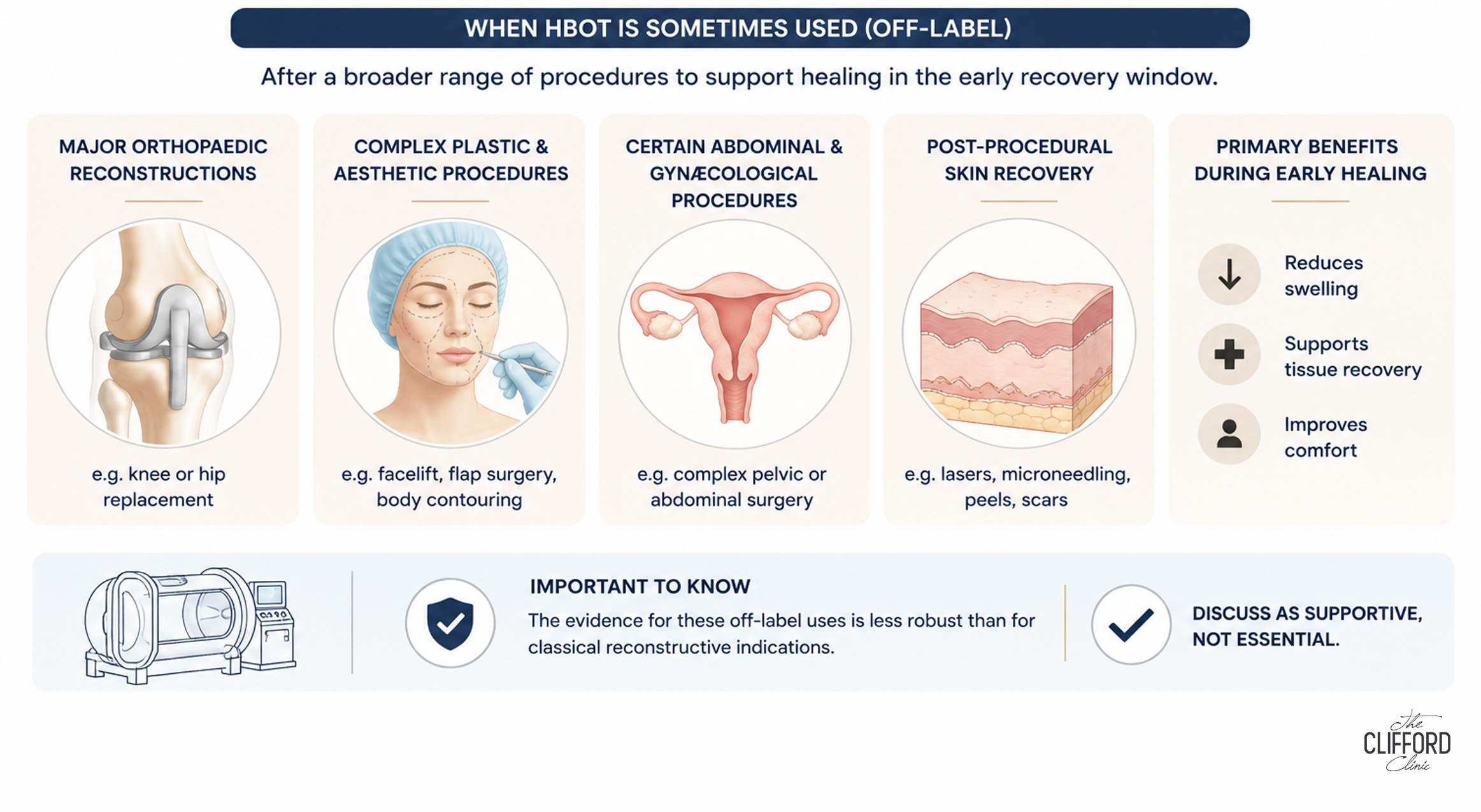
Outside the formally recognised indications, HBOT is sometimes used after a broader range of procedures, such as major orthopaedic reconstructions, complex plastic and aesthetic procedures, certain abdominal and gynaecological procedures, and post-procedural skin recovery, primarily to support swelling reduction, tissue recovery and patient-reported comfort during the early healing window.
The evidence in these off-label uses is less robust than in the classical reconstructive indications. It should be discussed as supportive rather than essential.
Timing: When to Start Post-Op Sessions
The right time to start post-operative HBOT depends on the procedure and the surgical team’s plan. For tissue clearly at risk, such as a compromised graft or flap or an acute reattachment, HBOT typically starts as soon as it is clinically safe, often within the first 24 to 48 hours. For elective adjunctive use, sessions may start a few days after surgery, once the immediate post-operative period is stable. An individualized protocol is important to maximize benefits.
How HBOT Combines With Standard Post-Surgical Care
HBOT integrates with the rest of post-operative care, namely appropriate wound dressings and surgical follow-up, infection control, pain management, glycaemic control where relevant, mobilisation and physiotherapy.
For elective procedural patients exploring HBOT, planning a course before surgery, including any required screening, is more useful than scrambling after the procedure. The setting also matters. A hard-shell chamber at a therapeutic 2.0 ATA, supervised by a doctor, gives a meaningful dose rather than the underpowered exposure of a soft-shell session. Our hard-shell vs soft-shell comparison covers this distinction in detail.
Communicating With Your Surgeon

Patients should always discuss adjunctive HBOT with their operating surgeon before booking sessions. The surgeon may have specific timing preferences, advice on integration with wound care, or a reason to defer HBOT until a particular healing milestone. A good HBOT clinic will welcome and reinforce that surgeon-led conversation rather than circumvent it.
Be cautious if a clinic recommends HBOT after surgery without proposing any contact with your operating team.
Risks Specific to Post-Op Patients
Post-operative patients carry some specific risk considerations. Pneumothorax (a contraindication to HBOT) is sometimes a concern after thoracic surgery, recent fractures may complicate ear pressure equalisation, and certain wound infections may need to be controlled before pressurisation. These are the issues a doctor will screen for during the consultation.
On safe screening and standard side effects, see our detailed guide on hyperbaric oxygen therapy side effects and safety.
HBOT for Surgical Recovery and Tissue Support
| Use or Claim | Evidence Tier | How We Talk About It |
|---|---|---|
| Compromised Graft / Flap After Reconstruction | Supported | Recognised indication. HBOT used as adjunct. |
| Acute Peripheral Reattachment, Nerve, Vessel, Soft Tissue | Supported | Adjunct in selected cases, supports tissue survival. |
| Elective Post-Procedural Swelling and Recovery | Emerging | Off-label adjunct, reasonable in selected motivated patients. |
| Routine Uncomplicated Minor Surgery Recovery | Wellness | Not an established HBOT indication. Standard care alone. |
| Replacing Surgical or Post-Operative Care | Wellness | Not a credible claim. HBOT is an adjunct, never a substitute. |
MediSave and MediShield Life note
Selected post-operative HBOT cases that meet MOH’s clinical criteria for a recognised indication, such as compromised graft or flap, may qualify under two separate Singapore healthcare schemes. MediSave (CPF medical savings) can be used for up to S$100 per treatment session. MediShield Life (national health insurance) is a separate scheme with a claim limit of up to S$780 per treatment session. The two schemes operate independently. Routine elective post-procedural HBOT is paid out of pocket. Confirm with your treating doctor and the provider’s billing team.
The Clifford Clinic Perspective
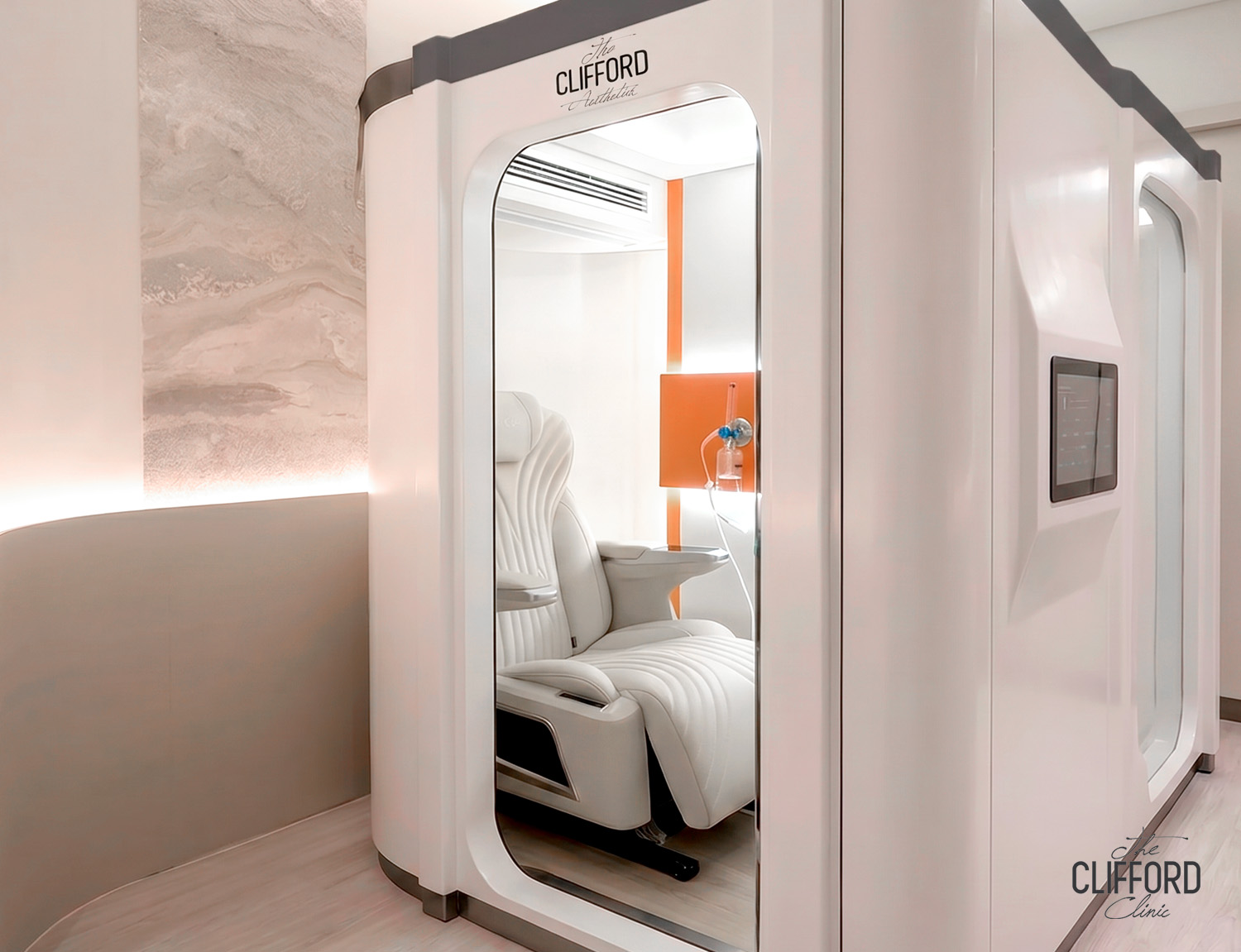
The Clifford Clinic’s clinical team treats post-operative HBOT as a natural fit. The clinic has plastic surgery and a Day Surgery unit, so a substantial proportion of HBOT use here is genuinely surgical, supporting recovery after procedures, reducing swelling and supporting tissue oxygenation in the early post-operative window.
At the more demanding end, the team has used HBOT for paediatric and adult reattachment cases, including finger reattachments where the survival of repaired nerves, blood vessels and soft tissue depends on adequate oxygen delivery while circulation is still fragile. In these cases the team’s clinical view is that HBOT can meaningfully improve outcomes, closing wounds faster and, in reattachment and compromised-tissue cases, raising the survival rate of the repair.
For elective post-procedural recovery, after significant aesthetic, reconstructive or orthopaedic procedures, the evidence is more modest. HBOT delivered through a hard-shell chamber at a therapeutic 2.0 ATA, with doctor-led screening, can support swelling reduction and patient-reported comfort.
Over four years and more than 200 patients, the clinical team’s consistent observation is that post-operative HBOT works best when it is integrated rather than tacked on.
Frequently Asked Questions
Will HBOT speed up my surgical recovery?
In selected cases, particularly compromised tissue and tissue at risk, yes. For routine uncomplicated procedures, the evidence is more modest and HBOT should be considered as supportive rather than essential.
When should I start post-op HBOT?
For tissue at risk, often within 24 to 48 hours of surgery. For elective adjunctive use, a few days after surgery once the immediate post-operative period is stable. Discuss timing with your surgeon and hyperbaric doctor.
Should I tell my surgeon I am doing HBOT?
Yes. Adjunctive HBOT belongs inside the surgical plan, not alongside it. Your surgeon may have specific timing or integration advice.
How many sessions are needed after surgery?
Varies by procedure and case. Compromised tissue protocols may run longer. Elective adjunctive recovery may use shorter courses. Your hyperbaric doctor will set the plan.
Is HBOT safe so soon after surgery?
In most cases, with appropriate screening, yes. Specific contraindications include pneumothorax and certain other conditions that the doctor screens for.
Will MediSave or MediShield Life cover post-op HBOT?
Sometimes, for recognised indications meeting MOH’s criteria. Routine elective post-procedural HBOT is paid out of pocket.
Can HBOT replace antibiotics or wound care?
No. It does not replace standard surgical and post-operative care, including infection control.
Can children have post-op HBOT?
Yes, in selected paediatric cases. The clinic has experience including paediatric reattachment cases, always with appropriate paediatric clinical input.
Key Research References
- Undersea and Hyperbaric Medical Society. Hyperbaric Oxygen Therapy Indications, 13th Edition. Compromised grafts and flaps.
- Bhutani S, Vishwanath G. Hyperbaric oxygen and wound healing. Indian Journal of Plastic Surgery.
- Heyboer M et al. Hyperbaric Oxygen Therapy. Side Effects Defined and Quantified. Advances in Wound Care.
- Babul S, Rhodes EC. The role of hyperbaric oxygen therapy in sports medicine. Overlapping soft tissue recovery evidence.
- Tibbles PM, Edelsberg JS. Hyperbaric-Oxygen Therapy. New England Journal of Medicine.
- Kirby JP et al. Essentials of Hyperbaric Oxygen Therapy, 2019 Review. Missouri Medicine.

To plan post-operative HBOT in coordination with your surgical team, book a consultation at The Clifford Clinic.

Author Bio
Dr Gerard Ee

Dr Gerard Ee is the Medical Director of The Clifford Clinic in Singapore. He earned his medical degree from St George's University of London and built his surgical experience across the Singapore General Hospital, National University Hospital, and Mount Sinai Hospital in New York. He holds Membership of the Royal College of Surgeons (Edinburgh) and a Postgraduate Diploma in Dermatology (Cardiff), and is fully accredited in aesthetic procedures including botulinum toxin, fillers, lasers, and light therapies. A strong advocate of minimally invasive, natural-looking results, Dr Ee has published in several medical and scientific journals and presented his research in cities including Taipei, Las Vegas, and London.
See all posts by Dr Gerard Ee »