
Acne Treatment Without Accutane, The Options in Singapore
Written by Dr Gerard Ee, Medical Director, The Clifford Clinic. Published 20 May 2026. Last medically reviewed and updated 3 September 2026.
If you have been offered Accutane and you would rather not take it
Isotretinoin, sold as Accutane or Roaccutane, is the most effective acne drug there is, and for some patients it is still the right answer. A large number of people offered it say no, because they are planning a pregnancy, because of liver or mood concerns, because of the monitoring, or simply because six months of a systemic drug is more than they want to take on for their skin. If that is you, there are still options, and this page sets out what they are.
This page covers the two treatments that work on the sebaceous gland directly rather than through the bloodstream, namely AviClear and AGNES RF. It sets out what each one does, who each one suits, how they are used together, and where they are not enough. It also sets out, honestly, when isotretinoin is still the better choice.

Why the standard approach stops working for some patients
Singapore’s climate does acne-prone skin no favours. Year-round humidity above 80% and persistent heat increase sweating and sebum output, and occlusion from masks or heavy sunscreen adds to it. Diet plays a part too. High-glycaemic foods have reasonably consistent evidence behind them, dairy less so, and neither causes acne on its own.
The standard sequence is a topical retinoid, a course of oral antibiotics, sometimes a chemical peel, and a review in three months. For mild acne this often works. For anything more, it can set up a cycle of initial improvement, antibiotic resistance, recurrence, and a growing sense that nothing is addressing the underlying cause.
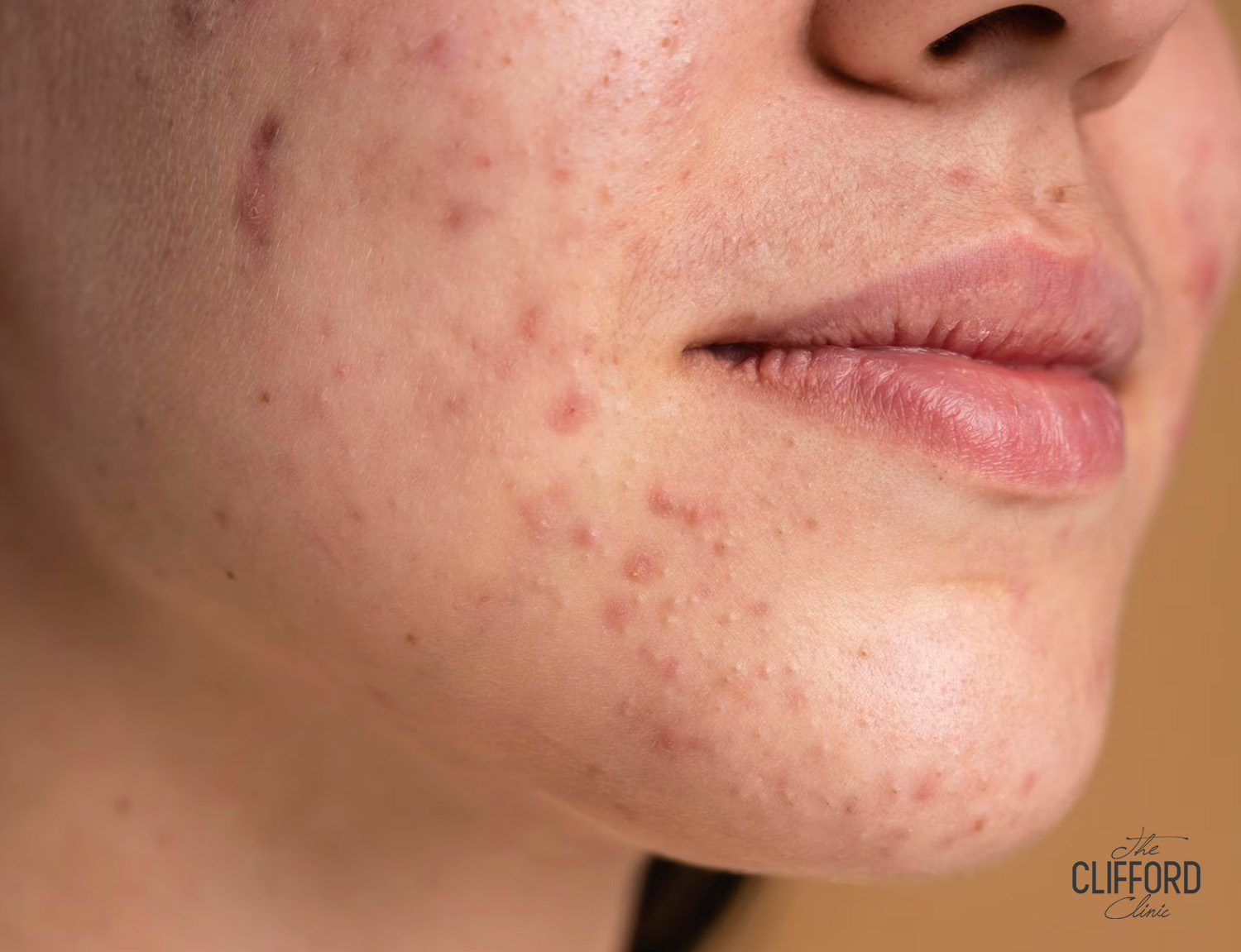
For most patients with moderate to severe acne the underlying problem is the sebaceous gland itself. It is producing too much oil. Reducing that output is what changes the disease. Repeatedly extracting each congested pore or comedone treats the visible lesion rather than the gland behind it, which is why the effect is temporary. Repeated extraction can also leave depressed scars.
This is where the two gland-targeting treatments come in. AviClear and AGNES RF both act on the sebaceous gland itself rather than on the surface of the skin or through the bloodstream, which is what makes them a genuine alternative for a patient who has declined isotretinoin. Neither requires taking a systemic drug for six months. Neither suits every patient either, and both depend on a doctor who knows which to use, in what sequence, and at what energy settings for a particular skin type.
Meet the Doctor: Dr Gerard Ee, Medical Director of The Clifford Clinic

The device matters less than the person operating it.
Dr Gerard Ee is a medical aesthetic doctor and the Medical Director of The Clifford Clinic in Raffles Place. His training comprises MBBS from St George’s University of London, MRCS Edinburgh, a Graduate Diploma in Practical Dermatology from Cardiff University, and rotations through Singapore General Hospital, National University Hospital, and Mount Sinai Hospital in New York.
That hospital training matters for a specific reason. It covers the full spectrum of skin disease rather than the cosmetic end alone, which is what allows a clear judgement about when a patient should be on isotretinoin, when they should not be, and what to offer them instead.
Two points about that experience are worth setting out.
The Clifford Clinic was among the first practices in Singapore to offer AviClear, the 1726 nm laser cleared by the US FDA for mild, moderate and severe inflammatory acne, and Dr Ee has been running it since it arrived here. That length of use matters less as a claim than as a practical fact. Energy settings and session spacing for Asian skin are learned from treating a few hundred faces, not from the manufacturer’s protocol card.
Dr Ee has used AGNES RF for more than a decade, close to the entire time it has been available in this region, and The Clifford Clinic was one of the earliest adopters of it for acne in Singapore.
That experience is what turns a customised plan from a phrase into something a patient can actually be given.
AviClear, reducing oil production without a systemic drug
AviClear was the first energy-based device cleared by the U.S. FDA specifically for the treatment of acne. It uses a 1726 nm laser wavelength that is preferentially absorbed by sebaceous glands without damaging surrounding skin.
The mechanism is selective photothermolysis. In plain terms, the laser heats the sebaceous glands enough to reduce how much oil they produce, without heating the skin around them. Isotretinoin also reduces sebum production, but it does so throughout the body, which is where its side-effect profile comes from. AviClear works on the glands the laser reaches, and only those.
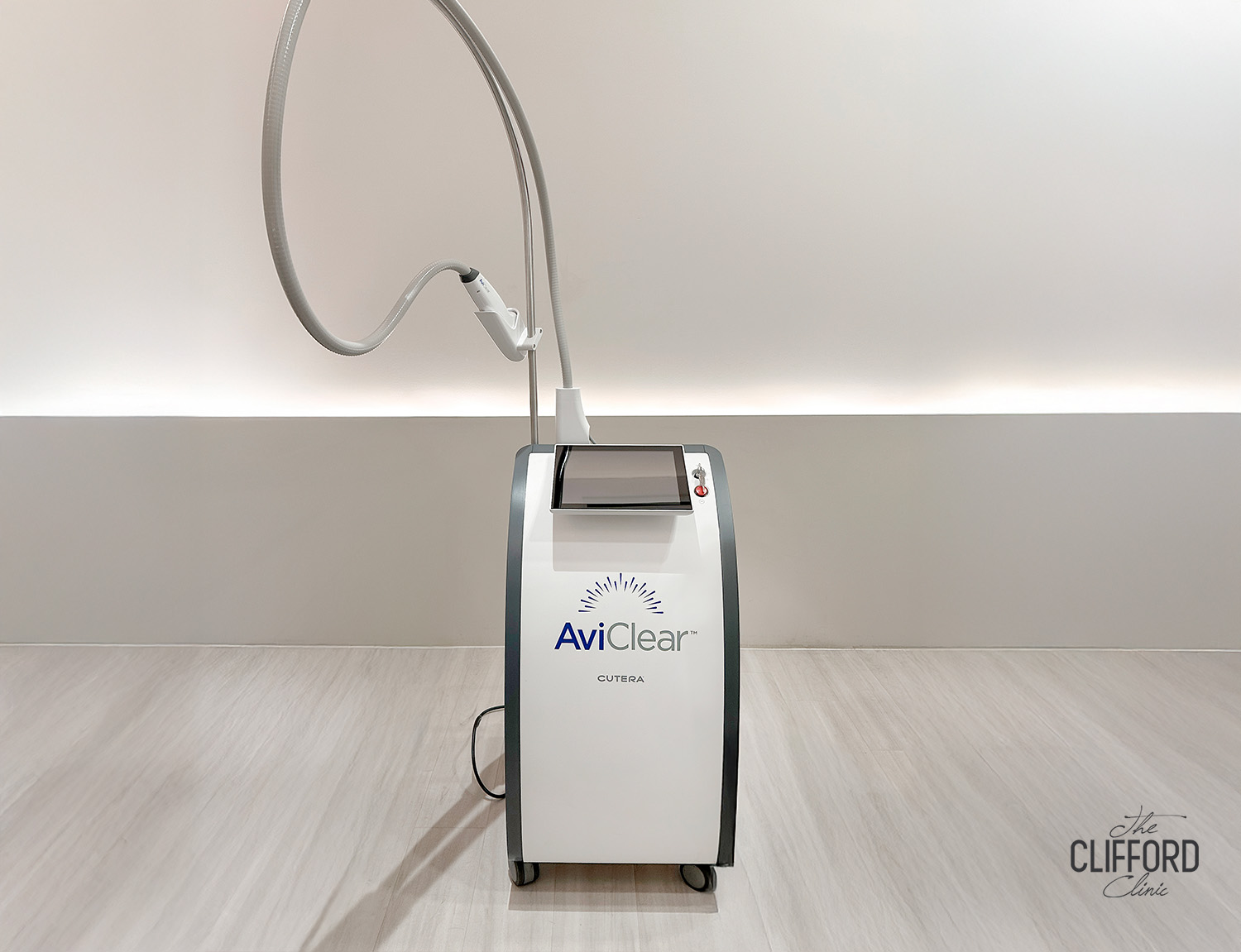
AviClear is the first energy-based device approved by the U.S. FDA specifically for the treatment of acne. It uses a precisely tuned 1726 nm laser wavelength that is selectively absorbed by sebaceous glands without damaging surrounding skin.
The mechanism is called selective photothermolysis. In plain English: the laser heats and downregulates the sebaceous glands, reducing oil output for the long term, in the same way that isotretinoin (Roaccutane) does but topically targeted, drug-free, and without the systemic side effects.
Why AviClear matters for the Singapore patient specifically
Many patients arrive at The Clifford Clinic having been offered isotretinoin and declined it, because of pregnancy planning, liver concerns, mood concerns, or simple caution. For many of these patients AviClear offers a way to reduce sebum production without taking a systemic drug. It is not as powerful as isotretinoin in severe nodulocystic disease, and Dr Ee will say so at consultation rather than after three sessions.
Sessions take about 30 minutes and there is no downtime, so most patients return to work directly afterwards. AviCool contact cooling keeps the treatment tolerable for sensitive Asian skin.
AviClear is suitable across a range of skin tones. It has been studied across a broad range of Fitzpatrick types. In Singapore, where a single waiting room holds every shade from Type II to Type V, that matters. The risk of post-inflammatory hyperpigmentation, which is the main hazard of poorly chosen laser settings on Asian skin, is lower with this wavelength and cooling than with older acne lasers.

AviClear is cleared for mild, moderate and severe acne. The standard protocol is three sessions, spaced roughly a month apart, with results that continue to develop over the following months as sebum production settles.
Where the plan stops being one machine
The temptation with a device this straightforward is to sell it as a package. The reason Dr Ee resists that framing is simple. The most resistant cases rarely respond to AviClear used on its own.
A genuine plan layers AviClear with other modalities depending on what the consultation reveals. AGNES RF is used for individual persistent cystic lesions, Gold photothermal therapy for diffusely oily skin with active inflammation, scar repair is queued for the months after the active breakouts are controlled, and topical maintenance protects the result.
That is what a customised plan actually means in practice. Not one machine, but a sequence of them chosen for one face.
AGNES RF, treating individual glands rather than the whole face
Where AviClear reduces oil production across the whole face, AGNES RF treats individual glands.
AGNES is a minimally invasive radiofrequency microneedling system that delivers tightly controlled radiofrequency energy through an insulated micro-needle directly into individual sebaceous glands. The insulation is the key element. Energy is delivered only at the tip, deep in the dermis where the problem gland sits, without damaging the surface skin on the way down.
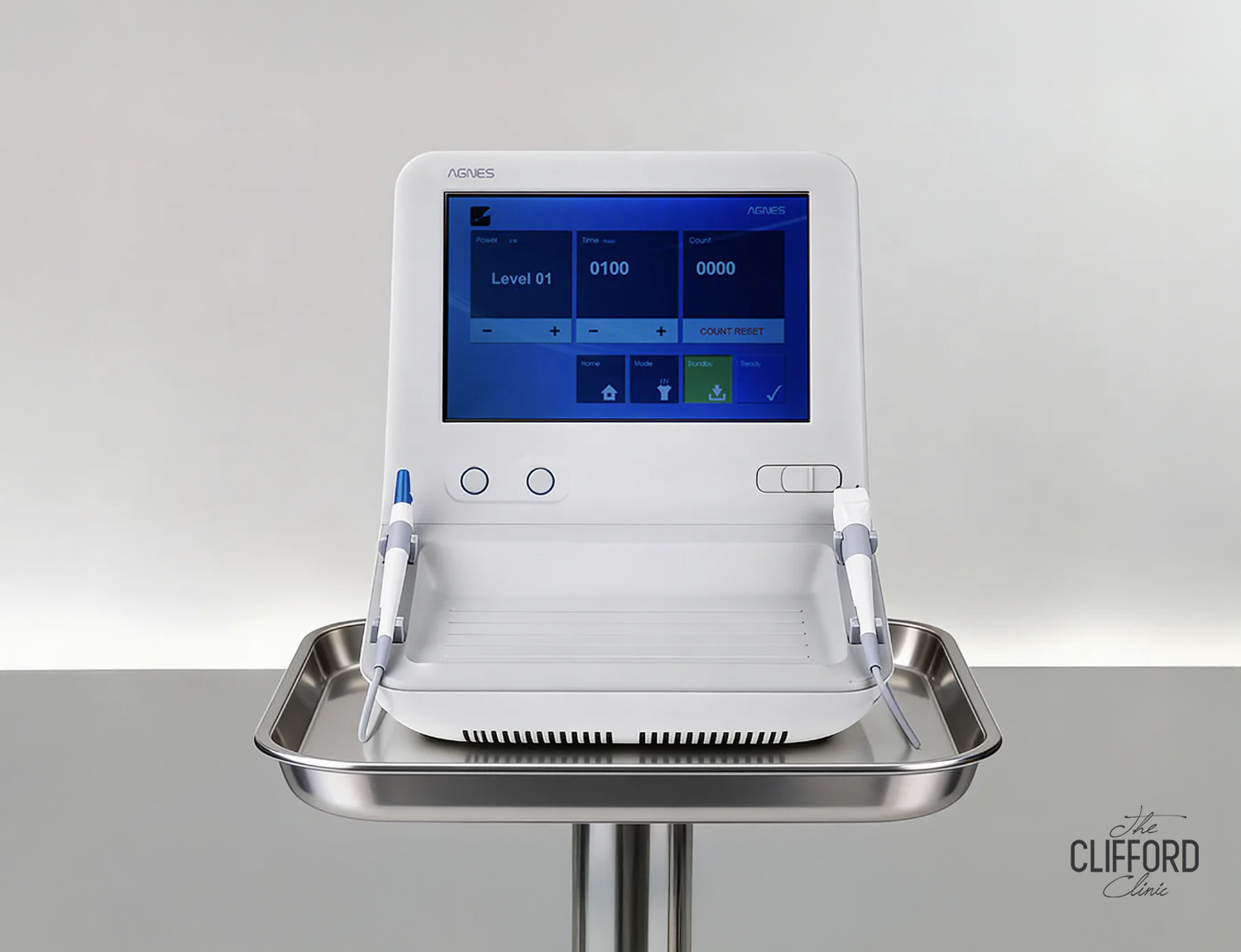
The intended effect is destruction of the treated gland, and a gland that has been destroyed does not resume producing oil. That does not make a patient permanently acne-free. Untreated glands elsewhere on the face can still become inflamed, which is why AGNES is used to target specific recurring lesions rather than as a whole-face solution.
The published evidence for AGNES is encouraging but thin. The most frequently cited work is a small case series following around twenty patients for a year, which reported low recurrence and substantial clearance after three sessions. Small single-arm series without a comparison group can only show that something appeared to work in that group. They cannot show how much of the effect was the treatment. The numbers are best treated as a promising early signal rather than a settled figure, and an individual result is better discussed at consultation than quoted from a study.
Why operator experience changes the outcome
AGNES is only as good as the operator’s ability to identify which individual glands to target, at what depth and at what energy. Under-treatment means the acne returns. Over-treatment risks mild scarring and prolonged redness.
It is not learned from a weekend course. It is learned from treating many hundreds of faces over more than a decade.
Three details of how AGNES is run at The Clifford Clinic follow from that.
Two different needle profiles are used for two different problems. A 1.5 mm needle with 0.45 mm base insulation targets sebaceous glands. A 1.2 mm needle with 0.2 mm insulation targets syringomas, which are commonly mistaken for acne and do not respond to acne treatment at all.
A two-day protocol is used for full effect. On day one, monopolar radiofrequency is delivered through the insulated micro-needle to destroy the gland. On day two, bipolar radiofrequency is delivered through a surface probe to clear residual debris and support healing.
Needle selection is made per lesion. Within a single session Dr Ee may switch needle sizes and energy settings depending on whether the problem is recurrent jawline cysts, comedonal forehead acne, or deep nodular lesions on the cheeks.
Who AGNES RF suits
AGNES RF suits patients with persistent acne in predictable places, such as the same three cysts on the right jawline every cycle. It also suits patients who cannot tolerate isotretinoin, and those who have had multiple courses of antibiotics without lasting effect. It is commonly combined with AviClear, which normalises oil production across the whole face while AGNES treats the small number of glands that account for most of the flares.
What actually happens at the consultation
Customisation is claimed on most aesthetic clinic websites. What follows is what it looks like in the consultation itself.
The first thirty minutes with Dr Ee are diagnostic rather than transactional. Six things are mapped.
Acne type, whether comedonal, inflammatory, nodulocystic, hormonal or mixed.
Skin tone and Fitzpatrick type, which determine laser settings and pigmentation risk.
Trigger pattern, including menstrual cycle, stress, diet, exercise and occlusive sunscreens.
Treatment history, covering what worked partially, what failed and what caused side effects.
Lifestyle and tolerance of downtime, since a wedding next week needs a different sequence from a student on a long break.
Scarring assessment, because the scar repair plan is designed from the start rather than after the acne is controlled.
Only after that map is built does the question of which treatment become worth asking. AviClear, AGNES RF, Gold photothermal therapy, Q-switched laser, topical maintenance and oral support are sequenced for one person rather than offered from a menu.

When isotretinoin is still the right answer
Being honest about this is the point of the page. Isotretinoin remains the most effective treatment available for severe nodulocystic acne, and there are patients for whom no laser or radiofrequency treatment is a fair substitute.
The first is severe nodulocystic acne that is already scarring. There the priority is stopping the scarring quickly, and nothing works faster.
The second is acne that has failed multiple full courses of combination treatment.
The third is widespread involvement of the chest and back as well as the face, where treating gland by gland is not practical.
What has changed is that declining it is no longer the end of the conversation. For moderate acne, for recurring lesions in predictable places, and for patients who cannot take a systemic drug, the gland-targeting treatments above are a genuine option rather than a consolation.
What to Ask Before You Book Any Acne Treatment in Singapore
Take this checklist to any clinic you are considering, and pay attention to the quality of the answer.
Who is the doctor performing the treatment, and how many years have they used this specific machine? If the answer is vague, ask again more directly. A doctor who uses a device regularly will have a specific number and will give it.
Will my plan change if my first session reveals something unexpected? A real customised plan is a hypothesis, not a contract. The answer should be yes.
What is the plan for acne scars that already exist, and when does that start? Scarring should be assessed at the first consultation, not after the acne has settled.
What happens if my acne does not respond? The answer you want is a specific Plan B, whether that is a different modality, a change in sequence, or a frank recommendation to go back to systemic treatment.
Are the lasers and devices FDA-cleared or CE-marked for acne specifically? AviClear, for instance, was the first energy-based device cleared by the US FDA specifically for acne. Clearance for the specific indication is what matters, rather than clearance for something else.
Where this leaves you
Patients considering acne treatment now arrive better informed than they did a few years ago, reading study summaries, comparing wavelengths and asking how much experience a doctor actually has with a given device. Those are the right questions to ask.
The Clifford Clinic was an early adopter of AviClear in Singapore and Dr Ee has used it since it became available here. He has used AGNES RF for more than a decade. Both treatments act on the sebaceous gland, both can be adjusted down to the individual lesion, and in the right sequence they give a patient who has declined isotretinoin a real alternative to consider.
If you have been offered isotretinoin and have not been able to say yes to it, there is a real conversation to be had about what else is available, and about whether, in your case, the drug is still the better option. Book a consultation, bring your treatment history and any previous prescriptions, and ask the questions above.
About The Clifford Clinic

The Clifford Clinic is a medical aesthetic clinic at 50 Raffles Place, Singapore 048623. Under the medical direction of Dr Gerard Ee, MBBS (UK), MRCS (Edinburgh), Graduate Diploma in Practical Dermatology (Cardiff), the clinic focuses on sebaceous-gland-targeted acne treatment and was an early adopter of AviClear in Singapore. To book a consultation, call +65 6532 2400 or WhatsApp +65 8318 6332.
Frequently asked questions
Is there an alternative to Accutane for acne in Singapore?
Yes, for many patients. AviClear and AGNES RF both reduce sebum production by acting on the sebaceous gland directly rather than through the bloodstream, so they avoid the systemic side effects that lead people to decline isotretinoin. They are not equivalent to it in severe disease.
Is AviClear as effective as Accutane?
No, not in severe nodulocystic acne, and any clinic that claims otherwise is overselling it. What AviClear offers is a meaningful reduction in oil production without a systemic drug, which for moderate acne is often enough.
Can I have these treatments if I am pregnant or planning to be?
Isotretinoin is absolutely contraindicated in pregnancy. AviClear is not used in pregnancy either, because the manufacturer lists pregnancy as a contraindication. Where a pregnant or breastfeeding patient wants more than topical treatment, Gold photothermal therapy is Dr Ee’s treatment of choice. Tell us at consultation if you are pregnant or trying to conceive, so that the plan is built around it from the start.
What if I try these and my acne does not improve?
Then the plan changes, whether that means a different modality, a different sequence, or a frank discussion about returning to systemic treatment. That is a normal outcome rather than a failure, and it should be planned for from the first consultation.

Author Bio
Dr Gerard Ee

Dr Gerard Ee is the Medical Director of The Clifford Clinic in Singapore. He earned his medical degree from St George's University of London and built his surgical experience across the Singapore General Hospital, National University Hospital, and Mount Sinai Hospital in New York. He holds Membership of the Royal College of Surgeons (Edinburgh) and a Postgraduate Diploma in Dermatology (Cardiff), and is fully accredited in aesthetic procedures including botulinum toxin, fillers, lasers, and light therapies. A strong advocate of minimally invasive, natural-looking results, Dr Ee has published in several medical and scientific journals and presented his research in cities including Taipei, Las Vegas, and London.
See all posts by Dr Gerard Ee »