




Breast Implant Safety and Monitoring, Rupture, Capsular Contracture and BIA-ALCL
Breast Implant Safety and Monitoring, Rupture, Capsular Contracture and BIA-ALCL
Breast implants are regulated medical devices used in large numbers worldwide, and serious implant-associated disease is rare. Implants are nonetheless not lifetime devices, complications do occur, and current information is the basis of a sound decision. As Dr Naidu tells his patients, “Implants do not have an automatic ten-year expiry date, but they do require lifelong awareness and follow-up. We replace them because there is a problem or because you want a change, not simply because the calendar has reached ten years.” This guide covers the risks patients actually research, the current advice of regulators such as Singapore’s Health Sciences Authority (HSA) and the United States Food and Drug Administration (FDA), and how long-term monitoring works. It forms part of our full resource on breast augmentation with implants in Singapore.
Common surgical risks of breast implant surgery
Breast augmentation carries the risks common to any operation, namely infection, bleeding and haematoma (a blood collection that may require drainage), seroma (a fluid collection), poor wound healing, thickened or stretched scars, and the risks of anaesthesia. Implant-specific early problems include altered nipple or breast sensation, which is usually temporary but occasionally persists, and asymmetry or malposition of the implant, which may require surgical adjustment.
Capsular contracture after breast augmentation
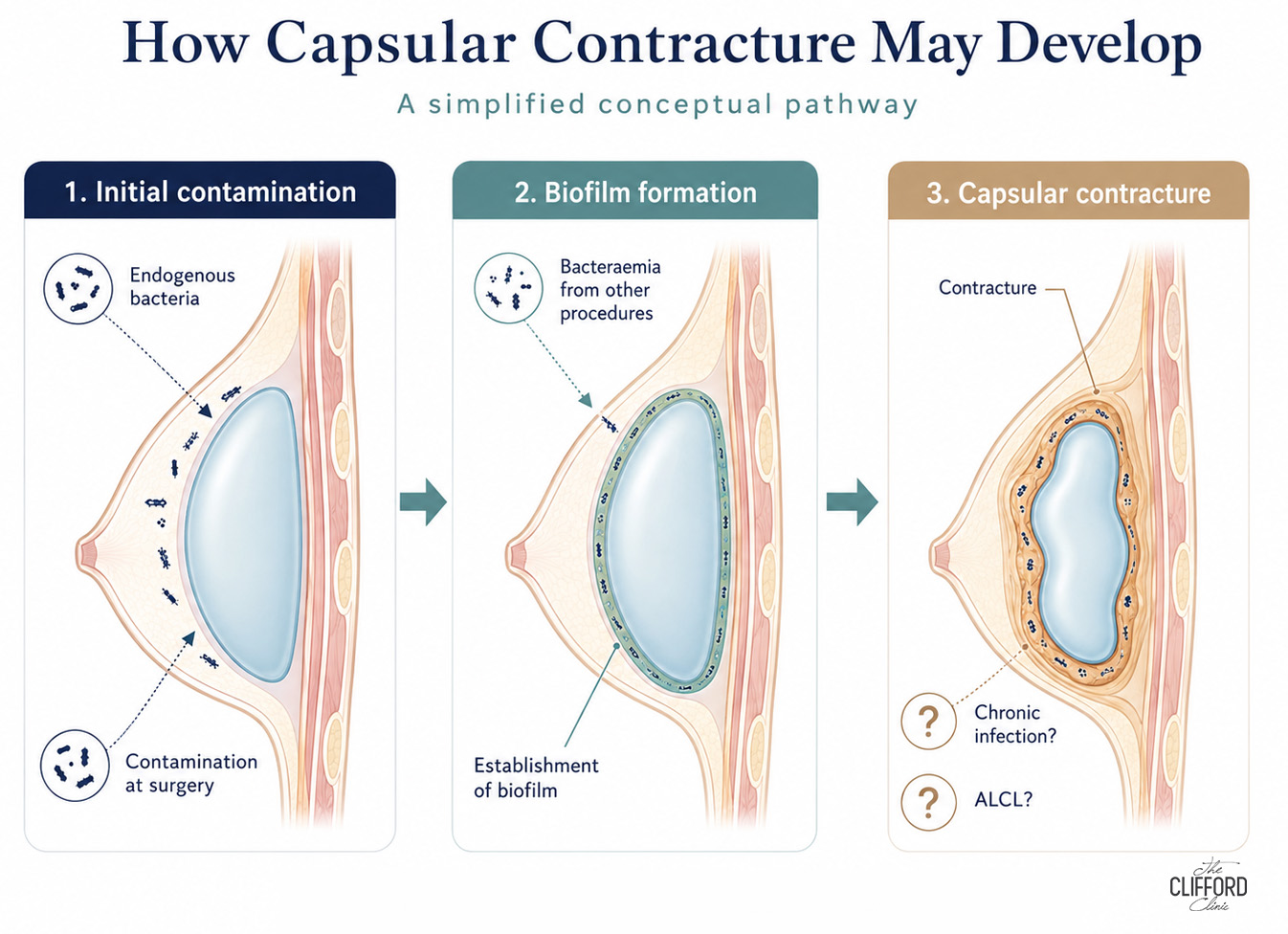
The body forms a thin capsule of scar tissue around any implanted device. In some patients that capsule tightens and thickens, a process termed capsular contracture, and the breast then feels firm, appears distorted or becomes uncomfortable. Severity is graded from unnoticeable (Baker I) to hard, distorted and painful (Baker IV). Milder grades may simply be monitored, whereas symptomatic contracture is usually treated with revision surgery, in which the capsule is released or removed, often with exchange of the implant. The contracture itself is thought to follow persistent low-grade inflammation at the implant surface, which is why bacterial contamination at the time of insertion, haematoma and seroma are all treated as risk factors, and why measures such as pocket irrigation and careful haemostasis form part of the operation. Reported rates vary by implant, surgical technique and study design, so any figure quoted at consultation should be accompanied by its source and the implant type it describes.
Implant rupture and why silent rupture matters
Implant shells can fail through wear, through trauma, or without any identifiable cause, and the likelihood increases with time. Saline rupture announces itself because the implant deflates as the saline is absorbed. Cohesive silicone rupture behaves differently. The FDA notes that it can be silent, producing no symptoms at all, with the gel typically retained within the capsule. The cohesive gel used in current implants holds its shape rather than dispersing, so a shell tear may leave the breast looking and feeling entirely normal, and the capsule that forms around every implant contains the leaked gel within the pocket. Physical examination alone is therefore not sufficient reassurance, which is the reason imaging surveillance exists.
Imaging surveillance with MRI and ultrasound
Magnetic resonance imaging (MRI) is the most accurate test for silicone rupture, because it distinguishes silicone from surrounding tissue directly and can show gel that has escaped the shell but remains inside the capsule, the pattern that produces no symptoms at all. Ultrasound is quicker, cheaper and involves no contrast, but it is more dependent on the operator and less reliable for a small or contained tear. The FDA currently accepts ultrasound as a screening alternative in patients without symptoms, and suggests a first scan at five to six years after silicone implant surgery, then every two to three years thereafter, with MRI where the result is equivocal or symptoms are present. An individual surveillance plan, covering both the imaging method and the interval, is set with the operating surgeon. At Clifford this is arranged individually with Dr Naidu at follow-up review, in line with current FDA and HSA guidance.
BIA-ALCL, a rare capsule-associated lymphoma
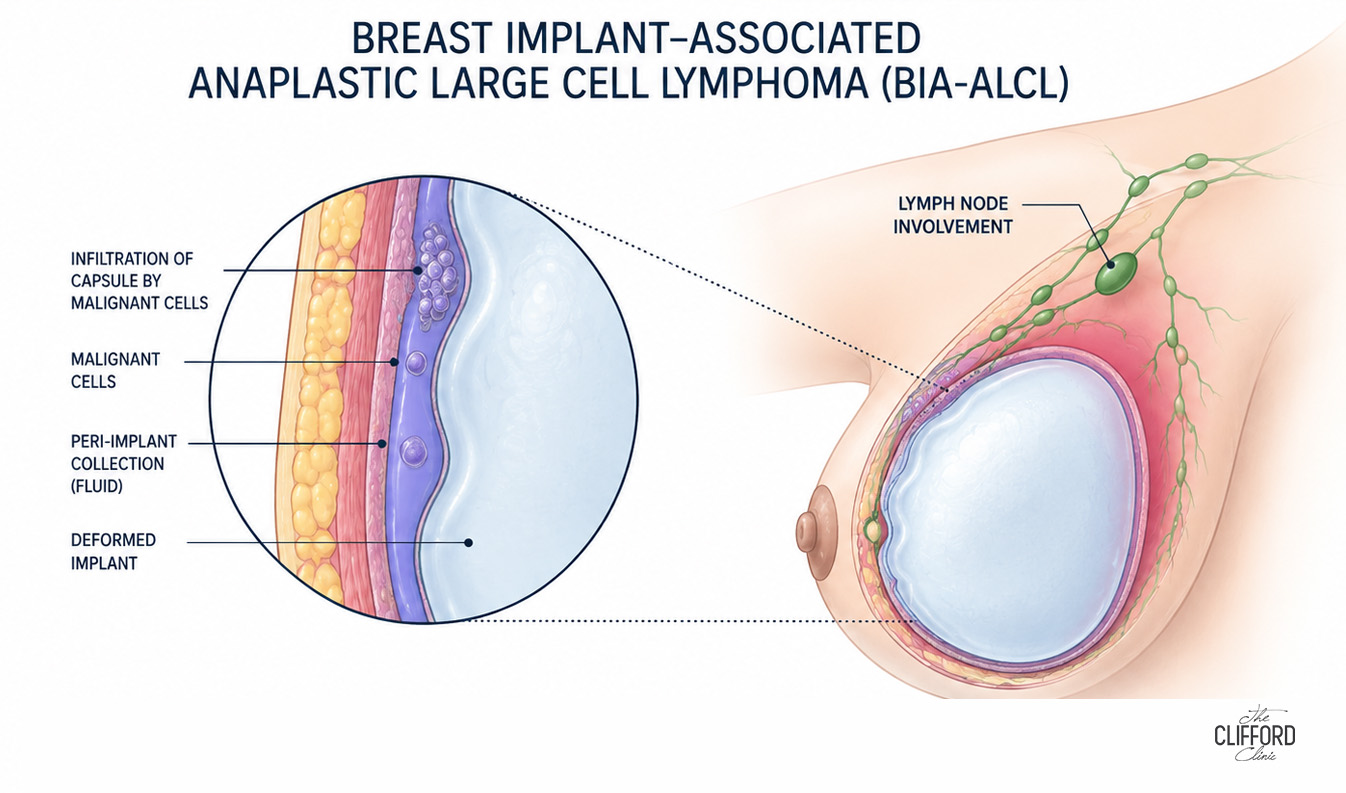
Breast implant-associated anaplastic large cell lymphoma (BIA-ALCL) is a rare cancer of the immune system that arises in the capsule surrounding an implant. It is not breast cancer, and it does not arise from breast tissue. Four points are reflected in both HSA and FDA guidance.
- It has been reported predominantly with textured-surface implants, and certain macro-textured products were withdrawn worldwide on that basis. The leading explanation is that a heavily textured surface carries a greater bacterial load and provokes sustained inflammation in the capsule, and that chronic immune stimulation is what occasionally gives rise to the lymphoma.
- Presentation is characteristically late. Persistent swelling from a fluid collection around the implant, pain, or a palpable mass typically appears years after the original surgery, most often between seven and ten years. A breast that has been stable for years and then enlarges over weeks is the pattern that should prompt assessment, and the fluid is sampled and tested rather than simply drained.
- Where it is detected early, it is usually treatable, most commonly by surgery that removes the implant together with the surrounding capsule.
- Regulators do not recommend precautionary removal of implants in patients who have no symptoms. Individual medical advice applies in every case.
BIA-SCC and other rare capsule-associated cancers
Regulators have also reported rare cases of squamous cell carcinoma (BIA-SCC) and of various lymphomas arising in the capsule around an implant. These reports remain rare, and the FDA has advised awareness of them, including among patients who are considering implants, while investigation continues. The practical implication is identical to that for BIA-ALCL. New and persistent changes around an implant warrant assessment, irrespective of how long the implant has been in place.
Breast implant illness and how it is assessed
Some patients report systemic symptoms such as fatigue, joint pain and cognitive difficulty, which they attribute to their implants and which are described collectively as breast implant illness (BII). BII is not currently a formal medical diagnosis, no diagnostic test establishes it, and research is ongoing. Some patients report improvement after implant removal, although the studies reporting this are limited in size and design, and most lack a control group, which makes it difficult to separate a true effect of explant from the natural fluctuation of the symptoms themselves. A credible clinic neither dismisses these reports nor promises that explant will resolve them. Patients presenting with such symptoms should be evaluated properly, with other causes excluded, and counselled honestly about what removal can and cannot be expected to achieve.
Whether implants require routine removal at ten years
There is no automatic ten-year replacement rule. The ten-year figure entered common use because it approximates the point at which reoperation rates in the manufacturers’ long-term studies become appreciable, not because the device expires on that date. Implants are nonetheless not lifetime devices, and the FDA states that the chance of needing removal or replacement rises the longer implants remain in place. Surgery is considered for a specific reason, namely rupture, contracture, malposition, symptoms or a change in the patient’s own preference, all of which are covered in removal, replacement and revision.
Symptoms that should prompt assessment
Certain changes warrant review at any time, including many years after surgery. They are new or persistent swelling, a change in breast size or shape, a lump in the breast or armpit, new firmness, tightening or distortion, persistent pain, redness or rash over the breast, and any symptom that causes concern. Routine breast cancer screening should continue as advised for the patient’s age, and the mammography facility should always be told that implants are present (see pregnancy, breastfeeding and mammograms).
How to read breast implant risk statistics
Risk figures circulate widely online, and most are quoted without the context that gives them meaning. Four questions turn such a statistic into information. The first is which implant the figure describes, because rates differ by surface, generation and brand, and a figure from 1990s textured implants says nothing about a current smooth device. The second is the period measured. A 10-year cumulative rate is naturally higher than a 3-year rate, and comparing them side by side misleads. The third is the population studied. Cosmetic augmentation and post-cancer reconstruction have different baseline risks, and registry data, manufacturer core studies and single-clinic series measure differently. The fourth is what the figure is a risk of. A reoperation rate includes elective size changes, not only complications. This page therefore avoids naked percentages. Any figure quoted to a patient, including by us at consultation, should arrive attached to its implant type, its timeframe and its source, and a patient is entitled to ask for all three.
The capsule, a normal response that occasionally becomes a problem
Every device implanted in the human body is walled off by a thin layer of collagen known as the capsule. Around a breast implant this response is normal, expected and usually helpful, because the capsule stabilises the implant within its pocket. The capsule becomes clinically relevant in three situations. It matters when it tightens and thickens, which is the capsular contracture discussed above. It matters when fluid accumulates between the capsule and the implant late after surgery, a late seroma that is investigated specifically because of the BIA-ALCL association. It matters during revision surgery, when the surgeon decides how much of the capsule to remove. Recognising that the capsule is the patient’s own tissue rather than part of the implant clarifies much of the discussion in our removal and revision guide.
How long-term monitoring works in practice
Long-term implant care rests on five habits. The first is knowing the implant, which means keeping the implant card recording brand, model and serial numbers. At Clifford the implant card is provided and Motiva warranty registration is completed by the clinic. The second is attending review on the surgeon’s schedule. The third is imaging surveillance at the intervals set out above. The fourth is reporting any new change promptly rather than waiting for the next appointment. The fifth is maintaining age-appropriate breast screening alongside implant follow-up. Safety information changes as regulators update their advice, so this page carries a last-reviewed date and is updated at least annually.
What a proper informed consent discussion looks like
Reading a page of this kind is preparation, whereas informed consent is a conversation. Before agreeing to surgery a patient should have heard, from the operating surgeon rather than from a coordinator alone, the realistic benefits for their own anatomy, the alternatives including doing nothing, the common self-limiting complications and the rare serious ones, what implants mean for the decades ahead in monitoring, possible revision and screening logistics, and the specific plan if something goes wrong, covering who to call, who operates and at what cost. There should be time to reflect between explanation and decision, written information to take away, and answers that survive follow-up questions. A clinic that treats the risk conversation as an obstacle to booking is revealing how it values that conversation, whereas a clinic that treats it as the core of the consultation is demonstrating how it will behave if a patient ever becomes the rare statistic. That behavioural signal is one of the most useful safety indicators a patient can observe before surgery.
Frequently asked questions
Are breast implants safe?
They are regulated devices with a well-documented risk profile. Most patients have no serious complication, but risks including capsular contracture, rupture and the rare implant-associated cancers are real and deserve honest discussion rather than dismissal.
What does capsular contracture feel like?
It presents as progressive firmness of the breast, sometimes with visible distortion or discomfort, appearing months to years after surgery.
How would I know if my silicone implant ruptured?
There may be a change in shape, new firmness or discomfort, or no symptom whatsoever. Because silicone rupture can be silent, imaging surveillance is recommended rather than reliance on symptoms alone.
Should I have my textured implants removed?
Current regulatory guidance does not support removal on the basis of fear alone in a patient without symptoms. Any new swelling, pain or mass should be assessed promptly, and the individual situation discussed with a doctor.
I don’t know what implants I have. What should I do?
Start with the records held by the original clinic. Where those are unavailable, imaging can characterise the implant, and implants fitted with a radio-frequency identification (RFID) chip can be read directly. Establishing the implant’s identity is worth doing before a problem arises rather than after.
Is breast implant illness recognised in Singapore?
The symptom reports are taken seriously internationally and research continues, but there is currently no diagnostic test that attributes systemic symptoms to implants. A sensible pathway in Singapore is proper medical evaluation of the symptoms, honest counselling on the available evidence, and an individualised decision about explant, which is the approach taken at consultation.
Do implants increase breast cancer risk?
Implants are not associated with an increased risk of breast cancer itself. The implant-associated concerns are the rare capsule-related conditions described above, which are a different category of disease, together with the practical effect of implants on screening views. An implant can obscure part of the breast on a standard mammogram, which is why additional Eklund displacement views are taken, and why the imaging centre should be told about the implants when the appointment is booked.
How often should I see a doctor about my implants if nothing is wrong?
Follow the surgeon’s review schedule, keep to the imaging surveillance intervals set out above, and treat any new change as a prompt for review regardless of the calendar. The absence of a routine removal rule does not imply the absence of routine attention.
Medically reviewed by Dr Gerard Ee. Annual review is mandatory for this page. Surgery described on this page is performed by Dr Shenthilkumar Naidu, MBBS (NUS), FRCS (Edin), MOH-accredited Consultant Plastic Surgeon, whose research has been published in peer-reviewed journals including Plastic and Reconstructive Surgery.
Selected References. U.S. FDA, breast implant screening recommendations · HSA Singapore, breast implant advisories · ACR Appropriateness Criteria, Breast Implant Evaluation, Journal of the American College of Radiology (2023).
Explore the full breast implant series
Considering breast augmentation? Visit the main Breast implants at The Clifford Clinic service page to book a consultation, or continue with the rest of this series.
Breast Augmentation With Implants in Singapore — the complete guide
· Breast Implant Cost in Singapore
· Motiva Breast Implants in Singapore
· Breast Implant Size and Profile
· Breast Implant Placement, Incisions and Scars
· Breast Augmentation Recovery Timeline
· Breast Implants vs Fat Transfer vs Breast Lift
· Breast Implant Removal and Revision
· Breast Implants, Pregnancy, Breastfeeding and Mammograms.

Author Bio
Dr Gerard Ee

Dr Gerard Ee is the Medical Director of The Clifford Clinic in Singapore. He earned his medical degree from St George's University of London and built his surgical experience across the Singapore General Hospital, National University Hospital, and Mount Sinai Hospital in New York. He holds Membership of the Royal College of Surgeons (Edinburgh) and a Postgraduate Diploma in Dermatology (Cardiff), and is fully accredited in aesthetic procedures including botulinum toxin, fillers, lasers, and light therapies. A strong advocate of minimally invasive, natural-looking results, Dr Ee has published in several medical and scientific journals and presented his research in cities including Taipei, Las Vegas, and London.
See all posts by Dr Gerard Ee »