
Botox for Lower Back Pain and Chronic Lumbar Muscle Spasm
Quick answer. Botox (botulinum toxin type A) can help a selected group of chronic lower back pain sufferers whose pain is driven by overactive lumbar muscles. Pooled trials show meaningful pain reduction and functional gains over placebo, though the benefit tends to fade over time and it is not a suitable treatment for every type of back pain.
Written and medically reviewed by Dr Gerard Ee of The Clifford Clinic, Singapore. Last updated July 2026.
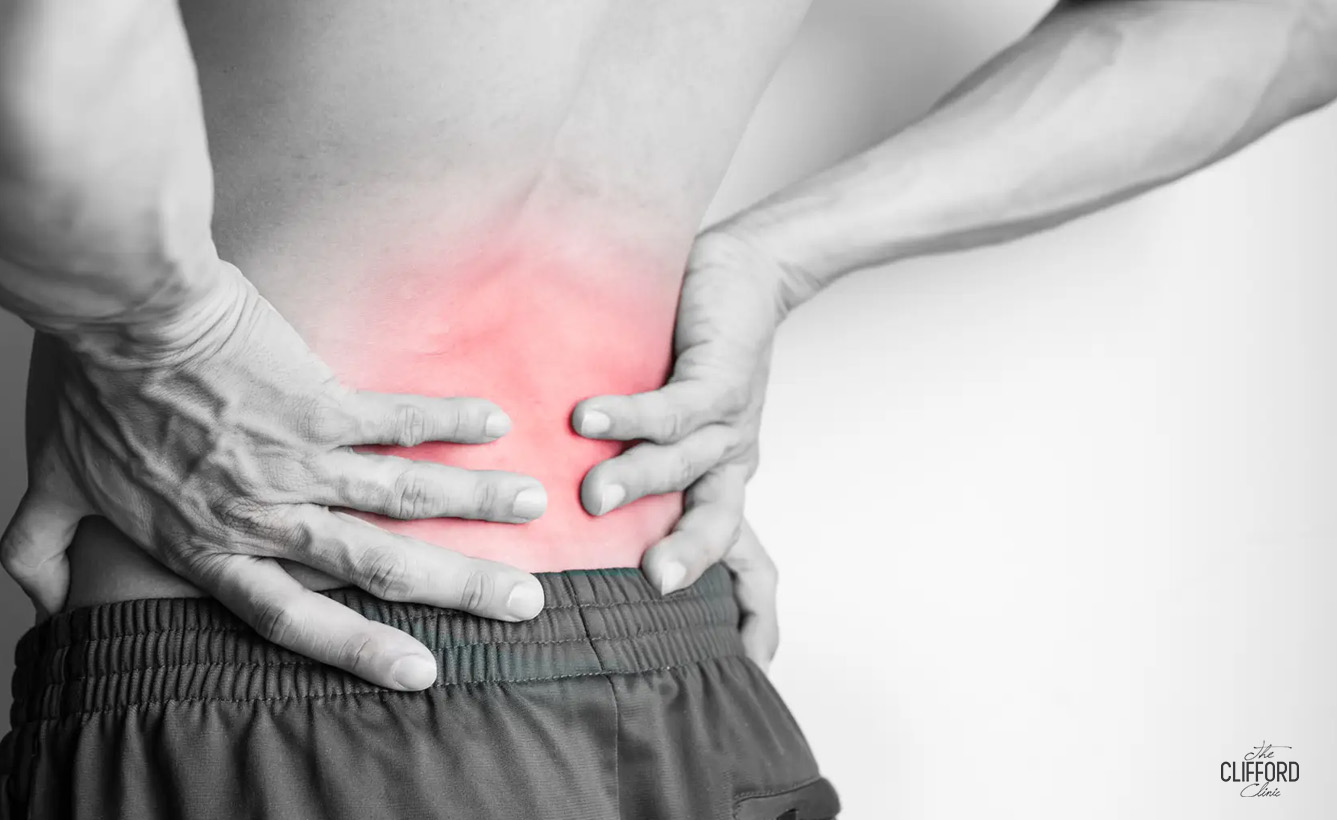
Chronic lower back pain is one of the most common and disabling health issues. In many patients, the pain arises not from a disc or nerve alone but from the lower back muscles that have developed a persistent, protective spasm. When the paraspinal muscles alongside the spine remain tight over months, they produce a deep, aching, sometimes one-sided pain that stretching and analgesics relieve only briefly. For these patients, botulinum toxin injection represents a targeted option.
The following sections describe the effect of botulinum toxin on lumbar muscle spasms, what the trials demonstrate, who is likely to benefit, how the treatment is performed, and how it compares with steroid injections and other measures.
What chronic lower back pain from muscle spasm looks like
Lower back pain is defined as chronic when it persists beyond three months. There are many possible causes, including discs, joints, and nerves, but a large proportion of chronic cases involve a substantial muscular component. The paraspinal muscles maintain upright posture and control movement. When they are overloaded, injured, or responding to an underlying spinal problem, they can lock into sustained contraction. This muscular guarding is protective in the short term but becomes a source of pain when it persists. Typical features are tight, tender bands within the muscle, reduced flexibility, and pain that worsens with prolonged sitting, standing, or activity. This pattern is the most likely to respond to treatment that reduces muscle overactivity.
Why lumbar tightness causes pain
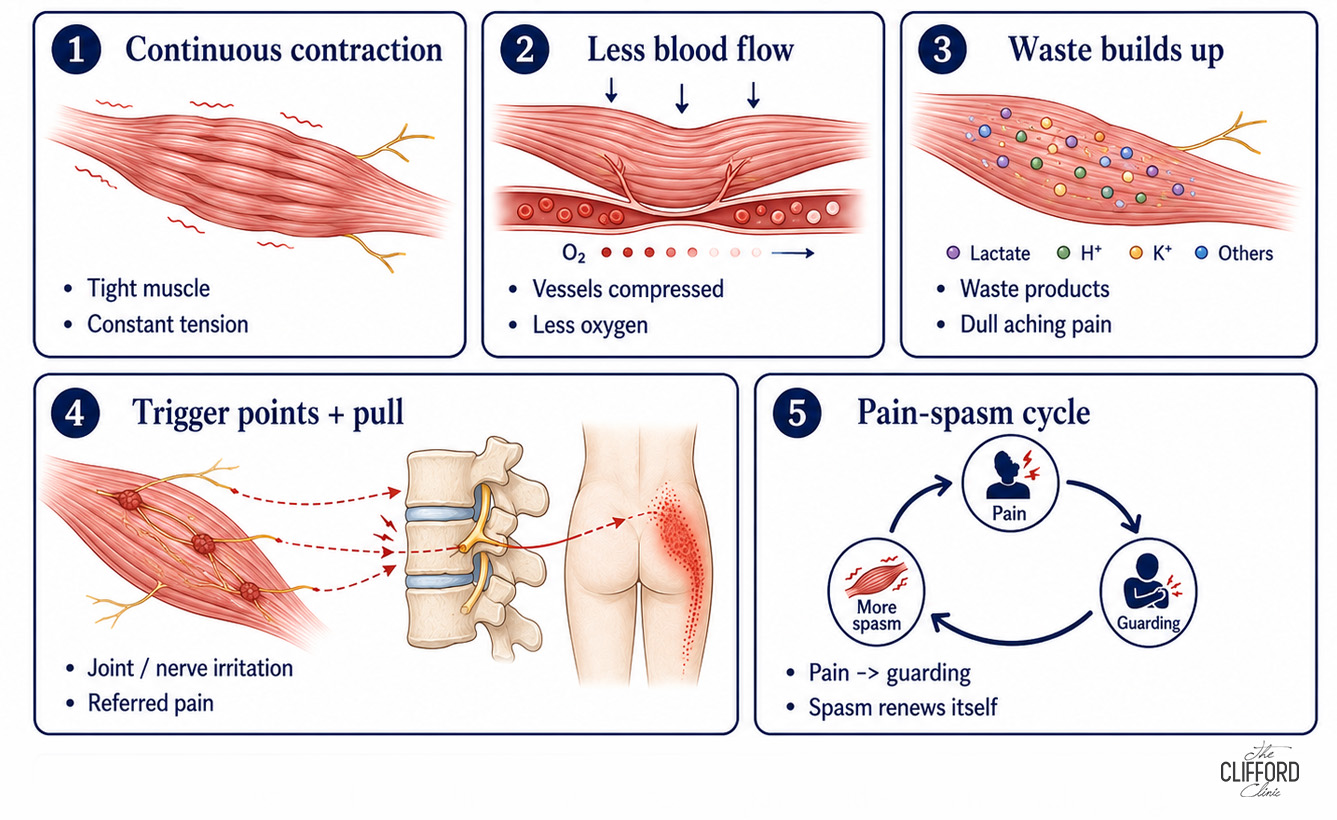
A muscle in continuous contraction behaves very differently from a resting one. Sustained tension squeezes the small blood vessels within the muscle, reduces oxygen delivery, and allows waste products to build up, producing dull, aching pain. The taut bands that form pull on the joints of the spine and can irritate the small nerves that supply the muscle. Trigger points within the muscle refer pain to nearby areas, so a spasm in one muscle can produce pain across the whole lower back or into the buttock. As the pain itself makes muscles guard more, the spasm keeps renewing itself.
Why conventional treatments sometimes fall short
Standard care and the appropriate starting point include remaining active, physiotherapy, core strengthening, heat, oral analgesics, anti-inflammatory medications, and sometimes muscle relaxants or injections. Most patients improve. A proportion do not, often because these measures do not switch off muscle overactivity itself. Oral muscle relaxants sedate the whole body before they meaningfully relax a single region of the back. Steroid injections reduce inflammation but not spasm. Manual therapy and dry needling can release trigger points, but in refractory cases the spasm returns within days. Where the muscle fails to relax despite rehabilitation, treatment that reduces its overactivity becomes a logical option.
How Botox works for lower back pain
Botulinum toxin type A is injected into the overactive paraspinal muscles. It blocks the release of acetylcholine at the neuromuscular junction, the signal that tells a muscle to contract, so the treated muscle relaxes over one to two weeks. As the sustained tension eases, blood flow improves, trigger points settle, and the mechanical pull on the spine reduces. Botulinum toxin also calms pain nerves directly by lowering the release of pain messengers such as substance P and calcitonin gene-related peptide, and some of the toxin is carried back into the spinal cord where it can reduce the amplified pain state that keeps a back sensitive. The aim is to interrupt the cycle of spasm and pain long enough for rehabilitation to restore normal, comfortable movement.
What the evidence shows
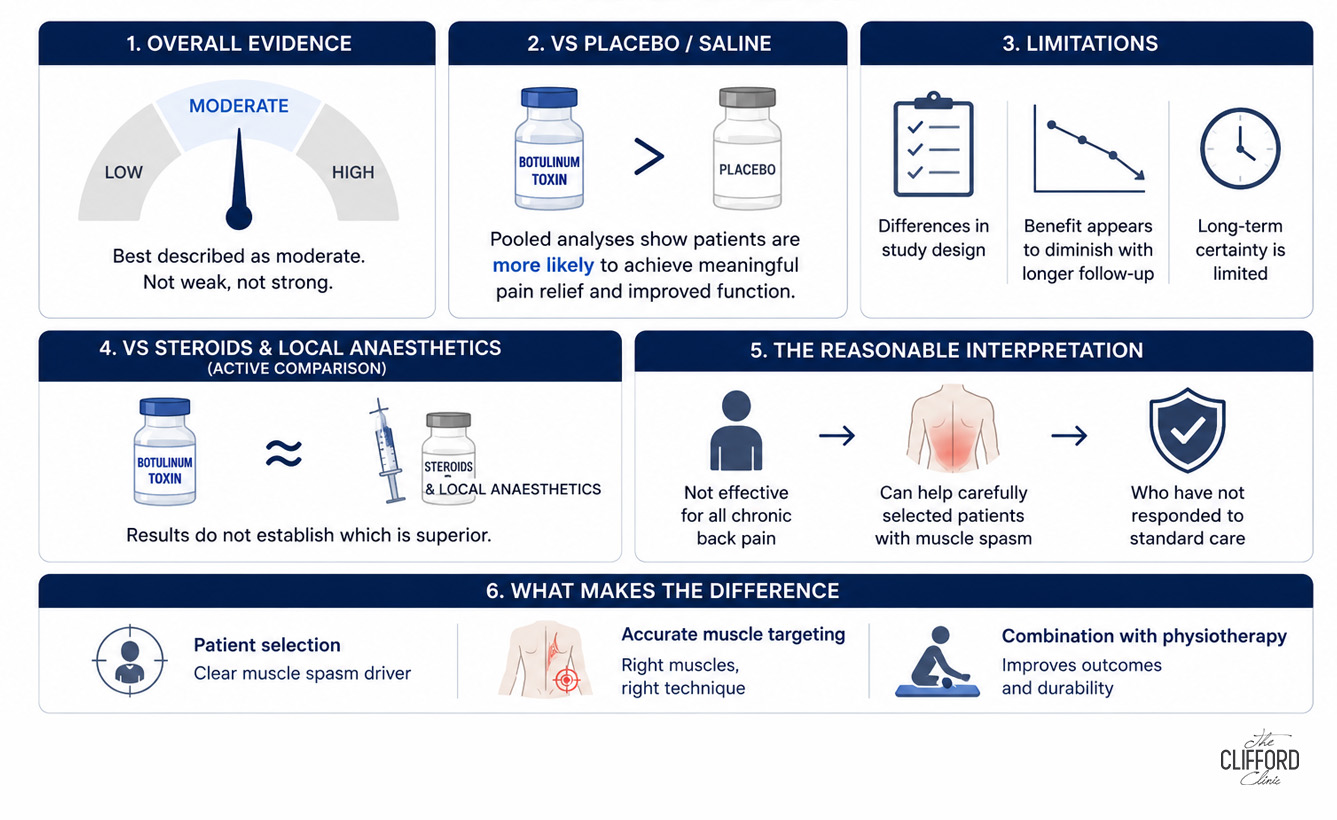
The evidence for botulinum toxin in chronic low back pain is best described as moderate. Pooled analyses of randomised trials clearly indicate that patients treated with botulinum toxin are more likely to achieve meaningful pain relief and improved function than those given placebo or saline. At the same time, the certainty of this evidence is limited by differences in study design, and the benefit appears to diminish with longer follow-up. When botulinum toxin is compared directly with steroids and local anaesthetics rather than placebo, the results do not establish which is superior. The reasonable interpretation is that botulinum toxin is not effective for all chronic back pain but can help carefully selected patients whose pain is clearly driven by muscle spasm and who have not responded to standard care. Patient selection, accurate muscle targeting, and combination with physiotherapy distinguish good responders from poor ones.
For back pain that is genuinely coming from tight, overactive muscle rather than the disc or nerve, and that has not settled despite plenty of physiotherapy and stretching, botulinum toxin can be very effective. When a scan shows severe pathology that surgery would treat better, I recommend the surgical route instead.
Dr Gerard Ee, Medical Director, The Clifford Clinic
The best candidates have already done the physiotherapy and stretching, yet the muscle pain remains. Accurate targeting is what makes the difference.
Dr Dinesh Sirisena, Consultant in Sports and Exercise Medicine, The Clifford Clinic
In practice, botulinum toxin is reserved for back pain that is clearly muscular and has resisted an adequate course of physiotherapy. Spine imaging and orthopaedic review are arranged where the presentation suggests a disc, a nerve, or another structural cause.
Who may benefit, and who should avoid treatment
Botox for Back Pain: Who May Benefit
| May Benefit | Less Likely to Benefit or Should Avoid |
|---|---|
| Chronic Back Pain with Clear Muscle Spasm or Tender Trigger Points | Pain due mainly to nerve compression or a disc, without muscle spasm |
| Palpable Tightness in the Paraspinal Muscles | Pregnancy or breastfeeding |
| Failed Physiotherapy, Medication, and Other Injections | Neuromuscular disease such as myasthenia gravis |
| Willing to Combine Injection with a Rehabilitation Plan | Infection at the injection site or allergy to the product |
Comparison with steroid injection and other options
A common question is whether botulinum toxin is superior to a steroid injection. The two perform different functions. Steroids reduce inflammation, while botulinum toxin reduces muscle overactivity and calms pain nerves. For pain driven by muscle spasm, botulinum toxin addresses the actual problem, and in myofascial pain its benefit can outlast that of a steroid, whose effect tends to fade. Steroids remain cheaper and faster for inflammatory pain, but repeated steroid injection can thin tissue over time. Botulinum toxin is not a substitute for physiotherapy, which remains the foundation of care.
Pain Treatment Options Compared
| Treatment | Main Action | Best For | Typical Duration |
|---|---|---|---|
| Physiotherapy and Exercise | Retrains and strengthens | First line for all | Long term if maintained |
| Corticosteroid Injection | Reduces inflammation | Inflammatory or joint pain | Weeks to a few months |
| Dry Needling or Local Anaesthetic | Releases trigger points | Active trigger points | Days to weeks |
| Botulinum Toxin, Botox | Reduces muscle spasm | Refractory muscular or myofascial pain | Two to six months |
Risks and side effects
At the doses utilised for back pain, botulinum toxin is well tolerated. The commonest effects are temporary injection site soreness or bruising and mild, temporary weakness of the treated muscles, which are generally acceptable when the target is an overactive muscle. Occasionally the effect spreads slightly to a neighbouring muscle, causing mild weakness that resolves as the toxin wears off. Serious effects are rare at these doses, though all botulinum toxin products carry a warning about the rare risk that the effect may spread more widely. Treatment is avoided during pregnancy and breastfeeding, in certain neuromuscular conditions, and where there is local infection.
Where botulinum toxin sits in back pain care
The evidence in non-specific chronic low back pain has grown over the last two years. Reviews now report clinically meaningful gains in pain and function with a comparatively long duration, at least comparable to steroids and local anaesthetics, although the benefit tends to decline over longer follow-up and some trials have been negative. The pattern that emerges is that botulinum toxin is suitable for patients whose pain is driven by muscular and paraspinal tightness rather than every case of back pain. Benefit has also been reported in lumbar fasciitis and in sacroiliac joint dysfunction, and injection of the lumbar muscles and hip flexors is regarded as a safe adjunct.
Botulinum toxin is a safe adjunct in chronic lower back pain, but it must be part of a larger treatment plan alongside activity modification, rehabilitation and the usual measures. Targets such as the quadratus lumborum and iliopsoas can be considered, and tightness in the quadratus lumborum is often a significant contributor to one-sided or localised lower back pain.
Dr Dinesh Sirisena, Consultant in Sports and Exercise Medicine, The Clifford Clinic
Speak to our doctors

Botulinum toxin for muscle and joint pain is a considered, individualised treatment. To determine whether it is appropriate, arrange a consultation with the team at The Clifford Clinic or read more about Dr Gerard Ee’s work. The clinicians will review the individual’s history, perform an examination, and explain the available options before any treatment is planned.
Frequently Asked Questions
Can botulinum toxin help chronic lower back pain?
It can help a selected group whose pain is driven by overactive, spasming lumbar muscles that have not responded to physiotherapy and medication. Pooled trials demonstrate meaningful gains over placebo. It is not effective for back pain caused primarily by disc disease or nerve compression without a muscular component, so careful clinical assessment is essential.
Does botulinum toxin work better than steroid injection?
The two act differently. Steroids reduce inflammation, while botulinum toxin reduces muscle spasm and calms pain nerves. For pain driven by muscle overactivity, botulinum toxin addresses the actual problem and, in myofascial pain, can last longer, whereas steroids are better for inflammatory pain. A direct comparison for back pain has not yet been established.
How long does botulinum toxin last for back pain?
Relief usually develops over one to two weeks and lasts approximately two to six months, and the benefit tends to fade at longer follow-up. If effective, treatment may be repeated. Combination with physiotherapy tends to extend the benefit.
Who is suitable for the treatment?
The most suitable candidates have chronic back pain with clear muscle spasm or trigger points, have tried standard care without adequate relief, and are willing to combine the injection with rehabilitation. Patients who are pregnant or breastfeeding or who have certain neuromuscular conditions are not suitable.
Does insurance cover botulinum toxin for back pain?
This varies by insurer and treatment plan, and as this is an off-label use, coverage is not guaranteed. The clinic can provide supporting documentation, and coverage should be confirmed with the insurer before treatment.
Related Conditions
Explore the rest of our botulinum toxin for musculoskeletal pain series.
- Botox for Muscle Pain (main guide), the overview of botulinum toxin for musculoskeletal pain
- Botox for Quadratus Lumborum Pain, stubborn one-sided lower back spasm
- Botox for Tight Hip Flexors, anterior hip pain in runners and cyclists
- Botox for Iliopsoas Syndrome, psoas spasm and snapping hip
- Botox for Gastrocnemius Tightness, calf tightness and cramps
- Botox for Plantar Fasciitis, chronic heel pain that resists other measures
- Botox for Trapezius and Shoulder Myofascial Pain, trapezius tightness and shoulder trigger points
Compare Treatments and Procedures
Understand the treatment options and what they involve.
- Botox vs Steroid Injection, how the two injections differ and when each is chosen
- Botox vs PRP, muscle relaxation compared with tissue healing
- Botox vs Dry Needling, two trigger point options compared
- Ultrasound Guided Injections, why guidance matters for deep muscles
- Recovery and Physiotherapy after Botox, what to expect and how to get the most from treatment
More from The Clifford Clinic
Related treatments and services offered at our clinic.
- Platelet Rich Plasma Injections for Musculoskeletal Injury Recovery
- Botox for the Trapezius Muscle
- Botox Treatment for Cervical Torticollis
- Bioscaffold Therapy for Musculoskeletal Regeneration
- Hyaluronic Acid Injection for Knees
About the Authors

Dr Dinesh Sirisena is a Consultant in Sports and Exercise Medicine at The Clifford Clinic. He completed his sports and exercise medicine training in the United Kingdom and has cared for elite football, rugby, athletics, and hockey teams, including at the London 2012 Olympic and Paralympic Games. He specialises in ultrasound-guided injections and other non-surgical treatments for muscle, tendon, and joint pain, has led a musculoskeletal service as its medical director, and is an assistant professor at the NUS Yong Loo Lin and NTU Lee Kong Chian schools of medicine.

Dr Gerard Ee is the Medical Director of The Clifford Clinic. He trained at St George’s University of London, is a Member of the Royal College of Surgeons of Edinburgh, and built his orthopaedic experience at National University Hospital and Singapore General Hospital with a focus on the knee, joint. and spine. He has published widely in peer-reviewed orthopaedic and spine journals. Read more about his work at drgerardee.com.
Together at The Clifford Clinic, these doctors have utilised botulinum toxin for muscle and joint pain for more than 16 years, performing around 100 of these treatments each year.
Selected orthopaedic and spine publications by Dr Gerard Ee
- Ee G, Srivastava A, Peng CWB, Tan SB, Tow BPB. Management of the neglected and healed bilateral cervical facet dislocation. European Spine Journal. 2014.
- Ee WWG, Lau WLJ, Yeo W, Yap VB, Yue WM. Does minimally invasive surgery have a lower risk of surgical site infections compared with open spinal surgery. Clinical Orthopaedics and Related Research. 2014.
- Ee G, Jiang L, Guo CM, Yeo W, Tan SB, Tow B, Chen J, Yue WM. Comparison of clinical outcomes and radiographic measurements in four treatment modalities for osteoporotic compression fractures. Journal of Spinal Disorders and Techniques. 2015.
- Ee G, Pang SY, Kumar N, Malhotra R. A silent acute abdomen in a patient with spinal cord injury. BMJ Case Reports. 2013.
References
- The efficacy and safety of botulinum neurotoxin type A in treating chronic low back pain, a systematic review and meta-analysis. European Journal of Pain. 2025.
- Efficacy of botulinum toxin type A for treating chronic low back pain, a systematic review and meta-analysis. European Journal of Clinical Pharmacology. 2026.
- Myofascial pain syndrome, an update on clinical characteristics, etiopathogenesis, diagnosis and treatment. Muscle and Nerve. 2025.
- Neurobiological mechanisms of botulinum neurotoxin induced analgesia for neuropathic pain. Pharmacology and Therapeutics. 2024.
- The analgesic effects of botulinum neurotoxin by modulating pain related receptors, a literature review. Molecular Pain. 2024.
- Approved uses and prescribing information for botulinum toxin type A. United States Food and Drug Administration. 2024.
- Double blind randomised trial of botulinum toxin for mechanical chronic low back pain. World Journal of Methodology. 2024.
- Open label study of botulinum toxin for resistant chronic low back pain. Cureus. 2021.
- Meta analysis of botulinum toxin for fasciitis pain in the lumbar and neck and shoulder regions. Medicine. 2023.
- Review of botulinum toxin for sacroiliac joint dysfunction. European Spine Journal. 2024.
- Stiff person spectrum cohort with paraspinal and hip flexor injection. Therapeutic Advances in Neurological Disorders. 2025.
Medical disclaimer. This article is for general education and does not replace a clinical assessment with a qualified doctor. Botulinum toxin for musculoskeletal pain is an individualised treatment that is off label for most of these conditions. Suitability, dosing, and outcomes vary between individuals. Please seek an in-person consultation at The Clifford Clinic before making any treatment decision.