

Sebacia Gold Microparticles Evidence: The Clinical Trials Behind Gold PTT
Sebacia is the brand under which light-absorbing gold particles were trialled and sold, and the studies below are the evidence for gold photothermal therapy as a technology. The Clifford Clinic performs Gold PTT with its own gold nanoparticle preparation, not the Sebacia product. The terms microparticle and nanoparticle are used across this literature for the same class of gold-coated particle. This page explains what the trials found and what they do and do not tell you.
It has been nearly two decades since there has been any innovation in the acne treatment industry – and the escalating concern about antibiotic resistance has driven the need for a more effective, safe and durable treatment.
The problem with majority of acne treatments to date (e.g. Isotretinoin, birth control pills and antibiotics) is that they only target one or more of the symptoms of acne – instead of treating the root cause of the condition.
So, while they may provide temporary relief and mild improvement – acne can still recur once treatment stops. Those suffering from severe acne may also not see much results with some of these treatments.
Why acne is so hard to treat
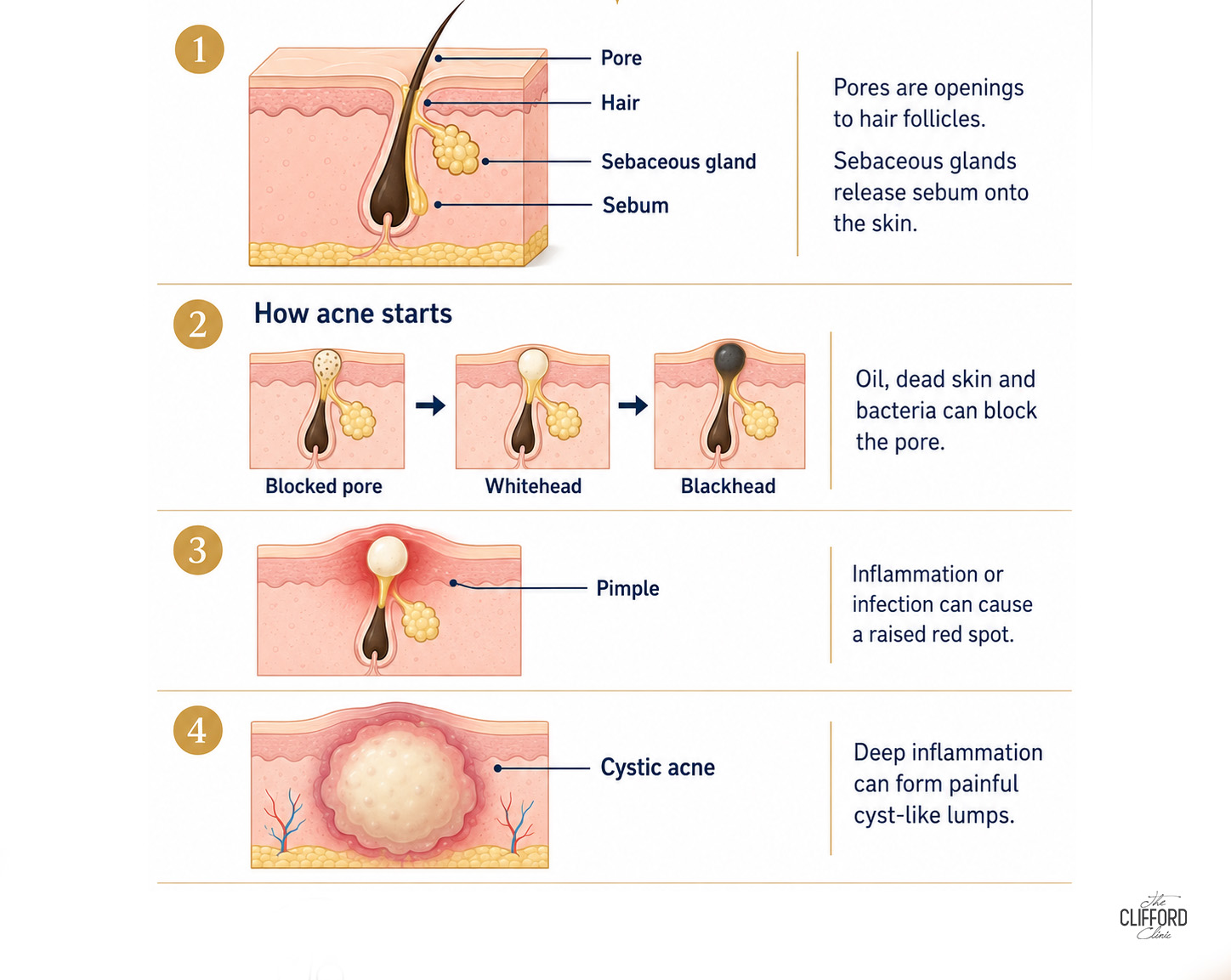
It is well-known that acne is caused by 3 main factors:
• Excessive oil production by sebaceous glands
• Clogged pores
• Bacterial proliferation, specifically the P.acnes bacteria
Being a multi-factorial problem that manifests in the form of blackheads, pimples and even deep acne scars – this makes acne one of the most difficult skin issues to treat, especially if you suffer from hormonal acne. This is why the best acne spot treatment should be highly customised and include a combination approach to treating acne.
Tackling acne at its source: Sebacia microparticles
The particles used in the trials were developed by Sebacia Inc. and consist of a silica core wrapped in a gold shell, engineered to absorb near-infrared laser light. The technology received FDA clearance in the United States in 2018; regulatory status differs by country. Gold photothermal therapy delivers such particles into the pores where the sebaceous glands sit, then heats them with a laser so that the gland’s activity is reduced. At The Clifford Clinic the delivery is done with the Bellasonic 40 kHz LDM ultrasound and the activation with an 800 nm diode or 1064 nm long-pulsed laser, using the clinic’s own gold nanoparticle preparation.
Produced by Sebacia Inc., a dermatology and aesthetics company – the Gold Photothermal Therapy (PTT) treatment involves delivering Sebacia microparticles deep into the pores where the sebaceous glands are found, and heating them up with a dermatology laser to shrink and minimise their activity.
Because the heat is generated inside the gland, sebum output falls, and with it the likelihood of blocked pores and inflammation. Histological work on sebum-targeted photothermal treatments shows selective injury to the sebocytes with the epidermis spared. The glands are not eliminated and acne is not removed outright; the trials measure a reduction in inflammatory lesions, which is the figure to look at below.
Given its excellent safety profile – Sebacia microparticles are biocompatible with human tissues and thus ideal for penetrating into the deeper layers of the skin. Designed to work selectively and locally – there is no need to worry about damage to the surrounding tissues with this treatment.
The sham-controlled randomised trial
The foundational study randomised 51 patients to gold particle photothermal treatment or a sham procedure. Three treatments were given one to two weeks apart. At 14 weeks, inflammatory lesion counts had fallen by 53% in the treated group against 30% in the sham group. The importance of a sham arm is that acne fluctuates and improves with attention alone; the 30% sham response shows how much of any improvement is not the treatment, and the gap between the two is the treatment effect.
The European multicentre open-label study
This study followed patients with moderate to moderately severe acne through one course of treatment at several European centres. After one course, 76% of patients achieved at least a 40% reduction in inflammatory lesions; of those responders, 89% still had at least a 40% reduction at 36 weeks. Patients who responded less well to the first course benefited from a second. Being open-label, the study has no control arm, so its numbers are best read for durability — how long a response lasts — rather than for the size of the effect.
Laser-activated gold particles with topical retinoids
A prospective multicentre study treated patients with mild-to-moderate inflammatory acne who were using topical retinoids, activating the particles with a 1064 nm Nd:YAG laser. Lesions fell by 55% at month two and 68% at month twelve, and 59% of patients were clear or almost clear at one year. This is the study most relevant to how the treatment is used in practice — alongside a retinoid rather than instead of one.
The Asian study
A study of gold nanoparticle photothermal therapy in Asian patients reported a significant reduction in lesions and in the inflammatory infiltrate on histology, with no serious adverse effects. It is the only one of the four conducted in Asian patients and the only one using the nanoparticle terminology, which makes it the most directly relevant of the four here. It is also the smallest and its authors describe it as preliminary, so it indicates rather than confirms how the treatment behaves in skin types prone to post-inflammatory pigmentation.
What the numbers mean for a patient
Read together, the trials support three practical statements. Gold-particle photothermal therapy reduces inflammatory acne by roughly half over the first three to four months, and by more when a topical retinoid is used alongside it. Most patients keep their improvement for nine months to a year, and those who slip back respond to a second course. Side effects are mild and short-lived, with no serious adverse events in any of the four studies. What the trials do not show is complete or lasting clearance in everyone: around a quarter of patients did not reach the 40% threshold after one course, which is why the treatment is planned as a course with review rather than promised as a fix. The 2024 American Academy of Dermatology acne guideline concluded that the evidence for device treatments as a group is insufficient to support a formal recommendation.
Why can’t laser treatment alone do the job?
The lasers used in Gold PTT treatment are nothing new – and are simply used to activate the gold microparticles and convert them into heat energy.
Although acne laser treatment alone has also proven to be effective – it can only go so far as it is unable to penetrate into the deeper layers of the skin without potentially being harmful to the surrounding tissues.
Because the gland’s activity is reduced, the effect outlasts the course: improvement was maintained at 36 weeks in most responders and at one year in the retinoid study. Some patients are able to reduce their medication afterwards, but the trials describe reduction and maintenance, not an end to acne for good, and a repeat course is sometimes needed.
This is good news for patients who do not wish to be reliant on drugs and systemic medication such as Accutane – a medication which although similarly tries to target the sebaceous glands, is widely known for its adverse effects such as possible birth defects in women and increased cholesterol.
The treatment process
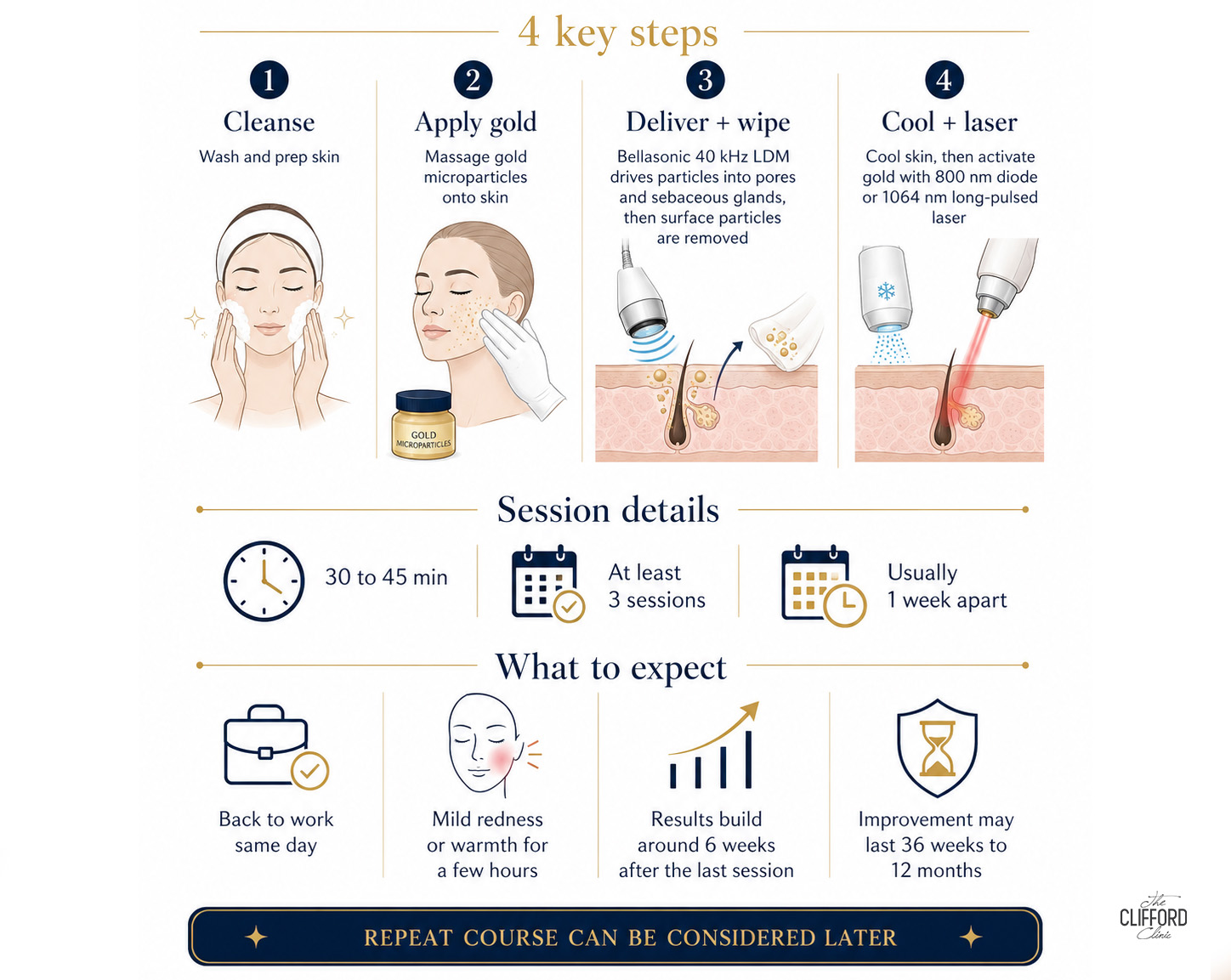
The Clifford Clinic’s Gold PTT treatment involves 4 key steps:
• Cleansing the face
• Massaging the gold microparticles onto the skin
• Cooling the skin
• Laser treatment
Delivering the gold nanoparticles into the pores and sebaceous glands with the Bellasonic 40 kHz LDM ultrasound, then wiping away surface particles, then activating the gold in the glands with the 800 nm diode or 1064 nm long-pulsed laser. Each session takes 30 to 45 minutes, and a course is at least three treatments, usually one week apart; most patients see the improvement consolidate around six weeks after the last session.
Most patients go straight back to work; mild redness or warmth may last a few hours. In the follow-up studies improvement lasted to 36 weeks and to 12 months in most responders, after which a repeat course can be considered. Whether it suits you depends on your pattern of acne, which is set out on our Gold PTT vs AGNES vs AviClear page.
FAQ
• What are gold microparticles?
Gold microparticles are essentially bulk gold that has been broken down into much smaller compounds – usually with a diameter between 1 to 100 nanometers. This makes them ideal for penetrating the tiny pores in the skin and reaching its target, i.e., the sebaceous glands.
The Sebacia microparticle is engineered with gold wrapped around a silica core – designed to selectively absorb the light from a laser system, and locally work its magic on the sebaceous glands.
• What makes your Gold PTT treatment different from other acne treatments?
Gold PTT is one of three treatments at the clinic that act on the sebaceous gland, alongside AGNES and the 1726 nm laser. Which of the three suits a patient is the subject of our who suits which page.
• Can I combine Sebacia with other acne treatments?
In short, yes.
At our clinic, we believe in using a combination approach to provide a more holistic treatment for our patients. Using facials, chemical peels, laser treatments, and topical and oral therapy, and Gold PTT works best alongside treatments that address the other drivers of acne. It reduces the likelihood of recurrence rather than preventing it.
In fact, Gold PTT treatment actually works best when appropriately paired with treatments that address other underlying issues.
• Why should I get Gold PTT treatment done at The Clifford Clinic?
The Clifford Clinic was the first clinic in Singapore to offer gold photothermal therapy, and it remains one of the three sebaceous-gland treatments we use, alongside AGNES and the 1726 nm laser
References
- Reynolds RV, Yeung H, Cheng CE, et al. Guidelines of Care for the Management of Acne Vulgaris. Journal of the American Academy of Dermatology. 2024;90(5):1006.e1–1006.e30.
- Walsh TR, Efthimiou J, Dréno B. Systematic Review of Antibiotic Resistance in Acne: An Increasing Topical and Oral Threat. The Lancet Infectious Diseases. 2016;16(3)–e33.
- U.S. Food and Drug Administration. Sebacia Microparticles: 510(k) Premarket Notification K181518. 2018.
- Paithankar D, Hwang BH, Munavalli G, et al. Ultrasonic Delivery of Silica–Gold Nanoshells for Photothermolysis of Sebaceous Glands in Humans: Nanotechnology from the Bench to Clinic. Journal of Controlled Release. 2015;206:30–36.

Author Bio
Dr Gerard Ee

Dr Gerard Ee is the Medical Director of The Clifford Clinic in Singapore. He earned his medical degree from St George's University of London and built his surgical experience across the Singapore General Hospital, National University Hospital, and Mount Sinai Hospital in New York. He holds Membership of the Royal College of Surgeons (Edinburgh) and a Postgraduate Diploma in Dermatology (Cardiff), and is fully accredited in aesthetic procedures including botulinum toxin, fillers, lasers, and light therapies. A strong advocate of minimally invasive, natural-looking results, Dr Ee has published in several medical and scientific journals and presented his research in cities including Taipei, Las Vegas, and London.
See all posts by Dr Gerard Ee »