
ABNOM Treatment Singapore, Dermal Pigmentation and Laser Expectations
Written by Dr Bernard Ong. Medically reviewed by Dr Gerard Ee
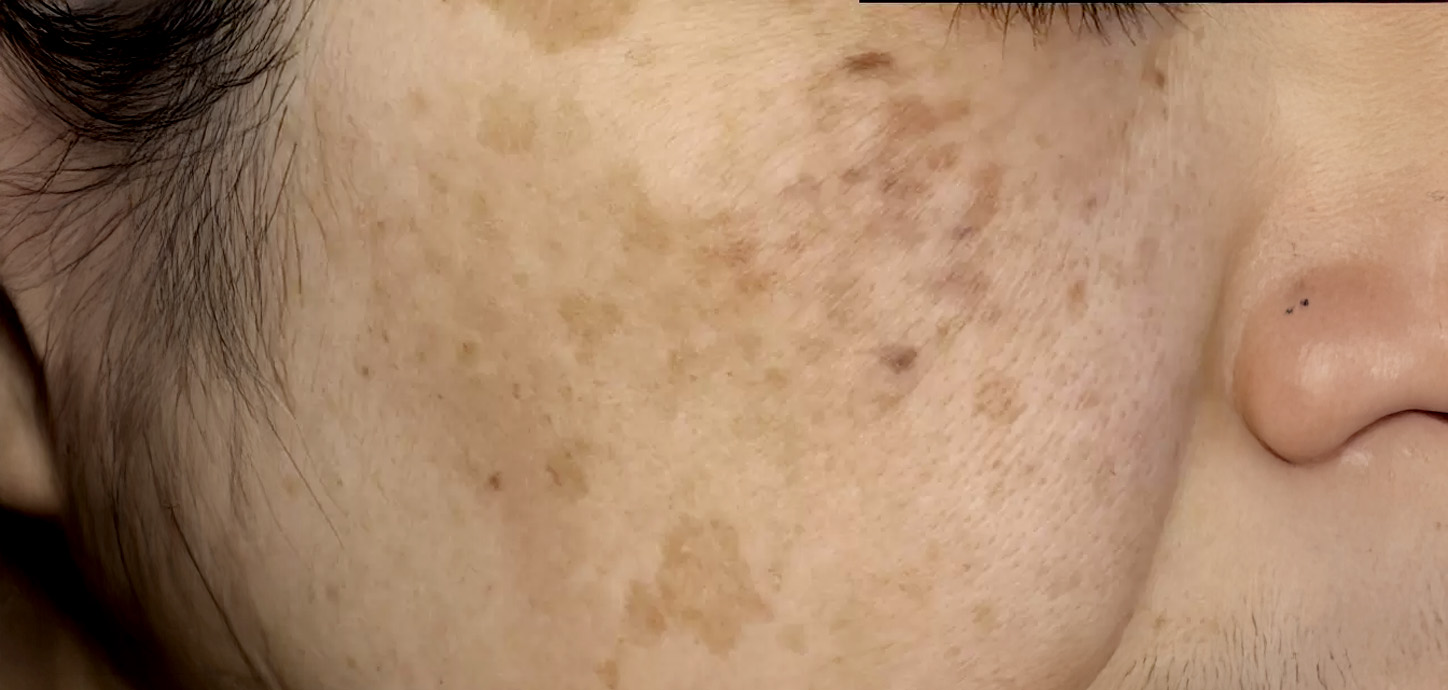
ABNOM stands for acquired bilateral naevus of Ota-like macules, the medical name for Hori’s naevus. It is a dermal pigmentation that produces grey-brown speckles across both cheekbones and is common in Asian skin. Because the pigment sits deep in the dermis, it does not respond to creams and is often mistaken for melasma. It is treated with deeply penetrating pigment lasers over a staged course, and once fully cleared it tends not to return.
What is ABNOM?
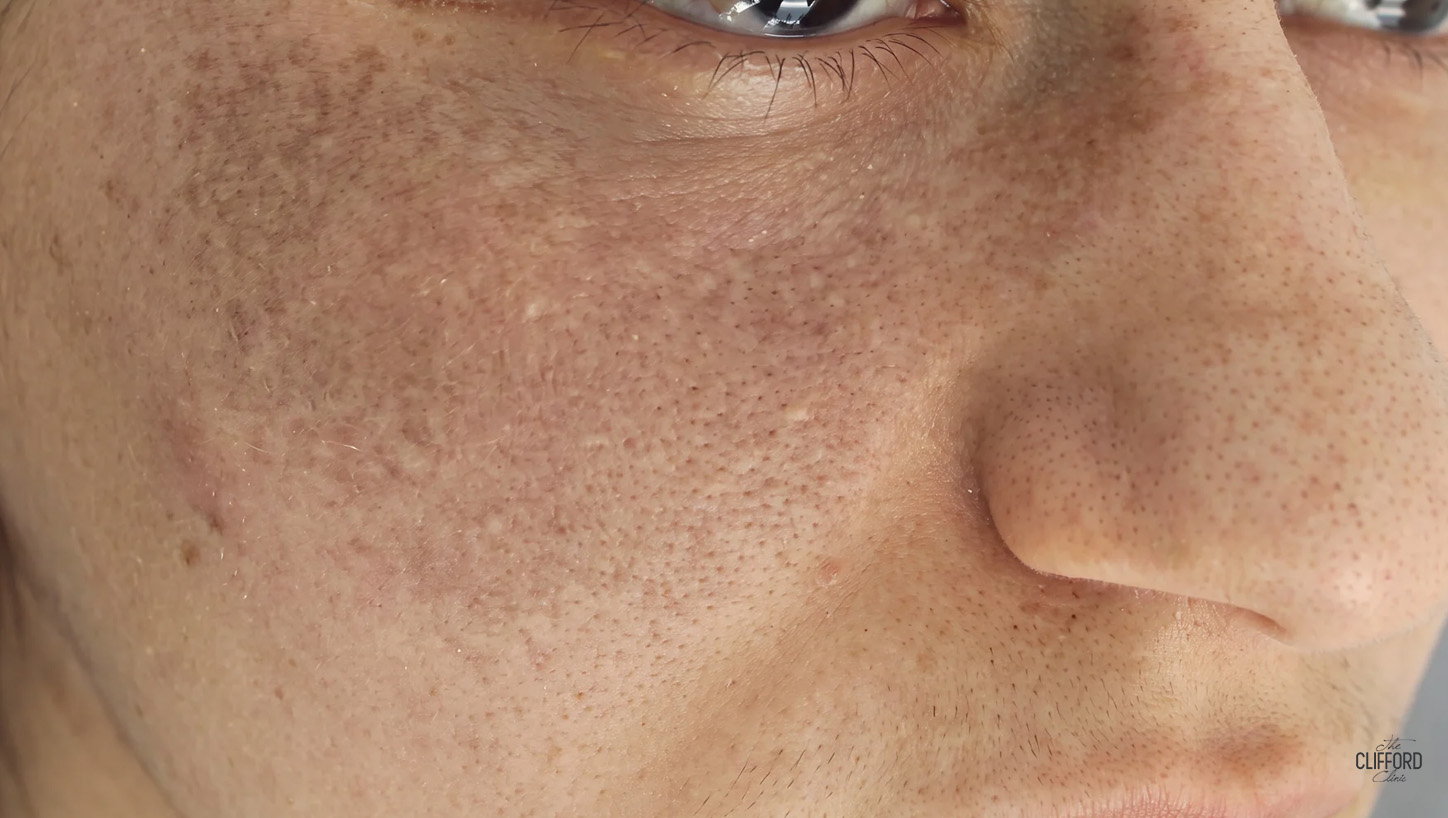
ABNOM is a condition in which melanocytes reside in the dermis and produce visible pigment in the skin over both cheeks. It typically emerges in adulthood, more often in women, and is characteristic of East and Southeast Asian skin. The name reflects its resemblance to naevus of Ota, but ABNOM affects both sides of the face and appears later in life.
Why ABNOM is often mistaken for melasma
ABNOM and melasma present in the same clinical setting, on the cheeks of adult women with Asian skin, and can appear as a brown-grey discolouration. The crucial difference is depth. Melasma may sit in the epidermis, dermis or both, whereas ABNOM is dermal. Patients frequently spend months on whitening creams for suspected melasma before an examination reveals that the pigment is dermal ABNOM, which no cream can reach.
How ABNOM appears in Asian skin
On deeper skin tones, ABNOM often looks ashy, muddy or slate-coloured, arranged in fine speckles rather than a smooth patch. It deepens gradually over years, and can occur alongside melasma, so a single face may carry two overlapping conditions.
Epidermal vs dermal pigmentation
Epidermal Pigment and Dermal Pigment Compared
| Feature | Epidermal Pigment | Dermal Pigment, ABNOM |
|---|---|---|
| Location | Upper layer of skin | Deeper dermal layer |
| Colour Tendency | Tan to brown | Grey-brown, grey-blue |
| Response to Creams | Some response | None |
| Laser Needed | Shorter wavelengths can help | Deeper 1064 nm wavelength required |
| Course Length | Often shorter | Usually several sessions |
| Recurrence After Clearance | Varies | Low once fully cleared |
Why dermal pigmentation is harder to treat
Dermal pigment is physically deeper and out of reach of topical agents and superficial laser settings. Clearing it requires a wavelength that penetrates to the dermis, delivered patiently across several sessions while the body removes the fragmented pigment. ABNOM therefore requires a staged plan rather than a rapid intervention.
Pico laser and Q-switched laser for ABNOM
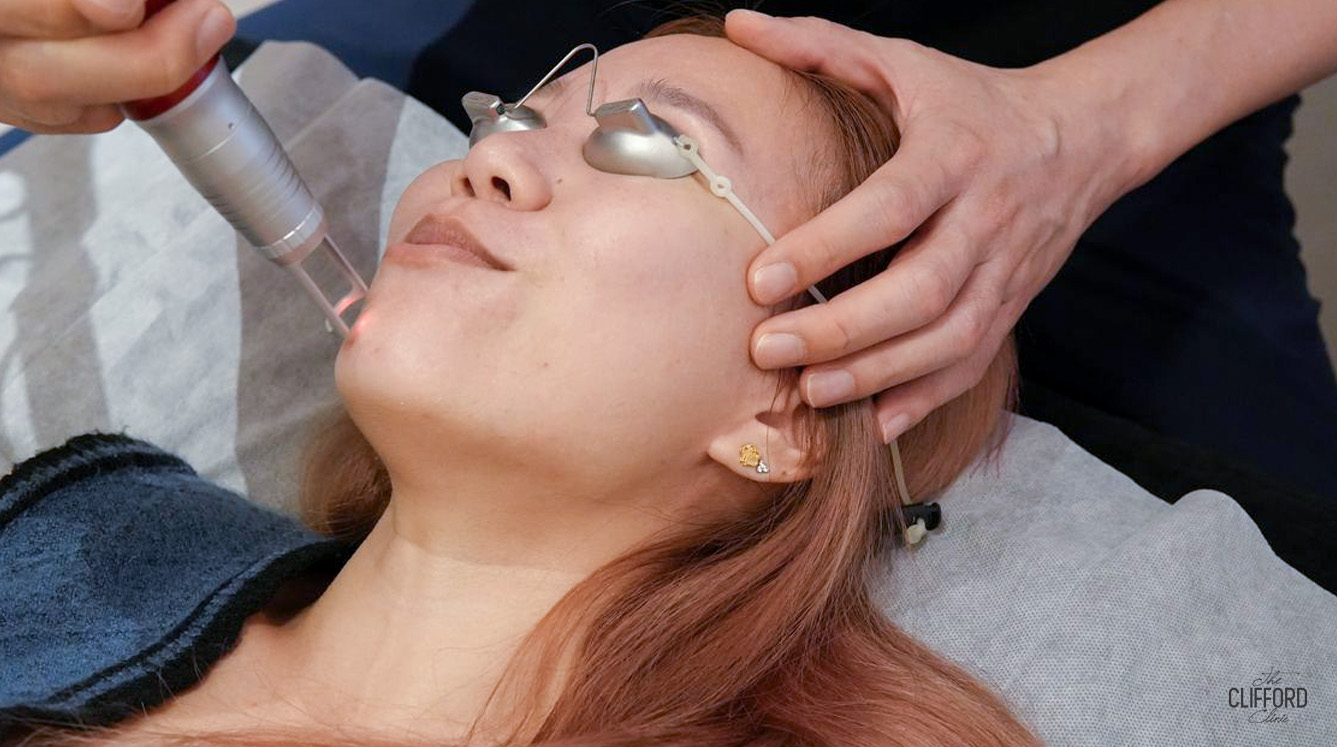
- Pico laser at 1064 nm.Short pulses fragment dermal pigment with minimal heat, which helps protect Asian skin from post-inflammatory hyperpigmentation.
- Q-switched neodymium YAG laser at 1064 nm.A well-established treatment for dermal pigmentation, effective over a longer course.
For a direct comparison of the two, see our article on Pico laser versus Q-switched laser.
Session planning and expectations
ABNOM is treated in a series of sessions spaced several weeks apart, allowing pigment clearance between visits and keeping settings conservative. Temporary darkening between sessions is expected. Over a course, the expected trajectory is steady lightening, with progress tracked photographically and settings adjusted accordingly.
Side effects and post-inflammatory hyperpigmentation
The main temporary risk is post-inflammatory hyperpigmentation, which is more common in darker skin. Conservative energies, adequate spacing and strict daily sun protection reduce this risk. Any coexisting melasma must be managed alongside, because melasma can flare if treated aggressively.
Maintenance after treatment
ABNOM that is fully cleared usually does not recur, because the abnormal dermal cells are removed rather than suppressed. Ongoing sun protection remains sensible for general skin health and to manage any concurrently present melasma or prevent the development of new solar lentigo.
Suitable and not suitable
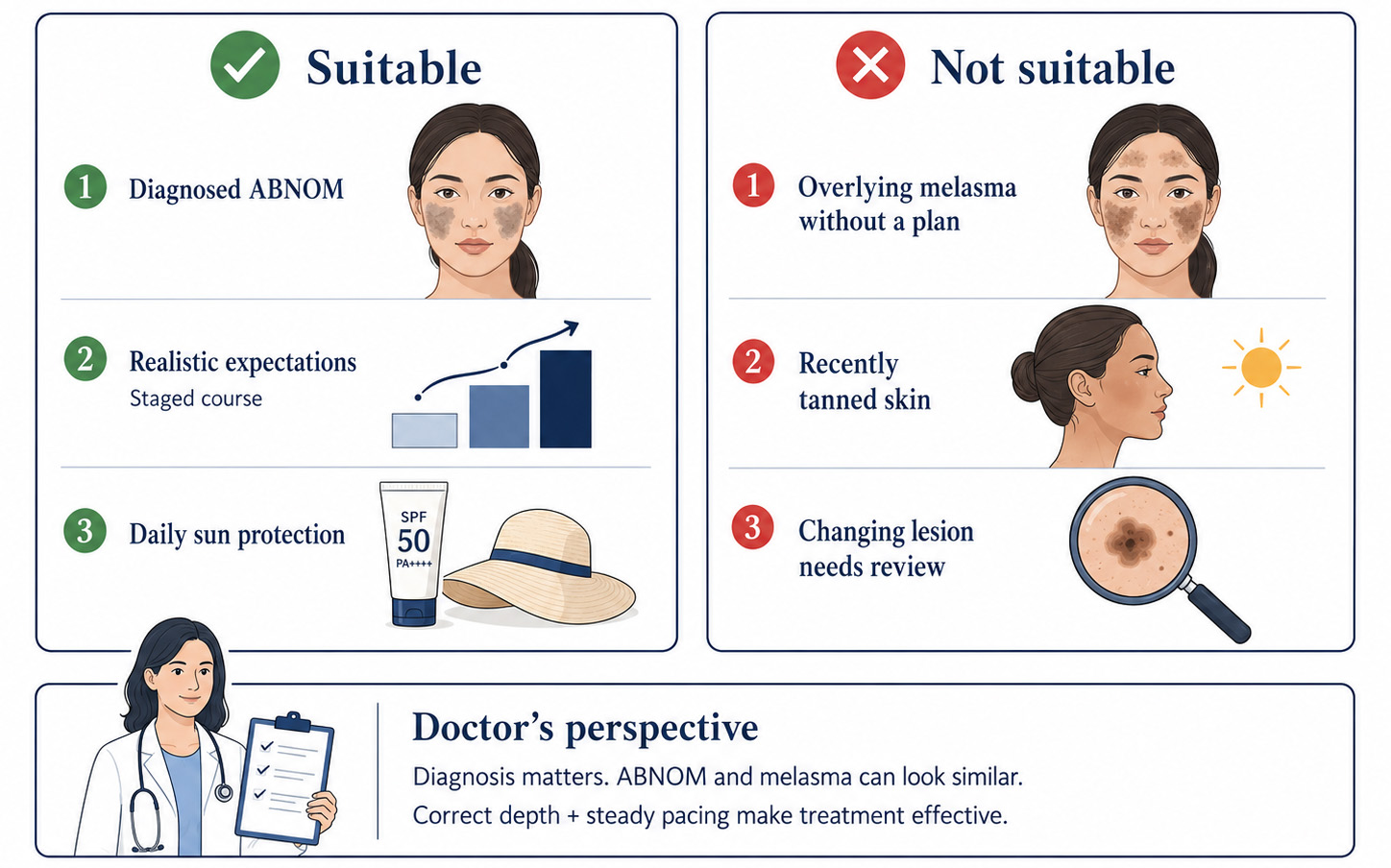
- Suitable: diagnosed ABNOM, realistic expectations of a staged course, commitment to sun protection.
- Not suitable: untreated overlying melasma without a combined plan, recently tanned skin, or any undiagnosed changing lesion.
Doctor’s perspective. ABNOM is one of the clearest examples of why accurate diagnosis matters more than empirical treatment. Two patients with identical-looking cheeks may require completely different treatment, because one has dermal ABNOM and the other has melasma. Reaching the correct depth at an appropriate pace is what renders stubborn cheek pigmentation treatable.
Why ABNOM sits deep in the skin
ABNOM, or acquired bilateral naevus of Ota-like macules, is a form of dermal melanocytosis in which pigment-producing cells are located within the dermis. This depth is the defining feature of the condition and the reason it behaves so differently from surface pigment such as freckles or sun spots. Pigment held in the dermis cannot be reached by creams or by superficial treatments, and its grey-brown appearance reflects the depth at which the pigment sits.
How dermal pigment is cleared
Clearing dermal pigment is a gradual process. The laser breaks the deep pigment into fine particles, which the body removes over the weeks that follow, so treatment is delivered as a staged course rather than a single session. A deeply penetrating wavelength is essential, and picosecond delivery fragments the pigment with less heat and a lower risk of post-inflammatory pigmentation than older nanosecond lasers, which matters in the darker skin tones most affected. A picosecond ruby wavelength offers an additional route for resistant dermal pigment. Some temporary darkening between sessions is expected, and the principal risk, transient post-inflammatory hyperpigmentation, is minimised with conservative energies, adequate spacing and diligent sun protection. Once the dermal cells responsible are cleared, recurrence is uncommon.
The wavelengths that reach ABNOM
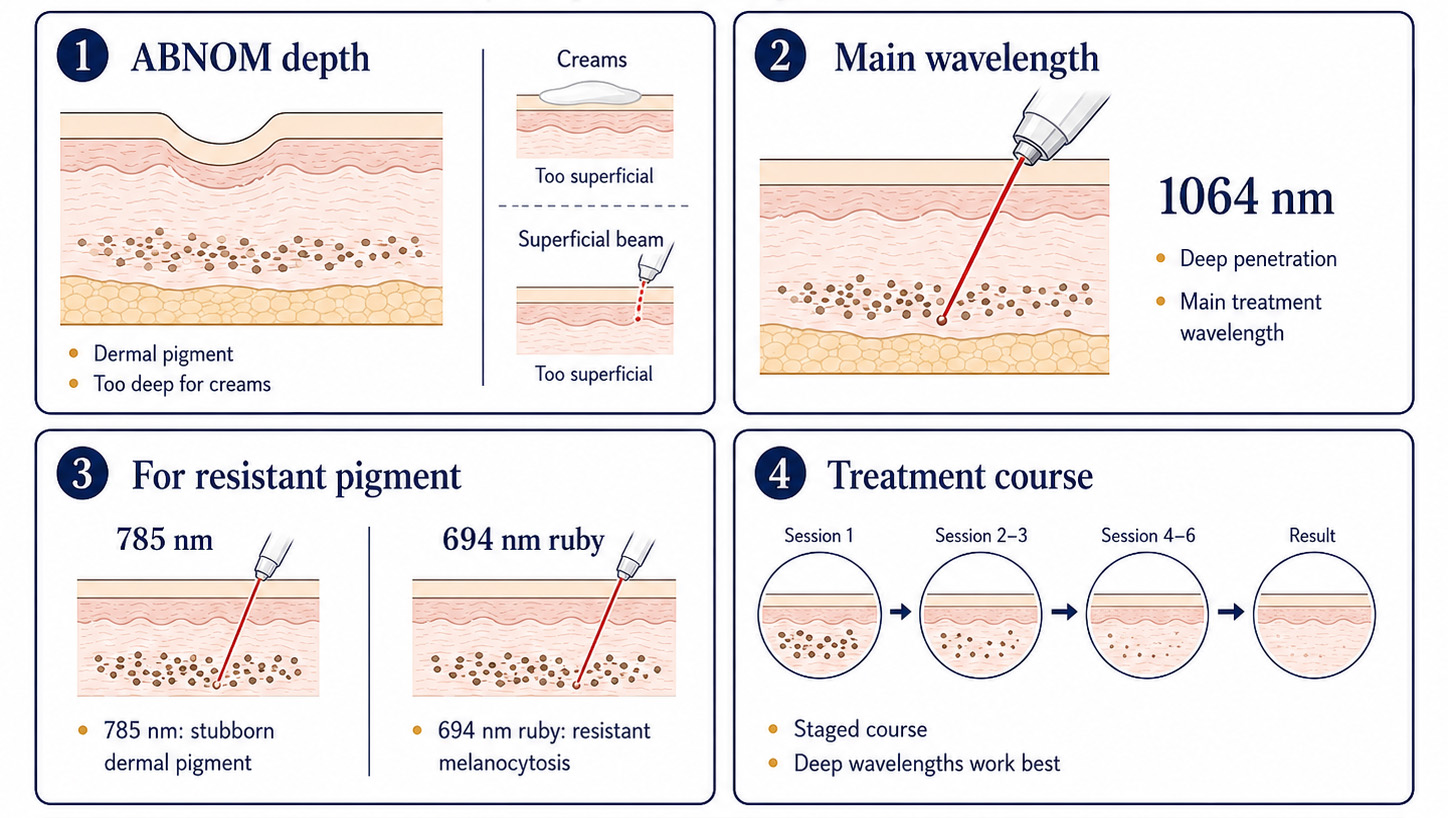
ABNOM sits in the dermis, so it is treated with the deeper 1064 nm wavelength, with a 785 nm near-infrared beam useful for stubborn dermal pigment. A 694 nm picosecond ruby wavelength can also help resistant dermal melanocytosis. Superficial wavelengths and creams do not reach this depth, so a staged course with a deep-penetrating wavelength is the effective route.
Frequently asked questions
What is ABNOM?
ABNOM is acquired bilateral naevus of Ota-like macules, a dermal pigmentation on both cheeks, also known as Hori’s naevus, common in Asian skin.
Is ABNOM the same as Hori’s naevus?
Yes. ABNOM and Hori’s naevus are two names for the same dermal pigmentation.
Can Pico laser treat ABNOM?
Yes. A 1064 nm picosecond laser reaches dermal pigment and clears it over a course, with less heat than older lasers.
Why does ABNOM need multiple sessions?
Dermal pigment clears gradually as the body removes fragmented particles between sessions, so treatment is staged over several visits.
Is ABNOM the same as melasma?
No. ABNOM is dermal and does not respond to creams, whereas melasma is often more superficial and relapse-prone. The two can coexist.
Can ABNOM be treated with creams?
No. Topical agents cannot reach dermal pigment. Deeply penetrating laser is the effective route once the diagnosis is confirmed.
Have your cheek pigmentation assessed

If suspected melasma has not responded to creams, ABNOM may be the reason. Learn about pigmentation treatment in Singapore, or book at The Clifford Clinic, 50 Raffles Place, #01-01 Singapore Land Tower. Call (65) 6532 2400 or WhatsApp (65) 8318 6332.
Selected References
- A systematic review of picosecond laser in dermatology: evidence and recommendations. Lasers in Surgery and Medicine, 2021. https://onlinelibrary.wiley.com/doi/10.1002/lsm.23244.
- Wavelength-dependent threshold fluences for melanosome disruption with picosecond lasers. Lasers in Surgery and Medicine, 2024. https://pubmed.ncbi.nlm.nih.gov/38436524.
- Lasers and energy-based devices for treatment of pigmented lesions with histologic and ultrastructural correlation: a systematic review. Dermatologic Surgery, 2026. https://pubmed.ncbi.nlm.nih.gov/40767860.
- Disorders of hyperpigmentation, part I: pathogenesis and clinical features of common pigmentary disorders. Journal of the American Academy of Dermatology, 2023. https://pubmed.ncbi.nlm.nih.gov/35151757.
- Comparing the efficacy and safety of a 730 nm picosecond laser with a 532 nm Q-switched Nd:YAG laser for facial pigmented disorders. European Journal of Medical Research, 2026. https://pubmed.ncbi.nlm.nih.gov/41782066.
- DermNet: lasers in dermatology. https://dermnetnz.org/topics/lasers-in-dermatology.

Author Bio
Dr Gerard Ee

Dr Gerard Ee is the Medical Director of The Clifford Clinic in Singapore. He earned his medical degree from St George's University of London and built his surgical experience across the Singapore General Hospital, National University Hospital, and Mount Sinai Hospital in New York. He holds Membership of the Royal College of Surgeons (Edinburgh) and a Postgraduate Diploma in Dermatology (Cardiff), and is fully accredited in aesthetic procedures including botulinum toxin, fillers, lasers, and light therapies. A strong advocate of minimally invasive, natural-looking results, Dr Ee has published in several medical and scientific journals and presented his research in cities including Taipei, Las Vegas, and London.
See all posts by Dr Gerard Ee »