

Circumcision Pain, Anaesthesia and Safety – What to Expect Before, During and After
During circumcision, pain should be minimal because anaesthesia is used, and once the anaesthesia is working, the procedure should not hurt. In the first few days afterwards, adults typically report a pain level of around 3 to 4 out of 10, and parents report around 4 to 5 out of 10 for children, both well managed with simple painkillers. In our clinic, adults and boys aged 6 and above have local anaesthesia, with light sedation if requested. Younger children under 6 need general anaesthesia and are referred to a paediatric setting. Serious complications are rare when trained practitioners do the procedure in a sterile setting, and a Cochrane review of 18 trials reported no severe adverse events. Warning signs to act on include persistent bleeding, a smelly discharge or pus, fever, and pain that painkillers do not control. For the complete overview, see our Circumcision Singapore guide.
Pain during the procedure versus after
During the procedure, the area is numbed with anaesthesia, so once it takes effect, you should feel little or nothing, aside from perhaps some pressure. The discomfort people worry about mostly belongs to the period after the procedure, once the local anaesthetic wears off. That pain is usually mild to moderate, around 3 to 4 out of 10 for adults in the first few days, and settles steadily with medication and rest.
Real pain scores
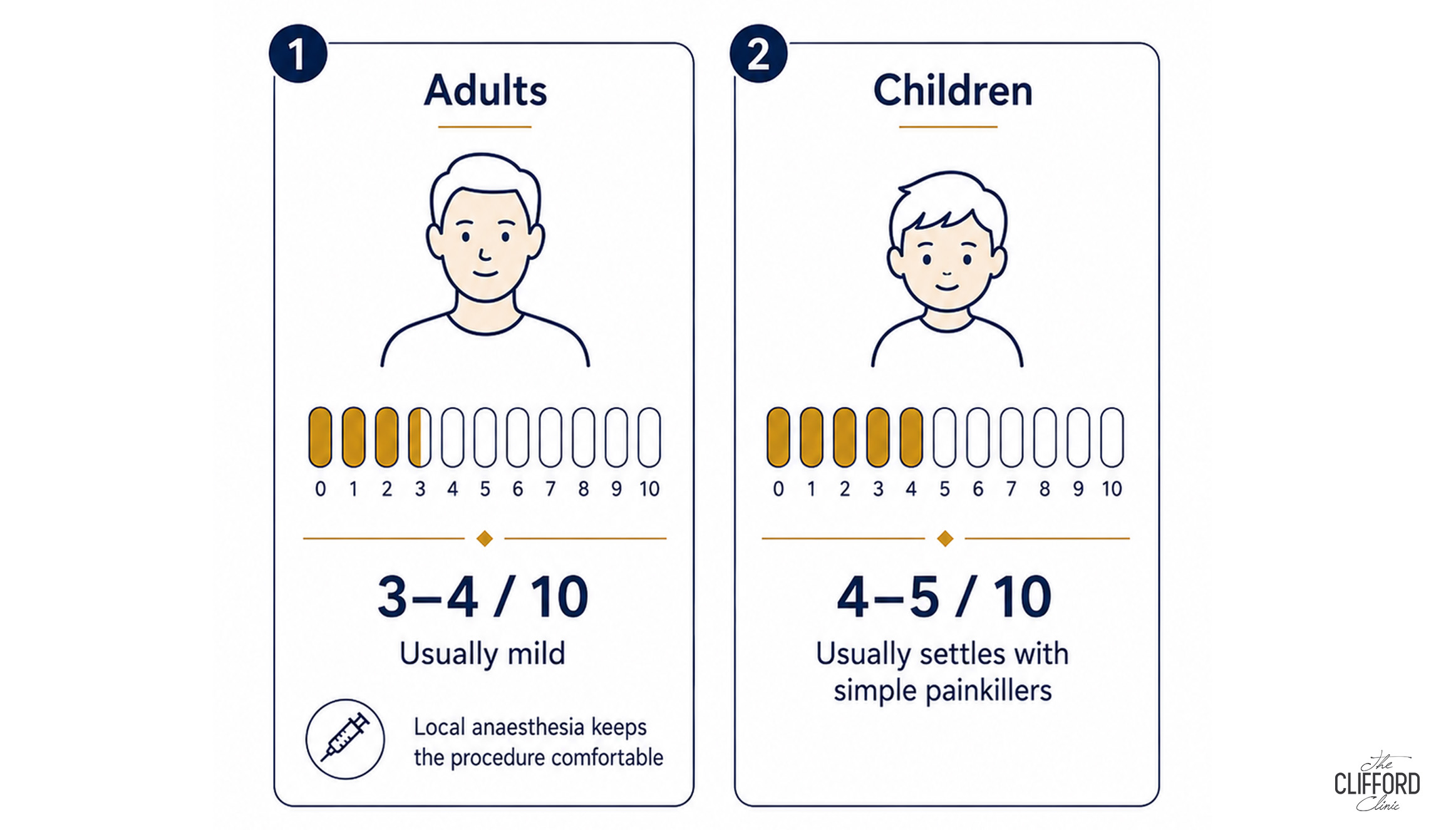
In practice, adult patients usually report a pain level of around 3 to 4 out of 10 after the circumcision, since the local anaesthesia keeps the procedure itself comfortable. For children, parents commonly report around 4 to 5 out of 10, with pain resolving with simple painkillers.
Local anaesthesia, sedation, and general anaesthesia
There are three main anaesthesia approaches, matched to the patient. Local anaesthesia numbs only the surgical area while you stay fully awake, and it is the usual choice for adults. A numbing cream is applied first, followed by a ring block and a dorsal penile nerve block. Sedation can be added to local anaesthesia to help anxious patients feel relaxed, and an anaesthetist is available for sedation cases where needed. General anaesthesia puts you completely asleep and is used for younger children under 6, so they remain still and comfortable. It is provided in a paediatric setting. Boys aged 6 and above are treated under local anaesthesia with sedation.
What patients usually feel
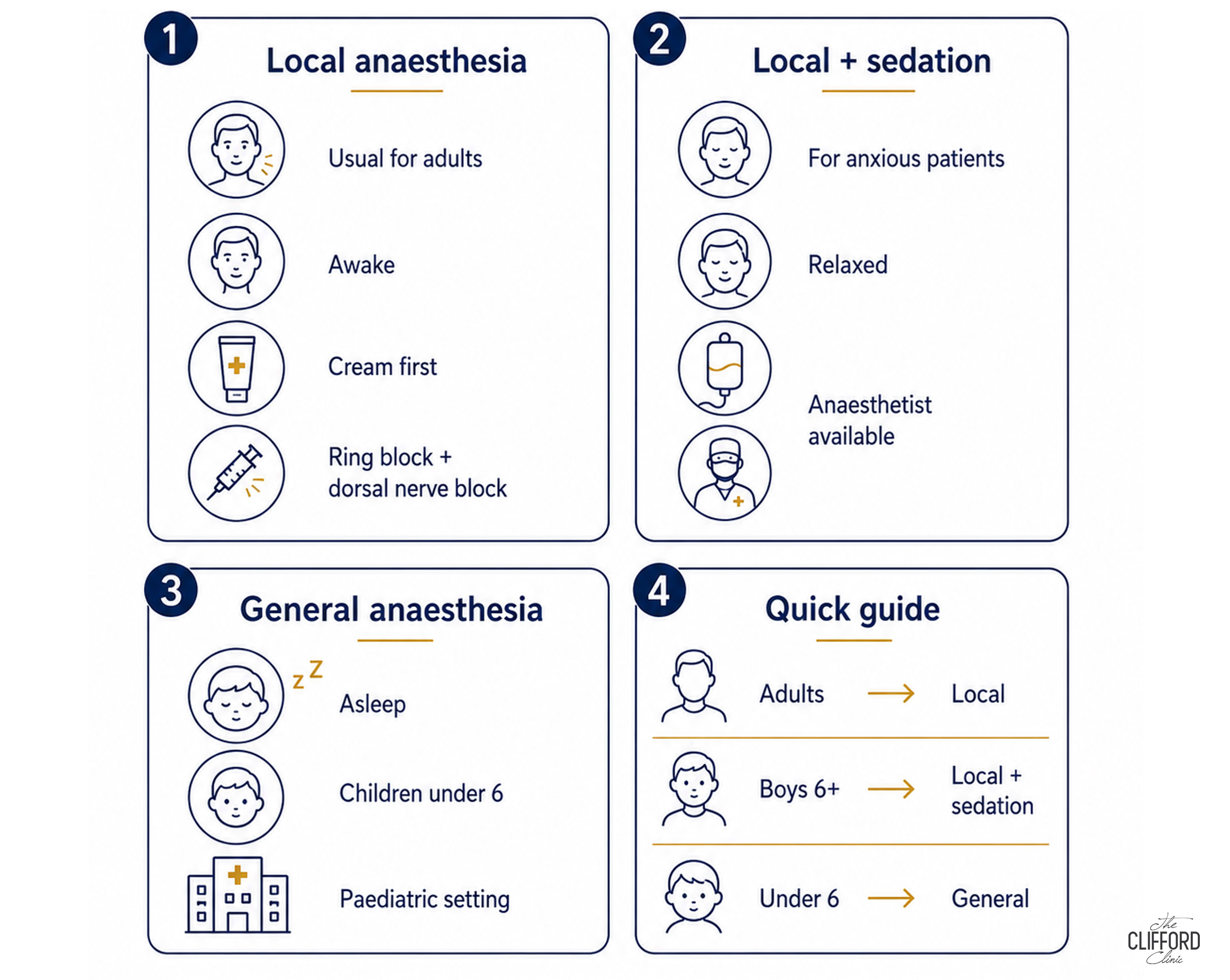
With local anaesthesia, most adults describe feeling the initial numbing, then pressure or movement rather than pain during the procedure itself. The local anaesthetic typically lasts several hours and wears off after about six to eight hours. Therefore, it is important to take the first dose of the painkiller on time. Younger children under general anaesthesia feel nothing during the procedure and typically recover within a short time, with mild grogginess as the anaesthesia wears off. In most cases, the early recovery sensations are usually described as soreness and tightness rather than sharp pain.
The painkiller plan
Taking regular painkillers keeps you comfortable through the first days. You will be prescribed oral painkillers to take on a regular schedule, rather than waiting for pain to build up. Antibiotics are commonly prescribed too, which should be taken as directed. Taking the medication as directed, resting, and using supportive underwear all reduce discomfort. If the prescribed analgesic plan is not controlling your pain, that is a reason to contact the clinic rather than simply enduring it.

The painless myth
The word painless is often misunderstood. Painless does not mean you will feel nothing, and it does not mean that there is no recovery discomfort at all. What anaesthesia delivers is a procedure that should not hurt once the anaesthesia is working. Mild pain during the recovery process is normal and is managed with painkillers. Claims that any single technique is completely painless with no discomfort during healing are marketing rather than clinical reality.
How complications are classified
The World Health Organisation provides a standard way to grade adverse events. Mild events require little or no treatment, such as minor wound disruption, slight bleeding that stops on its own, or mild swelling. Moderate events need active treatment, such as antibiotics for infection or a suture for bleeding or wound separation. Severe events are those that require a transfusion, hospitalisation, or result in lasting damage, and these are rare. Using this framework, the evidence shows that most adverse events after circumcision are mild and self-limiting when the procedure is done properly.
Safety and complication rates
When circumcision is performed in a sterile medical setting by trained practitioners, serious complications are uncommon. Wound infection rates generally range from about 0.5 to 5 percent. The largest comparative review, a Cochrane review of 18 trials with 3,472 participants, reported no severe adverse events in either device-based or conventional groups. Bleeding is the most common complication overall and is usually controlled with simple pressure, cautery, or a suture, while device methods tend to show minimal blood loss.
Day surgery safety
The Clifford Surgery performs circumcision in a Ministry of Health-accredited Day Surgery Centre rather than a basic clinic room, which is more sterile and has the equipment available to control bleeding, making it safer than a simple clinic procedure. A consultation and suitability assessment is performed by our doctor, followed by a discussion on the choice of anaesthesia. The procedure is done in a dedicated operating room, with a monitored recovery period and clear discharge instructions with follow-up. Circumcision is a minor day surgery procedure, and there is normally no need for hospital-level care for the cases treated here.
Who needs anaesthetist support

Most adult cases under local anaesthesia do not need a separate anaesthetist. Boys aged 6 and above have local anaesthesia with sedation, and an anaesthetist provides the sedation safely. Younger children under 6 need general anaesthesia, which requires an anaesthetist and appropriate monitoring, and is part of why that age group is treated in a paediatric setting. The assessment determines what level of anaesthesia support your case needs, and the clinic arranges it accordingly.
What pain is not normal
Pain that steadily worsens after the first couple of days, rather than improving, is not expected. Persistent bleeding is a key symptom to act on quickly and should prompt urgent care. A smelly discharge or pus from the wound, fever, pain that painkillers do not control, or difficulty passing urine are also reasons to contact the clinic. These problems are uncommon, but recognising them early makes them easy to manage.
Red flag guidance
When to Contact the Clinic After Circumcision
| Sign | What to Do |
|---|---|
| Persistent Bleeding | Apply gentle pressure and seek urgent care |
| Smelly Discharge or Pus from the Wound | Contact the clinic, possible infection |
| Pain Not Controlled by Painkillers | Contact the clinic for review |
| Fever | Contact the clinic, possible infection |
| Difficulty Passing Urine | Seek prompt medical attention |
| Dressing Fallen Off and You Are Unsure | Call the clinic for guidance |
A note from the clinic
“The fear we hear most is pain. We explain that once the anaesthesia is working, the procedure should not hurt, and that afterwards most adults rate the soreness at about 3 to 4 out of 10 for a few days. We do not promise a painless procedure, but with a combination of numbing cream and local anaesthesia, the pain during the circumcision is very manageable. ”
Frequently asked questions
How painful is circumcision on a scale of 1 to 10?
During the procedure, pain should be minimal once the anaesthesia is working. In the first few days afterwards, adults usually report around 3 to 4 out of 10, and parents report around 4 to 5 out of 10 for children, well managed with painkillers.
Will I be awake during circumcision?
Adults are usually awake under local anaesthesia, sometimes with light sedation. Boys aged 6 and above are also awake, under local anaesthesia with sedation. Younger children under 6 are asleep under general anaesthesia in a paediatric setting.
Is local anaesthesia enough?
For most adults, yes. A numbing cream is applied first, then a ring block and dorsal penile nerve block fully numb the area, with light sedation available if you prefer.
Is circumcision really painless?
Painless is a misunderstanding. Anaesthesia makes the procedure comfortable, but some mild soreness during healing is normal. No technique removes all discomfort afterwards.
How risky is circumcision?
Serious complications are rare in trained hands. Infection rates are around 0.5 to 5 percent, and a Cochrane review of 18 trials reported no severe adverse events.
What pain is normal after circumcision?
Mild to moderate soreness, with a pain score of 3 to 4 out of 10 for adults, with swelling and sensitivity in the first one to two weeks, improving over time.
What pain is a warning sign?
Pain that painkillers do not control, persistent bleeding, a smelly discharge or pus, fever, or difficulty passing urine are warning signs that need review.
Is an anaesthetist available for sedation?
Yes. Where light sedation is chosen, an anaesthetist is available to provide it safely.
Can I go home the same day?
Yes. Circumcision is a minor day surgery, and most patients are observed for a short period and then discharged the same day.
How does a Day Surgery Centre keep the procedure safe?
It is more sterile than a basic clinic room and has equipment to control bleeding, with a structured workflow of assessment, sterile operating room, appropriate anaesthesia, monitored recovery, and follow-up.
Book a consultation about pain and anaesthesia

If pain is your main worry, a consultation is the best place to get a straight answer. The doctor will explain the anaesthesia options, the painkiller plan, and the warning signs to watch for.
Book a consultation at The Clifford Surgery
Related guides
- Circumcision Singapore, the complete guide
- Circumcision cost in Singapore
- Adult circumcision in Singapore
- Child circumcision age guide
- Phimosis and tight foreskin treatment
- Circumcision techniques compared
- MediSave, insurance and Baby Bonus for circumcision
Medical review box

This article is written by Dr Law Zhi Wei of The Clifford Surgery. Dr Law is a Singapore-trained doctor with more than five years of surgical posting experience. He graduated from the National University of Singapore with an MBBS and holds Membership of the Royal College of Surgeons of Edinburgh, a Graduate Diploma in Family Medicine, and a Postgraduate Diploma in Practical Dermatology from Cardiff University. He trained in the Urology Department at Singapore General Hospital, where he performed hundreds of circumcisions, and completed rotations in urology, general surgery, and paediatric surgery at KK Women’s and Children’s Hospital, Sengkang General Hospital, and Changi General Hospital. He has personally performed more than 500 circumcisions across the conventional, laser-assisted, Shang Ring, and ZSR Stapler techniques, and he handles the consultation, the procedure, and the aftercare for each patient, supported by the dedicated Urology Department led by Dr Nathaniel Heah. Dr Law is also a published urology researcher, with peer-reviewed work in journals including the Journal of Urology, BJU International, the Asian Journal of Urology, and European Urology Supplements. The Clifford Surgery operates a sterile surgical theatre as a Ministry of Health-accredited Day Surgery Centre. It is a CPF and MediSave accredited, CDA-approved medical institution. We assist with hospital insurance claims where there is a medical indication. This content is general information and not a substitute for a personal consultation. Last updated June 2026.
Dr Law Zhi Wei profile, https://cliffordclinic.com/dr-law-zhi-wei/
Dr Nathaniel Heah profile, https://cliffordclinic.com/dr-nathaniel-heah/
Clinical research and publications, https://cliffordclinic.com/clinical-research/
References
- National University Hospital, Services for Circumcision. https://www.nuh.com.sg/care-at-nuh/services/department-of-urology/services-for-circumcision
- KK Women’s and Children’s Hospital, Laser Circumcision Outcomes. https://www.kkh.com.sg/about-kkh/who-we-are/clinical-outcomes/laser-circumcision-outcomes
Medical evidence references
- Hohlfeld A, Ebrahim S, Shaik MZ, Kredo T. Circumcision Devices Versus Standard Surgical Techniques in Adolescent and Adult Male Circumcisions. The Cochrane Database of Systematic Reviews. 2021. https://www.cochranelibrary.com/cdsr/doi/10.1002/14651858.CD012250.pub2/full
- Friedman B, Khoury J, Petersiel N, et al. Pros and Cons of Circumcision, An Evidence-Based Overview. Clinical Microbiology and Infection. 2016. https://pubmed.ncbi.nlm.nih.gov/27497811
- Hohlfeld AS, Ebrahim S, Zaki Shaik M, Kredo T. Circumcision Devices Versus Standard Surgical Techniques in Adolescent and Adult Male Circumcisions, A Cochrane Review. BJU International. 2022. https://pubmed.ncbi.nlm.nih.gov/34587354
- Zhang Q, Gao L, Liu D, et al. Comparative Analysis on the Outcomes in Circumcising Children Using Modified Chinese ShangRing and Conventional Surgical Circumcision. Pediatric Surgery International. 2022. https://pubmed.ncbi.nlm.nih.gov/36550318