
Acne Treatment Price in Singapore, What Determines the Cost
Written by Dr Bernard Ong. Medically reviewed by Dr Gerard Ee Dr Gerard Ee (MBBS, MRCS, Diploma in Practical Dermatology, Cardiff) is the Founder and Medical Director of The Clifford Clinic, with more than 14 years of experience treating acne, and among the first doctors in Singapore to use AGNES and AviClear. This article reflects the clinical approach of The Clifford Clinic, and is for general education only. It does not replace a personal consultation. Last reviewed July 2026.
Price is among the first questions patients raise about acne treatment, and among the hardest to answer with a single figure. Acne treatment in Singapore ranges from a prescription cream to a multi-session device programme, and the cost that applies in any individual case depends on the diagnosis rather than on the treatment requested. This guide sets out the price structure of the main treatment categories, the reasons quotations differ between clinics, and how value is assessed beyond the headline figure.
Summary
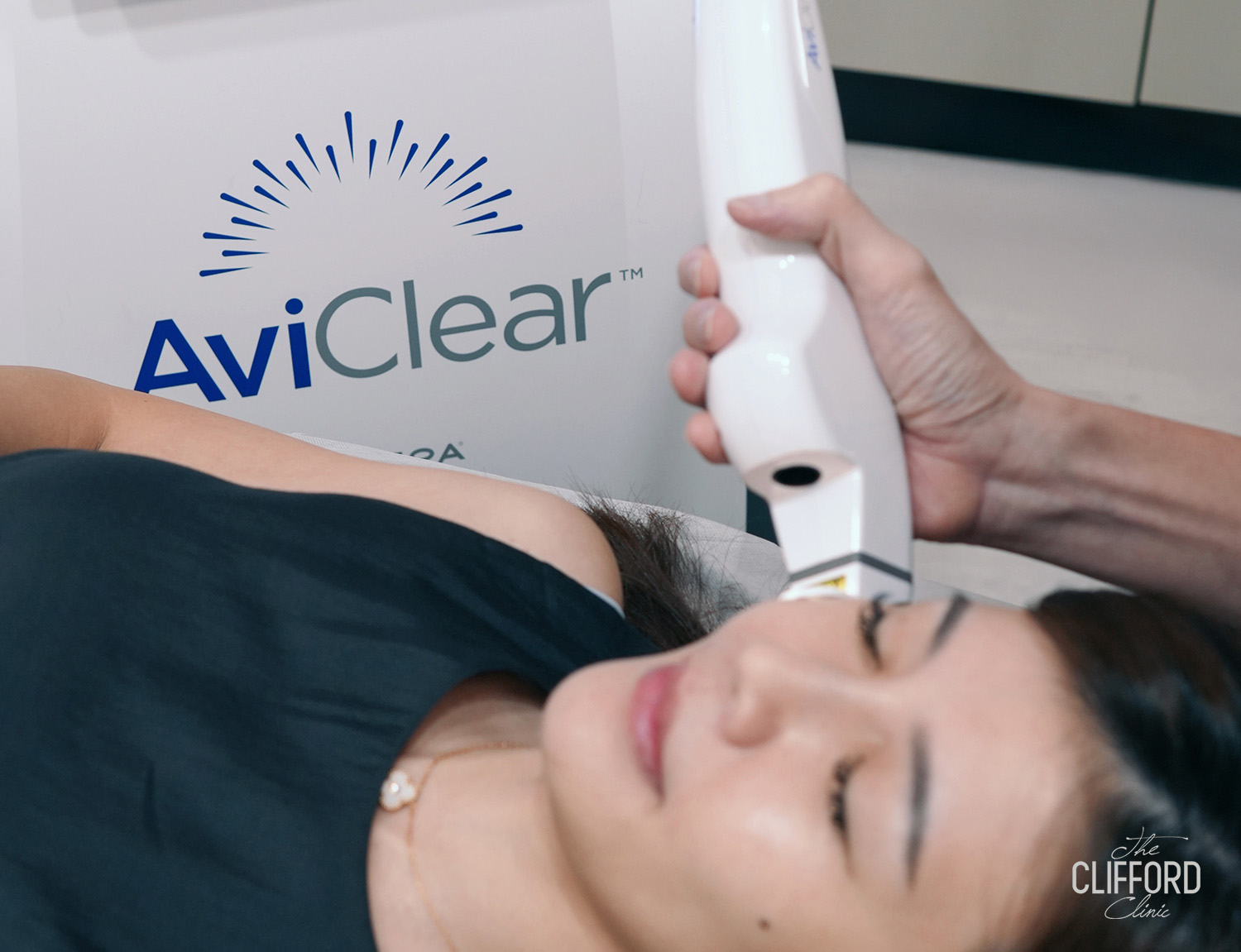
Prescription topicals constitute the most affordable tier and control a large share of mild acne. Oral medication carries additional consultation and monitoring costs but remains moderately priced. Device treatments such as AGNES, AviClear and Gold PTT occupy the higher tier because they require specialised equipment and a course of several sessions, and they are generally reserved for acne that relapses persistently or that has not responded to medication. The difference between the tiers is not intensity but target. Topical and oral agents act on the inflammation and the bacterial and hormonal drivers behind it, whereas the device tier acts on the sebaceous gland itself, which is why its effect can persist after the course ends. A treatment that fails at low cost is more expensive than a treatment that succeeds at high cost, so assessment precedes any quotation.
What determines a quotation
A meaningful quotation follows a diagnosis, because the assessment establishes the acne type, its severity, the proportion that is active inflammation rather than congestion, whether scarring has begun, and what has already been tried. Two patients with visually similar breakouts can require substantially different plans. One may clear with topicals and a short antibiotic course, whereas the other presents with oily, relapsing acne for which a sebum-targeting device programme is appropriate. A package quoted before this assessment is priced for an average patient rather than for the condition actually present.
The price tiers explained
Topical and oral medication
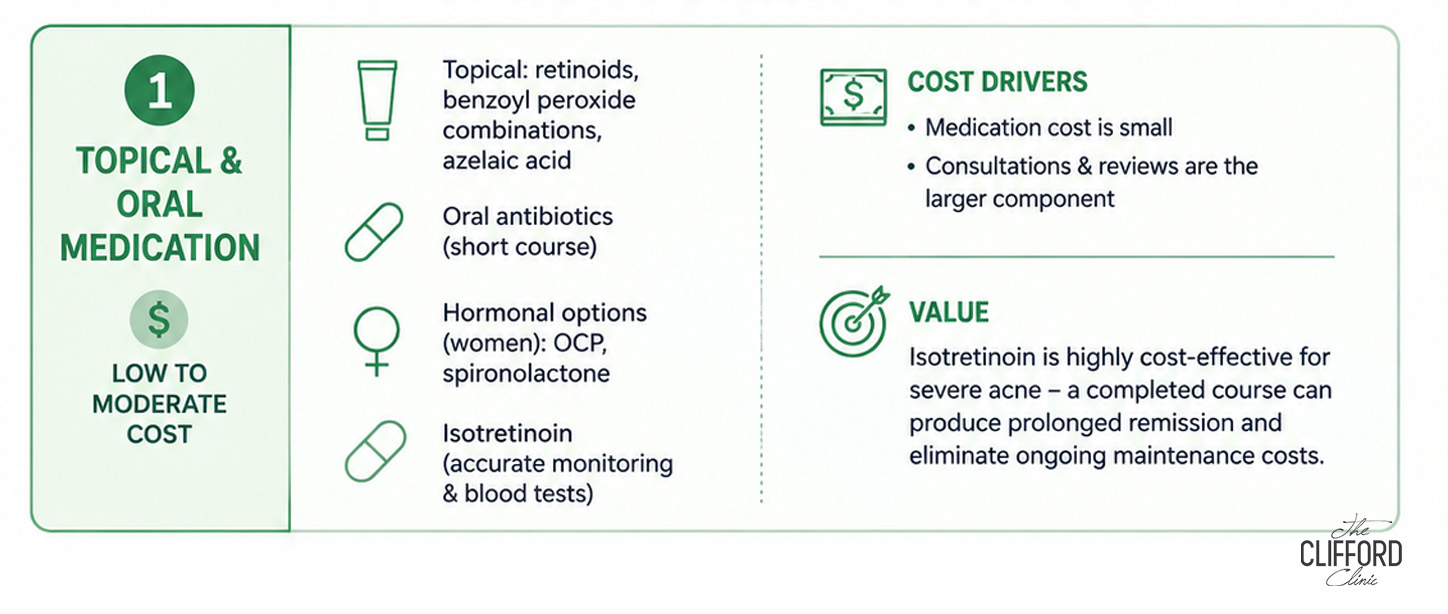
Prescription retinoids, benzoyl peroxide combinations and azelaic acid form the affordable foundation of most plans. In this tier the medication itself is the smaller component of the cost, and the consultation and review schedule is the larger one. Oral antibiotics add a modest amount for a time-limited course. Hormonal treatments for women, including combined oral contraceptives and spironolactone, are similarly accessible but require medical review. Isotretinoin requires regular consultations and blood tests throughout the course, which raises its total cost. It nonetheless remains among the most cost-effective options for severe acne, because a completed course can produce prolonged remission and so removes the recurring expense of maintenance treatment.
Device treatments
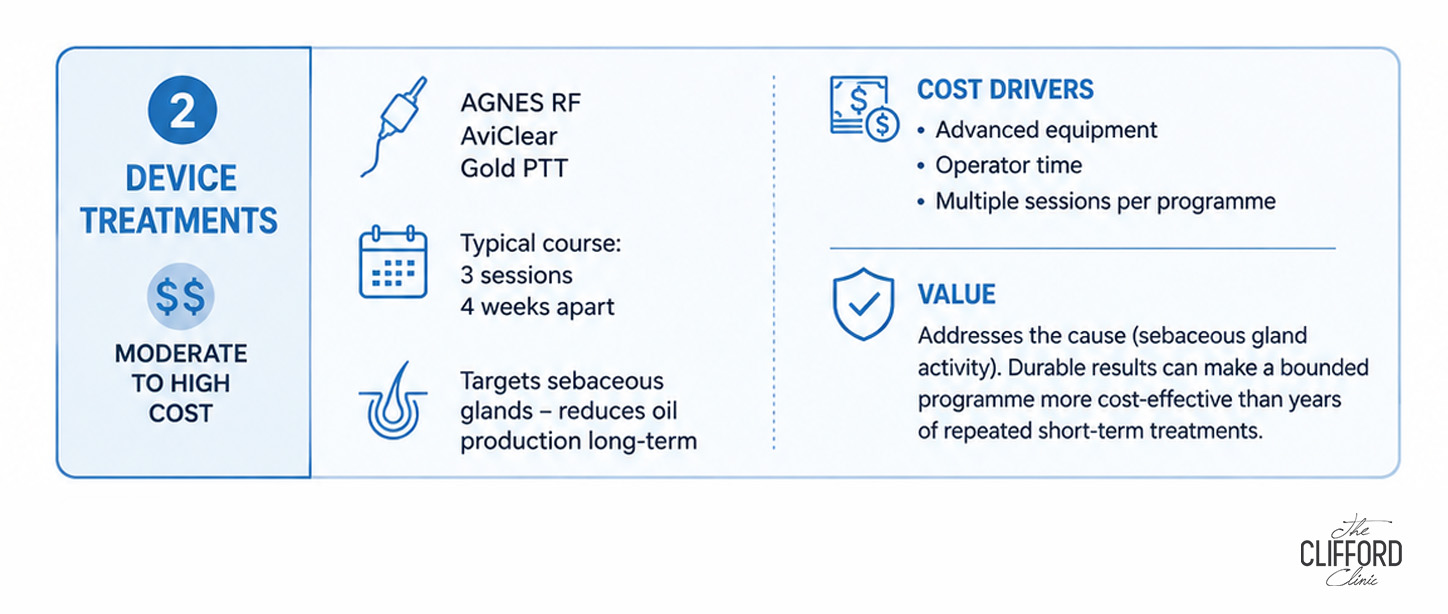
AGNES radiofrequency, AviClear and Gold PTT are priced per session or per programme, and a realistic course comprises several sessions. Published protocols for sebaceous-gland radiofrequency treatment have used three sessions at four-week intervals, which indicates the scale of a typical programme and the interval over which the cost is incurred. The higher price reflects the equipment, the operator time and the durability of the outcome. Treatments that reduce sebaceous gland activity address the structure that produces the oil in which acne develops, rather than the lesions already present, and the reduction persists while the treated glands remain less active. For patients who have relapsed repeatedly after medication, or for whom oral drugs are unsuitable or unwanted, the total cost of a bounded device programme can be lower than several years of repeated short-term treatment.
Supporting treatments
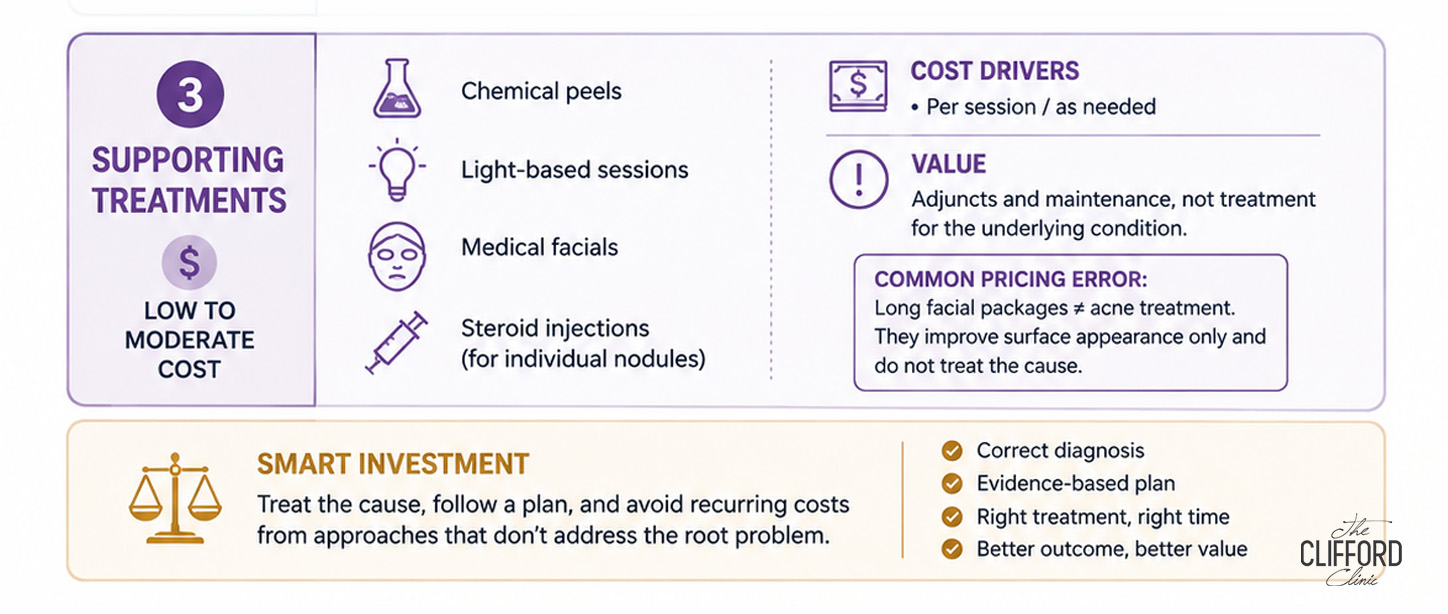
Chemical peels, light-based sessions, medical facials and steroid injections for individual nodules occupy the lower to middle tier. They are best understood as adjuncts and maintenance within a plan rather than as treatment for the underlying condition. A recurring pricing error is a long facial package purchased as acne treatment. Such packages improve the surface appearance of the skin without acting on the inflammation, the sebaceous activity or the follicular obstruction that generate the lesions, and the accumulated expenditure frequently exceeds the cost of the medical treatment that would have been effective.
Why quotes differ between clinics
Differences in price reflect equipment, doctor time, the number of sessions proposed and the extent of the diagnosis preceding the plan. Quotations are best compared on their inclusions rather than their headline figures, namely review consultations, medication, the specific device, the number of sessions, and the provision made if the response is slower than anticipated. A clinic that explains its reasoning, matches the plan to the diagnosis and states realistic expectations is pricing a clinical outcome. A clinic offering a fixed bundle before examination is pricing a product.
Common costly errors
The most expensive errors are rarely the treatments themselves, but the months spent on packages that do not address the cause, the repeated changes of clinic that leave no plan to run to completion, and the deferral of medical care until scarring has developed. Scar repair is substantially more expensive than acne control because it treats permanent structural damage to the dermis, which requires resurfacing or remodelling procedures over multiple sessions, whereas acne control treats a reversible inflammatory process. A further error is judging a plan by its price per session rather than by the probability that it will clear the skin.
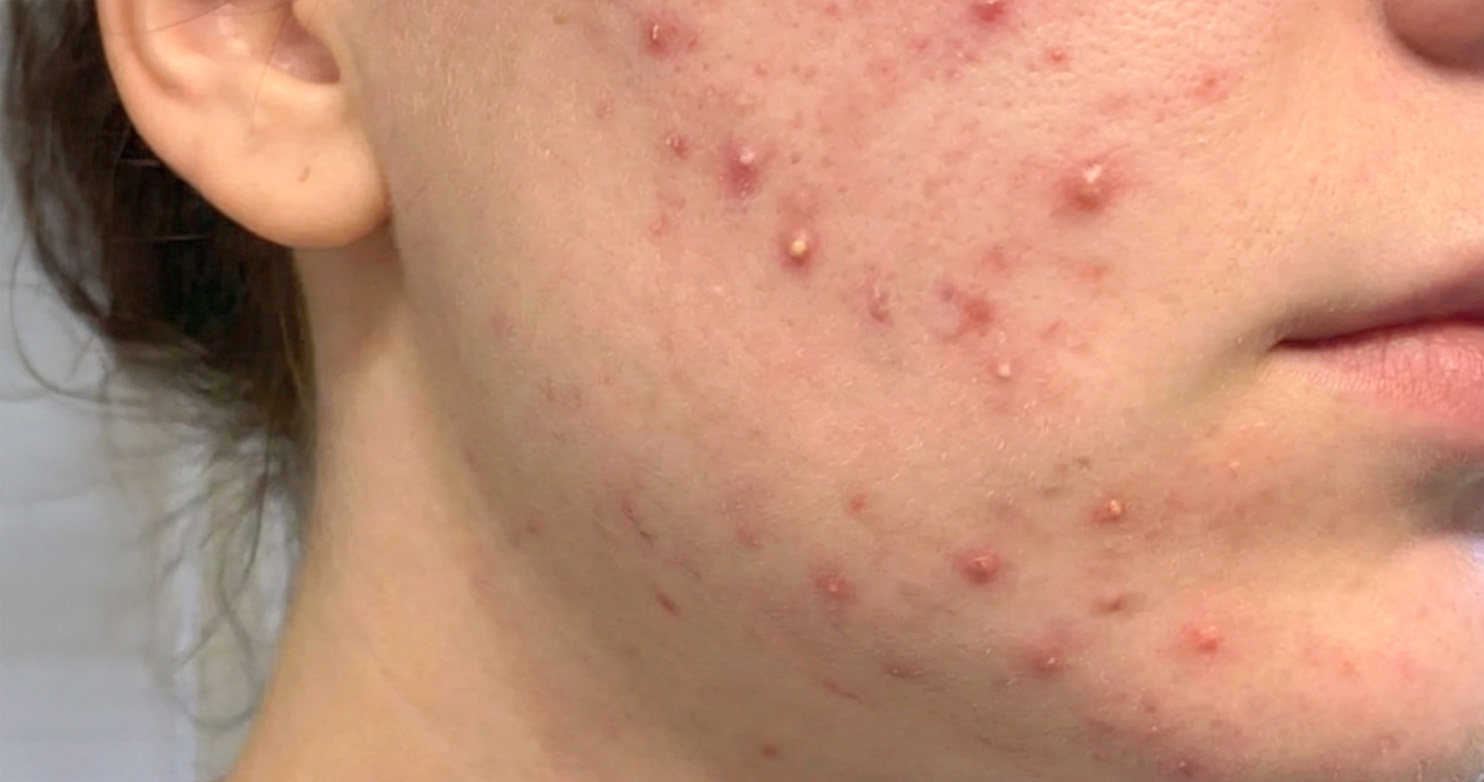
What the evidence shows about acne treatment costs
Clinical guidelines recommend beginning with the least intensive effective option and escalating deliberately, which is also the most economical sequence. The 2024 American Academy of Dermatology guideline for acne vulgaris issues good practice statements supporting the combination of topical agents with differing mechanisms of action, the limitation of systemic antibiotic use, and the pairing of any systemic antibiotic with topical treatment. Antibiotic stewardship guidance for acne recommends that systemic antibiotics be given for a limited period of three to four months rather than open-ended, which caps the cost of that tier and limits the development of resistance that would render a repeat course ineffective. The durability that device pricing assumes is supported directly by trial evidence, in that a randomised controlled study of selective sebaceous gland electrothermolysis found that 63 patients who completed three microneedle radiofrequency sessions at four-week intervals showed a significant reduction in inflammatory lesions at twelve weeks compared with the control group. A bounded programme with a persisting effect can therefore cost less across two years than repeated cycles of short-term treatment, which is the calculation that applies to relapsing acne.
What to expect realistically
The expected sequence is an assessment first, a plan matched to the diagnosis, and a quotation itemising what each stage involves. Results are measured over weeks to months, with reviews at which the plan is adjusted according to the response. Guaranteed outcomes and single-price packages warrant caution, because acne does not behave uniformly between patients and honest pricing reflects that variability.
When to see a doctor
Where cost has been the reason for deferring treatment, earlier review is preferable. Acne treated early is less expensive to control, because fewer lesions require less intensive intervention and the risk of scarring, which is the costly outcome, is lower. A staged plan can begin in the affordable tiers and escalate only where the response demonstrates the need.
A worked example of a staged plan
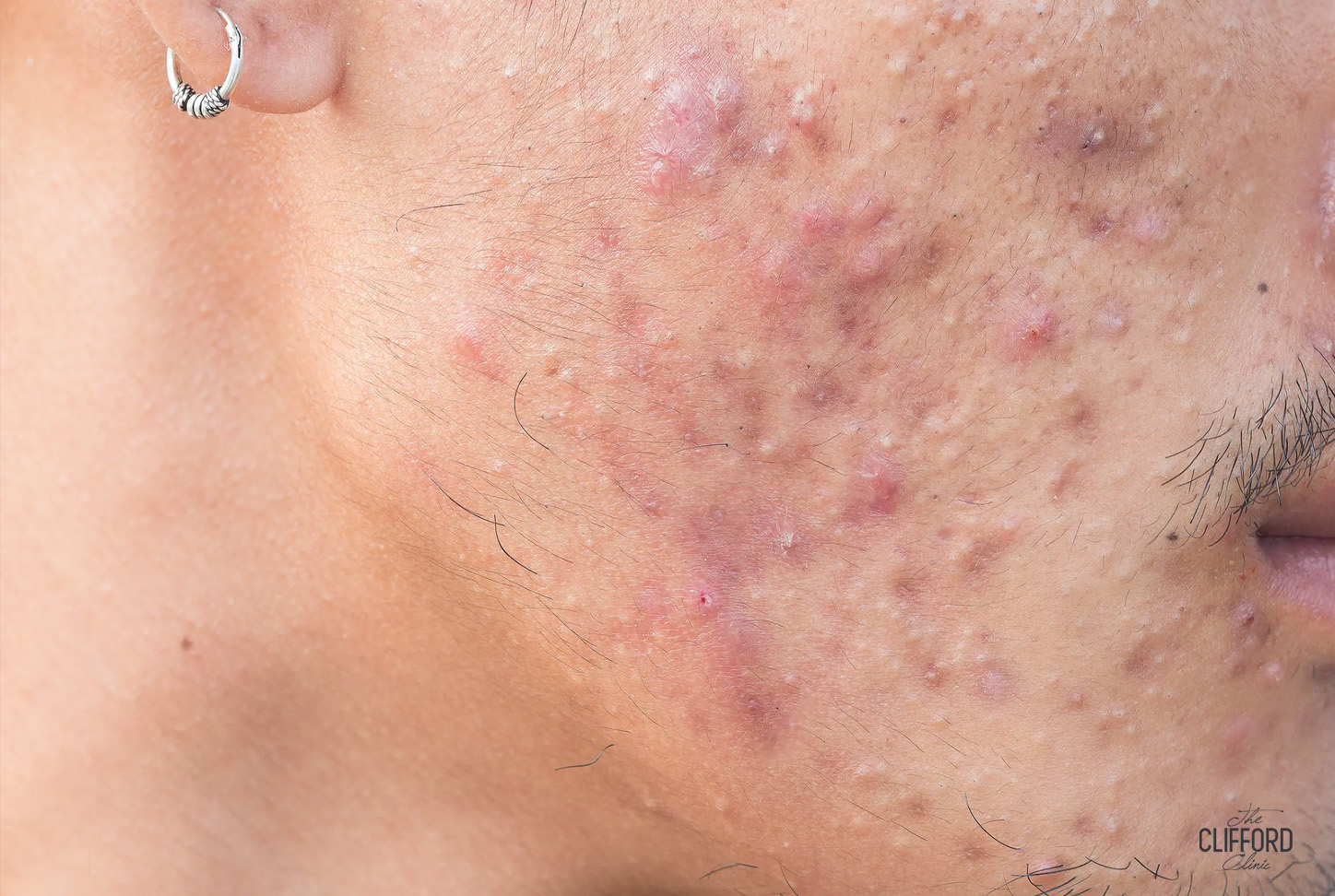
Consider a typical moderate case, an adult with oily skin, inflamed papules across the cheeks, a few deeper lesions each month, and early post-inflammatory marks. A staged plan begins with prescription topicals and a time-limited oral course, priced in the affordable tier. At the review after six to eight weeks, which is the interval over which a topical and oral regimen can be judged, treatment is not escalated if inflammation is settling, and total expenditure remains modest. Where the pattern is clearly relapsing and sebum-driven, a device programme is proposed with an itemised cost, and the decision is made with the contribution of each tier stated. Staging constrains expenditure because escalation occurs only where the clinical response establishes the need.
The alternative sequence is the package-first path, in which a bundle of facials is purchased before diagnosis, several months of surface maintenance follow while inflammation continues in the dermis, the same medical plan is then purchased in any case, and scar repair is added that earlier treatment would have avoided. The largest avoidable component of acne expenditure is the period spent on treatment that does not act on the disease.
Does insurance or MediSave cover acne treatment?

Acne treatment in Singapore is largely an outpatient, self-funded matter. Standard consultations, prescription medication and aesthetic device programmes are typically paid out of pocket, and MediSave does not cover aesthetic treatments. Where acne care overlaps with broader medical needs, such as monitoring during an isotretinoin course, some costs may fall within ordinary outpatient benefits depending on the insurer and the policy. A patient’s own policy position should be confirmed before treatment begins. Any clinic proposing that treatment be presented to an insurer as something other than what it is should be avoided, as misrepresenting a claim exposes the patient to the loss of cover.
The factors most within a patient’s control are starting treatment while acne is mild and inexpensive to treat, completing courses rather than repeating them, and allowing scheduled reviews to determine escalation, so that no tier is purchased before the response indicates it is required.
Questions that reveal the value of a quotation
When comparing clinics, a small number of questions expose the substance behind a price. The first concerns the diagnosis on which the plan is based and the reason the proposed treatment suits that acne type. The second concerns what each session and each course includes, how many sessions the estimate assumes, and the review schedule. The third concerns the provision made if the response is slow, and the cost if fewer sessions prove sufficient. The fourth concerns who performs the treatment and who reviews progress. A clinic pricing a clinical outcome can answer these directly, whereas a clinic pricing a product generally cannot.
Where expenditure is justified, and where it is wasted
Expenditure is justified on diagnosis, on evidence-based medication used correctly, and on device programmes matched to a relapsing, sebum-driven pattern. It is wasted on facials purchased as treatment for the disease, on premium formulations whose active ingredients are identical to standard ones, and on plans abandoned before completion, which forfeits the cumulative effect that produces the result. Response depends on whether the mechanism of the treatment matches the mechanism of the disease, and not on the amount paid.
Frequently asked questions
What should I budget for acne treatment?
Costs range from affordable prescription topicals to higher-tier device programmes such as AGNES and AviClear. The applicable figure depends on the acne type and severity, which is the reason credible clinics assess the skin before quoting.
Why do acne treatment prices vary so much between clinics?
Prices reflect equipment, doctor time, session counts and the extent of the diagnosis preceding the plan. The comparison that matters is what each quotation includes and the clinical reasoning behind it, rather than the headline figure.
Is expensive acne treatment worth it?
Where acne relapses persistently, treatments that reduce sebaceous gland activity can cost less over time than repeated short-term treatment, because their effect is more durable. Cost is therefore assessed per outcome rather than per session.
Are acne treatment packages a good deal?
Packages are appropriate only where they follow a diagnosis, since a package sold before the skin is examined is priced for an average patient rather than for the acne present, and facial-only packages do not treat inflammatory acne.

Get an honest, itemised plan after a proper assessment.
The Clifford Clinic, 50 Raffles Place, Singapore Land Tower. Call (65) 6532 2400 or WhatsApp (65) 8318 6332 to arrange a consultation.
Related reading
- Best Acne Treatment in Singapore A Doctor-Led Guide
- Acne Treatment at The Clifford Clinic
- A Doctor’s Honest Acne Guide (2026)
- AGNES Acne Treatment
- Isotretinoin How It Works (Dr Gerard Ee)
Selected References
- HealthHub Singapore. Acne. https://www.healthhub.sg/a-z/diseases-and-conditions/acne.
- Reynolds RV, Yeung H, Cheng CE, et al. Guidelines of care for the management of acne vulgaris. J Am Acad Dermatol. 2024. American Academy of Dermatology. https://www.aad.org/member/clinical-quality/guidelines/acne.
- Acne vulgaris. https://dermnetnz.org/topics/acne.
- Guidelines of care for the management of acne vulgaris. JAAD. https://www.jaad.org/article/S0190-9622(23)03389-3/fulltext.
- Long-term outcomes of 1726 nm laser treatment for acne. JAAD. https://www.jaad.org/article/S0190-9622(25)02900-7/fulltext.
- Ahn GR, Kim JM, Park SJ, et al. Selective sebaceous gland electrothermolysis using a single microneedle radiofrequency device for acne patients, a prospective randomised controlled study. Lasers Surg Med. 2020. PubMed. https://pubmed.ncbi.nlm.nih.gov/31502662/.
- Dreno B, Thiboutot D, Gollnick H, et al. Antibiotic stewardship in dermatology, limiting antibiotic use in acne. Eur J Dermatol. 2014. PubMed. https://pubmed.ncbi.nlm.nih.gov/24721547/.
Medical disclaimer. The Clifford Clinic publishes this article as general patient education only. It is not a substitute for an in-person clinical assessment, and the suitability, outcome and risk profile of any treatment differ from patient to patient. Arrange a consultation with one of our doctors before beginning treatment for acne.