
Mild, Moderate or Severe? How Acne Grading Decides Your Treatment
Written by Dr Bernard Ong. Medically reviewed by Dr Gerard Ee. Dr Gerard Ee (MBBS, MRCS, Diploma in Practical Dermatology, Cardiff) is the Founder and Medical Director of The Clifford Clinic, with more than 14 years of experience treating acne, and among the first doctors in Singapore to use AGNES and AviClear. This article reflects the clinical approach of The Clifford Clinic, and is for general education only. It does not replace a personal consultation. Last reviewed July 2026.
Patients commonly share a description of their acne that reflects distress rather than clinical severity. The purpose of clinical acne grading is treatment stratification. Similar lesion counts in two different distribution patterns may warrantdifferent plans, and a single scarring nodule may alter urgency of treatment over multiple blackheads. Grading also establishes a baseline, so that improvement at review is measured rather than recalled. This guide explains how our doctors grade acne and what each grade implies for treatment.
Acne severity grading in brief
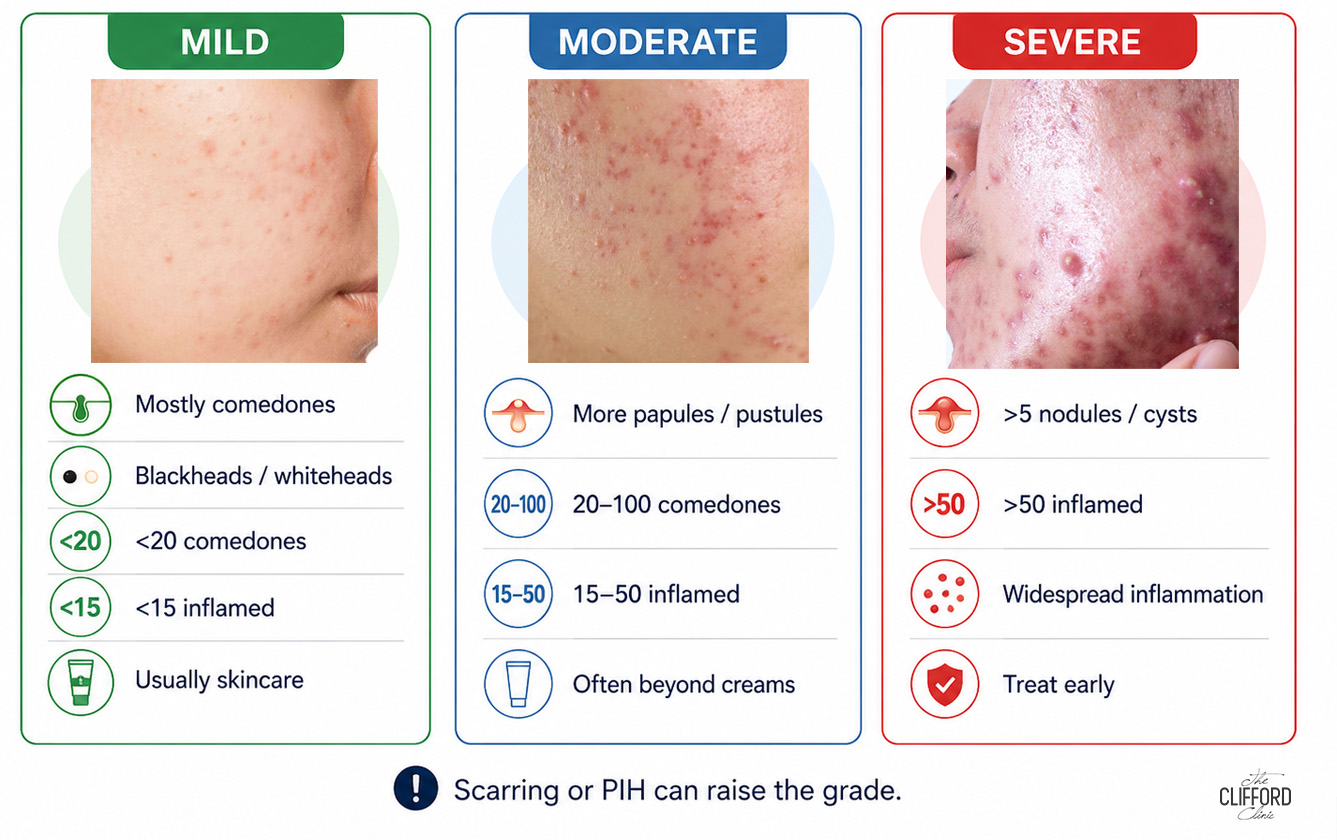
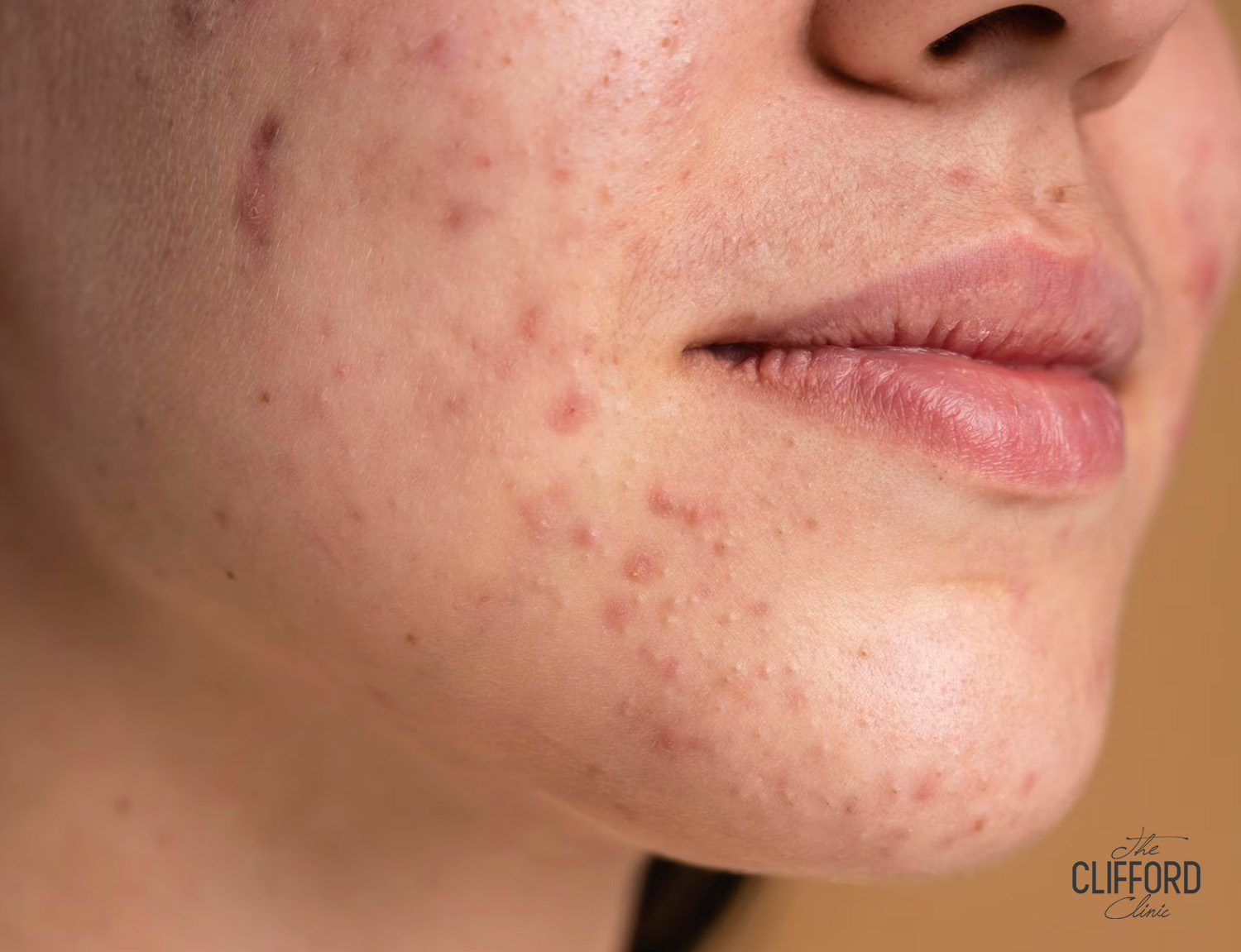
Grading combines lesion type, lesion count, the area involved and whether scarring or pigmentation is already occurring. Mild acne is predominantly comedonal, meaning blackheads and whiteheads with few inflamed lesions, and responds to medical skincare. As a working guide, mild disease carries fewer than about twenty comedones and fewer than about fifteen inflamed lesions. Moderate acne has substantial inflamed papules and pustules, commonly twenty to a hundred comedones and fifteen to fifty inflamed lesions, and usually requires treatment beyond creams. Severe acne features more than about five nodules or cysts, inflamed lesion counts above fifty, or widespread inflammation, and is treated urgently because scarring accumulates while decisions are postponed. These counts orient the assessment rather than settle it, since scarring risk can raise the effective grade regardless of lesion count.
How acne is graded at the consultation
The examination identifies which lesion types are present, namely open comedones (blackheads), closed comedones (whiteheads), inflamed papules (small raised red lesions), pustules (papules containing visible pus), and the deeper nodules and cysts that sit below the surface. Nodules are firm, deep and often painful, whereas cysts are softer and contain fluid. Both extend into the dermis, the layer in which scarring originates. Distribution is mapped across face, chest, shoulders and back, since truncal involvement raises both grade and scarring concern. Marks and true scars are recorded, together with whether the patient extracts or squeezes lesions, because that physical trauma converts temporary blemishes into permanent scars and shifts the urgency upward. Lesions are counted by region rather than estimated at a glance, and photographs are taken so progress can be measured objectively.
What each grade means for treatment
Mild acne
Mild acne consists predominantly of blackheads and whiteheads with limited inflammation. The problem is follicular obstruction rather than deep inflammation. Medical skincare addresses most cases. The foundation is a topical retinoid, which normalises the shedding of cells that block the follicle, with benzoyl peroxide where inflamed lesions appear. In-clinic support such as HydraFacial, which extracts and clears blocked follicles, assists where congestion is heavy. Aggressive intervention is unnecessary and often counterproductive, since over-treating mild acne produces irritation without benefit.
Moderate acne
Moderate acne presents with substantial inflamed papules and pustules, often across a wider area and sometimes with early marks. Topical treatment alone is usually insufficient at this grade. Options include a short antibiotic bridge alongside topicals, gland-directed treatment where oiliness and recurrence dominate, and hormonal therapy in women whose acne concentrates along the jawline and flares with the menstrual cycle. This is the grade at which the choice between AGNES, AviClear and photothermal therapy is usually determined, guided by whether breakouts recur in fixed spots or spread diffusely. AGNES treats individual sebaceous glands through a fine insulated microneedle, which suits acne that returns to the same few sites. AviClear and photothermal therapy act across a whole field, reducing output from many glands at once, and therefore suit diffuse or persistently oily acne.
Severe acne
Severe acne features nodules, cysts, or extensive inflammation across multiple areas. It is treated promptly and decisively, because every additional month of deep inflammation adds to the permanent scarring that will need separate repair later. Individual painful nodules can be settled within days by an intralesional steroid injection, which suppresses inflammation locally while definitive treatment takes effect. Isotretinoin remains the most effective option for severe disease, because it reduces sebaceous gland size and sebum output for a prolonged period after the course ends. In our practice it is nonetheless a last resort, reached after gland-directed and hormonal options have been properly considered, because it requires monthly monitoring and is contraindicated in pregnancy.
Why scarring risk can override lesion count
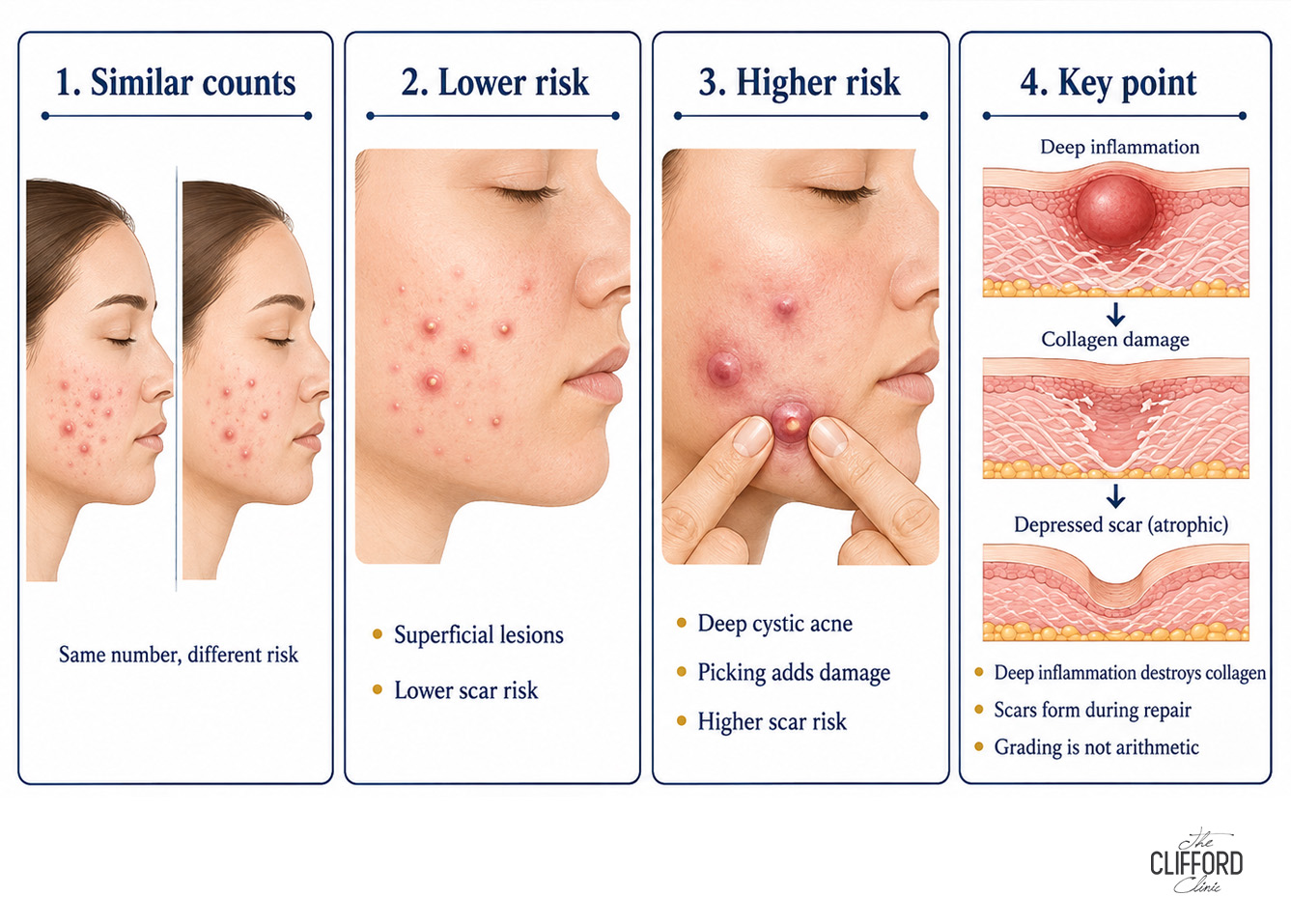
Two patients can present with similar numbers of lesions and face very different risks. Deep nodular inflammation destroys collagen in the dermis, and the repair that follows is imperfect, leaving a depressed scar. Habitual squeezing adds mechanical damage that no topical treatment can reverse. More assertive treatment is warranted for a patient with modest lesion counts who picks constantly, or whose few lesions are deep and cystic, than the count alone would suggest. Grading is not arithmetic. It is a judgement about how much permanent damage is being risked while treatment is deliberated.
Using the grade to measure treatment progress
An accurate baseline is what makes review meaningful. Patients consistently underestimate their own improvement, because the skin is seen daily and change is incremental. A recorded grade and baseline photographs allow the plan to be assessed objectively at eight to twelve weeks, rather than by competing impressions. This also protects patients from abandoning a plan that is in fact succeeding, one of the commonest reasons acne treatments appears to fail.
When escalation is not appropriate
A higher grade does not automatically justify the most aggressive treatment available. Mild comedonal acne is not placed on a device programme when topicals will suffice. Systemic medication is not started for acne that has never been given an effective course of topical treatment. Scar repair is not begun at any grade while active inflammation continues, because new lesions will generate new scars.
Common grading mistakes

The commonest is self-grading by emotional impact rather than clinical features. It leads patients with mild acne to request aggressive treatment, and patients whose cystic acne is already scarring to delay presentation. The second is grading only the face while ignoring the chest and back, where scarring can be worse and raised scars are possible. The third is treating without any baseline, which leaves no means of establishing later whether the plan worked.
What clinical guidelines recommend
International guidelines, including those of the American Academy of Dermatology, treat structured severity assessment as the basis for treatment selection, with topical therapy for mild disease, combination and systemic options for moderate disease, and prompt decisive treatment for severe nodulocystic acne to limit scarring. Earlier effective treatment reduces permanent scarring. The major scarring risk factors are deep inflammatory lesions and mechanical trauma from squeezing. Maintenance treatment after clearance is warranted regardless of initial grade, because the underlying tendency to form lesions persists once existing lesions resolve.
What to expect from a grading consultation
A grading consultation describes the acne in specific terms rather than as bad or mild, records photographs at baseline, and produces a plan proportionate to the grade rather than to the strongest available option. Review follows at a defined interval, usually eight to twelve weeks, at which the grade is reassessed. Where scarring risk is high, treatment is recommended at a pace faster than lesion count alone might suggest.
When to see a doctor
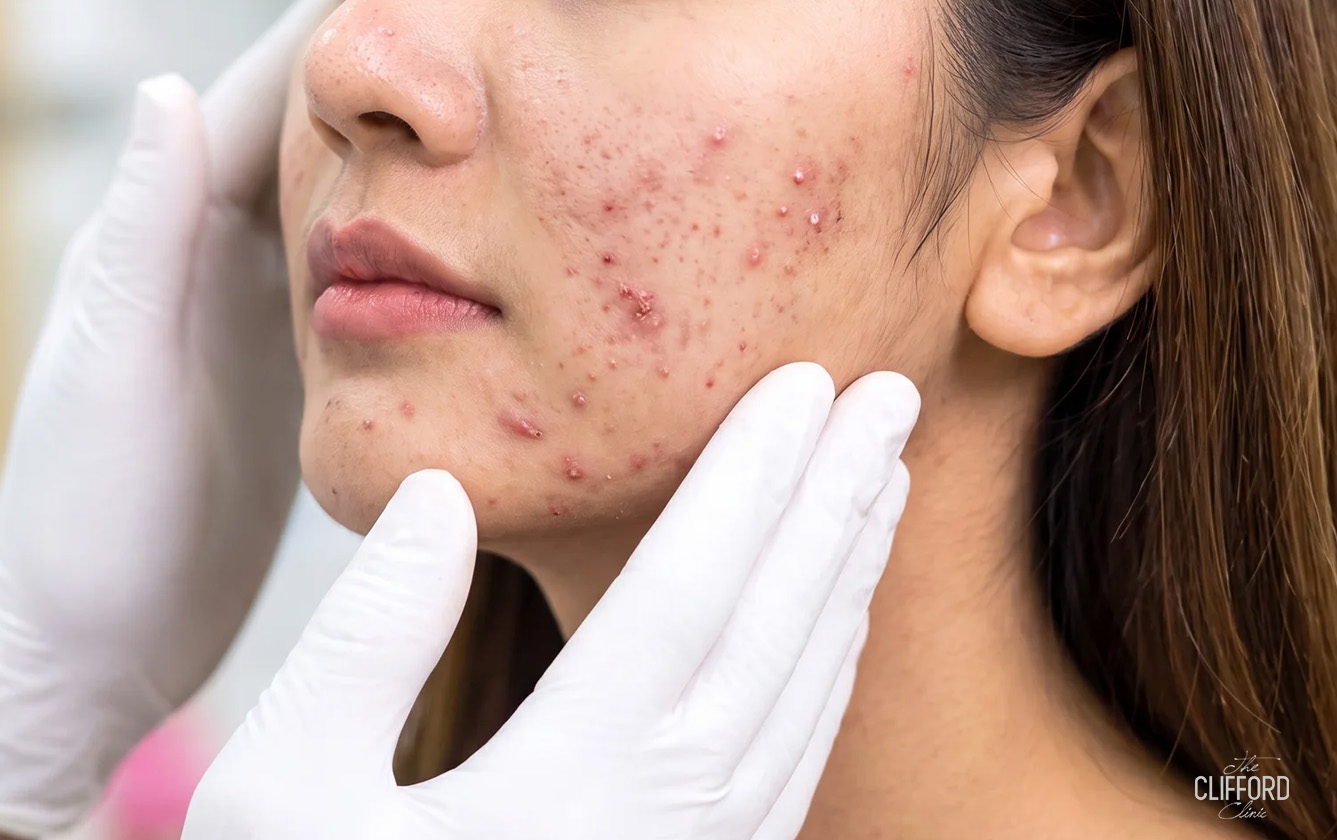
Medical assessment is warranted if you have deep or painful lesions, if scars or marks are appearing, or if acne involves the chest or back. It is equally warranted where lesions are squeezed regularly, or where the severity is simply not known. Being graded properly is the step that makes every subsequent decision rational.
Why lesion counts alone mislead
Lesion counting is attractive because it appears objective, but it conceals distinctions that matter clinically. Thirty scattered closed comedones and thirty deep inflamed papules produce identical counts and entirely different risks, prognoses and plans. A count also disregards the area involved, so facial acne and acne of the face and trunk together can score identically while representing very different disease burdens. A count says nothing about trajectory, which is often the most useful information available, since acne worsening over three months warrants earlier intervention than acne of the same severity that has been stable for years.
Grading is therefore best made by a doctor who has examined a great many faces, rather than derived from a photograph or an online questionnaire.
How the grade shapes cost and treatment duration
The grade also determines the scale of the commitment. Mild acne treated with medical skincare is a modest, mostly self-managed commitment reviewed at eight to twelve weeks. Moderate acne implies a plan over three to six months with scheduled reviews and possibly a device programme. Severe acne implies decisive treatment, closer monitoring over six to twelve months and, frequently, a separate scar phase afterwards. Patients who know their grade can therefore anticipate the scale of treatment before any figure is quoted. That is a fairer starting point than a package price offered before examination.
This also explains why two patients leave the same clinic with very different quotations. The difference is rarely commercial. It reflects the grade, the drivers and the scarring risk. Being told the grade plainly, and what it implies, is what distinguishes a diagnostic consultation from a product recommendation.
Frequently asked questions
How do I know if my acne is mild, moderate or severe?
Grading combines lesion type, count, area involved and whether scarring has begun. Mild acne is mostly blackheads and whiteheads with few inflamed lesions. Moderate acne has substantial inflamed papules and pustules, commonly fifteen to fifty. Severe acne features nodules, cysts or widespread inflammation. Only a clinical examination settles the grade, because scarring risk can raise it regardless of count.
Does acne severity decide the treatment?
Severity is the main determinant, alongside acne type and drivers. Mild acne responds to medical skincare, moderate acne usually requires oral or gland-directed treatment in addition, and severe acne is treated promptly to limit permanent scarring.
Can mild acne still need urgent treatment?
Mild acne can require urgent treatment. A few deep cystic lesions, or a habit of squeezing, raises scarring risk above what the lesion count suggests, and treatment is escalated accordingly.
Why are photographs taken at the first visit?
Improvement is gradual and easily underestimated. Baseline photographs and a recorded grade allow real progress to be measured at review instead of recalled.

Not sure how serious your acne is? A proper grading makes the plan clear.
The Clifford Clinic, 50 Raffles Place, Singapore Land Tower. Call (65) 6532 2400 or WhatsApp (65) 8318 6332 to arrange a consultation.
Related reading
- Best Acne Treatment in Singapore, A Doctor-Led Guide
- Acne Treatment at The Clifford Clinic
- How Our Doctors Choose Your Acne Treatment
- Types of Acne and How to Treat Them
- Cystic Acne Treatment
- About Dr Gerard Ee
Selected References
- HealthHub Singapore. Acne. https://www.healthhub.sg/a-z/diseases-and-conditions/acne.
- American Academy of Dermatology. Guidelines of care for the management of acne vulgaris. https://www.aad.org/member/clinical-quality/guidelines/acne.
- Acne vulgaris. https://dermnetnz.org/topics/acne.
- Guidelines of care for the management of acne vulgaris. JAAD. https://www.jaad.org/article/S0190-9622(23)03389-3/fulltext.
- Intralesional corticosteroid injection for acne nodules. PubMed. https://pubmed.ncbi.nlm.nih.gov/28871928/.
- Oral isotretinoin for acne. Cochrane Database of Systematic Reviews. https://pubmed.ncbi.nlm.nih.gov/30484286/.
Medical disclaimer: This article is for general education and does not replace an in-person consultation. Treatment suitability, results and risks vary between individuals. Please speak with a qualified doctor before starting any acne treatment.

Author Bio
Dr Gerard Ee

Dr Gerard Ee is the Medical Director of The Clifford Clinic in Singapore. He earned his medical degree from St George's University of London and built his surgical experience across the Singapore General Hospital, National University Hospital, and Mount Sinai Hospital in New York. He holds Membership of the Royal College of Surgeons (Edinburgh) and a Postgraduate Diploma in Dermatology (Cardiff), and is fully accredited in aesthetic procedures including botulinum toxin, fillers, lasers, and light therapies. A strong advocate of minimally invasive, natural-looking results, Dr Ee has published in several medical and scientific journals and presented his research in cities including Taipei, Las Vegas, and London.
See all posts by Dr Gerard Ee »