



Inside a Billionaire’s Longevity Routine and the Parts Worth Copying
Written by Dr Gerard Ee, Founder and Managing Director of The Clifford Clinic. Last medically reviewed 12 November 2026
Key points
- The Wall Street Journal has profiled Larry Connor, a 76-year-old US property billionaire who spends six figures a year to slow ageing.
- About a fifth of the members of one private club for the ultra-wealthy have installed a hyperbaric oxygen chamber at home.
- Professor S. Jay Olshansky, an ageing researcher quoted in the article, names diet and exercise as two of the most effective ways to live longer, and both cost almost nothing.
- Diet and exercise form the core of any longevity routine, and every test or treatment is an addition to them rather than a substitute.
- The additions with published research behind them, all available in Singapore, are hyperbaric oxygen therapy, a multi-cancer blood test, a lipoprotein test, Zone 2 lactate testing and breathwork.
Larry Connor is 76, runs a property company with more than 15,000 apartments and has flown to the International Space Station. He stopped celebrating his birthday at 30. This week The Wall Street Journal described the team of about 15 professionals who manage his health, the three doctors he can call at any hour and the 68 medical tests he will undergo at the Mayo Clinic this year. A colleague told the paper that Connor often says, “Hey, I might live forever.”
Few people have a private health department. The parts of his routine supported by published research, however, are not reserved for billionaires. Diet and exercise come first, and the evidence-based tests and treatments that remain are available at The Clifford Clinic, a longevity clinic in Singapore.
How much billionaires spend on longevity
The Wall Street Journal reports that wealthy families now spend tens or even hundreds of thousands of US dollars a year on health. One concierge medicine chief executive describes his service as a “family office for your health”. Members of one private club for the ultra-wealthy each spend at least US$200,000 a year. In a survey by the Swiss bank UBS, more than half of wealthy investors expected to live to 100.
Some spending goes much further. The article describes a retreat in the Amazon offering experimental gene injections at around US$15,000 each. Professor S. Jay Olshansky, who has studied ageing for decades, told the paper that people should “proceed with caution” with extreme treatments. He added that two of the most effective ways to live longer, eating well and exercising, cost almost nothing.
Experimental gene injections carry unknown risks and have no published evidence of extending human life. A sound longevity plan rests instead on measures that are safe, measurable and supported by published research.
Diet and exercise, the core of every longevity routine
Beyond the staff and the scans, the article returns repeatedly to diet and exercise. Connor fills his day with squash, yoga and high-intensity workouts. Another member of the ultra-wealthy club in the story starts each morning with olive oil and lean protein and takes his daily steps on the beach. Professor Olshansky names the same two habits as the most effective ways to live longer.
Published research supports both habits. In a Spanish trial of 7,447 adults at high cardiovascular risk, a Mediterranean diet supplemented with extra-virgin olive oil or nuts lowered the combined rate of heart attack, stroke and cardiovascular death by about 30% compared with a reduced-fat diet. In a study of 122,007 adults who completed a treadmill test, survival improved with each higher level of fitness, and the least fit had about five times the risk of death of the fittest.
Every test and treatment described below adds to diet and exercise and never replaces them. The Clifford Clinic guide to the best diets for longevity covers the eating patterns with the strongest evidence.
Hyperbaric oxygen therapy, and why the ultra-wealthy are buying home chambers

The most striking figure in the article is that about a fifth of the members of that private club have installed a hyperbaric chamber at home.
In hyperbaric oxygen therapy, the patient breathes oxygen inside a chamber pressurised to about twice normal air pressure. At that pressure far more oxygen dissolves directly into the blood plasma, which carries it to tissue that ordinary breathing leaves short of oxygen. Hospitals have used the treatment for decades for decompression sickness, non-healing wounds and radiation injury.
The longevity interest stems from a 2020 Israeli study of 35 healthy adults aged 64 and over who completed 60 sessions over 90 days. Afterwards, telomeres, the protective caps on the ends of chromosomes, were more than 20% longer in several types of immune cell, and the number of senescent, or worn-out, immune cells had fallen. The study was small and had no control group, so the findings remain preliminary, but they account for the demand for home chambers.
Chamber pressure determines how much extra oxygen reaches the tissue. The study used a hard-shell chamber at 2.0 atmospheres absolute (ATA), twice normal air pressure, whereas many home chambers are soft inflatable units that typically reach about 1.3 ATA. The Clifford Clinic chamber is a hard-shell unit that reaches 2.0 ATA, and a doctor screens every patient before the first session. Sessions start from S$250. The clinic guide to hyperbaric oxygen therapy in Singapore lists the conditions it treats and the full cost table. Dr Gerard Ee describes how he runs hyperbaric oxygen therapy at the clinic on his own site.
Multi-cancer blood test, one sample that screens for up to 50 cancers

Connor’s 68 tests include a full-body magnetic resonance imaging (MRI) scan and a high-resolution brain scan. The rationale is early detection, because cancer found at an early stage is usually far easier to treat than cancer found late.
Most standard screening tests look for one cancer at a time. A multi-cancer early detection (MCED) test takes a different approach. Tumours shed tiny fragments of their DNA into the bloodstream, and the test detects those fragments in a single blood sample. The Clifford Clinic uses LucenceINSIGHT, a multi-cancer blood test from Lucence, a company founded in Singapore, in the version that screens for up to 50 types of cancer.
Blood is drawn at the clinic and sent to the laboratory, and Dr Gerard Ee explains the result and arranges any follow-up scan that is needed. The test adds to routine screening such as a mammogram, a Pap smear and a colonoscopy and does not replace them, because a negative result cannot rule out every cancer. The price is quoted at consultation. The full body cancer screening page lists what else the screening includes.
Lipoprotein testing, the cholesterol test that counts the particles
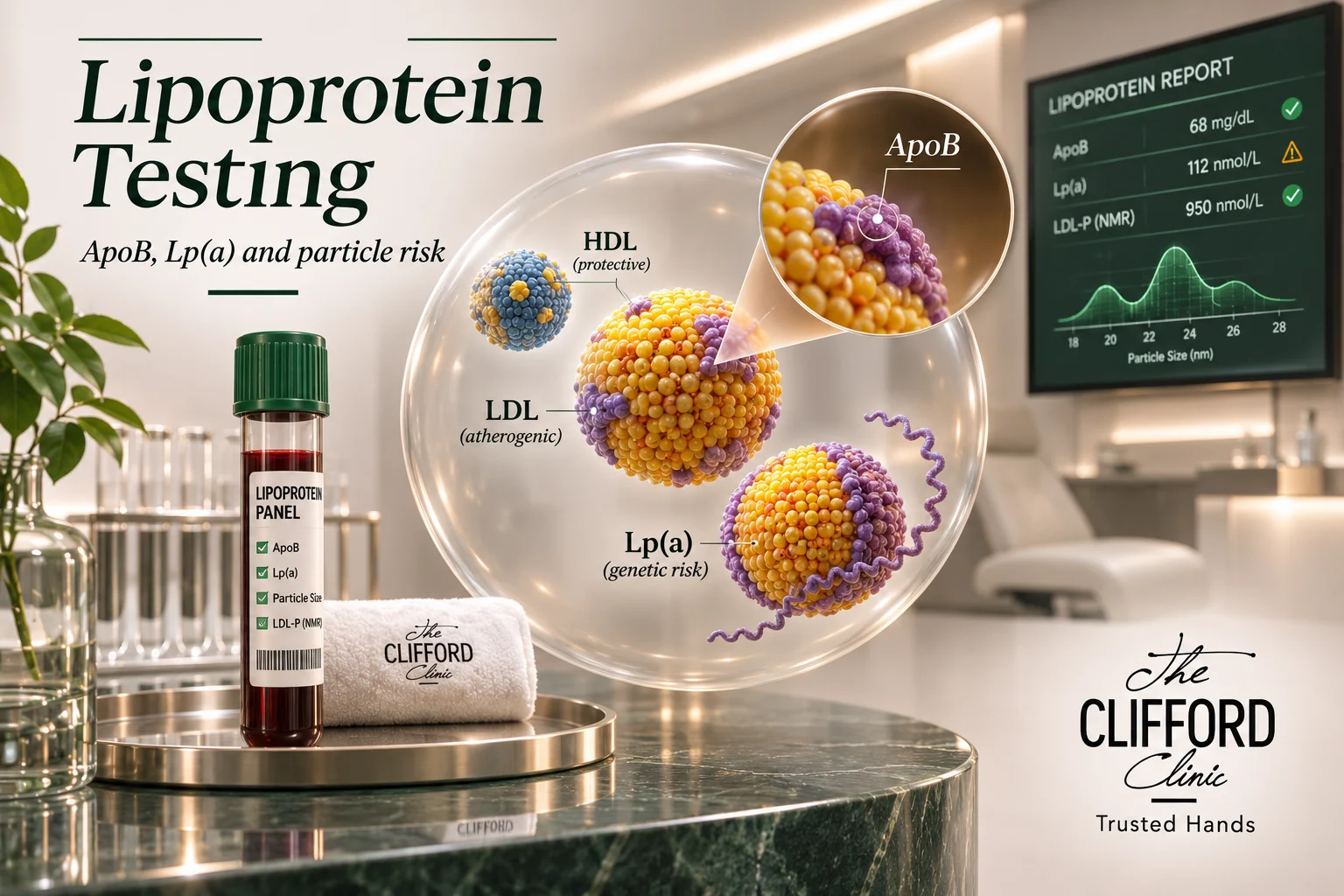
Connor shows visitors a chart of his cholesterol falling steadily over the past decade, and tracking it over years is sound practice. The standard cholesterol test, however, has a limitation. It measures how much cholesterol is in the blood, not how many particles carry it, and it is the particles that enter the artery wall and build plaque.
A lipoprotein test counts them. Each potentially harmful particle carries exactly one molecule of apolipoprotein B (ApoB), so the ApoB level gives the number of those particles. Lipoprotein(a), or Lp(a), is an inherited particle that a routine panel does not include, and because its level is set largely by genes, most people need to check it only once. A nuclear magnetic resonance (NMR) lipoprotein profile shows the number and size of the particles. Two people with the same low-density lipoprotein (LDL) cholesterol can therefore carry very different particle numbers and very different risk.
The test requires a single blood draw at the clinic. Advanced testing starts from S$450, with the consultation charged separately. Details are on the advanced cholesterol blood test page. Dr Ee explains why he looks beyond a standard cholesterol blood test in his own practice.
Zone 2 lactate testing and VO2 max, how hard to train for longevity
Connor ends many days in the office gym with a trainer and then asks for an extra workout. Professor Olshansky’s advice points the same way, since exercise is the cheapest longevity treatment available. The practical question is training intensity.
Zone 2 training is steady exercise at an effort that still allows a conversation. At this intensity the muscles burn mostly fat, and over months they adapt by building more mitochondria, the structures inside each cell that convert food and oxygen into energy. A larger and healthier mitochondrial pool improves stamina and blood sugar control and helps preserve energy with age.
Most people estimate their Zone 2 from a formula based on age or from a fitness watch, and these estimates are often wrong. Training too hard moves the body out of Zone 2 without the person noticing, while training too gently produces little adaptation.
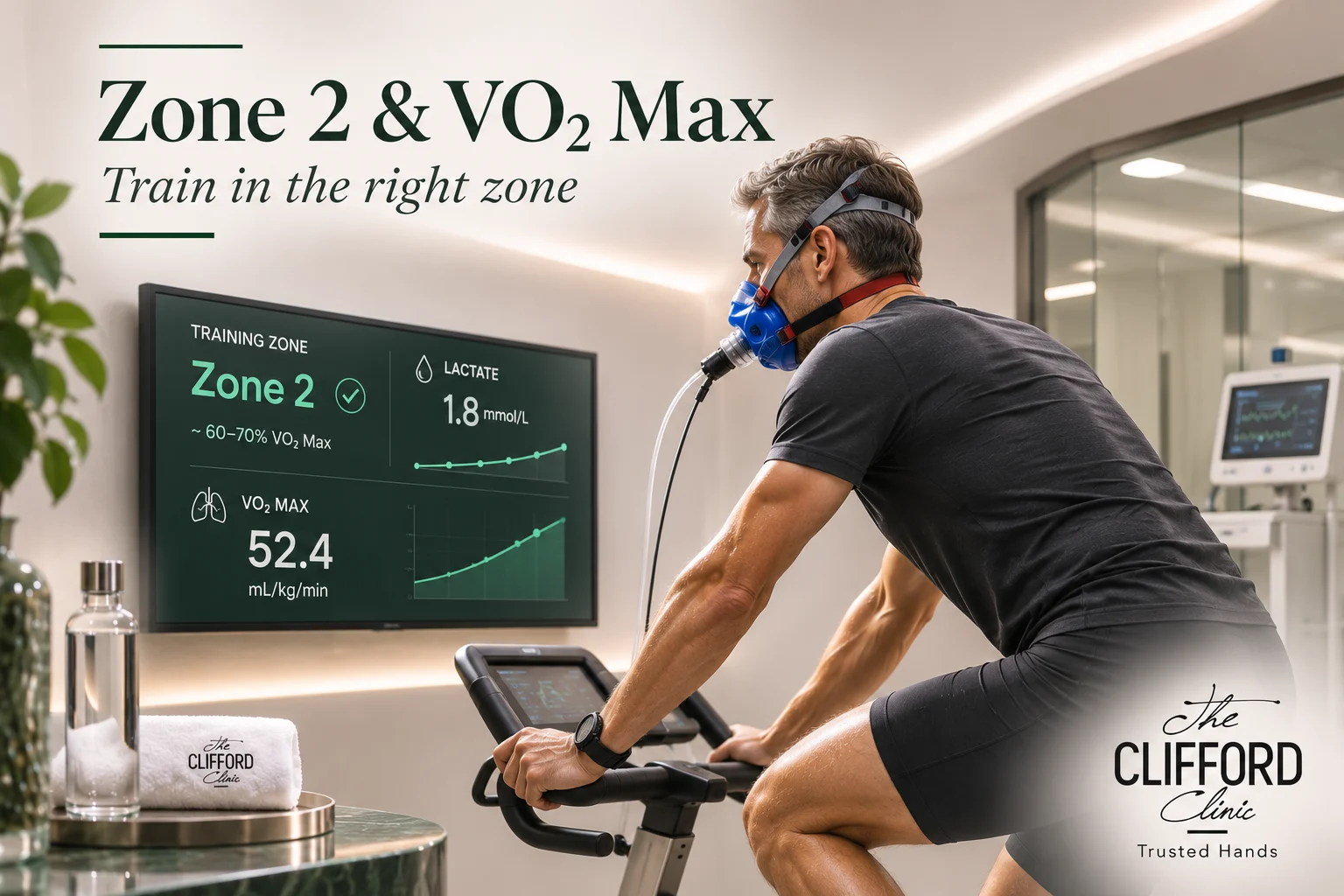
A lactate threshold test measures the actual Zone 2 range. The patient walks or cycles in stages of gradually increasing effort, and at each stage a drop of blood from the fingertip is tested for lactate. The heart rate at which lactate begins to rise marks the upper limit of Zone 2, and the patient leaves with a personal heart rate range for training.
The clinic also offers VO2 max testing, which measures the maximum amount of oxygen the body can use at full effort. VO2 max is one of the strongest single measures of fitness and a strong predictor of long-term survival. The Zone 2 lactate test is S$800, and a VO2 max test can be added for S$200.
Breathwork for longevity, what slow breathing does to the body
At the Amazon retreat, one guest spent an hour on breathing exercises and told the paper it took him to a state he had never experienced before. The same techniques require no travel and no equipment.
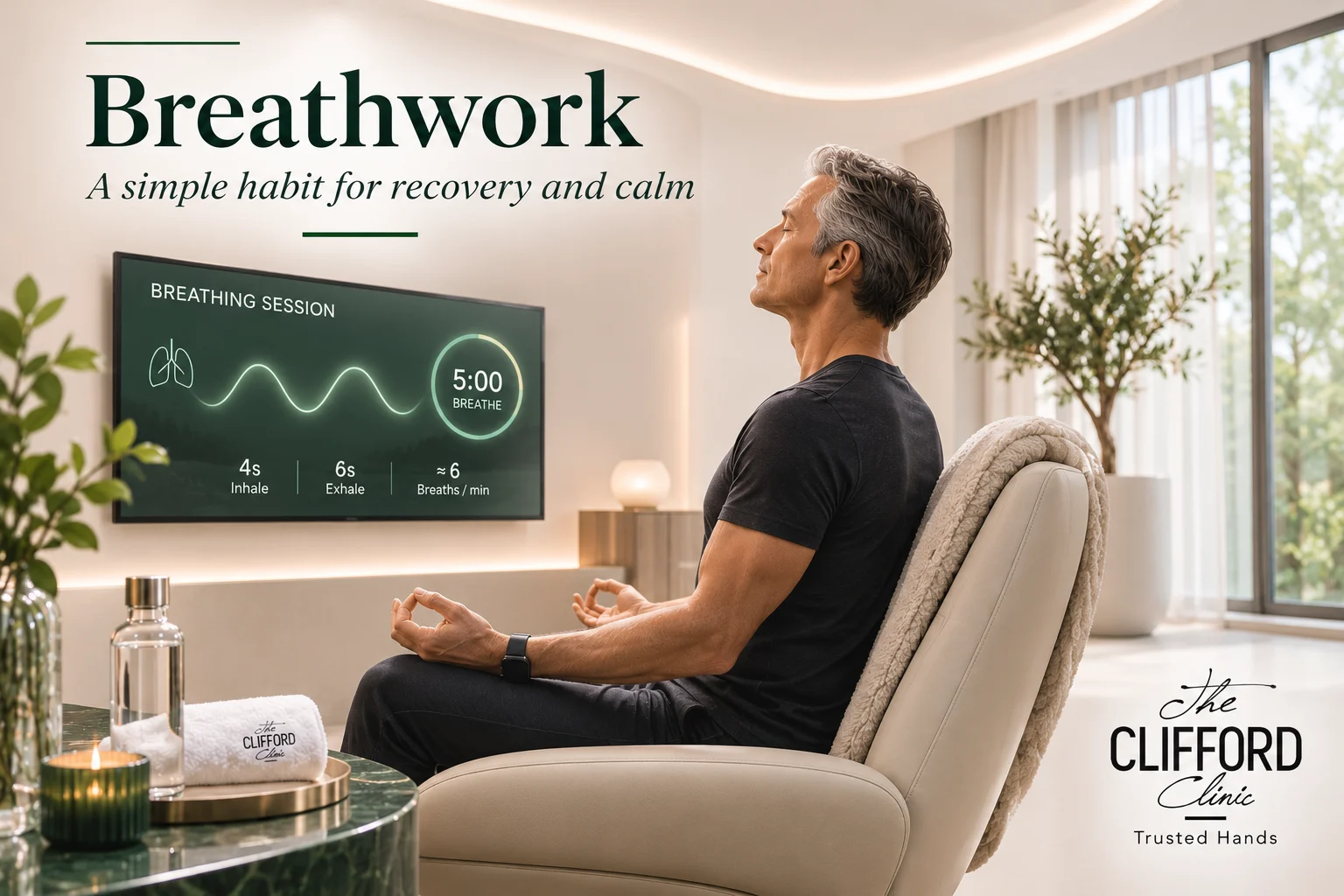
Breathwork is the most affordable habit in the article. Slow, controlled breathing, at fewer than 10 breaths a minute, slows the heart rate and shifts the nervous system from its stress response towards its rest response. A 2018 systematic review linked slow breathing with greater heart rate variability, a marker of that shift, and with lower anxiety and better mood. Techniques such as belly breathing, box breathing and the 4-7-8 breath take minutes to learn and cost nothing to practise.
The Clifford Clinic breathwork and meditation workshop teaches these techniques in a guided group session, and private sessions are also available.
A billionaire longevity routine without the billionaire budget
Connor told the paper he is focused on the quality of his remaining years, not only on how long he lives. That goal does not require a staff of 15, and the evidence-based core of his routine reduces to six habits.
- Eat well and move every day, which costs almost nothing.
- Measure your fitness once with a Zone 2 lactate test and a VO2 max test, then train in the right zone.
- Screen early with routine checks and the LucenceINSIGHT multi-cancer blood test.
- Support recovery and healthy ageing with a course of hyperbaric oxygen therapy.
- Check your particle numbers with a lipoprotein test.
- Practise slow breathing for a few minutes a day.
Dr Ee gives his personal view on what he would keep from a billionaire’s longevity routine.
Billionaire longevity routine FAQ
Who is Larry Connor?
Larry Connor is a 76-year-old American property billionaire profiled by The Wall Street Journal in November 2026. He has flown to the International Space Station and has a team of about 15 professionals who manage his health.
How much do billionaires spend on longevity?
The Wall Street Journal reports that wealthy families spend tens to hundreds of thousands of US dollars a year on health. Members of one private club spend at least US$200,000 a year each. Connor’s own spending runs to six figures a year.
Is a home hyperbaric chamber the same as a clinic chamber?
A home chamber is usually not equivalent to a clinic chamber. Many home units are soft chambers that typically reach about 1.3 ATA, well below the 2.0 ATA of the hard-shell chambers used in research.
Which parts of a billionaire longevity routine are backed by research?
A healthy diet and regular exercise have the strongest evidence. Early cancer screening, lipoprotein testing, slow breathing and hyperbaric oxygen therapy also have published research behind them, although the longevity evidence for hyperbaric oxygen therapy is still preliminary. Experimental gene injections and unapproved treatments have no such evidence.
Book a longevity consultation at The Clifford Clinic
The Clifford Clinic, 50 Raffles Place, #01-01 Singapore Land Tower. Call (65) 6532 2400 or WhatsApp (65) 8318 6332.
References
- Banerji G. Meet the Real-Estate Billionaire Spending a Fortune to Slow Down Aging. The Wall Street Journal. 11 November 2026. wsj.com
- Hachmo Y, Hadanny A, Abu Hamed R, et al. Hyperbaric oxygen therapy increases telomere length and decreases immunosenescence in isolated blood cells, a prospective trial. Aging (Albany NY). 2020;12(22):22445-22456. doi.org/10.18632/aging.202188
- Mandsager K, Harb S, Cremer P, et al. Association of cardiorespiratory fitness with long-term mortality among adults undergoing exercise treadmill testing. JAMA Netw Open. 2018;1(6):e183605. doi.org/10.1001/jamanetworkopen.2018.3605
- Holloszy JO. Biochemical adaptations in muscle, effects of exercise on mitochondrial oxygen uptake and respiratory enzyme activity in skeletal muscle. J Biol Chem. 1967;242(9):2278-2282.
- San-Millán I, Brooks GA. Assessment of metabolic flexibility by means of measuring blood lactate, fat, and carbohydrate oxidation responses to exercise in professional endurance athletes and less-fit individuals. Sports Med. 2018;48(2):467-479. doi.org/10.1007/s40279-017-0751-x
- Estruch R, Ros E, Salas-Salvadó J, et al. Primary prevention of cardiovascular disease with a Mediterranean diet supplemented with extra-virgin olive oil or nuts. N Engl J Med. 2018;378(25):e34. doi.org/10.1056/NEJMoa1800389
- Sniderman AD, Thanassoulis G, Glavinovic T, et al. Apolipoprotein B particles and cardiovascular disease, a narrative review. JAMA Cardiol. 2019;4(12):1287-1295. doi.org/10.1001/jamacardio.2019.3780
- Zaccaro A, Piarulli A, Laurino M, et al. How breath-control can change your life, a systematic review on psycho-physiological correlates of slow breathing. Front Hum Neurosci. 2018;12:353. doi.org/10.3389/fnhum.2018.00353
- Poh J, et al. LucenceINSIGHT multi-cancer early detection test. J Clin Oncol. 2024;42(16 suppl):e15042.