
Preparation and Aftercare for Acne Device Treatment
Written by Dr Bernard Ong. Medically reviewed by Dr Gerard Ee. Dr Gerard Ee (MBBS, MRCS, Diploma in Practical Dermatology, Cardiff) is the Founder and Medical Director of The Clifford Clinic, with more than 14 years of experience treating acne, and among the first doctors in Singapore to use AGNES and AviClear. This article reflects the clinical approach of The Clifford Clinic, and is for general education only. It does not replace a personal consultation. Last reviewed in July 2026.
Patients booked for AGNES, AviClear or photothermal therapy consistently raise practical questions that receive less attention than the underlying science, namely how to prepare, what each session feels like, what the skin looks like afterwards, and when the result can fairly be judged. These answers carry clinical weight, because preparation and aftercare influence both comfort and outcome, and because a patient who knows what is normal does not abandon a treatment that is behaving exactly as expected. This guide sets out the practical side of gland-directed acne treatment.
Key takeaways
- Preparation is light for all three treatments, requiring clean skin on arrival, disclosure of current medication including any past isotretinoin, and baseline photographs.
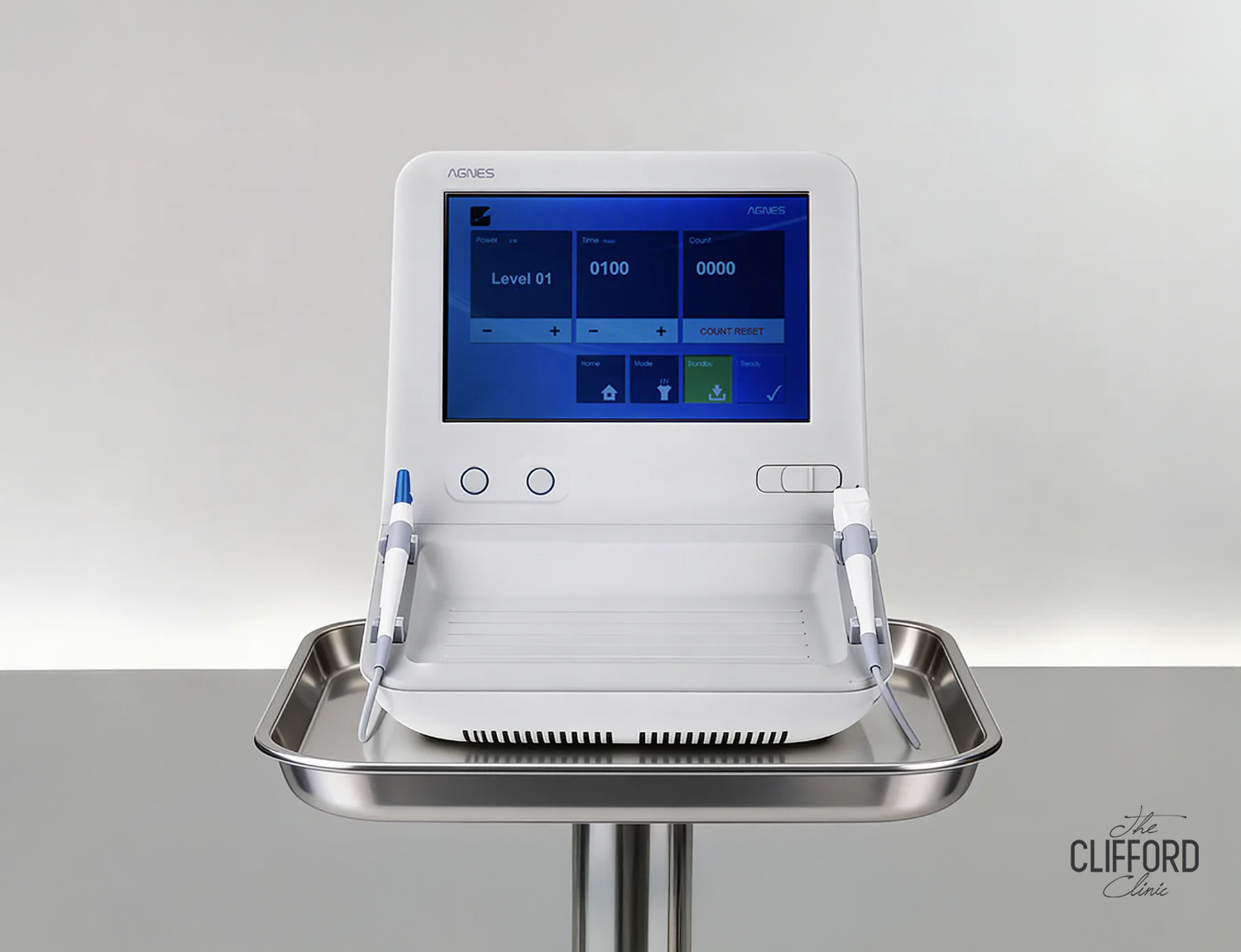
- AGNES is performed under local anaesthetic and leaves localised swelling for one to two days.
- AviClear requires no anaesthetic and leaves brief mild flushing.
- Photothermal therapy is the gentlest of the three, producing warmth and minimal redness.
Summary
Preparation is light for all three treatments, requiring clean skin on arrival, disclosure of current medication including any past isotretinoin, and baseline photographs. AGNES requires local anaesthetic and produces localised swelling confined to the treated spots for one to two days, because the energy is delivered into individual glands rather than across the surface. AviClear requires no anaesthetic and produces brief flushing, as the 1726 nm wavelength is absorbed by sebum and cooled at the skin surface throughout. Photothermal therapy is the gentlest of the three, producing warmth and minimal redness. Aftercare in every case is a simple routine, daily sunscreen, and a brief pause on strong actives. Results are assessed across months rather than weeks, because these treatments alter gland behaviour progressively rather than suppressing lesions immediately.
What the pre-treatment consultation covers
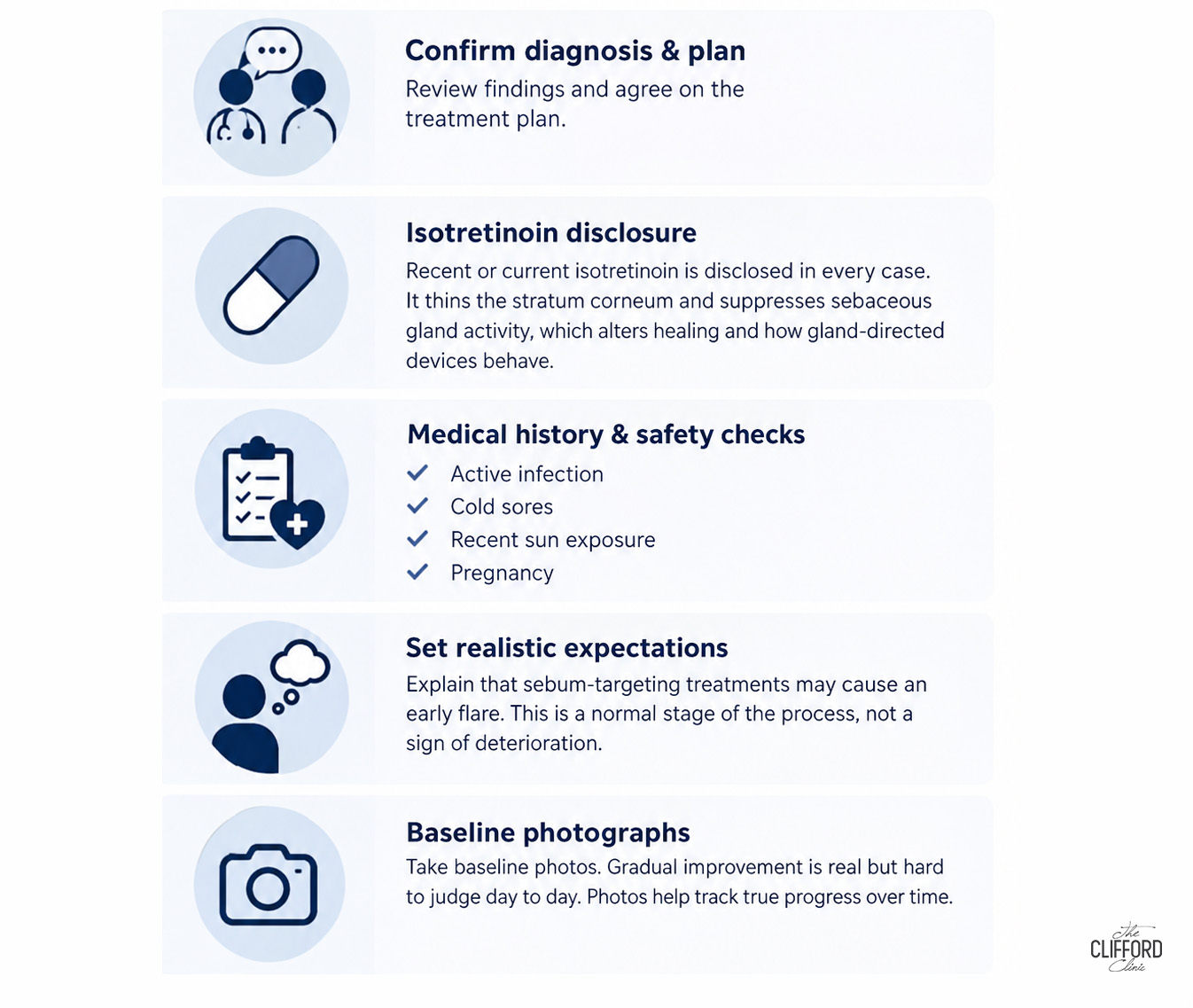
The pre-treatment discussion confirms the diagnosis and the plan, and covers the medication and history that affect timing. Recent or current isotretinoin is disclosed in every case, because it thins the stratum corneum and suppresses sebaceous gland activity, which alters both how the skin heals and how a gland-directed device behaves. Active infection, cold sores, recent sun exposure and pregnancy are each checked. Realistic expectations are set explicitly, including the possibility of an early flare with sebum-targeting treatment, so that a normal stage of the process is not mistaken for deterioration. Baseline photographs are taken, which matters more than patients anticipate, since gradual improvement is genuinely difficult to self-assess.
Preparation before a session
Skin should be clean and free of makeup on arrival, or time allowed for its removal. Deliberate sun exposure and tanning are avoided in the preceding days, since recently tanned skin carries more surface melanin and absorbs more energy than the treatment assumes. Usual skincare continues unless otherwise directed, although strong actives such as high-strength acids are commonly paused for a day or two beforehand. Eating normally before AGNES is advised, as sessions under local anaesthetic are better tolerated when a patient is not fasting. Slightly more time than the procedure itself should be allowed, because anaesthetic requires time to take effect where it is used.
What each acne device session feels like
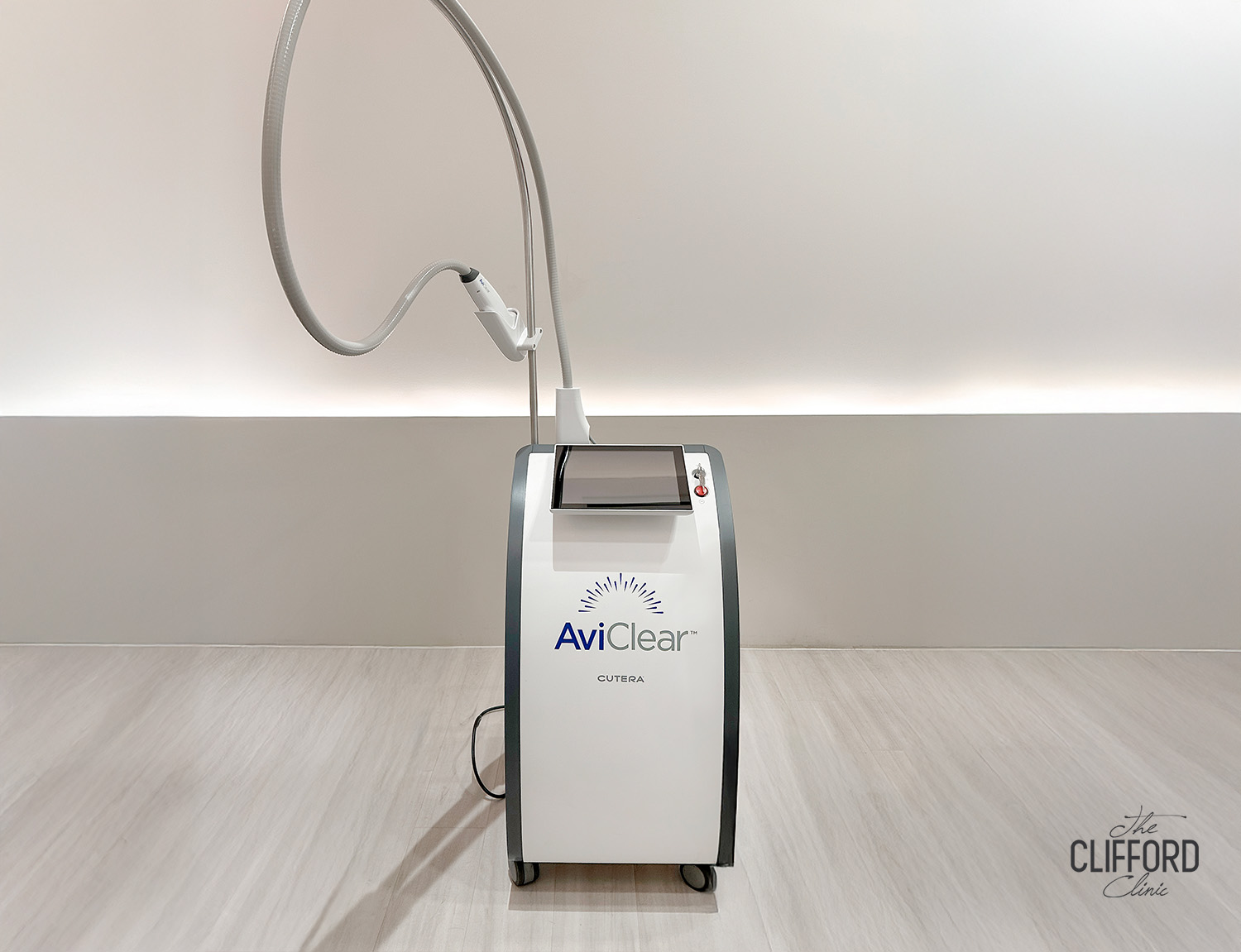
AGNES involves topical or local anaesthetic followed by fine insulated microneedles placed into individual problem glands, described by patients as brief sharp sensations rather than sustained pain. AviClear delivers pulses of warmth beneath a continuously cooled handpiece and is generally well tolerated without numbing, requiring approximately thirty minutes for a full face. Photothermal therapy involves a gold nanoparticle preparation being driven into the pores with Bellasonic ultrasound, after which the laser passes over the skin and is felt as gentle warmth. All three are tolerated by the great majority of patients without difficulty, and a patient who has completed one commonly finds the others comparable.
Immediately afterwards
AGNES produces localised swelling and redness around the treated spots for one to two days, and occasionally small crusts at the needle entry points, which settle with simple care and should not be picked. AviClear produces mild flushing that typically fades within hours, after which normal activities resume immediately. Photothermal therapy produces minimal redness, and makeup may be worn the same day. Across all three, deliberate heat such as saunas and hot yoga is avoided on the day of treatment, sunscreen is applied diligently, and strong actives are resumed after a day or two rather than the same evening.
The early flare and why it is not treatment failure
Sebum-targeting treatment can produce a temporary increase in small breakouts during the early weeks, as treated glands reduce output and the congestion already within the follicle is expelled. This is common, anticipated, and settles as sessions accumulate, typically resolving within the first four to six weeks of a course. It is also the single commonest reason patients discontinue a treatment that is working, having concluded at week two that the treatment has worsened their skin. Advance knowledge that this can occur is most of the remedy, and reporting it at review allows reassurance or adjustment rather than unannounced discontinuation.
How results from acne device treatment are judged
Fair assessment is measured in months. For AGNES, the question is whether the treated glands cease to recur across subsequent cycles, judged spot by spot. For AviClear and photothermal therapy, the question is whether the treated area as a whole shows fewer, smaller and faster-healing lesions with reduced surface shine, judged across the course and the months following it. Improvement from gland-directed treatment continues to develop after the final session, so the best result is usually not the one visible on the last day of treatment. Serial photographs taken under matched lighting resolve this, because incremental change seen daily in a mirror is systematically under-detected.
Circumstances that warrant postponing a session
A session is postponed where there is active skin infection or an inflamed cold sore within the treatment area, significant recent sun exposure or sunburn, a pregnancy in which the specific treatment is unsuitable, or intercurrent illness. Postponement is also preferred where expectations have not been properly set, because an informed patient completes a course whereas an uninformed patient abandons it.
Common mistakes during a treatment course
The commonest error is judging the result too early and stopping mid-course. Picking at post-AGNES crusts is the next most frequent, and risks leaving marks where the skin would otherwise have healed cleanly. Layering aggressive actives immediately after a session, in the hope of accelerating the result, instead irritates the barrier and delays it. Omitting sunscreen afterwards carries a particular cost in this climate, where ultraviolet exposure drives post-inflammatory pigmentation in treated skin. Discontinuing medical skincare on the assumption that the device replaces it is the last of the five, and misreads a relationship in which the two act together.
What the evidence shows for acne device treatment
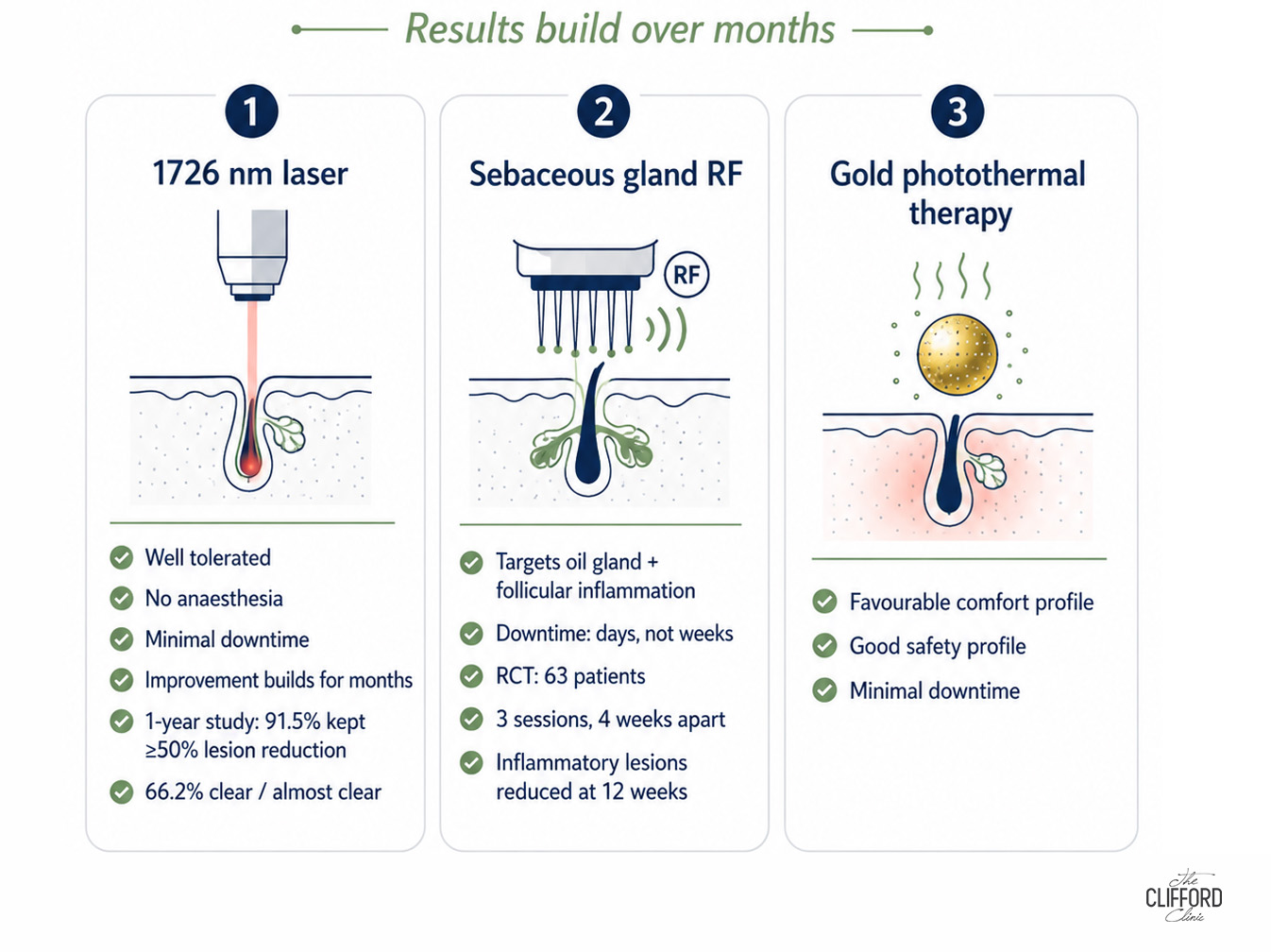
The 1726 nm laser is well tolerated without anaesthesia and requires minimal downtime, with improvement that continues to build for months after the treatment course across a range of skin types. One year data from a prospective multicentre study reported that 91.5 per cent of patients retained a reduction of at least half in inflammatory lesion count, and 66.2 per cent were rated clear or almost clear on investigator assessment. Radiofrequency delivered directly into the sebaceous gland reduces gland activity and follicular inflammation, with recovery measured in days rather than weeks. A randomised controlled trial of 63 patients with moderate to severe facial acne, treated three times at four-week intervals with a single insulated microneedle device, found inflammatory lesions significantly reduced at twelve weeks against the control arm. Gold nanoparticle photothermal therapy carries a favourable comfort and safety profile with minimal downtime. The consistent finding across all three is that results accrue progressively, which is why assessment intervals are set in months.
Realistic expectations from a treatment course
Each session is completed within an hour, visible effects resolve within one to two days, and an early flare may occur in the first weeks. Improvement is progressive across the course and continues beyond it, with the clearest picture emerging in the months after the final session. A simple supporting routine is maintained throughout, and review is conducted by comparing photographs rather than exchanging impressions.
When to see a doctor
Contact the clinic between sessions if swelling is unusually severe or prolonged, if a treated area becomes increasingly painful or appears infected, or if you are concerned about an early flare. None of these is common, and each is more easily addressed early than late.
Scheduling a course around personal commitments
These treatments carry little downtime and therefore fit most schedules, although a degree of planning improves the experience. AGNES is best scheduled when one to two days of localised swelling will not coincide with a significant event, which is why patients often choose the start of a quieter week. AviClear and photothermal therapy leave so little visible effect that they are readily accommodated within a working day, though sun protection afterwards matters more than usual. Where a wedding, photography or travel is anticipated, raising it at the planning stage allows the course to be arranged to peak at the appropriate time rather than mid-flare.
The early flare is the specific reason a course is timed against the calendar rather than started on the first available date. Where a major event falls six weeks away, commencing a sebum-targeting course the preceding month is poor timing, and either an earlier start or a deferral is usually advised. Patients rarely think to raise their calendar in a medical consultation, but for elective treatment it materially alters the recommendation.
Maintenance between sessions
The device accounts for the greater part of the change, but what happens between sessions determines how much of it is retained. A simple routine of gentle cleanser, light non-comedogenic moisturiser and daily sunscreen protects the result, and where a topical retinoid forms part of the plan it usually continues, with timing adjusted around session dates. Adding further products in the hope of accelerating progress is counterproductive, because barrier irritation is the commonest self-inflicted setback during a course.
A single image taken in consistent lighting every two weeks provides an objective record, which matters because daily mirror inspection reliably under-detects gradual improvement. Patients who track progress in this way are considerably less likely to abandon a course prematurely, and arrive at review with usable information rather than impressions.
Frequently asked questions
How should I prepare for AGNES or AviClear?
Arrive with clean skin, avoid deliberate sun exposure beforehand, disclose all current medication including any past isotretinoin, and allow extra time where local anaesthetic is used. Baseline photographs are taken at the first session.
Is there downtime after AviClear or Gold PTT?
AviClear typically leaves mild flushing that fades within hours, and photothermal therapy leaves minimal redness with same-day makeup. AGNES leaves localised swelling for a day or two around treated spots.
Why did my acne get worse after starting treatment?
A temporary early flare is common with sebum-targeting treatment, as treated glands reduce output and existing congestion is expelled. It settles as sessions accumulate, typically within the first four to six weeks, and is not a sign that the treatment is failing.
When will I see results from acne device treatment?
Improvement builds progressively and continues for months after the final session, so results are judged across months rather than weeks, with photographs compared at review.

Whether a session is already booked or the decision is still open, our doctors will set out exactly what to expect.
The Clifford Clinic, 50 Raffles Place, Singapore Land Tower. Call (65) 6532 2400 or WhatsApp (65) 8318 6332 to arrange a consultation.
Related reading
- Best Acne Treatment in Singapore: A Doctor-Led Guide
- Acne Treatment at The Clifford Clinic
- How Our Doctors Choose Your Acne Treatment
- AGNES Acne Treatment
- AviClear Acne Treatment
- Gold Photothermal Treatment
Selected References
- HealthHub Singapore. Acne. https://www.healthhub.sg/a-z/diseases-and-conditions/acne
- American Academy of Dermatology. Guidelines of care for the management of acne vulgaris. https://www.aad.org/member/clinical-quality/guidelines/acne.
- Acne vulgaris. https://dermnetnz.org/topics/acne
- A 1726 nm laser system for the treatment of acne vulgaris. PubMed. https://pubmed.ncbi.nlm.nih.gov/36197599/.
- Long-term outcomes of 1726 nm laser treatment for acne. JAAD. https://www.jaad.org/article/S0190-9622(25)02900-7/fulltext
- Radiofrequency microneedling of the sebaceous gland for acne. PubMed. https://pubmed.ncbi.nlm.nih.gov/31502662/
- Guidelines of care for the management of acne vulgaris. JAAD. https://www.jaad.org/article/S0190-9622(23)03389-3/fulltext
Medical disclaimer: The Clifford Clinic publishes this article as general patient education only. It is not a substitute for an in-person clinical assessment, and the suitability, outcome and risk profile of any treatment differ from patient to patient. Arrange a consultation with one of our doctors before beginning treatment for acne.