


ECM Skin Boosters vs HA Fillers for Atrophic Acne Scars in Singapore: 10 Things Every Patient Should Know Before Choosing
If you have tried lasers, microneedling, and months of topical treatment, and the pitted scars still show up, you are not alone. Atrophic acne scars are stubborn because the problem lies in the skin’s structure, not just on its surface.
At this point many patients in Singapore start looking at injectables, and two very different options often confuse patients. A hyaluronic acid (HA) filler and an ECM skin booster. Both work differently, last for different lengths of time, and suit different scars.
This guide breaks down the differences, what the published evidence shows, which scars respond and which do not, and when combining treatments is most appropriate. For a broader overview of the category, there is also a complete guide to ECM skin boosters at The Clifford Clinic, along with details of the ECM skinbooster (Re2O) treatment itself.
On this page
- What is the real difference between an ECM skin booster and an HA filler for acne scars?
- Which atrophic acne scars respond to injectables, and which do not?
- Does HA filler actually improve acne scars, and how long does it last?
- What does the evidence show for ECM skin boosters in atrophic acne scars?
- Should you lift the scar floor or remodel the scar tissue?
- Why is subcision so often part of the conversation for rolling scars?
- How many sessions, and how soon will you see a difference?
- Is one option more comfortable or lower in downtime?
- Which scar and patient profile suits an ECM booster, an HA filler, or both?
- Can these be combined with lasers, microneedling or subcision?
- Frequently asked questions
1. What is the real difference between an ECM skin booster and an HA filler for acne scars?
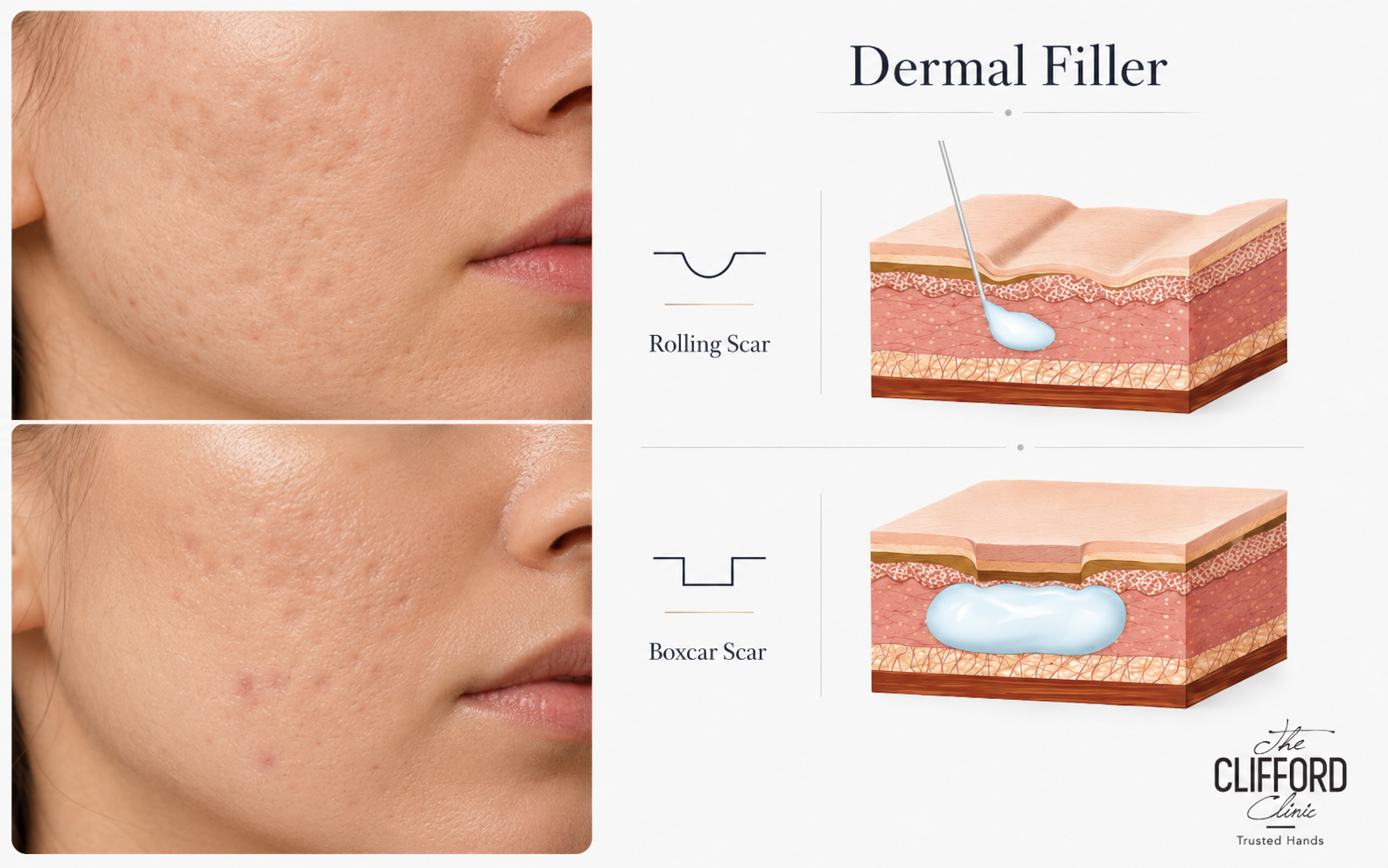
An HA filler is a hyaluronic acid gel placed beneath a depressed scar to push it up toward the level of the surrounding skin. It works through physical augmentation of the skin.
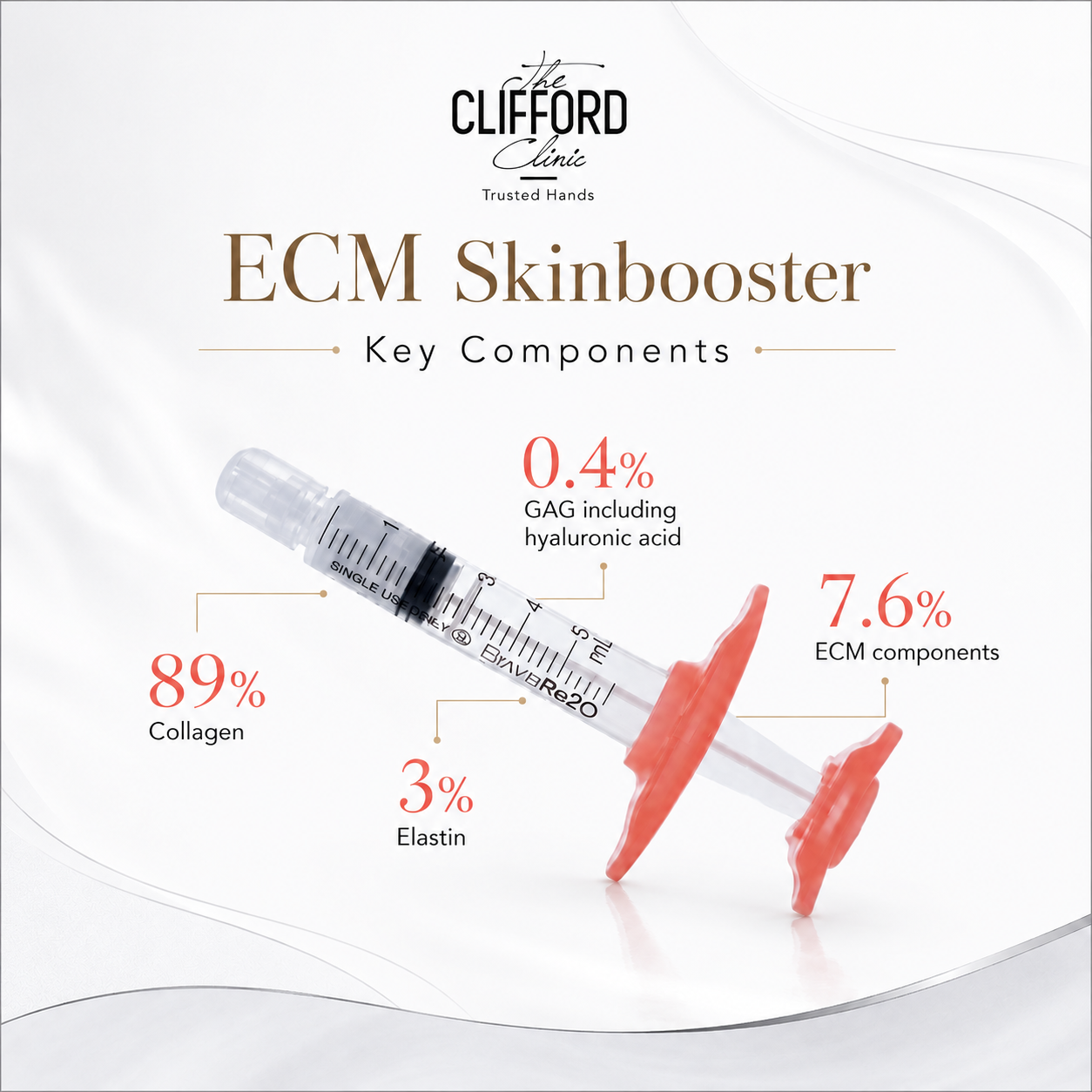
ECM skin boosters provide the skin with human acellular dermal matrix, a processed scaffold made of the same building blocks found in your own dermis. This includes Type I collagen, fibronectin, laminin, and glycosaminoglycans. Rather than adding volume, it provides fibroblasts with a structural template to remodel scarred soft tissue.
Filler is an immediate cosmetic lift that you see on the same day. An ECM booster is a slower, regenerative approach aimed at repairing the scarred dermal matrix. That key difference directly affects the durability, the number of sessions, and which type of scar each one suits.
Because ECM skin boosters are built from the same families of molecules as your own dermis, it is designed to integrate with your skin. That is the fundamental difference between supplementing the dermal matrix and filling a space.
2. Which atrophic acne scars respond to injectables, and which do not?
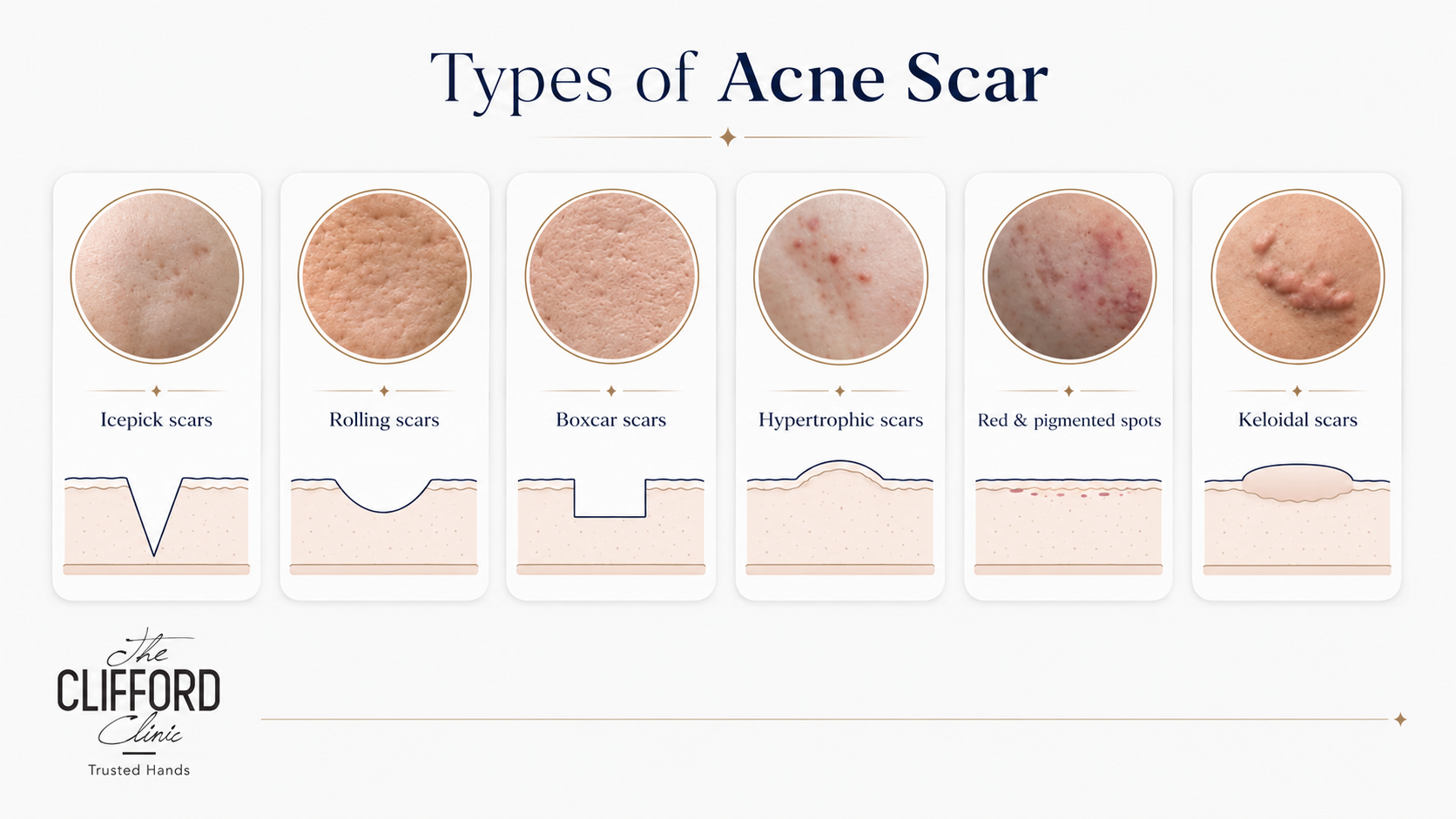
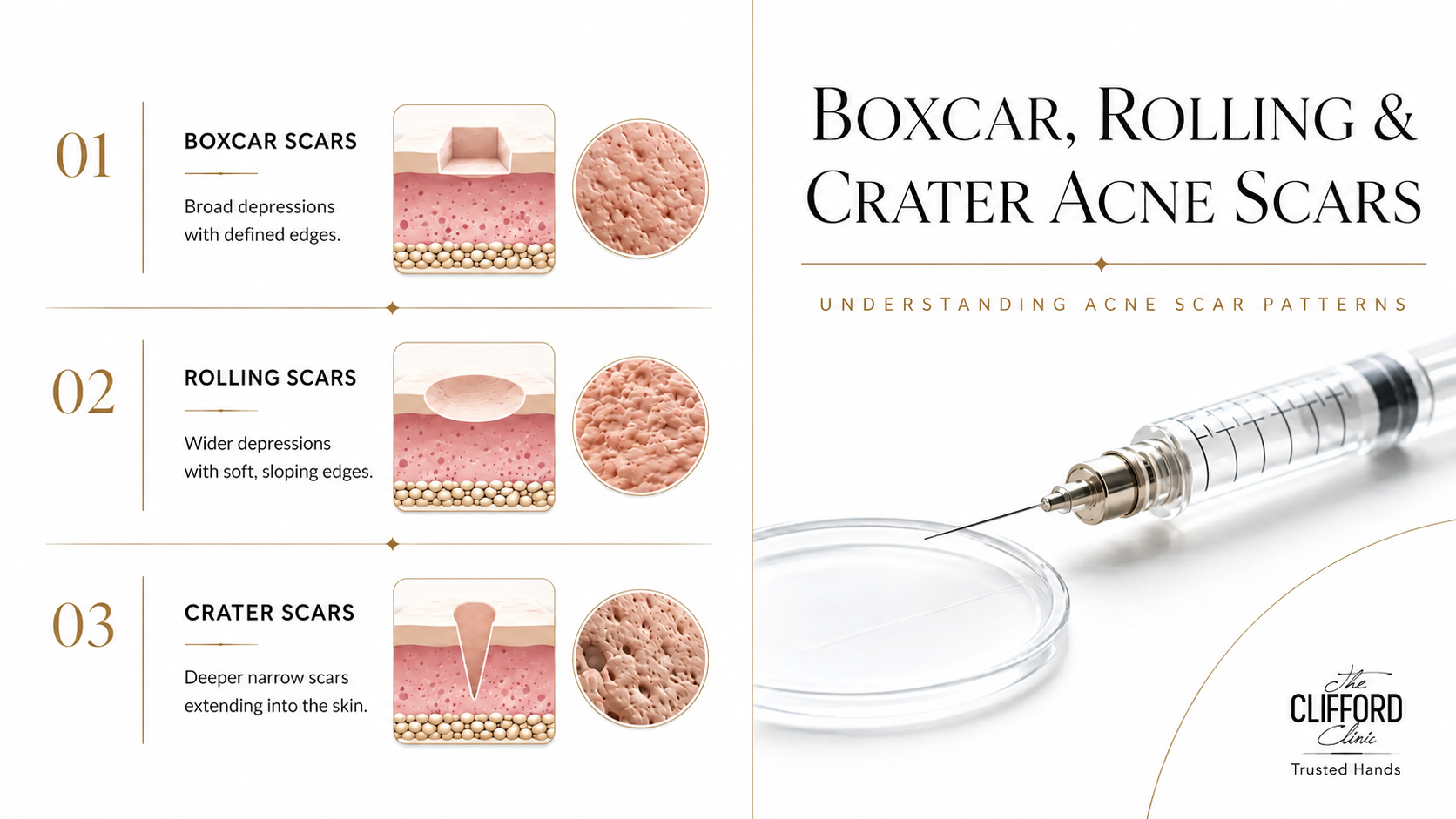
Atrophic scars are usually grouped into rolling (broad, shallow, and tethered), boxcar (sharp vertical edges), and ice-pick (narrow and deep). Rolling and shallow boxcar scars tend to respond with injectables. Narrow ice-pick scars rarely improve with filler or skin boosters alone and usually need targeted approaches such as TCA CROSS or punch techniques.
Because most patients have a mix of different scar types, a thorough plan often combines injectables with energy-based treatments rather than relying on one alone. You can read more about the range of acne scar treatments at The Clifford Clinic.
3. Does HA filler actually improve acne scars, and how long does it last?
The strongest evidence is a split-face, blinded, placebo-controlled trial in which a hyaluronic acid filler significantly reduced atrophic facial scar severity compared with saline, with improvement lasting up to two years.
Despite the immediate improvement, the results are not permanent. The HA gel is gradually broken down by the body, so the results would fade, and maintenance is required.
4. What does the evidence show for ECM skin boosters in atrophic acne scars?
In a split-face study, ECM skin boosters produced significantly greater improvement in validated acne-scar scores when compared with the untreated control side at three months. ECM skin booster delivers an acellular dermal matrix to the scarred soft tissue, creating a scaffold for fibroblasts to populate. The fibroblasts infiltrate and deposit Type I and Type III collagen over time, improving acne scars over time.
ECM skin boosters also work by improving the skin barrier and lowering inflammatory signalling. Research has also shown that the introduction of acellular dermal matrix, through ECM skin boosters, promotes fibroblasts to synthesise more hyaluronic acid.
5. Should you lift the scar floor or remodel the scar tissue?
If the priority is an immediate visible improvement before an event, lifting the scar with HA filler is a reasonable choice. If the priority is gradual change in the scarred tissue itself, an ECM skin booster does that by supporting the formation of new collagen where the dermis has been damaged.
These goals are not mutually exclusive. In practice, many patients benefit from an immediate lift with an HA filler and a longer-term remodelling with an ECM skin booster.
6. Why is subcision so often part of the conversation for rolling scars?
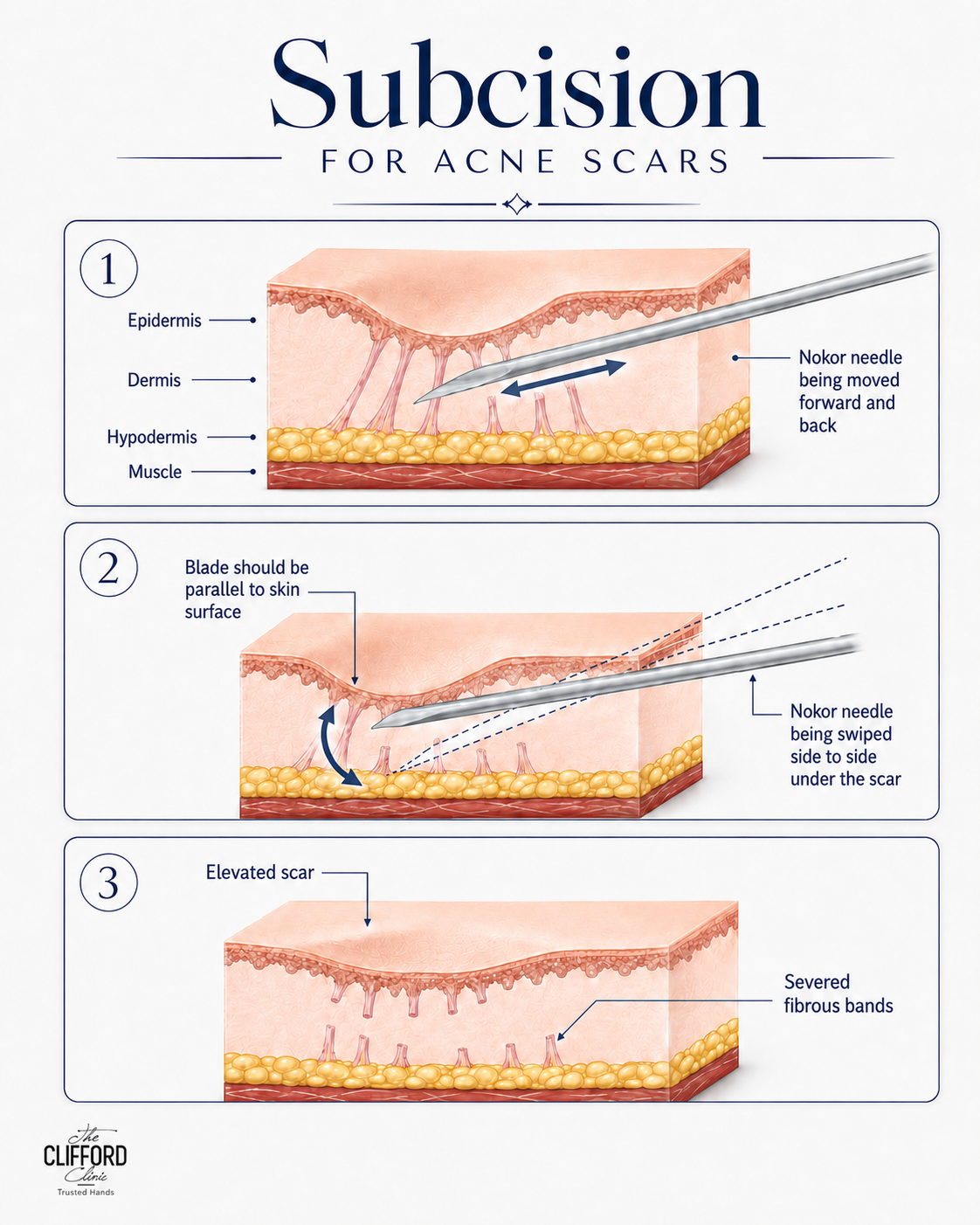
Rolling scars are pulled down by fibrous bands that connect the surface to deeper tissue. Subcision uses a fine needle or a blunt cannula to release these bands, allowing the depressed area to lift. Without releasing the fibrous bands, both HA filler and ECM skin boosters are ineffective.
Research supports combining subcision with cross-linked hyaluronic acid, and have found that a combination approach is superior to subcision alone. Therefore, we frequently place HA fillers or ECM skin boosters after releasing fibrous bands.
7. How many sessions, and how soon will you see a difference?
HA filler gives an immediate visible change, but it needs maintenance as it is absorbed over time. An ECM skin booster usually works after an initial course of sessions spaced a few weeks apart, with skin improvements appearing gradually over weeks. Results are then reviewed before any maintenance decision is made.
8. Is one option more comfortable or lower in downtime?
Topical numbing creams will be applied before both treatments. Patients typically feel mild discomfort during either procedure and can return to normal activities soon after. Mild redness, swelling, or small bruises are common. These tend to be slightly more pronounced when subcision is performed, as cutting the tethering bands can cause bruising.
9. Which scar suits an ECM booster, an HA filler, or both?
As a general guide, for patients with broad rolling or shallow boxcar scars who require immediate improvement, an HA filler is the preferred treatment. Patients with thin, crepey, or diffusely scarred skin would benefit more from a gradual regenerative approach with ECM skin boosters. Most patients present with a mix of scar types and would respond best to a combination of HA filler and ECM skin boosters. The table below summarises the trade-offs.
At a glance, the choice between an ECM skin booster and an HA filler for atrophic acne scars comes down to gradual structural rebuilding versus immediate, reversible volume. The comparison below sets out how each one works, how quickly it acts, how long it lasts, and which scar types it suits.
ECM Skin Booster vs HA Filler for Atrophic Acne Scars: mechanism, onset, durability, reversibility, downtime and which scars suit each (Singapore). Pricing is discussed at consultation.
At a glance, the choice between an ECM skin booster and an HA filler for atrophic acne scars comes down to gradual structural rebuilding versus immediate, reversible volume. The comparison below sets out how each one works, how quickly it acts, how long it lasts, and which scar types it suits.
ECM Skin Booster vs HA Filler for Atrophic Acne Scars: mechanism, onset, durability, reversibility, downtime and which scars suit each (Singapore). Pricing is discussed at consultation.
| Factor | ECM skin booster (hADM) | HA filler |
|---|---|---|
| What it is | A processed, collagen-rich dermal scaffold | A hyaluronic acid gel |
| What it targets | The scarred dermal matrix, supporting new collagen synthesis | Volume under the scar, lifting the floor |
| Onset | Gradual, over weeks to months | Immediate, same day |
| Durability | Longer-term as your own collagen responds; maintenance still useful | Temporary; gel absorbs over months to about two years |
| Reversibility | Not reversible | Reversible with hyaluronidase |
| Typical downtime | Short (redness, mild swelling) | Short (redness, mild swelling, possible bruising) |
| Best-suited scar | Thin, crepey or diffusely scarred skin; mixed presentations | Broad rolling or shallow boxcar scars wanting a fast, reversible lift |
| Overall recommendation | Consider when the goal is gradual, structural change in the scar tissue | Consider when the goal is a fast, reversible lift for a suitable depressed scar |
10. Can these be combined with lasers, microneedling or subcision?
Acne scarring rarely comes in a single form, therefore, single-modality plans are often insufficient. Most patients require a combination of injectables with or without subcision, and energy devices such as fractional CO2 or radiofrequency microneedling.
Because most patients have a mix of scar types, a thorough plan often combines injectables with energy-based and resurfacing devices rather than relying on one alone. You can read more about the range of acne scar treatments at The Clifford Clinic.
Frequently asked questions
Are ECM skin boosters and HA fillers safe for acne-scarred skin?
Both have reassuring safety profiles in the published literature. Most patients experience transient redness, swelling, or small bruises after the treatment. Serious complications are uncommon.
Will the results be permanent?
Neither is strictly permanent. HA filler fades over months to about two years as the hyaluronic acid gel gets absorbed. An ECM scaffold supports your own collagen, so its effect can be longer-lasting, but maintenance would still be recommended.
Can an HA filler result be reversed?
Yes. Hyaluronic acid can be dissolved with hyaluronidase if you are unhappy or over-corrected.
Which is better for rolling scars?
Rolling scars usually require subcision to release the tethering bands. An injectable then supports the lift. Either an HA filler, an ECM skin booster, or a combination of both can work once the scar has been released.
Is filler or subcision better for acne scars?
They do different jobs. Subcision releases the fibrous bands that tether a rolling scar, while a filler or ECM skin booster supports the lift afterwards. For tethered scars, subcision usually comes first, then the injectable.
How does this compare with a polynucleotide (PN) skin booster?
A polynucleotide skin booster mainly signals repair and improves overall skin quality, rather than addressing the volume deficit in a depressed scar. You can read more about polynucleotide (PDRN) skin boosters on the Clifford Clinic website.
Do these treatments work on ice-pick scars?
Generally no. Narrow, deep ice-pick scars respond better to focused techniques such as TCA CROSS or punch methods.
How soon will I see results?
HA filler is visible on the same day. An ECM skin booster works gradually over weeks to months, usually across a short course of sessions.
Is there much downtime?
Downtime is minimal for both. Expect short-lived redness, swelling, or small bruises, with a little more bruising if subcision is performed.
Can I combine these with laser treatment?
Yes. Both are commonly combined with fractional CO2 or radiofrequency microneedling to address surface texture.
How much do they cost in Singapore?
Cost depends on your scar type, the number of areas, and the overall plan, so pricing is discussed at consultation rather than quoted online.
Can I have both treatments in one plan?
Often yes. Many patients use a hyaluronic acid lift for immediate improvement and an ECM skin booster for gradual scar remodelling.
Are these suitable for sensitive or darker skin in Singapore’s climate?
Yes. Both treatments are safe for sensitive or darker skin types.
Do I still need good acne control first?
Yes. Treating scars works best once active acne is under control, otherwise new scars can keep forming and undo the progress.
Related reading at The Clifford Clinic
- Elravie Re2O ECM skin booster: the complete guide
- Re2O ECM skinbooster treatment at The Clifford Clinic
- ECM skin booster guide by Dr Gerard Ee
- Dermal fillers for acne scars compared
- Energy-based treatments for depressed acne scars
Book a consultation at The Clifford Clinic
If atrophic acne scars are bothering you, the most useful next step is a face-to-face assessment, where your scar types can be mapped and a treatment plan discussed. To arrange a consultation at The Clifford Clinic, get in touch using the details below or through the clinic’s contact page. You can also read more about the ECM skinbooster treatment beforehand. Pricing is provided at consultation, once your scars have been assessed and a plan agreed.
The Clifford Clinic
50 Raffles Place, #01-01 Singapore Land Tower, Singapore 048623 (Exit B from Raffles Place MRT)
Phone: (65) 6532 2400 WhatsApp: (65) 8318 6332
Email: thecliffordclinic@gmail.com
Contact page: cliffordclinic.com/contact
Monday to Friday: 10am to 8pm; Saturday: 10am to 5pm; closed Sundays and public holidays.
References
- Park J, et al. Micronized acellular dermal matrix combined with platelet-rich plasma in the treatment of atrophic acne scars: a self-controlled split-face study. Journal of Cosmetic Dermatology. 2024. PubMed: 38558364.
- Siperstein R, et al. A split-face, blind, randomized placebo-controlled clinical trial investigating the efficacy and safety of hyaluronic acid filler for the correction of atrophic facial scars. Journal of Cosmetic Dermatology. 2022. PubMed: 35689521.
- Prospective clinical trial demonstrating the efficacy of hyaluronic acid filler for the improvement of atrophic facial scars up to 2 years. Dermatologic Surgery. 2024. PubMed: 38968085.
- Abdel Hay R, et al. Interventions for acne scars (Cochrane systematic review). Cochrane Database of Systematic Reviews. 2016.
- Lee YI, et al. Split-face randomised controlled trial of a human acellular dermal matrix (Elravie Re2O) skin booster versus a hyaluronic acid control. International Journal of Molecular Sciences. 2026. PubMed: 41828422; PMC: 12985180.
- Liu, Sun. Human acellular dermal matrix upregulates fibroblast hyaluronic-acid synthesis via the JAK2/STAT3 pathway. RSC Advances. 2020. PubMed: 35518338.
- Assessment of inflammatory suppression and fibroblast infiltration in tissue remodelling by supercritical CO2 acellular dermal matrix (scADM). 2024. PMC: 11228881.
- Yue B, et al. Long-term safety of acellular dermal matrix in periocular use. Aesthetic Plastic Surgery. 2018. PubMed: 30097671.
- Goodman GJ, Baron JA. Postacne scarring: a qualitative global scarring grading system. Dermatologic Surgery. 2006.
- Combined subcision approach with fractional CO2 laser or cross-linked hyaluronic acid versus subcision alone in atrophic post-acne scar treatment. 2022. PMC: 9789008.
- L&C Bio. Elravie Re2O human acellular dermal matrix skin booster, including AlloClean Technology decellularisation process: product and training materials.