
Why Pigmentation Looks Darker After Pico Laser
Medically reviewed by Dr Bernard Ong. Edited by Dr Gerard Ee, Medical Director, The Clifford Clinic.
Some darkening after Pico laser can be normal. Treated spots often turn darker for three to seven days as shattered pigment rises and flakes away, before fading over two to four weeks. What is not expected is a whole patch becoming progressively darker over weeks, which may indicate post-inflammatory hyperpigmentation (PIH) or melasma rebound and should be reviewed by your clinic rather than treated with more laser.
Is it normal for pigmentation to look darker after Pico laser?
Often, yes, briefly. Discrete spots such as freckles and sun spots darken to a coffee-ground appearance within a day of treatment, sometimes forming fine crusts, then flake and fade. This expected darkening is localised to what was treated, stable rather than spreading, and improving within one to two weeks.
Why some spots darken before they fade
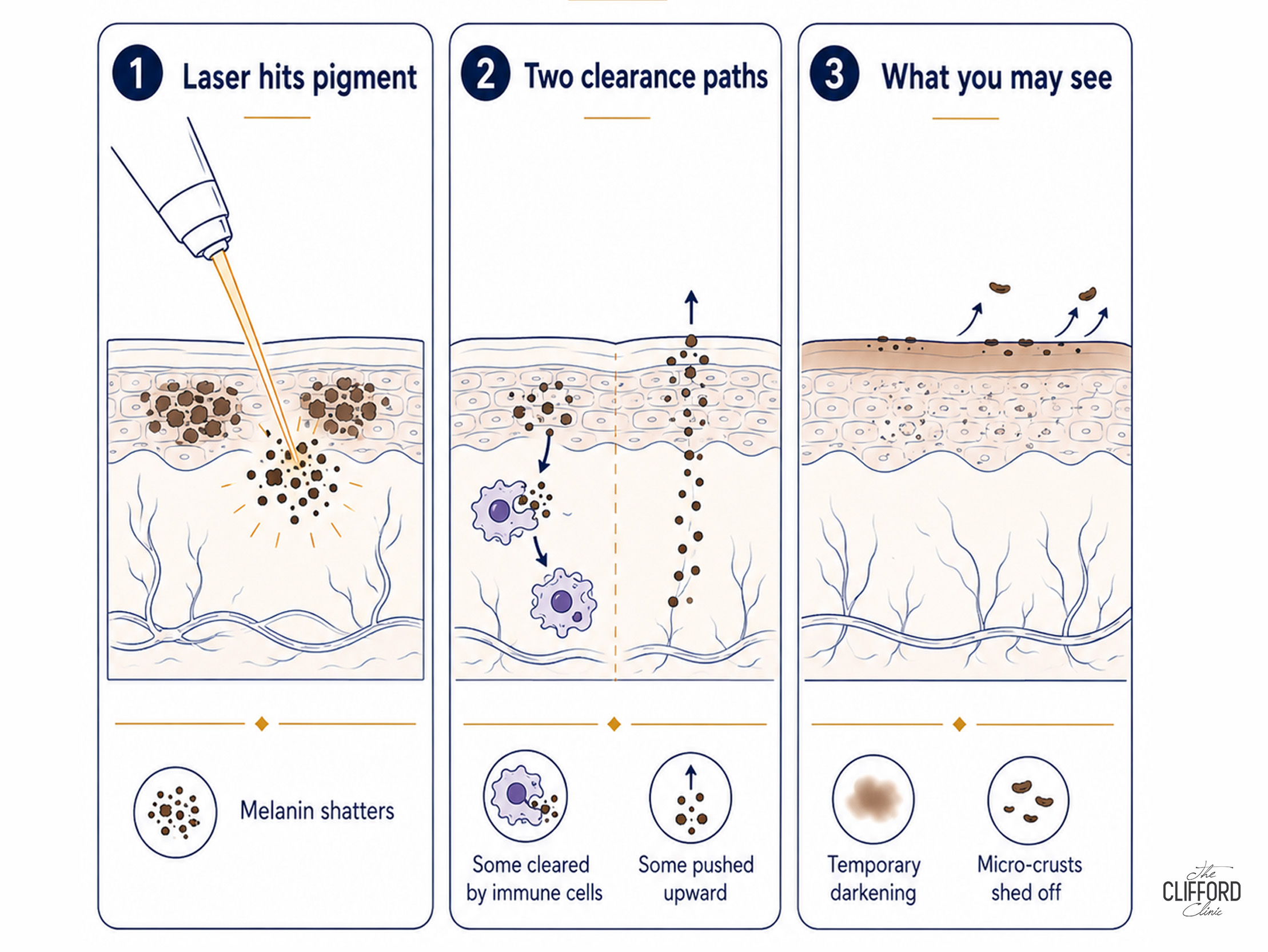
The laser shatters melanin into fragments. Some fragments are cleared by immune cells, while superficial pigment is pushed upward through the epidermis and shed, visible on the surface as temporary darkening and micro-crusts on the way out. Darkening of this kind is a stage of clearance.
Expected darkening vs possible complication
Post-Laser Darkening vs PIH or Melasma Rebound
| Feature | Expected Post-Laser Darkening | Possible PIH or Melasma Rebound |
|---|---|---|
| Timing | Within 24 hours of treatment | Appears or worsens 1–4 weeks after treatment |
| Location | Exactly the treated spots | Spreads beyond spots or affects the whole patch |
| Course | Steadily improves after day 5–7 | Progressively darkens or plateaus darker than before |
| Surface | Fine crusts or flaking | Smooth skin, no crusting, just deepening colour |
| Sensation | None to mild tightness | Often none, sometimes follows irritation or sun exposure |
| Action | Routine aftercare and sunscreen | Contact clinic, pause further sessions and review plan |
Difference between expected darkening and PIH
Post-inflammatory hyperpigmentation is new pigment made by melanocytes reacting to inflammation, whether from the laser itself, sun exposure during recovery, picking at crusts, or heat. It typically emerges after the initial healing week, in or around the treated area, and can take months to fade. Asian skin’s reactive melanocytes make PIH the most common meaningful side effect of any energy treatment in Singapore, hence its important that the doctor and his experience matter.
Melasma darkening: why it needs caution
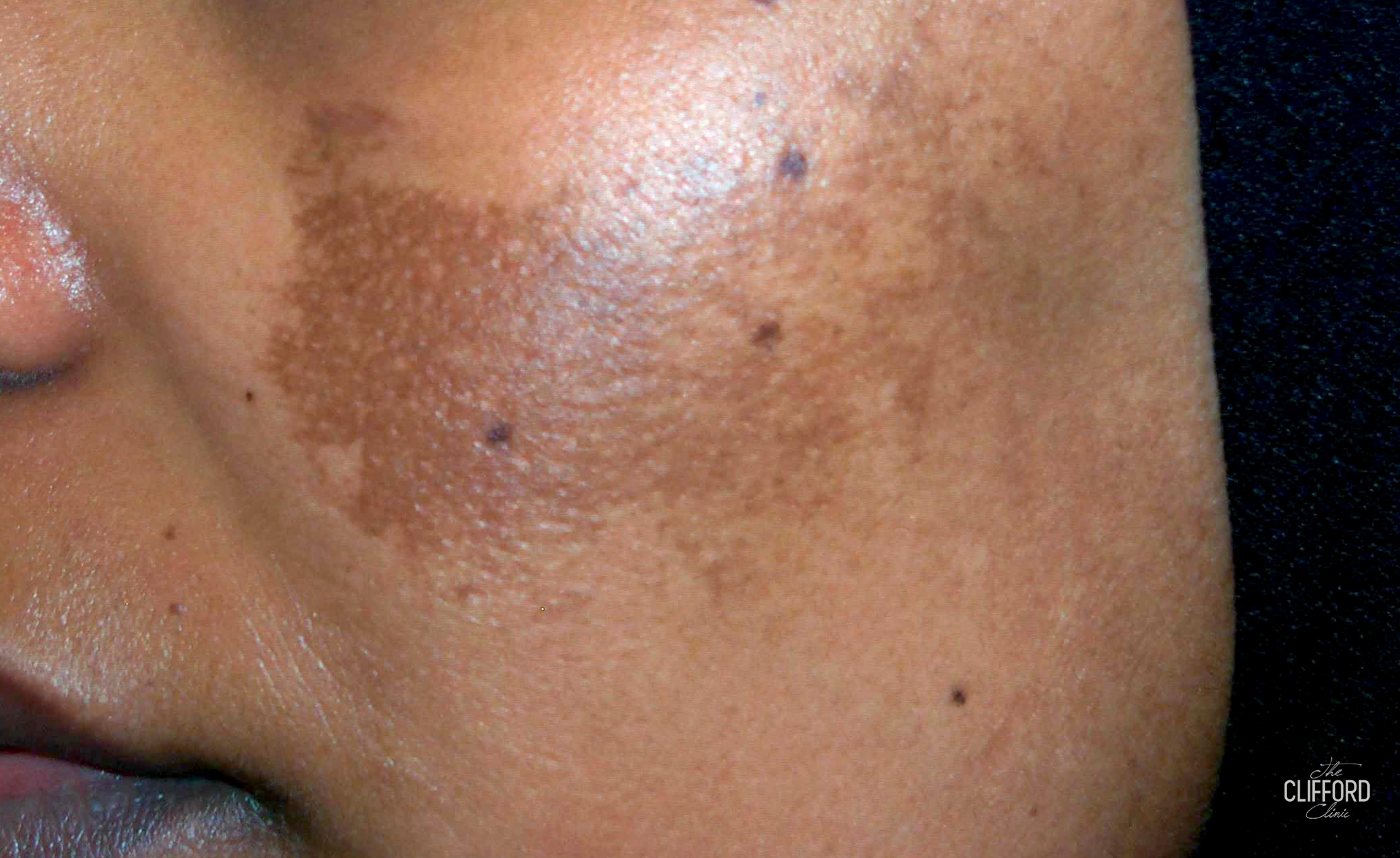
In melasma, progressive darkening after laser deserves particular respect: it may be rebound, the condition reacting to treatment inflammation by producing more pigment. Continuing to laser darkening melasma usually deepens the problem. The correct response is to pause laser work, reinforce tinted sunscreen and topicals and let your doctor reassess the plan.
Why darkening is usually about the settings
In most cases, darkening after a pigment laser is a settings issue rather than a fault of the laser itself. The energy delivered, the wavelength chosen and the endpoint aimed for decide how the skin responds, and when any of these does not match the pigment and the skin tone, temporary darkening becomes more likely. There are two common ways this happens.
The first is energy that is too high. When the fluence is set higher than the pigment needs, the treatment delivers more heat and mechanical shock than necessary. The target pigment may still clear, but the surrounding skin is inflamed, and in reactive Asian skin that inflammation prompts the melanocytes to produce new pigment, which appears as post-inflammatory hyperpigmentation around the treated area. In this situation the spot itself is gone, yet the skin around it looks darker for a time.
The second is settings that are inappropriate for the pigment type or its depth. Superficial pigment such as a freckle absorbs a strongly absorbed shorter wavelength well, while dermal pigment needs a longer wavelength to be reached at all. Using an aggressive setting intended for a discrete surface spot on skin that is reactive, or using a superficial wavelength on deeper pigment, either overtreats the surrounding skin or fails to reach the target. Both kinds of mismatch can leave the skin looking darker rather than clearer.
This is why the clinical endpoint matters so much. The aim during treatment is a gentle, barely visible whitening of the pigment rather than an aggressive frost, and this restraint matters most in medium and darker skin, where the margin between an effective setting and an excessive one is narrow. Because darkening is largely settings dependent, the remedy is to adjust the plan, by lowering the energy, choosing a wavelength matched to the pigment depth, widening the spacing between sessions and setting a gentler endpoint, rather than by abandoning treatment altogether.
Pico Laser Settings Problems and How They Are Corrected
| Settings Problem | What Happens on the Skin | How a Doctor Corrects It |
|---|---|---|
| Energy Too High for the Pigment | Surrounding skin becomes inflamed, with temporary PIH around a cleared spot | Lower the energy, aim for gentle whitening and widen session spacing |
| Wavelength or Setting Mismatched to Pigment Depth | Overtreated surface or an untouched deeper target, causing uneven darkening | Match the wavelength to the pigment depth and reassess the diagnosis |
| Aggressive Endpoint in Reactive or Darker Skin | Frosting and a higher risk of post-inflammatory pigment | Treat to a barely visible whitening and stage results over more sessions |
When lentigines and melasma overlap
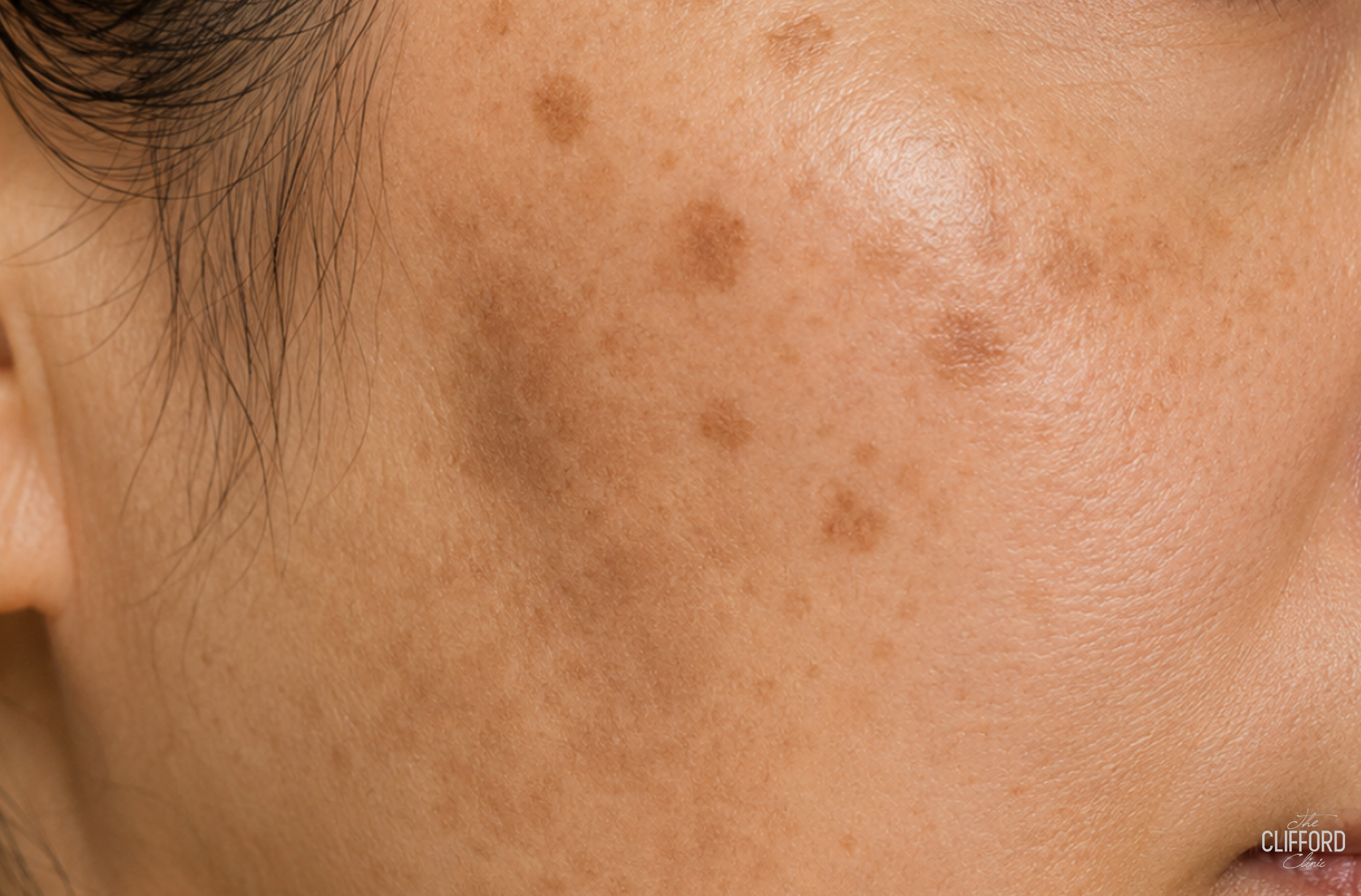
One of the more difficult situations, and a common reason for darkening, is when discrete sun spots or lentigines sit within or over a melasma-prone area on the same cheek. These two conditions frequently coexist, layered on top of one another, and they call for opposite settings. A solar lentigo or a lentigine is an epidermal, well-defined patch that often needs a higher, more definitive setting to clear fully, and clearing it produces the expected transient darkening and fine crusting as the fragmented pigment rises and sheds. Melasma, by contrast, is a reactive condition that is easily provoked by exactly those higher settings.
This creates a genuine clinical tension. The lentigine may need a higher setting to be removed, yet that same setting can inflame the surrounding melasma-prone skin and cause temporary post-inflammatory hyperpigmentation in the field around it. So when a patient sees darkening after such an area is treated, it is often not a simple failure. It can be the expected consequence of treating a lentigine at the energy it genuinely needs, with temporary post-inflammatory pigment appearing in the melasma-prone skin nearby. This temporary darkening is usually self limiting and settles over weeks to months with photoprotection and topical treatment, and it is different from melasma rebound, which is the melasma itself worsening because it was treated too aggressively.
Managing this overlap well is a matter of diagnosis and sequencing. A doctor maps the layers first, often with a dermatoscope and a Wood’s lamp, to separate the discrete lentigines from the melasma field. The melasma is stabilised first with sun protection and topical treatment so that it is calmer before any laser. The lentigines are then treated carefully, sometimes as individual spots at the setting they need rather than by passing high energy across the whole cheek, so that the melasma-prone skin around them is spared as far as possible. Conservative energies, careful wavelength selection and adequate spacing between sessions keep the balance, and where some temporary post-inflammatory pigment does appear, it is anticipated, explained in advance and managed with sunscreen and topicals until it fades.
What to do in the first week
Follow standard aftercare. Gentle cleanser and moisturiser, mineral SPF 50 every morning, no actives, no heat, and hands off the crusts.
What not to do
Do not scrub or exfoliate darkened spots to speed them up. Do not apply lightening creams to irritated skin without your doctor’s instruction. Do not book an earlier extra session to force the darkening away. Do not sunbathe or skip sunscreen because the damage feels done. Each of these converts recoverable darkening into longer-lasting pigment.
When to contact the clinic
- Darkening still worsening after day 7, or appearing in week 2-4
- Colour change spreading beyond the treated spots
- A melasma patch deepening at any point during a course
- Blistering, raw skin, significant pain or signs of infection
- Any change that worries you. Photos cost nothing to review
How to reduce the risk of rebound pigmentation
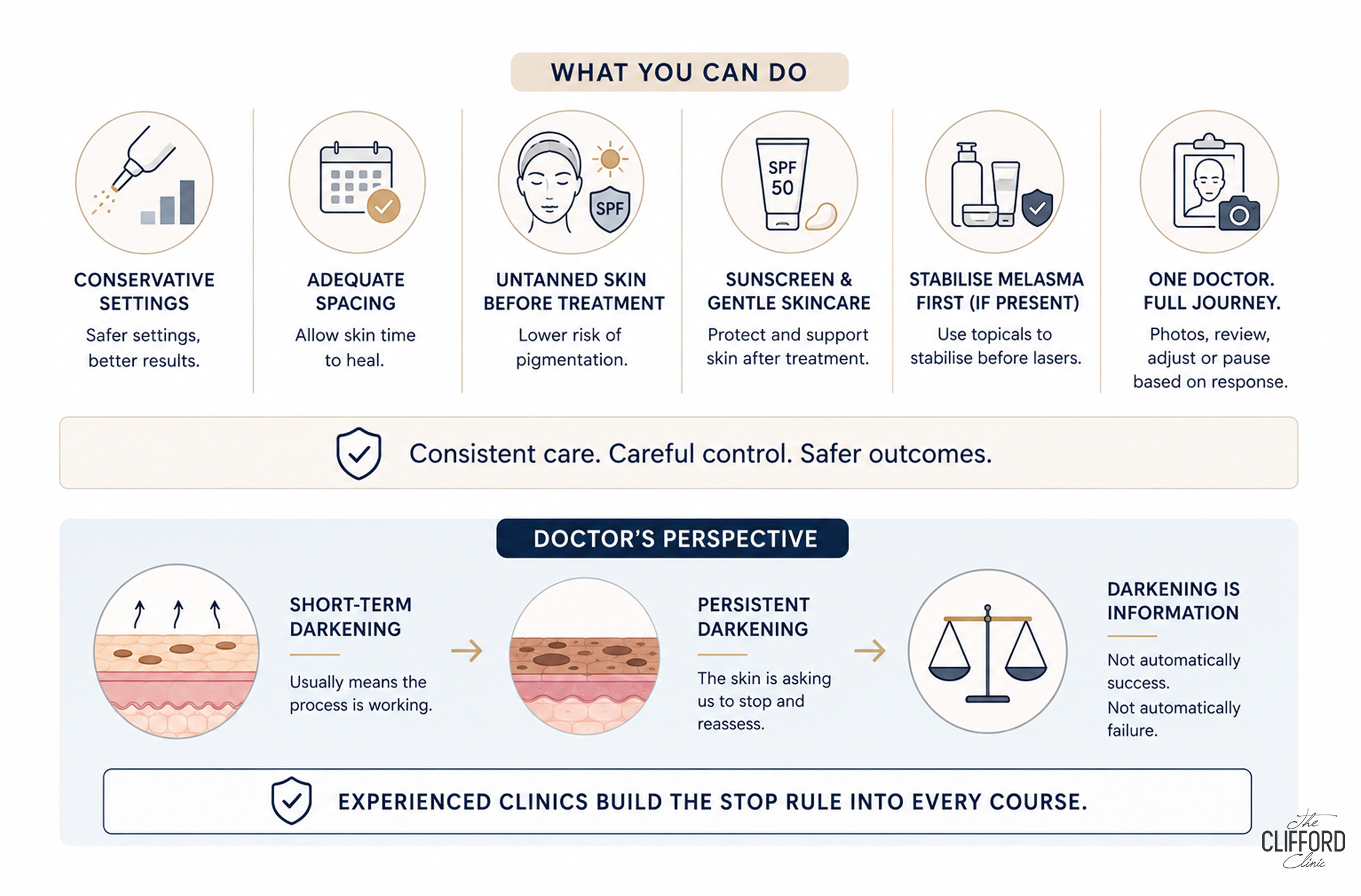
Choose conservative settings with adequate spacing between sessions, keep skin untanned before treatment, be rigorous with sunscreen and gentle skincare afterwards, and, if you have melasma, stabilise it with topicals before any laser. Risk falls further when one doctor follows your whole course with photos, adjusting or pausing based on your skin’s response.
Doctor’s perspective. Short-term darkening of treated spots usually means the process is working. Patches that keep darkening are the skin asking us to stop and reassess. Experienced clinics build that stop rule into every course. Darkening is information, not automatically success and not automatically failure.
What to expect over the next sessions
Once darkening from a session has fully settled and faded, typically two to four weeks, your doctor evaluates the net change and adjusts. Over a course, each round should leave spots lighter than the last. A course that leaves you darker each round is the wrong course, whatever was originally planned.
Frequently asked questions
Why did my pigmentation get darker after Pico laser?
Most commonly it is expected transient darkening of treated spots as fragmented pigment sheds. Less commonly it is PIH or melasma rebound, which shows up later, spreads or keeps deepening, and needs clinic review.
How long does darkening last after Pico laser?
Expected spot darkening typically fades over one to three weeks. PIH, if it develops, can take two to six months to fade with proper care.
Is darkening a sign that Pico laser worked?
Not necessarily either way. Transient spot darkening is a common stage of clearance, but the treatment’s success is judged by the net lightening once skin settles, not by the intensity of the darkening.
Can Pico laser cause post-inflammatory hyperpigmentation?
Yes, uncommonly, like any energy-based treatment, with higher risk in darker skin tones, tanned skin, aggressive settings and poor aftercare.
What should I avoid if pigment looks darker?
Scrubbing, actives, heat, sun exposure, picking, and unsupervised extra laser sessions. Protect the skin and let your doctor see photos.
When should I worry after Pico laser?
If darkening worsens past a week, spreads, involves a melasma patch, or comes with blistering, pain or infection signs, contact your clinic promptly.
Does darkening mean the laser settings were wrong?
Often the darkening is settings-related, either energy that was too high or a setting not matched to the pigment type and depth, which is why the fix is usually to adjust the wavelength, lower the energy and set a gentler endpoint rather than to stop treatment. Expected short-term darkening of a treated spot as the pigment sheds is different and settles on its own.
Can treating a sun spot on a melasma-prone cheek cause temporary darkening?
Yes. A sun spot or lentigine often needs a higher setting to clear, and that setting can provoke temporary post-inflammatory pigmentation in the surrounding melasma-prone skin. This is usually self-limiting and fades with sun protection and topicals, and it is managed by mapping the layers, stabilising the melasma first and treating the spots carefully.
Does darkening mean the laser settings were wrong?
Answer: Often the darkening is settings related, either energy that was too high or a setting not matched to the pigment type and depth, which is why the fix is usually to adjust the wavelength, lower the energy and set a gentler endpoint rather than to stop treatment. Expected short-term darkening of a treated spot as the pigment sheds is different and settles on its own.
Can treating a sun spot on a melasma-prone cheek cause temporary darkening?
Answer: Yes. A sun spot or lentigine often needs a higher setting to clear, and that setting can provoke temporary post-inflammatory pigmentation in the surrounding melasma-prone skin. This is usually self limiting and fades with sun protection and topicals, and it is managed by mapping the layers, stabilising the melasma first and treating the spots carefully.
Concerned about changes after a laser session?
We review post-laser concerns from any patient of our clinic promptly, photos first. Learn more about Pico laser in Singapore and pigmentation treatment in Singapore, or contact The Clifford Clinic, 50 Raffles Place, #01-01 Singapore Land Tower, (65) 6532 2400, WhatsApp (65) 8318 6332.
Selected References
- DermNet: postinflammatory hyperpigmentation. https://dermnetnz.org/topics/postinflammatory-hyperpigmentation
- Comparing the efficacy and safety of a 730 nm picosecond laser with a 532 nm Q-switched Nd:YAG laser for facial pigmented disorders. European Journal of Medical Research, 2026. https://pubmed.ncbi.nlm.nih.gov/41782066.
- DermNet: lasers in dermatology. https://dermnetnz.org/topics/lasers-in-dermatology