


Conjuran Knee Injections: What to Expect
Written by Dr Gerard Ee
If you have been researching non-surgical options for knee osteoarthritis in Singapore, you may have come across the name Conjuran, newer addition to the range of knee joint injections.
Patients often ask how it differs from the more familiar hyaluronic acid and PRP treatments. This guide explains what a Conjuran knee injection is, how polynucleotide treatment is thought to work, which knee conditions it suits, and what to expect through the process, with the clinical perspective from Dr Gerard Ee at The Clifford Clinic.
What Is a Conjuran Knee Injection?
Conjuran is a polynucleotide intra-articular injection that is delivered directly into the knee joint. Its active component is sodium polynucleotide, a preparation made up of purified DNA fragments that are used in a range of medical applications.
In knee care, polynucleotides are used as an injectable option for osteoarthritis symptoms and cartilage-related wear. While conjuran is often discussed alongside viscosupplementation because it is used to support earlier-stage cartilage wear, it sits in its own treatment category separate from viscosupplementation.
Conjuran is not the same as a hyaluronic acid gel injection, and it is not PRP. This distinction matters as patients sometimes incorrectly assume all “knee gel injections” are interchangeable. Conjuran is a polynucleotide treatment with its own proposed mechanism, its own ideal candidate, and its own place in a stepwise treatment plan.
How Conjuran Is Thought to Work
Polynucleotide injections such as Conjuran work in two practical ways.
First, they may support joint lubrication and reduce friction, helping to ease the movement-related discomfort that is typical of osteoarthritis. Second, they are thought to help create a more supportive joint environment. Conjuran injections can result in a calmer, less irritated setting inside the knee which can make symptoms easier to control.
Polynucleotides are also known for their proposed anti-inflammatory and tissue-supportive properties. Conjuran aims to reduce pain and improve function so that the knee feels more comfortable to use and easier to rehabilitate. However, it is important to note that conjuran does not to regrow a damaged joint or reverse established arthritis.
What Knee Conditions Can Conjuran Help?
Conjuran is commonly considered for knee osteoarthritis symptoms and early to moderate cartilage wear, particularly when pain is activity-related and is affecting day-to-day function.
You may be suitable for Conjuran if you have:
- Persistent knee pain that fits an osteoarthritis pattern.
- Early to moderate cartilage wear seen on imaging.
- Pain that limits climbing stairs, prolonged walking, squatting, or exercise.
- A preference for a non-surgical option.

Conjuran is generally not used as a primary treatment for mechanical problems such as a meniscus tear that causes locking, significant ligament instability, suspected joint infection, unexplained joint swelling, or end-stage osteoarthritis where surgical planning may be more appropriate. Because knee pain can arise from the joint surface, the meniscus, the tendons or even be indirectly caused by issues originating from another part of the body, a proper consultation is essential before deciding on Conjuran.
Conjuran vs Hyaluronic Acid vs PRP
One of the most common questions asked by patients is how Conjuran compares with hyaluronic acid (HA) and PRP. The three are often grouped together because they are all injected into the knee. However they belong to different categories, work in different ways, and suit different stages of the same disease. Choosing between them is less about which one is “best” and more about matching the right tool to the right knee.
Hyaluronic acid (viscosupplementation). Hyaluronic acid is a viscosupplement. It restores the lubricating and shock-absorbing properties of synovial fluid, which thins and loses elasticity in osteoarthritis. After injection, HA temporarily improves how the cartilage surfaces glide over each other, reduces mechanical friction, and improves comfort with everyday movement. It suits the classic “dry and creaky” osteoarthritic knee, where stiffness, grinding and activity-related ache dominate the picture.

Modern preparations such as Synolis VA combine 2 percent non-crosslinked HA with 4 percent sorbitol as an antioxidant, which is intended to extend symptom relief by reducing oxidative stress in the joint. Effect typically builds over a few weeks and lasts six to twelve months in responders.
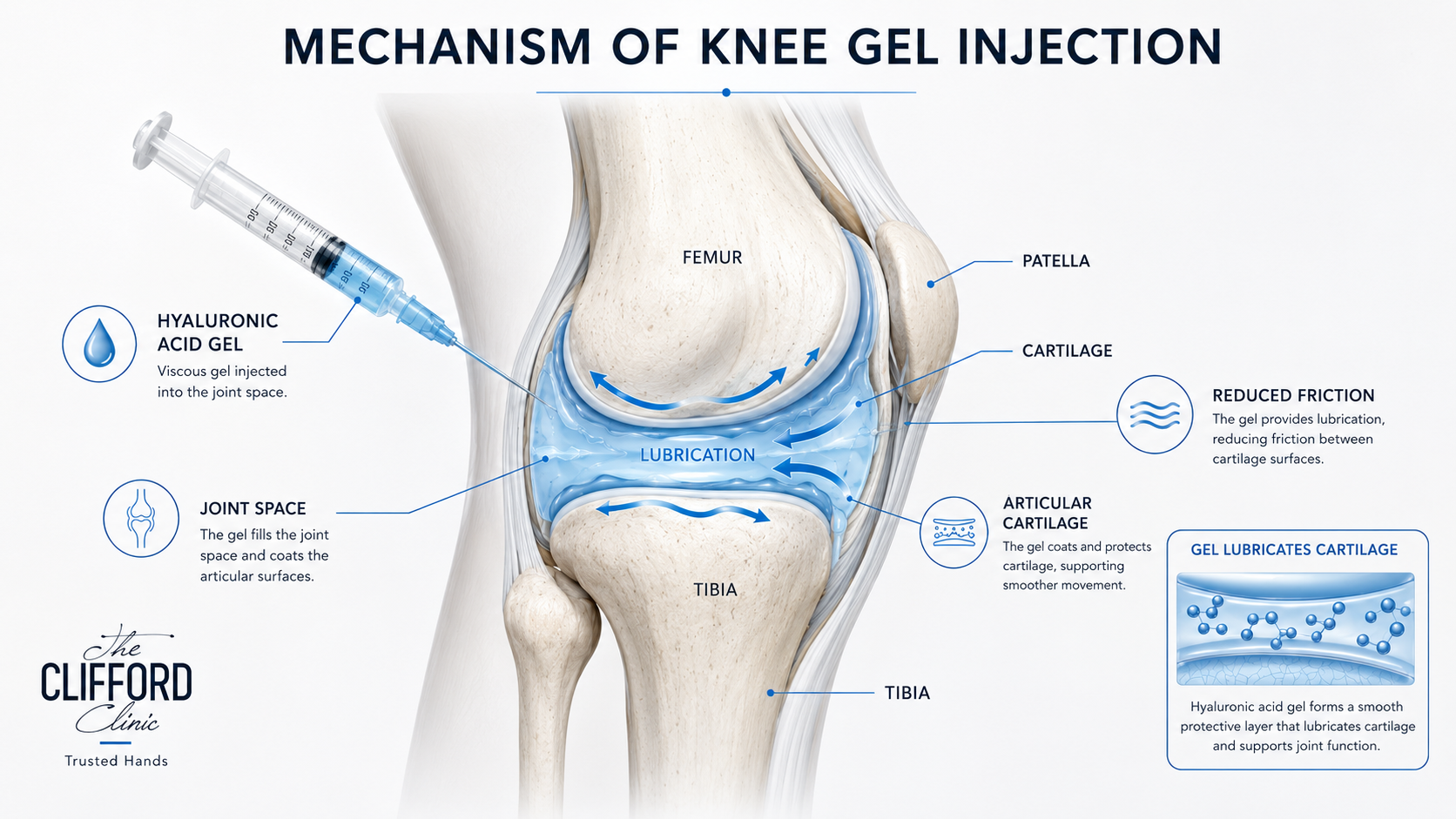
Conjuran (polynucleotide). Conjuran sits in the same broad strategic family as HA. It is treated, in practice, as a polynucleotide viscosupplement alternative to HA rather than as a PRP equivalent. Conjuran is composed of purified polynucleotides, which provide a viscosupplement-style cushioning effect on injection and, by their proposed biological signalling, may support the local soft-tissue environment. Patients who fit a viscosupplement strategy but would prefer a polynucleotide product over HA are reasonable candidates. The expected pattern of relief is similar to HA: gradual onset, several months of duration in responders, and best results when paired with strengthening, weight management and load adjustment.
PRP (platelet-rich plasma). PRP is a different category of treatment. It is an autologous orthobiologic, meaning it is prepared from the patient’s own blood. After centrifugation, the platelet-rich fraction is separated and injected into the joint. Platelets release growth factors and cytokines that modulate the local biological environment of the knee, with a hypothesised effect on synovial inflammation and on the cartilage matrix in selected mild-to-moderate disease. PRP is not a lubricant and is not a cure. It does not regrow cartilage. It is best considered in mild-to-moderate osteoarthritis without an active flare, in patients who want longer-duration relief than a steroid would give and who understand that PRP is part of a broader plan that includes rehabilitation. Modern systematic reviews of leukocyte-poor PRP commonly show outperformance of HA for pain and function at six to twelve months in this group.
Side-by-side at a glance.
| Feature | Hyaluronic acid | Conjuran | PRP |
|---|---|---|---|
| Category | Viscosupplement | Polynucleotide viscosupplement | Autologous orthobiologic |
| Primary effect | Lubrication, shock absorption | Cushioning, proposed tissue support | Biological signalling in the joint |
| Best-fit picture | “Dry and creaky” OA knee | Viscosupplement strategy, polynucleotide preference | Mild-to-moderate OA, non-flared, wanting longer-duration relief |
| Onset of effect | Gradual, over weeks | Gradual, over weeks | Gradual, over weeks |
| Typical duration in responders | 6 to 12 months | Months, similar pattern to HA | 6 to 12 months |
| Made from the patient’s blood | No | No | Yes |
| Suited to an actively flared knee | Not first-line | Not first-line | Not first-line (steroid first) |
| Suited to end-stage bone-on-bone OA | Limited role | Limited role | Limited role |
How the choice is made. There is no universally “best” injection. The decision depends on the dominant driver of the pain, imaging findings, severity of the disease, what the patient has already tried, and what longer-duration relief looks like for that individual. A useful way to think about it is below.
A knee that is dry, stiff and creaky, with grinding on stairs and activity-related ache in established but not end-stage osteoarthritis, often fits a viscosupplement strategy first. The choice between HA and Conjuran in this group is a clinical and patient-preference call rather than a hierarchy.
A knee with mild-to-moderate osteoarthritis, no active flare, and a patient who wants longer-duration relief and is willing to continue with strengthening and load adjustment is the most defensible PRP picture. PRP is offered as part of a broader plan rather than as a single fix.
A knee that is in an active flare, with effusion, warmth and a recent worsening, is usually a steroid conversation first. PRP, HA or Conjuran can follow once the inflammation has settled.
A knee with end-stage bone-on-bone osteoarthritis and major function loss is, more often than not, an orthopaedic referral conversation rather than an injection conversation. No injection can rebuild a joint that has progressed to end-stage disease.
The honest summary is that HA and Conjuran share a viscosupplement strategy and are often interchangeable in practice, while PRP sits in a different category and is considered selectively in the right patient, with realistic expectations and as part of a broader plan.
What to Expect at Your Consultation
At The Clifford Clinic, a Conjuran treatment plan begins with a doctor-led consultation focused on diagnosis and suitability. A typical consultation will cover a detailed symptom map of what triggers your knee pain, a focused knee examination including range of motion and functional loading, a review of imaging where needed (X-ray, ultrasound or MRI), and a discussion of your treatment options.
The Clifford Clinic offers conjuran alongside hyaluronic acid, PRP and other approaches for dealing with knee pain. If an injection is deemed appropriate, the expected treatment timeline, realistic outcomes and safety considerations will be explained to you before proceeding.
What Happens During the Injection
A Conjuran knee injection is performed in clinic using sterile technique. On the day of the treatment, the skin is cleaned and prepared, the knee is positioned for safe access, and the polynucleotide preparation is injected into the joint space. You will then be observed briefly post-injection before being given aftercare instructions. Ultrasound guidance may be used where it meaningfully improves the accuracy of delivery.

Most patients describe brief pressure or stinging during the injection, followed by a temporary feeling of fullness or mild soreness in the knee.
How Many Sessions and What Recovery Looks Like
Polynucleotide knee treatments are commonly delivered as a short course of sessions, with the plan reviewed based on how your knee responds and how your function improves. The exact schedule is decided at consultation according to the severity of your osteoarthritis.
Most patients can return to light daily activities shortly after the injection. Patients are advised to keep activity comfortable for the first few days, briefly avoid high-impact loading such as running or heavy leg training. Structured strengthening and physiotherapy is also recommended post-injection. Progress is usually tracked using practical markers such as stair comfort and walking tolerance.
If you develop increasing warmth or swelling at the injection site, fever or worsening pain, you should contact the clinic for assessment immediately.
Benefits and Limitations — An Honest Summary
Conjuran offers a non-surgical injection option for osteoarthritis symptoms and cartilage wear, a way to reduce pain and improve function in cases exhibiting early to moderate cartilage wear, and a supportive step that can make rehabilitation more tolerable.
However, response to conjuran may vary between individuals. Conjuran does not repair large ligament tears or fix a mechanically locking meniscus. It is also not positioned as a guaranteed solution, and long-term outcomes still depend heavily on strengthening, load management and overall joint health.
Expert Opinion: The Clifford Clinic’s Approach to Conjuran
At The Clifford Clinic, Conjuran is offered within a personalised, stepwise framework. Dr Gerard Ee and the team do not treat polynucleotide injection as a default treatment for all knee pain cases. Rather, it is considered only when the clinical diagnosis genuinely points to it as an appropriate treatment after the true source of knee pain has been identified.
The Clifford Clinic’s first key principle is diagnostic accuracy. Because knee pain has many possible sources, our doctors work to confirm the root cause of the pain before recommending Conjuran, hyaluronic acid, PRP or any other treatment path. This protects patients from being treated for the wrong problem.
The second key principle is that an injection serves as a support, not a standalone fix. Conjuran is used to reduce pain enough so that the patient can rebuild strength and manage load through structured rehabilitation. Structured strengthening and physiotherapy are still considered the parts of treatment that drive durable improvement.
Throughout the treatment plan, the clinic will communicate transparently about realistic outcomes and limitations so patients can make clear and informed decisions. Our broader aim is to help patients stay active and, where possible, delay or avoid knee replacement surgery.
Frequently Asked Questions
Is Conjuran the same as a hyaluronic acid knee injection? No. Although both are intra-articular injections used for osteoarthritis symptoms, Conjuran is a polynucleotide treatment, while hyaluronic acid is a viscosupplement. They have different proposed mechanisms.
Is Conjuran the same as PRP? No. PRP is made from components of your own blood. Conjuran is a polynucleotide preparation. They are different treatments with different proposed modes of action.
How soon will I feel improvement after a Conjuran injection? Many patients notice gradual improvement over a number of weeks. The timeline depends on osteoarthritis severity, activity load and rehabilitation progress.
Can I walk after a Conjuran injection? Light walking is usually fine soon after the procedure. Your doctor will advise you when you can return to strenuous exercise.
Can Conjuran replace physiotherapy? No. Strengthening and load management remain central to knee health. Conjuran is used to support your ability to rehabilitate, not to replace that work.
Related Reading
Other guides in The Clifford Clinic knee injection series:
- Hyaluronic Acid Knee Injections (Viscosupplementation): A Patient’s Guide
- PRP Injections for Knee Osteoarthritis: How They Work and Who They Help
Clinic treatment pages:
- Conjuran knee injections at The Clifford Clinic
- Hyaluronic acid knee injections at The Clifford Clinic
Speak to The Clifford Clinic About Your Knee Pain
If you are exploring a Conjuran knee injection in Singapore, the right first step is a proper assessment to confirm whether it suits your knee.
Knee assessments and injections at The Clifford Clinic are carried out by an experienced medical team that includes sports physicians and orthopaedic surgeons supported by an MOH-approved day surgery facility. Knee joint injections may also be claimable through Medisave and insurance and the clinic can advise on your eligibility and coverage at consultation.
The Clifford Clinic 50 Raffles Place, #01-01 Singapore Land Tower, Singapore 048623 (Exit B, Raffles Place MRT) Phone: (65) 6532 2400 | WhatsApp: (65) 8318 6332
About Dr Gerard Ee

Dr Gerard Ee is a physician at The Clifford Clinic whose main specialty is dermatology and aesthetic medicine, and who is also trained in orthopaedic surgery, with a substantial peer-reviewed research record in orthopaedics. His published work spans knee surgery, including studies on total knee arthroplasty and joint line restoration in journals such as The Knee and the Journal of Bone and Joint Surgery (British), as well as shoulder, spine and bone-healing research in titles including Knee Surgery, Sports Traumatology, Arthroscopy, Clinical Orthopaedics and Related Research and the Journal of Orthopaedic Surgery and Research. This research-informed background underpins the evidence-based, individualised approach to knee care at The Clifford Clinic.
Medical Disclaimer
This article is for general education only and is not a substitute for personalised medical advice. Suitability for Conjuran or any knee injection can only be determined after an in-person assessment by a qualified doctor. Outcomes vary between individuals.