
Antibiotics for Acne in Singapore, Why Courses Are Kept Short
Written by Dr Bernard Ong. Medically reviewed by Dr Gerard Ee. Dr Gerard Ee (MBBS, MRCS, Diploma in Practical Dermatology, Cardiff) is the Founder and Medical Director of The Clifford Clinic, with more than 14 years of experience treating acne, and among the first doctors in Singapore to use AGNES and AviClear. This article reflects the clinical approach of The Clifford Clinic, and is for general education only and does not replace a personal consultation. Last reviewed in July 2026.
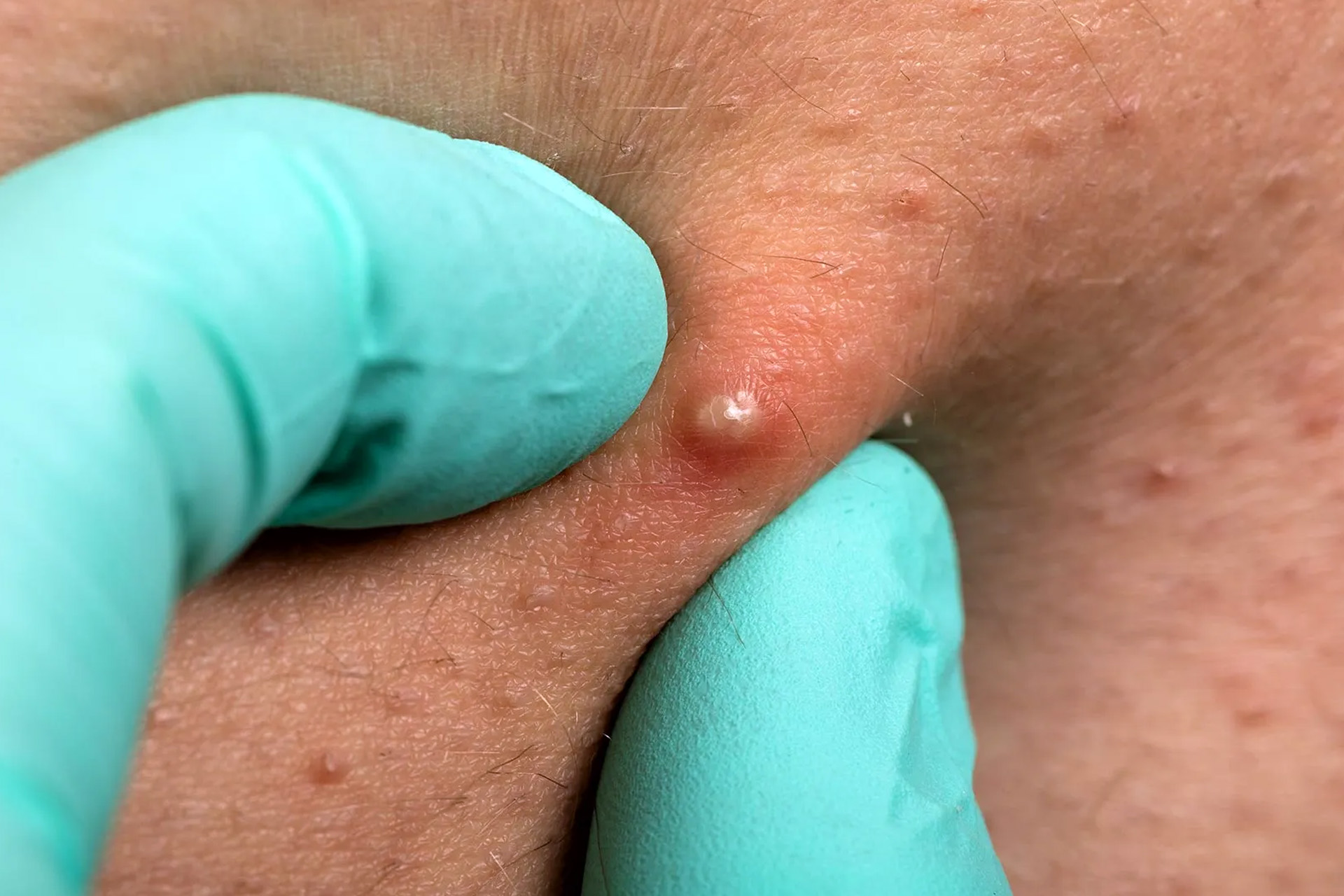
Oral antibiotics have been used to treat acne for decades and retain a defined clinical role, although the manner of their use has changed considerably. Patients frequently present having taken repeated courses over several years, and report that each course produced less benefit than the one before. That observation is clinically accurate rather than imagined. It reflects two distinct processes, namely the development of antibiotic resistance in the organisms involved and the fact that acne is not primarily a bacterial infection. This guide sets out how antibiotics are prescribed at the clinic, why courses are deliberately short, and which treatments carry the longer-term result.
Our quick answer
Antibiotics are used for a short, defined period in inflammatory acne, always alongside topical treatment, and are not continued beyond that course. They reduce inflammation quickly, which allows slower-acting treatments time to take effect. They are not a cure, because they do not change oil production or follicular blockage. Repeated long courses select for resistant organisms, disturb the skin and gut microbiome, and can aggravate conditions that mimic acne. Where acne relapses repeatedly after antibiotics, gland-directed treatment or hormonal therapy is generally indicated rather than a further course.
What we look for during the consultation
Before prescribing, the doctor confirms that this is inflammatory acne vulgaris rather than a mimic. This distinction determines whether the prescription helps or harms, since Malassezia folliculitis frequently worsens on antibiotics, whereas rosacea and perioral dermatitis follow different treatment rules. The history covers previous antibiotic courses and how long each held, since a shrinking window of benefit is a resistance signal. The assessment also establishes whether the underlying driver has ever been treated, as a patient presenting for a fourth course is more likely to have an untreated sebaceous or hormonal driver than a persistent infection.
The role of antibiotics in acne
Oral antibiotics act in acne partly by reducing the bacteria involved in inflamed lesions, and substantially through a direct anti-inflammatory effect within the follicle. That anti-inflammatory action accounts for the resolution of inflamed papules and pustules more rapidly than most topical agents achieve. They do not, however, reduce sebum production, relieve follicular obstruction or alter the hormonal signal driving the glands. Since sebum production, follicular obstruction and androgen signalling are the processes that generate the disease, antibiotics treat its visible consequence rather than its cause. Acne therefore recurs when the course ends and no other element of the plan has changed.
Why long courses lose effectiveness
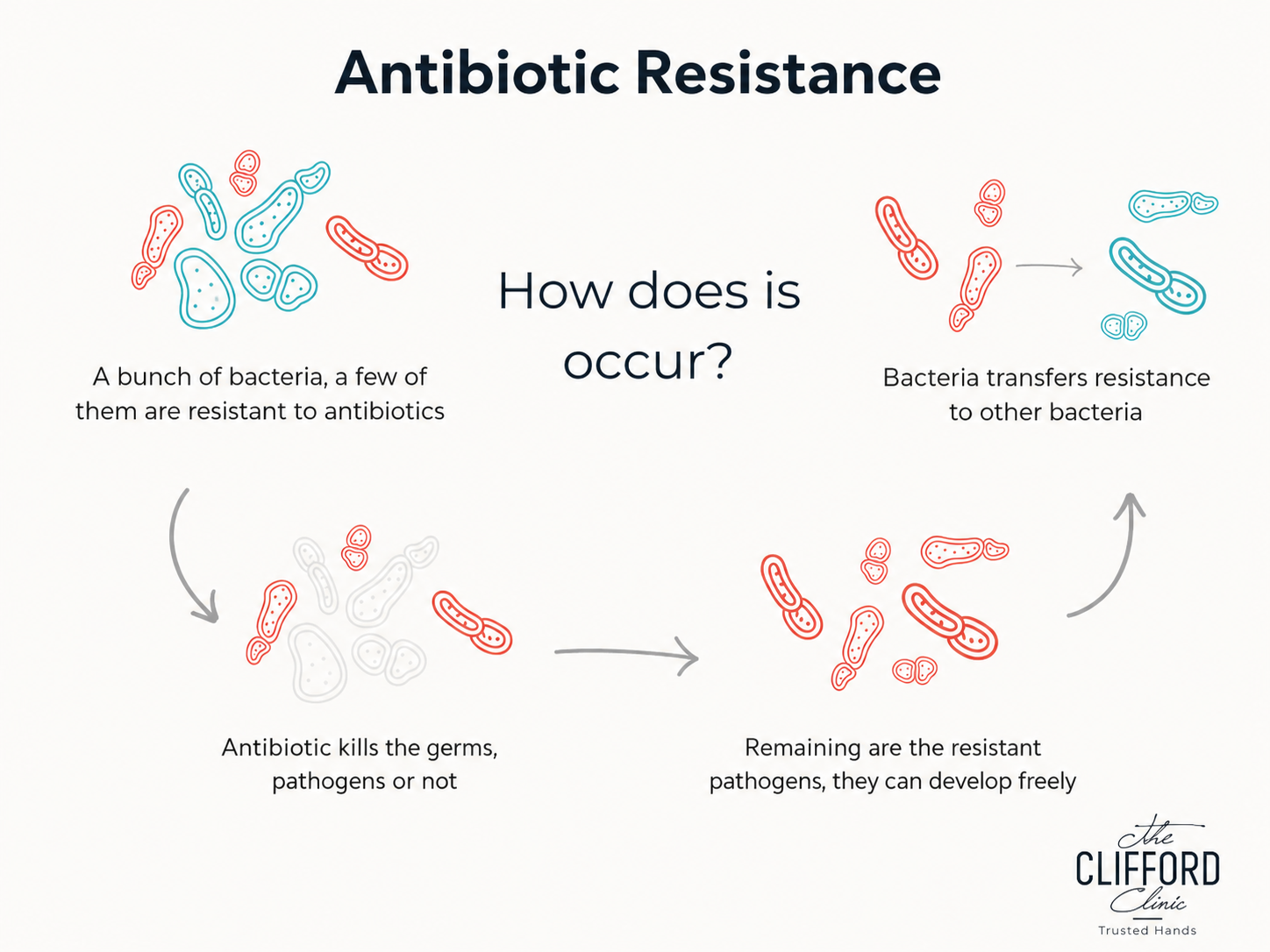
Extended and repeated antibiotic use selects for resistant organisms, so subsequent courses work less well and for shorter periods. Resistance is not confined to the skin, and constitutes a public health concern rather than solely a personal inconvenience. Beyond resistance, antibiotics disturb the balance of organisms on the skin and in the gut. One practical consequence is proliferation of Malassezia yeast once its bacterial competitors are suppressed. Affected patients report that the eruption becomes more extensive, itchier and more uniform in appearance while taking a course prescribed for acne. Where that pattern is recognised, the diagnosis rather than the dose requires review.
Proper antibiotics use for acne
Used correctly, a course is defined in advance, paired with a topical retinoid or benzoyl peroxide from the first day, and reviewed rather than repeated automatically. Contemporary guidance places that defined course at around three months, with reassessment at that point rather than open-ended continuation. Combining with benzoyl peroxide is particularly useful because it reduces the emergence of resistance. The topical agent continues after the antibiotic stops, and it is that continuation which prevents the immediate relapse patients frequently describe. Where a course delivers little benefit, extending it is rarely productive, whereas reassessment of the diagnosis and of the underlying driver generally identifies why the response was poor.
What we use instead for the long term
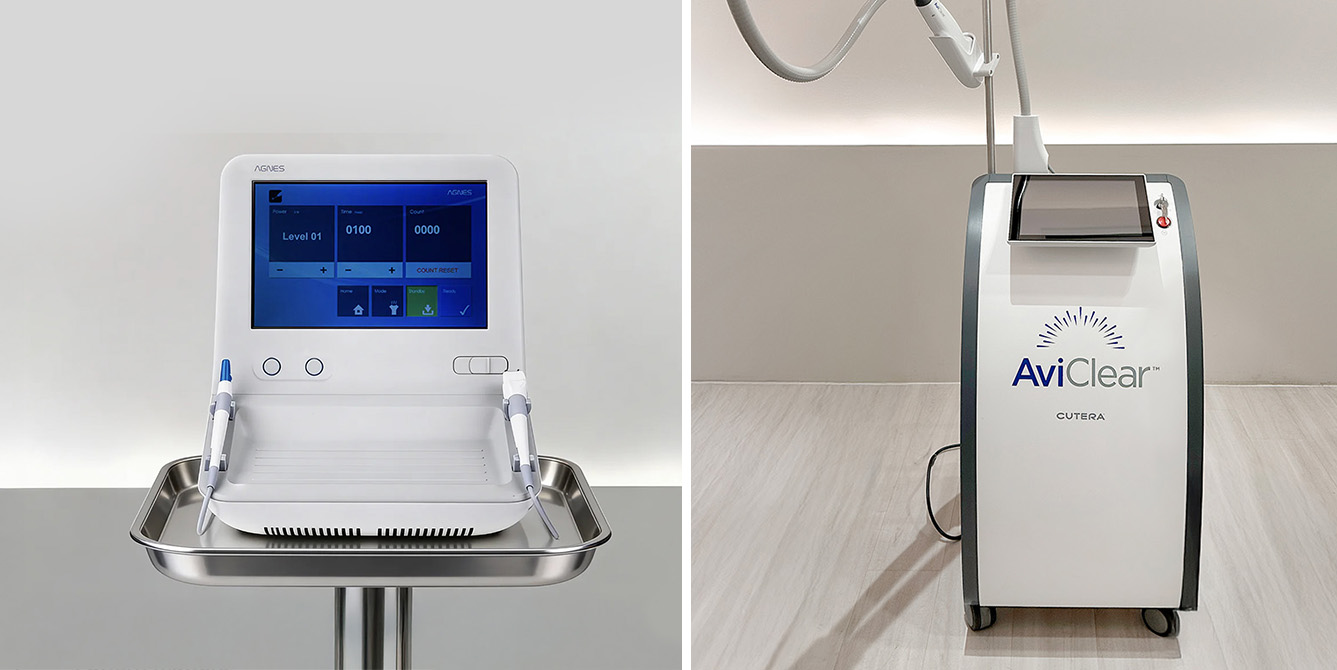
For an oily, relapsing pattern, gland-directed treatment produces the more durable result, since reducing sebaceous output alters the conditions in which lesions form rather than suppressing their consequences. AGNES delivers radiofrequency through a fine insulated microneedle to coagulate individual sebaceous glands, and is therefore suited to lesions that recur in the same locations. AviClear is a 1726 nm laser, a wavelength preferentially absorbed by sebum, which reduces output across more diffuse oily congestion. Gold and platinum photothermal therapy provide a lower-intensity route appropriate for teenagers and for pregnant and breastfeeding patients. Each is delivered as a course rather than a single treatment, and improvement continues over the three to six months following it. For women with a jawline pattern, hormonal therapy addresses the androgen signal directly. A medical skincare routine underpins each of these approaches and continues between treatments. Isotretinoin remains available as a last resort for severe or scarring disease.
Common mistakes we see
The commonest is treating antibiotics as a maintenance medication, taken on and off for years. The second is taking a course without a topical agent alongside it, so no treatment sustains the improvement once the antibiotic stops. The third is continuing a course that is visibly worsening the skin, when such deterioration points instead toward fungal folliculitis. The fourth is assessing acne treatment as a whole on the basis of antibiotics alone and concluding that no treatment is effective, when the treatments directed at the cause have never been attempted.
What the evidence shows
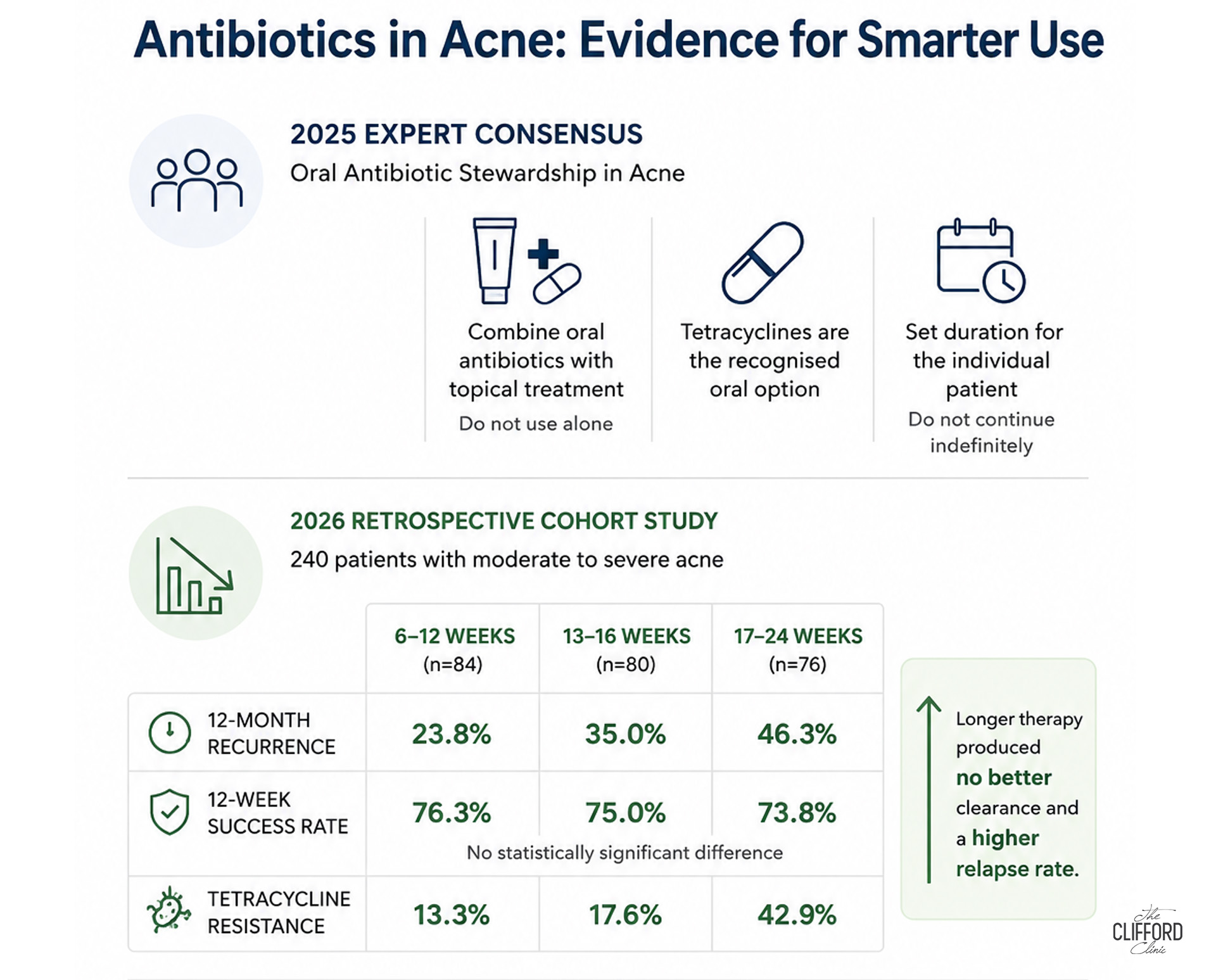
A 2025 expert consensus panel on oral antibiotic stewardship in acne concluded that oral antibiotics should be combined with topical treatment rather than given alone, that tetracyclines are the recognised oral option, and that duration should be set for the individual patient rather than continued indefinitely. A 2026 retrospective cohort of 240 patients with moderate to severe acne quantifies what prolonged courses cost. Comparing courses of six to twelve weeks, thirteen to sixteen weeks and seventeen to twenty-four weeks, twelve-month recurrence rose with duration, at 23.8 per cent, 35.0 per cent and 46.3 per cent respectively, while twelve-week success rates were statistically indistinguishable at 73.8 to 76.3 per cent. Tetracycline resistance was detected in 42.9 per cent of the prolonged-exposure group against 13.3 to 17.6 per cent of the shorter groups. Longer therapy therefore produced no better clearance and a higher relapse rate. A 2023 European position statement sets out the diagnostic criteria and antifungal treatment algorithms for Malassezia folliculitis, the condition most often mistaken for acne and most reliably aggravated by antibacterial therapy.
What to expect from a course
A short defined course generally settles inflammation within several weeks, while the topical or device treatment running alongside it is what sustains that result once the antibiotic stops. The course is then reviewed at its defined end point rather than repeated automatically, and a decision is taken on whether the underlying driver has been adequately treated. For patients who have already completed several courses, the consultation is directed toward identifying that driver rather than issuing a further prescription.
When to see a doctor
Assessment is appropriate for patients who have taken more than one or two antibiotic courses for acne. The same applies where each successive course produces less benefit than the last, where the acne worsens or becomes itchy during a course, and where it returns promptly every time a course ends. Each of these findings indicates that the plan requires change rather than repetition.
Which antibiotics are used, and why the choice matters
The oral antibiotics used in acne are the tetracyclines, principally doxycycline and minocycline, with sarecycline available as a narrower-spectrum option. They are selected for their anti-inflammatory activity within the follicle as much as for their antibacterial effect, which is why they outperform agents that are more potent against bacteria but less active in skin. Tetracyclines are avoided in pregnancy and in young children, where the treatment plan is built from topical and device-based options instead. Doses and durations are set with that dual action in mind, and topical antibiotics are generally avoided as standalone treatment because they drive resistance readily. Where a topical antibacterial is wanted, benzoyl peroxide is preferred, since resistance to it does not develop in the way it does to antibiotics.
Pairing an oral antibiotic with benzoyl peroxide reduces the emergence of resistant organisms, while pairing it with a retinoid ensures the follicular obstruction is treated during the period in which the inflammation settles. A course prescribed in isolation is the regimen most likely to produce brief improvement followed by prompt relapse.
What Resistance Means for the Individual Patient
Resistance is usually presented as a public health abstraction, which understates its consequences for the individual. For a single patient, resistance means that the medication which settled the skin last year is less effective this year and for a shorter period, so the intervals between courses shorten as the benefit from each diminishes. It also narrows the options available should an infection later arise that requires the same class of antibiotic for a more serious indication.
The practical implication is that antibiotic use should be allocated deliberately. A short course used to control inflammation while a durable treatment takes effect is a proportionate use. Repeated courses used as the sole strategy are not, and leave the individual patient and the wider population with fewer effective options subsequently. A decision not to prescribe a fifth course rests on that reasoning rather than on any reluctance to treat.
Frequently asked questions
How long should I take antibiotics for acne?
Courses are kept short and defined, paired with a topical treatment throughout, and reviewed rather than repeated indefinitely, with current guidance placing that defined course at around three months. Longer or repeated courses select for resistant organisms without addressing the cause of the acne, and are associated with higher relapse rates rather than better clearance.
Why does my acne come back after antibiotics?
Antibiotics reduce inflammation but do not change oil production, follicular blockage or hormonal drivers. When the course ends and nothing else has changed, the acne resumes.
Can antibiotics make acne worse?
They can, where the diagnosis is in fact Malassezia folliculitis, since suppressing the bacterial population allows the yeast to proliferate. Skin that becomes itchier and more uniformly papular during a course should be reassessed.
What can I use instead of antibiotics for acne?
A medical skincare routine forms the foundation of treatment. Gland-directed treatments such as AGNES, AviClear and photothermal therapy address oil production directly, and hormonal therapy suits androgen-driven acne in women.
| If several antibiotic courses have already been completed, an assessment directed at the underlying driver is the more productive next step.
The Clifford Clinic, 50 Raffles Place, Singapore Land Tower. Call (65) 6532 2400 or WhatsApp (65) 8318 6332 to arrange a consultation. |
Related reading
- Best Acne Treatment in Singapore, A Doctor-Led Guide
- Acne Treatment at The Clifford Clinic
- How Our Doctors Choose Your Acne Treatment
- 12 Reasons Acne Treatment Fails
- AGNES Acne Treatment
- AviClear Acne Treatment
Selected References
- HealthHub Singapore. Acne. https://www.healthhub.sg/a-z/diseases-and-conditions/acne.
- American Academy of Dermatology. Guidelines of care for the management of acne vulgaris. https://www.aad.org/member/clinical-quality/guidelines/acne.
- DermNet. Acne vulgaris. https://dermnetnz.org/topics/acne.
- Rosenberg AL, et al. Optimal use recommendations and stewardship principles with oral antibiotics in acne vulgaris management, an expert consensus panel. J Clin Aesthet Dermatol. 2025. https://pubmed.ncbi.nlm.nih.gov/41640785/.
- Guidelines of care for the management of acne vulgaris. JAAD. https://www.jaad.org/article/S0190-9622(23)03389-3/fulltext.
- Henning MAS, et al. Position statement, recommendations on the diagnosis and treatment of Malassezia folliculitis. J Eur Acad Dermatol Venereol. 2023. https://pubmed.ncbi.nlm.nih.gov/36912427/.
- Long-term outcomes of 1726 nm laser treatment for acne. JAAD. https://www.jaad.org/article/S0190-9622(25)02900-7/fulltext.
- Wang L, et al. Long-term impact of antibiotic exposure duration on recurrence and microbial resistance in moderate-to-severe acne, a real-world retrospective analysis. Front Med. 2026. https://pubmed.ncbi.nlm.nih.gov/41994433/.
Medical disclaimer: The Clifford Clinic publishes this article as general patient education only. It is not a substitute for an in-person clinical assessment, and the suitability, outcome and risk profile of any treatment differ from patient to patient. Arrange a consultation with one of our doctors before beginning treatment for acne.

Author Bio
Dr Gerard Ee

Dr Gerard Ee is the Medical Director of The Clifford Clinic in Singapore. He earned his medical degree from St George's University of London and built his surgical experience across the Singapore General Hospital, National University Hospital, and Mount Sinai Hospital in New York. He holds Membership of the Royal College of Surgeons (Edinburgh) and a Postgraduate Diploma in Dermatology (Cardiff), and is fully accredited in aesthetic procedures including botulinum toxin, fillers, lasers, and light therapies. A strong advocate of minimally invasive, natural-looking results, Dr Ee has published in several medical and scientific journals and presented his research in cities including Taipei, Las Vegas, and London.
See all posts by Dr Gerard Ee »