
Acne Scars vs Hyperpigmentation: PIH, PIE and True Scars
Written by Dr Bernard Ong. Medically reviewed by Dr Gerard Ee
The Clifford Clinic has over 16 years of experience treating acne and acne scars, having treated over 5,000 cases of acne and over 3,000 cases of acne scars.
Confusing acne scars with acne marks causes anguish (and unnecessary spending). Sorting out which one a patient has is often the most valuable five minutes of a consultation, because it can save them from paying for resurfacing they do not need. This builds on our complete acne scar treatment guide, what causes acne scars and the types of acne scars.
Acne marks: PIH and PIE
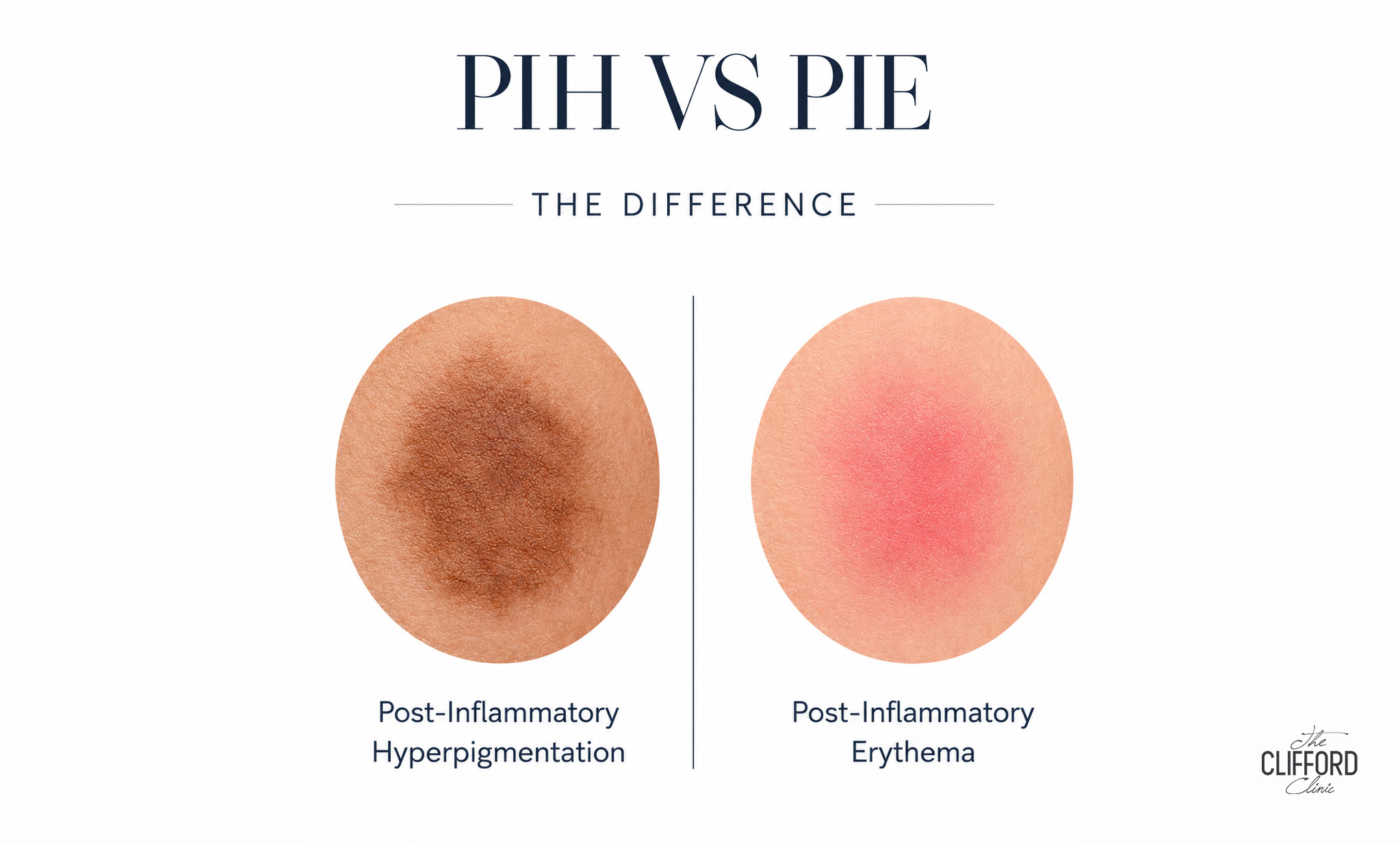
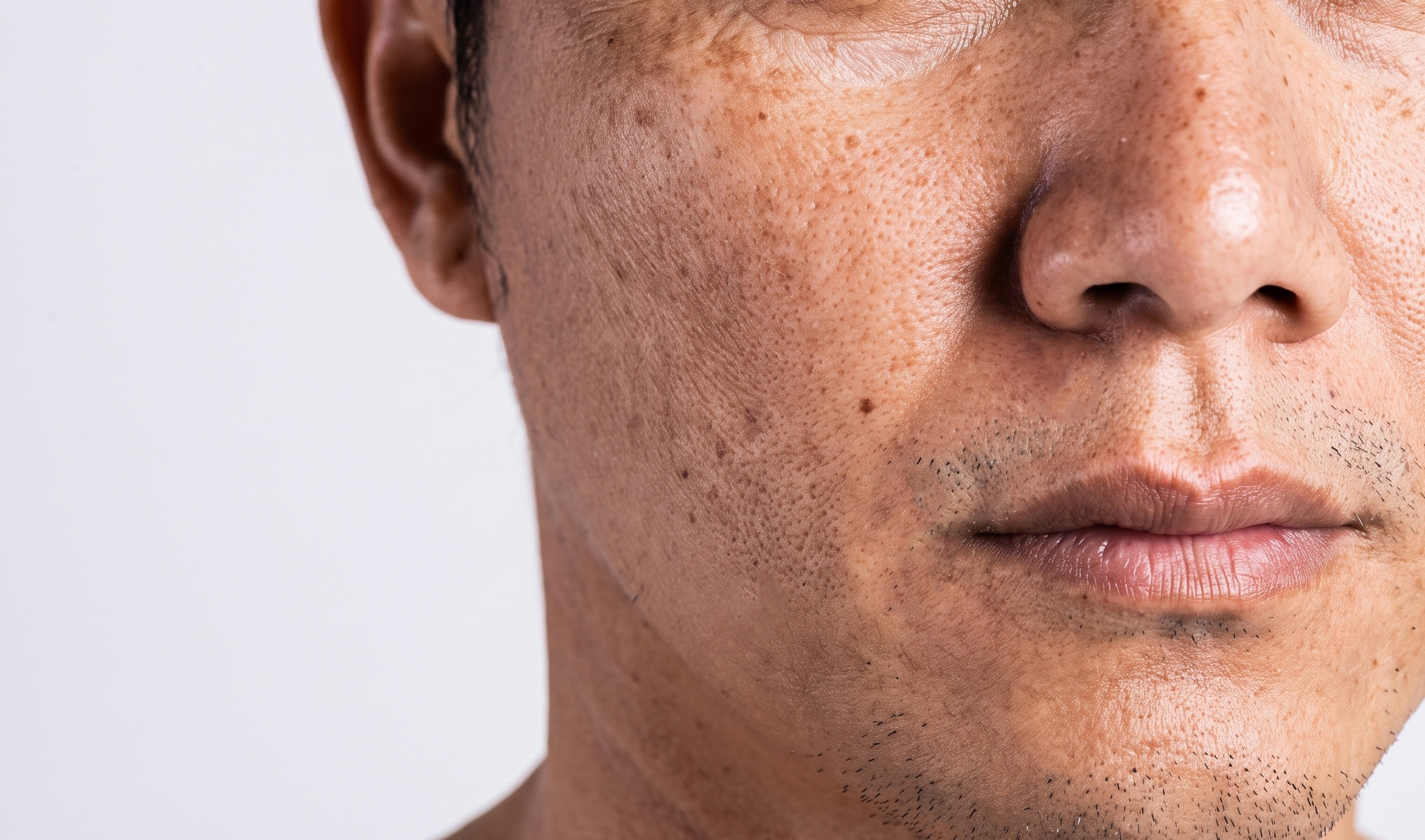
Acne marks are flat changes in colour, with the skin’s texture intact. Post-inflammatory hyperpigmentation (PIH) is excess pigment left after a breakout, showing as brown or tan marks, more common in deeper skin tones. Post-inflammatory erythema (PIE) is dilated blood vessels, showing as pink or red marks, more common in lighter skin. Both are temporary. Because only colour changes, not structure, they fade over weeks to months and are helped by sunscreen, topical actives and gentle treatments.
True scars: a change in texture
A true acne scar is a change in texture (a depression, a raised area, or an uneven surface) from altered collagen. Unlike marks, scars do not fade on their own. They need treatment that remodels collagen at depth, such as subcision, RF microneedling, lasers or biostimulators. The types of acne scars guide covers these in detail.
A simple test to tell them apart
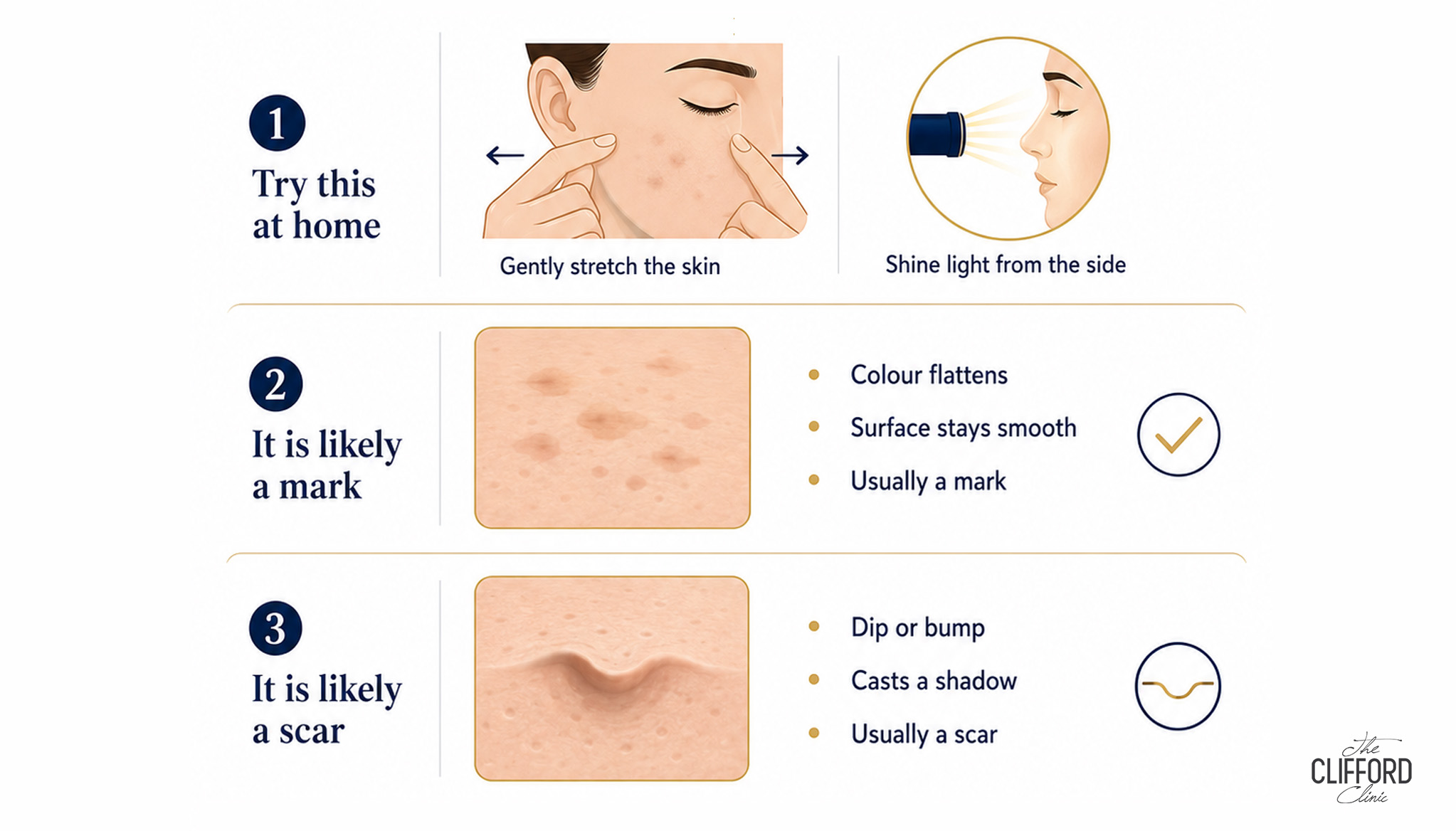
Try a home check. Stretch the skin gently, or shine a light across it from the side. If the discolouration flattens and the surface stays smooth, it is a mark. If you see a dip or bump that casts a shadow, it is a scar. This prevents two costly mistakes which are over-treating marks that would have faded and under-treating scars that need intervention. When both coexist, which is common, treat the scar and let the pigment settle, often with the same skin-quality measures.
Why does the distinction change the treatment
Marks and scars sit at different depths and respond to different tools. Pigment and redness are superficial and reward a gentle, lower-energy approach, good skincare, sun protection, and devices made for pigment rather than deep remodelling. Scars are deep and need higher-energy, collagen-building treatment. An aggressive resurfacing laser used on what is actually PIH risks irritating the skin and, in darker tones, can worsen pigmentation. The diagnosis dictates the intensity.
Marks, scars and darker skin
Deeper skin tones are more prone to PIH and more vulnerable to pigment problems if treated too aggressively. For these patients, separating mark from scar, rigorous sun protection, and epidermis-sparing treatments are the priorities. Our acne scar treatment for dark skin guide covers the safe options.
Common patterns in practice
Most often, a patient convinced they have extensive scarring turns out to have mostly PIH that will fade with time and sun protection, plus a few true scars worth treating. The plan becomes simpler and cheaper than they feared. The opposite also happens when someone dismisses textured scars as marks and waits in vain for them to fade. Both come down to an accurate assessment before any money is spent.
How long do marks take to fade, and how to help them
Red marks (PIE) usually settle over a few weeks to a few months. Brown marks (PIH) can take several months or longer, particularly in darker skin. The single most effective step is rigorous daily sun protection, since UV deepens pigment and prolongs redness. Gentle topical actives such as vitamin C, niacinamide, azelaic acid and retinoids speed fading further.
Marks reward patience and protection. Scars reward intervention. Knowing which you have prevents overtreatment.
Treating marks: lasers and light
When marks are slow to fade, several laser and light treatments help, but the right choice depends on whether the mark is brown (pigment) or pink (vascular). Match the device to the colour of the mark.
Q-switched laser (pink and brown marks)
The Q-switched laser is the versatile workhorse, targeting both pink and brown discolouration. Its very short, high-energy pulses break up excess pigment and settle redness, making it a useful option for the mixed marks most patients have.
Pico laser (brown marks only)
Picosecond (Pico) lasers excel at pigment but work on brown marks only, so they are usually wrong for acne marks, which are often pink or mixed. The exception is darker-skinned patients, particularly of Indian or Malay ethnicity, who tend to develop more PIH. In these predominantly-brown cases a Pico laser has a clear role. As with any pigment laser in darker skin, conservative settings avoid provoking more pigment.
V Beam pulsed dye laser (gold standard for redness)
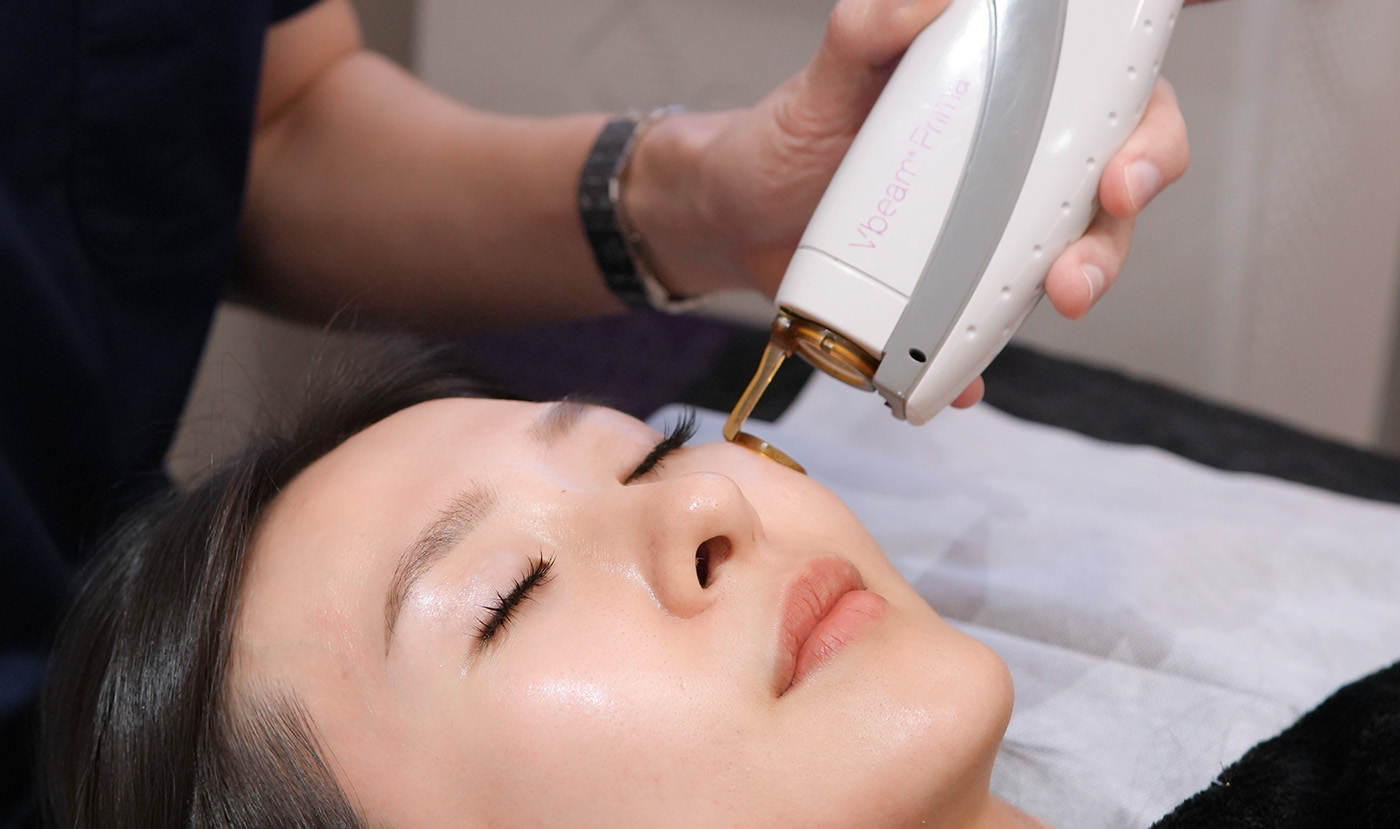
For pink marks, the V Beam pulsed dye laser is the gold standard. It selectively targets the dilated vessels behind redness, making it the treatment of choice for all PIE, and for sensitive, easily flushed skin and rosacea. Because it works on vessels rather than pigment, it clears the red marks that pigment lasers cannot.
In short, colour guides the laser. Q-switched for pink and brown, V Beam for pink and erythema, Pico for predominantly brown pigment, most relevant in darker skin prone to PIH.
Why the wrong diagnosis costs you money
Confusing marks with scars costs money as well as appearance. Treating fading PIH with expensive resurfacing pays for what time and sunscreen would have done for free, often while irritating the skin. Conversely, those who dismiss true textured scars as marks wait months for a change that never comes, delaying effective treatment. Either way, an inaccurate diagnosis wastes money and time.
A few minutes with angled light and a stretch test can steer a patient away from an unnecessary package toward the simple measures their skin needs, or confirm that what they have is structural and worth treating.
When marks and scars appear together
Most patients have a mixture of fading marks and true scars. Treat the scar with collagen-remodelling treatment, let the pigment settle with sun protection and gentle topicals, and add pigment-specific treatment only if the marks are slow to fade. Treating both aggressively at once is usually unnecessary and risks irritation.
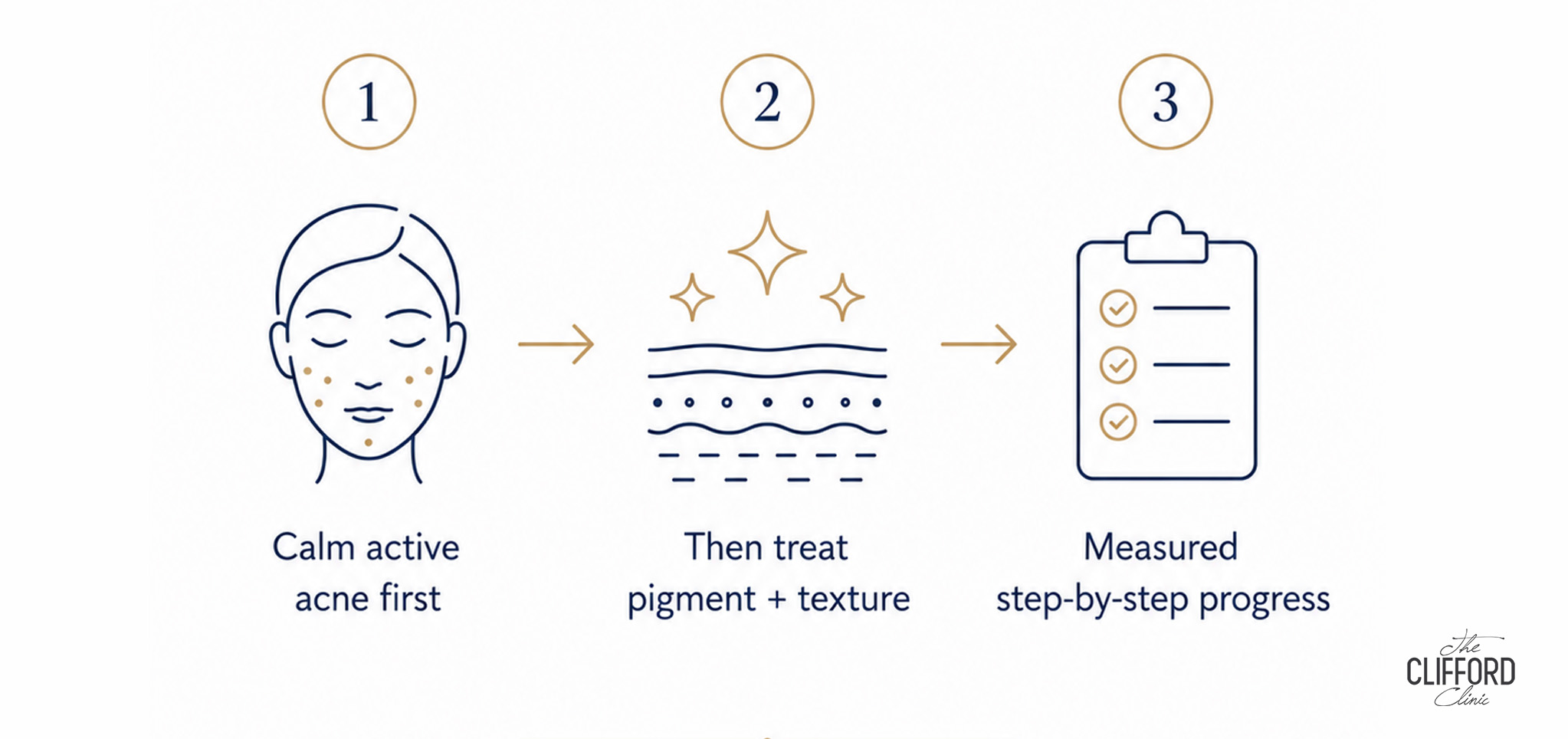
Sequencing matters. Calm any active acne first, then address pigment and texture in measured steps. This beats one intensive push. Patience with marks and precision with scars serves these patients best.
Clinical summary
Acne marks (PIH and PIE) are flat, temporary colour changes that fade with time and good skincare. True acne scars are permanent textural changes that need collagen-remodelling treatment. The stretch-and-light test tells them apart quickly, but an in-person assessment is safest, particularly in darker skin. To continue, read do acne scars go away on their own, the best product question for marks, or how subcision treats true rolling scars.
Frequently Asked Questions
What is the best product for acne scars?
No topical product can remove a true scar, because scars are a structural change below the surface. Products help with marks (PIH and PIE). Ingredients like sunscreen, retinoids, vitamin C and azelaic acid fade discolouration. True scars need clinical treatment.
Can I remove acne scars naturally?
Natural remedies and skincare can fade post-acne marks over time but cannot remodel a true scar. Improving an actual depression or raised scar requires treatments that rebuild collagen at depth.
What is the difference between PIH and PIE?
PIH is brown or tan pigmentation, more common in deeper skin tones. PIE is pink or red marks from dilated vessels, more common in lighter skin. Both are flat and usually temporary, unlike true scars.
Will my acne marks fade on their own?
Usually yes. PIH and PIE typically fade over weeks to months, faster with daily sun protection. True scars do not fade on their own and need treatment.
What laser is best for acne marks?
It depends on the colour. For pink marks (post-inflammatory erythema), the V Beam pulsed dye laser is the gold standard. Q-switched lasers treat both pink and brown marks. Pico lasers work mainly on brown pigment, so they suit predominantly brown PIH, particularly in darker skin, rather than acne marks in general.

Written by Dr Bernard Ong, The Clifford Clinic. This article is for general education and reflects Dr Ong’s clinical experience treating acne scars in Singapore. It is not medical advice. Treatment suitability, results, downtime and cost vary between individuals. Please arrange a consultation for advice specific to your skin.

Author Bio
Dr Gerard Ee

Dr Gerard Ee is the Medical Director of The Clifford Clinic in Singapore. He earned his medical degree from St George's University of London and built his surgical experience across the Singapore General Hospital, National University Hospital, and Mount Sinai Hospital in New York. He holds Membership of the Royal College of Surgeons (Edinburgh) and a Postgraduate Diploma in Dermatology (Cardiff), and is fully accredited in aesthetic procedures including botulinum toxin, fillers, lasers, and light therapies. A strong advocate of minimally invasive, natural-looking results, Dr Ee has published in several medical and scientific journals and presented his research in cities including Taipei, Las Vegas, and London.
See all posts by Dr Gerard Ee »